 +91 7014607737
 info@technoloader.com





Table of Contents
Quick Summary
What It Is: Blockchain consulting helps businesses assess, plan, and build blockchain solutions for specific business needs.
Why It Matters: It can reduce project risks, improve security, and help businesses avoid costly technology decisions.
The Bottom Line: Not every business needs blockchain. A traditional database may be the better choice for many use cases.
Blockchain consulting is a professional service that helps businesses plan, build, and launch blockchain solutions safely. A blockchain consultant guides you through strategy, platform choice, smart contracts, security, and compliance.
Most companies don’t need blockchain everywhere. They need it in the few places where a shared, tamper-resistant record would solve a real problem. Using blockchain for problems it cannot solve can waste development time and resources.
That’s the gap good blockchain consulting closes. You can skip costly mistakes, pick the right technology, and ship a solution that actually works.
So what does blockchain consulting really involve? This guide explains what it is and what a consultant does. It also covers how engagements run, what they cost, and how to choose a partner.
What Is Blockchain Consulting?
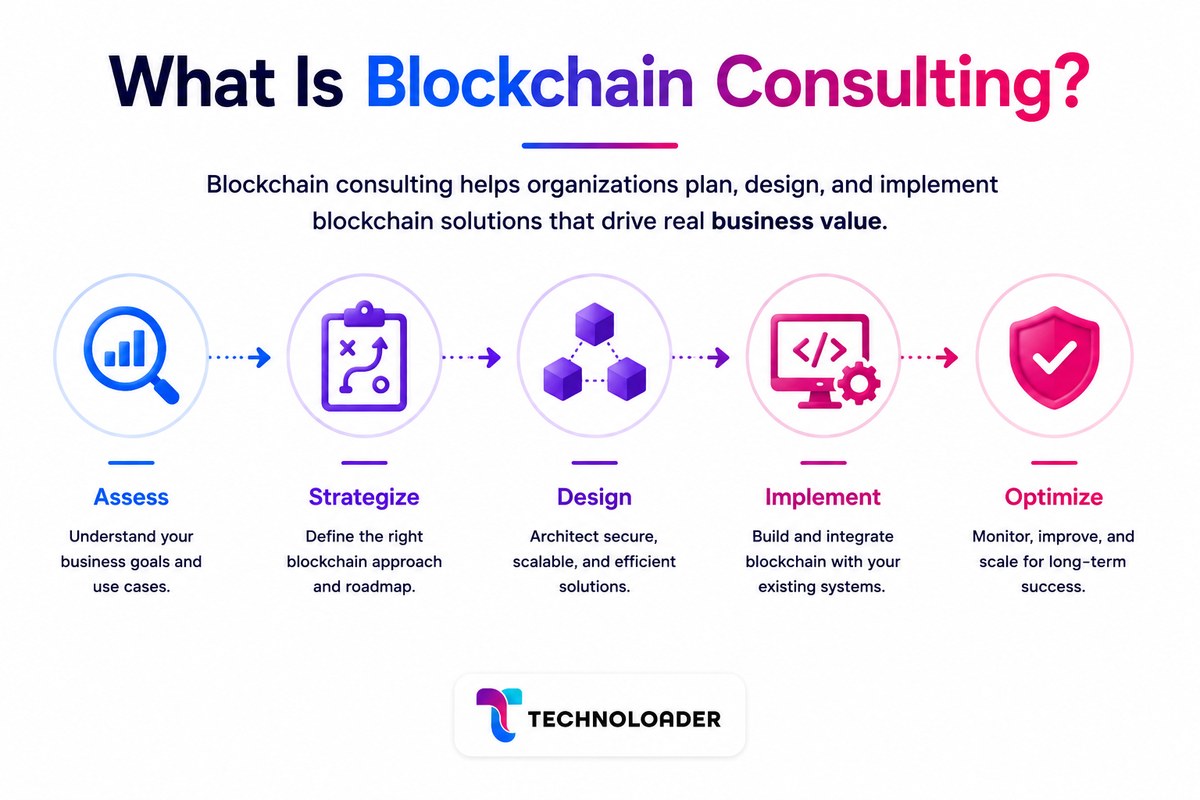
Blockchain consulting is a professional service that helps a business understand, plan, and build blockchain solutions. A consultant checks whether blockchain fits your goals, picks the right technology, and guides the build through launch. The aim is to solve a problem without wasting time or budget on the wrong approach.
Let me define the core term first. A blockchain is a type of distributed ledger that stores records across a network of computers called nodes. Transactions are grouped into blocks and linked using cryptography.
Once confirmed, records become tamper-resistant. That means changing them is difficult, though not impossible.
Blockchain is part of a wider family called distributed ledger technology (DLT). DLT means shared records with no central owner. Not all DLT systems use blockchain. Blockchain consulting can help you assess these options and choose the right technology for your use case.
A good blockchain project starts with a simple question — do you need blockchain at all? A traditional database may be faster, cheaper, and easier to manage for some use cases. I would recommend it when it fits the problem better.
You can start with two questions. Who needs to write to the record? Do those parties trust each other? If one organization controls the data, a traditional database may be enough. If several parties need to share records without relying on one central party, blockchain may be worth considering.
When blockchain fits the use case, it can provide a shared record that is difficult to alter. The value comes from using blockchain technology to solve a business problem.
Blockchain technology market is also growing. According to Fortune Business Insights, the global blockchain market was valued at $20.16 billion in 2024. It is projected to reach $393.42 billion by 2032, which points to strong growth through the decade. Blockchain consulting can help businesses assess where this technology fits their needs.
What Does Blockchain Consulting Involve?
It’s expert help that turns a business goal into a working, secure blockchain solution. It starts with whether you need one at all. Then it covers strategy, platform choice, and safe delivery.
Also ReadPrice matters, but experience, capability, and trust should come first. Use the checklist below to compare firms.
Blockchain Consulting vs Blockchain Development
Blockchain consulting decides what to build and why. Blockchain development builds it. Consulting covers strategy, feasibility, and platform choice. Development covers writing, testing, and deploying the code.
Most projects need both, and many firms, including ours, offer them together. Blockchain development services deliver the build once the plan is set.
Think of it like building a house. Consulting is the architect and the survey. Development is the construction crew. You can hire them separately. Still, they have to agree on one plan before a single brick is laid.
There’s a third term you’ll hear often: blockchain advisory. It focuses on strategy and guidance rather than a full build. It suits early research or teams that need a clear recommendation.
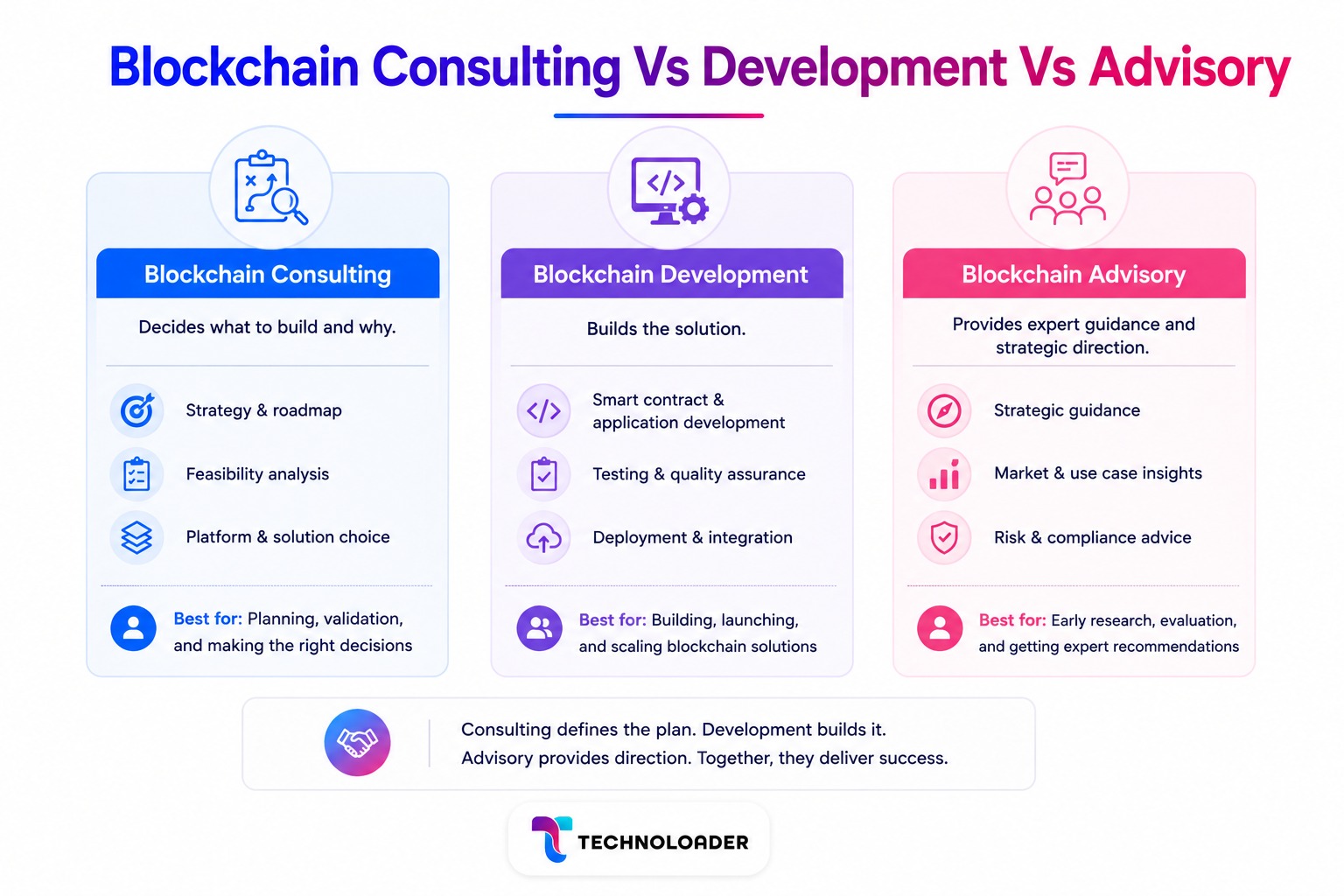
The table below shows the major differences between the three concepts.
| Blockchain Consulting | Blockchain Development | Blockchain Advisory | |
|---|---|---|---|
| Main question | Should we, and how? | How do we build it? | What are our options? |
| Core output | Strategy, roadmap, architecture | Working, tested software | Recommendations, feasibility view |
| Typical stage | Before and during a build | During the build | Early research or board level |
| Best for | Turning a goal into a plan | Turning a plan into a product | Deciding whether to start |
So which do you actually need? The answer depends on where you are. If you have a goal but no plan, start with blockchain consulting. If you have a locked plan, you need development. If you’re still exploring, advisory is enough for now.
Teams that go straight to development can end up building the wrong solution well. The code may work, but it may solve a problem that never needed blockchain. Starting with consulting can prevent that costly mistake.
Let me give you a common example. A client may come in convinced that they need blockchain. We map the process and find that one trusted party controls the data. A traditional database would work better and cost less.
In that case, I would say so and help them avoid months of unnecessary work. That honest advice can be worth the consulting fee.
The reverse can happen too. A client may underestimate the trust problem they face. A shared ledger may turn out to be the better solution. Good blockchain consulting helps you identify both cases early.
What’s the Difference Between Blockchain Consulting, Development, and Advisory?
Blockchain consulting focuses on planning and deciding what to build. Blockchain development turns that plan into working software. Advisory focuses on research, options, and recommendations.
Also Read
What Does a Blockchain Consultant Do?
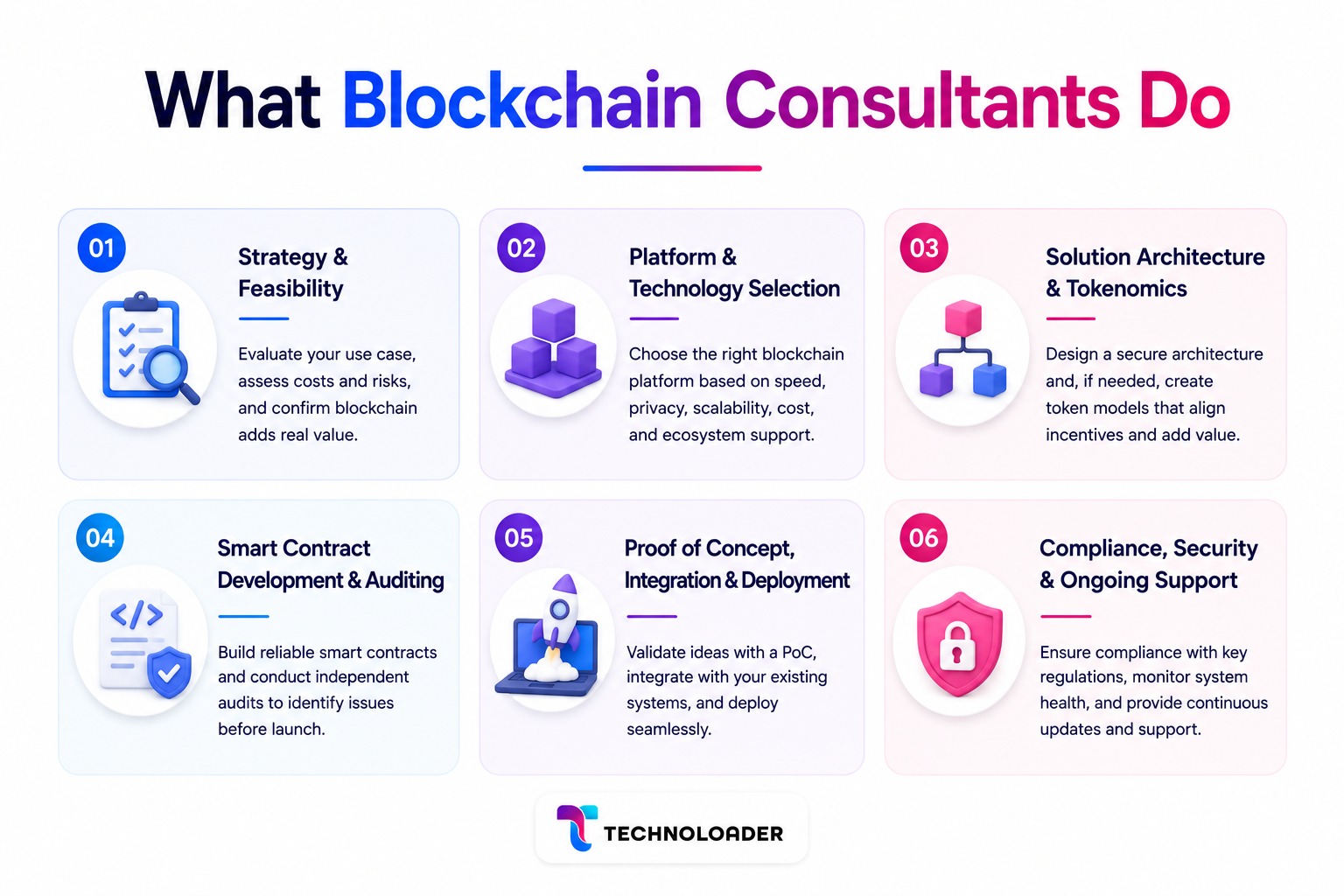
A blockchain consultant turns a business idea into a technical plan, then helps deliver it. Full blockchain consulting services usually span six areas. Those are strategy and feasibility, platform selection, architecture and tokenomics, smart contract development and auditing, delivery, and ongoing support.
Below is what each one involves, and why it protects your budget.
Strategy & Feasibility Assessment
The first job of a blockchain consultant is to check whether blockchain fits your needs. A consultant studies your process, your data, and your partners. Then they judge if a shared ledger adds real value. You get a clear yes, no, or “not yet,” with reasons. This single step prevents most failed projects.
Feasibility assessment also covers cost, timelines, technical needs, and risks. The business case is assessed before development starts. If the numbers do not work, you find out early while there is still time to change course.
Platform & Technology Selection
Another service is choosing the right blockchain platform. Public blockchain networks like Ethereum are open to everyone. Ethereum uses proof of stake, an energy-light way to secure the network.
Permissioned networks like Hyperledger Fabric restrict who can join and access the network. It suits organizations with strict access needs.
Each platform involves trade-offs in speed, privacy, cost, security, and decentralization. A consultant matches the platform to your needs. The assessment can cover transaction capacity, fees, security, and developer support. Our guide to choosing the right blockchain explains this process in more detail.
Solution Architecture & Tokenomics
Architecture is the blueprint for how everything connects. It covers the ledger, the apps, and the data that stays off-chain. It also covers the links to your existing systems. A weak design can cause performance, security, and integration problems later.
Some projects also need tokenomics, which covers the rules and economics behind a digital token. On crypto and token design, the same expert may act as a cryptocurrency consultant.
Good tokenomics should reflect real user needs, incentives, and risks. The design should rely on realistic assumptions rather than hype.
Smart Contract Development & Auditing
Smart contracts are self-executing programs that run automatically when their coded conditions are met. They power most blockchain applications, from payments to Web3 products. A small bug can move real money by mistake. So the code has to be right the first time.
An independent review checks the code for security flaws before launch. We treat smart contract audits as mandatory, not optional. Skipping them is the most expensive shortcut in this field.
Proof of Concept, Integration & Deployment
A consultant builds a small proof of concept (PoC) before the full system. A PoC tests the risky assumptions at low cost. If it works, it grows into a full product. If it doesn’t, you’ve saved a fortune and a lot of time.
Deployment also involves integration with your existing systems. Your blockchain solution may need to connect with an ERP, payment gateway, mobile app, or other business software. Good integration allows the new solution to work with your existing processes and systems.
Compliance, Security & Ongoing Support
Blockchain projects can involve KYC, AML, data privacy, and other regulatory requirements. A consultant can help you understand the rules that may apply to your project and location. These requirements can vary by country and by the type of blockchain application.
This is guidance, not legal advice, and we bring in your lawyers where needed. Our overview of blockchain compliance covers the main points.
Support continues after launch. Networks can change, security risks can develop, and usage can grow over time. Ongoing support can include monitoring, updates, security fixes, and performance improvements. A live blockchain system needs regular maintenance to remain secure and reliable.
What’s the Work of a Blockchain Consultant?
A consultant tests whether blockchain fits, picks the platform, and designs the architecture. They oversee smart contract development and audits, manage delivery, and handle compliance and support.
Also Read
How Does Blockchain Consulting Work?
Blockchain consulting engagement usually runs in seven steps, from discovery to ongoing support. Each step has a clear output that you can review before the next one starts. Here is the process used across most projects.
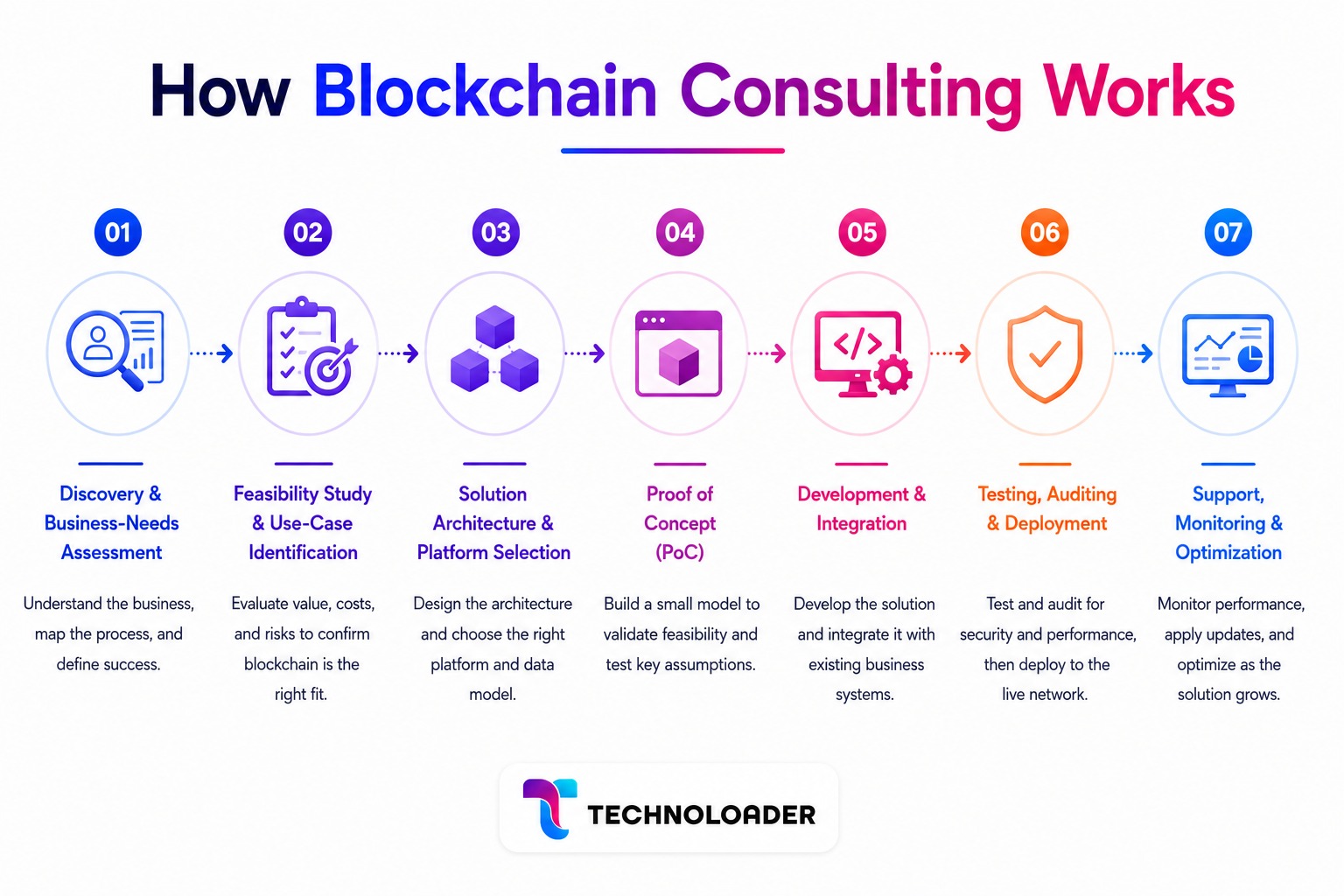
Step 1: Discovery & Business-Needs Assessment
The first step is to understand your business, not the technology. What problem are you trying to solve? Who is involved? The process and its main problems are mapped out. Then, both sides agree on what success should look like. The parties who need to approve the project are also identified. Everyone needs to agree before the project can move forward.
Step 2: Feasibility Study & Use-Case Identification
The next step is to check if blockchain is a good fit. The assessment covers the expected value, cost, and risks. If a database would work better, that option should be considered instead. If blockchain is the right choice, the first use case is defined. A focused use case is easier to plan and test than a long list of ideas.
Step 3: Solution Architecture & Platform Selection
The solution is designed at this stage. The right platform is selected and the system architecture is mapped out. The team also decides which data should stay on-chain and which should stay off-chain. You receive a technical plan and a roadmap for the project. Data structures and access rules are also agreed at this point.
Step 4: Proof of Concept (PoC)
A small working model is built to test the most important parts of the solution. A PoC helps answer technical questions with real results. You can test the model, get feedback from users, and decide whether to continue. You prevent major spending on a solution that does not work as expected.
Step 5: Development & Integration
Once the PoC works, full blockchain development can begin. The team builds and tests the smart contracts and application. The new solution is then connected to your existing systems. Development is completed in stages, so you can review the work throughout the project. The system is tested before anything goes live.
Step 6: Testing, Auditing & Deployment
Before launch, the system goes through testing and security checks. The code is reviewed for security issues and the system is tested under expected loads. Any problems are fixed before another round of checks. The solution is then deployed to the live blockchain network, known as the mainnet.
Step 7: Support, Monitoring & Optimization
The launch is not the end of the project. The system needs monitoring and performance checks as usage changes. Blockchain networks can also change over time. So, the ongoing support helps keep the solution secure and up to date. Support can continue for as long as your business needs it.
One important part of this process is the review at each step. At each stage, you can change the scope, switch platforms, or stop the project. These review points can prevent costs from growing without control. A project that moves forward in clear stages is easier to manage and review.
How Does a Blockchain Consulting Engagement Work?
It moves through seven reviewable steps. Those are discovery, feasibility, architecture, a proof of concept, development, testing and audit, then launch and support. Each stage ends in a deliverable you approve.
Why Do Businesses Need Blockchain Consulting?
Businesses need blockchain consulting to avoid mistakes before development begins. The wrong platform, weak smart contract, or unnecessary blockchain can raise project costs. A consultant can identify these risks beforehand and help you make sound decisions.
Below are the seven benefits of blockchain consulting that matter most to a business case.
Avoid Costly Build Mistakes & Reduce Project Risk
The biggest savings from blockchain consulting come from avoiding a costly mistake before development begins. A consultant checks your assumptions before they become part of the code.
Across the 450+ projects we’ve delivered, the pattern is clear. Early scoping prevents late disasters. Fixing a flaw at the design stage costs a fraction of fixing it after launch.
Pick the Right Platform the First Time
Switching blockchains mid-project can cost time and money. With blockchain consulting, you work with a consultant who helps you choose well at the start. The assessment can cover speed, fees, privacy, security, and other technical needs.
It can also cover options like Layer 1 and Layer 2 networks. Get it right once, and you avoid a full rebuild.
Faster, Lower-Risk Time to Market
Blockchain consulting offers experience that can shorten the path from planning to launch. Businesses are exposed to established processes that can help teams avoid common problems and repeated work.
Reusable patterns can reduce the time needed for new projects. Tested approaches also reduce time spent solving the same problems again.
Stronger Security & Independent Audits
Security needs attention from the start of a blockchain project. Consultants can conduct security reviews and arrange independent smart contract audits. Smart contracts control assets or trigger actions on a blockchain. Independent audits can identify vulnerabilities before a contract goes live. We treat security as a requirement, not a late add-on.
Regulatory Compliance (KYC, AML, GDPR)
Crypto and data regulations vary by country and use case. Blockchain consulting helps identify relevant KYC, AML, and privacy requirements. This is informational guidance that works alongside your legal team. Building compliance for blockchain projects before development is easier than after launch.
Access to Scarce Blockchain Expertise
Skilled blockchain engineers are hard to find and slow to hire. Consulting gives you that expertise on demand, without a long recruitment cycle. At Technoloader, about 80% of our team are dedicated blockchain specialists. Hiring that depth in-house can take many months. A consultant gives you the same capability in weeks.
Clearer ROI & Realistic Expectations
Working with a good consultant helps set honest expectations. You learn about the benefits of blockchain for businesses and the limits. There’s no hype in that conversation. This makes it easier to decide whether a pilot is worth pursuing. Clear planning can also guide decisions about future development.
What Are the Benefits of Blockchain Consulting for Businesses?
Blockchain consulting helps businesses reduce project risks, choose the right technology, improve security, and plan for compliance. It also provides specialist expertise and set realistic expectations for costs, timelines, and returns.
Also Read
Blockchain Consulting Use Cases by Industry
Blockchain consulting applies across many industries, wherever a shared, trusted record adds value. Finance, supply chain, healthcare, real estate, gaming, and government all use it differently.
The table below maps common use cases of blockchain to the outcomes they target.
| Industry | Common Use Case | Outcome It Targets |
|---|---|---|
| Finance & DeFi | Payments, settlement, tokenized assets | Faster settlement, fewer intermediaries |
| Supply Chain | Provenance and tracking | Verifiable origin, less fraud |
| Healthcare | Shared records, drug traceability | Better data integrity and access control |
| Real Estate | Property tokenization, title records | Fractional ownership, cleaner records |
| Gaming | In-game assets, play-to-earn | True digital ownership for players |
| Government | Identity, land registry, voting records | Transparent, tamper-resistant records |
Blockchain in banking supports payments, settlement, and tokenized assets. A tokenized asset is an on-chain claim on something real. The asset itself stays referenced off-chain, under normal legal ownership. A consultant can help banks assess these use cases and their risks.
For supply chain, a shared ledger tracks where goods came from. Every party sees the same record, so disputes shrink. Blockchain in logistics supports traceability across suppliers, carriers, warehouses, and buyers.
The technology alone does not solve poor data quality. A consultant also needs to plan how each party records and verifies its data.
In healthcare and real estate, the theme is trusted records. Hospitals protect data integrity and control who sees what. Access control for shared records is the real prize for using blockchain in healthcare.
In real estate, the legal system still owns the final title. Blockchain in real estate supports that system, which records property transactions and ownership history, but they don’t replace it. Blockchain consulting helps to keep that line clear.
Entertainment offers another use case through digital rights. Blockchain in entertainment helps record ownership, transfers, and royalty payments for digital assets. The value depends on how the system connects with existing contracts and payment systems.
Gaming and government also use blockchain for different purposes. Games can give players verifiable ownership of certain digital assets.
For play-to-earn projects, players can earn tokens, but rewards tend to vary and carry financial risks. Token values can also change, so these systems should not be presented as guaranteed income.
Governments test identity, land registry, and voting records. Enterprise blockchain projects often begin in these regulated sectors. Both want records that no single party can change on their own.
These blockchain use cases share one common feature. Several parties need access to records they can trust. The use case needs a shared, tamper-resistant record. If it does not, a traditional database may offer lower costs and simpler management.
Blockchain consulting starts with the business problem and then tests whether blockchain fits. That approach separates real problems blockchain solves from an expensive experiment.
Which Industries Use Blockchain Consulting the Most?
Finance, supply chain, healthcare, real estate, and gaming lead in adoption. Each uses blockchain for a different job. Examples include faster settlement, verifiable provenance, trusted records, and true digital ownership.
Also Like
How Much Does Blockchain Consulting Cost?
Blockchain consulting cost depends on the project scope, so there is no single price. For example, a short advisory review would cost less than a full build with audits and integration. You are paying for lower risk and a safer path forward.
Below are the main engagement models and the factors that affect the final price. Blockchain consulting usually comes in one of three models. Each model fits a different stage of a project.
- Advisory or Hourly: Short, focused guidance. Best for early research or a second opinion.
- Fixed-Scope Project: A defined deliverable, like a feasibility study or a proof of concept, for an agreed fee.
- Dedicated Team: Ongoing experts who work as an extension of your business. It is often billed monthly.
Many projects combine these models as they progress. You might start with hourly advice, then move to a fixed-scope proof of concept. From there, you can use a dedicated team for the full build.
Several factors affect the final cost. Scope is the biggest factor, since advice costs less than a full build. Platform choice matters too, as some networks require more specialized skills.
Complexity, integrations, and compliance needs also increase the work involved. Security audits are also one cost you should never remove. The timeline matters too. A rushed schedule may cost more. Give the project enough time, and the total cost may be lower.
Here is my honest advice when setting a budget for blockchain development costs. Do not choose a consulting company based on price alone. A low quote that skips audits or feasibility work can become far more expensive later.
Ask for a clear quote for stages instead. A good blockchain consulting firm will price discovery and a proof of concept first. You only commit to the full build after those stages are complete. You spend a little to learn more, then decide with real evidence in hand.
What’s the Cost for Blockchain Consulting?
It depends on scope, not a fixed rate. Light advisory work is billed by the hour. A fixed-scope study or proof of concept carries a set fee. A dedicated team is billed monthly. Scope, platform, complexity, and audits influence the price.
How Can You Choose a Blockchain Consulting Company?
Choose a blockchain consulting company based on evidence, not promises. Look for relevant projects, strong security practices, and clear advice. A good partner should also tell you when blockchain is not the right choice.
Price matters, but experience, capability, and trust should come first. Use the checklist below to compare firms.
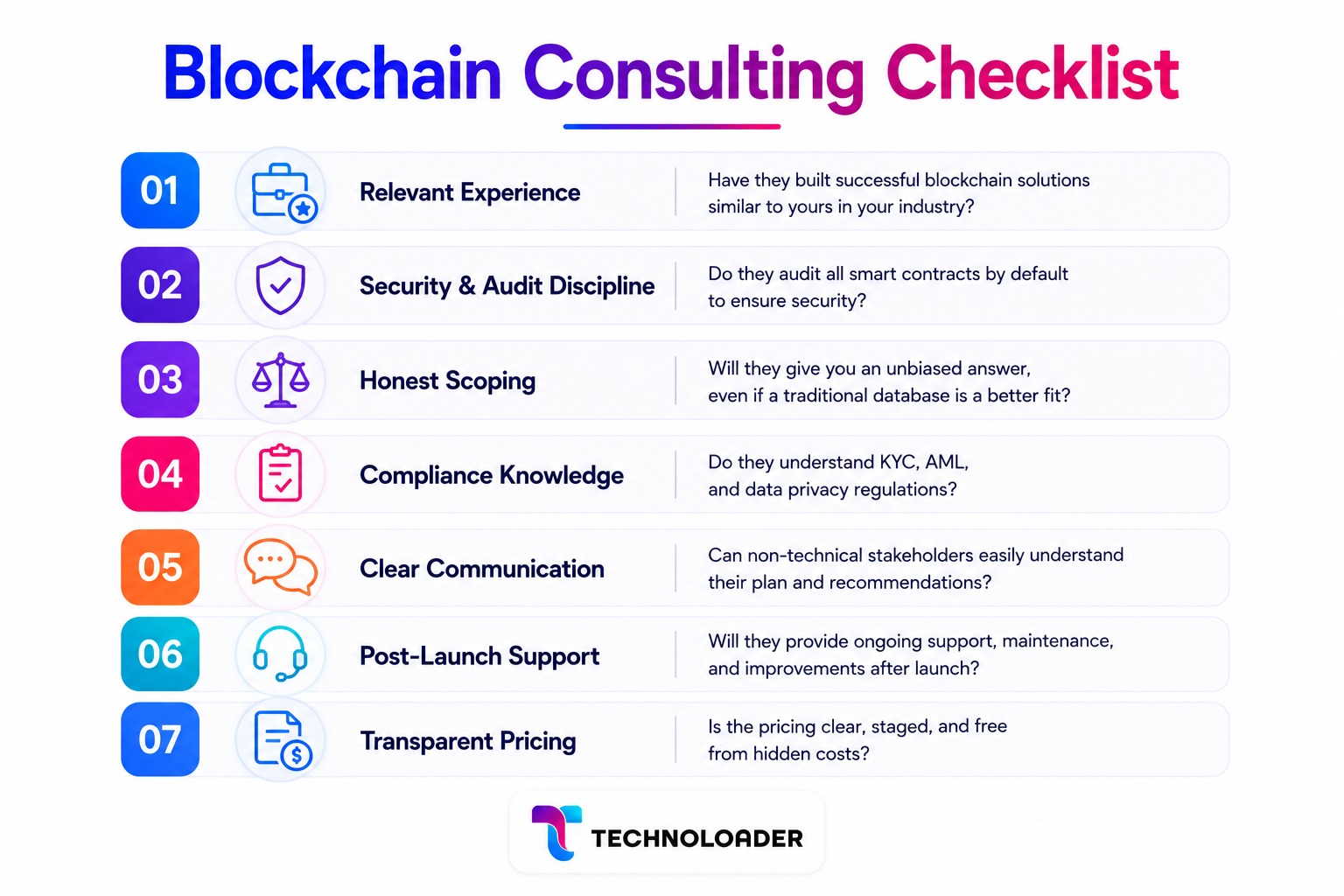
- Relevant Experience: Have they completed projects similar to yours and your industry?
- Security and Audit Practices: Do they audit smart contracts before deployment?
- Honest Scoping: Will they tell you when a database is a better choice?
- Compliance Knowledge: Do they understand KYC, AML, and data privacy requirements?
- Clear Communication: Can they explain their plan in simple terms?
- Post-Launch Support: Will they support the system after launch?
- Transparent Pricing: Is the quote clear and divided into project stages?
Start with the portfolio. Ask for case studies that match your problem and check the results. At Technoloader, clients can review projects across crypto exchanges and enterprise platforms. Completed work gives you more to assess than a sales presentation.
Look for results, not just client logos. A named client shows who they worked with. A clear result tells you what they achieved. Ask what problem the project solved and how the team measured success.
Then test their honesty. A company that recommends blockchain for every problem deserves caution. A good blockchain consulting firm should ask difficult questions before recommending a solution. They may even advise you not to build on blockchain.
Watch for warning signs. Guaranteed returns, vague timelines, and no mention of audits should raise concerns. Giving a pricing quote before even understanding your needs is another warning sign.
Next, assess security and compliance. Ask how the company audits code and handles regulatory requirements. These answers can help you assess the quality of its blockchain consulting services. Also ask who will work on your project. Get the names and roles of the people assigned to the work.
Finally, assess communication. You may work with the team for several months. If they cannot explain the plan clearly, the project may become difficult to manage. If you also need development services, our guide to hiring a blockchain development company covers that process in more detail.
How Do I Choose a Blockchain Consulting Company?
Score each firm on proof, not sales talk. Look for relevant case studies, audit discipline, compliance knowledge, honest scoping, and clear communication. Choose a partner who prices discovery first and will tell you when you don’t need blockchain.
Also Read
FAQ
1. What does a blockchain consultant do?
A blockchain consultant helps you decide if, where, and how blockchain fits your business. Blockchain consulting can cover strategy, platform selection, architecture, smart contract development, audits, compliance, and support. The work can take a project from the initial idea through development and launch.
2. How much does blockchain consulting cost?
The cost depends on the project scope. For instance, short advisory work may use an hourly rate. A fixed-scope study or proof of concept would have a set fee. A dedicated team may work on a monthly basis. Platform choice, project complexity, and security needs can also affect the cost.
3. What’s the difference between blockchain consulting and blockchain development?
Consulting covers strategy, feasibility, and architecture. Development writes, tests, and deploys the code. Blockchain consulting helps decide what to build and why. Development builds it. Most real projects need both, in that order. Many firms provide the two together.
4. How do I choose a blockchain consulting company?
When choosing a blockchain consulting firm to partner with, look for proof of their expertise. Check relevant case studies, security practices, audit processes, and compliance knowledge. A good partner should also tell you when blockchain is not the right choice. Capability, experience, and trust are important assessment factors.
5. Do I need blockchain, or is a regular database enough?
In many cases, a regular database is the better choice. Blockchain makes more sense when many parties need one shared, tamper-resistant record. If one company controls the data, a database is faster and cheaper. A good blockchain consulting firm should tell you when blockchain is unnecessary.
6. Which industries benefit most from blockchain consulting?
Finance, supply chain, healthcare, real estate, gaming, and government all use blockchain. Each of these industries uses blockchain for different needs, such as settlement, traceability, or shared records. The common factor is a need for records that several parties can access and verify.
7. How long does a blockchain consulting engagement take?
The timeline depends on the project scope. A feasibility study may take a few weeks. A full project with development and security audits will take longer. Blockchain consulting does follow several stages, with each stage producing a reviewable result.
8. Is blockchain consulting worth it for a small business?
It can be if you have a clear use case for blockchain. For a small business, the main value may be avoiding an expensive mistake. A short advisory project can answer the main questions without a large initial budget. You do not need a large project to get useful direction.
9. What does a blockchain consulting engagement deliver?
Typical deliverables include a feasibility assessment, technology recommendation, and solution architecture. You may also receive a proof of concept and project roadmap. Later stages can include tested code, audit reports, and live deployment. The exact deliverables depend on the scope of the engagement.
10. Do I need to know how to code to work with a blockchain consultant?
No. A good consultant explains everything in plain business terms. Your job is to know the problem and the goals. Theirs is the technology. The best engagements feel like a clear conversation, not a technical lecture you can’t follow.
Conclusion
So, what is blockchain consulting? It’s expert help that turns a business goal into a secure, working blockchain solution. It starts with whether you need one at all. The value lies in better decisions about the right use case, platform, and audited code you can trust.
If you’re weighing a blockchain project, start small and start honest. A short discovery engagement will tell you far more than months of guessing.
Ready to explore your idea with people who’ve built these systems? Talk to our blockchain team for a straight answer on whether blockchain fits your business.

Vipin Kumar
Vipin Kumar is the Founder & CEO of Technoloader, a Clutch Top 10 Blockchain Development Company for 2025. A serial technology entrepreneur and blockchain architect with a B.Tech background, Vipin has led the delivery of 450+ projects across DeFi, NFT marketplaces, AI/ML, and custom Web3 platforms for clients in the UAE, India, the US, and beyond. He also founded SALIQ (saliq.ai), an AI-driven conversational marketing platform.
Published in Blockchain Development


