+91 7014607737
 info@technoloader.com





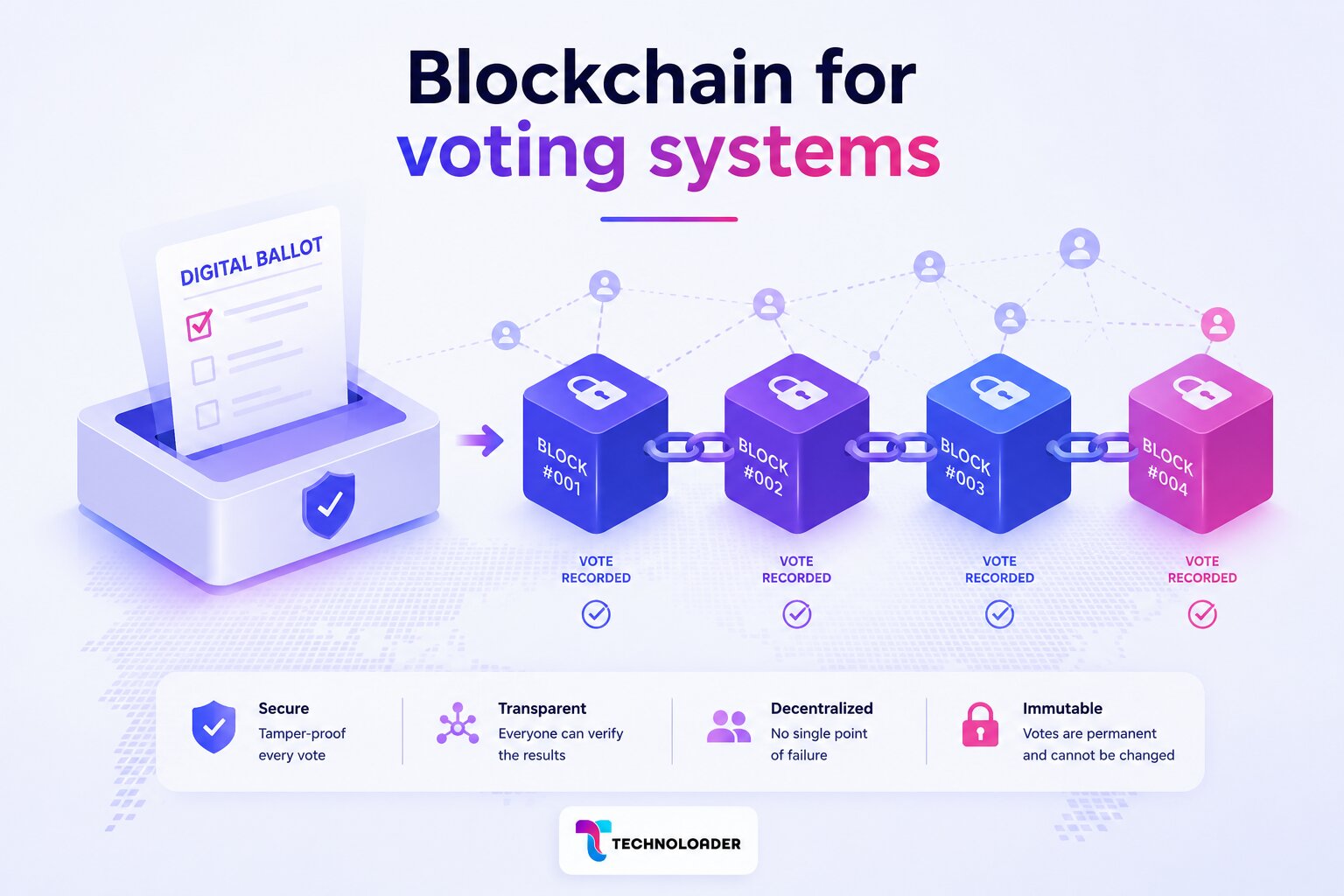
Table of Contents
Blockchain for voting systems records each vote on a shared, tamper-resistant digital ledger. Many copies of that ledger sit across a network of computers. Because of this, a recorded result becomes hard to change in secret.
Supporters believe this can make elections more transparent and easier to audit.
Many elections face problems like fraud, missing votes, and long counting times. Blockchain fixes this by creating a clear record that everyone can verify.
In 2018, West Virginia became the first US state to test blockchain mobile device voting in a federal election. Since then, small pilots have appeared around the world. Yet many election-security experts remain cautious, and for solid reasons.
This guide keeps both sides honest. You’ll learn how blockchain voting works, its types, benefits, and limits. We’ll also look at real-world examples and lessons I’ve picked up from researching blockchain voting projects.
Key Takeaways
- What it is: Blockchain voting systems record votes on a secure digital ledger that’s difficult to alter secretly.
- The real benefit: Tamper-proof records improve transparency, auditability, and counting speed.
- The hard limit: Blockchain doesn’t fix voter device security, identity verification, or coercion.
- Where it works now: Decentralized Autonomous Organization (DAO) governance and corporate shareholder voting.
- The bottom line: Promising, but not a proven replacement for public elections voting.
What Is Blockchain Voting?
Blockchain for voting systems records votes as entries on a distributed ledger. A distributed ledger is a database copied across many computers, called nodes. Each new batch of records links to the one before it. This chain makes it very hard for anyone to change votes without others noticing.
Many people mistake e-voting for blockchain voting, but the two are different. E-voting means any electronic voting, including machines at a polling station. Blockchain voting adds a shared ledger to record and check those votes. So blockchain technology is one tool inside the wider world of digital voting.
Not every blockchain voting system works the same way. Some are ballot boxes that store the actual votes on the blockchain. Others use the blockchain only to publish and verify election results. Knowing which approach a system uses helps you understand how it works.
Using blockchain for voting systems makes elections easier to verify and tougher to mess with. However, it can’t solve every security problem. It cannot stop hackers from stealing voter identities or people from paying others for their votes.
What is blockchain voting, in simple terms?
Blockchain for voting systems stores votes in a shared record that’s difficult to change in secret. It gives voters and election officials a clear way to verify results.
Also Read
How Does Blockchain Voting Work?
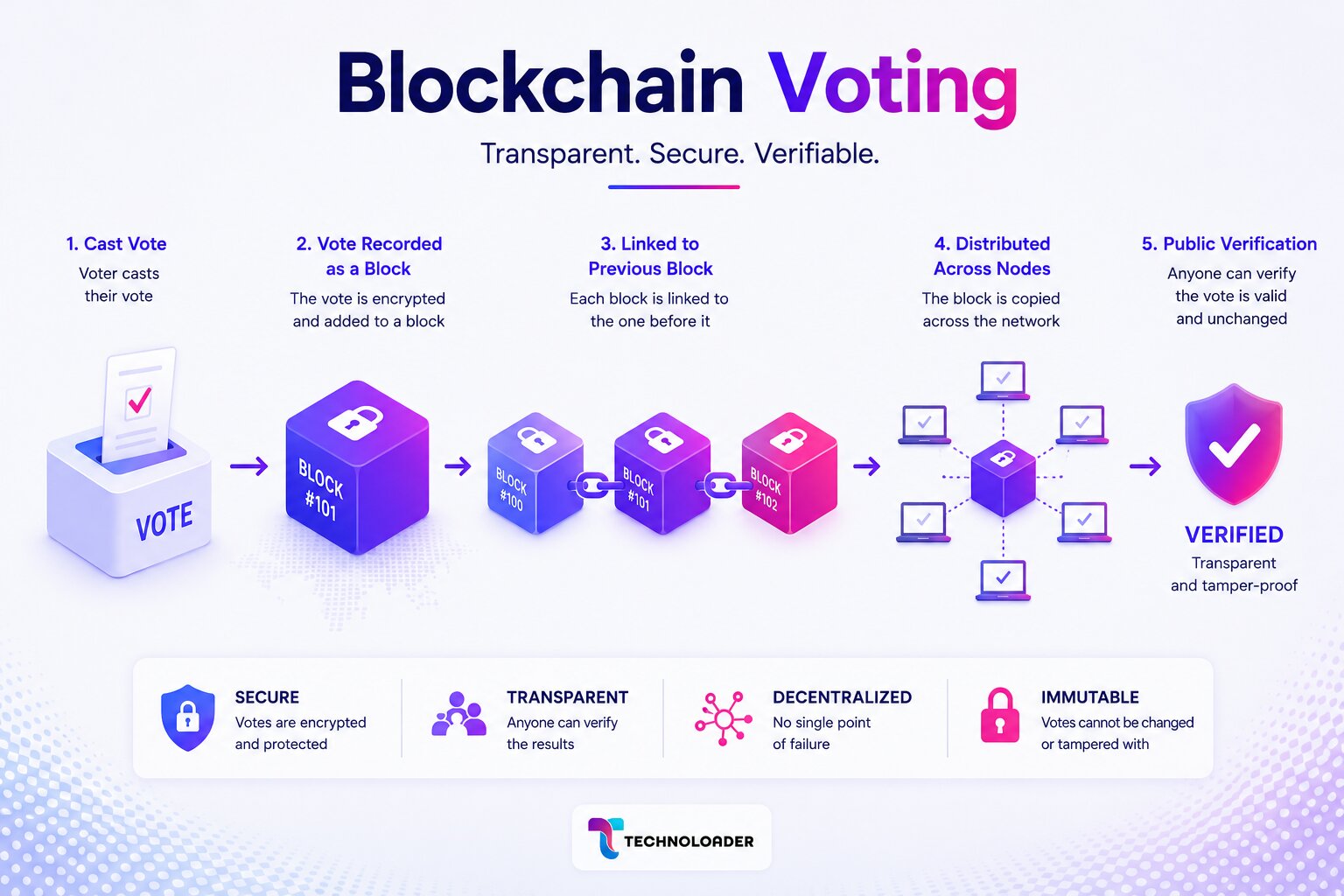
Blockchain for voting systems follows five main steps, from checking a voter’s identity to confirming the final results. Each step uses cryptography to keep votes secure and private.
However, a blockchain can’t prove who you are. Election officials must verify your identity before your vote reaches the ledger.
Here’s the step-by-step process of blockchain voting:
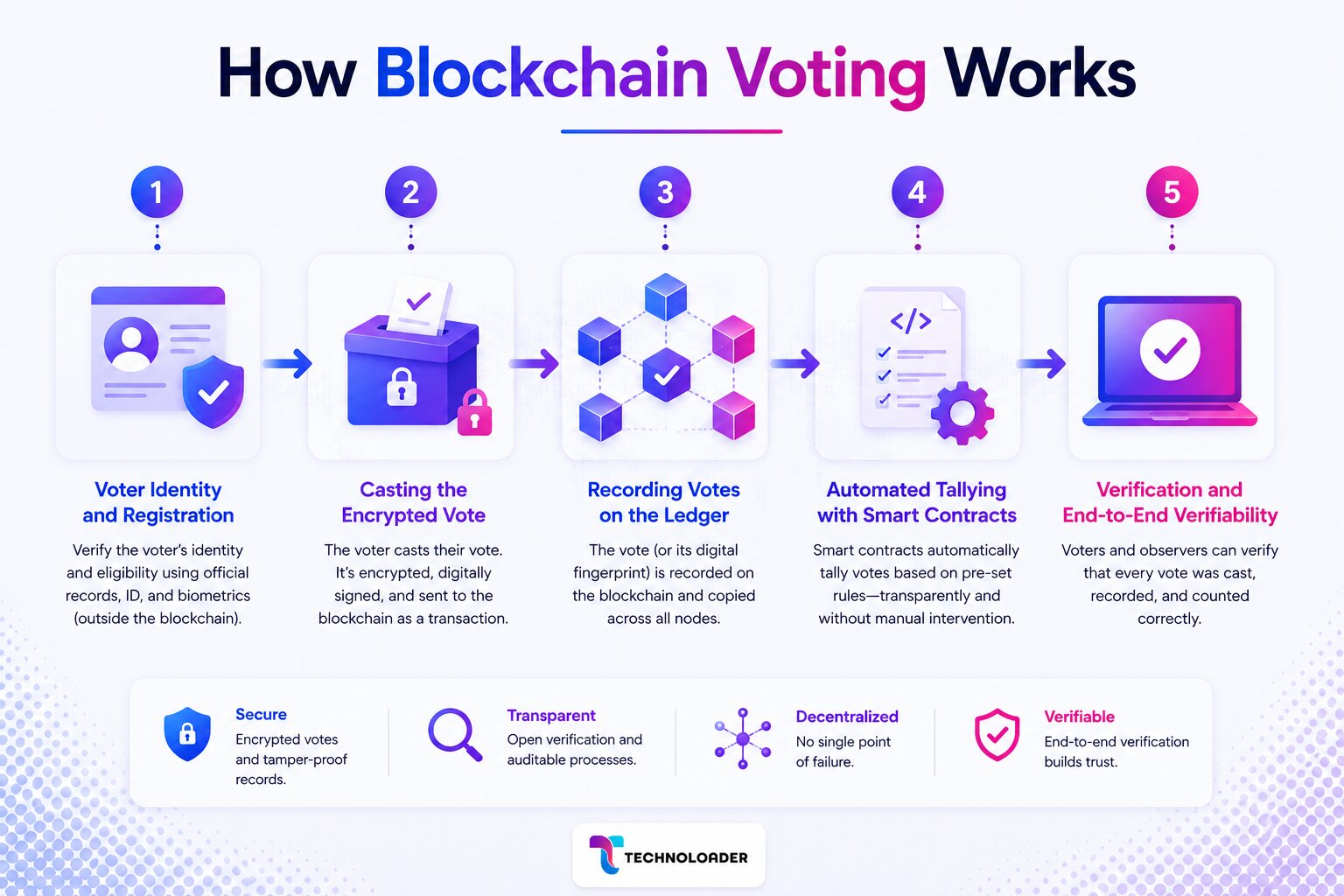
1. Voter Identity and Registration
First, the election system checks that you are eligible to vote. It checks your identity against an official list of registered voters. It may use your government ID, biometrics, and other details.
The whole process happens outside the blockchain, before you cast your ballot. This is mainly because the ledger can’t verify voter identity.
2. Casting the Encrypted Vote
Next, you choose your candidate through a secure app or voting portal. Do it just like you would in a traditional election. The system encrypts your vote and signs it with a private digital key. It then sends the vote to the blockchain network as a transaction.
Encryption keeps your choice private as it travels across the internet. Even if someone intercepts the data, they can’t see how you voted.
3. Recording Votes on the Ledger
The network stores your vote, or a secure digital fingerprint of it, on the ledger. Every node keeps a copy of the record. So, changing a recorded vote without detection becomes very difficult.
Some blockchain voting systems store full ballots on the chain. Others only keep your digital fingerprint or smart contract hash and store your ballot off-chain.
4. Automated Tallying With Smart Contracts
Many blockchain voting systems use smart contracts to count votes automatically. A smart contract is a computer program that follows rules created before the election starts. It counts each vote as it comes in.
Since anyone can look at the code, the counting process is easier to verify. Some systems also use strong protection to count votes while keeping individual choices secret. This speeds things up and cuts out a lot of extra hand-counting.
5. Verification and End-to-End Verifiability
Finally, voters and election observers can confirm that every vote appears in the final count.
Reliable blockchain voting systems let you verify that your vote was cast, recorded, and counted correctly. Experts call this end-to-end verifiability. Tools like Microsoft ElectionGuard can provide this feature without using blockchain.
The Cryptography Behind Private Votes
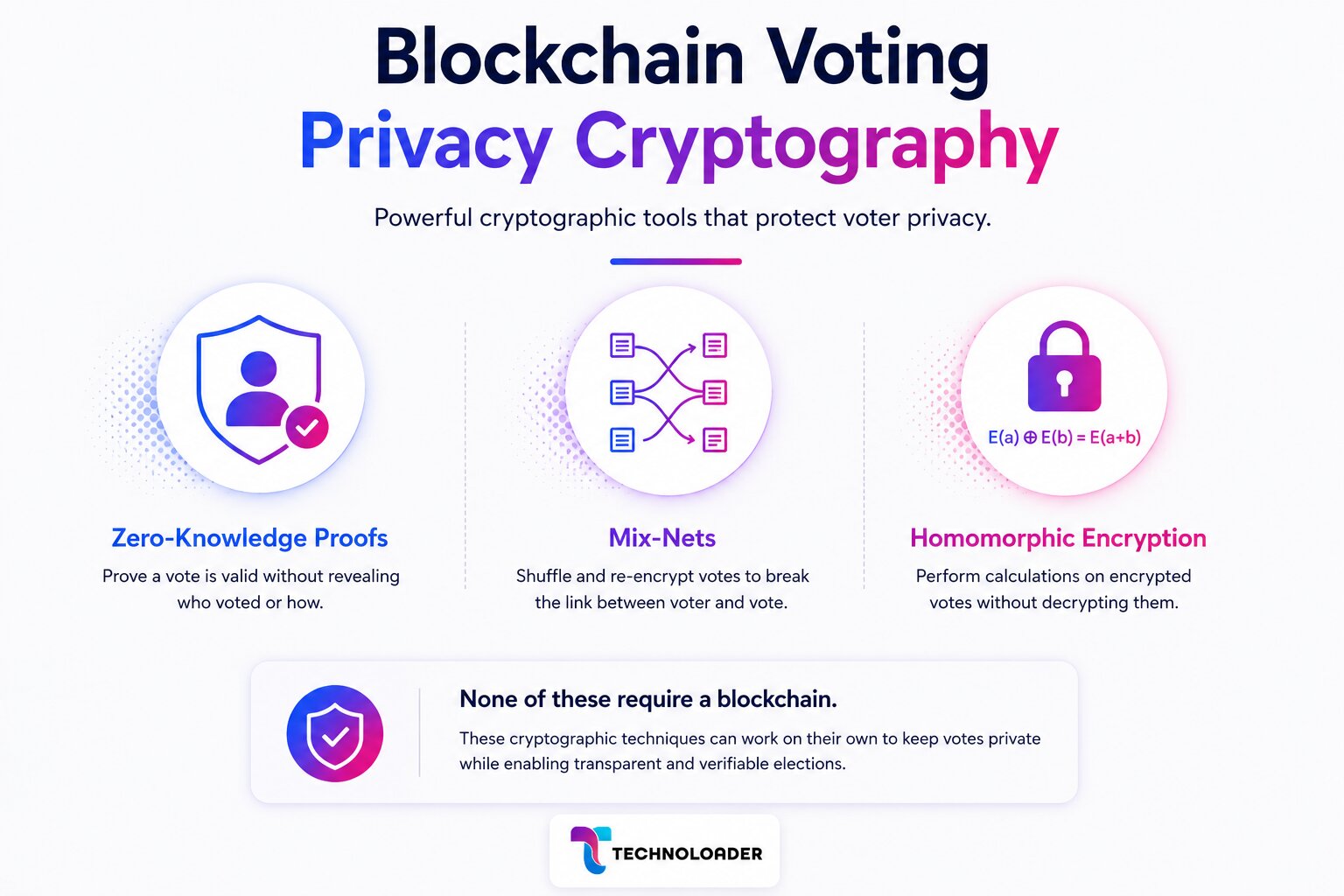
Blockchain is only one part of a secure voting system. Cryptography works in the background to keep every vote private and safe. It uses smart math to protect your ballot while making sure your vote still counts.
Zero-knowledge proofs show your vote is valid without revealing who you voted for. Mix-nets also shuffle ballots so no one can trace the vote back to you. Finally, homomorphic encryption lets election officials count votes without seeing each person’s choice.
These tools improve privacy and security and work even without blockchain.
How does blockchain voting work, step by step?
First, the system verifies your identity outside the blockchain. Next, you cast an encrypted ballot. The network records it on the ledger, and smart contracts count the votes. Finally, you and election officials can verify that the system counted every vote correctly.
Also Read
What Are the Different Types of Blockchain Voting Systems?
Blockchain for voting systems comes in several forms. Each one solves a different problem. The main types include public and permissioned blockchains, on-chain ballot boxes, and bulletin board systems.
The key difference comes down to who controls the blockchain and how the system stores votes.
Public vs Permissioned Blockchains
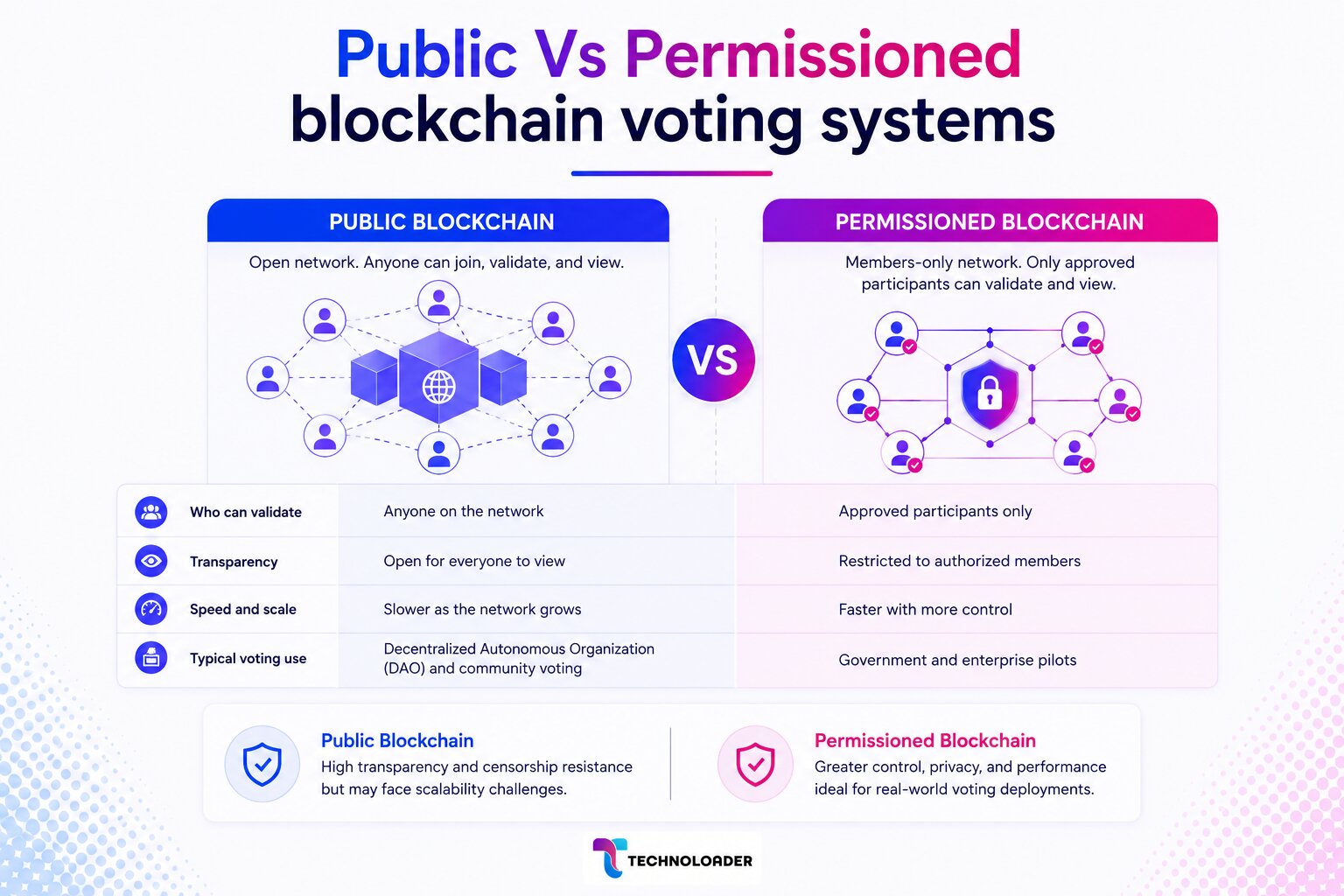
A public blockchain lets anyone join the network, validate transactions, and view the ledger. Popular public networks like Ethereum follow this model. They provide a high level of transparency because many people can verify records.
Permissioned blockchains only allow approved members to validate records. Most governments prefer permissioned networks because they offer more control and privacy. For example, Voatz runs on a permissioned Hyperledger setup.
Here are their key differences:
| Feature | Public Blockchain | Permissioned Blockchain |
|---|---|---|
| Who can validate | Anyone on the network | Approved participants only |
| Transparency | Open for everyone to view | Restricted to authorized members |
| Speed and scale | Slower as the network grows | Faster with more control |
| Typical voting use | Decentralized Autonomous Organization (DAO) and community voting | Government and enterprise pilots |
On-Chain Ballot Box vs Bulletin Board
An on-chain ballot box stores encrypted votes directly on the blockchain. This creates a permanent record of every vote.
A bulletin board system stores election records on the blockchain, while another system stores and counts the actual votes. So the blockchain only keeps a copy of the final records for verification.
Many blockchain elections actually use this second approach. Knowing the difference helps you choose the right system.
Vote-Weighting Models
Blockchain voting systems follow different voting rules. Some elections use one-person, one-vote, where every voter has equal power. Others use token-weighted voting, giving more influence to people who own more tokens.
Quadratic voting sits between the two. It reduces the advantage of large token holders while still allowing stronger support for important issues. People can cast multiple votes for one issue, but each extra vote costs more digital tokens.
These models are most common in blockchain governance rather than in public elections.
Blockchain Voting vs Other Approaches
It also helps to compare blockchain for voting systems with other approaches. Paper voting is slow but easy to understand. End-to-end verifiable systems add cryptographic checks without a ledger. Blockchain voting adds a shared digital ledger to help record and verify votes.
Here’s how blockchain voting systems compare to other traditional and digital methods:
| Approach | How Votes Are Trusted | Main Strength | Main Limit |
|---|---|---|---|
| Traditional paper | Physical ballots and manual audits | Doesn’t rely on software and is easy to understand | Slow counting and limited remote access |
| Blockchain voting | Votes recorded on a shared ledger | Tamper-resistant record, transparency, and faster tally | Device security, identity, and coercion risks remain |
| E2E-verifiable (no blockchain) | Cryptographic receipts and public checks | Verifiable without a ledger | Complex to run and still depends on secure devices |
What are the main types of blockchain voting?
Key options include public and permissioned blockchains. Some stores store ballots directly on the chain, while others use it only to verify results. Governance systems also differ in how they assign voting power to each participant.
What Are the Benefits of Blockchain Voting?
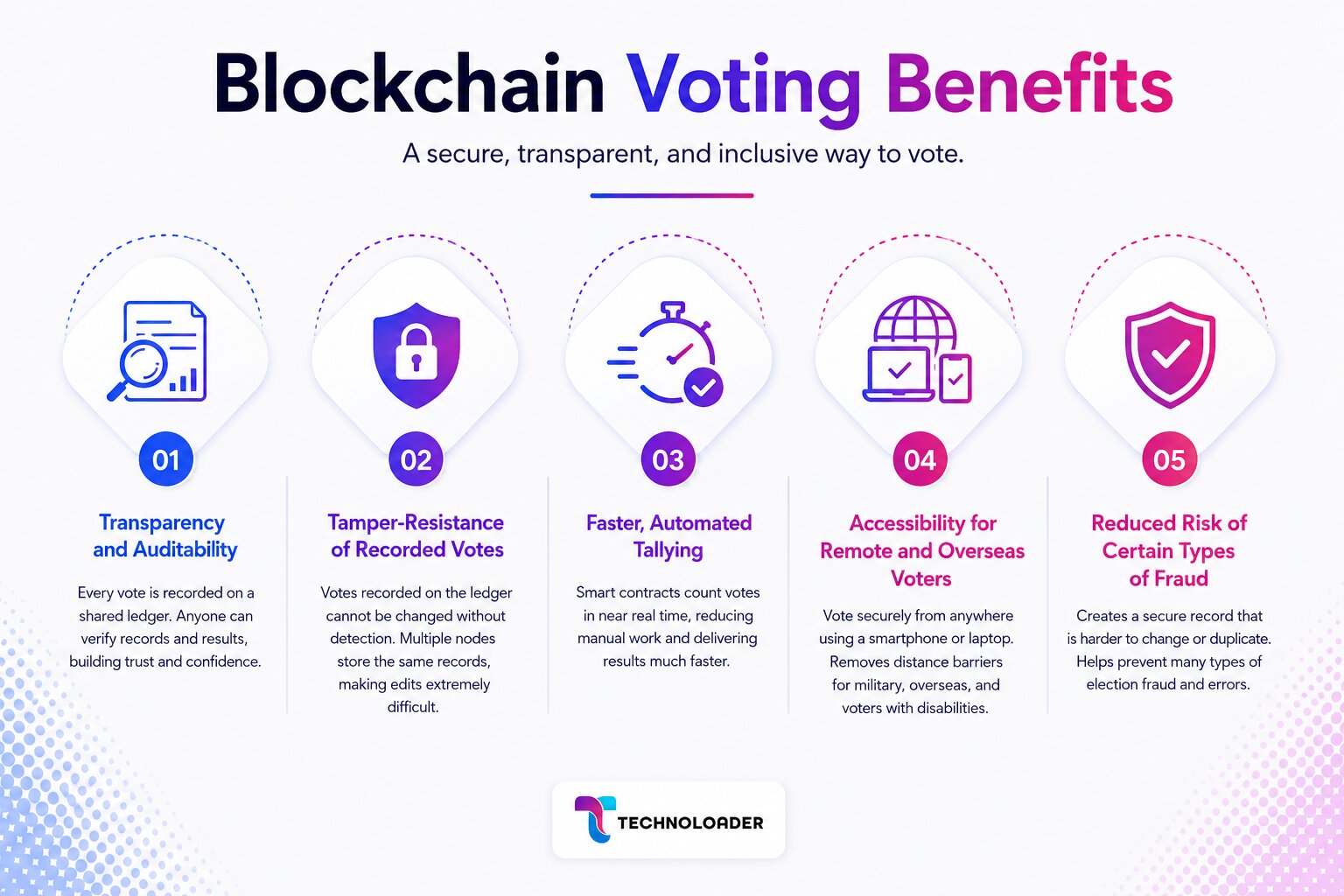
Blockchain for voting systems brings several upgrades to the digital electoral process. It makes voting more transparent, keeps recorded votes secure, and speeds up vote counting. The approach also supports remote voters and reduces common types of election fraud.
Below are the main benefits of blockchain voting systems in more detail:
Transparency and Auditability
Since every vote is recorded on a shared ledger, everyone can view the same voting record. Election officials and auditors can check results without relying on one central system.
This openness builds trust and confidence. It helps resolve issues quickly, even when the winner only leads by a handful of votes. Strong privacy measures must still protect every voter’s identity.
Tamper-Resistance of Recorded Votes
Once the ledger records a vote, changing it without leaving evidence becomes difficult. Many blockchain nodes store the same records, making secret edits much harder.
Even so, no online system is impossible to attack. Blockchain makes tampering harder, but it doesn’t entirely prevent hacking.
Faster, Automated Tallying
Traditional elections often require workers to collect ballots and count them by hand. This process can take hours or even several days, especially in large elections.
Smart contracts can count votes in near real time. This cuts manual handling and speeds up results. In one corporate pilot, Santander and Broadridge showed near-instant investor voting. That replaced a process that used to take about two weeks.
Accessibility for Remote and Overseas Voters
Many people can’t easily travel to a polling station. These include military personnel, overseas citizens, and people with disabilities.
Blockchain for voting systems allows you to vote securely from a smartphone or laptop. No matter where you are in the world, you can participate without facing distance barriers. However, researchers still debate whether it increases voter turnout.
Reduced Risk of Certain Types of Fraud
Blockchain creates a record that’s much harder to change or duplicate without detection. This makes certain types of election fraud easier to prevent.
However, no voting system can stop every possible type of fraud. Attackers can still target voter devices, identity checks, or registration systems. Strong security remains essential.
What are the advantages of blockchain for voting systems?
This voting approach helps protect votes, speeds up counting, and improves transparency. It also supports remote voting and reduces specific election fraud risks.
Also Read
Challenges, Risks, and What Experts Say
Blockchain doesn’t solve the hardest problems in election security. That’s the clear message from leading researchers. The U.S Vote Foundation 2026 report reveals that blockchains can’t determine exactly who’s trying to vote.
This means the ledger protects a vote only after it is correctly recorded. The riskiest moments happen before and around that step.
Here are the main concerns:
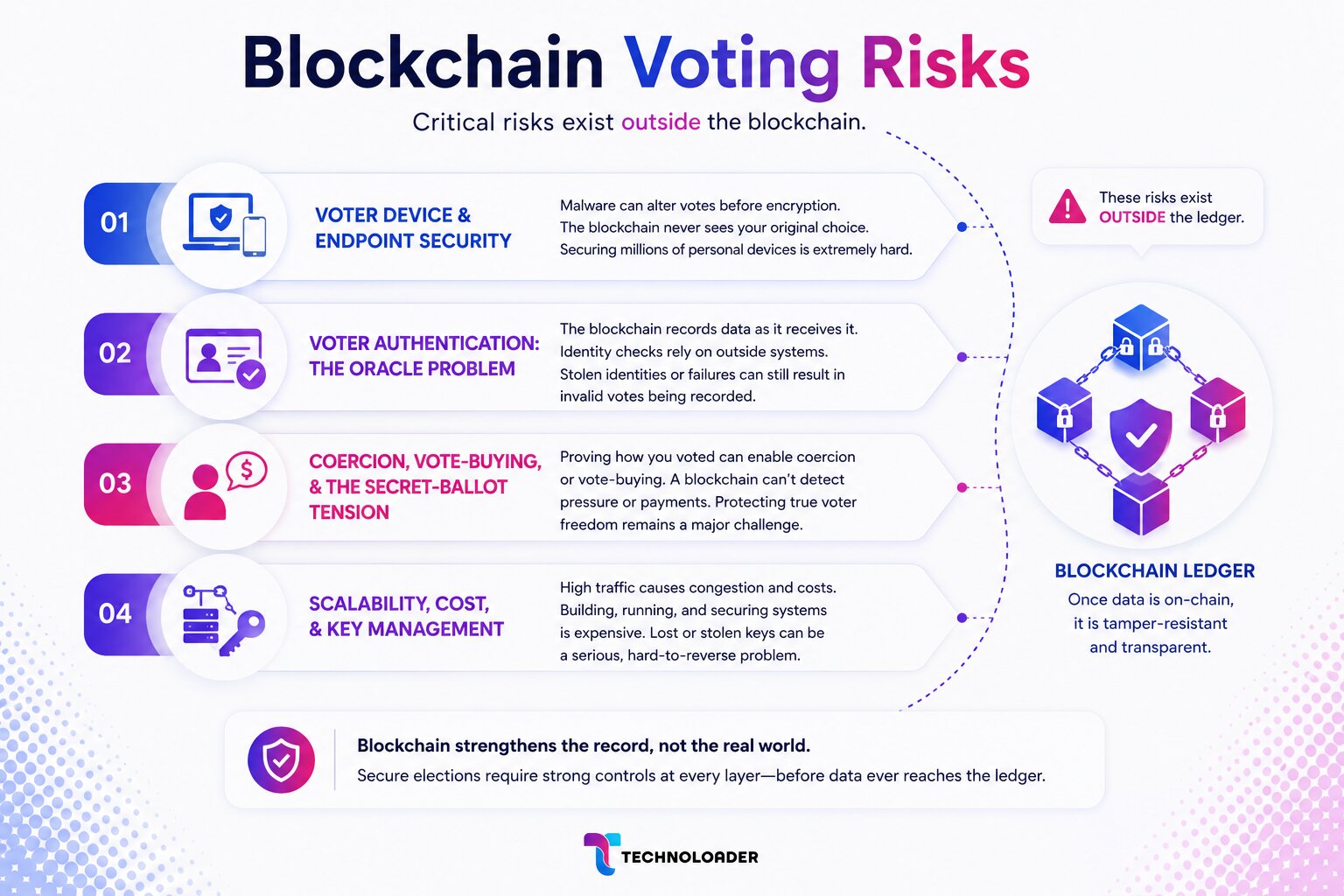
Device and Endpoint Security
Malware on a phone or computer can change a vote before it is encrypted. The blockchain never sees the original choice, so it cannot catch this. Securing millions of personal devices is extremely hard. This is one reason a secure blockchain app still cannot guarantee a safe election.
Voter Authentication: The Oracle Problem
Blockchain records data exactly as it receives it. The ledger can’t prove that an actual, eligible person cast a vote. This verification depends on outside systems and data. They must confirm that you’re the right person and that you can vote only once.
If someone steals a digital identity or if the identity check fails, the blockchain may still record an invalid vote.
Coercion, Vote-Buying, and the Secret-Ballot Tension
Secret ballots protect voters from pressure and vote buying. Some blockchain voting systems may allow you to prove how you voted. While this sounds useful, it can also encourage coercion or vote buying.
A blockchain can’t tell whether someone forced you to vote or offered money for your vote. Building strong protection against these risks remains difficult.
Scalability, Cost, and Key Management
National elections involve millions of voters at once. Public networks can face congestion, delays, and higher costs at that scale. Building and maintaining these systems also costs money. Governments need secure servers, software, testing, staff training, and ongoing maintenance.
Key management is another concern. A lost or stolen private key can be a serious, hard-to-reverse problem.
What the Experts Say
The expert consensus is cautious about public elections.
A 2024 National Institute of Standards and Technology (NIST) study shows that voter verification remains a key challenge. Less than 50% of 241 participants verified their ballots. Only 6.6% spotted and mentioned errors to poll workers.
The U.S. Vote Foundation has also warned against blockchain voting. It shares that malware could change votes on devices before they’re transmitted.
According to a global evaluation published by MDPI in 2026, real-world testing remains highly limited. The most successful projects are restricted to small academic pilots.
Regulations and Safer Alternatives
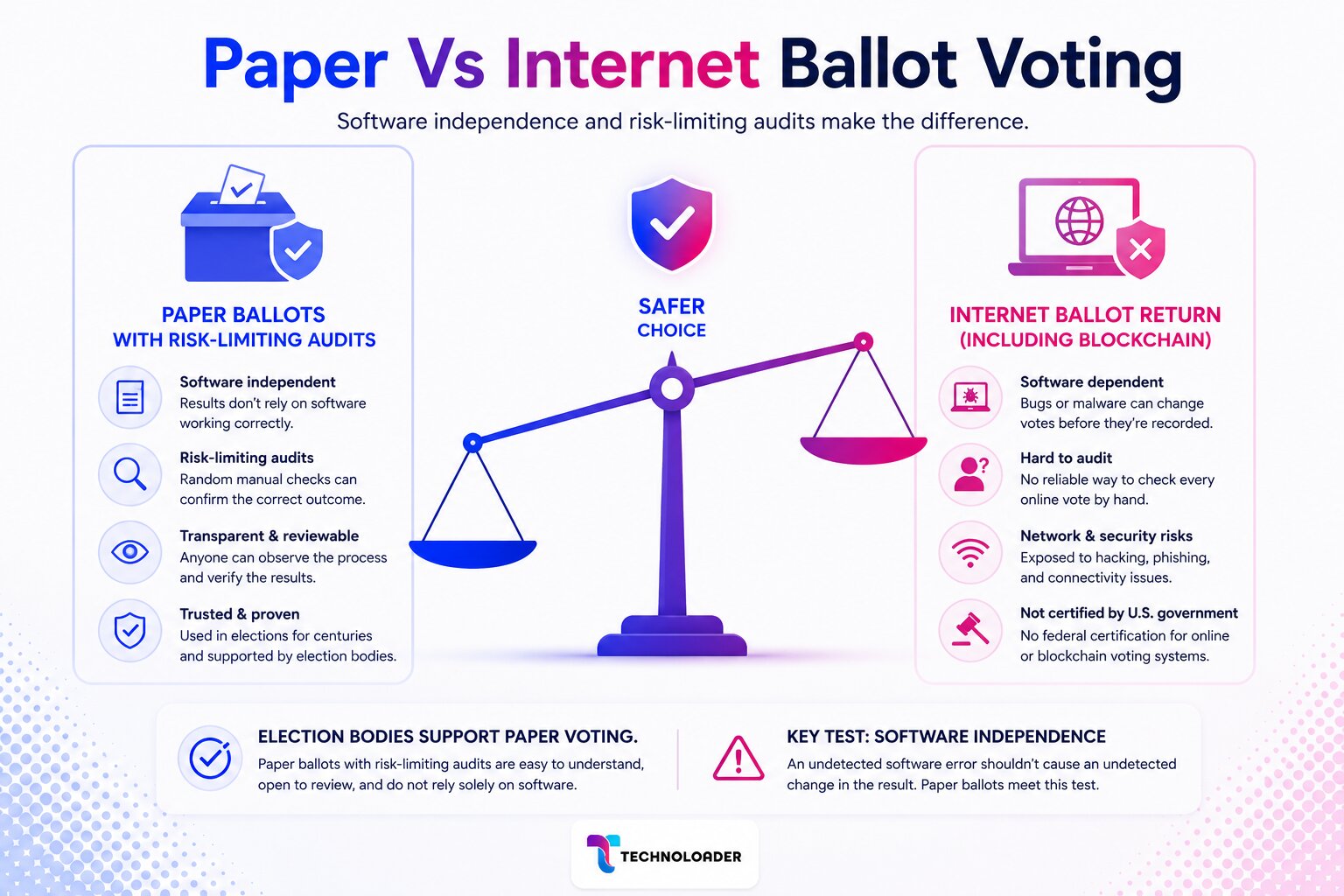
No U.S. government certification officially approves online or blockchain voting systems. The election bodies support voting physically with a paper ballot. This method is easy to understand, open to review, and doesn’t depend only on software.
A useful test here is software independence. It means an undetected software error shouldn’t cause an undetected change in the result. Paper ballots meet this test. Blockchain voting through personal devices generally does not.
Is blockchain voting actually secure?
Blockchain only protects votes after the system records them correctly. However, it can’t stop malware, identity fraud, or voter coercion before that happens. Most election experts don’t recommend this approach for binding public elections today.
Real-World Examples of Blockchain Voting
Several cities and countries around the world have launched real-world trials of blockchain for voting systems. Most of these projects were small, and several ended after security reviews. Looking at these examples helps you understand what worked, what failed, and why.
Here are the clearest blockchain use cases, with their honest outcomes:
West Virginia and Voatz
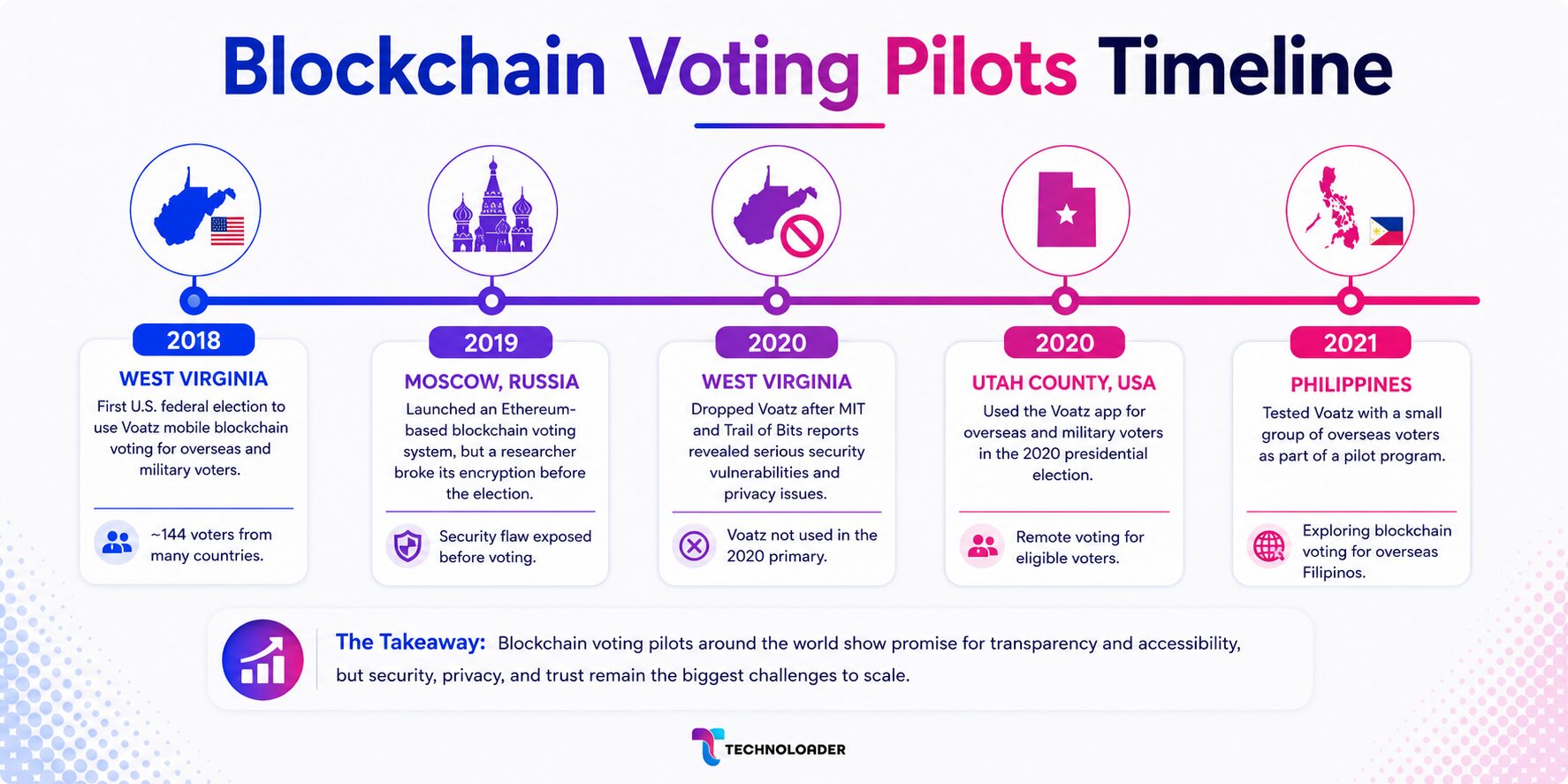
West Virginia used the Voatz app in 2018 for overseas and military voters. It was the first US federal election to test mobile blockchain voting. The app ran on a permissioned Hyperledger network. About 144 voters took part, sending ballots from many countries.
In 2020, MIT researchers published a report titled “The Ballot is Busted Before the Blockchain.” The study revealed severe security vulnerabilities and privacy issues. Security firm Trail of Bits also found serious security issues that could invalidate an election.
After these findings, West Virginia stopped using Voatz in its 2020 primary election. Officials later confirmed that although university students attempted to study the system in 2018, no votes changed during the pilot.
Utah County also used Voatz for its 2020 presidential ballots. In 2021, the Philippines tested Voatz with a small group of overseas voters.
Not every outcome is negative, though. Analysts at Brookings believe blockchain for voting systems could improve election transparency if security challenges are solved.
Moscow, Zug, Tsukuba, and Thailand
Several other places also tested blockchain for voting systems. Moscow launched an Ethereum-based voting system in 2019, but a researcher broke its encryption before the election.
Zug, Switzerland, also held a small trial with about 72 voters in 2018. Tsukuba, Japan, tested blockchain voting for local proposals that same year. Thailand’s Democrat Party also used a blockchain audit layer for a primary with more than 120,000 voters.
Myth-Busting: Estonia and Sierra Leone
Some popular claims about blockchain voting systems are incorrect. Estonia has been running an online voting system since 2005. However, it doesn’t use blockchain to record public election votes. The country relies on digital identity cards, encryption, and other security technologies.
Sierra Leone also didn’t run an official blockchain election in 2018. A private company simply observed and mirrored the results of a few districts. Election officials publicly confirmed they didn’t use blockchain in the official count.
Why Most Public Pilots Stalled
Most blockchain voting projects followed a similar pattern. They were small, non-binding, or quietly dropped.
The biggest challenges were rarely about the ledger itself. They mostly involved device security, identity verification, voter coercion, and public trust. Smaller private voting projects were also easier to manage than nationwide elections.
| Place | Year | System | Status and Outcome |
|---|---|---|---|
| West Virginia, USA | 2018 | Voatz (Hyperledger) | Overseas-voter pilot. Dropped in 2020 after security research |
| Moscow, Russia | 2019 | Ethereum-based | A researcher broke the encryption before the vote |
| Zug, Switzerland | 2018 | uPort app | Small consultative trial, about 72 voters |
| Tsukuba, Japan | 2018 | My Number ID | Local proposal voting; early-stage trial |
| Thailand | 2018 | Zcoin audit layer | Party primary with over 120,000 voters |
| Utah County, USA | 2020 | Voatz | First US presidential ballots via a blockchain app |
| Philippines | 2021 | Voatz | Overseas-voter pilot for a group of volunteers |
Which countries have tried blockchain voting?
The United States, Switzerland, Japan, Thailand, Russia, and the Philippines have tested blockchain voting systems. Most projects were small, focused on limited groups, or later discontinued due to security concerns.
Also Read
Where Does Blockchain Voting Work Today?
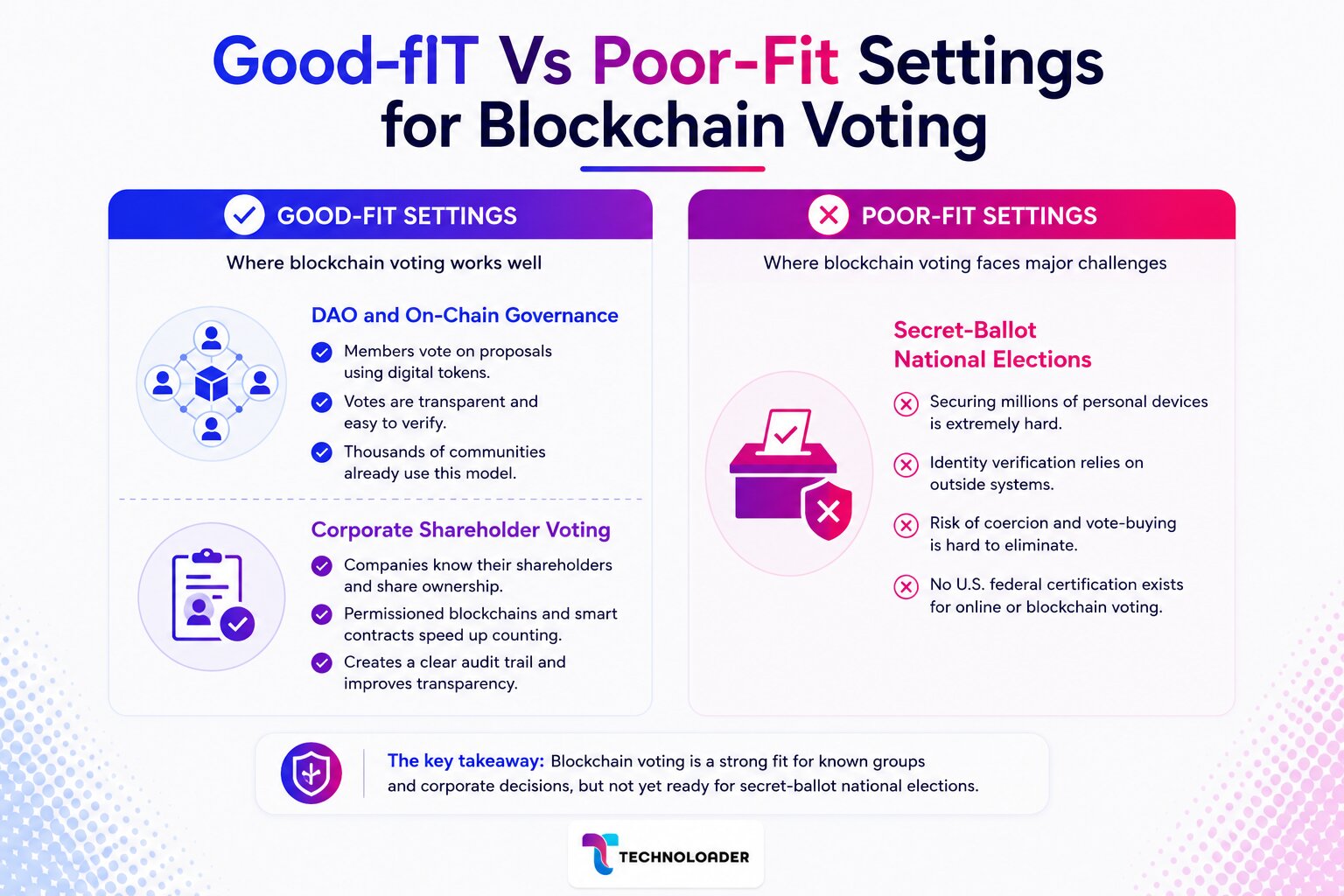
Blockchain voting works best in lower-stakes, lower-coercion settings. These are places where full transparency is welcome, not a risk. Secret-ballot national elections are the least ideal fit for blockchain voting systems.
The examples below already use blockchain technology today:
DAO and On-Chain Governance
Decentralized Autonomous Organizations (DAOs) use blockchain for decision-making. Members vote on proposals using digital tokens. Platforms like Snapshot let members vote through their crypto wallets, often without paying transaction fees.
Thousands of blockchain communities already use this approach. Everyone can verify votes, and that level of transparency builds trust.
Corporate Shareholder Voting
Big companies are using digital ledgers to manage board elections and shareholder decisions. Companies already know who their shareholders are. Plus, each person’s voting power depends on the number of shares they own.
Santander tested blockchain-based investor voting during its 2018 annual meeting. Universities, professional associations, and labor unions have also used similar systems.
Permissioned blockchains and smart contracts speed up vote counting and create a clear audit trail.
Government Pilots and the Road Ahead
Countries like Estonia and Switzerland are still testing blockchain for voting systems. Most pilot programs now pair new systems with paper records and strong audits.
Permissioned blockchain systems for known groups appear more practical in the near future. It may take several years before blockchain is trusted for nationwide public elections.
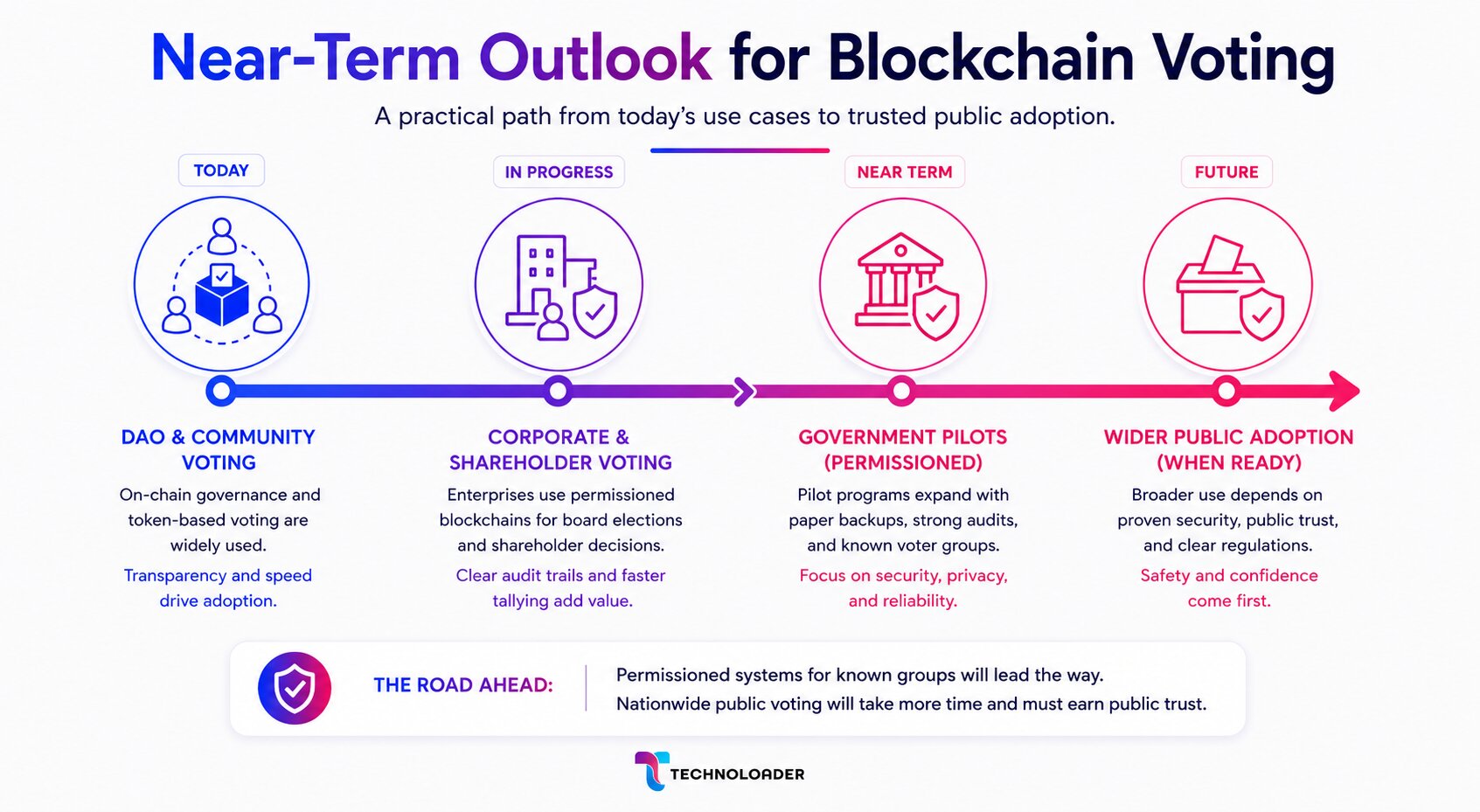
Where does blockchain voting actually work today?
Blockchain for voting systems works best in DAO governance and corporate shareholder voting. Here, voter identities are already known, and transparency supports the voting process. It still doesn’t fit secret-ballot public elections.
Frequently Asked Questions
How does blockchain voting work?
First, the election system verifies a voter’s identity outside the blockchain voting system. The voter then casts an encrypted ballot through a secure app. The network records the vote on a shared ledger, and a smart contract tallies the votes. After the election, anyone can verify the final results.
Is blockchain voting secure?
Blockchain for voting systems protects recorded votes from unauthorized changes. However, they can’t stop malware on personal devices, identity fraud, or voter coercion. Due to these risks, security experts don’t support blockchain voting for public election processes.
Which countries have used blockchain for voting?
The United States, Switzerland, Japan, Thailand, Russia, and the Philippines have run pilots. Most were small, non-binding, or discontinued. No major country uses blockchain for national elections today.
What are the disadvantages of blockchain voting?
The main issues are device security, voter authentication, and coercion risk. Scalability, cost, and key management add further concerns. These weak points sit outside the ledger, so the blockchain alone cannot fix them.
Is Estonia’s online voting based on blockchain?
No. Estonia’s internet voting uses digitally signed, encrypted ballots, not blockchain vote-casting. Estonia applies blockchain only to protect the integrity of certain state records. Calling it blockchain voting is a common myth.
Can blockchain eliminate election fraud?
No. It only makes some fraud harder to hide by protecting recorded votes. It cannot stop attacks on voter devices, identity checks, or coercion. So, it reduces certain risks rather than eliminating fraud.
What is the difference between blockchain voting and e-voting?
E-voting refers to any type of electronic voting. This includes machine-based voting at polling places. Blockchain voting adds a distributed ledger to record votes. Some secure voting systems also achieve verification without using blockchain at all.
How is a blockchain voting system built, and by whom?
It usually combines a permissioned ledger, smart contracts, identity checks, and strong cryptography. Specialist blockchain teams typically design, test, and audit these systems before any pilot.
Conclusion
Blockchain for voting systems is a promising idea with strengths and limits. It can improve transparency, protect recorded votes, and speed up counting. Yet it does not solve device security, voter identity, or coercion.
For now, it fits governance and shareholder voting better than secret-ballot elections.
The smart path is to match the tool to the right use case. Start where transparency helps, and the stakes are moderate. Then build strong security from day one.
If you’re exploring a secure, permissioned solution, our team can help you build blockchain solutions the right way. Talk to our experts to scope your project.
Have a question about blockchain voting? Drop it in the comments, and I’ll answer.

Vipin Kumar
Vipin Kumar is the Founder & CEO of Technoloader, a Clutch Top 10 Blockchain Development Company for 2025. A serial technology entrepreneur and blockchain architect with a B.Tech background, Vipin has led the delivery of 450+ projects across DeFi, NFT marketplaces, AI/ML, and custom Web3 platforms for clients in the UAE, India, the US, and beyond. He also founded SALIQ (saliq.ai), an AI-driven conversational marketing platform.
Published in Blockchain Development