+91 7014607737
 info@technoloader.com





Table of Contents
The main benefit of blockchain for businesses is trust without a middleman. It lets multiple parties share a single tamper-resistant record that they can all verify. This can reduce fraud, cut costs, and speed up transactions.
We have spent more than eight years building these systems. Across the 450+ projects we have delivered at Technoloader, the companies that win with blockchain are not chasing hype. They are solving a specific problem: data that multiple parties can trust.
Blockchain is growing fast. The global blockchain market was worth about $31 billion in 2024 and is projected to reach $1.43 trillion by 2030, according to Grand View Research. But growth alone does not make it the right choice for every business.
In this guide, we’ll explain what blockchain is, the business benefits of blockchain, and more. We’ll also be honest about the limits, because knowing where blockchain does not fit is part of using it well.
Key Takeaways
- Blockchain helps businesses improve security, transparency, and data accuracy. It also reduces reliance on central authorities.
- Smart contracts automate tasks, lower costs, and speed up transactions.
- The biggest benefits of blockchain show up in finance, banking, supply chain, and healthcare.
- Newer trends include asset tokenization, zero-knowledge privacy, and the use of blockchain with IoT and AI.
- Blockchain is powerful, but not a cure for everything. It is tamper-resistant rather than “unhackable.” It works best when multiple parties need to share data and build trust.
What Is Blockchain? A 60-Second Primer
A blockchain is a shared digital ledger that records transactions in blocks. It links each block to the one before it with a cryptographic fingerprint, called a hash, and replicates the ledger across many computers (nodes). Because every copy must agree, no single party can quietly change the record.
That shared, verifiable record is the whole point. No single company controls the record. Changes must be approved by the network, making the data harder to alter.
Four key ideas best explain how blockchain works:
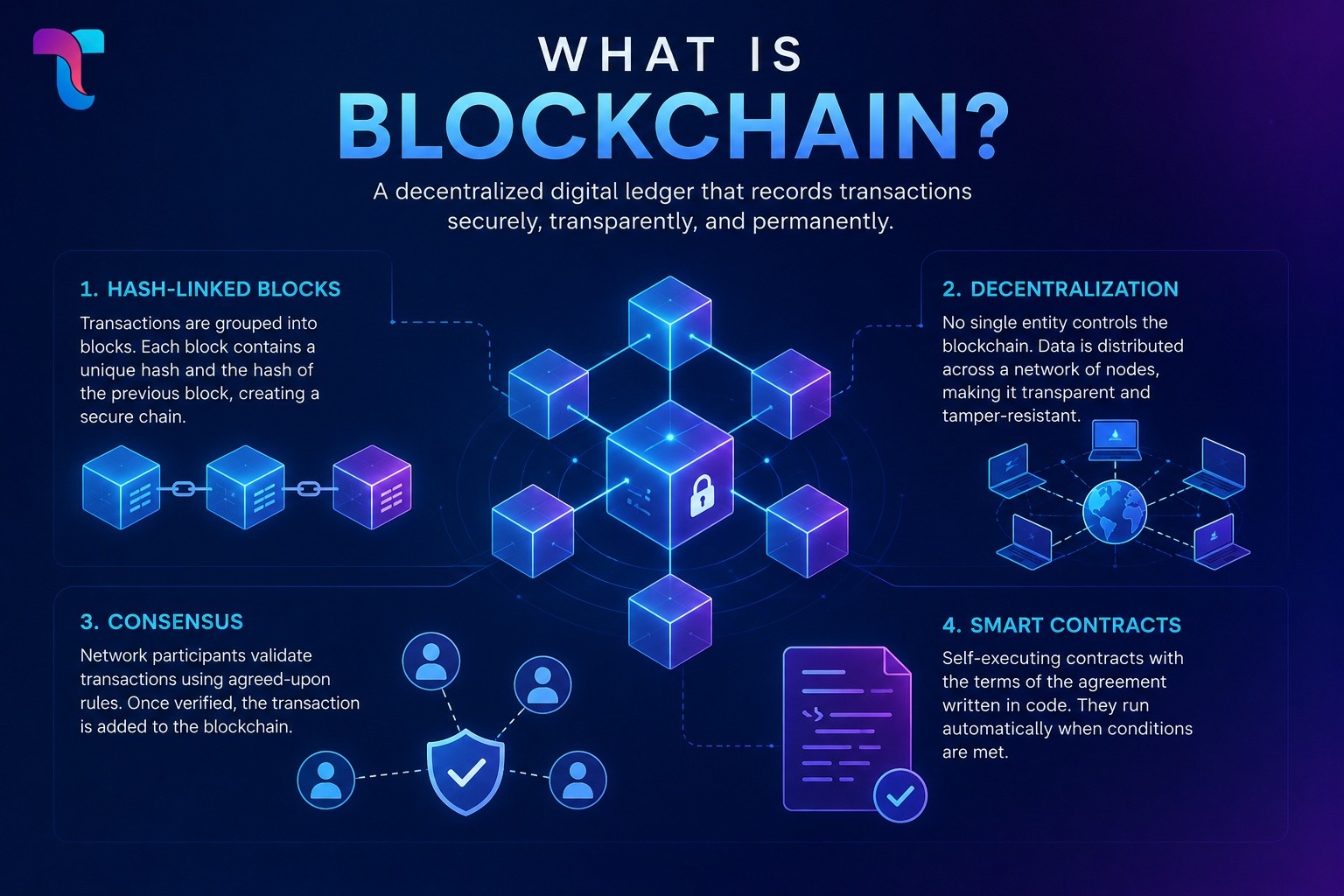
- Hash-Linked Blocks: Each block connects to the one before it through a hash. If someone changes old data, the chain breaks, and the network can detect it.
- Decentralization: The ledger is distributed across many blockchain nodes simultaneously. No single organization owns or controls all the data.
- Consensus: The network follows a shared set of rules. Participants must agree that a transaction is valid before adding it to the blockchain.
- Smart Contracts: Some blockchains can run programs called smart contracts. These programs perform actions automatically when the set conditions are met.
Some blockchains, such as Ethereum, are public and open to anyone. Others require permissions and are limited to approved members, which is what most enterprises choose.
We’ll come back to that choice later, because it determines which benefits of blockchain you get.
Also Read
What are the Key Benefits of Blockchain for Businesses?
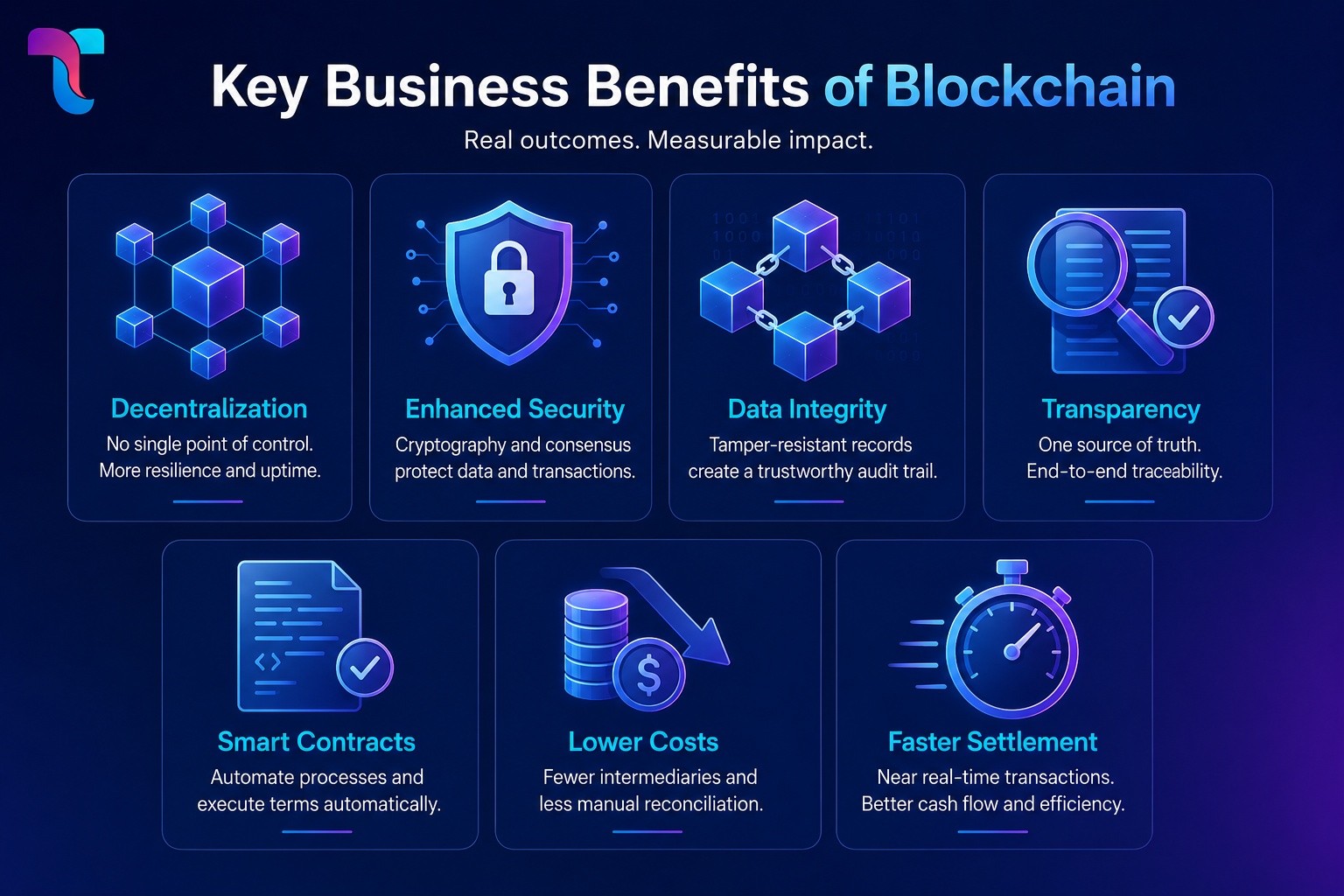
Blockchain offers many benefits for businesses. These include decentralization, stronger security, and greater transparency. It helps businesses prevent fraud and avoid disputes.
Let’s discuss the seven key benefits of blockchain in more detail.
Decentralization and No Single PoC
In traditional systems, one party controls the database. Blockchain stores the same record across many nodes. This removes the need for a single gatekeeper and reduces the risk of a single point of failure.
For business, this means fewer bottlenecks and more resilience. If one node fails, the network keeps running. It also allows partners to share data without handing control to any one company.
Enhanced Security
Blockchain improves security through cryptography and consensus. Transactions use private keys for verification. The network then confirms those transactions before adding them to a block.
We want to be clear here, because this is where marketing often overshoots. Blockchain is not “unhackable.” Risks like smart contract bugs, stolen private keys, and majority (51%) attacks still exist.
The main benefit is strong security built into the system. However, security also depends on good development practices. That is why you need audits and proper key management to secure a blockchain app.
Data Integrity and Tamper-Resistance
Blockchain helps keep records accurate and reliable. Once the network confirms the data, changing it becomes very difficult. The system can also reveal signs of tampering if someone tries to change records.
For businesses, this means a more trustworthy audit trail. Financial entries, ownership records, and compliance logs become harder to alter. This helps improve trust and reduce fraud.
Transparency and Traceability
Blockchain creates a shared record that all approved participants can access. Because everyone works from the same data, there is a single source of truth.
Public chains allow anyone to verify records. Permissioned chains share that visibility only with approved network members.
This makes end-to-end tracking of products, payments, and assets much easier. That’s why it’s one of the key benefits of blockchain for businesses.
Automation With Smart Contracts
Smart contracts are programs that run automatically when set conditions are met. They let you encode a process, such as a payment release on delivery. So, it executes without manual checks or middlemen.
The benefit is speed and consistency. The caveat is that a smart contract does exactly what its code says, including any bugs, and it often needs an oracle to bring in trusted off-chain data. Good design and auditing matter.
Lower Costs and Fewer Intermediaries
One of the benefits of blockchain is that it removes layers of reconciliation and some middlemen. It can cut transaction and admin costs, especially where many parties pay middlemen to establish trust.
We say “can” because savings depend on the use case. Also, the public network fees may rise with demand. The benefits of blockchain are real but specific, rather than universal.
Faster Settlement and Efficiency
Traditional payment systems often rely on several intermediaries. This can slow down cross-border settlement. Blockchain uses a distributed ledger to help process transactions faster.
Quicker settlement means businesses can access funds sooner. This helps improve cash flow and reduce delays.
The biggest benefits of blockchain are better security, greater trust, and faster processes. It can also help businesses reduce costs and improve information flow.
Also Read
What are the Benefits of Blockchain for Different Industries?
Blockchain delivers the most value when it solves a specific business problem. Different industries use it in different ways.
In this section, we’ll cover the various use cases of blockchain for different industries.
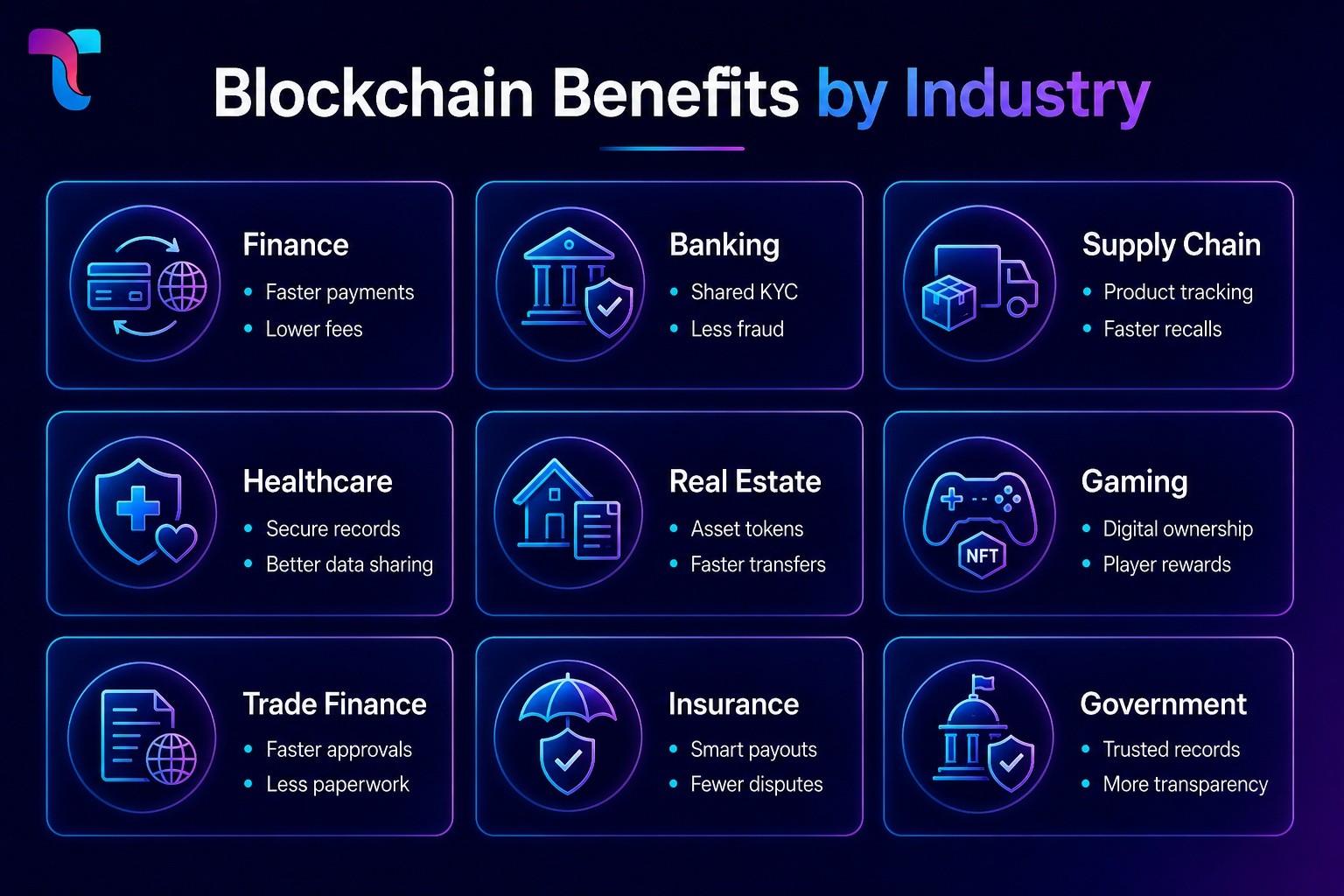
Finance and Payments
One of the biggest benefits of blockchain in finance is faster settlement.
Blockchain’s clearest win in finance is near-real-time settlement. J.P. Morgan’s Kinexys platform uses blockchain to settle institutional payments in near real time. It operates 24/7 and avoids many of the delays found in traditional banking systems.
The benefits of blockchain for financial institutions include:
- Faster cross-border payments
- Fewer intermediaries
- Easy transaction trails
- Automatic, conditional, payment flows
Banking
Banks use blockchain for faster settlement, shared KYC checks, and tamper-resistant records. This helps institutions work from the same trusted data and makes fraud harder to hide.
A shared, immutable ledger can also reduce operational delays between banks. Since everyone uses the same record, there is less need to exchange files and reconcile data. This can lower costs and improve efficiency.
Supply Chain and Logistics
Many supply chains depend on information shared between manufacturers, suppliers, distributors, and retailers. Blockchain provides a shared and trusted record that everyone can use.
Faster traceability means faster recalls, less waste, and verifiable provenance. This also helps prove authenticity and fight counterfeit goods. We see the same logic in blockchain for logistics, from shipment tracking to customs paperwork.
Healthcare
Blockchain helps healthcare providers manage records and patient consent. It creates tamper-evident audit trails and gives patients control over data access.
Sensitive data and critical information are usually stored outside the blockchain. The blockchain stores a hash or pointer instead. The blockchain data stays in secure off-chain storage that supports HIPAA compliance.
One of the key benefits of blockchain in healthcare is that it makes data easier to share between providers. It also helps protect privacy and maintain data integrity.
Real Estate
One of the growing benefits of blockchain in real estate is tokenization. Blockchain uses tokenization to represent property ownership with digital tokens.
This can enable fractional ownership, faster transfers, and clearer ownership records. However, legal rights still depend on traditional property records and local regulations.
Gaming
One of the benefits of blockchain in gaming is digital ownership. Players can own in-game digital assets through NFTs and earn rewards through play-to-earn games.
However, players usually own the NFT, not the game itself. Access to content may still depend on the game studio. That’s why blockchain games should focus on player value, not income promises.
Trade Finance
Trade finance depends on documents that many parties must review and trust. Blockchain helps by storing key documents on a shared ledger. This includes documents like letters of credit and bills of lading.
This reduces duplication and speeds up approvals. It also makes document fraud more difficult. For exporters and banks, this can shorten processes from weeks to days.
Insurance
The benefits of blockchain in insurance are evident, as insurance often depends on trust between parties. Blockchain records policies and claims on a shared ledger that all approved parties can trust.
It can also automate claim payouts through smart contracts. This helps insurers reduce paperwork, speed up claims, and prevent disputes.
Government and Public Records
Governments use blockchain to create trusted public records. These records can include land registries, credentials, and other official information. One of the benefits of blockchain is that it makes records easier to verify and harder to change.
Blockchain can also support transparent voting systems. Governments can verify every vote while protecting voter privacy. This helps improve public trust.
The benefits of blockchain can be seen across many industries. Businesses use it to share trusted data, improve transparency, speed up processes, and reduce fraud. The exact use case may vary, but the goal is often the same: better efficiency and trust.
Also Read
What are Some Advanced and Emerging Benefits of Blockchain?
Beyond the established benefits of blockchain, we see the most forward-looking value for businesses in 2026 in five areas:
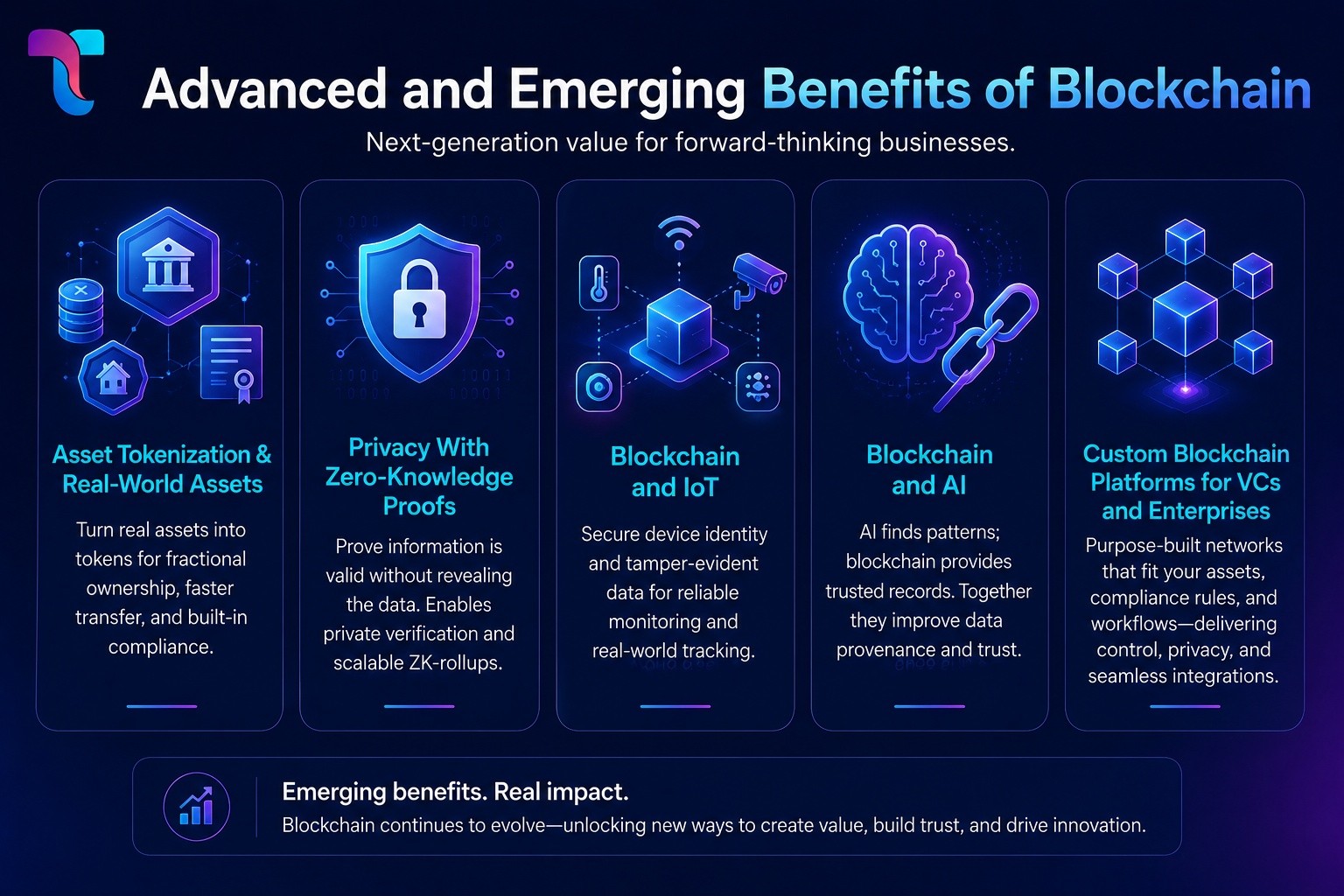
Asset Tokenization and Real-World Assets (RWA)
One of the growing benefits of blockchain is asset tokenization. It turns assets, such as real estate, bonds, and commodities, into digital tokens.
The benefits include fractional ownership, faster transfers, and automated compliance checks. Rules, such as investor eligibility, can be built into the token itself.
A token does not replace legal ownership. Existing legal and custody frameworks still determine ownership rights and enforceability. As adoption grows, tokenization is moving from early testing to regulated, real-world deployment.
Privacy With Zero-Knowledge Proofs
A zero-knowledge proof lets someone prove a claim without sharing the data behind it. This is one of the growing benefits of blockchain for businesses that need privacy.
For example, a business can prove a customer passed KYC, or that a transaction is valid. In both cases, the sensitive information stays private.
It also powers ZK-rollups that help blockchains scale by bundling many transactions into a single proof. This helps regulated industries balance transparency with privacy.
Blockchain and IoT
One of the growing benefits of blockchain is trusted IoT data. Blockchain technology can create tamper-evident records and verify device identities.
You can store sensor readings on a shared ledger that no single party can change. This is useful for cold-chain monitoring, energy metering, and similar use cases.
The caveat is the last-mile problem, as the blockchain secures data after it reaches the ledger. So, the sensor should also be trustworthy and secure.
Blockchain and AI: Partners, Not Rivals
A common question is whether AI will replace blockchain. The honest answer is no, because they solve different problems.
AI finds patterns and makes predictions. Blockchain technology creates trusted records that are difficult to change.
Together, blockchain and AI can solve problems that neither technology can solve alone. Blockchain can verify AI training data and model outputs. AI can analyze blockchain activity to spot fraud and risk.
As autonomous AI agents now make transactions, keeping a record of what they did becomes essential. Bringing the two together is a core part of what we do at Technoloader.
Custom Blockchain Platforms for VCs and Enterprises
This is one of the emerging benefits of blockchain for large organizations.
Off-the-shelf tools rarely fit a fund’s or an enterprise’s exact workflow. A custom blockchain platform is designed around your assets, compliance rules, and participants.
This is useful for venture firms managing tokenized funds or enterprises running a private consortium. This offers greater control, more privacy, and a system that better fits the business.
We have seen growing demand for these blockchain solutions in our recent projects.
The benefits of blockchain are expanding beyond payments and transactions. Businesses now use it to manage assets, protect private data, support AI, connect devices, and build custom platforms.
Also Read
Public vs Private Blockchain Network: Which Benefits Apply?
The benefits of blockchain depend on the type of blockchain network you choose: public or private.
Public blockchains, such as Ethereum, are open to everyone. Anyone can join, make transactions, and verify records. You get maximum decentralization and transparency, but less privacy and lower throughput.
Private or permissioned blockchains, such as Hyperledger Fabric, allow only approved participants. You gain privacy, speed, and control, but it is partially decentralized. For most enterprises, a private blockchain network is the practical choice.
There is also a middle path: a consortium chain run by a group of known organizations. It is common in banking and supply chain networks, where competitors need to share data.
Your choice depends on your needs for access, privacy, and transparency.
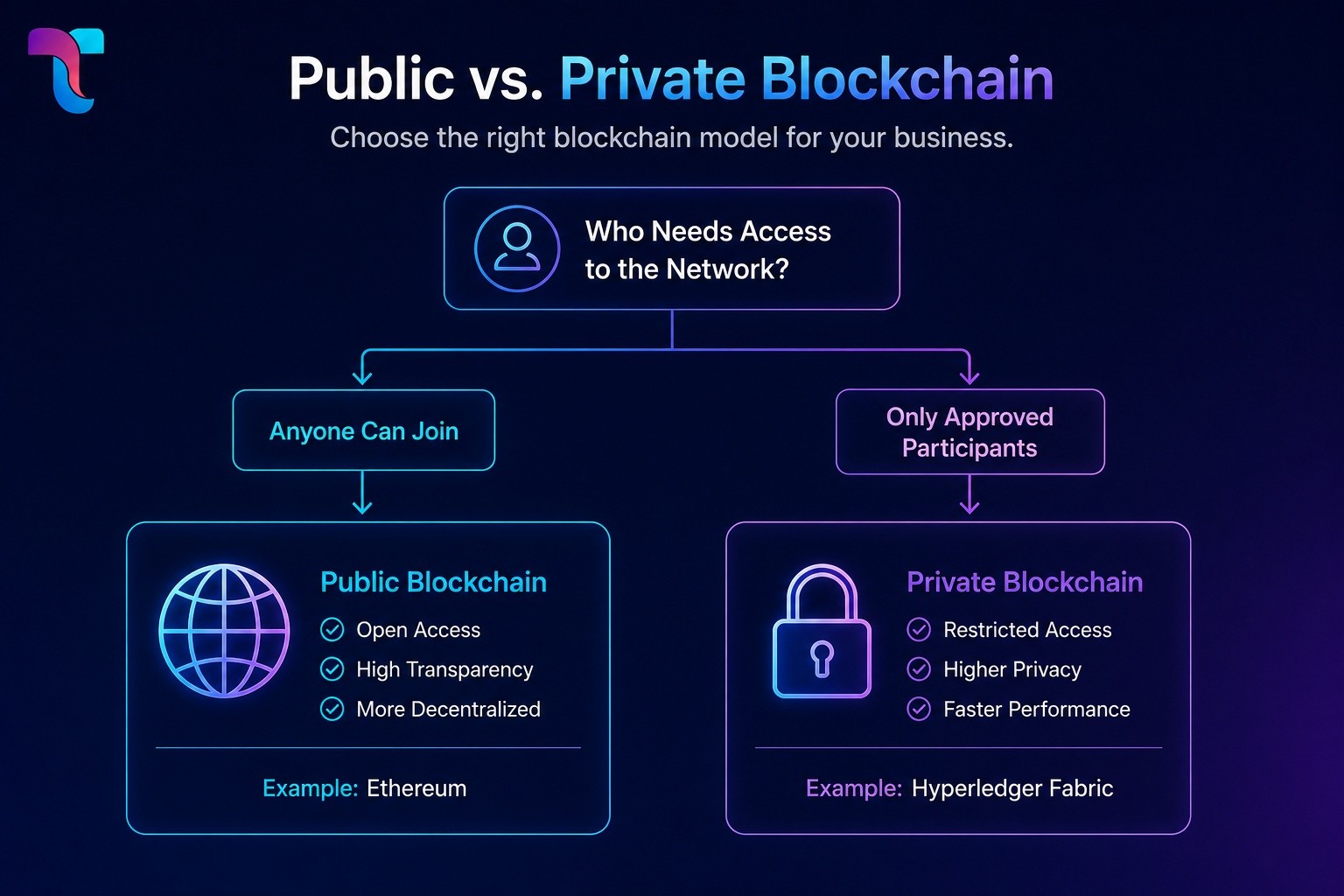
A public token sale, for example, will occur on a public blockchain network. A hospital network sharing records would likely choose a private one. Choosing the right model is key to getting the right benefits of blockchain.
At a Glance Comparison: Private vs Consortium vs Public Blockchain
| Private (Permissioned) | Consortium | Public (Permissionless) | |
| Who can participate? | Only approved network participants | A group of known organizations | Anyone |
| Privacy | High: data access is restricted | Medium: shared among members | Low: data is public |
| Speed & throughput | High: fewer nodes | Medium to high | Low: more nodes |
| Decentralization | Low | Medium | High |
| Control | High | Medium | Low |
| Best for | An internal business network | Industry networks | Public blockchain applications |
What are Some Challenges of Blockchain You Should Consider?
Blockchain is powerful, but it is not the right tool for every job. Being clear about the limits is part of using it well, and it’s the question serious buyers ask me most.
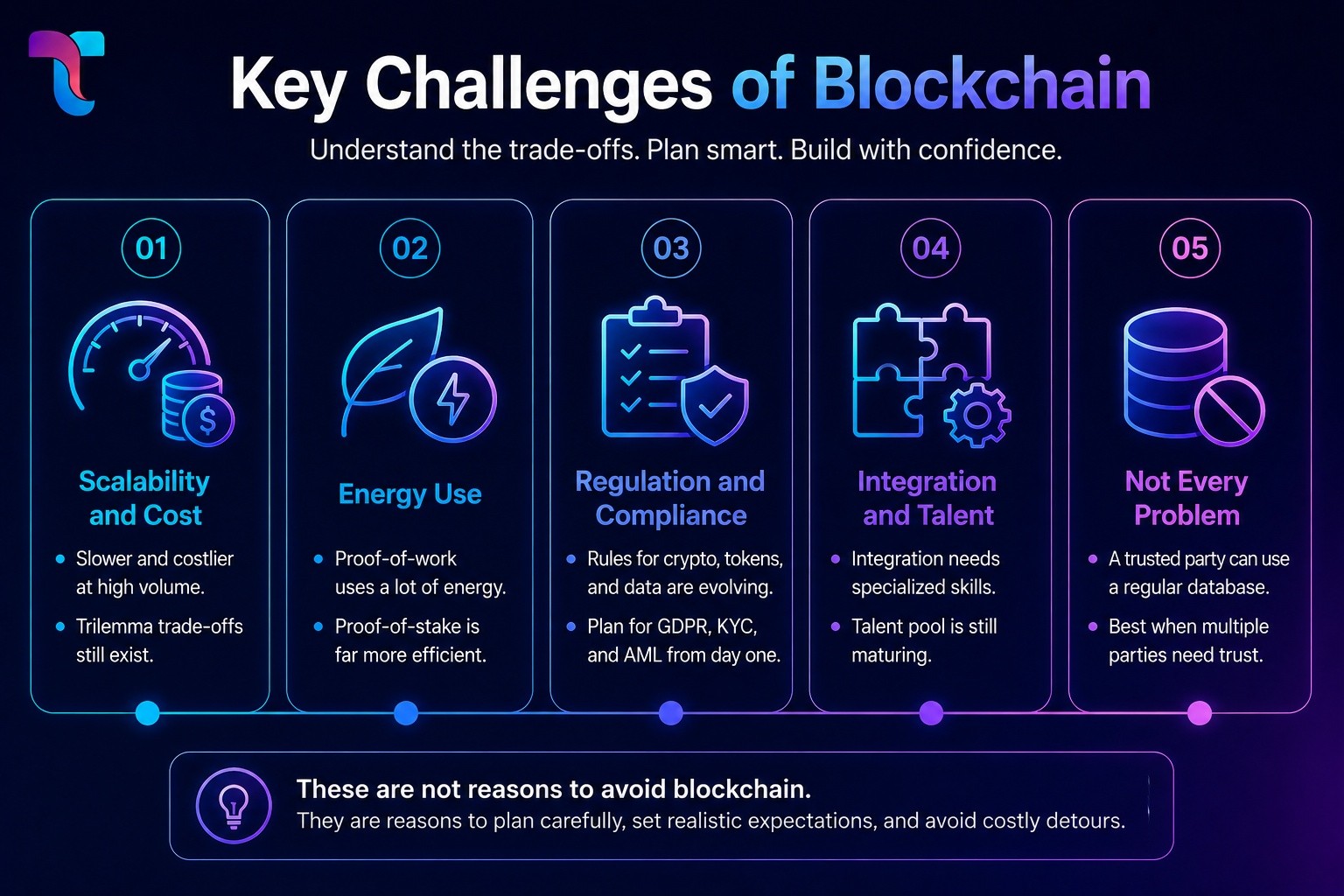
- Scalability and Cost: Public networks can slow down and get expensive when usage is high. This is the heart of the blockchain trilemma: it is hard to maximize decentralization, security, and scalability at the same time. That’s probably why most designs balance the three. Layer-2 networks ease the pressure, but the trade-offs do not disappear.
- Energy Use: Proof-of-work chains like Bitcoin consume significant energy. However, some networks, such as Ethereum, have taken measures to become more energy-efficient. So, the chain you choose matters for sustainability goals.
- Regulation and Compliance: Rules for crypto, tokens, and data are still evolving across regions. Plan for compliance, GDPR, KYC, and AML from day one, rather than as an afterthought.
- Integration and Talent: Connecting blockchain to existing systems takes specialized skills. The talent pool is still growing, which is why many companies partner rather than build a team from scratch.
- It’s Not Always Needed: If a single trusted party can own the database, a normal database is simpler and more cost-effective. Blockchain proves its value when several parties must trust shared data without trusting each other.
This doesn’t mean you should avoid blockchain, but that you should plan carefully. Being honest about the limits helps you choose the right projects, set realistic expectations, and avoid costly mistakes.
Also Read
How to Start Using Blockchain in Your Business
After hundreds of projects, here is the path we recommend for capturing the benefits of blockchain in practice.
- Find a High-Fit Use Case: Look for shared data, multiple parties, and a trust gap. Those are the real-world problems blockchain solves best.
- Choose the Chain Type and Consensus: Select either a public or a private blockchain based on your privacy, speed, and cost needs. Consider the trade-off before choosing the right blockchain.
- Build a Focused Pilot: Prove the value on one workflow before scaling. A small proof of concept de-risks the bigger investment and gives stakeholders something concrete to react to.
- Decide How You’ll Build: Off-the-shelf tools rarely fit specialized needs. A custom platform, built by an experienced team, gives you control and a better fit.
- Plan Security and Compliance Early: Budget for smart-contract audits, key management, and regulatory review before launch. Security is far easier and less costly to build in at the start than to bolt on later.
The teams that succeed treat the first project as a learning investment, then expand once the model is proven. If you don’t have the in-house capabilities, hiring a blockchain development company can help.
Conclusion
The value of blockchain is simple: it helps multiple parties trust the same data without relying on a single owner. This delivers lower cost, less fraud, and faster settlement.
The benefits of blockchain are strongest where many parties share information. It has applications across industries, such as finance, healthcare, real estate, and gaming.
Still, blockchain is not the right fit for every project. Businesses see the best results when they focus on the right use case and build with a clear plan.
If you are exploring where blockchain fits in your business, we would be glad to help you scope it. Talk to our blockchain development team for a practical, no-pressure assessment.
Frequently Asked Questions
- What are the main benefits of blockchain for businesses?
The main benefits are decentralization, enhanced security, and tamper-resistant records. It helps reduce fraud and cut out unnecessary intermediaries. That’s why blockchain is now used well beyond cryptocurrency.
- What are the pros and cons of blockchain?
The pros are trust without a middleman, strong security, transparency, and faster settlement. The cons are cost limits on public networks, energy use on proof-of-work chains, and more. Blockchain is well-suited to problems involving shared data and limited trust.
- How does blockchain improve security?
Blockchain secures data with cryptography and network consensus. This means that records are tamper-resistant and signed by their owners. It’s not “unhackable,” though. Smart-contract bugs, stolen keys, and majority attacks remain real risks. So, audits and strong key management are essential.
- What are the benefits of blockchain in finance and banking?
In finance and banking, blockchain enables near-real-time settlement, fewer intermediaries, shared KYC, and records that reduce fraud. J.P. Morgan’s Kinexys platform, for example, settles institutional payments in near real time, around the clock.
- What are the benefits of blockchain in healthcare?
One of the benefits of blockchain in healthcare is better data security and control. It helps protect patient data and gives patients more control over who can access it. Private records are stored in secure storage that complies with HIPAA rules.
- What are the benefits of blockchain in supply chain management?
Blockchain gives everyone in the supply chain access to the same trusted record. This makes it easier to track products from start to finish.
- Will blockchain be replaced by AI?
No. AI and blockchain solve different problems. AI finds patterns and makes predictions, while blockchain creates trusted records that are difficult to change. They also work well together. Blockchain can verify the source of AI data and outputs. AI can analyze activity on the blockchain.
- What is the difference between public and private blockchains?
A public blockchain is open to everyone. Anyone can join, use, and verify it. Networks like Ethereum offer high levels of decentralization and transparency.
A private or permissioned blockchain restricts access to approved members. Networks like Hyperledger Fabric provide more privacy, speed, and control. Most enterprises choose a permissioned model.
- What is asset tokenization, and why does it matter?
Tokenization represents rights to a real-world asset, such as real estate or bonds, as on-chain tokens. This can make ownership easier to divide and transfer.
However, the token is only a legal claim. Off-chain legal and custody frameworks still determine ownership rights and enforceability.
- How can a business start using blockchain?
Start by finding a use case with shared data and a trust gap, choose between a public or permissioned chain, then build a focused pilot. Decide whether to build or partner, and plan security audits and compliance early. Scale only after the pilot proves value.

Vipin Kumar
Vipin Kumar is the Founder & CEO of Technoloader, a Clutch Top 10 Blockchain Development Company for 2025. A serial technology entrepreneur and blockchain architect with a B.Tech background, Vipin has led the delivery of 450+ projects across DeFi, NFT marketplaces, AI/ML, and custom Web3 platforms for clients in the UAE, India, the US, and beyond. He also founded SALIQ (saliq.ai), an AI-driven conversational marketing platform.
Published in Blockchain Development