+91 7014607737
 info@technoloader.com





Table of Contents
Blockchain in logistics is the use of a shared, tamper-evident digital ledger for the supply chain. It records every shipment and transaction as goods move.
With blockchain in logistics, manufacturers, carriers, customs, and retailers all see the same trusted information. It’s this shared record that makes the process clearer, helps prevent fraud, and speeds up tasks that usually involve a lot of paperwork.
I’ve spent more than eight years building blockchain platforms for clients globally. In this period, the field of logistics has stood out as one in which blockchain has proven its value. The benefits are clear, but there are also real limitations.
This guide covers how the technology works, its benefits, and real use cases. We also cover current platforms, real challenges, and what the future may hold.
Key Takeaways
- What It Is: Blockchain in logistics is a shared, tamper-evident ledger that records goods as they move across the supply chain
- Why It Matters: It replaces siloed records and manual paperwork with one trusted source of truth for every partner
- The Reality: Most logistics networks use permissioned blockchains, not public chains like Bitcoin or Ethereum
- Proof, Not Hype: Early flagships like TradeLens failed on adoption, while newer consortia such as GSBN now scale
- The Honest Caveat: Value depends on shared data standards, clean input data, and broad industry adoption
What Is Blockchain in Logistics?
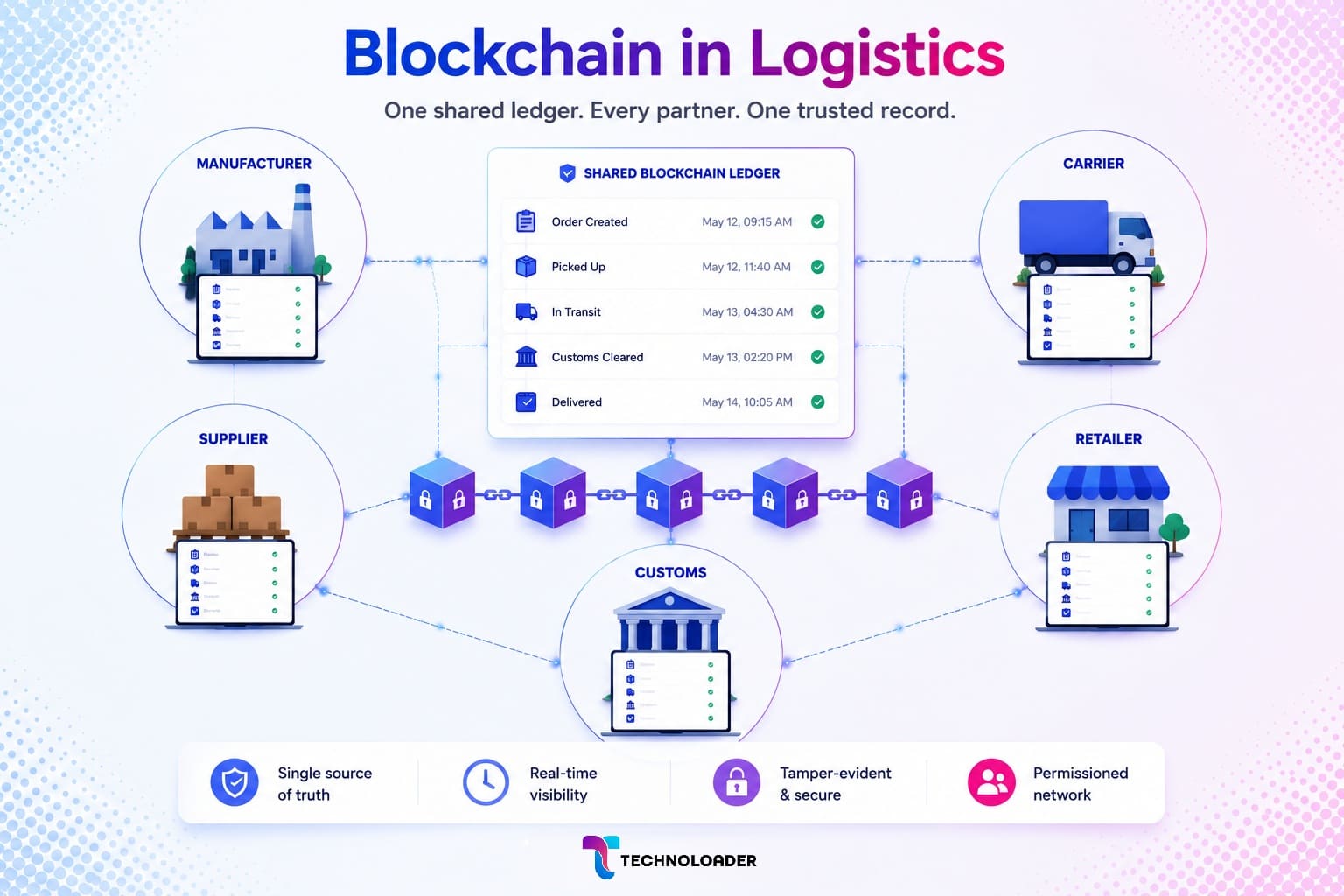
Blockchain in logistics is a shared digital ledger that records each shipment, handoff, and transaction. Every authorized partner sees the same trusted record in near real time.
Each entry is time-stamped and cryptographically linked to the one before it. That design makes the record tamper-evident. Any attempt to alter confirmed data is easy to detect.
It helps to be precise here. Blockchain isn’t the same as cryptocurrency.
In most supply chains, only approved members can join the network and add data. These permissioned networks create a single source of truth for manufacturers, suppliers, carriers, customs, and retailers. Having everyone see the same information is what makes blockchain valuable here.
You can learn more in our guide to blockchain use cases across industries.
The market is growing quickly, but estimates differ depending on what’s included. According to a 2024–2030 Grand View Research report, the blockchain supply chain market was worth $2.3 billion in 2023. It could reach $192.9 billion by 2030.
Other research firms, such as IMARC and MRFR, give more cautious estimates. They predict the market will reach $35 billion to $55 billion by the early 2030s.
Quick Answer: What Is Blockchain in Logistics?
It’s a shared, tamper-evident ledger that logs goods as they move through the supply chain. Every approved partner reads the same verified record, which builds trust and cuts disputes.
You May Also Like
How Does Blockchain Work in Logistics and Supply Chain?
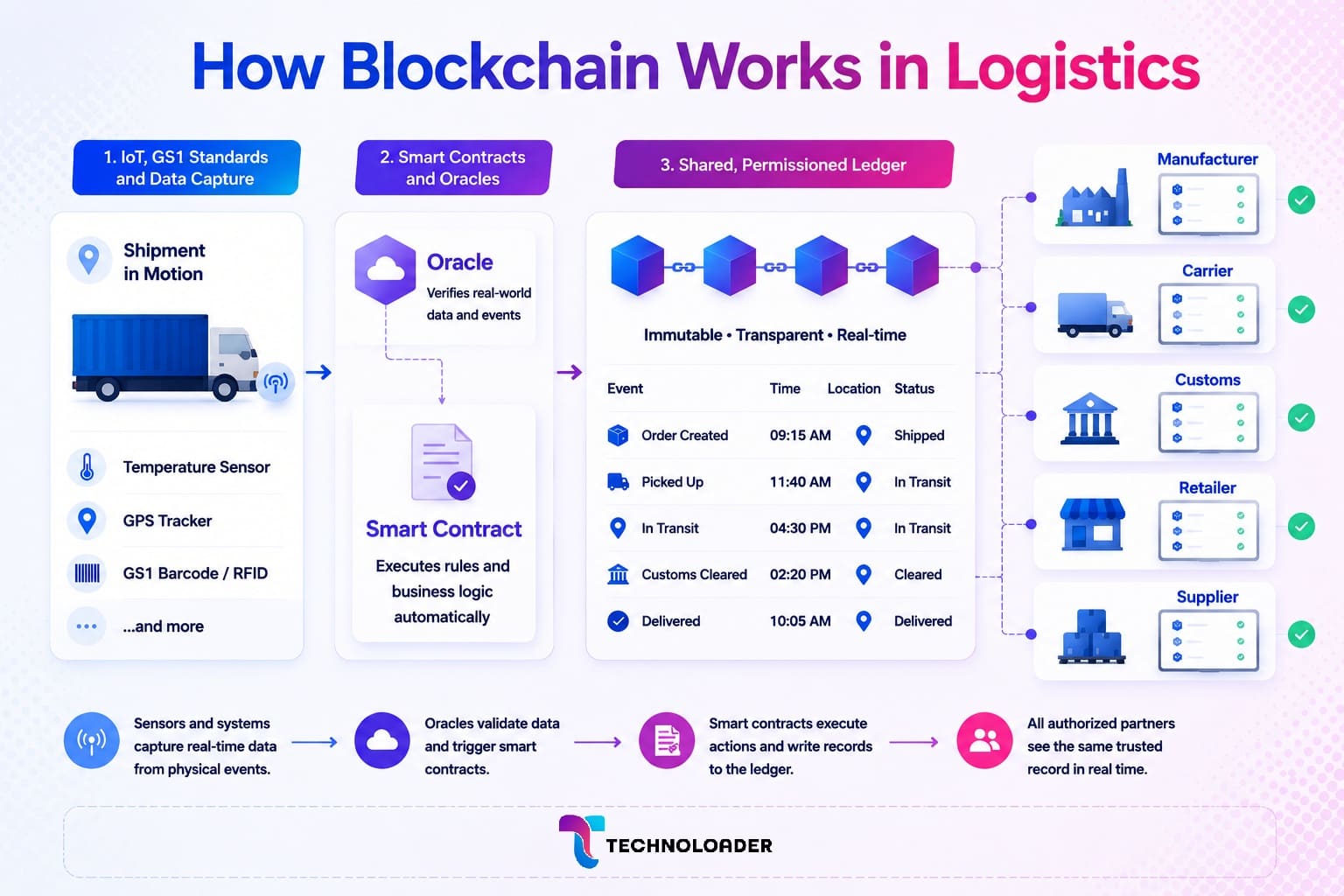
Blockchain in the supply chain works by giving every partner one synchronized record. Data is entered once, then shared and verified across the network. Here’s how the main parts fit together.
The Shared, Permissioned Ledger
A blockchain groups transactions into blocks that are cryptographically hash-linked in sequence. Copies of the ledger are stored across many partner nodes or computers, so no single party has control.
Most logistics networks don’t use fully public blockchains. They opt for permissioned or consortium frameworks such as Hyperledger Fabric and Corda (R3), which allow only approved members to join. With these setups, access is limited to trusted parties, helping protect privacy and meet compliance rules.
Our comparison of private vs public blockchain explains the trade-off in greater depth.
Smart Contracts and Oracles
A smart contract is self-executing code that runs when its conditions are met. For example, it can release a payment the moment a delivery is confirmed.
Since smart contracts can’t directly see or fetch external, real-world data on their own, they rely on blockchain oracles. These middleware services are trusted and securely relay or bring verified off-chain data on-chain. Port scans, customs events, and IoT readings all reach the contract this way.
See our primer on what a smart contract is.
IoT, GS1 Standards, and Data Capture
IoT sensors provide live data on conditions like temperature, humidity, and shock. This information shows how sensitive cargo was handled during transport.
Shared standards make supply chain data usable across partners.
A good example is GS1’s EPCIS 2.0 standard, which was ratified in 2022 and later adopted as ISO/IEC 19987:2024. It defines the “what, when, where, and why” of each supply chain event. These standards make it easier for different systems to work together.
Quick Answer: How Does Blockchain Work in a Supply Chain?
Partners share one permissioned ledger of hash-linked records. Smart contracts automate actions when conditions are met. Oracles feed verified real-world data, while GS1 standards keep supply chain events consistent across systems.
You May Also Like
Key Benefits of Blockchain in Logistics
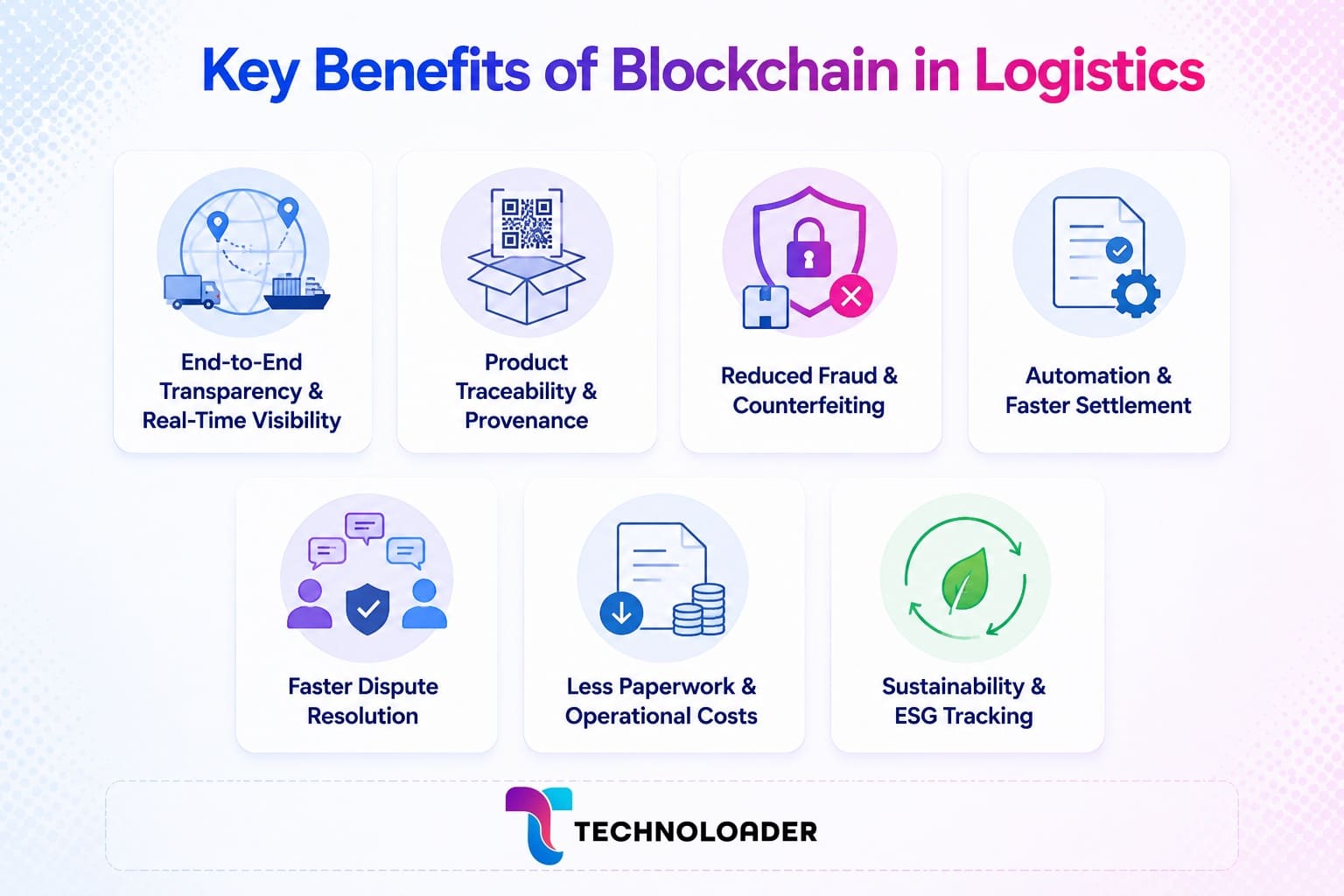
The benefits here come down to trust, speed, and lower costs. Having a shared record removes the guesswork that can slow down global trade. Here are the advantages I see most often in real projects.
End-to-End Transparency and Real-Time Visibility
Every partner on the blockchain gets shared, real-time visibility into a shipment’s journey. Each update is time-stamped, so no one has to wait for manual status calls.
The reason this matters is that there’s still a gap in visibility. In its 2024 Supply Chain Pulse survey, McKinsey found that 60% of respondents had good visibility into tier-one suppliers. But only 30% had such visibility beyond that first tier.
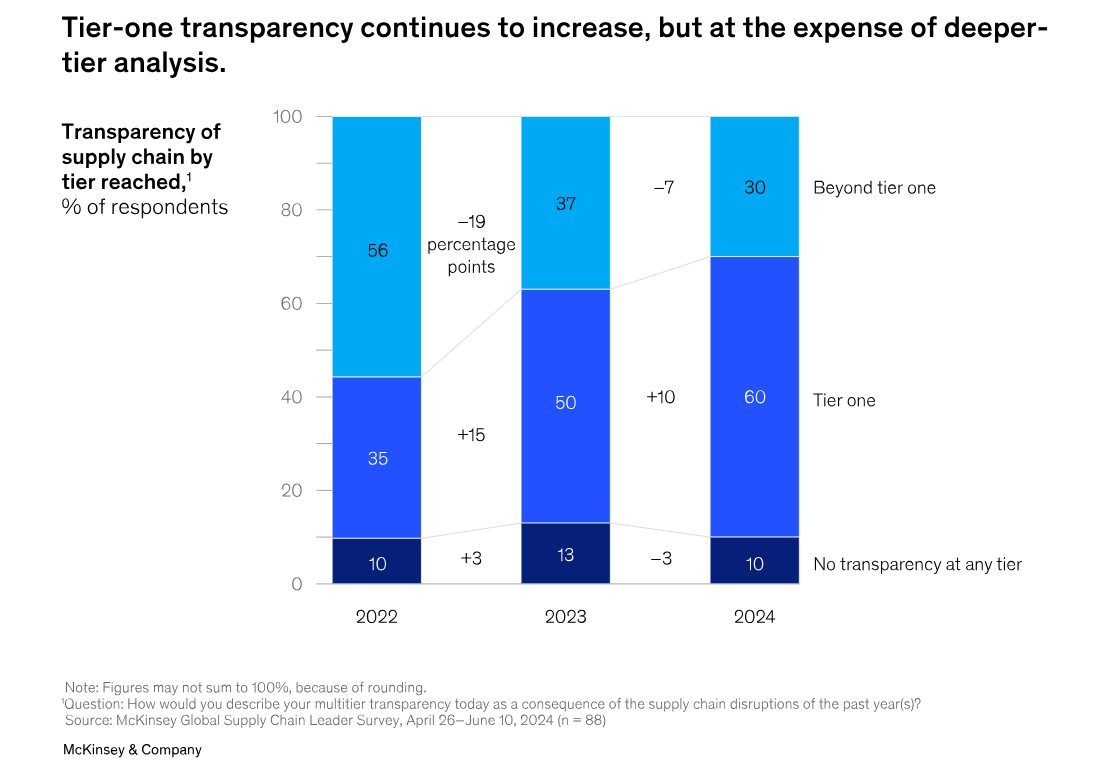
Many leaders call real-time visibility a must-have, yet they haven’t fully implemented it. Shared ledgers help close that gap and improve supply chain transparency.
Product Traceability and Provenance
Blockchain records a one-step-forward, one-step-back trail for every product. You can trace an item from its origin to the final mile.
Shoppers can even scan a code to confirm a product’s source and handling. That proof supports blockchain traceability in food, pharma, and luxury goods.
Reduced Fraud and Counterfeiting
It’s much harder to alter shipping data without being noticed when using blockchain in logistics. Records are tamper-evident, which helps protect high-risk goods from counterfeiting.
The stakes are huge. The OECD and EUIPO estimated global trade in counterfeit goods at about $467 billion, based on the most recent 2021 seizure data. Verifiable provenance is a direct defense.
Automation and Faster Settlement
Smart contracts automate slow, manual steps such as customs triggers and payments. Actions happen as soon as the agreed conditions are met.
This reduces the work needed to match records and speeds up settlements between trading partners. With fewer manual steps, there are also fewer costly mistakes.
Faster Dispute Resolution
Most disputes crop up when information is missing or doesn’t line up. With a shared, tamper‑evident ledger, everyone works from the same proof.
Since stakeholders have access to the same data, it’s easier to resolve claims and move shipments forward. That can also reduce the time and cost spent investigating disputes.
Less Paperwork and Operational Costs
Global trade still relies on huge amounts of paperwork. In 2024, the International Chamber of Commerce assessed that about 4 billion paper documents are used in global trade every day.
One cross-border shipment can require dozens of documents from many different parties. In 2025, the WEF estimated that the use of digital trade tools could reduce trade costs by up to 25%. With blockchain in logistics, you can replace duplicate paperwork with a single shared record.
You can see related gains in our guide to blockchain benefits for businesses.
Sustainability and ESG Tracking
Blockchain can store a verified record of carbon data and ethical sourcing. This record supports ESG reporting and audits.
Demand for this is growing quickly. Global Market Insights valued the blockchain market for sustainable supply chains at about $827.6 million in 2024. Reliable data makes it easier to verify sustainability claims.
The table below summarizes the main benefits of blockchain in logistics, the logistics challenges they address, and supporting proof points.
| Benefit | Logistics pain it addresses | Proof point |
|---|---|---|
| Transparency and visibility | Siloed data, manual status checks | McKinsey 2024: visibility still a top gap |
| Traceability and provenance | Slow, broad recalls | One-step-forward, one-step-back trail |
| Reduced fraud and counterfeiting | Fake goods, altered records | OECD/EUIPO: ~$467B counterfeit trade |
| Automation and settlement | Manual customs and payments | Smart contracts trigger on delivery |
| Lower paperwork cost | Duplicate cross-border documents | WEF 2025: up to 25% trade-cost cut |
Quick Answer: What Are the Main Benefits of Blockchain in Logistics?
The core benefits are transparency, traceability, less fraud, automated settlement, faster disputes, lower paperwork cost, and stronger ESG proof. Each one flows from a single shared, tamper-evident ledger record.
You May Also Like
Blockchain Use Cases Across the Supply Chain
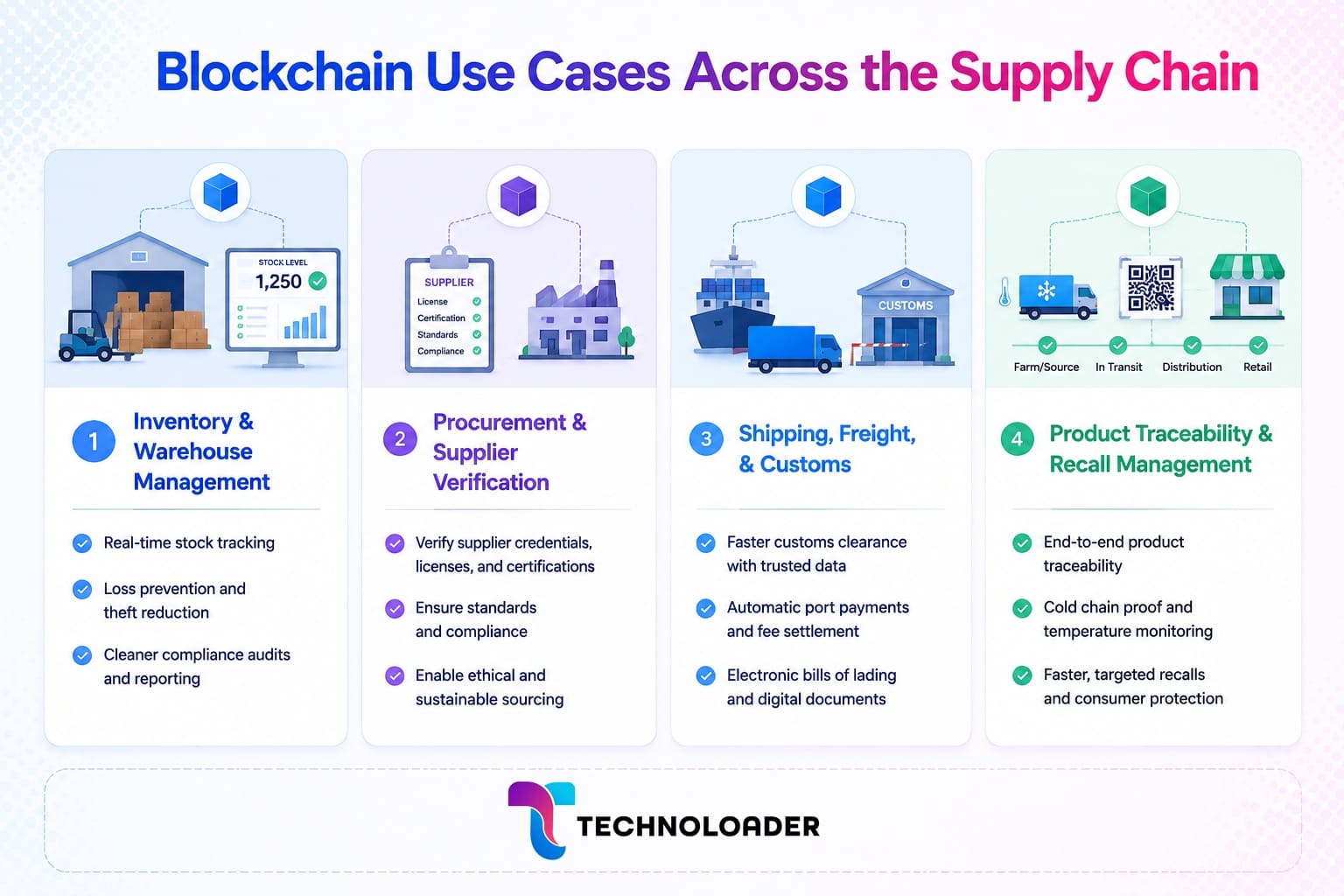
Blockchain supports inventory, procurement, shipping, and product traceability across the supply chain. Here are four areas where I see the strongest fit.
Inventory and Warehouse Management
Keeping inventory records aligned across multiple locations isn’t always easy. Blockchain gives every partner access to the same real-time inventory data, so everyone stays on the same page.
When inventory drops below a set level, smart contracts can automatically trigger reorders. The ledger also creates tamper-evident records that support audits and loss prevention.
Procurement and Supplier Verification
A shared ledger keeps all vendor transactions in one place. Buyers can easily check supplier credentials, standards, and compliance.
Using blockchain in procurement also helps with ethical sourcing. You can check labor practices and material origins, which are important in the food, fashion, and electronics industries.
Shipping, Freight, and Customs
Freight often takes a complicated route. One shipment might go through many ports, cross several borders, and change carriers before it arrives. With blockchain in logistics, all involved stakeholders can see the same shipment information the whole way.
Smart contracts take it further by handling customs clearance and port payments on their own. That cuts down on paperwork, delays, and the costly mistakes that creep in during handoffs. Electronic bills of lading, or eBLs, are one of the fastest-growing examples of this in action.
Product Traceability and Recall Management
In food and pharma, blockchain creates a clear record that tracks products from their source to the shelf. IoT sensors collect temperature data for items that require strict control, providing companies with real-time updates on sensitive shipments. This makes recalls faster, more targeted, and less wasteful.
This is important because the US CDC estimates that there are 48 million foodborne illnesses each year, and the USDA ERS estimates that the annual cost was nearly $74.7 billion in 2023 dollars. With blockchain tracing, recalls can focus on affected batches instead of removing whole product lines.
Explore more in our roundup of blockchain use cases.
Quick Answer: How Is Blockchain Used in Logistics?
Common uses include real-time inventory, supplier verification, automated shipping and customs, and product traceability. Each use replaces siloed records with one shared, verifiable trail across partners.
You May Also Like
Real-World Examples of Blockchain in Logistics
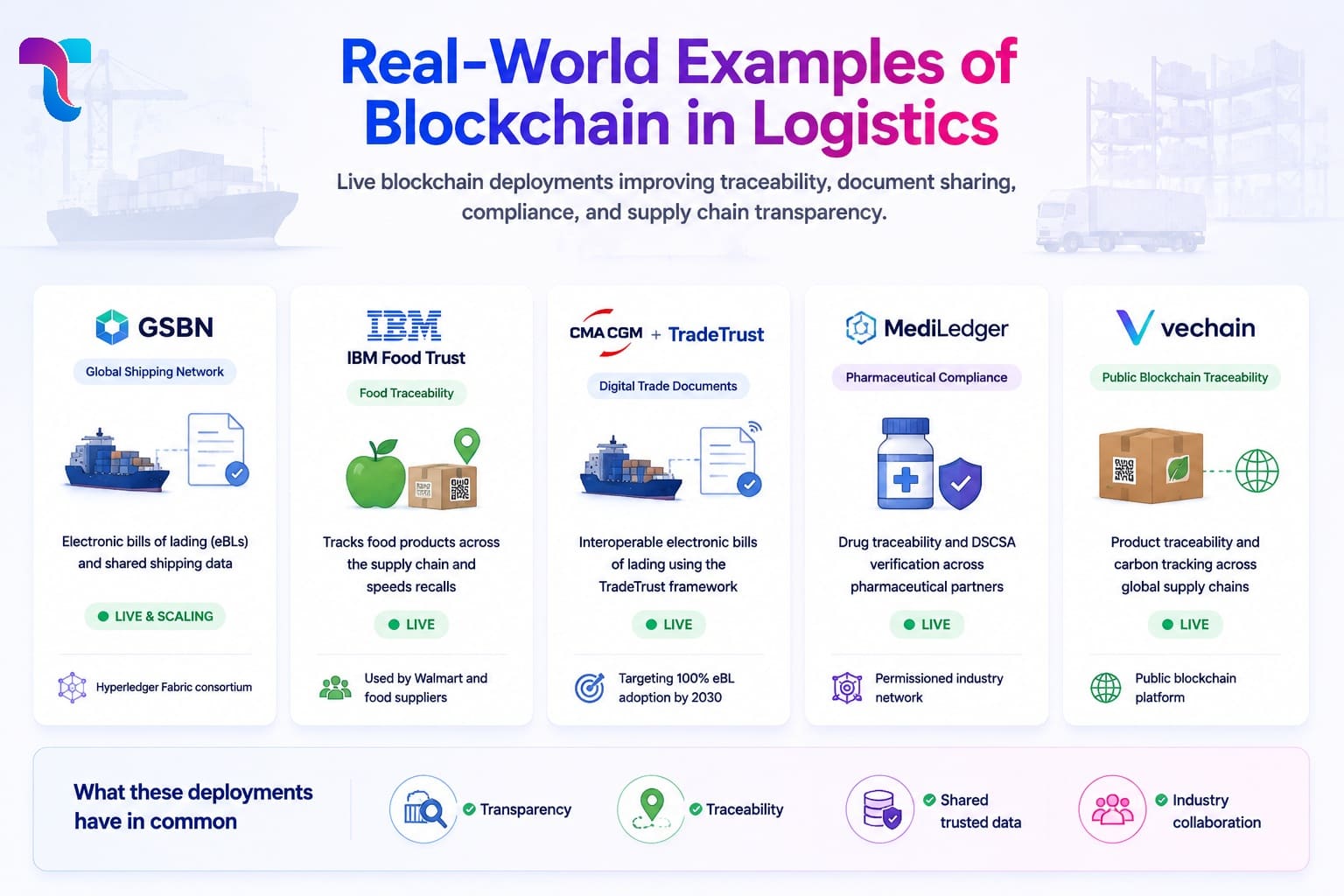
Many organizations already use blockchain in logistics for shipping, tracking food, meeting pharmaceutical rules, and handling digital trade documents. The examples below show how the technology works in real operations, not just in test projects.
GSBN: Blockchain eBLs at Scale
The Global Shipping Business Network, or GSBN, is a non-profit consortium built on Hyperledger Fabric. Its founders include major carriers like COSCO and Hapag-Lloyd, and terminal operators like PSA International and the Shanghai International Port Group.
GSBN focuses on electronic bills of lading and shared shipping data. Its eBL volume grew from over 100,000 in 2023 to more than 300,000 in 2024. This growth makes it a credible successor to earlier shipping consortia.
IBM Food Trust and Walmart
IBM Food Trust, built on Hyperledger Fabric, was one of the first major platforms to prove blockchain’s value in food traceability.
In a landmark 2016 pilot with Walmart, mango-tracing time was cut from nearly 7 days to 2.2 seconds. After a 2018 Romaine scare, Walmart asked leafy greens suppliers to join the platform.
Though highly influential, IBM has since retired the standalone blockchain network. Its capabilities were merged into the broader, AI-driven IBM Supply Chain Intelligence Suite to better support open API standards.
CMA CGM and TradeTrust
CMA CGM ranks among the top five largest shipping lines in the world. In 2025, it signed an MoU to advance blockchain-based eBL interoperability using the TradeTrust framework.
The goal is ambitious and public, with the carrier aiming for 100% eBL adoption by 2030. This shows there’s real commitment towards the use of shared digital trade documents.
MediLedger and Pharma Compliance
MediLedger is a pharmaceutical supply chain network built by Chronicled that uses a permissioned ledger shared by drug makers and distributors. What’s more, it supports compliance with the US Drug Supply Chain Security Act, or DSCSA.
The FDA’s one-year stabilization period ended on November 27, 2024. Enforcement was then rolled out in stages through 2025, with small dispensers covered into late 2026.
VeChain: Public-Chain Traceability
VeChain shows how a public chain can serve supply chains. It has powered traceability work with Walmart China.
Its partner DNV runs a carbon-tracking platform adopted by more than 100 enterprises by 2024. VeChain frames its certificates as tamper-evident records, not unbreakable ones.
Lessons From Early Pilots: TradeLens and Everledger
Not every high-profile blockchain project has lasted, which in itself is an important lesson.
TradeLens, built by IBM and Maersk, launched in 2018 with real promise. Maersk and IBM announced its discontinuation in late 2022, and it went offline by early 2023.
The main challenge was commercial, not technical. Rivals were cautious about a platform led by one big carrier, so it never gained industry-wide adoption.
Everledger, an early leader in diamond and luxury provenance, faced similar problems. The company went into administration in 2023 after a funding round failed. Both cases show that technology alone doesn’t guarantee success.
| Platform | Type / Chain | What It Does | Status (2026) |
|---|---|---|---|
| GSBN | Consortium / Hyperledger Fabric | Electronic bills of lading, shared shipping data | Live, scaling |
| IBM Food Trust | SaaS / Hyperledger Fabric | Food traceability (Walmart and others) | Live |
| CMA CGM (TradeTrust) | TradeTrust-based eBL framework | Interoperable electronic bills of lading | Live, targeting 100% eBL by 2030 |
| MediLedger | Pharma consortium / permissioned | DSCSA drug traceability and verification | Live |
| VeChain | Public blockchain | Product traceability and carbon tracking | Live |
| TradeLens | Consortium / Hyperledger Fabric | Shipping data platform | Discontinued 2022 to 2023 |
| Everledger | Permissioned provenance startup | Diamond and luxury tracing | Entered administration 2023 |
Quick Answer: Which Companies Use Blockchain in Logistics?
Live examples include GSBN, IBM Food Trust with Walmart, CMA CGM using TradeTrust, MediLedger in pharma, and VeChain. Earlier flagships like TradeLens and Everledger have since shut down.
You May Also Like
Challenges and Limitations of Blockchain in Logistics
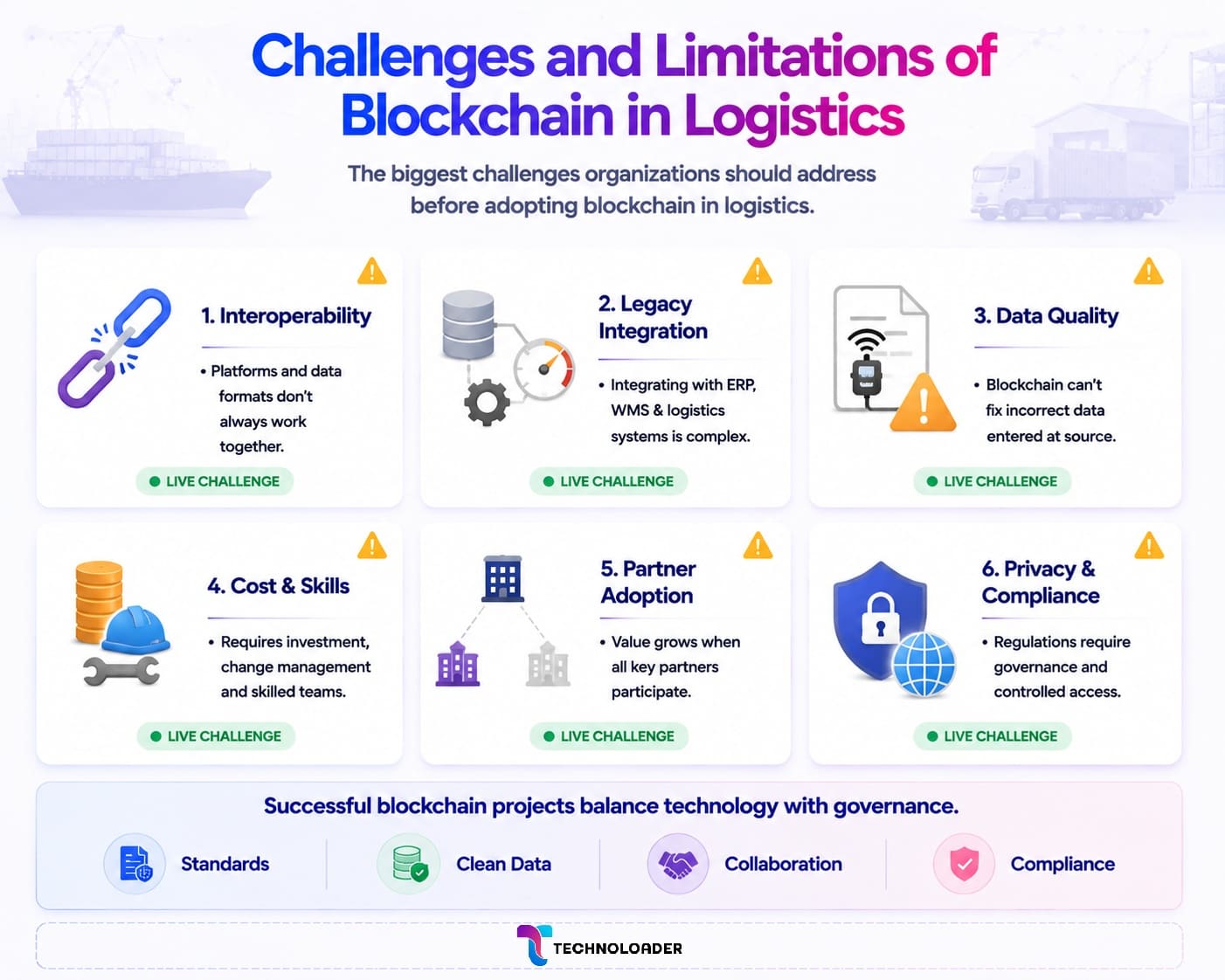
Blockchain in logistics comes with technical, operational, and organizational challenges. Understanding them helps you decide where the technology fits and where it doesn’t. Here are the constraints that matter most.
Interoperability and Data Standards
Many blockchain platforms still struggle to work together. A shipment might pass through several networks that use different formats.
Shared standards like GS1 EPCIS and DCSA data models help bridge this gap. Without these standards, a blockchain can become just another isolated system.
Scalability and Legacy Systems
Large numbers of transactions can put pressure on some networks. Throughput and costs need to be carefully managed.
In practice, integration is often the bigger challenge. Most firms must connect blockchain to existing ERP and warehouse systems. That work with legacy systems takes time and budget.
The “Garbage-In” Data Problem
This is one of blockchain’s biggest limitations, yet it’s easy to overlook. A blockchain can protect a record from being changed, but it can’t tell whether the original information was accurate.
If one enters wrong data or a sensor gives bad readings, the ledger will still record them. This is why trusted oracles, reliable devices, and careful data collection are just as important as the blockchain itself.
Cost, Talent, and ROI
Building a consortium network takes time and resources. It needs planning, change management, and skilled developers.
The technology is affordable when matched to the right use case. It’s a poor fit when a simple database would do just as well. Honest ROI analysis should come before any build.
Adoption, Governance, and Network Effects
A shared ledger is only as good as the number of partners actually using it. One firm going it alone won’t get far.
Governance is just as important as code. TradeLens showed that partners resist a network they see as controlled by a rival. Neutral, shared governance is often the difference between success and failure.
Regulation and Data Privacy
Cross‑border data rules are complicated, which means both personal and business information must be handled with care.
Permissioned blockchain designs help by controlling who can see specific data. Even so, limited access doesn’t automatically make a system compliant. Remember, every privacy law has its own requirements, and blockchain must be aligned with them.
Our guide on building a private blockchain covers these choices.
Quick Answer: What Are the Main Challenges To Weigh?
The biggest challenges include limited interoperability, scalability, and legacy system integration. Organizations must also address data quality, costs, partner adoption, governance, and regulatory compliance. None is a deal-breaker, but each needs careful planning.
You May Also Like
The Future of Blockchain in Logistics
Blockchain in logistics is now being combined with AI, IoT, and shared industry standards, with a focus on freight tokenization, digital identity, and tracking sustainability. By itself, your ledger will provide transparency, but when used with these technologies, it becomes a much stronger tool for managing complex supply chains.
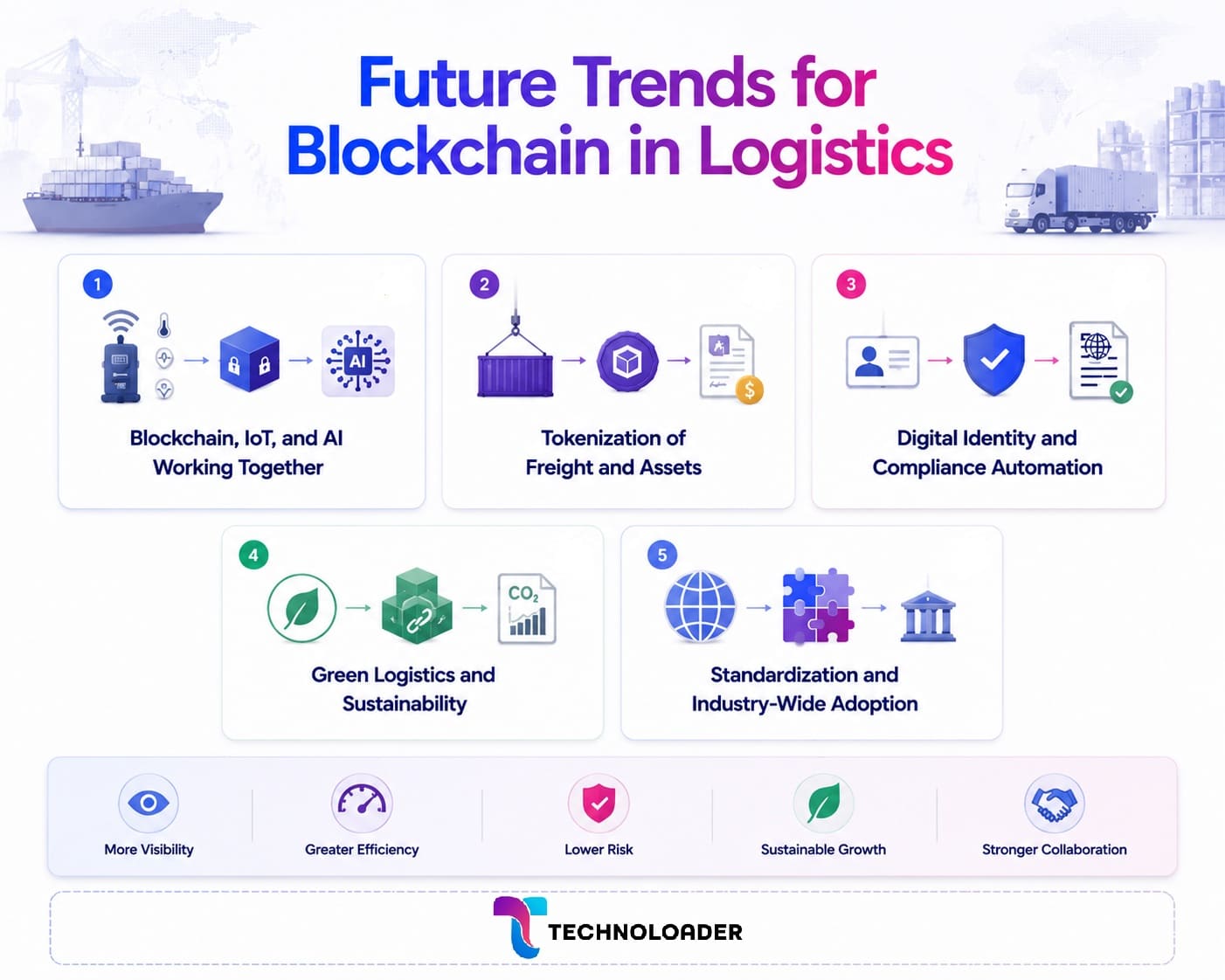
Blockchain, IoT, and AI Working Together
IoT sensors will feed more live data into blockchain records. These will range from temperature and location to shock for sensitive cargo.
AI can then analyze this verified data to predict delays and suggest better routes. Trusted data makes AI decisions more reliable.
Tokenization of Freight and Assets
Freight and cargo can be represented as digital tokens on a ledger. This could make it easier to trade or finance freight-related assets.
While the idea is promising, it’s still new. Any such model must follow local law, and it carries risk. This information is for context only, not investment advice.
Digital Identity and Compliance Automation
Blockchain can store verified identities for drivers, fleets, and containers. This speeds up cross-border checks and license verification.
Compliance processes can then run with less manual review, leading to faster and smoother border crossings.
Green Logistics and Sustainability
Pressure to meet ESG standards will continue to increase for global shippers. Blockchain can provide an auditable record of emissions and sourcing.
This record supports honest sustainability claims and gives regulators and investors information they can verify.
Standardization and Industry-Wide Adoption
Shared standards are the key to wider adoption. Groups like the BITA Standards Council, now an initiative under the GBBC, are developing rules to enable data systems to work together.
As these standards improve, more carriers, ports, and customs agencies are likely to adopt them. You can compare different networks in our guide to blockchain protocols.
Quick Answer: Where Is This Technology Heading?
The future of blockchain in logistics combines AI, IoT, digital identity, and shared standards. Wider adoption will depend on interoperability, practical use cases, and industry collaborations, not just better technology.
You May Also Like
Frequently Asked Questions
What is blockchain in logistics?
Blockchain in logistics is a shared, tamper-evident digital ledger that records shipments and transactions across the supply chain. All approved partners view the same trusted record, with no siloed databases or version conflicts that could affect transparency.
How does blockchain improve supply chain transparency?
Blockchain gives supply chain stakeholders a synchronized, time-stamped record of each shipment. The result is that no party depends on private, siloed data. Should discrepancies arise, there’s one source of truth to resolve them.
What are the main benefits of blockchain for logistics?
The main benefits of blockchain in logistics include transparency, traceability, reduced fraud, and automated settlement. It also speeds up dispute resolution, lowers paperwork costs, and supports stronger ESG reporting.
What role does logistics play within the supply chain?
The supply chain spans everything from sourcing to final delivery. Logistics, on the other hand, covers movement and storage. Since blockchain serves both layers, people sometimes use the two terms interchangeably.
Which companies use blockchain for supply chains?
Examples of companies that use blockchain in their supply chains include GSBN, IBM Food Trust with Walmart, CMA CGM, MediLedger, and VeChain. FedEx has also explored blockchain for shipment visibility and logistics data sharing.
Is TradeLens still operating?
No. IBM and Maersk discontinued TradeLens in late 2022, and it went offline by early 2023. It struggled to reach industry-wide adoption due to reservations from industry players, not because its technology failed.
What are the challenges of adopting blockchain?
The biggest hurdles are interoperability and scalability across different networks. Connecting blockchain to legacy systems often takes more time than expected. Plus, poor data inputs can corrupt the ledger, and adoption only works when enough partners join the network.
Is blockchain secure for supply chains?
Yes. Blockchain records are tamper-evident and extremely difficult to alter undetected. That said, no system is completely unhackable. Permissioned networks still require strong access controls and verified input data to stay secure.
How do I start using blockchain in my logistics business?
Start with one focused use case, such as traceability or electronic bills of lading. Confirm the ROI, pick the right partners, and work with an experienced blockchain team to build it.
Conclusion
Blockchain in logistics brings real transparency, traceability, and automation to the supply chain. It replaces separate records and manual paperwork with one trusted, shared source of truth. The best results happen when partners use shared standards.
This technology isn’t a one-size-fits-all solution. Success depends on clean data, good governance, and broad adoption, not just the code. Early projects that missed these points stalled, but neutral consortia that focused on them are now growing.
If you want to learn more about this technology, our team can help. We build practical, standards-ready solutions tailored to your needs. Reach out to our blockchain development team or contact us to get started.

Vipin Kumar
Vipin Kumar is the Founder & CEO of Technoloader, a Clutch Top 10 Blockchain Development Company for 2025. A serial technology entrepreneur and blockchain architect with a B.Tech background, Vipin has led the delivery of 450+ projects across DeFi, NFT marketplaces, AI/ML, and custom Web3 platforms for clients in the UAE, India, the US, and beyond. He also founded SALIQ (saliq.ai), an AI-driven conversational marketing platform.
Published in Blockchain Development