+91 7014607737
 info@technoloader.com





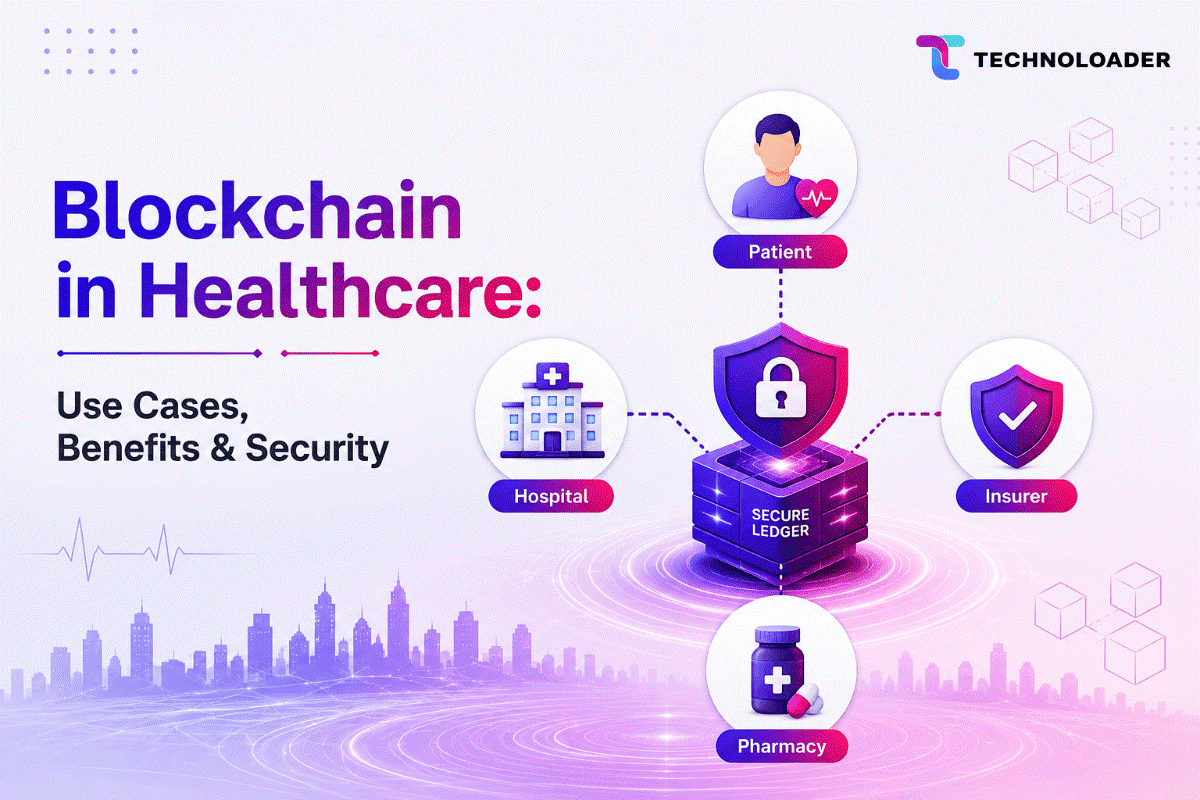
Table of Contents
Blockchain in healthcare is the use of a shared, tamper-evident digital ledger to record and protect health data.
It gives many parties one trusted source of truth. Providers, patients, insurers, and drug makers can verify the same records without a central gatekeeper.
I have spent more than eight years building blockchain systems. I have seen where blockchain technology in healthcare helps and where it doesn’t.
The stakes are high. Data security is the clearest example. The 2026 Healthcare Data Breach Statistics Report by The HIPAA Journal records 772 data breaches for 2025. The largest data breach in healthcare occurred in 2024 at Change Healthcare, which affected 192.7 million individuals.
Blockchain alone won’t fix this. However, when used well, it makes health data harder to tamper with and easier to share safely.
In this guide, I’ll explain how blockchain works across the health sector. We’ll cover real use cases, benefits, honest limits, and what comes next.
Key Takeaways
- What it is: Blockchain in healthcare is a shared, tamper-evident ledger for verifying health data across organizations.
- How it works: Patient data stays off-chain and encrypted. Only a hash, pointer, and access log go on-chain.
- Where it helps most: Records and interoperability, drug supply chains, clinical trials, insurance claims, identity, and genomics.
- The honest limit: It doesn’t make anything “unhackable,” and it doesn’t, by itself, make you HIPAA compliant.
- The bottom line: It’s a trust and traceability layer, not a database replacement. It fits some problems and not others.
What Is Blockchain in Healthcare?
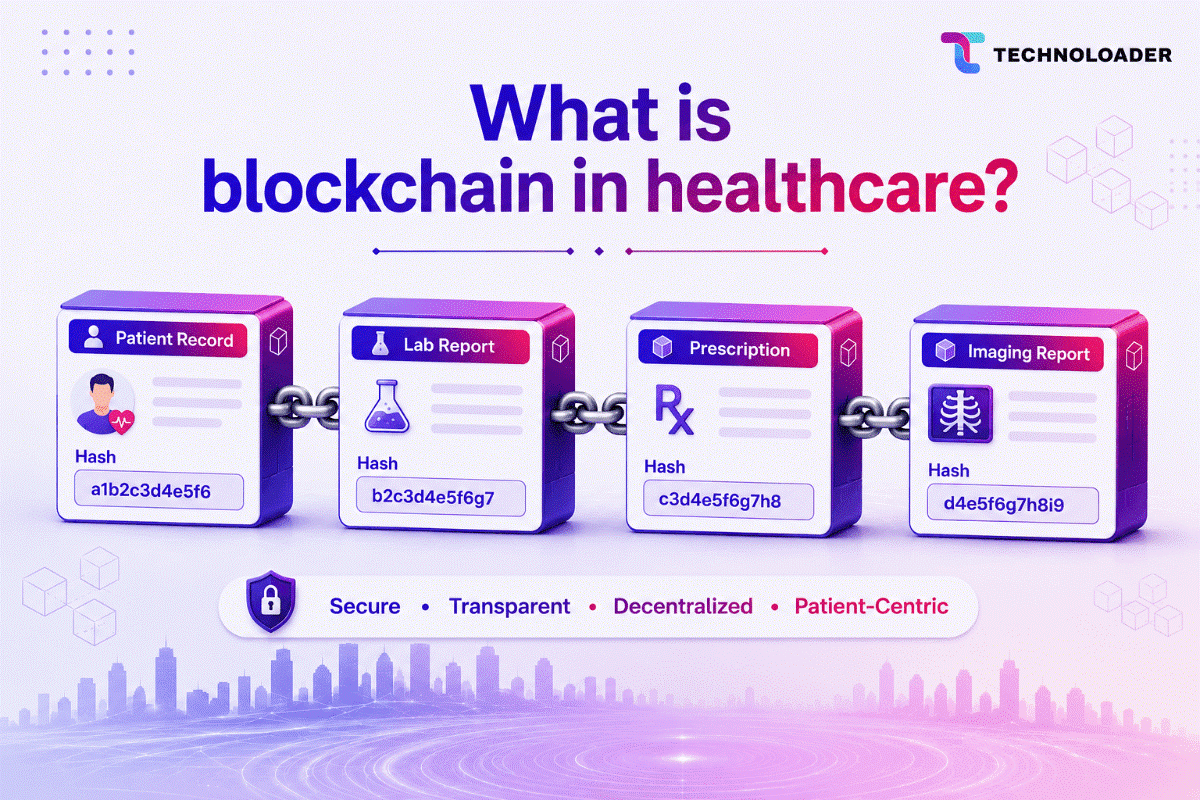
Blockchain in healthcare is a shared digital ledger that updates for everyone at the same time. New health data is grouped into blocks, and each block is locked onto the last one. Since they’re all chained together, you can’t secretly change any of the old data.
Once confirmed, an entry becomes tamper-evident. Any later change is then easy to detect.
That last point matters more than the word “blockchain.” A blockchain isn’t a faster database. It’s a way for parties who don’t fully trust each other to agree on one record. For healthcare, those parties are hospitals, clinics, insurers, labs, and drug makers.
When people talk about different kinds of blockchains, it usually boils down to two types: public and permissioned.
Public chains are open to anyone. In healthcare, you’ll almost always see permissioned chains, which are basically invite-only to make sure only approved people can get in.
Quick Answer
Blockchain in healthcare is a shared, tamper-evident ledger for the same health data. Hospitals, patients, insurers, and pharmacies can verify it without a single central authority. The data itself stays in secure systems; the ledger records proof and access.
Why Healthcare Needs Blockchain Now
Health data is valuable, sensitive, and badly fragmented. Your records may sit in a dozen systems that don’t talk to each other.
That gap creates risk, delay, and cost. Four problems stand out.
Start with security from attacks. In 2025, there were 772 data breaches in the US alone, according to the previously cited The HIPAA Journal report.
The Change Healthcare attack alone affected 192.7 million people, as noted earlier. A weak central system can expose an entire network.
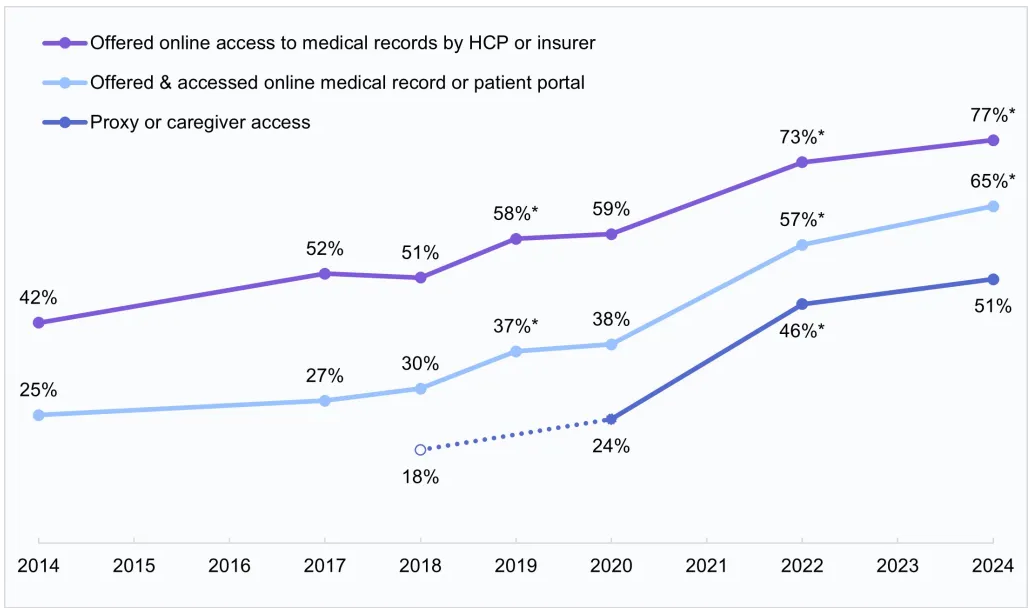
Next comes fragmentation. According to a 2024 Health IT report on the access and use of patient portals, 77% of patients are offered access to their records. Instead of relying on various hospital-owned portals, blockchain enables a patient-centric health record.
Another problem lies in the drug supply chain. The World Health Organization’s 2024 report on substandard and falsified medical products found that 1 in 10 falls in this category. The risk is higher in low- to middle-income countries. Counterfeit medicine puts patients in direct danger.
The claims process is another easy target for fraud. According to a 2025 Health Care Fraud report by the United States Sentencing Commission, healthcare fraud has increased by 1% since 2021. Bringing blockchain in healthcare helps shut this down because it creates a shared, permanent record that no one can sneakily alter or fake.
Quick Answer
Whether it’s data breaches, messy patient records, fake meds, or claims fraud, the root problem is always the same: different companies don’t have a single record they can all trust. That’s why people are becoming more interested in blockchain in healthcare. It gives everyone a shared, reliable baseline to work from.
Also Read
How Blockchain in Healthcare Works: On-Chain vs Off-Chain
You must understand this: patient data is almost never stored on the blockchain itself. That surprises people, so let me explain.
A blockchain copies its data to every node in the network. However, you don’t want millions of private medical records copied everywhere. These files are also too large for the network to handle, and strict health privacy laws limit how and where they can be stored.
So, the sensitive data stays off-chain. The chain stores three small things instead: a cryptographic hash of the record, a pointer to the record, and a log of every access.
If someone alters the off-chain record, its hash no longer matches. The tampering shows up at once.
This “on-chain proof, off-chain data” pattern is the backbone of serious designs. Research systems like FHIRChain use it to reference records without exposing them.
It also lets the technology stay compliant with health data standards like HL7 FHIR. It complements those standards rather than replacing them.
Public vs Private vs Consortium Blockchains
Most healthcare systems use a permissioned or consortium chain, not a public one. The public vs private blockchain comparison table below shows why.
| Type | Who Can Join and Validate | Best-Fit Healthcare Use | Key Trade-off |
|---|---|---|---|
| Public | Anyone, permissionless | Transparent drug tracking, public credentials | Strong transparency, but weak privacy and lower speed |
| Private (permissioned) | One organization’s vetted members | Internal records, audit trails within a hospital group | High control and speed, but more centralized |
| Consortium | A group of vetted organizations | Payer-provider networks, pharma supply chains | Shared governance, but needs partner agreement |
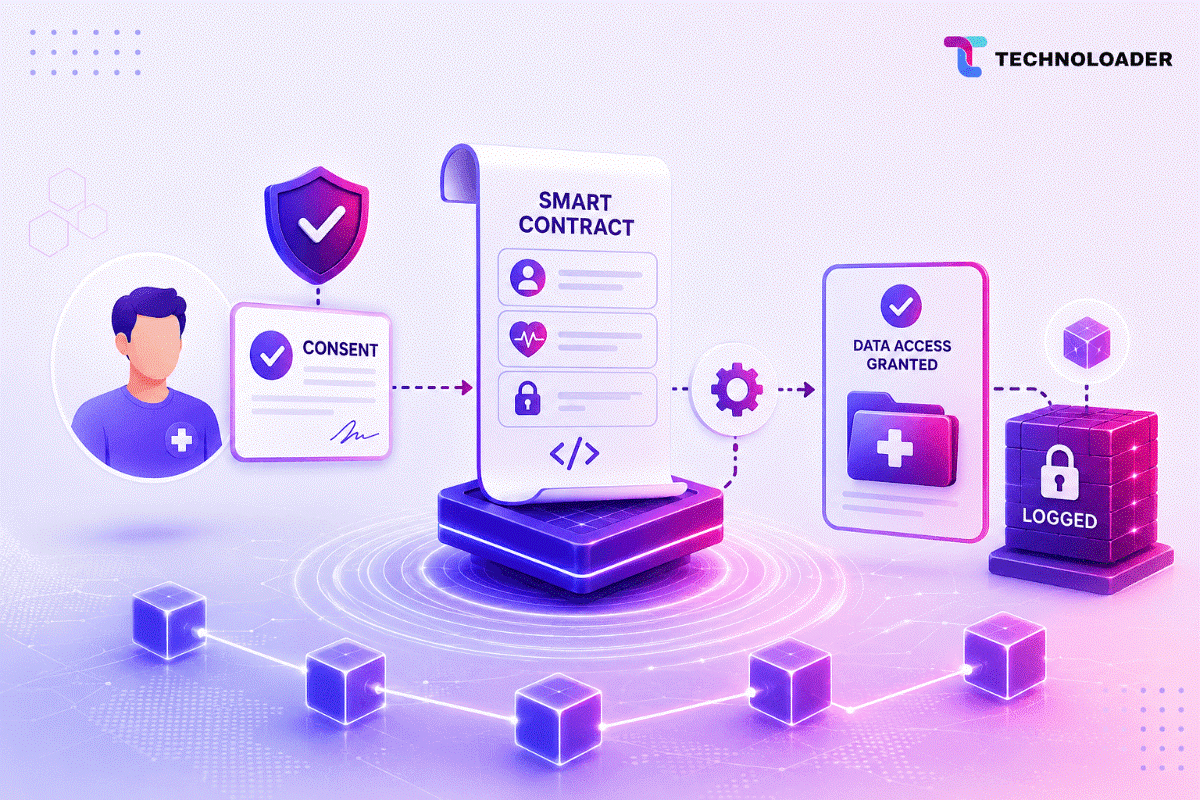
Smart contracts sit on top of this. A smart contract is code that runs automatically when set conditions are met. In healthcare, it can grant or revoke data access. It can also check a claim against a policy.
Here’s how smart contracts work for healthcare data access:
However, smart contracts have real limits. They can’t verify off-chain facts on their own, so they rely on trusted data feeds called oracles.
Their code can also contain bugs that are hard to fix once deployed. They enforce rules; they don’t replace human judgment.
Quick Answer
Is patient data stored on the blockchain? No. Protected health information stays off-chain in encrypted systems. The blockchain in healthcare holds only a hash, a pointer, and an access log. That’s enough to prove the data hasn’t been tampered with.
Also Read
Key Use Cases of Blockchain in Healthcare
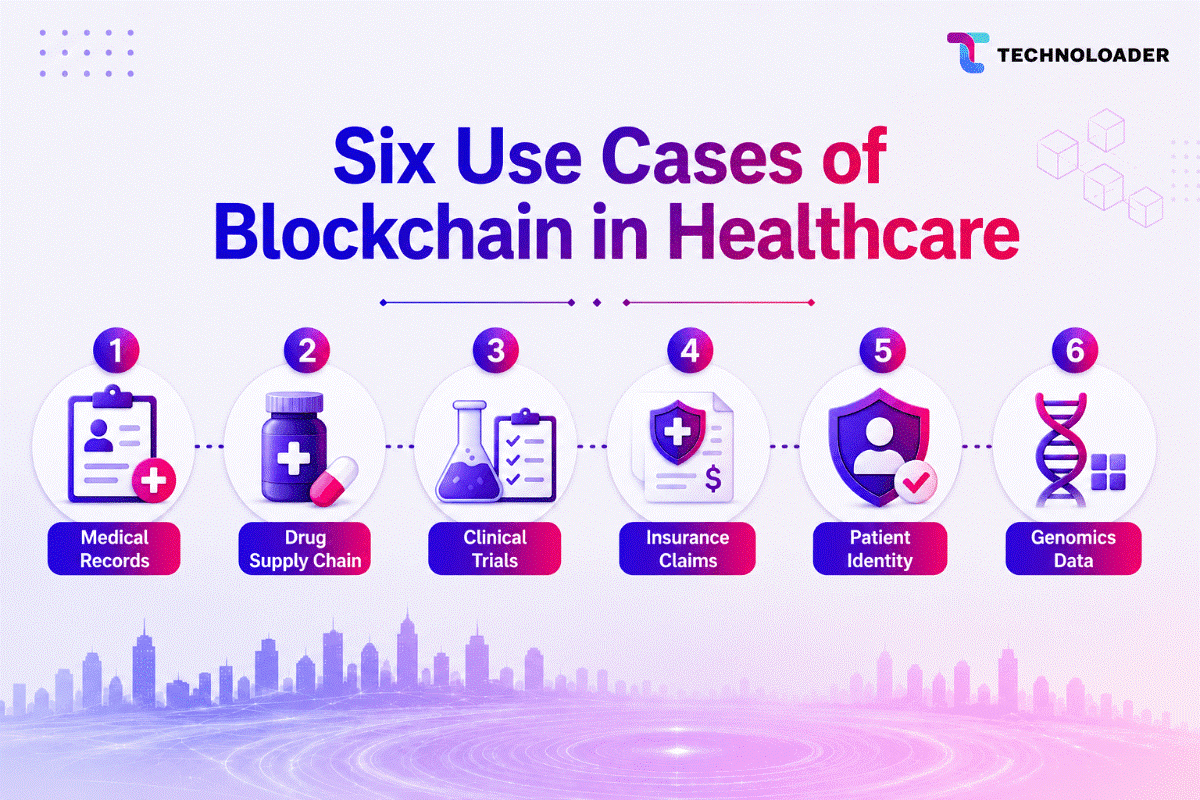
The strongest blockchain applications in healthcare follow the same pattern. It stems from a problem of trust between parties.
Blockchain adds a shared record, and everyone gains from the same verified truth. Here are the six use cases of blockchain in healthcare.
Electronic Health Records and Interoperability
The Problem: Patient histories are split across hospitals that can’t easily share them. Care suffers when a doctor can’t see the full picture.
The Solution: Instead of moving medical records around, blockchain in healthcare acts as a shared access key. The files stay exactly where they are in their normal systems, but patients can easily hand out or take back access permissions. This leaves a crystal-clear digital log of who has eyes on their data.
The Value: Providers see a fuller history faster. Patients control who reads their data and can see every access.
Drug and Pharma Supply Chain
The Problem: Counterfeit and diverted drugs enter the supply chain. Patients can’t always trust that a medicine is genuine.
The Solution: Each unit is recorded at every handoff, from maker to pharmacy. Any party can verify origin and custody against the shared ledger.
The Value: Using blockchain is one of the easiest ways to flag fake drugs early on. It also helps keep up with the US Drug Supply Chain Security Act, especially with the wave of strict data-sharing deadlines rolling out in 2025 and 2026.
Clinical Trials and Research Integrity
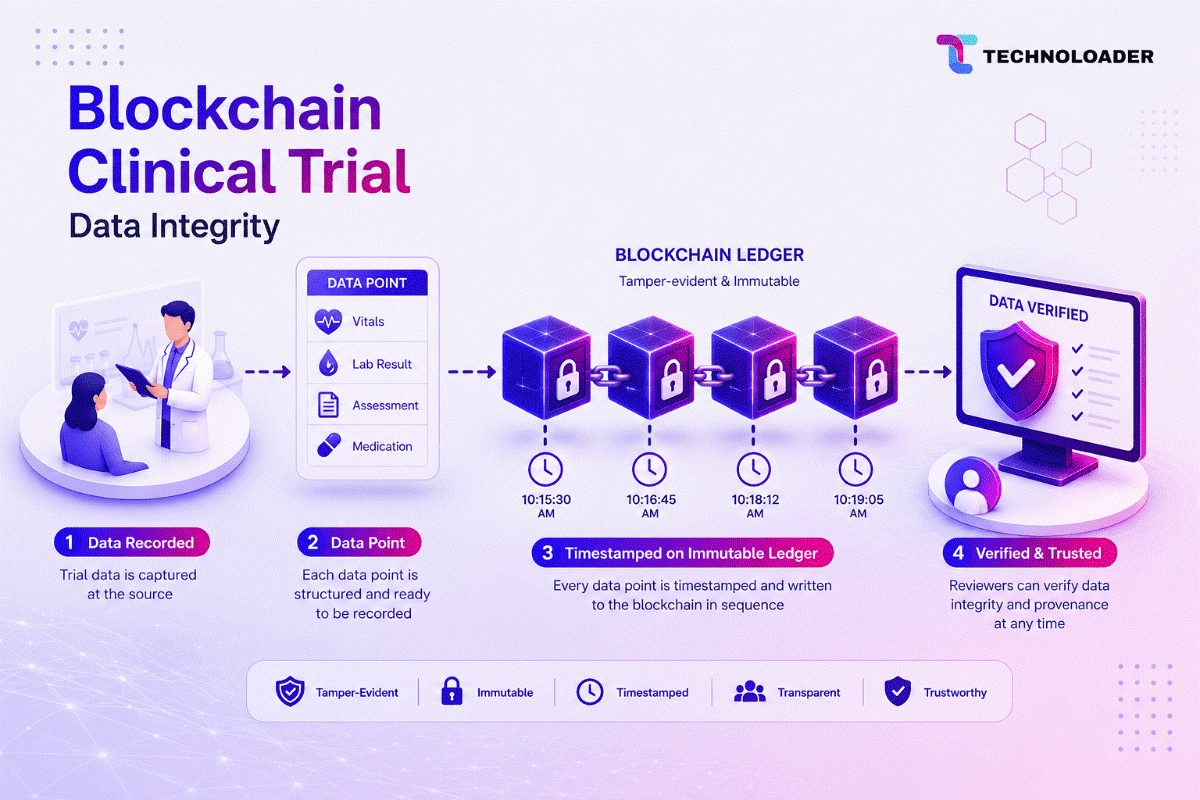
The Problem: It’s too easy for trial data to get manipulated. When researchers only report good results, it ruins the integrity of the whole study.
The Solution: Blockchain in healthcare gives every piece of data a permanent timestamp that nobody can change. It does the same thing for patient consent.
The Value: Reviewers can prove the data wasn’t altered after the fact. That raises confidence in the science.
Health Insurance Claims and Smart Contracts
The Problem: Claims are often manual, slow, and prone to error and fraud.
The Solution: A smart contract checks a claim against the policy and treatment record. Matching claims can settle automatically.
The Value: Fewer errors, faster payment, and less room for fraudulent submissions. Staff spend less time on rework.
Medical Identity and Credentialing
The Problem: Verifying a clinician’s credentials is slow and repeated at every new site. Patient identity theft is also common.
The Solution: Verified credentials live as tamper-evident records that any approved party can check.
The Value: Faster onboarding for providers and stronger identity checks for patients.
Genomics and Patient-Controlled Data Sharing
The Problem: Genomic data is deeply personal. Patients rarely control how it’s used or shared.
The Solution: A permissioned ledger lets patients consent to specific uses and track them.
The Value: Patients maintain control. Researchers still get access to consented data for the study.
The table below sums up where each use case fits.
| Use Case | Problem It Solves | Best-Fit Chain Type | Maturity | Example |
|---|---|---|---|---|
| Records and Interoperability | Fragmented patient data | Consortium | Pilot to production | Avaneer Health |
| Drug Supply Chain | Counterfeit and diversion | Consortium | Production | MediLedger |
| Clinical Trials | Data integrity | Permissioned | Pilot | Embleema (early) |
| Insurance Claims | Manual claims that are prone to fraud | Consortium | Pilot | Avaneer Health |
| Identity and Credentialing | Slow verification | Consortium | Early adoption | ProCredEx |
| Genomics and Data Sharing | Low patient control | Permissioned | Early | BurstIQ |
Quick Answer
The top uses are records and interoperability, drug supply chains, clinical trials, insurance claims, identity, and genomics. Each replaces blind trust with a shared, verifiable record.
Benefits of Blockchain in Healthcare
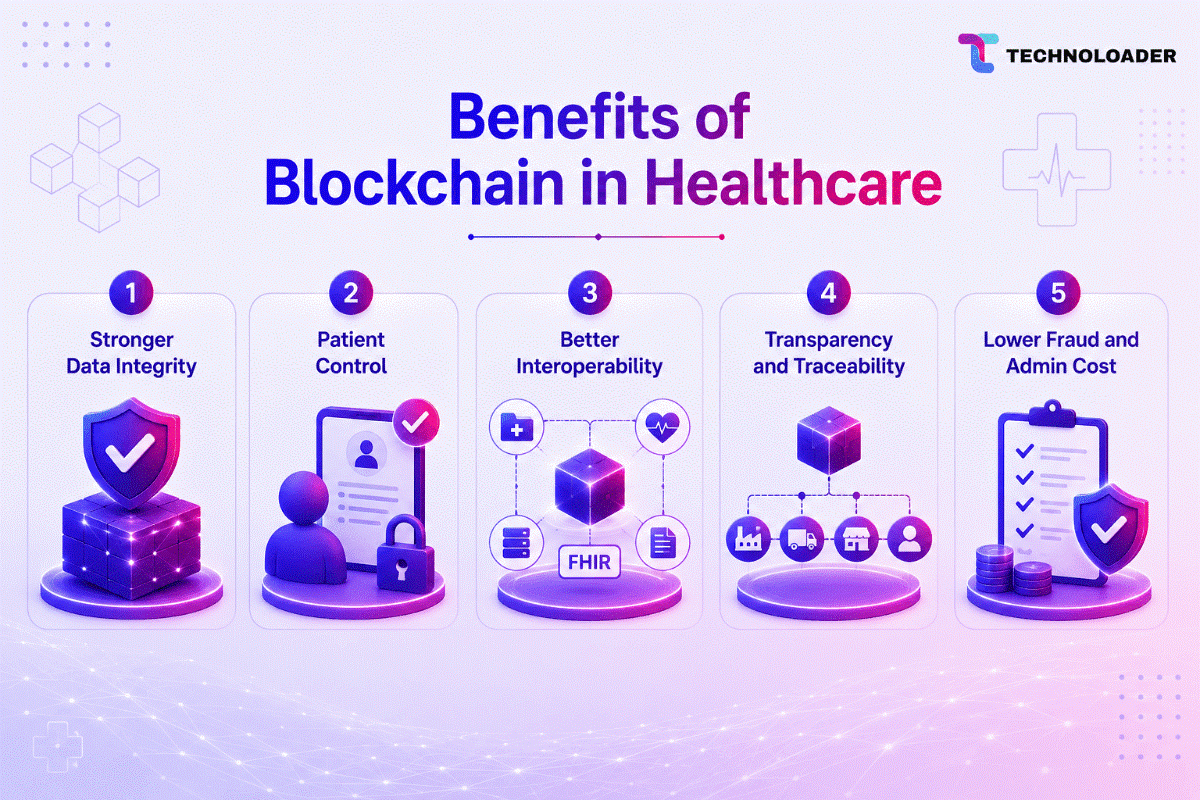
The benefits of blockchain in healthcare stem from a single idea. When you have a shared record that’s impossible to change in secret, it solves many real-world problems.
Stronger Data Integrity: Any change to a record is easy to detect. That makes tampering and quiet edits harder.
Patient Control: By using blockchain in healthcare, patients can grant and revoke access to their data. Every access is logged and visible to them.
Better Interoperability: A shared layer helps disconnected systems trust the same data. It works with standards like FHIR, not against them.
Transparency and Traceability: In a supply chain, every handoff is recorded. This makes recalls and audits faster.
Lower Fraud and Admin Cost: Automated checks reduce duplicates and catch bad claims sooner. Just keep in mind that a poorly optimized setup can drive up your blockchain cost, so good design is still a must.
Each benefit has a limit, and I won’t pretend otherwise. A shared ledger only helps when several parties need shared trust.
If you have a single team that handles private data, a normal encrypted database is often the better tool.
Quick Answer
The main advantages of blockchain in healthcare are stronger integrity, patient control, interoperability, traceability, and less fraud. You gain the most value when you have several organizations that must trust one record.
Real-World Examples of Blockchain in Healthcare
A growing list of blockchain in healthcare companies now runs live systems. I have carefully checked each one. As I go along, I flag claims that are dated or uncertain.
Theory is easy. So, let me name real blockchain projects and their honest status.
MediLedger: Runs a permissioned network for the US pharmaceutical supply chain. It supports drug verification under the DSCSA, with participation from most major drug makers in the US.
Estonia’s E-Health System: Uses Guardtime’s KSI technology to provide blockchain-based integrity verification for healthcare data. It doesn’t store health records directly on a blockchain.
Avaneer Health: This US network was founded by large payers and providers, including Aetna and Cleveland Clinic. It uses FHIR and blockchain in healthcare for eligibility, claims, and data exchange.
BurstIQ: Offers a health-data platform that manages consent and data governance.
ProCredEx: Uses distributed ledger technology to verify provider credentials. It remains in early adoption and has broadened into other regulated fields.
At Technoloader, healthcare is one of the industries we support, but we can’t publicly name a client here. My hands-on work has focused on private and permissioned blockchains, wallets, and secure data systems.
These systems follow the same model described above: off-chain sensitive information, while blockchain in healthcare provides a trusted layer.
Quick Answer
Real examples include MediLedger for pharma supply chains and Estonia’s Guardtime-secured e-health system. Others include Avaneer Health, BurstIQ, and ProCredEx.
Also Read
HIPAA, GDPR, and Blockchain Compliance
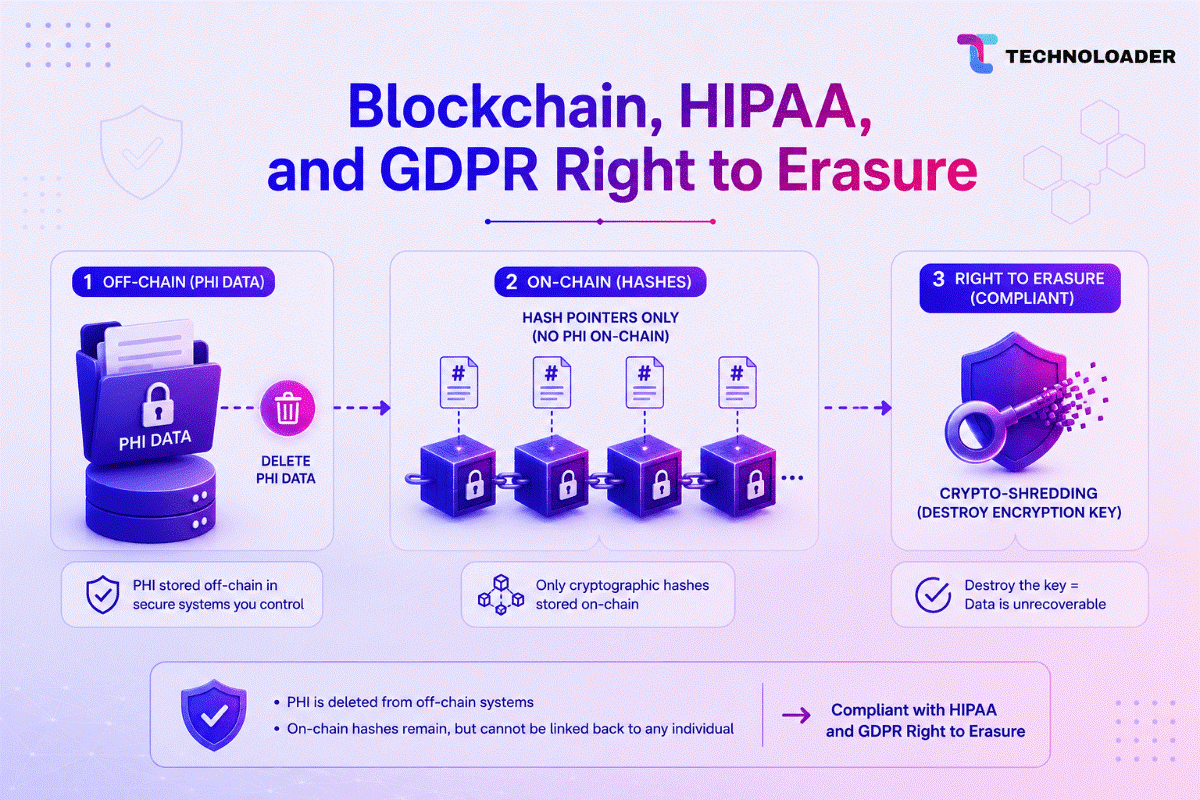
I must correct a common myth about blockchain in healthcare compliance. You’ll read that blockchain “ensures HIPAA compliance.”
This is simply not true, and believing it can get you in trouble. HIPAA compliance comes from how you handle protected health information.
You need off-chain storage, encryption, access controls, and business associate agreements. The use of blockchain in healthcare can support those controls, but it doesn’t grant compliance on its own.
GDPR raises a harder question. It gives people the right to erasure.
A blockchain is append-only, so you can’t simply delete an on-chain entry. At first glance, the two seem to clash.
Good designs solve this without deleting on-chain data. The personal data stays off-chain, where you can delete it.
The chain holds only a hash and a pointer, neither of which is the record itself. Teams also use “crypto-shredding,” in which destroying the key renders the encrypted data unreadable.
I want to be honest here. Regulators still debate whether an on-chain hash of personal data counts as personal data.
That’s why this is a managed trade-off, not a fully settled one. Treat any “fully compliant by default” claim with care.
Quick Answer
Does blockchain make healthcare HIPAA compliant? No. Blockchain alone doesn’t ensure HIPAA compliance. You still need off-chain protected data, encryption, access controls, and business associate agreements. Blockchain in healthcare supports these controls; it doesn’t replace them.
Also Read
Challenges and Limitations of Blockchain in Healthcare
I have built enough systems to respect the limits of this technology. Blockchain in healthcare faces real hurdles, and ignoring them leads to failed projects.
Cost and Complexity: A network needs partners, governance, and integration work. That’s a heavy lift for one hospital acting alone.
Scalability: Blockchains trade speed for shared trust. High-volume, real-time data can strain a poorly designed network.
Legacy Integration: Most hospitals run older record systems. Connecting them to a ledger takes careful engineering.
Regulatory Uncertainty: Rules governing health data and blockchain are still taking shape. That raises the risk of building the wrong thing.
Key Management: If a patient loses their private key, they may lose access. When we built Techno Wallet, key recovery was the hardest problem, not the ledger.
There’s one more limit worth noting. Blockchain implementation in healthcare isn’t always the answer. When you don’t need shared trust between parties, a normal encrypted database is simpler and faster.
Use blockchain when: Several organizations must trust one record, provenance and audit trails matter, or patients need verifiable access control.
Skip blockchain when: Only one team controls the data, you need very fast storage, or a normal encrypted database is already enough.
Quick Answer
The biggest challenges of blockchain in healthcare are cost and complexity, scalability limits, integration with legacy records, regulatory uncertainty, and key management. Blockchain isn’t fitting for situations where you don’t need shared trust.
The Future of Blockchain in Healthcare
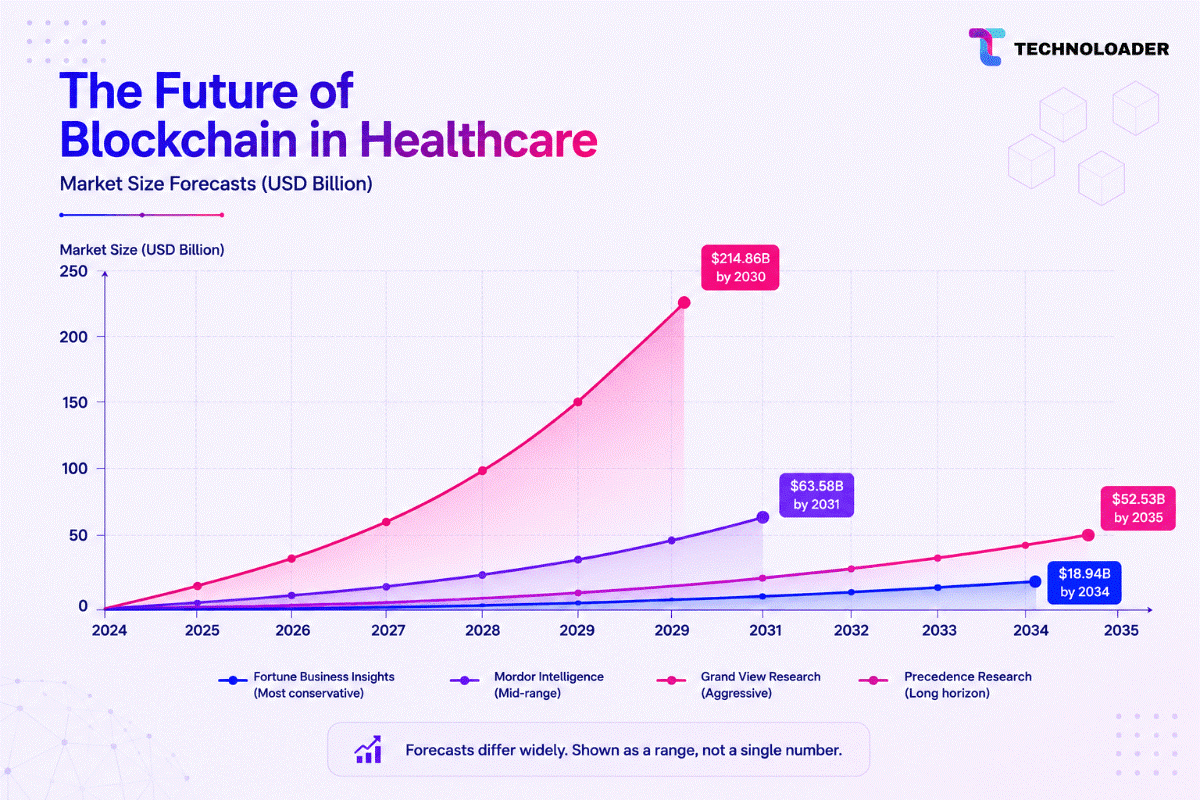
The blockchain in healthcare market is young and hard to size. Forecasts vary widely, so I present them as a range rather than a single number.
| Source | 2025 Size | Forecast | CAGR | Scope Note |
|---|---|---|---|---|
| Fortune Business Insights | $2.49B | $18.94B by 2034 | 24.7% | Most conservative |
| Mordor Intelligence | $5.5B | $63.58B by 2031 | 50.38% | Mid-range |
| Grand View Research | $11.32B (2024) | $214.86B by 2030 | 63.6% | Aggressive |
| Precedence Research | $26.04B | $52.53B by 2035 | 7.27% | Long horizon |
The spread itself tells the story. Everyone agrees that the use of blockchain in healthcare is growing fast.
No one agrees on how big it starts because they measure different things. So, treat any single headline number with care.
The more interesting shift is where AI and blockchain in healthcare meet. Healthcare AI needs trustworthy data.
A tamper-evident record of where data came from can make AI training safer to trust. Privacy tools like zero-knowledge proofs can also verify a fact without exposing the underlying record.
I expect steady, practical progress here, not a sudden leap. The winners will pair blockchain with existing standards and solve one real problem at a time.
Quick Answer
The market is forecast to grow fast, though estimates vary widely. The clearest near-term direction is pairing blockchain with AI. Tamper-proof records can help make health data and AI training more reliable.
Also Read
Frequently Asked Questions
What is blockchain in healthcare?
Blockchain in healthcare is a shared, tamper-evident ledger. It records and verifies health data across organizations. Sensitive data remains in secure systems, while the ledger records proof and access. It lets parties trust one record without a central gatekeeper.
Is patient data stored on the blockchain?
No. Protected health information stays off-chain in encrypted systems. The blockchain stores only a hash, a pointer, and an access log. This is enough to prove that the record hasn’t been altered.
What are the main use cases of blockchain in healthcare?
The leading uses are records and interoperability, drug supply chains, clinical trials, insurance claims, identity, and genomics. Guesswork is replaced with a shared record that everyone can verify.
How does blockchain improve healthcare data security?
Using blockchain in healthcare makes it easy to spot if someone tries to tamper with a record. It gets rid of that single point of failure and logs every access attempt. It’s a huge security upgrade, but it still doesn’t make any system 100% hack-proof.
Does blockchain make healthcare HIPAA-compliant?
Honestly, no. You still have to do the actual work of encrypting your files, keeping patient data off the chain, and managing who gets access. Blockchain in healthcare is just a helper tool here. It doesn’t automatically guarantee compliance.
Which companies use blockchain in healthcare?
Real examples include MediLedger for pharma supply chains and Estonia’s Guardtime-secured e-health records. Avaneer Health, BurstIQ, and ProCredEx are other examples of the use of blockchain in healthcare.
Is a public or private blockchain better for healthcare?
Most healthcare organizations use permissioned or consortium blockchains. Only approved members can join the network. This helps protect sensitive patient data and meet privacy regulations. Public blockchains are usually limited to specific blockchain in healthcare use cases, such as tracking the origin of public data.
What are the main challenges of blockchain in healthcare?
The key challenges are cost and complexity, scalability, integration with legacy systems, regulatory uncertainty, and key management. Blockchain also doesn’t help with problems that don’t require shared trust.
Conclusion
Using blockchain in healthcare doesn’t replace databases. Instead, it helps organizations share and verify trusted records. You can use it for everything — from patient records to tracking medicines through the supply chain.
When used well, it protects data integrity and gives patients real control.
The data stays off-chain, the limits are real, and compliance still takes work. The best results come from solving one clear problem with the right design.
Here at Technoloader, we build blockchain solutions for healthcare and other regulated industries. If you want to explore a use case, talk to our blockchain team or contact us for a consultation.

Vipin Kumar
Vipin Kumar is the Founder & CEO of Technoloader, a Clutch Top 10 Blockchain Development Company for 2025. A serial technology entrepreneur and blockchain architect with a B.Tech background, Vipin has led the delivery of 450+ projects across DeFi, NFT marketplaces, AI/ML, and custom Web3 platforms for clients in the UAE, India, the US, and beyond. He also founded SALIQ (saliq.ai), an AI-driven conversational marketing platform.
Published in Blockchain Development