+91 7014607737
 info@technoloader.com





Table of Contents
Quick Summary
Blockchain penetration testing is a controlled attack on a blockchain system. It helps you find security flaws before hackers can use them.
To perform a pentest, you find vulnerabilities and test their impact. You then report the issues, fix them, and test the system again. This helps lower the risk of stolen funds and unauthorized access.
Blockchain penetration testing is a security measure. Ethical hackers simulate an attack on your blockchain system to test how secure it is.
A good test starts by defining what to check and how it works. For example, test a smart contract to see if someone could bypass its access controls. You can then identify possible attack paths and try to exploit those weaknesses.
Record each vulnerability and explain how an attacker could exploit it. Then recommend a fix. Once you fix the issue, test the same weakness again.
I’ve led security-sensitive delivery across 450+ blockchain projects. I’ve seen similar security weaknesses appear. Proper blockchain penetration testing could have found those weaknesses earlier.
This guide walks you through blockchain pentesting. You’ll learn what to test, which tools to use, and what vulnerabilities to look for. You’ll also understand what blockchain penetration testing can cost.
What Is Blockchain Penetration Testing?
Blockchain penetration testing is a simulated cyberattack on a blockchain system. Simply put, a security tester pretends to be a hacker and tries to attack your blockchain project.
The tester looks at the different parts of the project, such as smart contracts, nodes, wallets, or APIs:
- Smart Contracts: The code that carries out actions on the blockchain
- Nodes: Computers that connect to the blockchain network and process or verify data
- Wallets: Where users manage their blockchain assets and sign transactions
- APIs: Connections that let different software communicate with the blockchain system
Two terms matter here:
- Blockchain penetration testing is also known as pentesting. It’s the process of mimicking an attacker to breach your security controls.
- A vulnerability assessment is different. It only finds and ranks weaknesses without exploiting them.
Blockchain systems need testing because some flaws are difficult to fix after deployment. For example, a smart contract may have a flaw that lets an unauthorized user withdraw funds. Once deployed, that flaw could put real assets at risk.
What Does Blockchain Penetration Testing Mean?
It’s an authorized attack that safely exploits weaknesses across your blockchain stack. It helps you fix the flaws before a real hacker exploits them.
Blockchain Pentest & Smart Contract Audit: What’s the Difference?
A blockchain pentest and a smart contract audit both look for security weaknesses. An audit mainly reviews smart contract code for flaws before deployment.
A penetration test takes an attacker-like approach. Testers try to exploit weaknesses in different parts of the blockchain system. This may include smart contracts, dApps, or APIs. These components are also a part of Web3 applications.
Here’s the difference between a pentest and smart contract audit at a glance:

Passing an audit doesn’t mean the whole blockchain project is secure. For example, a smart contract may have no known code flaw. But a stolen private key could still let an attacker control a privileged account.
Here’s a quick comparison table of a smart contract audit and a blockchain pentest:
| Dimension | Smart Contract Audit | Blockchain Penetration Test |
|---|---|---|
| Main Target | Smart contract code | The full stack, including smart contracts, dApps, APIs, or nodes |
| Approach | Manual review of smart contract code | Controlled attempts to exploit security weaknesses |
| Timing | Usually done before deployment | Pre-launch and on live blockchain systems |
| Main Question | What security flaws does the code have? | Can a real hacker break in? |
| Output | List of bugs and fixes | Exploitable vulnerabilities, their impact, and recommended fixes |
Is a Penetration Test the Same as a Smart Contract Audit?
No. A blockchain penetration test tries to exploit weaknesses in a blockchain system. A smart contract audit mainly reviews the contract’s code for security flaws.
Also Read
Why Does Blockchain Security Testing Matter?
Blockchain security testing matters because one security flaw can lead to financial losses. For example, CertiK recorded around $3.35 billion in Web3 losses in 2025. This was about 37% more than in 2024.
The Bybit attack alone caused around $1.5 billion in losses. Without this attack, total stolen funds in 2025 would have been lower than in 2024. The attackers compromised Bybit’s Safe Wallet. It was used to approve Bybit transactions.
They added harmful code to the interface. This changed what Bybit’s approved signers saw on their screens.
The signers approved the transaction. This changed the smart-contract rules that controlled the wallet. The attackers then gained control of the wallet and moved its funds.
These attacks can also damage customer trust. Customers may question whether their own assets are safe. Rebuilding that trust can take time.
A skilled blockchain tester can find these gaps and help secure the blockchain.
Why Is Blockchain Penetration Testing Important?
Blockchain penetration testing helps uncover weaknesses in wallets, transaction approvals, and smart-contract controls. If hackers exploit these weaknesses, they can steal funds.
This leaves the company to deal with financial losses. Customers may no longer trust the company with their assets.
What Does a Blockchain Penetration Test Cover? (The Core Layers)
A blockchain penetration test can examine seven core layers. These layers are the different parts of a blockchain system. They include smart contracts, consensus and protocol, nodes, and RPC and APIs.
They also include wallets, key management, dApp front ends, plus oracles and bridges:
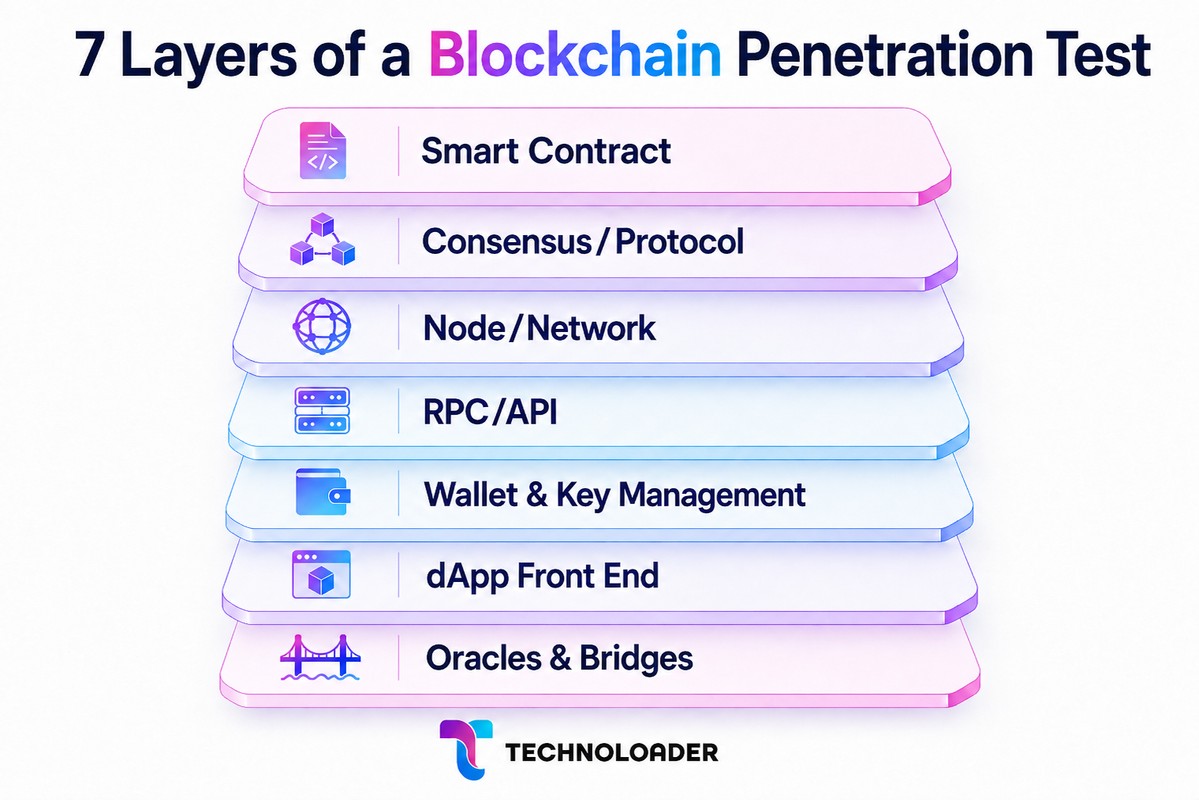
The table below explains what each layer does. You’ll also learn what to look for during blockchain penetration testing:
| Layer | What it Is | What to Look For |
|---|---|---|
| Smart Contract | Blockchain code that controls rules, transactions, and funds | Flaws that could let someone bypass access controls or move funds without permission |
| Consensus/Protocol | Rules that help the blockchain agree on valid transactions | Weaknesses that could allow transaction reordering or double-spending |
| Node/Network | Computers running blockchain software and the connections between them | Exposed services, weak authentication, or outdated software |
| RPC (Remote Procedure Call) and API (Application Programming Interface) | Interfaces that let apps communicate with blockchain nodes and services | Unauthenticated methods, injection, rate-limit gaps |
| Wallet and Key Management | Systems that store and use private keys to approve transactions | Exposed private keys or weak approval controls |
| dApp Front End | The website or app users use to interact with the blockchain | Malicious scripts or misleading transaction requests |
| Oracles and Bridges | Oracles bring outside data to a blockchain. Bridges connect different blockchains. | Manipulated oracle data or unauthorized cross-chain transfers |
Testing methods can vary by blockchain and layer. Layer 1 and Layer 2 networks can have different security risks. So, you need to account for how each network works.
What Does Blockchain Penetration Testing Include?
It spans seven layers. These include smart contracts, consensus, nodes, and APIs. It also covers wallets, dApp front end, and bridges.
Also Read
What Are the Most Common Blockchain Vulnerabilities?
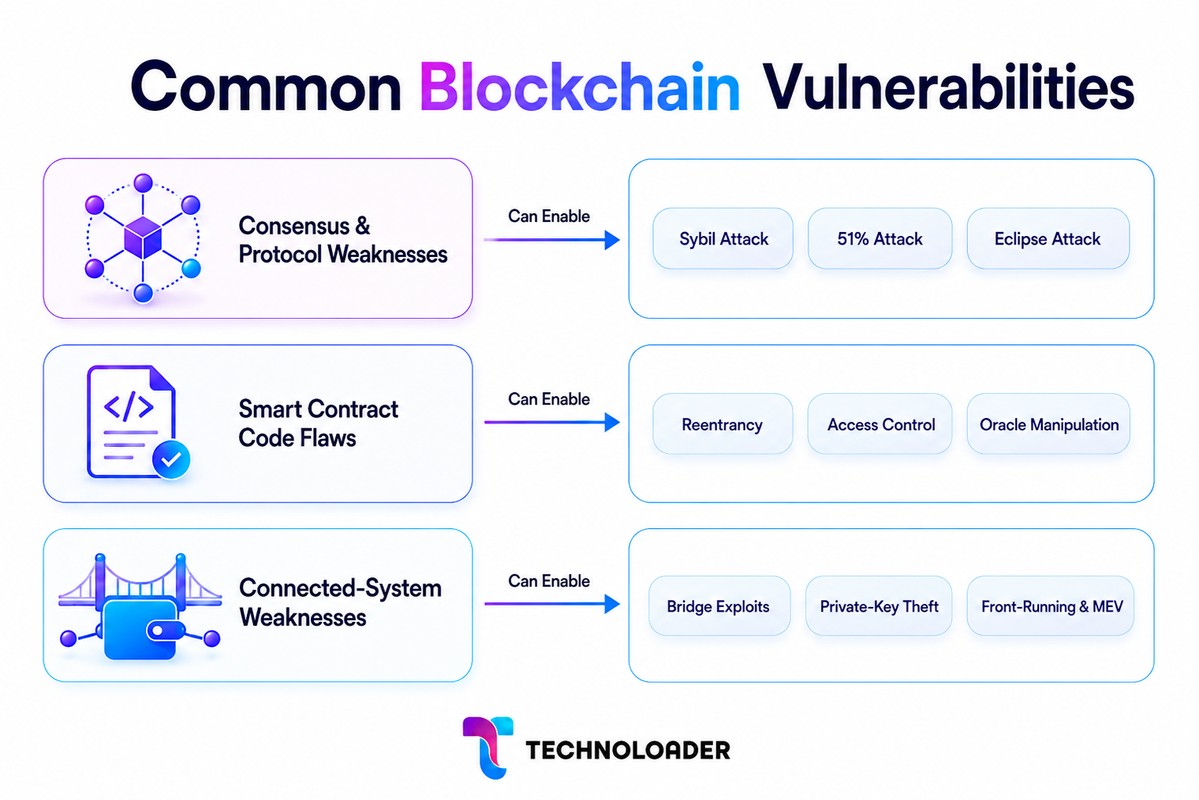
Most blockchain vulnerabilities fall into a handful of classes. These include consensus attacks, smart-contract code flaws, and other connected systems.
Here’s a visual of blockchain vulnerabilities and the attacks they can enable:
Consensus & Network Vulnerabilities
These are weaknesses in the code used by blockchain technology. This code helps the network agree on valid transactions. Hackers can exploit these flaws to disrupt transaction processing.
They can also reverse past payments or spend the same digital money twice. Here are some examples of attacks:
- Sybil Attack: A hacker can run many fake nodes that appear to be separate users. This can give the attacker more influence over parts of the network than they should have.
- 51% Attack: A hacker can gain control over half of the blockchain network’s staking power or hash rate. This can let them reverse recent transactions and spend the same money twice.
- Eclipse Attack: Attackers control most of the network connections to a specific node. This stops the node from communicating with honest nodes. The attacker can then control the blockchain data that node receives. This can include information about new transactions.
Code Flaws in Smart Contracts
Smart contracts contain the rules that control assets and transactions. Flaws in the smart contract’s code can let an attacker bypass restrictions. They can also withdraw funds or change how a transaction is processed.
I’ve broken down common ways attackers can exploit smart-contract code flaws. This includes reentrancy attacks, access control failures, and price oracle manipulation:
- Reentrancy Attack: A malicious contract calls a function on the target contract. This is done to withdraw funds. The attacker calls the function again before the first withdrawal is recorded. This can repeat the withdrawal and drain the contract’s funds.
- Access Control Failure: A smart contract may limit certain functions to specific addresses. For example, only the owner or administrator can call these functions. In some cases, the permission check is missing or flawed. This means an unauthorized address can call those restricted functions.
- Price Oracle Manipulation: A smart contract uses an oracle. This is a service that provides price information, such as an asset’s market price. An attacker can manipulate that price information. This causes the smart contract to use the wrong price.
The OWASP Smart Contract Top 10 lists common smart-contract risks.
Other Blockchain System Vulnerabilities
Blockchain security risks can also exist outside the core network and smart contracts. Bridges, private keys, and transaction processing can each introduce weaknesses.
Here are some common attacks:
- Bridge Exploits: Bridges transfer assets or information between different blockchains. Weak verification or stolen control keys allow attackers to move assets without authorization.
- Private-Key Theft: Private keys are secrets used to approve transactions on blockchain networks. If an attacker obtains one, they can sign transactions and move the assets controlled by that key.
- Front-Running and MEV: This involves profiting from pending transactions or their order on a blockchain. An attacker may see an unconfirmed trade and place their own trade first to profit from a price change.
What Are Some of the Most Common Blockchain Attacks?
Common blockchain attacks include 51% attacks, Sybil attacks, and eclipse attacks. They also include reentrancy, access-control, and price oracle manipulation. These attacks target different parts of a blockchain system. This can include smart contracts, bridges, and private keys.
Also Read
How Do You Perform Blockchain Penetration Testing?
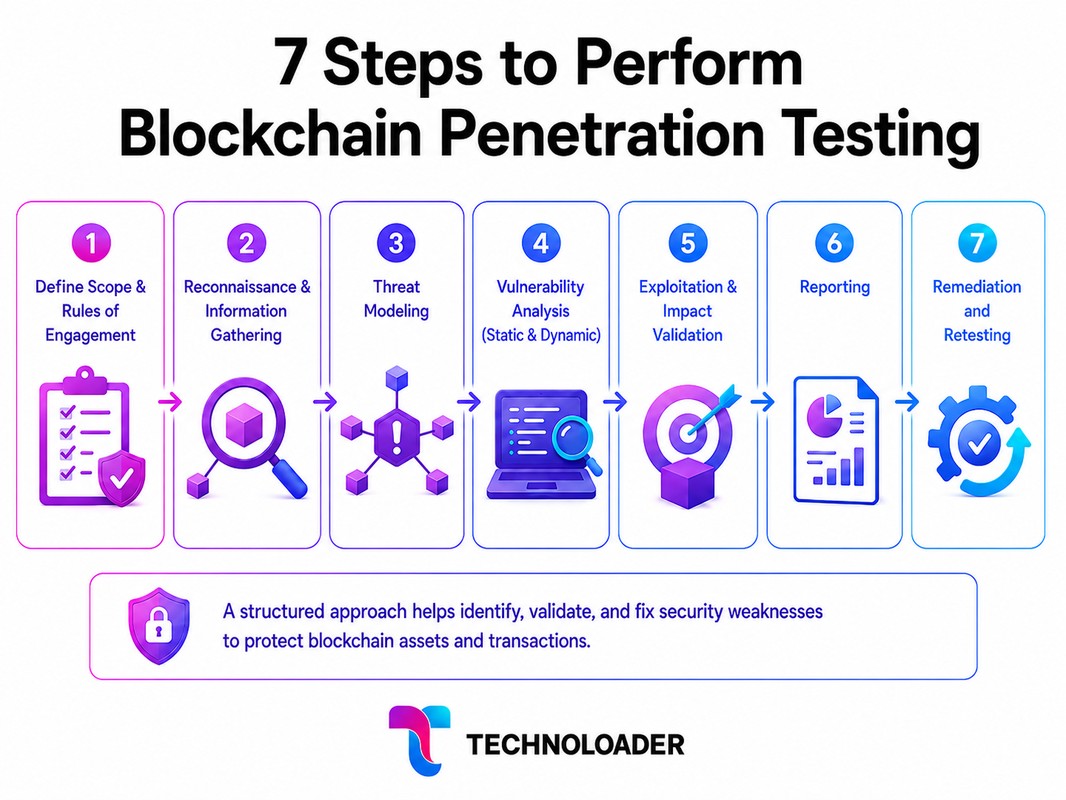
You need to follow seven steps to perform blockchain penetration testing effectively. The steps start with defining the test scope.
Next, perform reconnaissance, threat modeling, vulnerability analysis, plus exploitation and impact validation. You also need to consider reporting and retesting:
The need for blockchain security testing is also growing. In 2025, the market was worth US$455.1 million. It’s expected to grow at a 26.5% CAGR through 2033, according to Grand View Horizon:

Below is the exact sequence for blockchain penetration testing my teams use.
1. Define the Scope & Rules of Engagement
First, we decide exactly what the blockchain penetration testing team will test. This could be smart contracts, crypto wallets, blockchain nodes, APIs, or bridges.
Next, we set the testing rules. This means defining what testers can access or exploit and what must stay off-limits.
We also consider which test environment they should use. This can be a forked blockchain. It’s a copy of the system where testers can try attacks without affecting real users or funds.
Get the scope and rules approved in writing before testing begins. This helps avoid legal or operational risks.
2. Reconnaissance & Information Gathering
Reconnaissance means collecting information about the blockchain system before testing it. We identify its main parts. These may include smart contracts, blockchain network nodes, APIs, wallets, and bridges. The next step is to find areas that attackers could target.
Smart-contract code is reviewed for weaknesses. Block explorers can also show public activity. This includes transactions and contract interactions.
The process also includes identifying dependencies. These are external services or software the system relies on. My team also reviews project documents and past audit reports for known weaknesses.
3. Threat Modeling
This process identifies, assesses, and prioritizes potential security risks and attack methods. We do this before assets are exposed or code is deployed.
The goal is to understand how an attacker could exploit a blockchain system. This helps identify which attacks could cause the most damage. Here are some key questions my team asks during threat modeling:
- What blockchain assets need protection? (For example, crypto tokens or private keys)
- Who could attack the blockchain system? (Hackers, malicious validators, or compromised node operators)
- How could an attacker exploit the system? (Malicious inputs, consensus attacks, or economic manipulation)
- What would happen if an attack succeeded? (Stolen funds, changed data, or service disruption)
4. Vulnerability Analysis (Static & Dynamic)
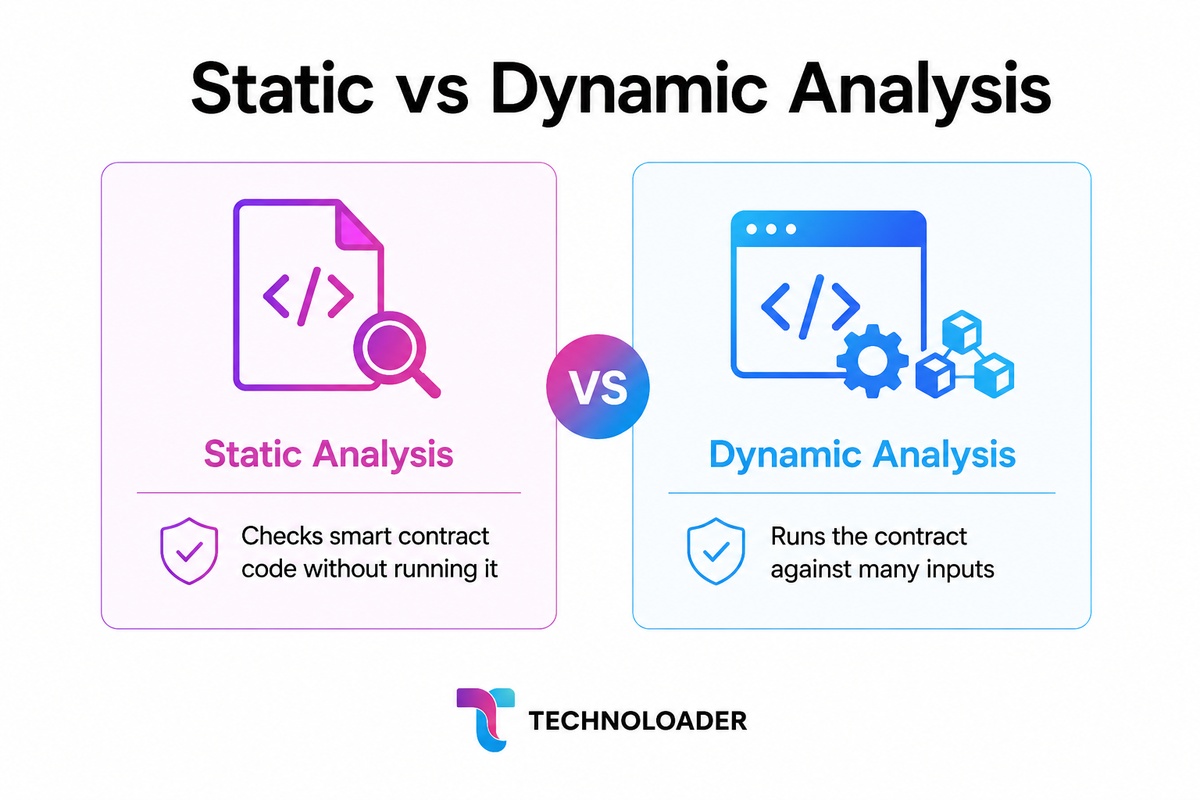
Vulnerability analysis involves looking for security weaknesses in the blockchain system. This can be done in two ways:
- Static Analysis: Checks smart contract code without running it
- Dynamic Analysis: Runs the contract against many inputs
We use tools like Echidna and Foundry to send many inputs to contract functions. This shows how the contract behaves under different conditions.
However, the test should cover more than smart contracts. It can include nodes, RPC endpoints, wallets, and the front end. This gives testers a broader view of the system’s security.
5. Exploitation & Impact Validation
Exploitation means testing whether a vulnerability can be used in a real attack. Testers may write test code or safely carry out an attack against a deployed smart contract, node, or API. This confirms whether the flaw is real.
Impact validation shows how serious the flaw is. For example, a tester checks if a smart-contract flaw could let an attacker steal funds. All testing stays controlled to avoid harming real users or funds.
6. Reporting
We document each finding and explain what went wrong, how it could be exploited, and how to fix it.
The report includes a summary for leaders and technical details for engineers. Each finding shows how serious the issue is and how testers reproduced it. It also explains what an attacker could do and how the team can fix the issue.
A clear report helps the team understand each weakness and decide what to fix first. This makes reporting a key part of blockchain penetration testing.
7. Remediation & Retesting
The final step in blockchain penetration testing is fixing issues and testing again. Remediation means fixing each security weakness. Retesting checks whether the fix actually works.
Confirm that the fix didn’t create other security issues. A vulnerability shouldn’t be considered fixed until testing confirms it’s gone.
What Are the Steps to Perform a Successful Blockchain Penetration Test?
Successful blockchain penetration testing follows seven steps. You define the scope, gather information, model threats, and find vulnerabilities.
Then test the impact of the vulnerabilities and report the findings. Don’t forget to retest after fixes.
Which Blockchain Pentesting Tools Should You Consider?
Match each tool to the right layer. For example, Slither, Mythril, Echidna, Foundry, and Certora target the smart-contract layer. For network nodes, RPC endpoints, and the front end, general tools like Burp Suite apply.
Here are the best blockchain penetration testing tools at a glance:
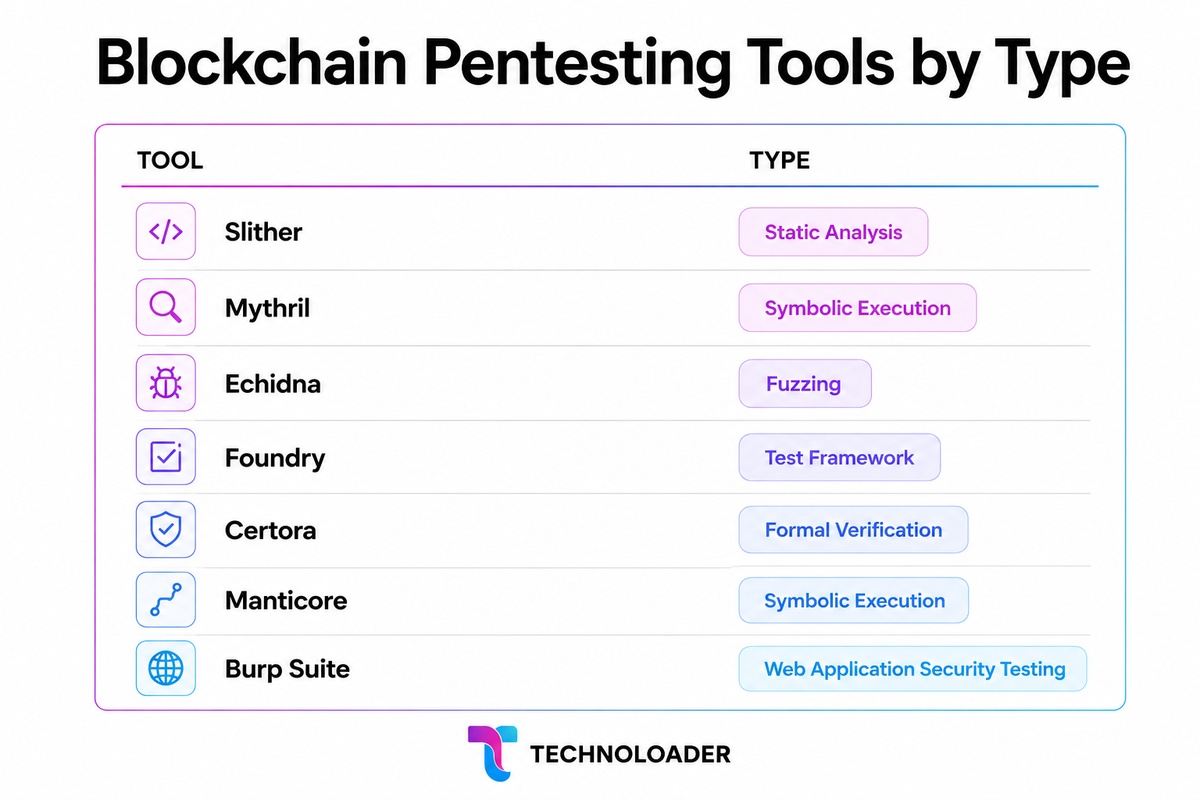
I’ve broken down each blockchain penetration testing tool by type and what it does:
| Tool | Type | What it Does |
|---|---|---|
| Slither | Static analysis | Analyzes Solidity and Vyper code and reports potential vulnerabilities |
| Mythril | Symbolic execution | Analyzes EVM bytecode – the machine-readable code used to run smart contracts.
It looks for execution paths that could cause security problems. |
| Echidna | Fuzzing | Checks whether rules you define for the contract remain true with multiple inputs.
For example, it can test whether an attacker could become the contract owner. |
| Foundry | Test framework | Runs fuzz and invariant tests on smart contracts |
| Certora | Formal verification | Checks a contract against written rules and can show when those rules are violated |
| Manticore | Symbolic execution | Explores different possible execution paths in EVM smart contracts. Generates inputs that can trigger a contract failure or violate a condition. |
| Burp Suite | Web application security testing | Tests RPC endpoints and the dApp front end |
Automated tools can also speed up vulnerability checks, according to arXiv. In 2025, three tools detected up to 76.78% of tested vulnerabilities in under one minute on average.
But these tools don’t replace blockchain penetration testers. You still need to review the results and test real attack scenarios.
Which Tools Are Used for Blockchain Penetration Testing?
Slither can analyze smart-contract code, while Mythril and Manticore use symbolic execution. Echidna and Foundry support fuzzing and invariant testing.
Certora checks contracts against written rules. Burp Suite tests RPC endpoints and dApp front ends.
What Standards & Frameworks Guide Blockchain Pentesting?
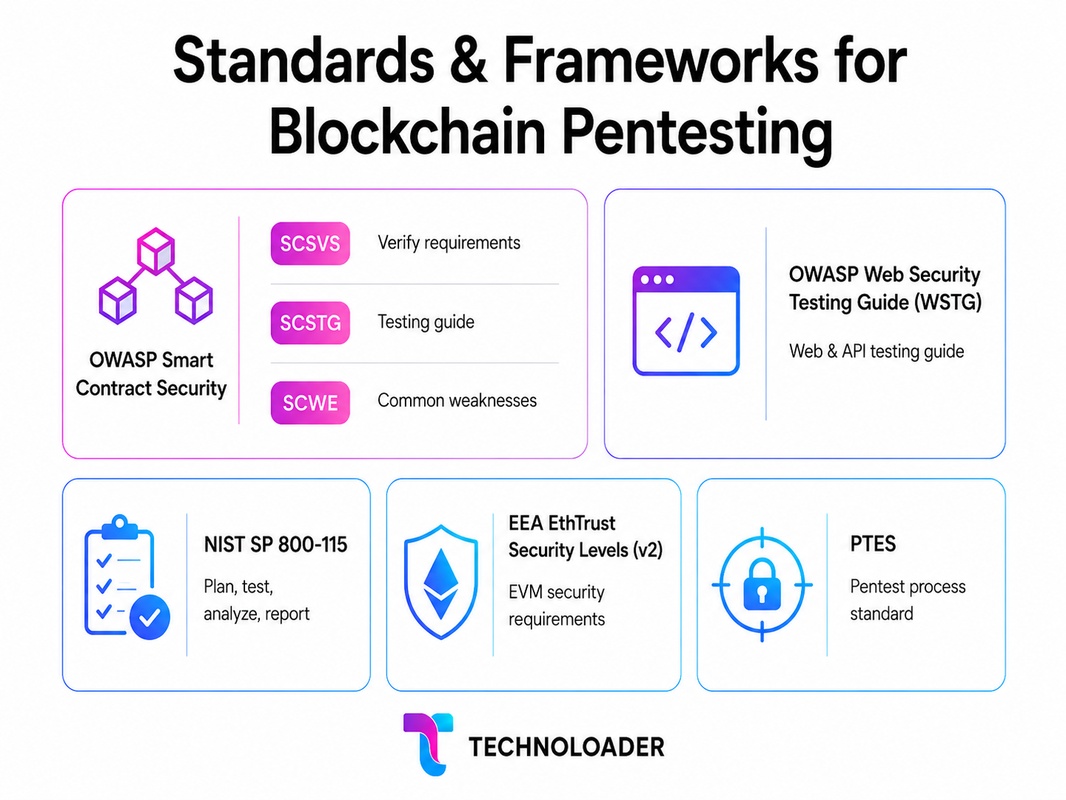
Standards and frameworks give testers structured ways to plan tests and find weaknesses. The main standards include OWASP’s Smart Contract and Web Security Testing Guides. NIST SP 800-115, EEA EthTrust Security Levels, and PTES are also on the list.
They help testers document findings and report results. Here’s a breakdown:
- OWASP Smart Contract Security:
- SCSVS: Security requirements used to verify smart contracts
- SCSTG: Guidance for testing smart contracts
- SCWE: A list of common weaknesses found in smart contracts
- OWASP Web Security Testing Guide (WSTG): A web application testing guide. It can be relevant when the blockchain system has a web interface or API that testers need to assess.
- NIST SP 800-115: Covers planning the assessment and identifying targets and vulnerabilities. It also covers testing them, analyzing results, and reporting.
- EEA EthTrust Security Levels (v2): Applies to smart contracts. It defines security requirements for Ethereum/EVM smart contracts.
- PTES: A general standard for blockchain penetration testing
Which Standards Guide Blockchain Penetration Testing?
OWASP guides smart-contract and web testing. NIST SP 800-115 and PTES provide general blockchain penetration testing methods.
The EEA EthTrust Security Levels add security requirements for EVM smart contracts.
Also Read
How Much Does Pentesting Cost & How Long Does it Take?
Cost and time depend on the scope, complexity, and layers tested. A live blockchain system may need more planning than a testnet.
There’s no flat rate. Ask blockchain penetration testing providers for a scoped quote.
Here are a few factors that can increase costs:
- Scope and Layers: A single contract costs less than a platform with nodes, APIs, and bridges
- Contract Complexity: More code and integrations require more testing time
- Live vs. Testnet: Testing a live system requires extra care to avoid disrupting users
- Manual Testing: Manual exploitation requires more time than automated scanning alone
- Retesting: Checking fixes adds another round of testing
Timelines follow the same logic. In my experience, a focused single-contract test can take about one to two weeks. Testing a full platform can take several weeks.
Here’s a table that breaks down estimated timelines for blockchain penetration testing:
| Engagement | Typical Scope | Typical Timeline |
|---|---|---|
| Single Contract | One contract, pre-deployment | About one to two weeks |
| Multiple Contracts/Protocol | Several contracts plus core logic | About two to four weeks |
| Full Platform | Contracts, nodes, APIs, wallets, and bridges | Several weeks, plus a retest |
What Is the Cost of Blockchain Penetration Testing and How Long Does it Take?
The cost depends on what you need tested. A single smart contract test costs less than a full platform with contracts, nodes, or APIs. Manual testing and retesting can also increase the cost.
Testing time depends on the same factors. A full-platform test takes longer than a single smart contract test.
How Should You Choose the Right Blockchain Pentest Provider?
Vet providers based on blockchain-specific experience and methodology. Ask for sample reports, manual testing, and retesting. Providers should also show you previous successful projects:

- Blockchain-Specific Experience: Proven smart contract and Web3 penetration testing
- Clear Methodology: A defined testing process based on OWASP, NIST, or PTES
- Sample Report: Shows clear findings, risk levels, impact, and recommended fixes
- Manual Testing: Skilled human testers who review results and test attack scenarios
- Retesting Included: They test your fixes again after the initial blockchain penetration testing
- Credible References: Named projects, client references, or verifiable case studies
What Is the Right Blockchain Pentest Provider for You?
Look for a provider with proven blockchain security experience and clear testing methods. Ask for a sample report and confirm that skilled testers perform manual testing.
Retesting should also be included. Pentest providers should also provide previous successful case studies.
FAQ
1. What is blockchain penetration testing?
Blockchain penetration testing is an authorized, simulated attack on a blockchain system. A tester probes your smart contracts, nodes, wallets, and APIs. The goal is to find and fix flaws before real attackers exploit them.
2. How is a blockchain pentest different from a smart contract audit?
An audit is a focused review of smart contract code, usually before deployment. A pentest is broader. It attacks the whole live system, including nodes, APIs, wallets, and the front end.
3. What are the stages of blockchain penetration testing?
Blockchain penetration testing typically runs in seven stages. You scope the work, gather information, model threats, and analyze vulnerabilities. Then you exploit confirmed issues, report the severity, and retest after remediation.
4. What are the main types of blockchain penetration testing?
The main types are black box, gray box, and white box. In black box testing, the tester has no internal knowledge of the system.
In white box testing, the tester has internal knowledge. This includes source code and system details. Gray box testing falls between the two.
5. What are the most common smart contract vulnerabilities?
The main smart contract vulnerabilities include access-control flaws and price oracle manipulation.
Other major risks include flash-loan attacks, poor input validation, and reentrancy. These categories are covered in the OWASP Smart Contract Top 10 (2026).
6. Which tools do blockchain security testers use?
Testers use Slither for static analysis and Mythril for symbolic execution. Echidna and Foundry handle fuzzing and invariant testing. For RPC endpoints and front ends, tools like Burp Suite work well.
7. How much does a blockchain pentest cost?
Cost depends on scope, contract complexity, and whether the blockchain system is live. A single-contract test costs less than a full-platform engagement with nodes and bridges.
8. How long does blockchain penetration testing take?
Timing depends on the scope. A focused single-contract test can take about one to two weeks. A full-platform engagement can take several weeks. Retesting after fixes can extend the timeline further.
9. How often should you run a blockchain penetration test?
Test before every major launch and after any significant code change. Many teams also run a scheduled test each year for live systems.
10. Is a blockchain pentest legally required?
No. Blockchain penetration testing isn’t generally required by law. Some financial entities have mandatory ICT testing requirements under regulations such as DORA. This can include blockchain penetration testing.
Blockchain Penetration Testing: What Are the Key Takeaways?
Blockchain penetration testing is a controlled attack on your blockchain system. It helps find security issues before attackers use them to gain unauthorized access.
To perform a blockchain penetration test, start by defining the scope and rules. Then gather information, model threats, and analyze vulnerabilities. Then safely test their impact, report the findings, and retest after fixes.
Tools can help with specific parts of this work. For example, Slither can scan smart-contract code for potential vulnerabilities. Echidna can test whether contract rules hold under many inputs.
If you want to work with an expert, explore our blockchain development services. You can also talk to our specialists about a scoped review of your blockchain system.

Vipin Kumar
Vipin Kumar is the Founder & CEO of Technoloader, a Clutch Top 10 Blockchain Development Company for 2025. A serial technology entrepreneur and blockchain architect with a B.Tech background, Vipin has led the delivery of 450+ projects across DeFi, NFT marketplaces, AI/ML, and custom Web3 platforms for clients in the UAE, India, the US, and beyond. He also founded SALIQ (saliq.ai), an AI-driven conversational marketing platform.
Published in Blockchain Development