+91 7014607737
 info@technoloader.com





Table of Contents
Quick Summary
- Blockchain for business is a secure digital ledger that lets teams share and check trusted records
- The shared record improves transparency between companies, reduces fraud, and cuts extra costs
- Common uses include supply chains, cross-border payments, trade finance, healthcare records, and asset tokenization
- Blockchain isn’t the same as cryptocurrency and isn’t completely “unhackable”
- This solution works best when several parties need one shared and trusted record
Blockchain for business is a shared digital ledger that securely records transactions. It stores these records across many computers instead of one central system. All approved teams can see the same data. No one can change past records without others knowing.
Even partners who don’t fully trust each other can still agree on one set of records. As a result, businesses can reduce errors, improve transparency, and speed up work.
Many teams still struggle with slow, manual processes and scattered data. Conflicting records can delay decisions, cause costly mistakes, and create extra work. Blockchain for business fixes this by giving your teams a single source of truth.
In this guide, you’ll learn what blockchain for business means and how it actually works. We’ll also look at the main network types, benefits, use cases, and limits. Finally, we’ll show you how to start using it wisely.
What Is Blockchain for Business?
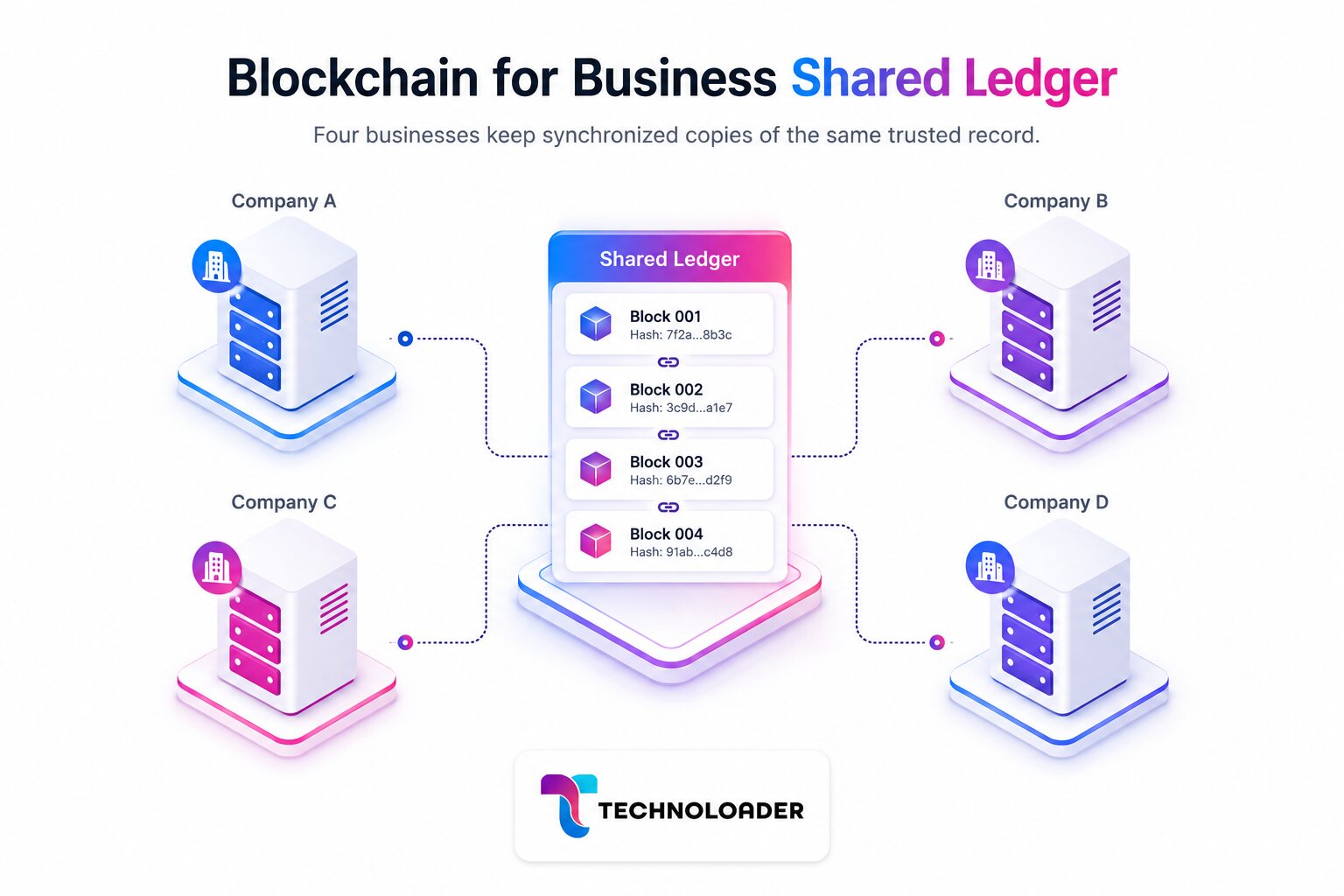
Blockchain for business is a shared digital ledger that stores company records securely. Unlike a normal database, no single person or group controls the data. Every member sees the same information at all times.
Each transaction on the blockchain network gets a timestamp and links to the one before it. This makes past data hard to change without others noticing.
Blockchain technology also uses smart contracts. These are programs that run when set conditions occur. For example, a smart contract can release payment after delivery. This reduces manual checks and speeds up routine tasks.
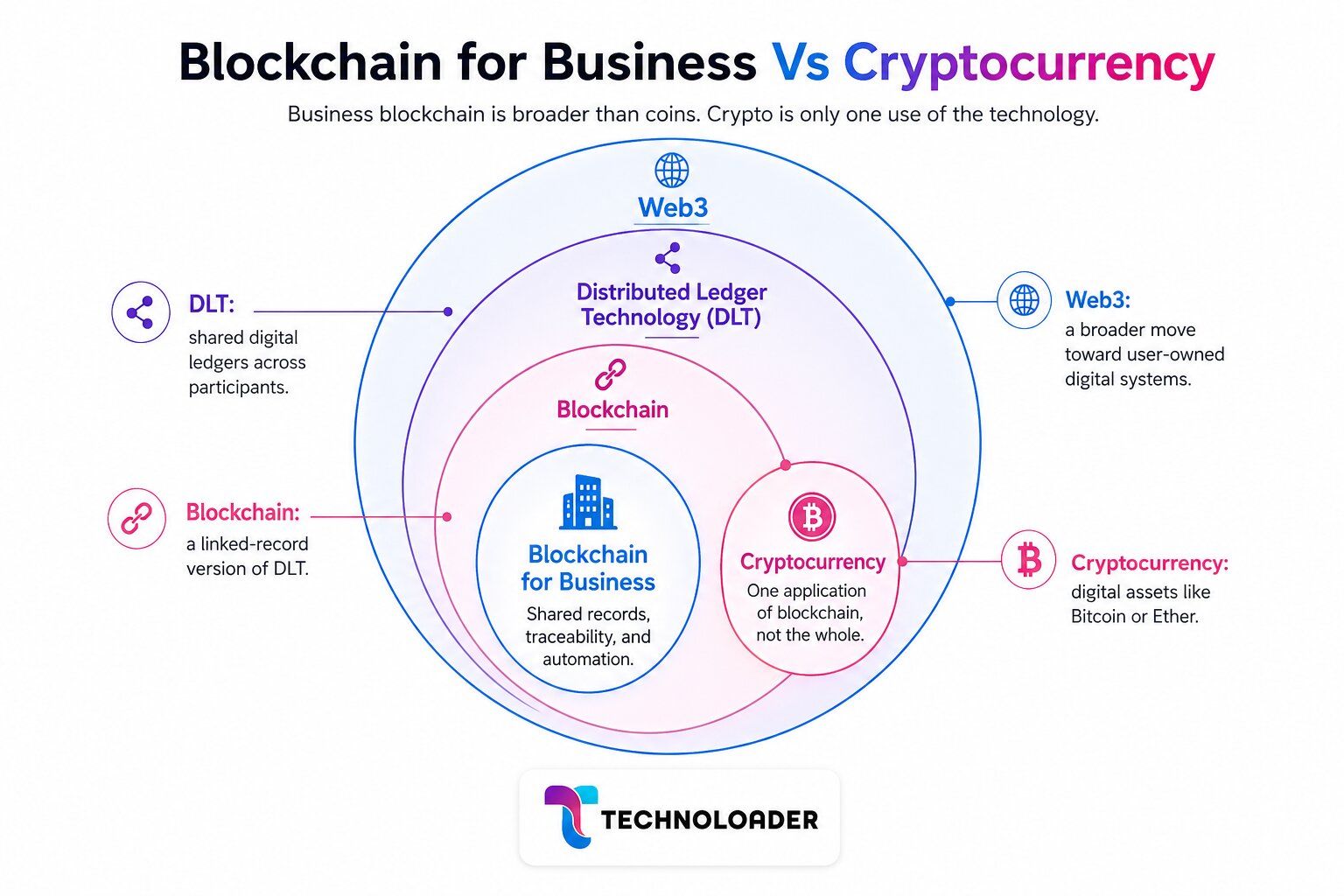
Most people also confuse blockchain for business with other related terms, such as:
- Cryptocurrency: A digital asset like Bitcoin and Ether that uses blockchain technology. You can use blockchain for business without creating a coin or trading crypto.
- Distributed Ledger Technology (DLT): A broad term for shared digital ledgers. Blockchain is only one type of DLT.
- Web3: A broad idea for a more open internet that uses blockchain technology. Users and businesses own their data instead of relying on giant tech platforms.
Public blockchains like Bitcoin aren’t a good fit for business use. A lot of companies prefer setting up permissioned or private networks that only let trusted partners join. This keeps your sensitive details safe and speeds up your daily work.
What is Blockchain for Business in Simple Terms?
It’s a tamper-evident digital ledger that lets companies share the same records. It removes middlemen and makes records easier to verify and trust.
Also Read
How Does Blockchain for Business Work?
Blockchain for business tracks, checks, links, and shares records across a secure network. First, someone submits a request. The network verifies it and adds it to a block. Then, a unique digital code links that block to the chain. This creates a permanent, shared record that every member can see.
The process follows four simple steps:
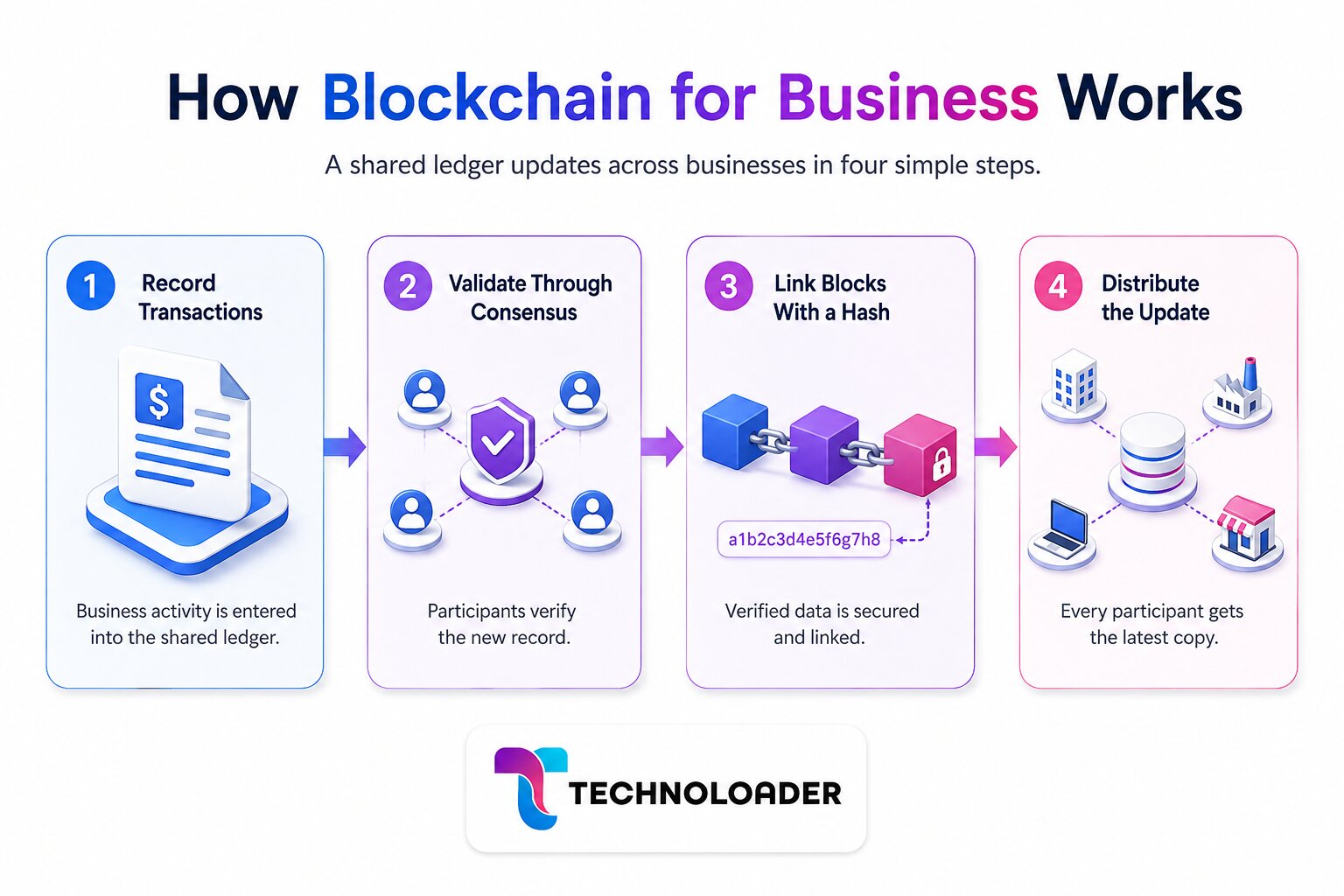
1. Record the Transaction
The process starts when someone creates a transaction. This could be a payment, shipment, or any other business event. The system records important details, such as who made it, what happened, and when.
The blockchain network then prepares this information for validation. It doesn’t add the record immediately. This step helps create a clear trail of business activity.
2. Validate It Through Consensus
Blockchain for business uses a consensus mechanism to validate transactions. This process gives members a shared way to approve new records.
Public blockchains may use methods such as Proof of Stake. Many business networks use permissioned systems where only approved members can confirm transactions.
The system checks whether the transaction meets the rules. If it passes, the network accepts it. This step helps prevent false or conflicting transactions before they enter your record.
3. Link the Block With a Hash
Next, the network groups approved transactions into a block. Each block gets a cryptographic hash, which works like a unique digital fingerprint. It represents the information inside that block.
The block also keeps the hash of the block before it. If someone changes an old record, the hashes no longer match. The network can then spot the change. This is why blockchain for business makes past records hard to alter secretly.
4. Distribute the Update
Next, the system sends the new block to every computer across the network. These computers are called nodes. Each user with access gets the same updated record.
There’s no single master server that holds the only record. Instead, the network keeps many copies in sync. This helps businesses maintain one shared and trusted record.
How Do Blockchain for Business Solutions Reach Agreement?
Members use a shared consensus rule to check whether each transaction qualifies. Once they agree, the network adds it to a hash-linked block. It then shares the updated copy with the other nodes. This process improves trust, tracking, and coordination between business partners.
Also Read
What are the Key Features of Blockchain for Business?
Blockchain for business has five main features that support safe and trusted transactions. They include decentralization, immutability, transparency, consensus, and automation.
The table below explains what each feature means and how it helps:
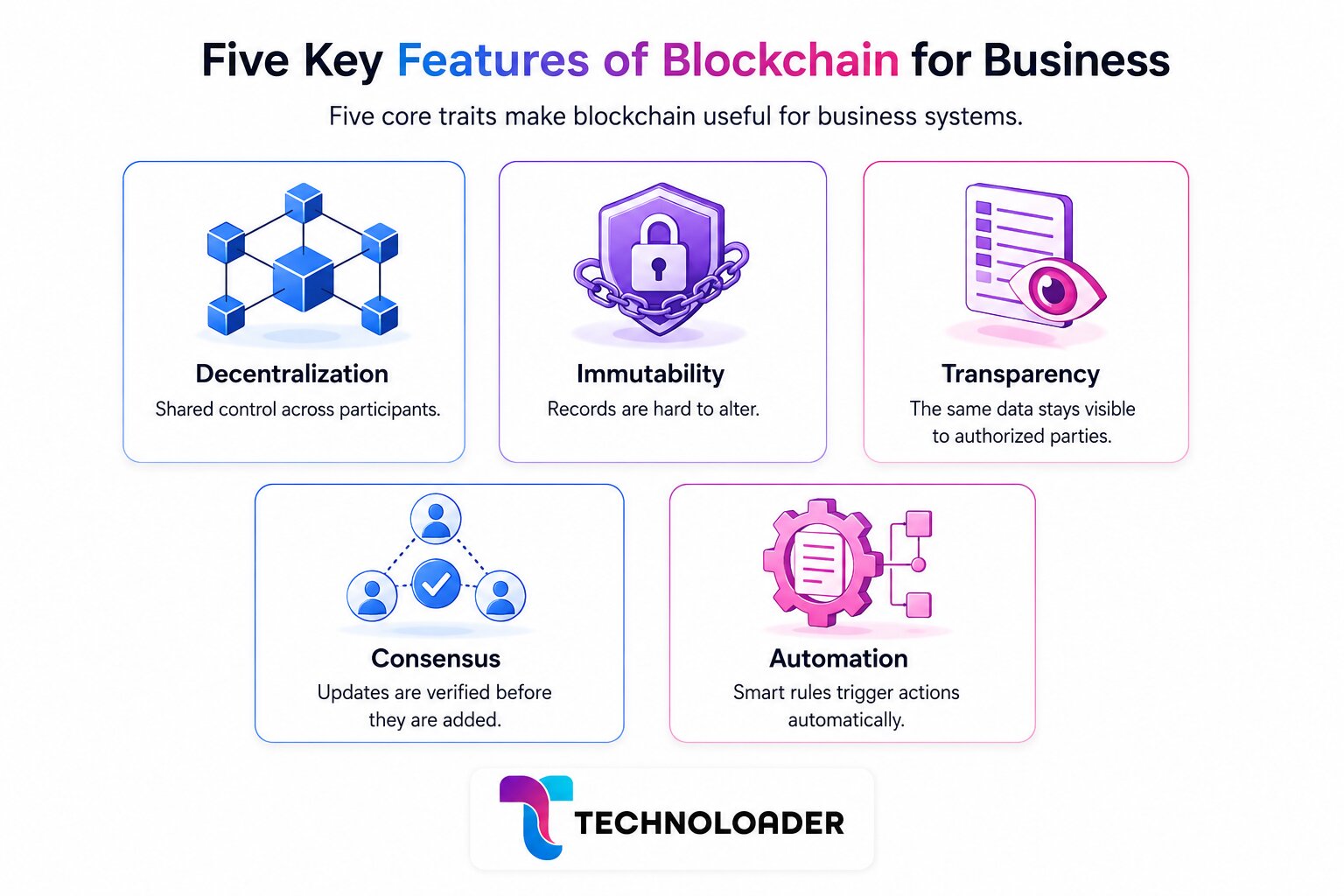
| Feature | What It Means | Why a Business Cares |
|---|---|---|
| Decentralization | Data and control sit across many network computers | Prevents system crashes and cuts out expensive middlemen |
| Immutability | Confirmed records become hard to change | Reduces fraud and creates a clear audit trail |
| Transparency | Approved members can view the same shared record | Reduces disputes and reconciliation between companies |
| Consensus | Members agree on which records are valid | Reduces the need for a central middleman |
| Automation | Smart contracts run when set rules are met | Saves time and reduces manual work |
Traditional systems often rely on one central database. Decentralization spreads data across many secure computers instead of one server. If one computer fails, your business keeps running without interruptions.
Immutability means recorded data becomes difficult to change. Blockchain for business makes unwanted changes easy to spot and reduces fraud. But it doesn’t make tampering impossible.
Transparency also helps when companies work together. When partners see the same data, they spend less time checking different records. This can reduce errors and disputes.
Consensus keeps the network in agreement. It gives independent companies a shared way to approve records.
Blockchain for business can automate tasks through smart contracts. The self-running programs take action when certain rules are met. For example, they could release a payment after a shipment reaches a set point.
What Are the Core Features of Blockchain for Business?
The key features include decentralization, immutability, transparency, consensus, and automation. Together, they help several parties share, trust, and act on the same record.
What are the Benefits of Blockchain for Business?
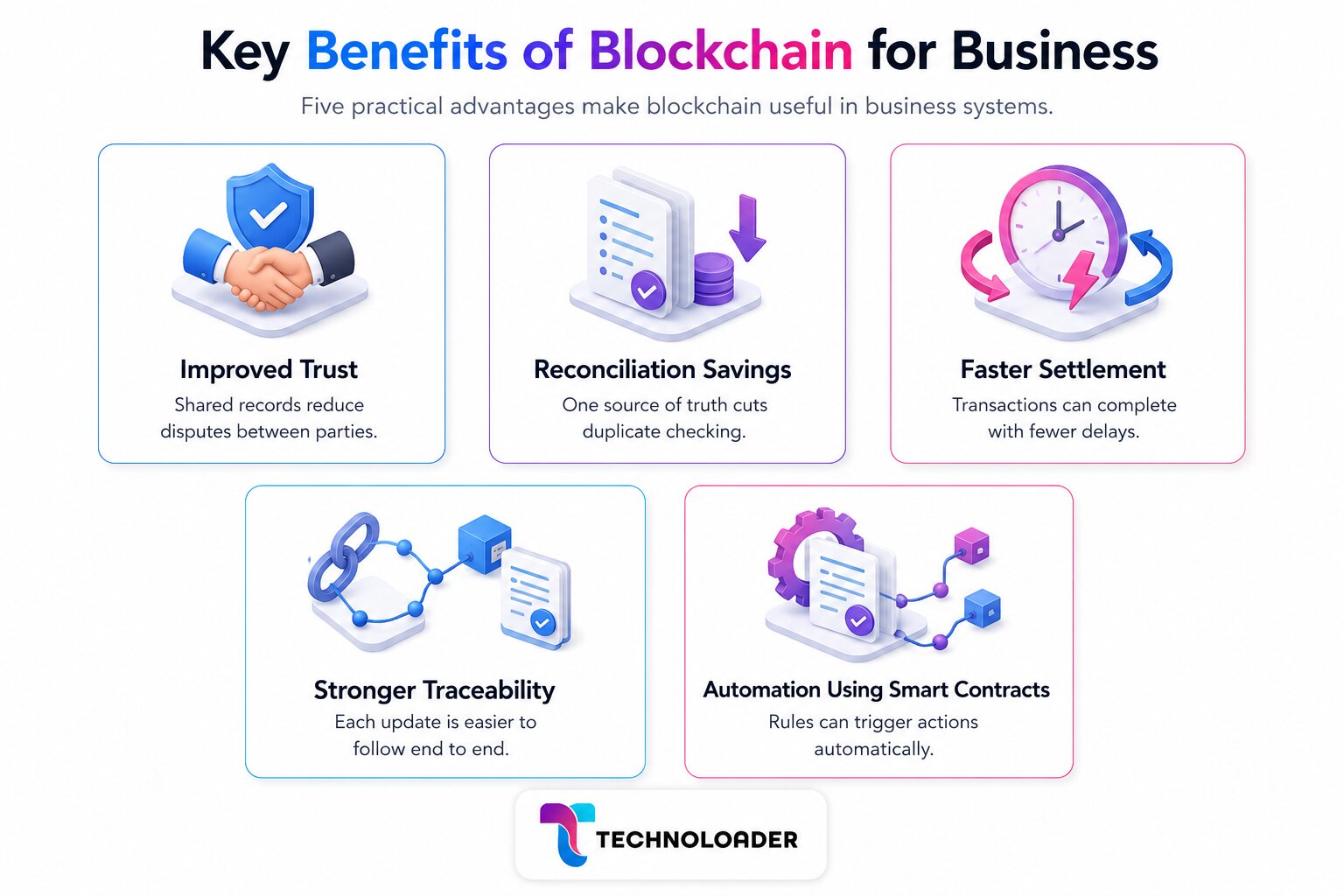
Blockchain for business makes transactions faster, safer, and more affordable. It does this by cutting manual work, speeding up settlements, and improving traceability. Partners and companies also trust each other when they have a mutual record.
Below are the main advantages of blockchain for businesses:
1. Increased Trust Between Parties
Businesses often work with partners they cannot watch closely. This can make shared data harder to trust.
Blockchain for business gives everyone the same record. Each partner can check important transaction details in near real time. When all partners see the same facts, disputes occur less often and trust improves.
2. Fewer Reconciliation Costs
Separate records can create extra work for your team. You may need to compare spreadsheets and check each entry.
With blockchain for business, everyone works from one shared ledger. This reduces manual checks and lowers the cost of keeping records in sync.
3. Faster Settlement
Traditional transactions often involve many checks and middlemen. So, payments may take days to clear.
Blockchain fixes this problem by processing transactions in near real time. When set rules match, smart contracts can release payments on their own. This helps you avoid delays from third parties.
Broadridge reported $368 billion in average daily transaction volume in November 2025. That was a 466% increase from the year before. With faster processing, you can settle payments in minutes.
4. Stronger Traceability
Blockchain records every step of an item’s journey permanently. You can track an asset from its starting point to its current location. Each step gets a timestamp and links to the next record.
You can use blockchain technology for product tracking, audits, and recalls. For example, tracing an affected product batch is quicker in one shared record. Partners also get a clearer view of what happened and when.
5. Automation Through Code
Smart contracts empower businesses by automating routine tasks. They follow rules written in computer code. Once the right conditions happen, the contract takes action.
For example, a contract could send a payment after confirming a delivery. You don’t have to handle it by hand. This reduces delays and lowers the risk of human error.
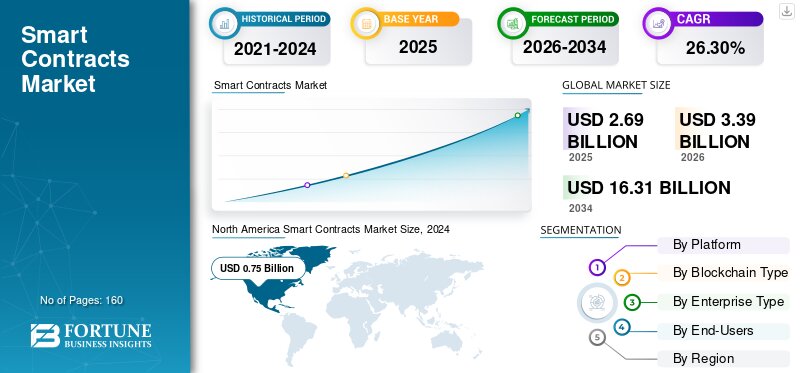
According to Fortune Business Insights, smart contract demand will keep rising. The global market was valued at $2.69 billion in 2025. It’s expected to grow from $3.39 billion in 2026 to $16.31 billion by 2034.
What Are the Biggest Benefits of Blockchain for Business?
The key benefits include greater trust, lower reconciliation costs, and faster settlements. Blockchain for business also improves traceability and automates routine tasks.
Also Read
What are the Different Types of Blockchain for Business?
The main types of blockchain for business include public, private, permissioned, and consortium. Each type gives you a different level of access and control. The right blockchain option depends on who can join the network. It also relies on who can approve new records and how much privacy you want.
Most firms pick permissioned or consortium models. That’s mainly because they blend control with shared trust. The table below will help you compare each option and pick the best fit:
| Type | Who Can Join | Best For |
|---|---|---|
| Public | Anyone | More transparency. Not suitable for private company data |
| Private | One company, by invitation | Internal records that one company owns and controls |
| Permissioned | Approved members with set roles | Most business workflows that need privacy and speed |
| Consortium | A group of approved companies | Shared industry networks, like banks or suppliers |
A public blockchain is open to anyone. It offers high transparency, but it may not be the right fit for private business data.
Unlike a public network, a private blockchain belongs to one company. The business controls who can use it, which gives you more control. However, it reduces the shared trust that makes blockchain useful.
For many companies, a permissioned or consortium blockchain is a better fit. Only approved users can access the network. You can also set clear roles and access rules.
A consortium blockchain for business works well for a group of companies. Banks, suppliers, and other partners can all share one network. Each company keeps its own identity and control.
Even so, some banks now use public blockchains. For instance, DBS used the public Ethereum network for tokenized products in 2025. So the “banks only use private chains” rule no longer holds.
Which Type of Blockchain is Best for Business?
In many cases, permissioned or consortium networks work best. They offer access control, better privacy, higher speed, and shared trust.
Also Read
What are the Applications of Blockchain for Business by Industry?
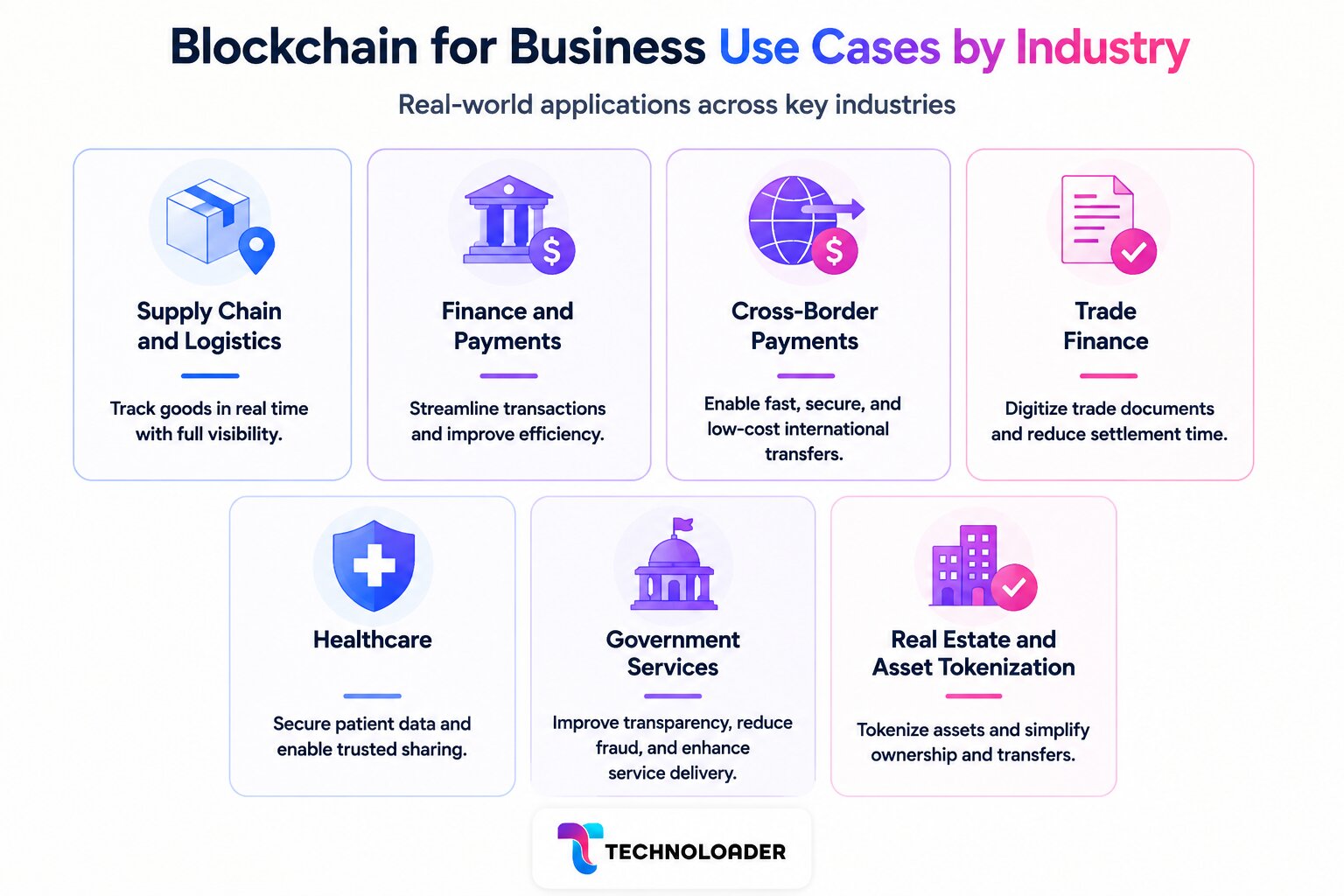
Blockchain for business works best when many partners need one trusted record. Top use cases include supply chains, payments, trade, healthcare, identity, and tokenized assets.
Here are the main areas where blockchain tech adds value.
Supply Chain and Logistics
Supply chains involve many companies, each with its own data. This can make tracking goods hard.
Blockchain in logistics gives partners one shared and traceable record. You can follow an item from its source to its final destination.
IBM Food Trust, used by Walmart, is a well-known example. The blockchain solution reduced mango-source tracking time from 7 days to 2.2 seconds.
Finance and Payments
Payments are one of the strongest uses of blockchain for business today. Shared ledgers can help banks settle transactions faster.
J.P. Morgan’s Kinexys platform shows how this technology can work at scale. The platform processed more than $3 trillion in transactions by April 2026. It now handles over $5 billion each day.
Digital assets now support real financial activity. They are moving beyond early tests and trials.
Cross-Border Payments
Sending payments across borders can take time because they involve several middlemen. The process also raises costs for companies.
Blockchain for business helps move value more directly. It removes middlemen and reduces the number of steps in a payment.
A 2026 BCG and Allium analysis estimated $350-$550 billion in stablecoin payments. The transactions were made for real goods and services. That shows growing blockchain use beyond crypto trading.
Trade Finance
Trade finance often relies on paper records. It also involves many repetitive checks between banks and traders, which cause delays.
Blockchain for business can give these parties one shared record. This can reduce duplicate work and delays.
History offers an important lesson here. Early networks like we.trade, Marco Polo, and TradeLens shut down between 2022 and 2023. Regardless, Komgo survived and remains active today. Its story shows that good governance matters as much as blockchain technology.
Healthcare and the Healthcare Supply Chain
Health data often sits in separate systems that may not work well together. A permissioned blockchain in healthcare can help providers share trusted data. You can also use it to manage patient consent.
In the supply chain, blockchain can help verify drugs and medical devices. This can make it easier to spot fake or unsafe products.
Digital Identity and Government Services
Blockchain for business can support digital credentials that you control. These credentials can prove claims such as a license or degree. It’s a great way to share proof without giving every detail to a central database.
Governments are testing this for records and public services.
Real Estate and Asset Tokenization
Blockchain for business can represent property and funds as digital tokens. This can make ownership easier to track and transfer.
The token represents a claim on an asset. The real asset still sits under normal legal and custody rules.
Tokenized real-world assets on public chains reached about $38.07 billion by mid-2026, according to RWA.xyz.
Insurance and Beyond
Insurance involves many claims and checks. This can create delays and disputes.
Blockchain for business can bring these records into one shared system. Smart contracts can also trigger payments when agreed conditions are met.
For example, a smart contract could release a claim payment after it confirms a covered event. This means blockchain in insurance can reduce manual work and speed up settlement. It also shows the technology’s value beyond finance.
What Are the Top Business Use Cases for Blockchain?
The main areas include supply-chain tracking, payments, cross-border payments, and trade finance. Healthcare records, digital identity, insurance, and asset tokenization also earn a spot.
Also Read
Is Blockchain for Business Secure?
Blockchain for business can improve security and reduce some types of fraud. Still, it’s not totally unhackable and cannot guarantee 100% safety.
The technology makes records tamper-evident and tamper-resistant. Changing a confirmed record is very hard under normal network rules. This gives you a strong layer of protection. Even so, it doesn’t mean that nothing can ever go wrong.
Risks can come from hackers, software, devices, and connected systems. Here are some common security risks to watch out for:
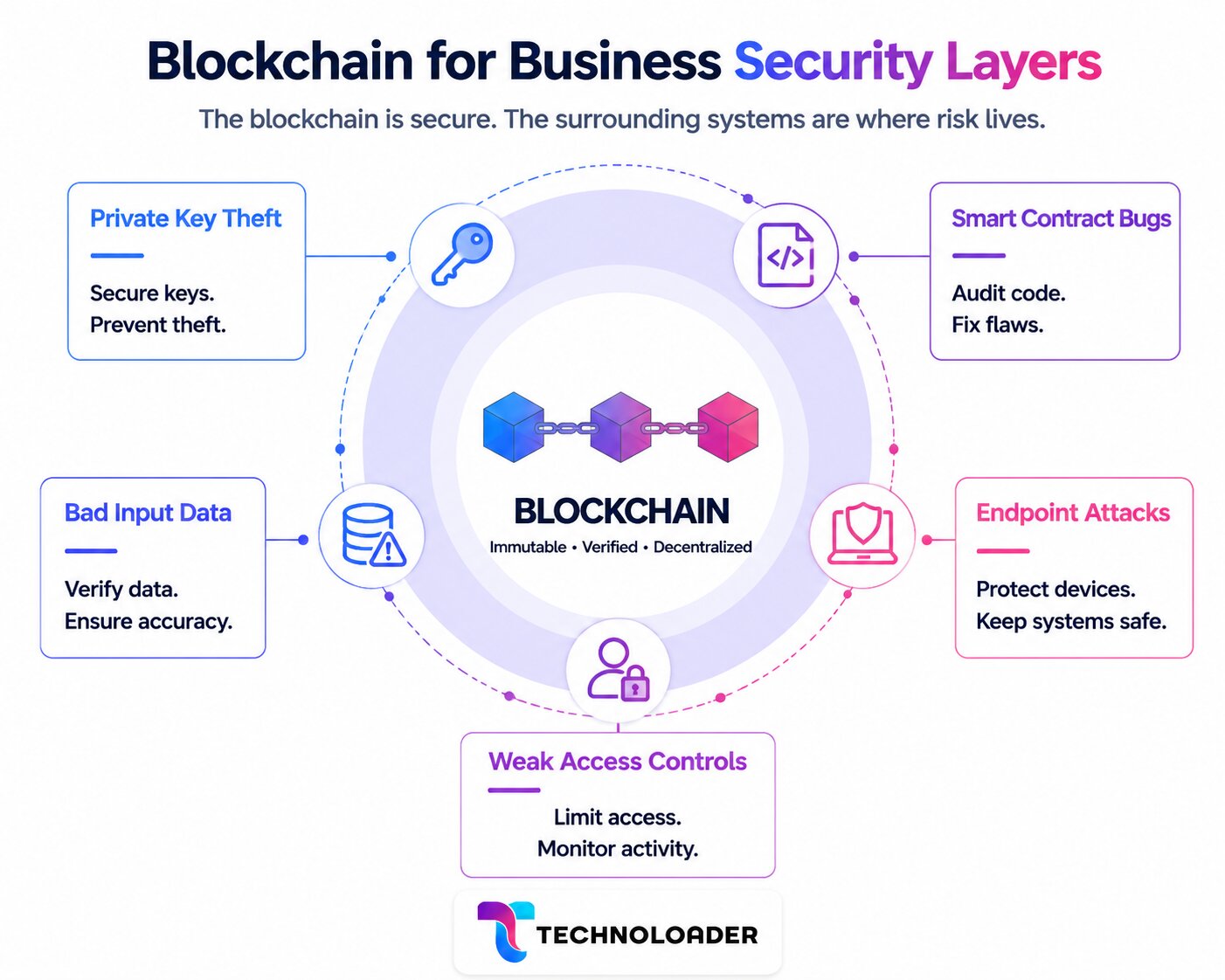
- Private Key Theft: Attackers can steal keys and access digital assets. To prevent this, store sensitive keys in secure systems with backup controls.
- Smart Contract Bugs: Coding mistakes can create security gaps. To avoid this, test and audit smart contracts carefully before using them.
- Bad Input Data: Blockchain for business cannot fix incorrect information. So, verify data before adding it to the network.
- Endpoint Attacks: Attackers can target computers, wallets, and other connected devices. You can secure your systems by updating them regularly.
- Weak Access Controls: Poor permissions can expose sensitive business records. Give users only the access they need and watch for unusual activity.
A public network with few participants can also face a majority attack. An attacker may gain enough control to change parts of its history. A large, well-spread network makes attacks harder and more costly.
Treat the blockchain as a firm base, then build good controls on top. Security is a shared job for every partner on the network.
Is Blockchain for Business 100% Secure?
No, blockchain for business doesn’t guarantee complete security. It makes data hard to alter and reduces certain fraud risks. However, you still need strong systems, controls, and security practices.
What are the Challenges and Limitations of Blockchain for Business?
Blockchain for business offers many benefits, but it also has limits. The main issues include low speed, high costs, adoption dependency, inaccurate data, and interoperability. You should understand these limits before launching a project.
Here are the main challenges of blockchain for business:
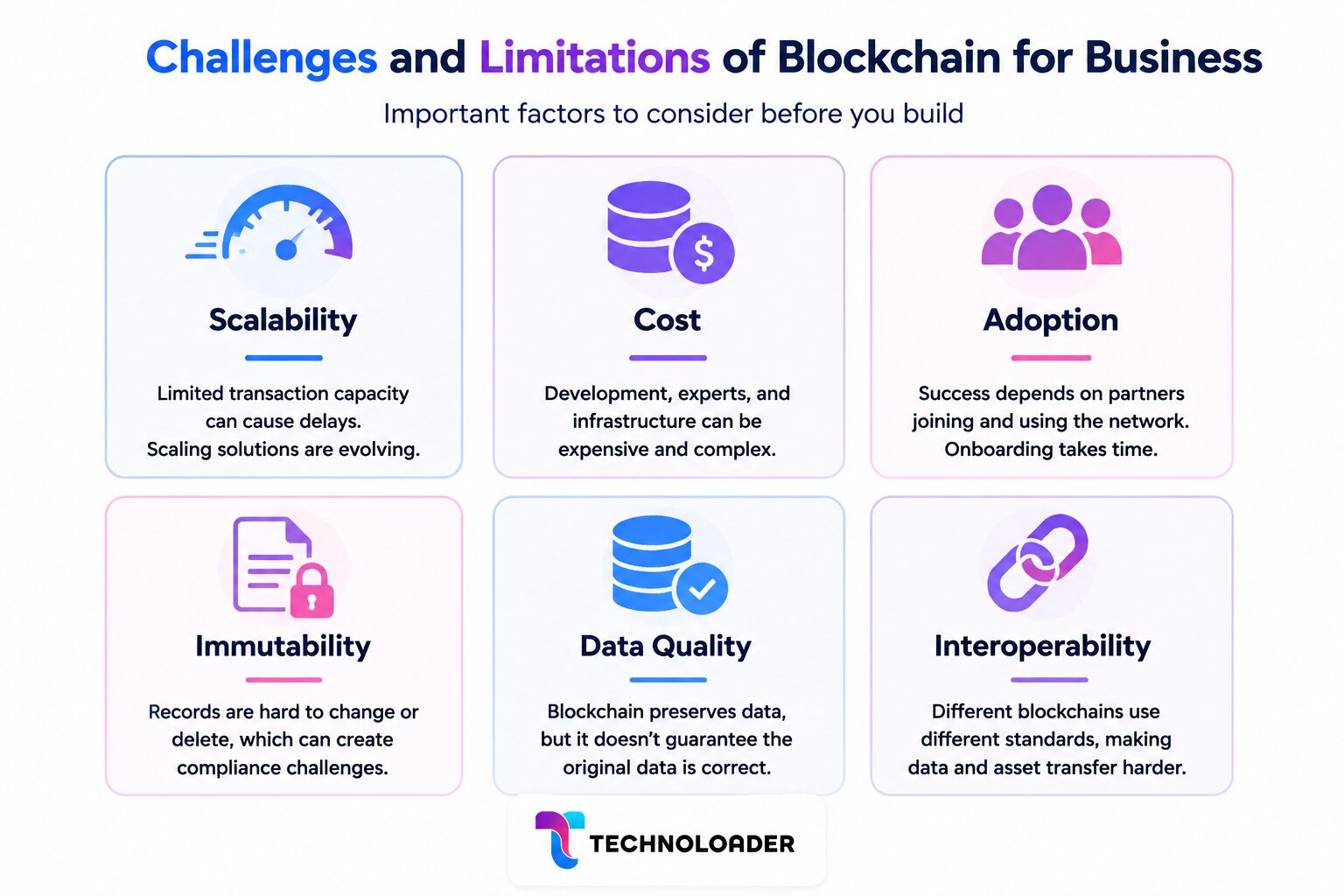
Scalability and Speed
Some blockchain networks can only handle a limited number of transactions. In 2026, many projects are using Layer 2 networks to improve speed and lower costs.
Rollups process groups of transactions off the main chain. They then record the results on the main network. This can reduce both cost and delays.
Cost and Complexity
Building blockchain for business requires new skills and tools. You may need experienced developers and security specialists. You might also face infrastructure and integration expenses.
If your shared-data problem is small, the extra cost may not make sense. Always compare blockchain with simpler options first.
Adoption Dependency
Blockchain for business works best when your partners join and use the network. Getting them onboard can take time.
Many early projects struggled for this reason. TradeLens is a useful example. The technology worked, but very few partners committed to the network.
Immutability Can Become a Liability
Hard-to-change records improve blockchain security and protect transaction history. These features are useful until you need to remove data.
Editing incorrect details or erasing sensitive information is very difficult. This can create problems with some privacy rules.
Data Quality
Blockchain for business only protects records from changes after you add them. It doesn’t prove that the original data was correct.
For example, a supplier could enter the wrong product details. The network records and preserves that mistake. This means you still need to verify information before it enters the chain.
Interoperability
Different types of blockchain networks use independent systems and standards. This means moving data between them can be difficult. Standards are getting better, but many blockchain projects still face friction here.
What Are the Main Challenges of Blockchain for Business?
The biggest issues include speed, cost, adoption, data quality, and interoperability. Blockchain for business also makes correcting records more difficult. Careful planning can help you manage these limits and avoid costly mistakes.
What Governance and Compliance Regulations Apply to Blockchain for Business?
Blockchain for business must follow the laws that apply to its use and location. These rules cover privacy, financial activity, security, governance, and data handling. They determine who controls the network and how you’ll protect private information.
Here are some of the main blockchain compliance rules to consider:
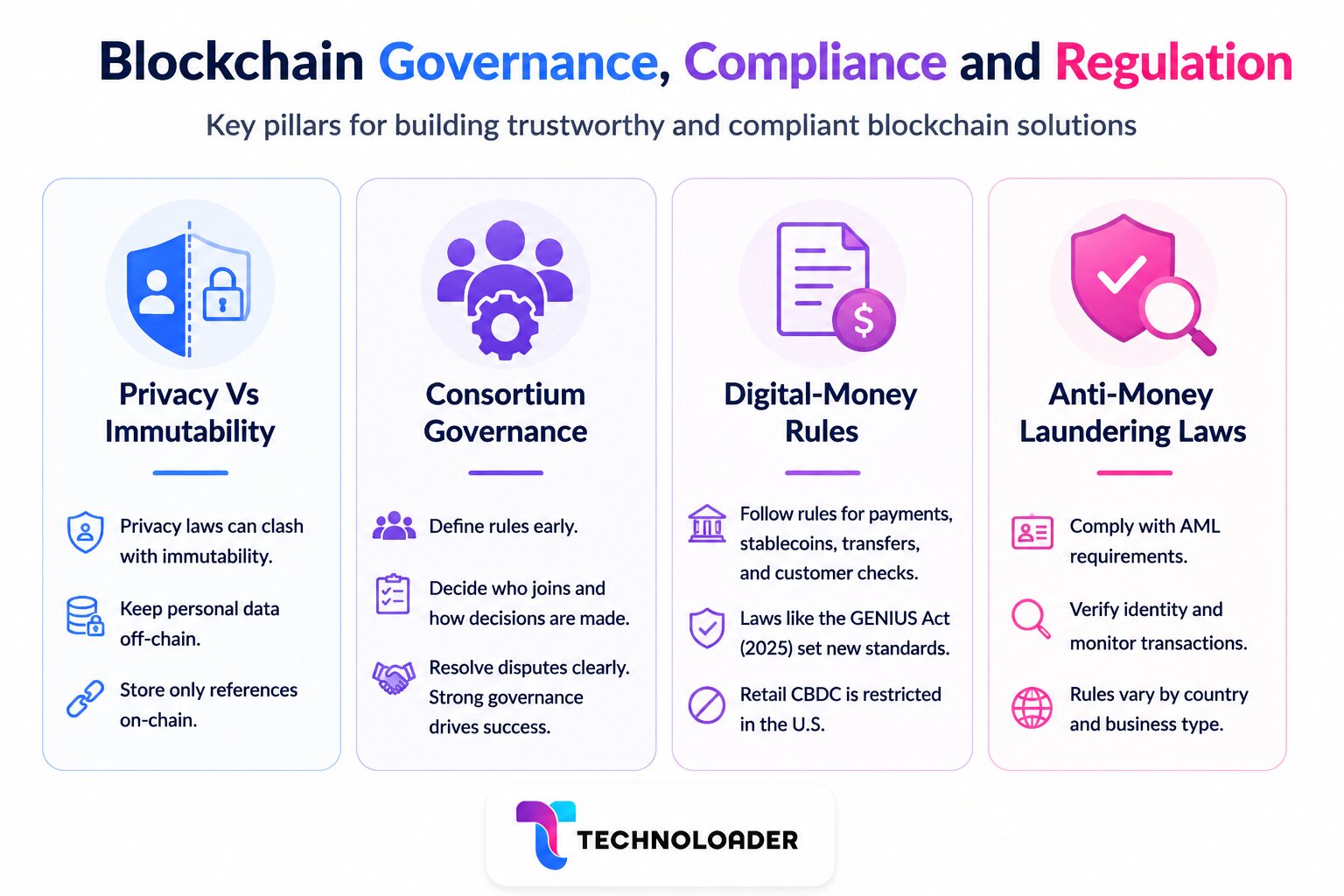
- Privacy Versus Immutability: Laws like GDPR give people the right to delete personal data. That can clash with blockchain’s hard-to-change records. A common fix is to store sensitive details off-chain. You can then keep a simple reference on the chain.
- Consortium Governance: Shared networks need clear rules from the start. You must decide who approves new members and handles disputes. Everyone should agree on these rules before launch. Weak oversight sinks more projects than the system itself.
- Digital-Money Rules: Financial blockchain projects face extra requirements. These rules cover payments, stablecoins, money transfers, and customer checks. In the United States, the GENIUS Act became law in 2025. It created a federal framework for payment stablecoins. A retail central bank digital currency is currently restricted there.
- Anti-Money Laundering Laws: Blockchain for business projects must follow AML requirements. These rules prevent money laundering and financial crime. They often involve customer identity checks and transaction tracking. Requirements vary by country and business type.
Is Blockchain for Business Compliant With Data-Privacy Laws?
It can be, if you design it with privacy in mind. Keeping personal data off-chain can help. Storing personal records on an unchangeable ledger may conflict with GDPR erasure rights.
Also Read
How Do You Implement Blockchain in Your Business?
The best way to use blockchain for business is to start small. Don’t try to change everything at once. Pick one real problem and test the idea first. A small project helps you prove value before you spend more. It also gives you time to find and fix problems early.
Here are five simple steps to follow:
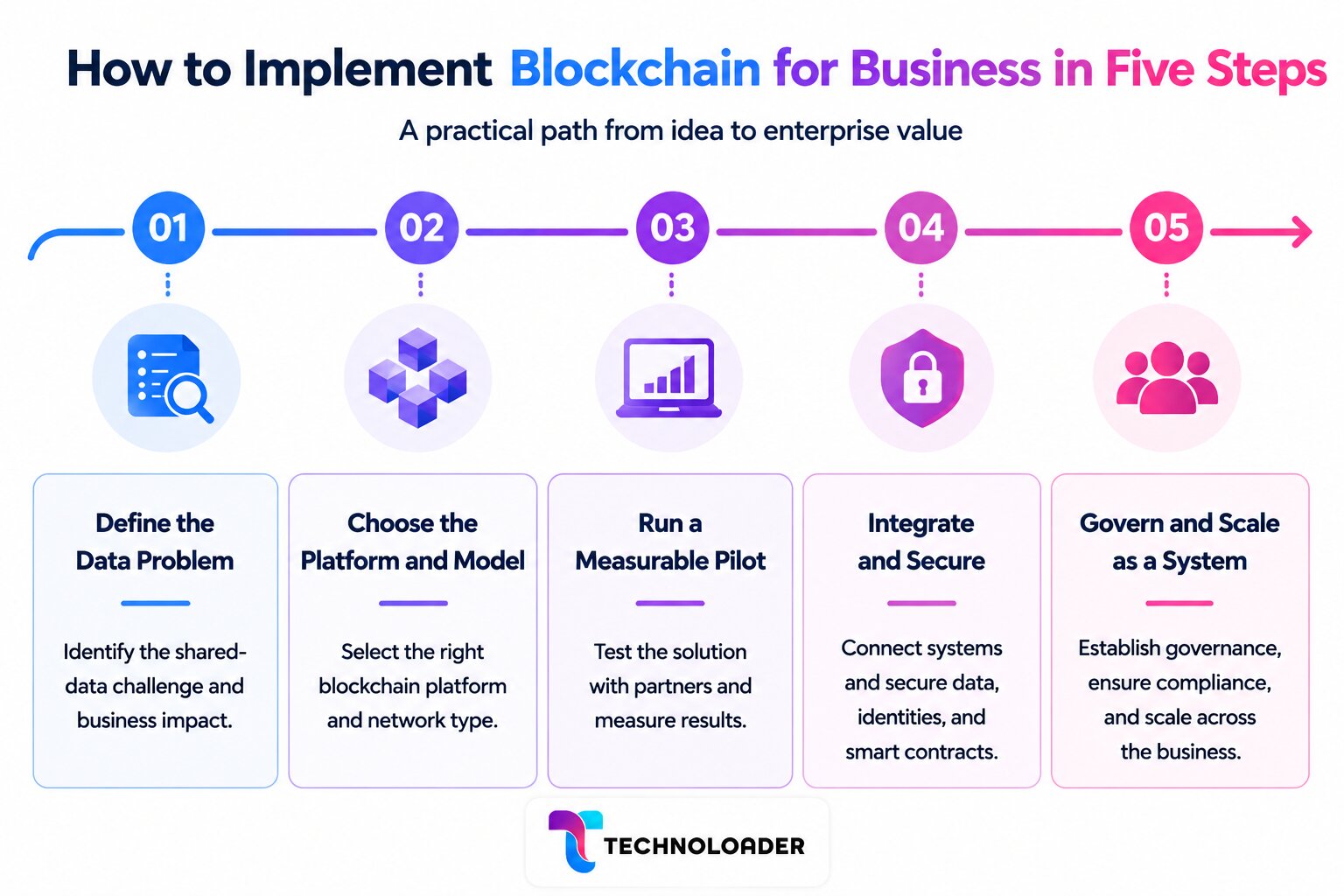
1. Define the Shared-Data Problem
Start with the business problem rather than the technology. Look for processes involving several parties and identify what records they need to share. Then, find the trust gap between the groups.
If the shared data issue is minor, stop here. A normal database may work better than blockchain.
2. Choose the Model and Platform
Next, pick the right blockchain type. A permissioned or consortium network often fits blockchain for business projects.
Then choose a platform that matches your needs. Don’t select a blockchain just because it’s popular. Instead, think about your privacy, speed, cost, and access needs. The best network should support your expected workload.
3. Run a Pilot With Clear Metrics
Start with one simple workflow that’s easy to measure. Set your goals before you begin. You could track time saved, costs reduced, or disputes avoided. Clear metrics help you prove that blockchain for business adds value.
If you cannot measure the results, you cannot tell if the pilot worked.
4. Integrate and Secure
Connect your blockchain test project to your existing business systems. These may include ERP, CRM, finance, identity, and data tools.
Then test the smart contracts and secure your private keys. You should also check the system for possible vulnerabilities and attacks.
Do this security work before launch rather than waiting until something goes wrong.
5. Govern and Scale
Finally, set clear rules. Agree on who runs the network, onboards new members, and settles disputes.
Once the pilot works, you can add more partners and workflows. Good governance keeps blockchain for business useful as participation grows.
Also, be realistic about costs. Building a custom blockchain needs skilled developers and time. Blockchain-as-a-Service (BaaS) can lower your starting cost by letting you use managed infrastructure.
Weigh both options against the value you expect to gain to pick the right fit.
How Do I Implement Blockchain for Business?
Start with a shared-data problem that needs a trusted record. Then choose the right network, run a test with clear goals, and link it securely. Finally, set strong governance rules before scaling blockchain for business across your organization.
Also Read
FAQ
1. What is blockchain for business, in simple terms?
Blockchain for business is a shared digital ledger that safely stores company data. It lets approved parties record payments, track assets, and share the same trusted information. No single person controls the full record.
Once the network confirms a record, it becomes very hard to change. This transparency makes blockchain for business useful when companies need to work together.
2. Is blockchain the same as cryptocurrency or Bitcoin?
No. Blockchain is the technology behind Bitcoin and many cryptocurrencies. Bitcoin is simply a type of cryptocurrency that runs on blockchain. Companies can use blockchain for business without coins or crypto trading. You can use it to track products, verify records, automate contracts, and share data.
3. What are the four types of blockchain?
The four main types are public, private, permissioned, and consortium. Public blockchains allow anyone to join. Private blockchains stay under one organization’s control. Permissioned and consortium blockchains limit access to approved members. Many companies choose these models for better privacy and control.
4. How can I use blockchain in my business?
Use blockchain for business when several parties need one trusted record. You can use it to track physical products across supply networks. It also speeds up cross-border payments via smart contracts and keeps financial records accurate. Healthcare groups store patient files safely on it, while real estate firms use it to process property titles faster.
5. Is blockchain for business 100% safe?
No technology is completely safe. Blockchain for business makes records very hard to change. However, attackers can still target wallets, accounts, smart contracts, and connected systems. To reduce risks, add strong security controls around the technology.
6. How much does blockchain implementation cost?
The cost depends on your project size, network choice, features, and build method. A custom system needs skilled developers and time, adding to your total budget.
Cloud services can lower your entry costs by renting tools to you. Always compare your total spend against the value you expect to get.
7. Is blockchain only useful for finance?
No. Finance is one of the strongest use cases. But blockchain for business can help in many other fields. Companies use it for supply chains, healthcare, real estate, and insurance services. It can fit any process where different parties need one trusted source of truth.
8. What is the biggest problem with blockchain for business?
Adoption and fit are two major challenges. A shared network needs partners to join and use it. Some projects fail because companies cannot agree on rules. Others fail because a normal database could solve the same problem. Before choosing blockchain for business, make sure you have a strong reason to use it.
9. Is any new tech replacing blockchain?
No. Blockchain continues to develop alongside AI and tokenization. Many AI systems and digital assets build on its foundation, rather than replace it. The trend points toward more integration with business tools.
Ready To Adopt Blockchain for Business?
Blockchain for business is a shared, tamper-evident ledger. It helps companies trust and use the same records without one central middleman.
Use blockchain for business when several parties need to share one trusted record. Skip it when a simple database can solve the problem.
If you are considering a real project, start small. Pick one clear problem and set simple success metrics. Then test the idea before you scale.
My team at Technoloader builds blockchain solutions for businesses. We can help from early planning through production.
If you have a use case in mind, contact us today, and we can map it out together. Feel free to share your questions in the comments, and I’ll answer them.

Vipin Kumar
Vipin Kumar is the Founder & CEO of Technoloader, a Clutch Top 10 Blockchain Development Company for 2025. A serial technology entrepreneur and blockchain architect with a B.Tech background, Vipin has led the delivery of 450+ projects across DeFi, NFT marketplaces, AI/ML, and custom Web3 platforms for clients in the UAE, India, the US, and beyond. He also founded SALIQ (saliq.ai), an AI-driven conversational marketing platform.
Published in Blockchain Development