+91 7014607737
 info@technoloader.com





Table of Contents
Quick Summary
- What it is: Blockchain tracks content rights, ownership, and payments on a shared, secure ledger.
- Why it matters: It cuts middlemen, pays royalties faster, and gives creators more control.
- Where it works: Streaming rights, royalty smart contracts, NFTs, anti-piracy, and fan engagement.
- Who uses it: NBA Top Shot, Audius, Royal, Chiliz–Socios, Ubisoft, and others in gaming, music, and sports.
- The honest limits: Use is still early, with regulation, cost, and ease of use remaining real hurdles.
Blockchain in entertainment is the use of distributed-ledger technology to record rights, ownership, and payments for digital content.
Creators, platforms, and fans all get access to the same secure ledger. As a result, the entertainment industry can strengthen digital rights management, better protect intellectual property, and automate payments.
The market is growing fast. Mordor Intelligence puts the blockchain in media and entertainment at $4.46 billion in 2026.
I’ve built blockchain and Web3 platforms for years, so this guide is practical.
You’ll see how blockchain in entertainment works, and where it’s used across streaming, music, film, gaming, and sports. We’ll also look at the gains and risks for businesses, and what’s next for the industry.
What Is Blockchain in Entertainment?
Blockchain in entertainment is a way to record who owns, licenses, and gets paid for creative content. It all sits on one shared, tamper-evident ledger where, once data is confirmed, changing it becomes very hard.
Instead of storing records in one place, a blockchain keeps a distributed ledger across many computers, known as nodes. Transactions are added in blocks and linked in series using cryptography.
That approach works well for the media and entertainment industries. The ledger records streaming rights, royalties, digital assets, and content authenticity, giving everyone the same trusted record to work from.
Blockchain in entertainment supports the music, film, gaming, sports, and live event sectors. It helps solve slow payments, unclear ownership, and digital rights management challenges.
You can read more about how blockchain works in our beginner guide.
Quick Answer: What Is Blockchain in Entertainment?
It’s the use of a shared, tamper-evident ledger to manage content rights, ownership, and payments. Blockchain in entertainment helps creators, platforms, and fans complete financial transactions with fewer middlemen and clearer records.
Also Read
How Blockchain Works in Entertainment
Blockchain technology in entertainment turns rights and payments into shared records and automated code. The ledger stores who owns what, and smart contracts handle the payouts.
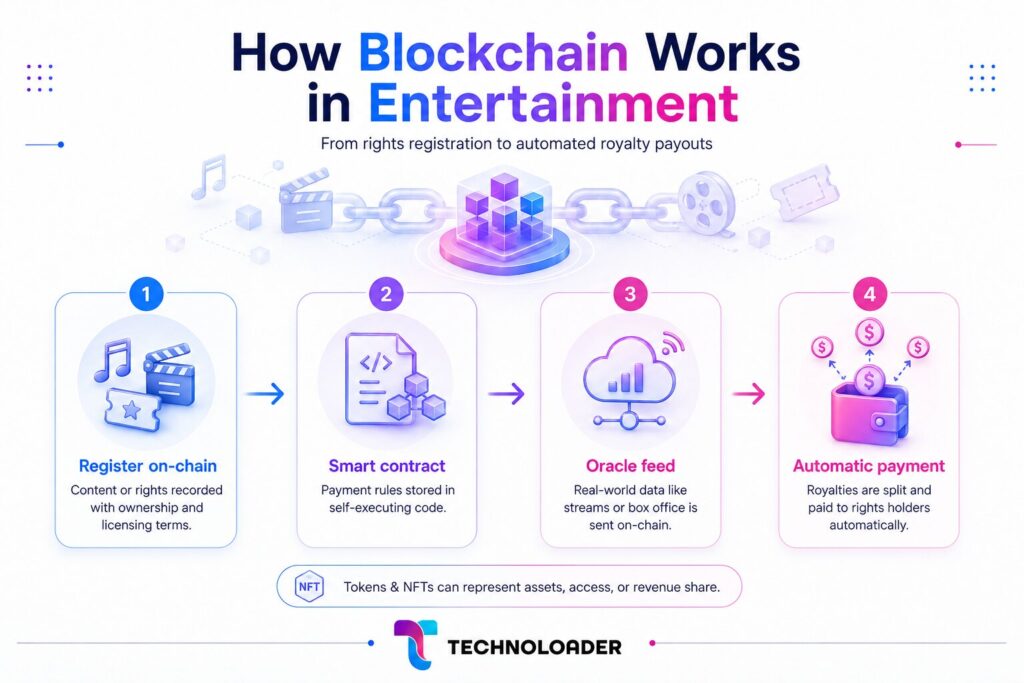
Here’s how the process works, in plain terms.
First, a piece of content or a right is registered on the decentralized ledger. This creates a verifiable record of ownership and licensing terms.
Second, a smart contract stores the payment rules. This contract is a self-executing program that runs automatically when its conditions are met.
Third, an oracle feeds real-world data into that contract. An oracle is a service that brings off-chain information, like a stream count or box-office sales, on-chain. Providers such as Chainlink supply this data.
Fourth, the smart contract releases payments automatically after its conditions are met. Creators, record labels, publishers, and other rights holders each receive the share they’ve agreed to.
Tokens and NFTs build on this system. They can represent digital assets, ownership, special access, or even a share of future revenue. They’re also easy to transfer across multiple platforms.
Quick Answer: How Does Blockchain Work in Entertainment?
Content rights are recorded on a blockchain, and smart contracts automate payments. Oracles supply real-world data, making licensing and revenue sharing faster and more reliable.
Also Read
Key Applications of Blockchain in Entertainment
The use cases of blockchain in entertainment span rights, royalties, ownership, anti-piracy, distribution, and fan engagement. Each one solves a specific, long-standing problem in the industry.
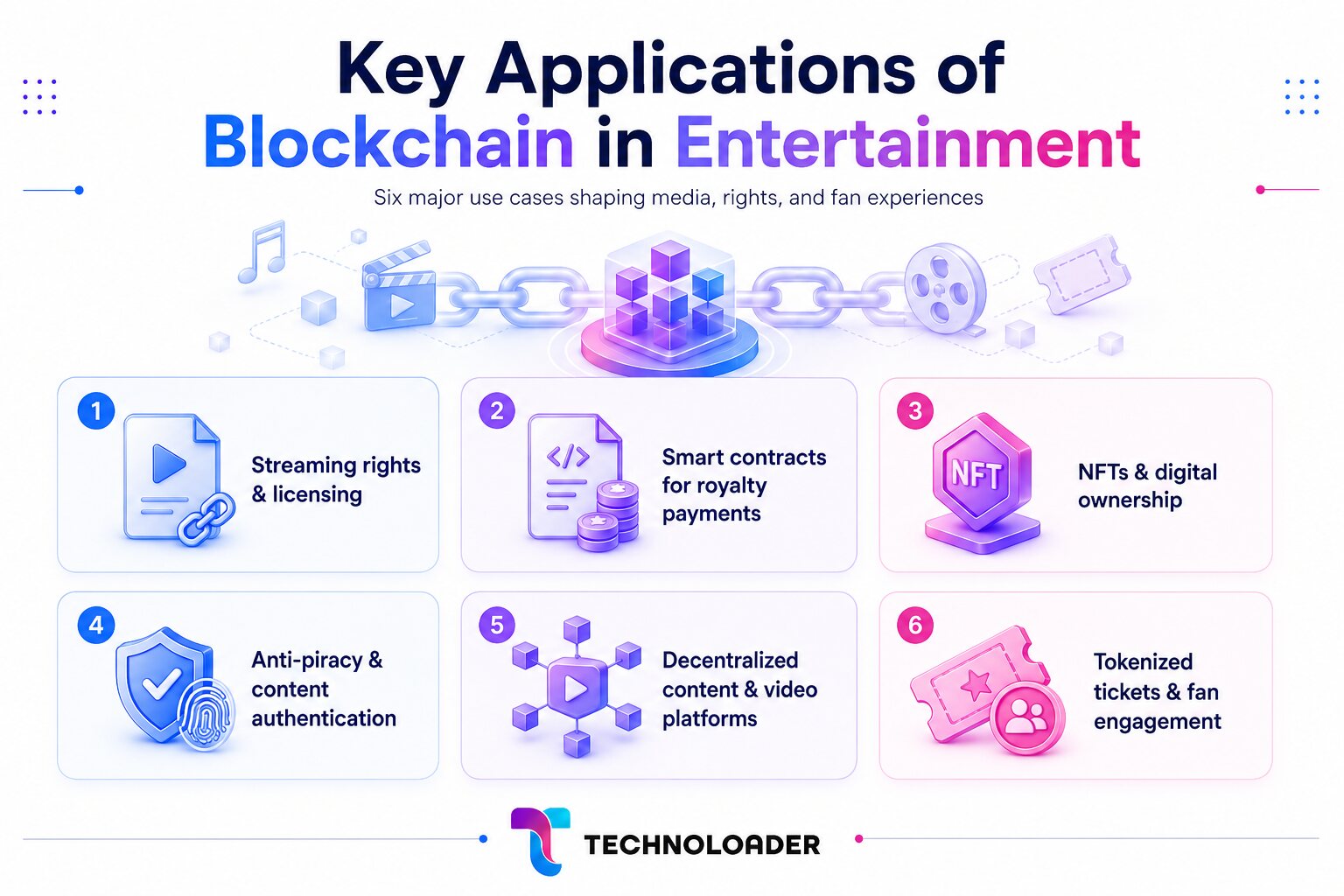
Streaming Rights and Licensing
Ownership, distribution deals, and royalty terms can all be recorded on a secure blockchain ledger. This gives streaming rights a single, shared source of truth.
When everyone uses the same data, creators, distributors, and platforms can track rights in real time. This lowers the risk of duplicate licensing or ownership disputes.
Machine-readable terms also help speed up monetization. Rights metadata stays attached to the content, so downstream platforms inherit the correct terms automatically.
Smart Contracts for Royalty Payments
Royalty payments no longer have to wait for manual processing. Smart contracts release funds automatically after their coded conditions are met, with an oracle supplying any required off-chain data.
A single contract, for example, can split revenue as soon as someone streams a song or rents a movie. Each rights holder then receives the share set out in the pre-agreed terms.
This reduces paperwork, speeds up financial transactions, and cuts payment disputes. Oracles are critical here. They bring real-world data like stream counts to the blockchain so contracts know when to pay.
Royal, a platform co-founded by musician Justin Blau, lets fans buy fractional rights to song royalties on the Polygon network. The exact revenue split varies by deal.
You can see more smart contract use cases beyond entertainment in our guide.
NFTs and Digital Ownership
Non-fungible tokens, or NFTs, give digital content a verifiable owner. These unique digital assets are usually built using ERC-721 and ERC-1155 smart contract standards.
Artists can tokenize music, videos, artwork, and other intellectual property, then sell directly to fans. Smart contracts can also pay creators a share of future resales.
One detail is worth keeping in mind. The media file usually stays off-chain, while the blockchain stores a secure, verifiable record that points to it. Standards like ERC-1155 also make it easier for creators to create and issue multiple editions of a collectible.
NBA Top Shot is a clear example. It sells officially licensed highlight collectibles on the Flow blockchain, with the video referenced rather than stored on-chain.
Anti-Piracy and Content Authentication
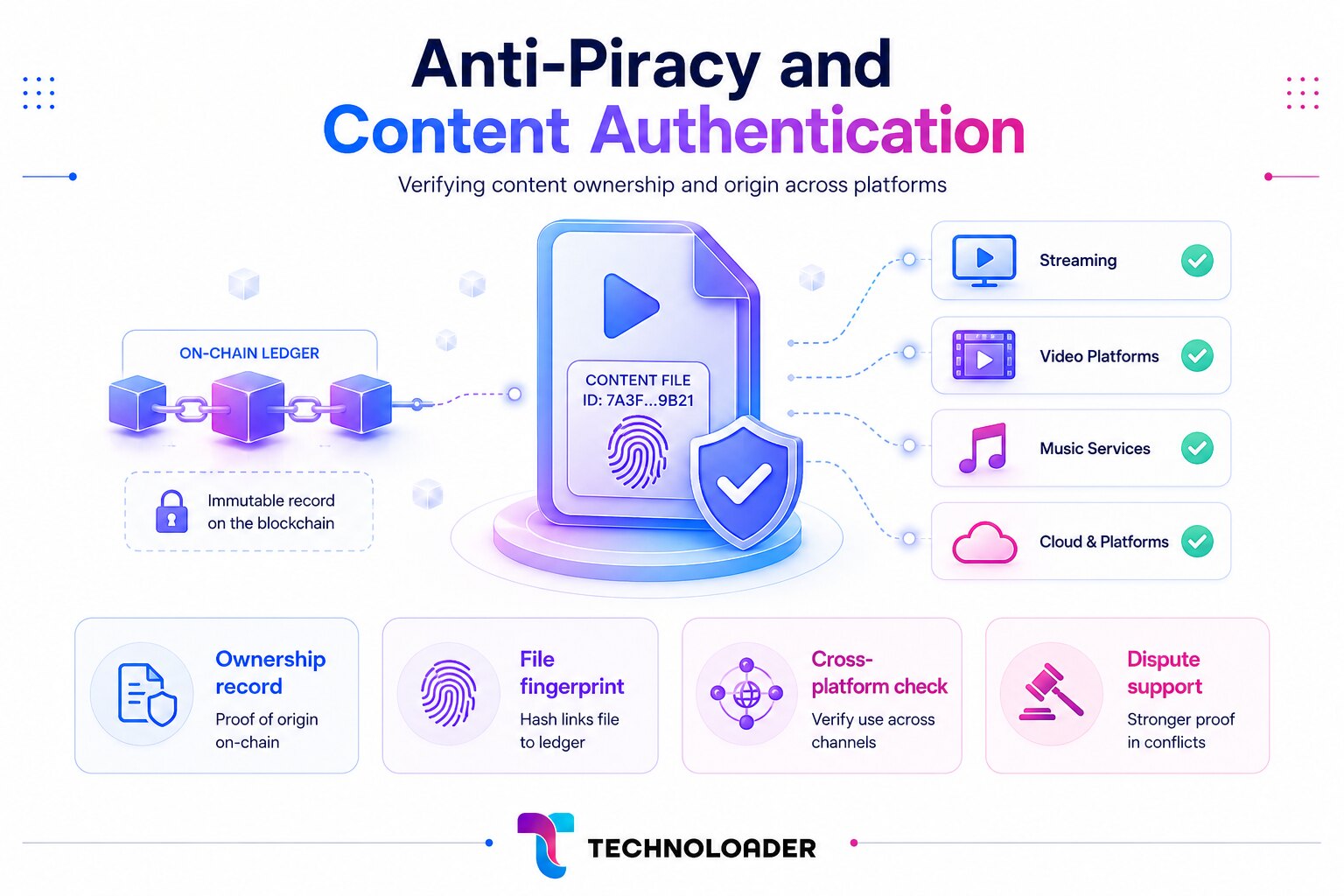
Blockchain helps protect intellectual property by creating a verifiable record of content ownership and origin. While it doesn’t stop piracy outright, it makes unauthorized copies easier to identify.
A traceable fingerprint on the ledger lets media companies and creators verify where content came from and how it’s being used.
That combination supports faster action against duplication and strengthens proof of ownership when disputes come up. Watermarking and hashing tie a specific file directly to its blockchain record.
Decentralized Content and Video Platforms
Decentralized platforms give creators more control over content distribution and earnings. They lean on peer-to-peer models and token rewards instead of one central owner calling the shots.
Audius is a popular music platform built around this idea. It’s a decentralized audio protocol whose token runs on Ethereum, with parts of its content layer on Solana.
Theta takes a similar approach to video. It uses a decentralized video and edge-delivery network, and Sony has supported the project as a validator.
The decentralized nature of these platforms can create new business models for creators. They also offer clearer revenue data and stronger fan relationships. Even so, adoption is still early, and success varies by platform.
Tokenized Tickets and Fan Engagement
Blockchain can also be used for digital tickets and fan rewards. NFT tickets may include resale rules, creator royalties, and proof of authenticity.
It’s important to understand the limits of this technology. Standards such as EIP-2981 signal an on-chain royalty, but payment still isn’t enforced automatically.
Whether royalties are paid depends on the marketplace or the smart contract design. So a “hard resale cap” needs careful design, not just an NFT.
Fan tokens work differently. Platforms like Chiliz and Socios.com let sports teams and brands reward supporters with voting rights, perks, and exclusive experiences.
These tokens are utility and engagement assets. They are not equity, tickets, or a payment method, and their value can go up or down. Treat this as informational only, not investment advice.
Quick Answer: What Are the Main Uses of Blockchain in Entertainment?
The main uses of blockchain in entertainment are:
- Streaming rights and automated royalties
- NFTs and content authentication
- Decentralized content distribution
- Tokenized fan experiences
Also Read
Who’s Using Blockchain in Entertainment?
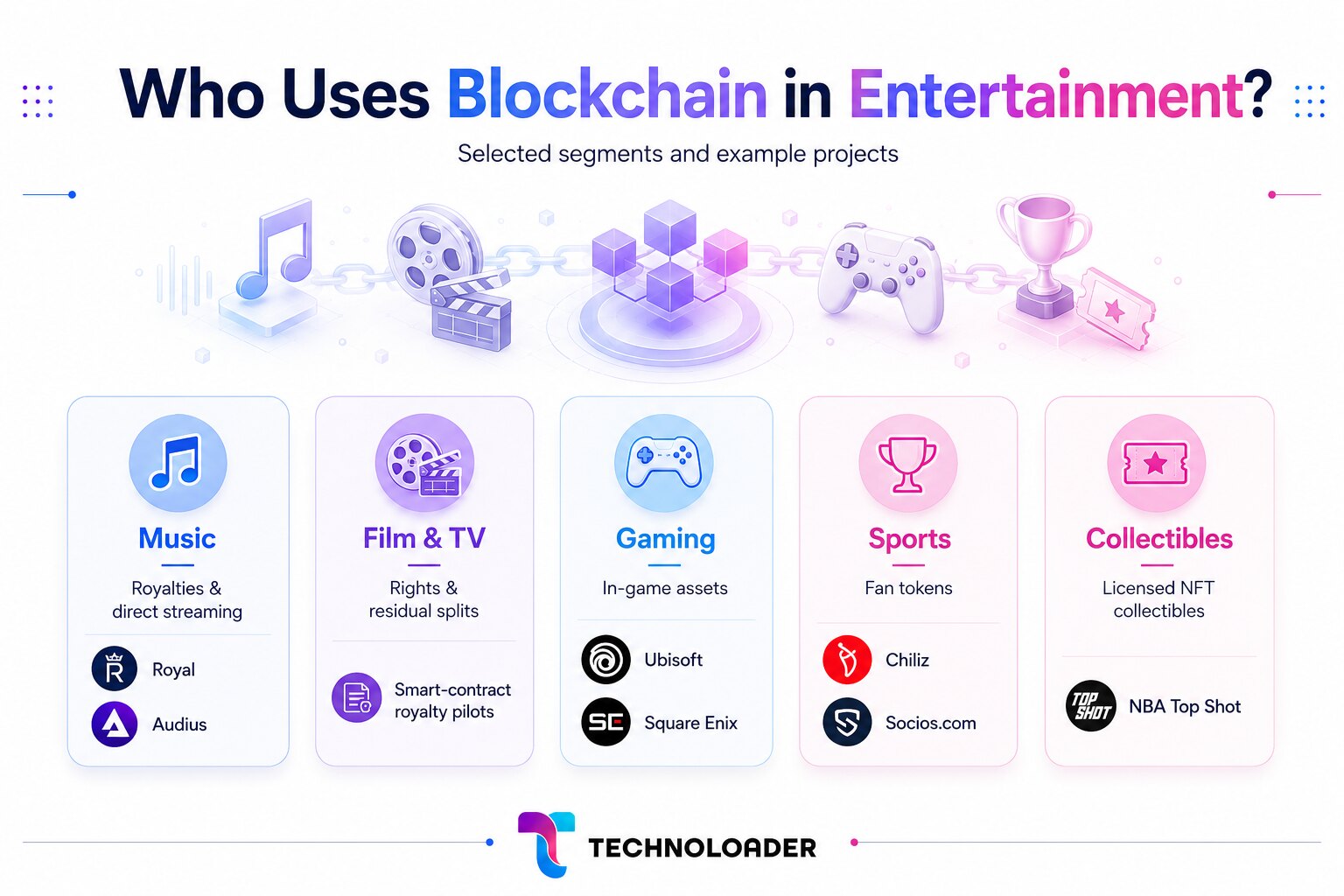
Several major entertainment and gaming companies now use blockchain in real products. Adoption spans music, sports, collectibles, and gaming, though many efforts are still in the pilot phase.
People often ask whether Disney uses blockchain. Disney created the technology that became Dragonchain and open-sourced it in 2016. There’s no ongoing partnership or financial tie between Disney and that independent project today.
Disney has also licensed digital collectibles through the VeVe platform. Its startup accelerator has included Web3 firms like Polygon and Flickplay in the past.
Gaming is where adoption runs deepest. Ubisoft has built on the Immutable network, and Square Enix moved its Web3 title to Sony’s public Ethereum layer-2 network Soneium.
You can explore the broader shift in our guide to play-to-earn games. In the table below, we map real examples by segment.
| Entertainment Segment | Blockchain Application | Real-World Example |
|---|---|---|
| Music | Royalties and creator-direct streaming | Royal (fractional royalties, Polygon); Audius (decentralized audio) |
| Film and TV | Rights and automated residual splits | Smart-contract royalty waterfalls (studio pilots) |
| Gaming | In-game assets and digital ownership | Ubisoft (Immutable); Square Enix (Soneium) |
| Sports | Fan tokens and engagement | Chiliz and Socios.com club fan tokens |
| Collectibles | Licensed NFT collectibles | NBA Top Shot (Flow) |
| Advertising | Ad verification and fraud reduction | On-chain impression logging |
VeChain has also been explored for content authenticity, per Mordor Intelligence. That said, some early NFT programs have already wound down, and many use cases are still experimental rather than mainstream.
Quick Answer: Which Companies Use Blockchain in Entertainment?
Examples include NBA Top Shot on Flow, Audius and Royal in music, and Chiliz-Socios in sports. Ubisoft and Square Enix build in gaming. Many projects are still pilots.
Also Read
Blockchain in Entertainment Market Size and Adoption
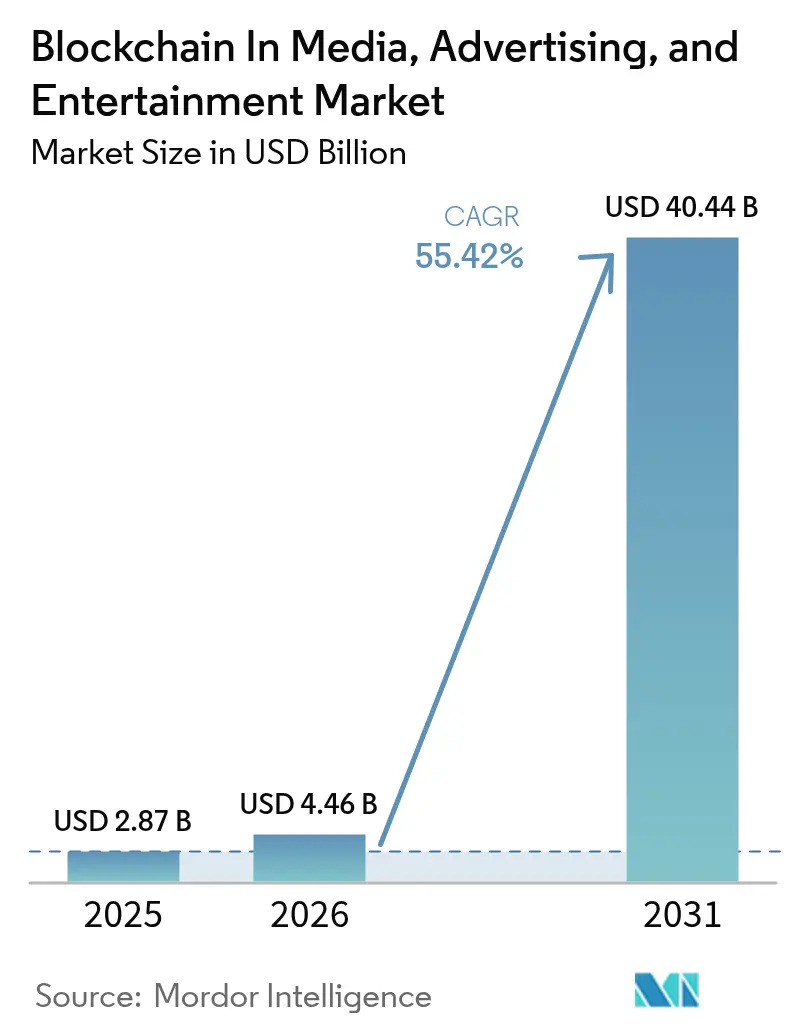
The blockchain in the media and entertainment market is still small, but it’s growing quickly.
Mordor Intelligence puts the blockchain in the media, advertising, and entertainment market at $4.46 billion in 2026. That’s up from $2.87 billion in 2025. It projects the market will climb to $40.44 billion by 2031, a 55.42% CAGR.
Adoption is uneven across segments.
Gaming currently leads, at about 30.55% of 2025 spending according to Mordor Intelligence. But sports tokenization is closing the gap as the fastest-growing category.
Geography shows a similar split. North America took roughly 38.40% of 2025 revenue, the largest regional share, even as Asia-Pacific posts the fastest growth of any region.
The media industry is also adopting blockchain technology for digital advertising. It helps verify impressions and reduce ad fraud, making campaigns more transparent.
Do note that various research firms use different scopes and report widely varied estimates. That means a single blended figure would be misleading. As such, treat these as the industry’s current best estimates, rather than locked figures.
Quick Answer: How Big is the Blockchain in Entertainment Market?
Mordor Intelligence estimates the market will reach $4.46 billion in 2026, up from $2.87 billion in 2025. It also forecasts $40.44 billion by 2031, a 55.42% CAGR, although estimates vary by research firm.
Also Read
Benefits of Blockchain in Entertainment
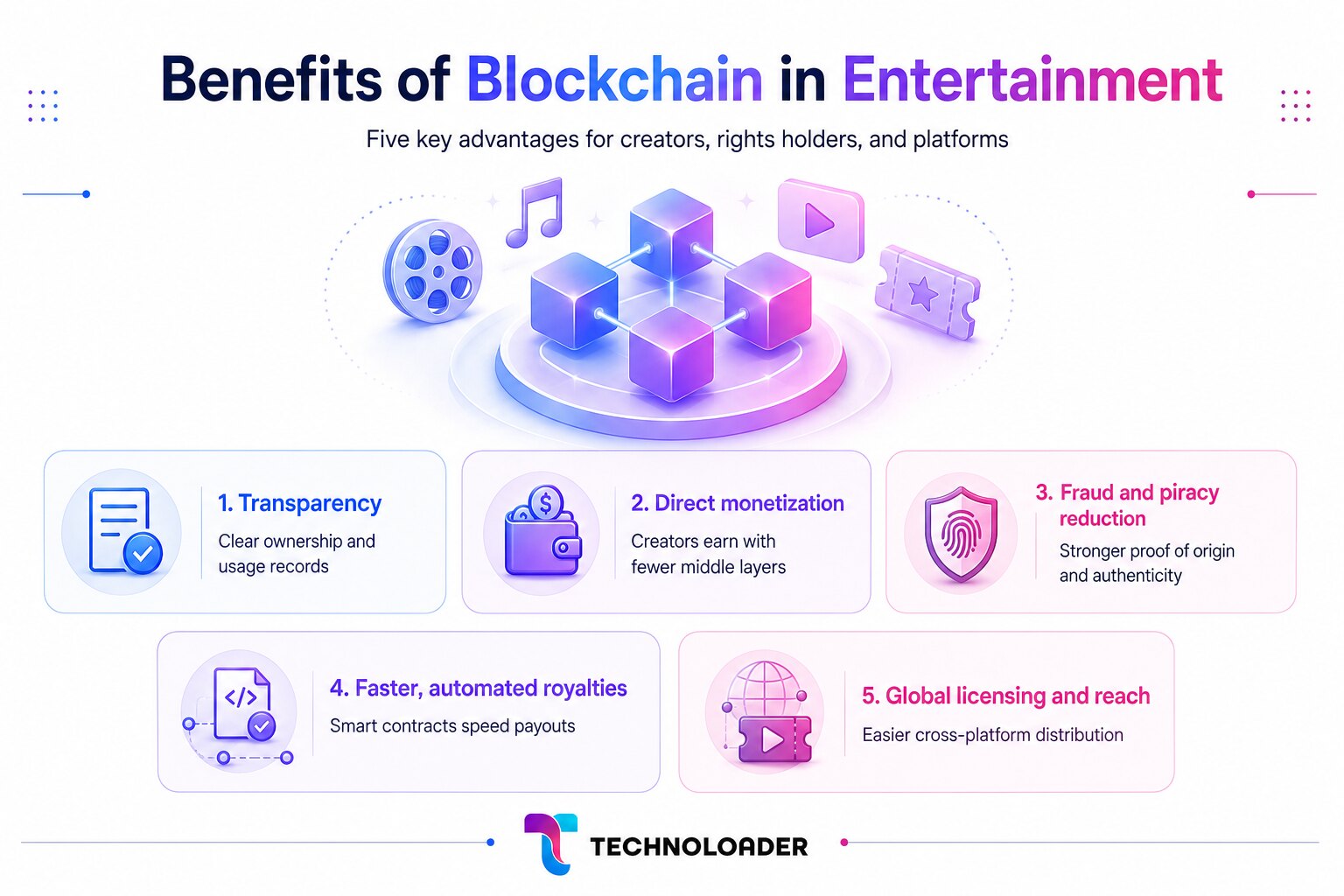
Blockchain brings the entertainment industry better transparency, monetization, trust, speed, and reach. These gains all flow from the shared ledger and automated payments.
Transparency
All transactions on the blockchain are recorded on a shared ledger. This gives creators, media companies, and fans the same ownership and revenue records.
With clear records in place, disputes, crediting mistakes, and hidden deals are less common. This transparency helps build trust across a complex industry.
Direct Monetization
Blockchain helps creators sell directly to fans with fewer middlemen. Tokens, NFTs, and peer-to-peer platforms also create new business models and revenue opportunities.
Creators can keep a bigger share of what they earn. They also build closer, more direct relationships with their audience.
Fraud and Piracy Reduction
A verifiable, traceable record makes some fraud and piracy harder to pull off. It doesn’t remove them, but it raises the difficulty and improves detection.
Unauthorized copies become easier to spot against the on-chain record. That protects both creators and honest buyers.
Faster, Automated Royalties
Once the agreed conditions are met, smart contracts automatically pay collaborators. That cuts much of the delay associated with traditional royalty processing.
As a result, payments arrive faster and with fewer errors, giving artists and contributors clearer, more timely compensation.
Global Licensing and Reach
Approved users can view licensing deals stored on a shared blockchain ledger. This makes cross‑border licensing easier and more reliable.
Clear records also help speed up content sharing across world markets. Stablecoin payments add another boost by making global payments faster.
Quick Answer: What Are the Benefits of Blockchain in Entertainment?
The main benefits of blockchain in entertainment are:
- Greater transparency
- Direct monetization
- Stronger fraud protection
- Faster royalty payments
- Simplified global licensing
Also Read
Challenges of Blockchain in Entertainment
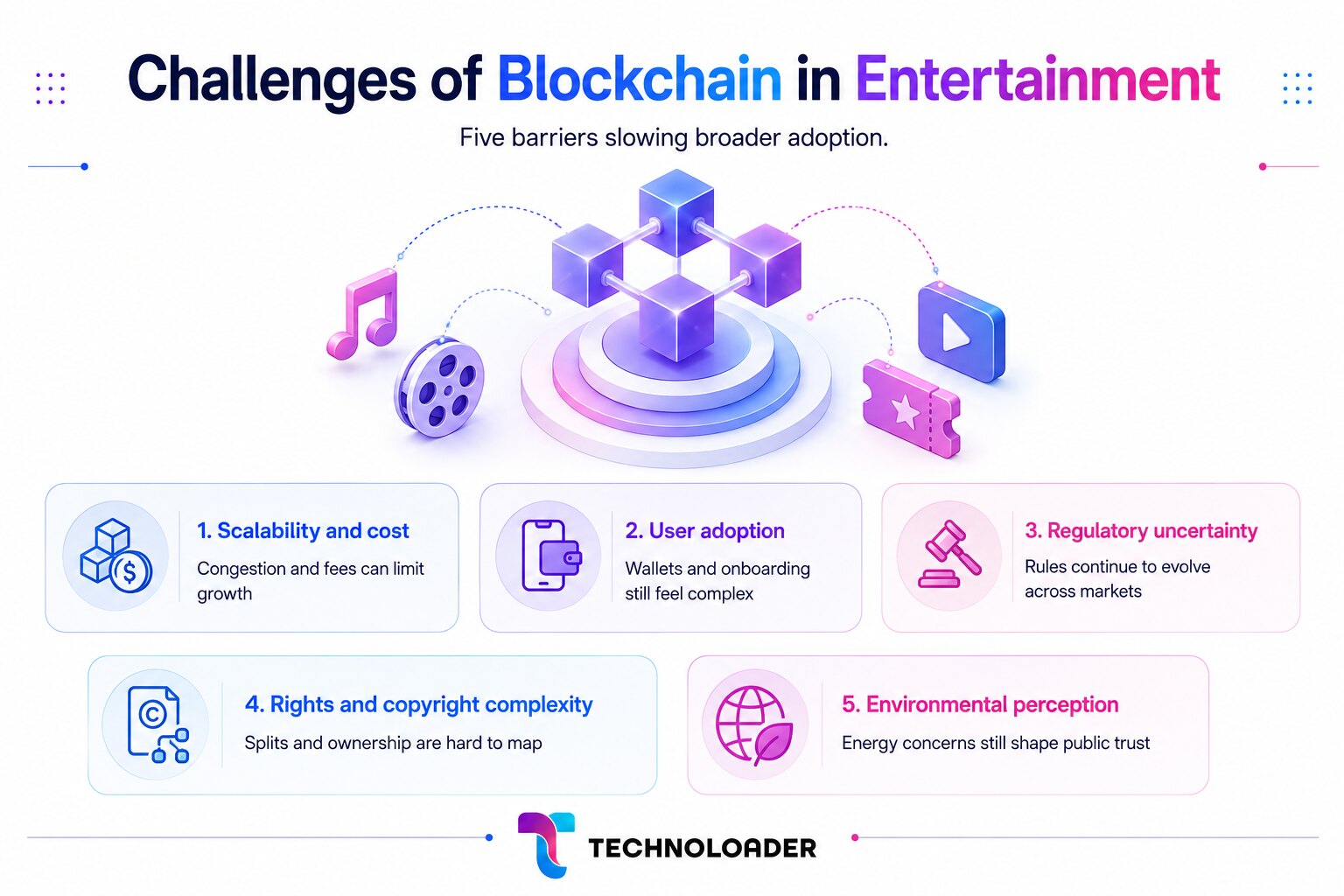
Blockchain in entertainment faces real challenges around cost, usability, regulation, rights, and perception. These issues explain why adoption is still at an early stage.
Before diving into each challenge, it helps to see the trade-offs side by side. The table below lines up the traditional royalty model against a blockchain-based one. This lets you weigh the promise against the drawbacks at a glance.
| Dimension | Traditional Model | Blockchain-Based Model |
|---|---|---|
| Settlement time | Months or quarters | Near real-time (oracle-triggered) |
| Intermediaries | Multiple collection agencies | Fewer |
| Transparency | Opaque statements | Shared, auditable ledger |
| Disputes | Reconciliation-heavy | Fewer, with one source of truth |
| Main caveat | Familiar and stable | Depends on correct data, oracles, and off-chain legal enforceability |
Scalability and Cost
Some base-layer blockchain networks become slower and more expensive during busy periods. That can make small financial transactions too costly.
Layer-2 networks, including Polygon, Immutable, and Base, help solve this problem. They process transactions faster and at a much lower cost.
User Adoption
Wallets, keys, and tokens remain part of the user experience for many blockchain apps. That’s often a hurdle for non-technical fans.
Adoption won’t become truly mainstream until onboarding feels as familiar as a standard app. Better wallet design is helping make that possible.
Regulatory Uncertainty
Rules for NFTs, fan tokens, and other digital assets are still evolving. Different countries often apply different legal standards.
That creates extra compliance work for entertainment companies. It also makes large blockchain projects harder to launch.
Rights and Copyright Complexity
Many rights holders can be tied to one creative work, which makes tracking intellectual property trickier. Writing those overlapping claims into smart contracts is difficult.
Shared rules are still taking shape across the media field, and old licensing data can cause mistakes. Some rights still need off‑chain checks since resale rules don’t run on their own.
Environmental Perception
Early blockchain networks gained a reputation for high energy use, largely because of proof-of-work systems like Bitcoin.
Ethereum switched to proof of stake at the Merge in September 2022. That cut its energy use by about 99.95%, per the Ethereum Foundation. Most entertainment activity now runs on proof-of-stake chains and layer-2 networks.
Quick Answer: What Are the Challenges of Blockchain in Entertainment?
The biggest challenges are scalability, user adoption, changing regulations, complex rights management, and outdated views about blockchain’s environmental impact.
Also Read
The Future of Blockchain in Entertainment
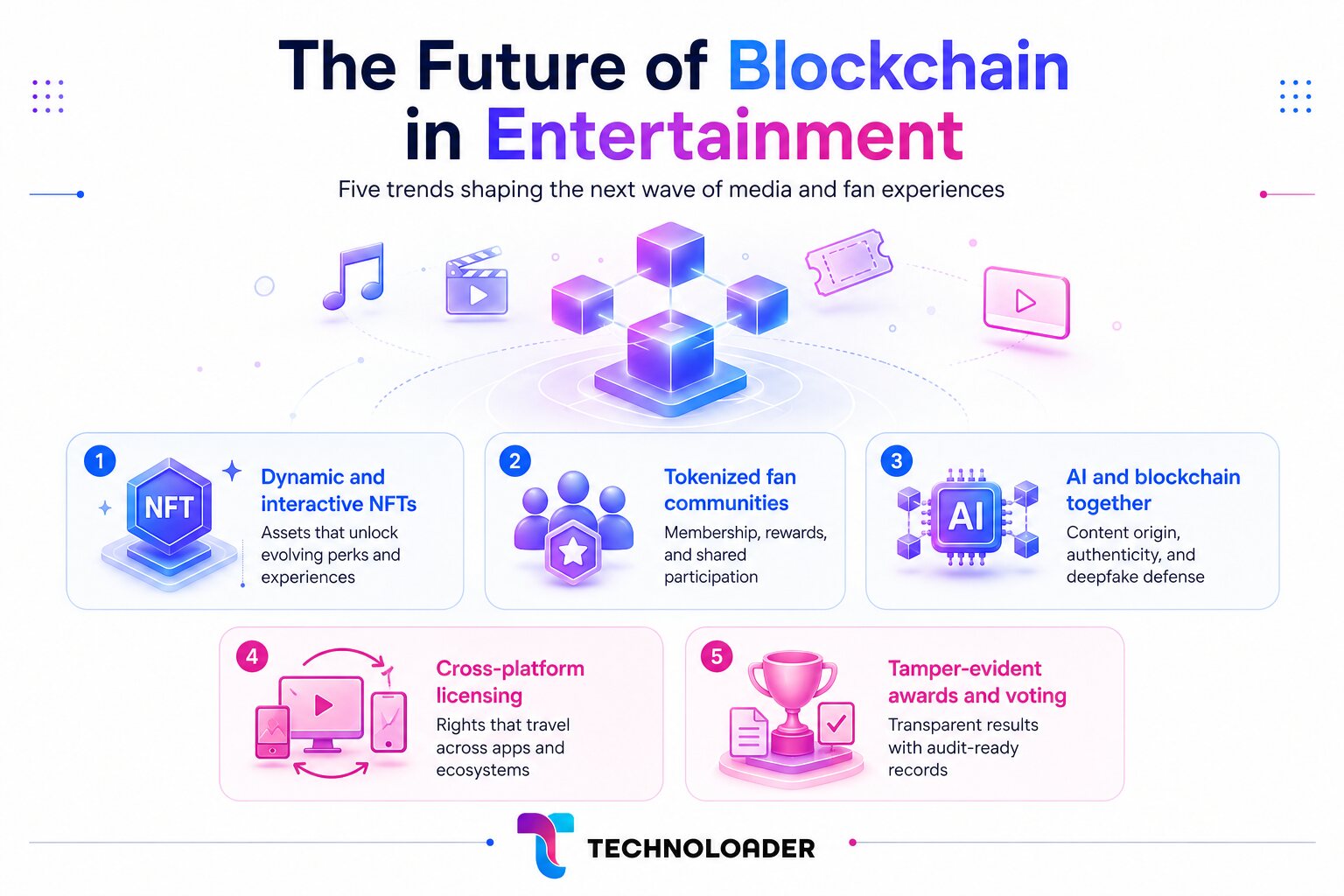
The future of blockchain in entertainment points toward richer ownership, deeper fan roles, and better content provenance. These trends build on the use cases already in the market.
Dynamic and Interactive NFTs
NFTs are moving beyond simple digital collectibles. They can unlock new experiences, metaverse assets, and content that changes over time.
Fans may soon own assets linked to virtual events or interactive shows. This builds deeper engagement and opens new ways to earn revenue.
Tokenized Fan Communities
Token‑gated groups are growing among artists, sports teams, and brands. They can give fans exclusive content, early access, rewards, and even voting rights.
These tokens focus on utility and engagement, not profit. They shouldn’t be seen as promises of financial gain.
AI and Blockchain Together
As AI tailors content, blockchain can confirm where that content came from. Together, they build a more trustworthy digital transformation across media and entertainment.
Blockchain also records content origin to fight deepfakes. This pairing may become a standard layer of authenticity. Read our Web3 primer to explore this growing space.
Cross-Platform Licensing
Managing rights across multiple platforms could become much easier with smart contracts. Creators would have one place to manage rights while reducing conflicts.
That level of portability still depends on shared standards and interoperability. As those improve, content licenses should move more easily between platforms.
Tamper-Evident Awards and Voting
Blockchain can also improve voting for awards, contests, and fan polls. A shared ledger creates an auditable record that’s harder to manipulate.
The result is a fairer, more transparent process that also builds audience trust in the outcome.
Quick Answer: What Is the Future of Blockchain in Entertainment?
The future of blockchain in entertainment includes dynamic NFTs, tokenized fan communities, AI-powered content verification, cross-platform licensing, and more transparent voting systems.
Also Read
Frequently Asked Questions
Is blockchain a dead technology?
No. Adoption in entertainment is still emerging, but it’s growing, especially in gaming, sports, and collectibles. Real products like NBA Top Shot and Audius remain active, even as hype cycles rise and fall.
Does Disney use blockchain?
Disney created the technology that became Dragonchain and open-sourced it in 2016, with no ongoing tie today. It has also licensed digital collectibles through VeVe and included Web3 firms in its accelerator.
How is blockchain used in streaming services?
Blockchain records rights and licensing on a shared ledger and automates royalty payments with smart contracts. This helps verify ownership and pay creators more transparently.
What are NFTs in entertainment?
NFTs in entertainment are unique tokens that represent ownership of or access to content, such as music, film, art, or collectibles. The media itself is usually referenced off-chain rather than stored on-chain.
Can blockchain stop piracy?
Not entirely. But blockchain does lower the risk of piracy by providing a verifiable record of content origin and usage. That makes unauthorized copies easier to detect and contest.
What are smart contracts in entertainment?
Smart contracts are self-executing programs that run when coded conditions are met. In entertainment, they automate licensing and royalty splits, often using an oracle to read real-world events.
Which companies use blockchain in entertainment?
Active examples include NBA Top Shot on Flow, plus Audius and Royal in music. Chiliz and Socios lead in sports, while Ubisoft and Square Enix build in gaming. Many efforts are still pilots.
Is blockchain being widely adopted in entertainment?
Not yet. Blockchain in entertainment is making the biggest inroads in gaming and sports, while other sectors are moving more cautiously. Strong market forecasts suggest that will change over time, but usability and regulation are still holding adoption back.
Also Read
Conclusion
Blockchain in entertainment is becoming a practical tool for managing rights, royalties, and digital content. It gives creators more control, faster payments, and new ways to connect with fans.
The gains are real, yet so are the limits around cost, usability, and regulation. The smartest teams pick one strong use case and build it well.
If you want to explore a blockchain or NFT product for content, our team can help. Partner with our blockchain development team or contact us to talk through your idea.

Vipin Kumar
Vipin Kumar is the Founder & CEO of Technoloader, a Clutch Top 10 Blockchain Development Company for 2025. A serial technology entrepreneur and blockchain architect with a B.Tech background, Vipin has led the delivery of 450+ projects across DeFi, NFT marketplaces, AI/ML, and custom Web3 platforms for clients in the UAE, India, the US, and beyond. He also founded SALIQ (saliq.ai), an AI-driven conversational marketing platform.
Published in Blockchain Development