+91 7014607737
 info@technoloader.com





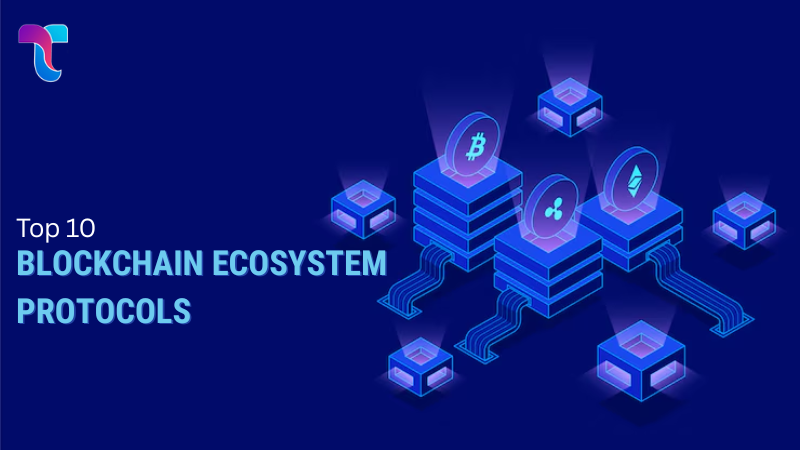
Table of Contents
Key Takeaways:
- Blockchain ecosystem protocols form the base of Web3 infrastructure. They define how decentralized networks operate, scale, and communicate with each other.
- Different blockchain ecosystem protocols serve different purposes. Bitcoin focuses on security and value storage, and Ethereum powers smart contracts and DeFi. Whereas networks like Polkadot and Cosmos enable interoperability.
- Scalability and performance improvements are driven by ecosystem protocols. For example, Ethereum’s layer-2 rollups process approximately 4,000 TPS as compared to Layer-1 solutions, which give ~30 TPS. This enables millions of users daily.
- Blockchain protocols are expanding beyond cryptocurrency. Industries such as finance, gaming, supply chain, healthcare, and digital identity are now adopting blockchain-based solutions.
- Enterprise adoption continues to grow. Frameworks, such as Hyperledger Fabric, are helping businesses use blockchain technology for secure and compliant systems.
- The future of blockchain is definitely multi-chain. Its protocols, such as Polkadot and Cosmos, are already connecting 100+ independent blockchains through IBC and parachain architecture.
Introduction
Blockchain isn’t just a buzzword anymore. It’s now becoming a core digital infrastructure.
In fact, worldwide spending on blockchain solutions is estimated to reach $19 billion. That’s just the beginning of what this technology can do.
That’s not hype; that’s adoption.
But behind every blockchain application, there are blockchain ecosystem protocols. These are basically the rules, frameworks, and standards that allow blockchains to function, scale, and interact with each other.
They determine how networks achieve consensus, how fast transactions settle, how blockchains communicate with each other, and how secure the entire system really is. These protocols are the invisible engines of Web3.
In 2026, the conversation isn’t just about “which blockchain is best?” It’s about which blockchain ecosystem protocols are building scalable, interoperable, modular infrastructure for the decentralized internet.
Without further delay, let’s get answers to all your questions in this blog!
What Are Blockchain Ecosystem Protocols?
Blockchain ecosystem protocols are basically the rules and frameworks that facilitate the operation, governance, and scalability of blockchain solutions. These protocols define the rules and standards that enable different blockchain components to interact.
They play an important role in the overall functioning of dApps, smart contracts, and cryptocurrencies. Each protocol has its own set of features, which include blockchain consensus mechanisms (for example, proof-of-work or proof-of-stake). Understanding these blockchain protocols is important, especially if you are looking to use blockchain technology for efficiency, innovation, and security.
Its key functions include:
- Defining consensus rules (PoW, PoS, NPoS)
- Enabling cross-chain communication
- Supporting smart contracts and dApps
- Governing network upgrades
Top Blockchain Ecosystem Protocols in 2026: Comparison Table
Here’s a comparison table of the best blockchain ecosystem protocols that will give you a quick sneak peek at each!
| Protocol | Layer Type | Consensus Mechanism | Finality / Scalability | Best For in 2026 |
|---|---|---|---|---|
| Bitcoin (BTC) | Public L1 | PoW | Slow base layer; strongest settlement security; scaling via L2s | Store of value, settlement, conservative financial rails |
| Ethereum (ETH) | Public L1 | PoS | L1 moderate; rollup-centric scaling; strongest app composability | DeFi, RWAs, DAOs, enterprise-grade smart contract ecosystems |
| Polkadot (DOT) | L0 + L1 | NPoS | Scales via parachains; strong governance & upgrade path | App-chains needing shared security + interoperability |
| Cosmos (ATOM) | L0 ecosystem | Tendermint-style PoS | Scales horizontally via app-chains; flexible design | Multi-chain ecosystems, app-chains, interchain DeFi/services |
| Solana (SOL) | Public L1 | PoH + PoS | Very high throughput; low latency; optimized execution | High-frequency DeFi, consumer apps, gaming, real-time apps |
| Avalanche (AVAX) | Public L1 | PoS-based | Fast finality; scalable via app-specific subnets | Custom chains, enterprise networks, gaming, compliant deployments |
| Cardano (ADA) | Public L1 | Ouroboros PoS | Steady scaling roadmap; L2/state channels approach | Governance-heavy apps, formal methods, and long-term stability focus |
| Algorand (ALGO) | Public L1 | Pure PoS | Fast finality; efficient base-layer execution | Tokenization, institutional use cases, low-latency transfers |
| Tezos (XTZ) | Public L1 | LPoS | Predictable upgrades; moderate throughput; governance strength | Regulated-friendly apps, long-lived protocols, tokenization |
| Hyperledger Fabric | Permissioned | Pluggable (Raft, etc.) | High throughput in controlled networks; private data | Supply chain, banking consortia, permissioned compliance networks |
The 10 Best Blockchain Ecosystem Protocols in 2026
Let’s now get into more detail about each blockchain ecosystem protocol that is influencing the decentralized future:
Bitcoin (BTC)

Bitcoin is the core of the blockchain industry. Launched in 2009 by Satoshi Nakamoto, Bitcoin introduced decentralized and trustless digital currency to the world Bitcoin is still the best option for security, decentralization, and a store of value even though it might not allow complex smart contracts.
In order to validate transactions and add new blocks to the chain, miners usually compete to solve challenging cryptographic puzzles using a Proof-of-Work (PoW) consensus mechanism. This energy-intensive process makes Bitcoin secure, and attacking the network would require an enormous amount of computational power and cost.
Strengths:
- Offers top-notch security as compared to others
- Hardcoded supply cap of 21 million BTC
- Most popular and liquid cryptocurrency
- Growing Layer 2 ecosystem to enable scalability
Real-World Use Case in 2026:
Bitcoin is currently being used as a reserve asset by big businesses and investors. Its lightning network enables near-instant, near-free micropayments globally. It is the backbone of conservative financial rails in the blockchain world.
Ethereum (ETH)
Ethereum is one of the most used smart contract platform in the world. Introduced in 2015 by Vitalik Buterin, it brought in programmability to the blockchain space.
This enabled developers to launch decentralized applications (dApps), decentralized finance (DeFi) protocols, non-fungible token (NFT) marketplaces, decentralized autonomous organizations (DAOs), and much more.
Ethereum progressed from Proof-of-Work to Proof-of-Stake in 2022, which reduced its energy consumption by ~99.9%. This allowed validators to stake ETH to participate in consensus. Its rollup-centric roadmap expands the network through Layer 2 solutions, which further push throughput to thousands of TPS with the addon of maintaining L1 security.
Strengths:
- Largest developer ecosystem in blockchain
- Strongest DeFi and NFT infrastructure
- A thriving L2 ecosystem increases scalability
- Enterprise adoption through private chains and EVM compatibility
Real-World Use Case in 2026:
Ethereum is the go-to platform for DeFi, real-world asset (RWA) tokenization, enterprise smart contracts, and DAOs. In 2026, it is the main force that boosts the majority of blockchain apps.
Polkadot (DOT)
Polkadot is a Layer 0 protocol that connects multiple blockchains into one unified network. Polkadot, developed by Ethereum co-founder Gavin Wood, offers a novel “relay chain + parachain” architecture that enables separate blockchains to exchange assets, communicate, and share security.
Polkadot relies on Nominated Proof-of-Stake (NPoS), in which DOT tokens are used by nominators to support validators. It provides shared security to all connected parachains. Each parachain is a specialized blockchain that can be customized for any use case while still benefiting from Polkadot’s security umbrella.
Strengths:
- True interoperability between heterogeneous blockchains
- Shared security model
- Strong cross-chain DeFi and application ecosystem
- Parachains enable specialized, interoperable blockchains
Real-World Use Case in 2026:
Polkadot is perfect for projects that need an independent blockchain. It is popular for cross-chain DeFi, enterprise chains, and identity or governance applications.
Cosmos (ATOM)

Cosmos is popular as the ‘Internet of Blockchains.’ It aims to solve blockchain fragmentation by enabling independent chains to communicate and transact with each other through a standardized protocol. Built with the Tendermint consensus engine and the Cosmos SDK, it has resulted in an enormous ecosystem of chains.
It acts as a central relay, while ‘zones’ are independent blockchains built with the Cosmos SDK. The Inter-Blockchain Communication (IBC) protocol allows assets and data to move between chains without a trusted third party. Every zone maintains its own set of validators and independency.
Strengths:
- IBC protocol is the gold standard for cross-chain communication
- Cosmos SDK makes launching an independent blockchain fast
- Near-instant finality with Tendermint BFT
- Each chain is fully sovereign and customizable
Real-World Use Case in 2026:
Cosmos is the ecosystem of choice for teams that want to launch their own blockchain with full sovereignty. Projects such as dYdX (crypto derivatives), Osmosis (DEX), and Celestia (data availability) all select Cosmos for its flexibility.
Solana (SOL)

Solana is one of the highest-performance Layer 1 blockchains. Known for its high-speed and near-zero transaction fees, Solana has become one of the best blockchain ecosystems in the space.
It combines PoH and PoS to achieve its remarkable throughput. PoH allows validators can process transactions in parallel without waiting for network consensus on ordering. Solana can theoretically process more than 65,000 TPS, with actual real-world performance in 2025-26 somewhere around 3,000 to 5,000 TPS under normal network conditions.
Strengths:
- Transaction fees are often below $0.001
- Thriving consumer app ecosystem
- Strong institutional and VC backing
- Growing DePIN ecosystem
Real-World Use Case in 2026:
Solana stands out for high-frequency trading, real-time gaming, consumer payments, and any application that demands speed at scale. Visa and other payment processors have explored Solana for payment settlement.
Avalanche (AVAX)
Avalanche is a Layer 1 blockchain that sets itself apart through its unique subnet architecture and lightning-fast finality. Avalanche, developed by Ava Labs, enables anyone to launch their own blockchain (which is also referred to as a subnet) that is entirely customizable for particular use cases and inherits Avalanche’s security and interoperability.
It uses a novel consensus protocol, also called Avalanche consensus, based on repeated sub-sampled voting, achieving finality in under 2 seconds. The network is made up of three interoperable chains: X-Chain, C-Chain, and P-Chain.
Strengths:
- Sub-2-second transaction finality
- EVM-compatible C-Chain makes migration from Ethereum easy
- Subnet architecture is ideal for enterprise and gaming deployments
- Strong growth in tokenized real-world assets (RWAs)
Real-World Use Case in 2026:
Avalanche is now becoming the platform of choice for enterprise blockchain deployments, regulated financial applications, and gaming studios that need a private or semi-private chain with proven security.
Cardano (ADA)
Cardano is a third-generation blockchain protocol. Founded by Ethereum co-founder Charles Hoskinson, the Cardano upgrade is backed by peer-reviewed research before implementation. This makes it one of the most methodical and formally verified blockchain platforms in existence.
This blockchain ecosystem protocol uses the Ouroboros Proof-of-Stake consensus protocol. The network is divided into two layers, which are namely: the Cardano Settlement Layer (CSL) for ADA transactions and the Cardano Computation Layer (CCL) for smart contracts. This allows each layer to be upgraded independently.
Strengths:
- Formally verified smart contract language
- Strong academic foundation and peer-reviewed protocol upgrades
- Growing presence in developing markets
- Low energy usage and effective PoS
Real-World Use Case in 2026:
Cardano is ideal for applications with a strong emphasis on governance, identity systems, supply chain monitoring, and regulated financial products where formal verification and auditability are more important than speed.
Algorand (ALGO)
Algorand is a high-speed and energy-efficient blockchain platform that uses Pure Proof of Stake to maintain decentralization and consensus. It is designed for instant finality and low-cost transactions, which makes it suitable for financial services and government-level use cases like central bank digital currencies (CBDCs).
Additionally, Algorand natively supports tokenised assets and smart contracts, with an emphasis on facilitating real-world adoption and large-scale enterprise applications.
Strengths:
- Scalable and carbon-negative by design
- Preferred digital identity projects and CBDCs
- Focuses on government and institutional adoption
Real-World Use Case in 2026:
Algorand is used for real-world financial apps such as central bank digital currencies (CBDCs), tokenized assets, and cross-border payment systems. Also, governments, financial institutions, and enterprises are exploring Algorand for secure digital identity systems, transparent supply chains, and institutional-grade blockchain infrastructure.
Tezos (XTZ)
Tezos is a unique blockchain known for its capacity for self-amendment and on-chain governance. Its stakeholders can easily vote on protocol upgrades that are deployed on the blockchain.
It uses Liquid Proof-of-Stake (LPoS), where token holders can either validate themselves or delegate their stake without losing custody of their XTZ. Its upgrades undergo a modification process. This makes Tezos uniquely adaptable without community splits.
Strengths:
- On-chain governance enables forkless protocol evolution
- Robust presence in the digital art and regulated NFT marketplaces
- Minimal carbon footprint and energy use
- Increasing use cases for institutional tokenisation
Real-World Use Case in 2026:
Tezos is popular for digital art NFTs, long-lived financial protocols, tokenization of regulated assets, and any application that values protocol stability and community governance.
Hyperledger Fabric
Hyperledger Fabric is a permissioned framework developed under the Linux Foundation. Rather than open participation, Fabric networks are composed of known and trusted participants, which makes them ideal for industries such as banking, supply chain, healthcare, and government.
Fabric uses a pluggable consensus model, where only authorized organizations can participate in the network. Performance and confidentiality of this blockchain are improved by the network’s “execute-order-validate” transaction flow. And using “private data collections,” data can be kept private between certain channel participants.
Strengths:
- Complete anonymity and privacy
- High throughput in regulated settings
- Modular architecture and pluggable consensus
- No need for gas fees or cryptocurrency
Real-World Use Case in 2026:
Trade finance platforms (we.trade), pharmaceutical drug traceability (MediLedger), food supply chains (IBM Food Trust), and global banking consortiums are all powered by Hyperledger Fabric.
Why Do These Ecosystem Protocols Matter in 2026?
As blockchain technology evolves, the spotlight has shifted from specific blockchain networks to ecosystem protocols. These procedures are more important than ever in 2026. This is why they are important:
Enabling Interoperability
Interoperability allows different blockchain networks to communicate and exchange data. In the early days of blockchain, most networks operated in isolation, which limited their usefulness.
However, blockchain ecosystem protocols now enable assets and data to move across multiple chains securely. This improves collaboration between platforms and helps creates an environment where dApps can interact across networks instead of being restricted to a single chain.
Supporting Scalability
The blockchain networks must be scalable to handle a larger number of users and transactions. It means a blockchain’s ability to process these transactions efficiently.
Ecosystem protocols introduce Layer-2 networks, modular blockchain architecture, and improved consensus mechanisms to increase transaction capacity. These improvements allow blockchain systems to support more large-scale apps.
Enhancing Security & Reliability
One of the most important parts of any blockchain network is security. These protocols define the rules that control how transactions are validated and how data is stored across the network.
By establishing clear standards and governance systems, these protocols help maintain trust, transparency, and reliability. This makes it easier for developers and businesses to develop applications that users can depend on while reducing the risk of network failures or malicious activities.
Driving Innovation Across Industries
These protocols help developers to create blockchain-powered solutions that were previously impossible. These technologies are now being used across industries such as finance, healthcare, gaming, supply chain management, and digital identity.
By providing a reliable infrastructure, these protocols allow businesses to experiment with dApps and tokenized systems that improve efficiency, transparency, and automation in different sectors.
Building the Foundation of Web3
Web3 represents the next generation of the internet, where users have greater control over their digital assets and data. Blockchain ecosystem protocols serve as the infrastructure that supports this decentralized environment.
They provide individuals with frameworks for running dApps, managing digital assets, and connecting a wide range of blockchain services. In 2026, Web3 is expanding, and these protocols are creating a more open, transparent, and user-controlled digital economy.
Conclusion
That brings us to the end of this blog!
Blockchain technology is changing fast, and the protocols in this ecosystem are pushing the next wave of new ideas. These protocols lay the groundwork for a more decentralized, efficient, and secure digital future.
In 2026, the blockchain ecosystem protocols will be the most important tools revolutionizing industries in the digital world.
So, are you curious about how these protocols can be used for your business or project? If so, get in touch with the experts at Technoloader. We are here to help you learn about, build, and lead in the blockchain world!
FAQs
Which is the best blockchain protocol in 2026?
In 2026, the best blockchain protocol will rely on how it is used. Ethereum is still the best platform for dApps and smart contracts because of its large developer ecosystem and strong Layer-2 scaling solutions. Solana is known for fast transactions and low fees. Polkadot and Cosmos, on the other hand, are more focused on making sure that different blockchains can work together.
What sets the Bitcoin and Ethereum protocols apart?
Bitcoin was designed mainly as a decentralized digital currency and store of value. It uses the Proof of Work consensus mechanism to maintain security and decentralization. Ethereum, on the other hand, does support smart contracts. This lets developers build dApps, DeFi platforms, and tokenized assets on its blockchain network.
Which blockchain protocol is the fastest?
Several blockchain networks focus on high transaction throughput. Solana is recognized for its fast processing and low latency. Some of the other blockchain networks, like Near Protocol, Aptos, and Sui, can also manage high transaction volumes.
What is the most eco-friendly blockchain protocol?
Blockchain networks that use Proof of Stake (PoS) usually use way less energy compared to those that rely on Proof of Work. Many modern protocols are designed with sustainability in mind. Some of the known eco-friendly blockchain ecosystem protocols are mentioned below:
- Algorand
- Tezos
- Ethereum
- Cardano
Which blockchain protocol is best for enterprises?
Hyperledger Fabric is one of the most used enterprise blockchain frameworks. It’s a permissioned network that lets organizations control participants, ensure privacy, and securely manage transactions.
Will new blockchain protocols replace Bitcoin and Ethereum?
It’s unlikely that new blockchain protocols will take over Bitcoin or Ethereum. Bitcoin continues to dominate as a store of value and secure settlement layer, while Ethereum remains the leading smart contract ecosystem.
Which blockchain protocol is best for interoperability?
Polkadot and Cosmos are two of the most well-known ecosystems built specifically for interoperability. They allow multiple blockchains to communicate and exchange data securely.

Deepa Manwani
Deepa Manwani is a Technical Content Writer at Technoloader with over 7 years of experience creating high-quality content across Blockchain, Web3, AI, and fintech. She specializes in translating complex technical concepts into clear, engaging, and informative content that helps businesses, developers, and users better understand emerging technologies. Her expertise includes writing technical blogs, technical documentation, whitepapers, platform guides, and in-depth content for crypto exchanges, DeFi platforms, trading systems, and enterprise software solutions. At Technoloader, she contributes to developing strategic content that supports product growth, strengthens brand credibility, and educates users about next-generation technologies shaping the future.
Published in Blockchain Development