+91 7014607737
 info@technoloader.com





Table of Contents
Blockchain app development costs in 2026 typically range from about $30,000 to $300,000 or more. The figure depends on what you build, the app’s complexity, and your team’s location.
A simple crypto wallet sits at the low end. An audited decentralized finance (DeFi) or gaming platform sits at the top.
Location matters as much as scope. Apps built in India often cost 30%-50% less. The same build is more expensive in the US or Western Europe.
I’ve helped ship blockchain apps across DeFi, non-fungible tokens (NFTs), gaming, and tokenization. The cost is never one number. It is a set of choices you control.
This guide gives you the full picture. You’ll see real cost ranges by use case, complexity, and country.
Here is a visual overview of what drives blockchain app development cost:
Key Takeaways
- The range is wide: Most blockchain apps cost between $30,000 and $300,000 or more, depending on scope and complexity
- Use case sets the floor: A wallet is far more affordable than a DeFi or gaming platform.
- Country is the biggest lever: India and Southeast Asia run well below the US and Europe
- The build is a down payment: Audits, infrastructure, and ongoing maintenance add to the costs.
- A minimum viable product (MVP) de-risks budget: Ship the core first, then scale on real demand.
How Much Does Blockchain App Development Cost?
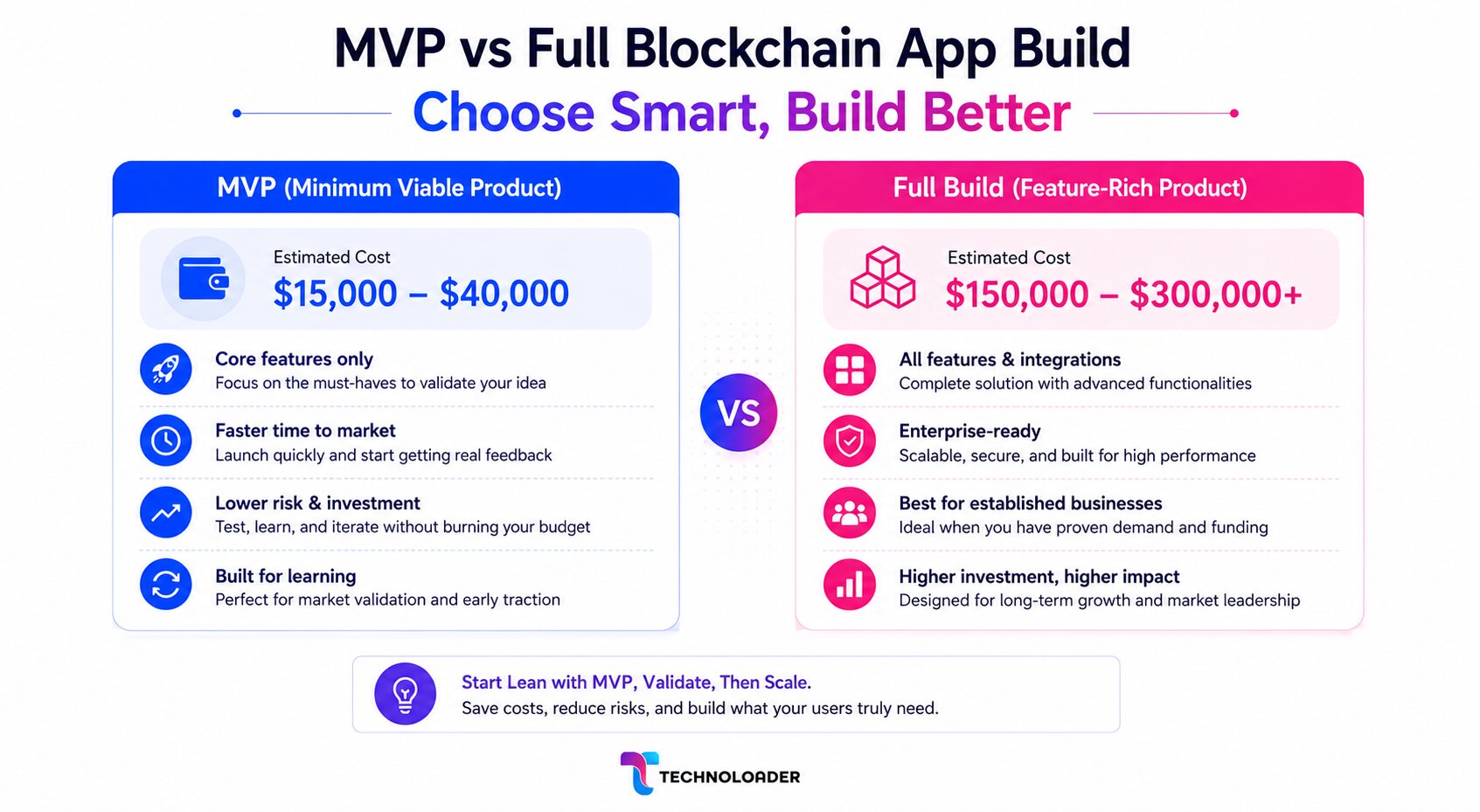
Blockchain app development cost in 2026 can range anywhere from $30,000 to over $300,000. A basic minimum viable product (MVP) may start around $15,000 to $40,000. A decentralized finance (DeFi) enterprise solution can cost $150,000 to $300,000+.
The final price depends on key cost factors. These include the app’s use case, complexity, consensus mechanism, security, and compliance requirements.
Before you set a budget, it helps to understand the key cost drivers. Here are some of the typical price ranges:
This breakdown shows what your blockchain app budget actually buys:
Cost by Complexity Tier
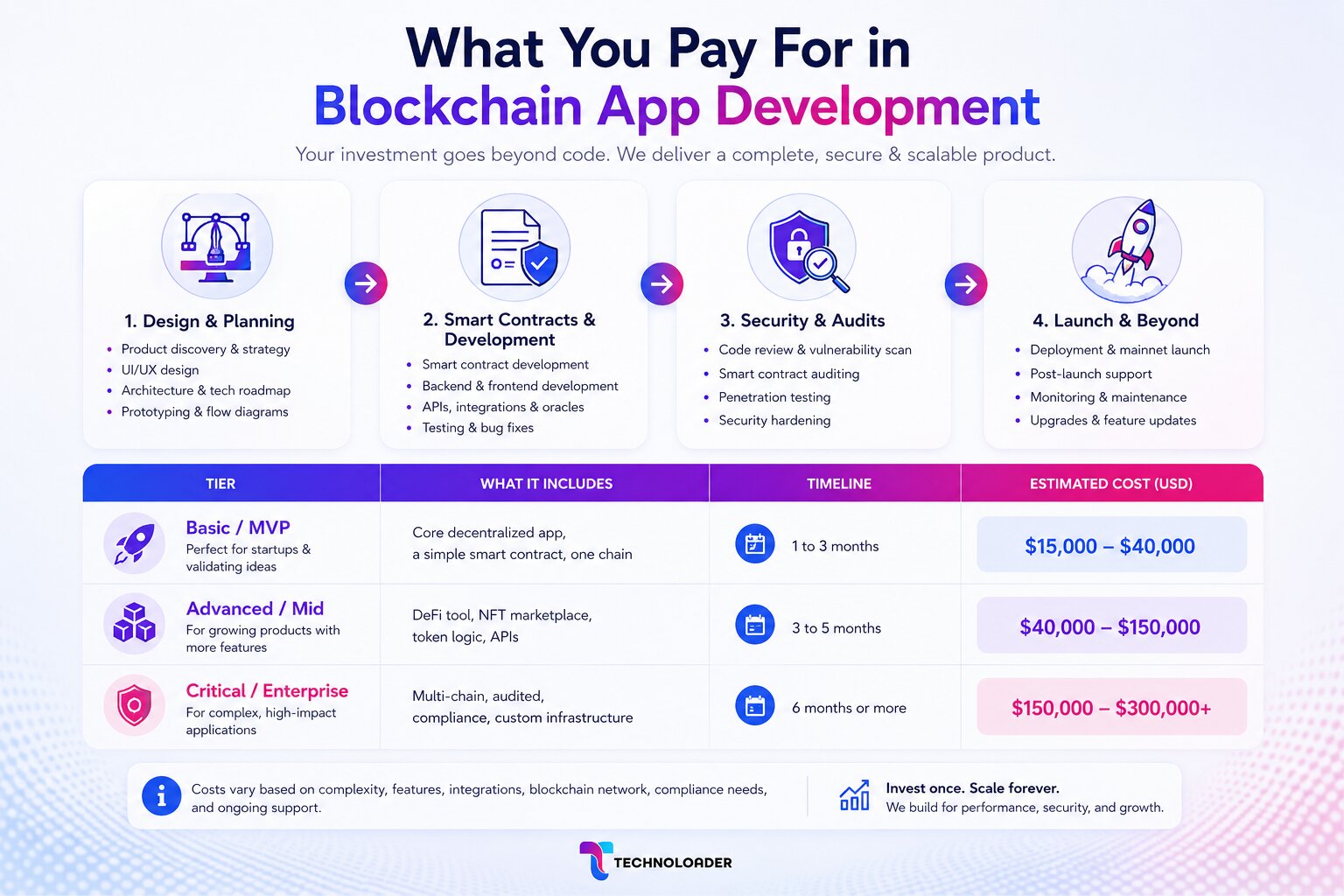
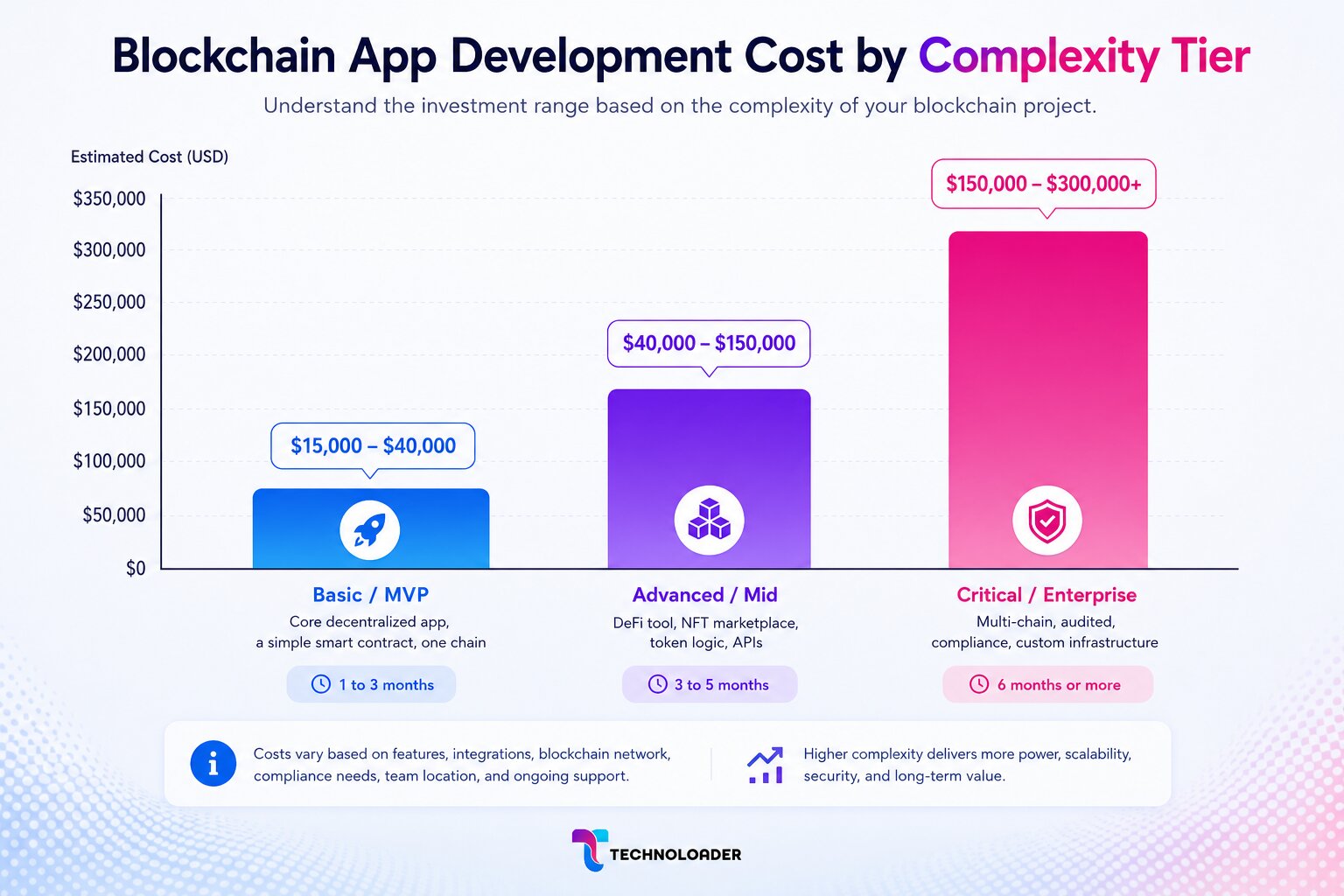
The complexity of your application determines your overall cost and budget. Most projects fall into three tiers. Each tier maps to a feature set and a timeline.
The ranges below are blockchain app development market estimates for 2026:
| Tier | What It Includes | Timeline | Estimated Cost (USD) |
| Basic / MVP | Core decentralized app, a simple smart contract, one chain | 1 to 3 months | $15,000 to $40,000 |
| Advanced / Mid | DeFi tool, NFT marketplace, token logic, APIs | 3 to 5 months | $40,000 to $150,000 |
| Critical / Enterprise | Multi-chain, audited, compliance, custom infrastructure | 6 months or more | $150,000 to $300,000+ |
An MVP proves your idea with the smallest viable build and basic features. An advanced app adds the core features users expect. A critical build carries audits, compliance, and scale from day one.
The chart below shows how costs rise across the three tiers:
Cost by Use Case and Complexity
Your total development cost depends a lot on what your app needs to do. Each type comes with different logic and risk. A crypto wallet usually costs less than an exchange. A game with its own economy, rewards, and assets can push costs much higher.
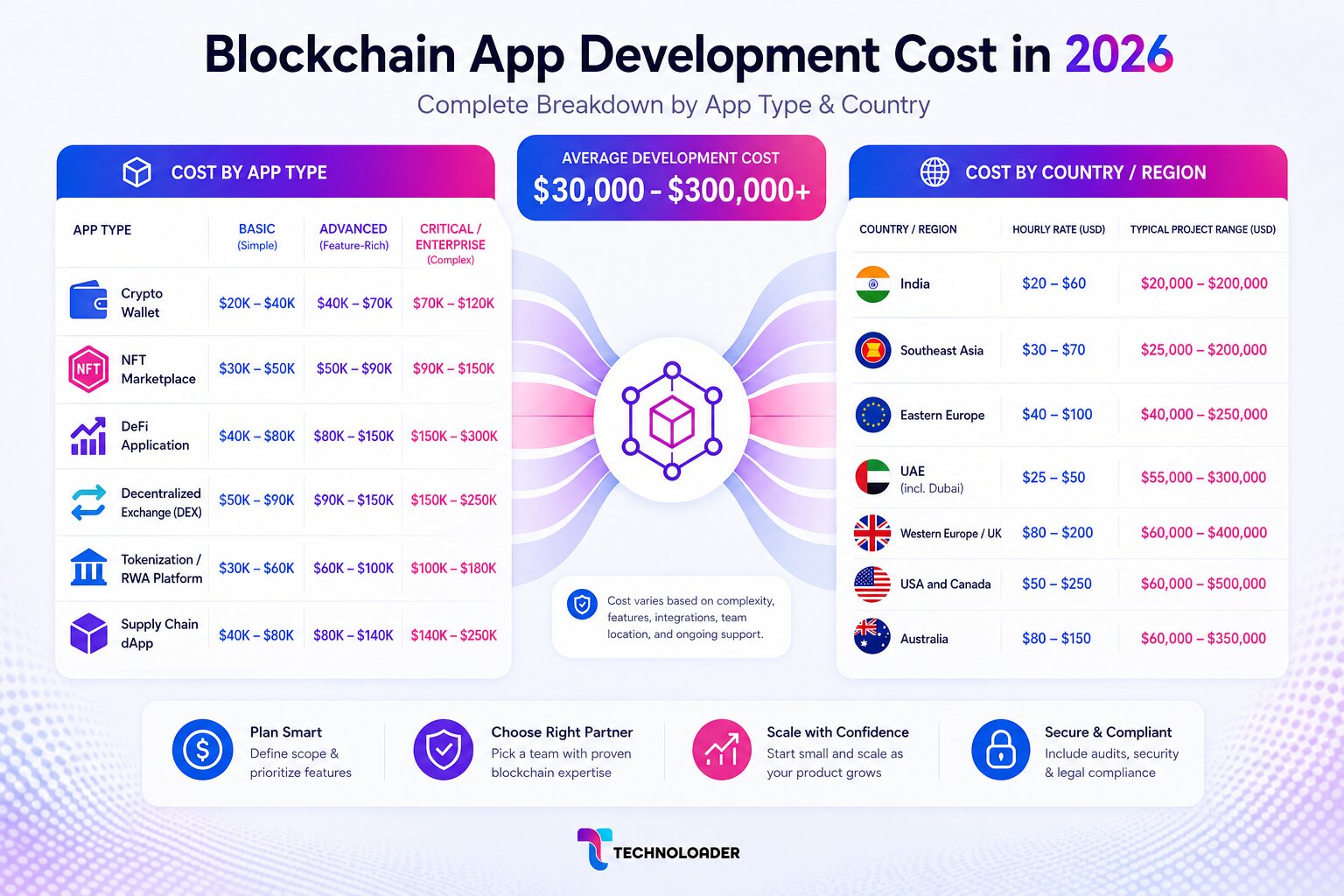
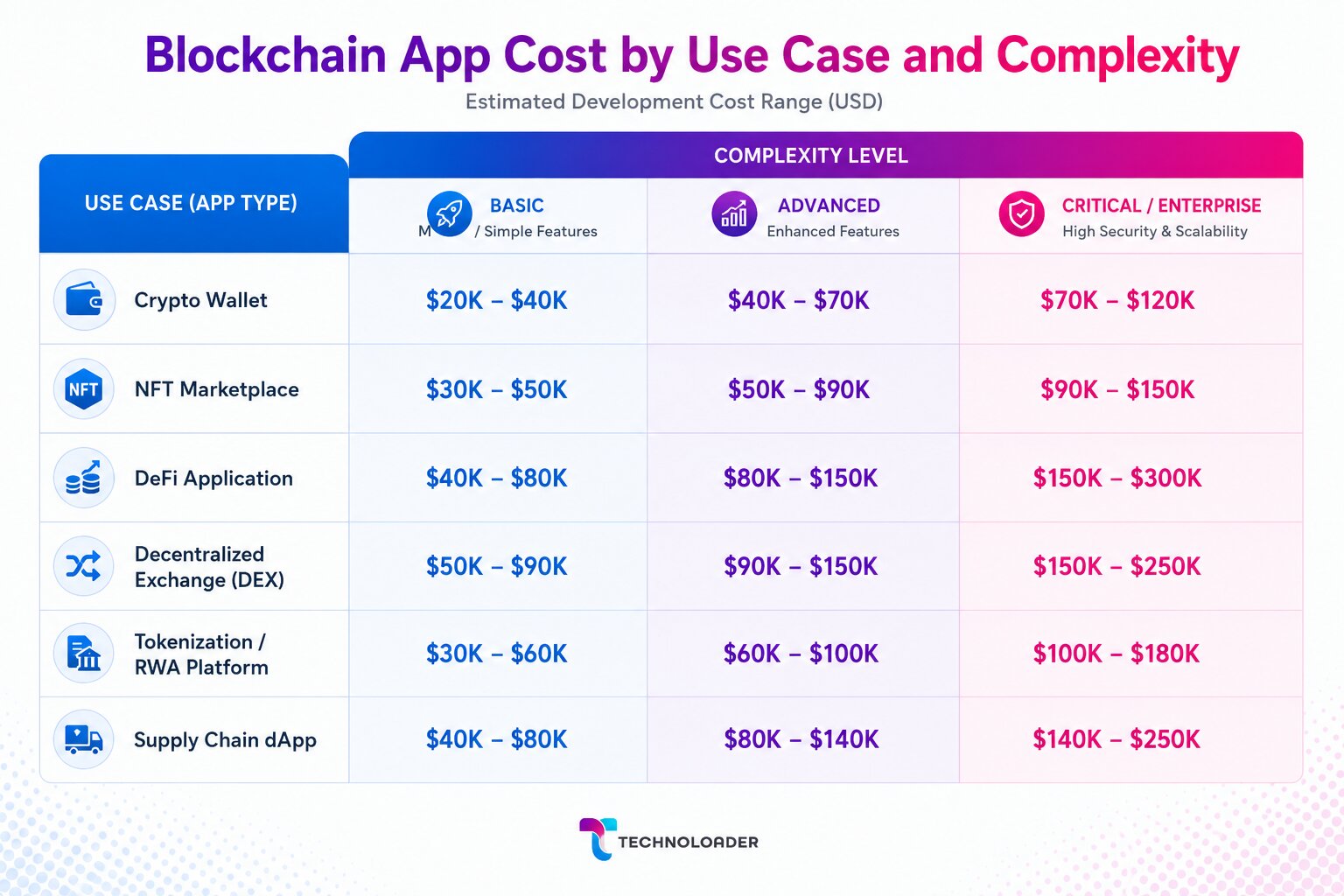
The table below shows estimated blockchain app development cost ranges by use case and tier:
| App Type | Basic | Advanced | Critical / Enterprise |
| Crypto wallet | $20K to $40K | $40K to $70K | $70K to $120K |
| NFT marketplace | $30K to $50K | $50K to $90K | $90K to $150K |
| DeFi application | $40K to $80K | $80K to $150K | $150K to $300K |
| Decentralized exchange (DEX) | $50K to $90K | $90K to $150K | $150K to $250K |
| Tokenization / RWA platform | $30K to $60K | $60K to $100K | $100K to $180K |
| Supply chain dApp | $40K to $80K | $80K to $140K | $140K to $250K |
These are starting ranges, not quotes. Your social blockchain app development cost, for example, shifts with its features.
Feeds, tokens, moderation, and wallet logic each add hours. A crypto wallet app sits well below a full exchange.
Here is how the major app types compare in terms of cost:
How much does blockchain app development cost in 2026?
Most blockchain apps range from about $30,000 for a basic MVP build to $300,000 or more for an audited enterprise platform. The price tracks your app type, complexity, and country.
You May Also Like:
Factors That Influence Blockchain App Development Cost
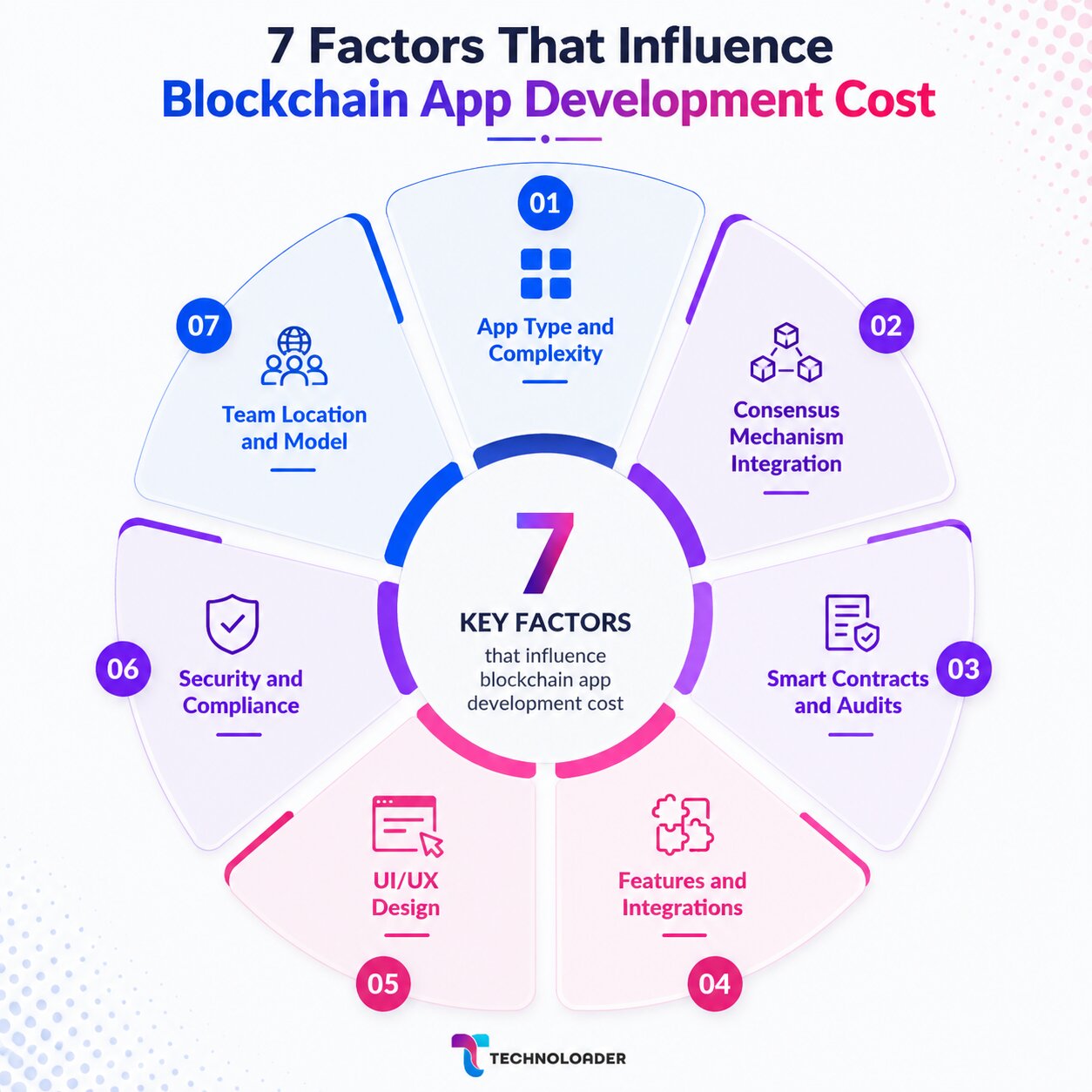
Seven factors drive most of the variation in blockchain app development cost. These include app complexity, smart contracts, platform choice, security requirements, integrations, design expectations, and compliance needs.
Two projects may use the same blockchain technology but end up with very different budgets. I walk every client through all seven before scoping a build.
The table below sums them up:
| Factor | Cost Impact | Why It Moves the Number |
| App type and complexity | High | More features and logic mean extra hours |
| Consensus mechanism integration | Medium to high | Custom rules and multi-layer setups increase development time |
| Smart contracts and audits | High | Security work is specialized and non-optional |
| Features and integrations | Medium to high | Each integration adds build and test time |
| UI/UX design | Medium | Custom design costs more than templates |
| Security and compliance | Medium to high | Regulated apps carry extra work |
| Team location and model | High | Rates and engagement type swing totals |
The graphic below maps the seven cost drivers at a glance:
1. Type and Complexity of the App
A simple wallet app with basic transfer functions requires fewer development hours. A complex decentralized finance (DeFi) app that requires complex smart contracts and advanced security needs more development time.
More features also mean more coding, testing, and quality checks. You can expect a highly complex app to increase your budget by 50% to 100% compared to a basic MVP.
2. Consensus Mechanism Integration
The consensus mechanism you choose affects both technical complexity and overall blockchain app development cost.
Consensus mechanisms determine how a blockchain validates transactions and keeps the network secure.
The more complex your consensus model and network architecture, the more time your team spends on development, testing, and optimization.
Using a basic Proof-of-Stake (PoS) algorithm on an existing blockchain network keeps your costs lower. Complex Proof-of-Work (PoW) algorithms for private networks require additional coding, infrastructure, and testing, which increase initial development costs.
Choosing a pre-built setup helps save money here.
3. Smart Contract Development and Audits
Smart contracts carry their own budget line. A smart contract is self-executing code that runs automatically when its conditions are met.
Simple smart contracts cost less to build and test. Complex contracts that manage staking, lending, token exchanges, or financial transactions require much more work.
Writing the code is one cost. Auditing is another.
A smart contract audit checks the code for vulnerabilities before launch. Audits are not optional on any app that holds value.
Many development teams use battle-tested libraries like OpenZeppelin to reduce the need for custom contract development. The more value your contracts move, the more audit budget they deserve.
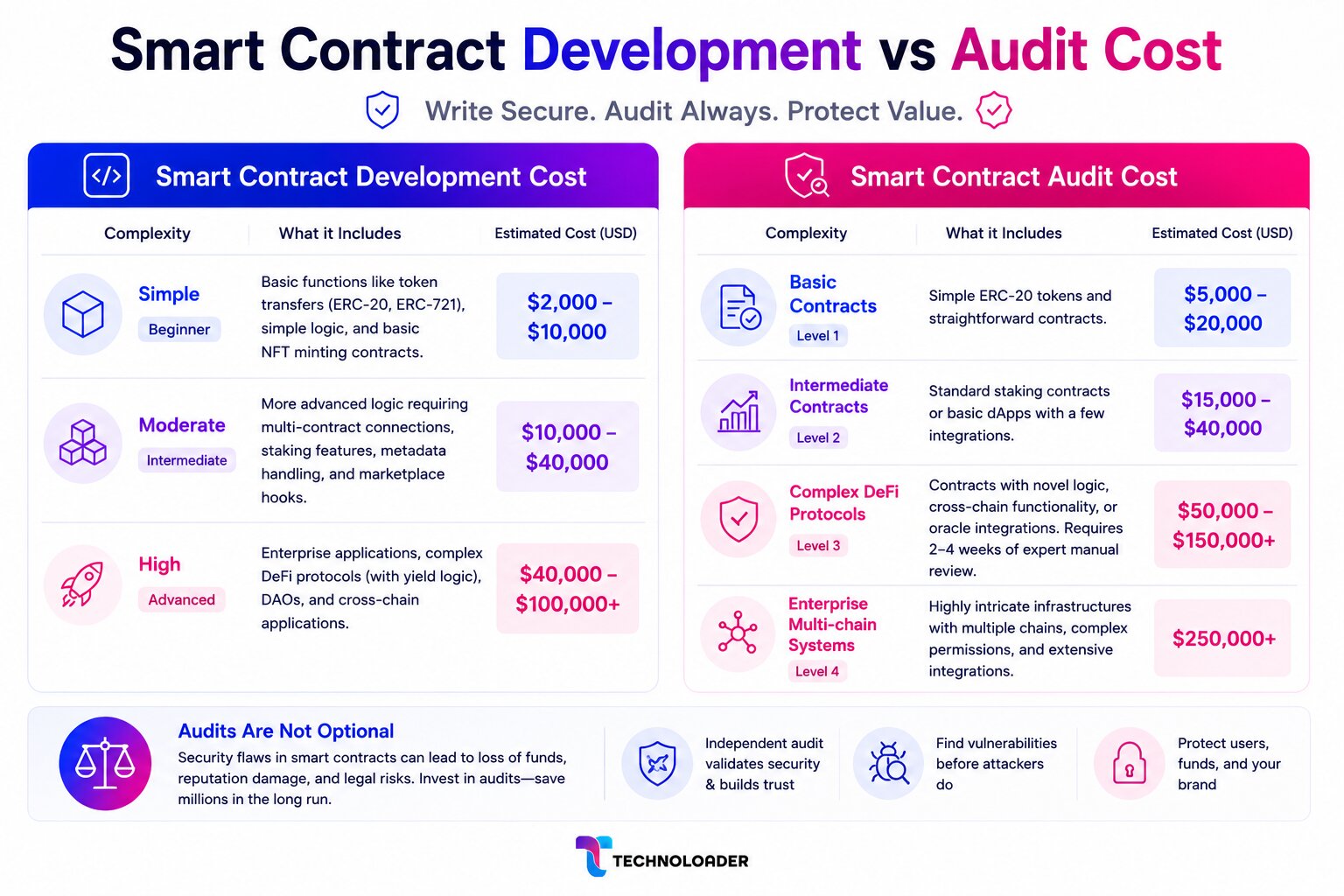
The visual below shows where smart-contract and audit costs sit in a build:
4. Features and Integrations
Every new feature adds to your final blockchain app development cost. Basic applications may only include user registration and wallet connectivity.
Cross-chain blockchain integrations add more workload. Connecting to different layers, exchanges, or external APIs means extra development and testing.
You can control your project budget by sticking to a tight list. Focus on features that add the most value to users, and save the “nice to have” ideas for later.
5. UI/UX Design
Design shapes adoption, so it earns its budget. A basic interface uses standard components and costs less.
A premium, custom interface with smooth wallet flows costs more. Good design reduces confusion and increases adoption.
In the apps I have shipped, clean flows lower support costs and lift retention. In Web3, a confusing wallet step is where many users quit.
6. Security and Compliance
A secure and compliant app protects your operating license.
Blockchain systems offer strong protection because data is distributed across many network participants. However, blockchain applications are tamper-resistant, not unhackable.
Regulated apps need more work. Know-your-customer, anti-money-laundering, and rules like GDPR or HIPAA can increase your blockchain app development cost.
This work reduces risk, but it doesn’t erase it. Skipping it to save money is the most expensive shortcut in this field.
7. Development Team Location and Engagement Model
Who builds your app and how you hire them swings the total cost more than almost anything else. Rates vary widely by country, which I’ll cover in detail below.
Your engagement model matters too.
A fixed-price contract works well for simple projects with a clear scope. For an evolving product, a dedicated team works better. A time-and-materials model suits a research-heavy app development process that takes longer.
What affects blockchain app development cost the most?
App type and team location significantly increase your final budget. Smart contracts and security work come next. Features, integrations, consensus mechanism, and design shape the final budget.
You May Also Like:
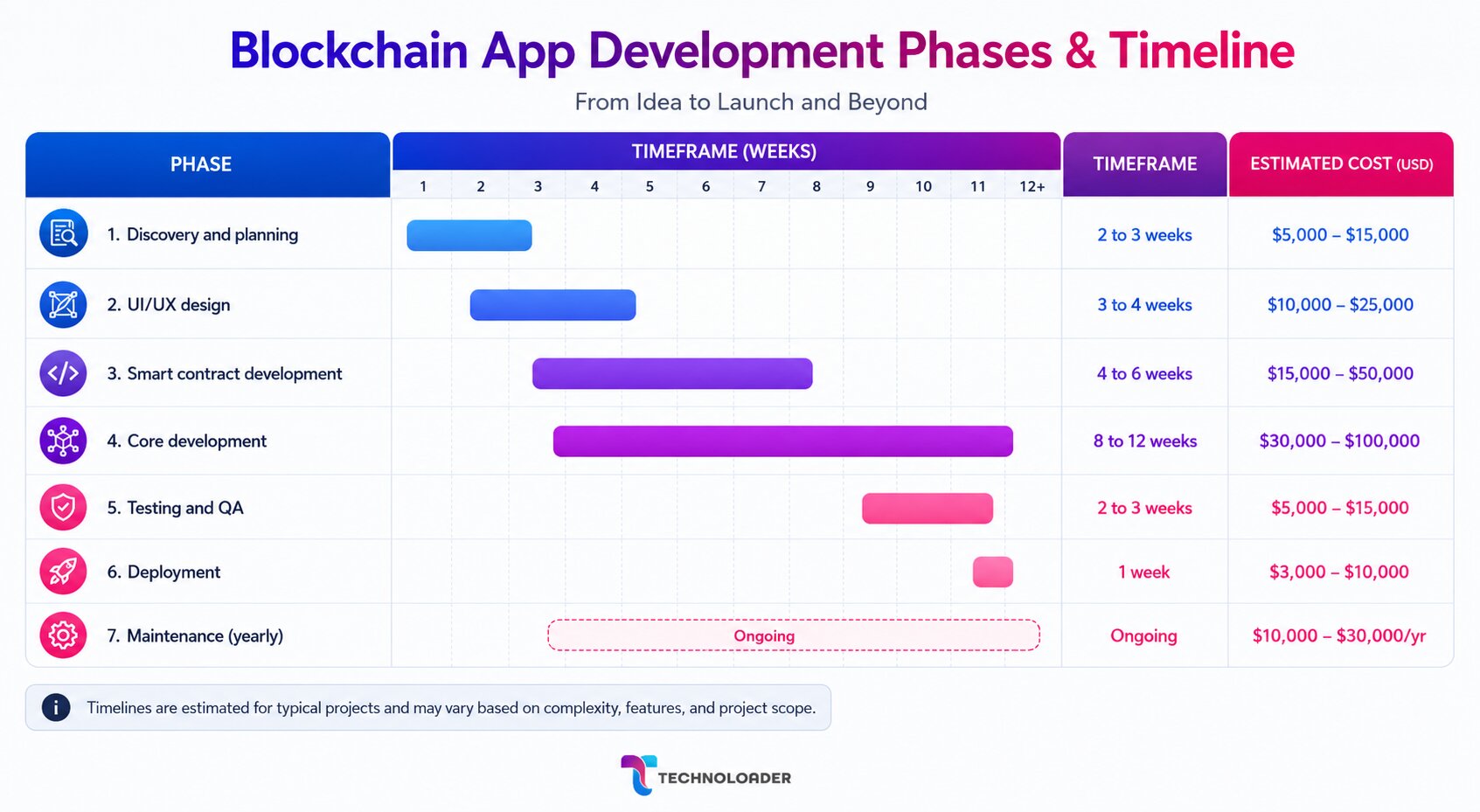
A blockchain app budget splits across seven phases, plus ongoing costs that many teams forget. Seeing the phases helps you plan your budget more accurately. It also shows where your money actually goes.
The ranges below are 2026 market estimates:
Phase-by-Phase Cost and Timeline
Each phase serves a different purpose and delivers a piece of your finished app.
Discovery sets the scope while design shapes the experience. Smart contracts and core development build the app’s logic. Finally, testing protects it, and deployment ships it.
The table below shows typical timelines and costs for a professional blockchain project:
| Phase | Timeframe | Estimated Cost (USD) |
| Discovery and planning | 2 to 3 weeks | $5,000 to $15,000 |
| UI/UX design | 3 to 4 weeks | $10,000 to $25,000 |
| Smart contract development | 4 to 6 weeks | $15,000 to $50,000 |
| Core development | 8 to 12 weeks | $30,000 to $100,000 |
| Testing and QA | 2 to 3 weeks | $5,000 to $15,000 |
| Deployment | 1 week | $3,000 to $10,000 |
| Maintenance (yearly) | Ongoing | $10,000 to $30,000/yr |
Discovery is the lowest-cost phase and the most valuable one. It defines your project goals, user flows, technical requirements, and blockchain architecture.
A clear scope here prevents expensive rework later. Skipping it is the most common budget mistake I see. Better to spend a week planning than a whole month rebuilding.
This timeline shows the phases and their typical duration:
Ongoing and Hidden Costs
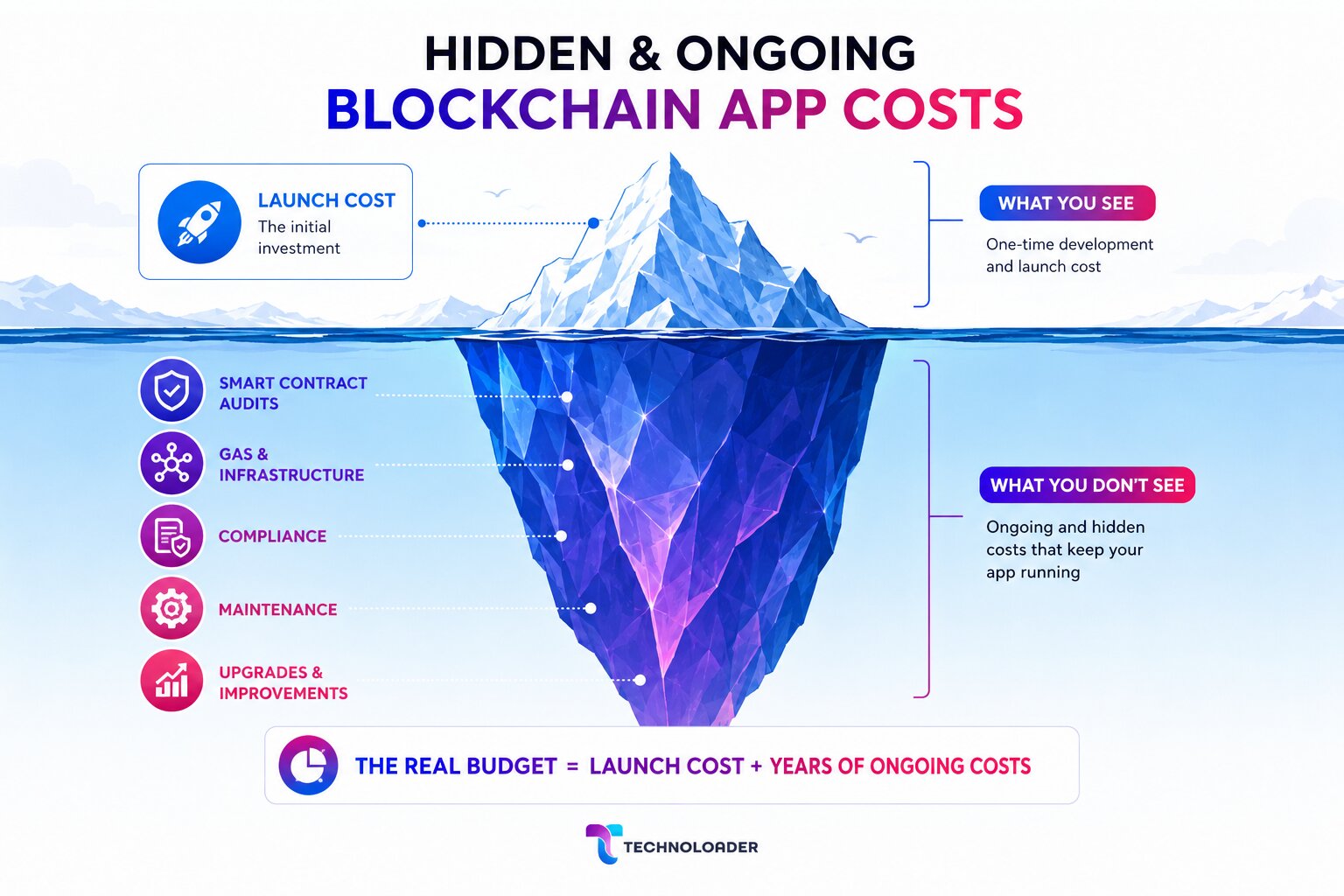
The launch price is the initial investment, not the full cost. Once your app goes live, you must budget for ongoing operational and maintenance costs.
Here are additional expenses that determine your total blockchain app development cost:
- Smart contract audits: One-time audits aren’t enough to secure your blockchain app. Re-audit your code after every major update.
- Gas and infrastructure: Blockchain nodes, servers, and network fees incur monthly fees. These costs scale with the number of users.
- Compliance: If you operate in regulated markets, you may need to obtain licenses and file blockchain compliance reports. The cost depends on your location.
- Maintenance: Plan for roughly 15%-20% of the initial development cost annually. Spend it on updates, continuous monitoring, bug fixes, and security improvements.
Projects that go over budget almost always under-scope audits and maintenance. Plan for the app’s full life cycle.
Here is a simple way to think about it. Add your launch cost, then add a few years of audits, infrastructure, and maintenance.
That combined total is your real budget. It’s what separates an app that lasts from one that stalls after launch.
The graphic below breaks down the costs that land after launch:
What are the hidden costs of a blockchain app?
Audits, infrastructure, compliance, and maintenance are the costs teams forget. Over a few years, they add up to a real share of the total, so treat them as part of the price.
You May Also Like:
Blockchain App Development Cost by Country
Blockchain app developer rates swing 4 to 5 times across countries. That makes location the single biggest lever on total cost.
The same app can cost three times more in one market than another. India and Southeast Asia run well below the US and Western Europe.
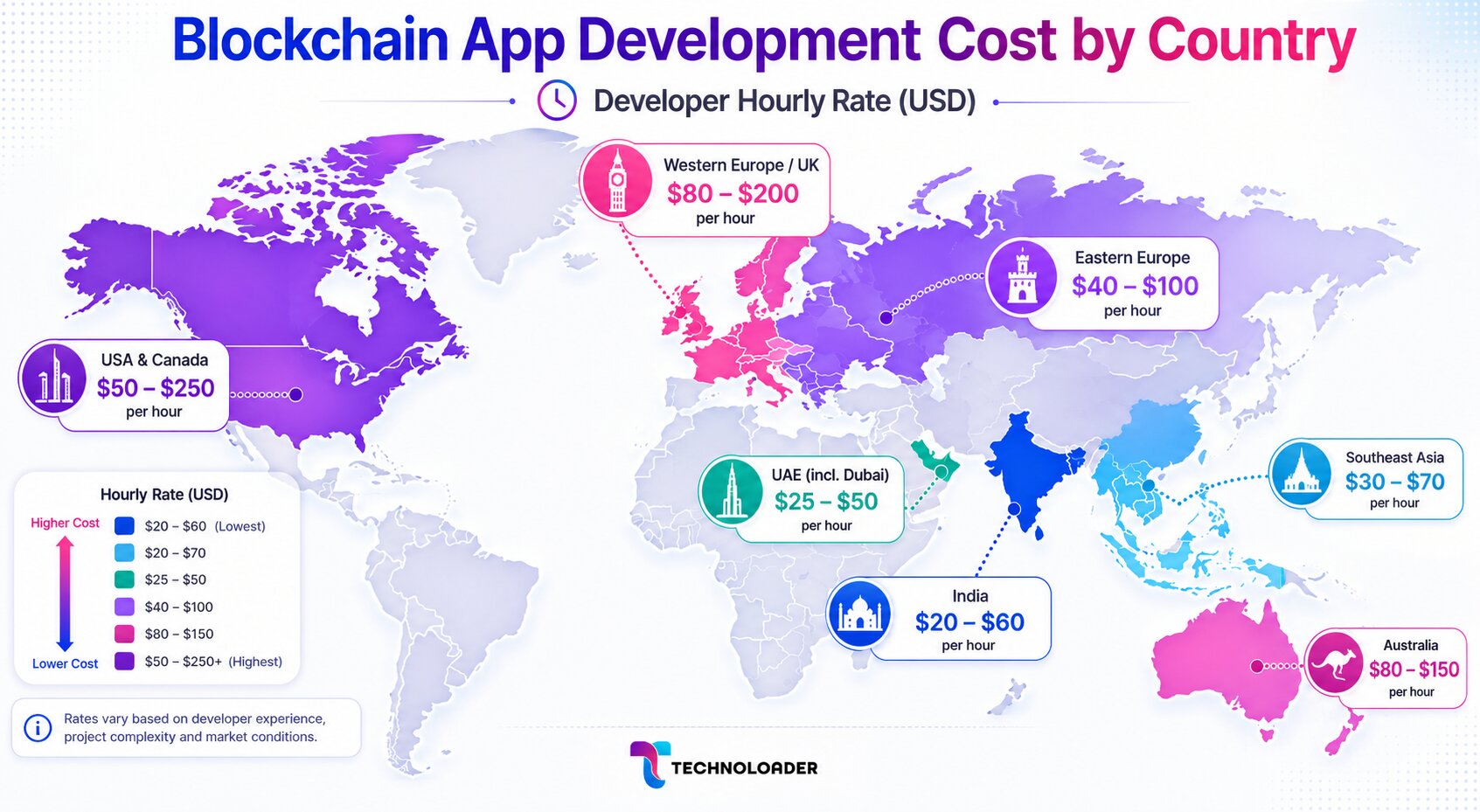
Here are 2026 blockchain app development cost estimates by country:
| Country / Region | Hourly Rate (USD) | Typical Project Range (USD) |
| India | $20 to $60 | $20,000 to $200,000 |
| Southeast Asia | $30 to $70 | $25,000 to $200,000 |
| Eastern Europe | $40 to $100 | $40,000 to $250,000 |
| UAE (incl. Dubai) | $25 to $50 | $55,000 to $300,000 |
| Western Europe / UK | $80 to $200 | $60,000 to $400,000 |
| USA and Canada | $50 to $250 | $60,000 to $500,000 |
| Australia | $80 to $150 | $60,000 to $350,000 |
India offers the most competitive rates among major regions. Blockchain app development costs in Dubai or the US sit higher than the same build in India.
That gap is why many companies hire offshore teams. Choosing experienced blockchain developers can reduce your overall spending by 60% without sacrificing quality.
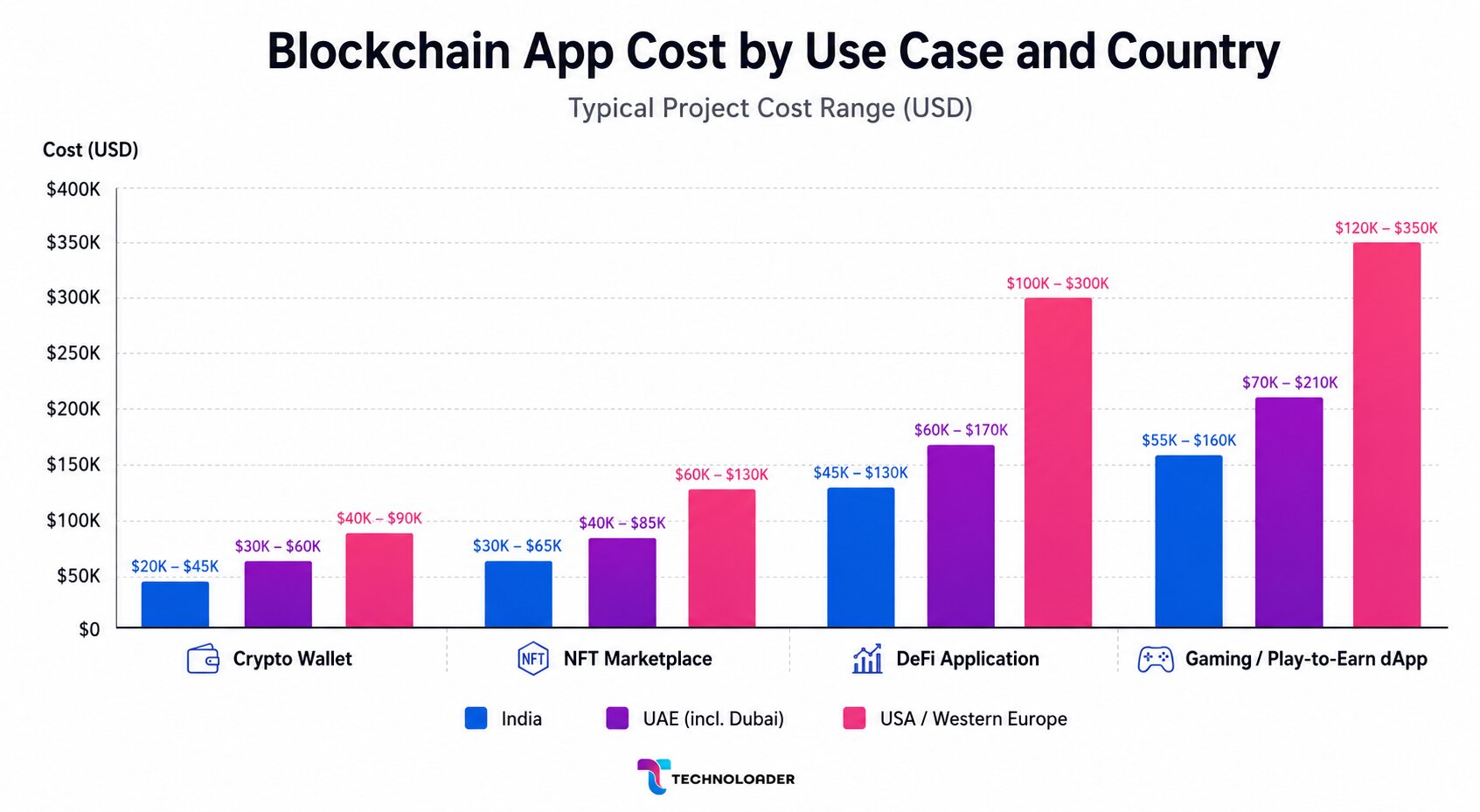
Pricing for the same app type also changes by country, as shown in the table below:
| App Type | India | UAE | USA / Western Europe |
| Crypto wallet | $20K to $45K | $30K to $60K | $40K to $90K |
| NFT marketplace | $30K to $65K | $40K to $85K | $60K to $130K |
| DeFi application | $45K to $130K | $60K to $170K | $100K to $300K |
| Gaming / play-to-earn dApp | $55K to $160K | $70K to $210K | $120K to $350K |
This chart compares the same app types across India, the UAE, and the West:
Quality is not tied to rate, though. Expertise matters more than geography. Judge a partner on portfolio and process, not on price alone.
As an India-based blockchain development company, Technoloader builds apps at competitive Indian rates. The company scopes each project and shares a custom quote, since real pricing depends on your exact features and timeline.
This map compares blockchain developer rates across regions:
You May Also Like:
How to Reduce Blockchain App Development Costs
You can lower your blockchain app development cost without cutting corners. The trick is making smarter decisions during planning and development.
The goal is not to remove important functionality. Instead, focus your budget on the features that create the most value.
Here are the moves I recommend most often:
The graphic below summarizes five practical ways to significantly reduce costs:
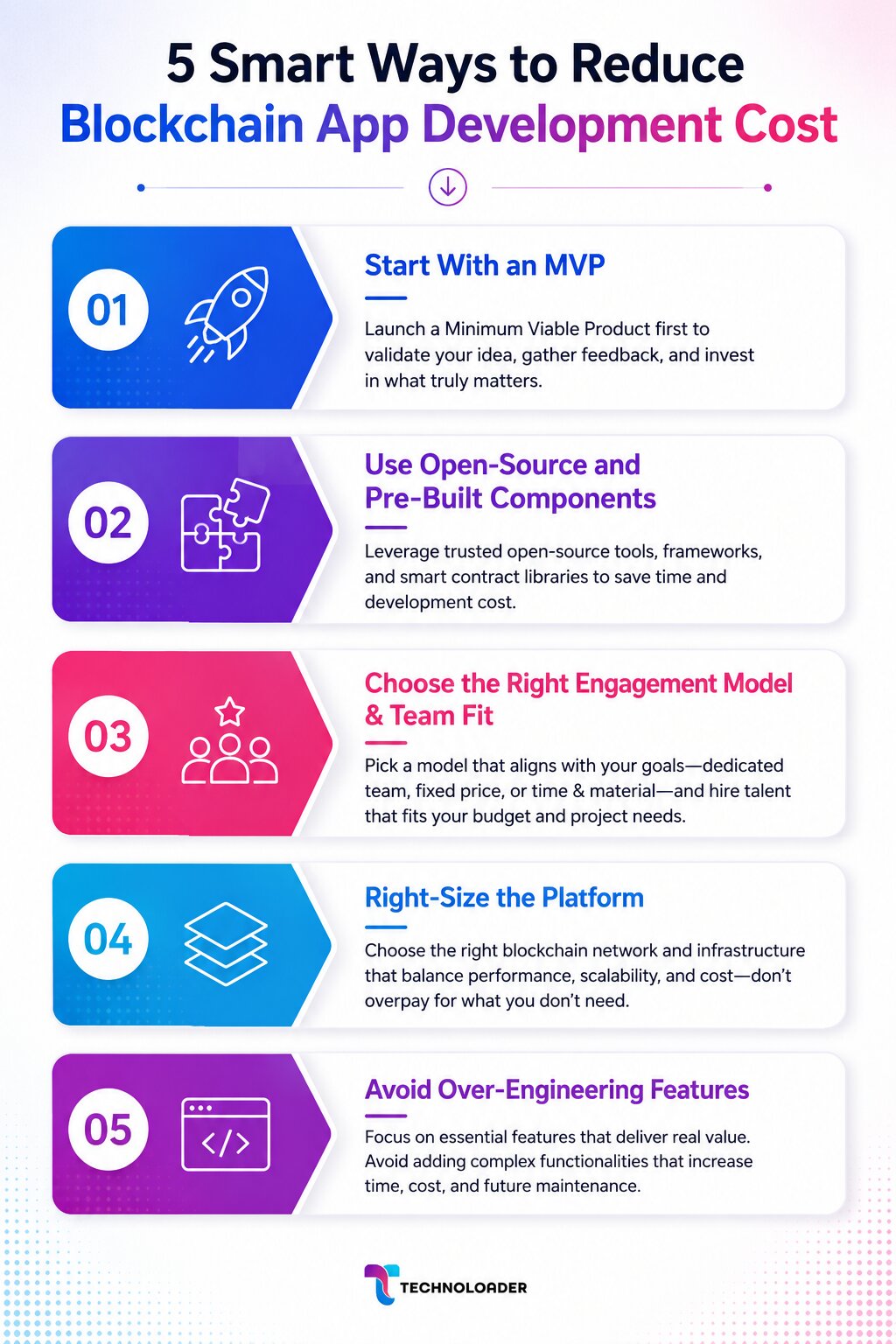
Start With an MVP
A minimum viable product (MVP) includes only the essential features needed to solve your users’ main problem.
This approach reduces your blockchain app development cost, shortens timelines, and lowers risk. It also gets you to market faster, which has its own value.
You can gather user feedback, then scale what works over time.
Here is how an MVP compares to a full build in terms of cost and time:
Use Open-Source and Pre-Built Components
You don’t need to build everything from scratch. Audited open-source libraries and proven templates save weeks of work. They also reduce risk, because the code is widely tested.
Resources such as OpenZeppelin provide audited smart contract templates that developers can customize.
The trade-off is less customization compared to building every feature from the ground up.
Choose the Right Engagement Model
Match how you hire app development companies to how your product will evolve.
A fixed-price contract works when you have a clear scope. A Time and Materials (T&M) model or a dedicated development company is best for a product that will keep changing.
The wrong model is where budgets quietly leak.
Right-Size the Platform
An expensive blockchain network isn’t always the right call. It only increases your blockchain app development costs.
A public or private network choice, or a low-cost layer-2 solution, can cut both build and running costs. Match the platform to your system capacity and privacy needs.
Avoid Over-Engineering Features
Stick to what your users actually need. Every feature you add increases your overall development cost.
Prioritize functionality that delivers clear value. Delay complex features until user demand justifies the investment.
One caution: Never save money by skipping audits or security testing. A low-cost launch that gets exploited costs far more than the audit would have.
What is the most affordable way to build a blockchain app?
Start with an MVP, use proven open-source tools, and pick a low-fee platform that fits your needs. Choose the right engagement model and keep the scope tight, but never trim security or audits to cut costs.
You May Also Like:
How to Estimate Your Cost and Choose a Partner
To estimate your blockchain app development cost, consider four factors. These include your app type, feature depth, platform, and compliance requirements. Once you understand them, you can create a realistic budget.
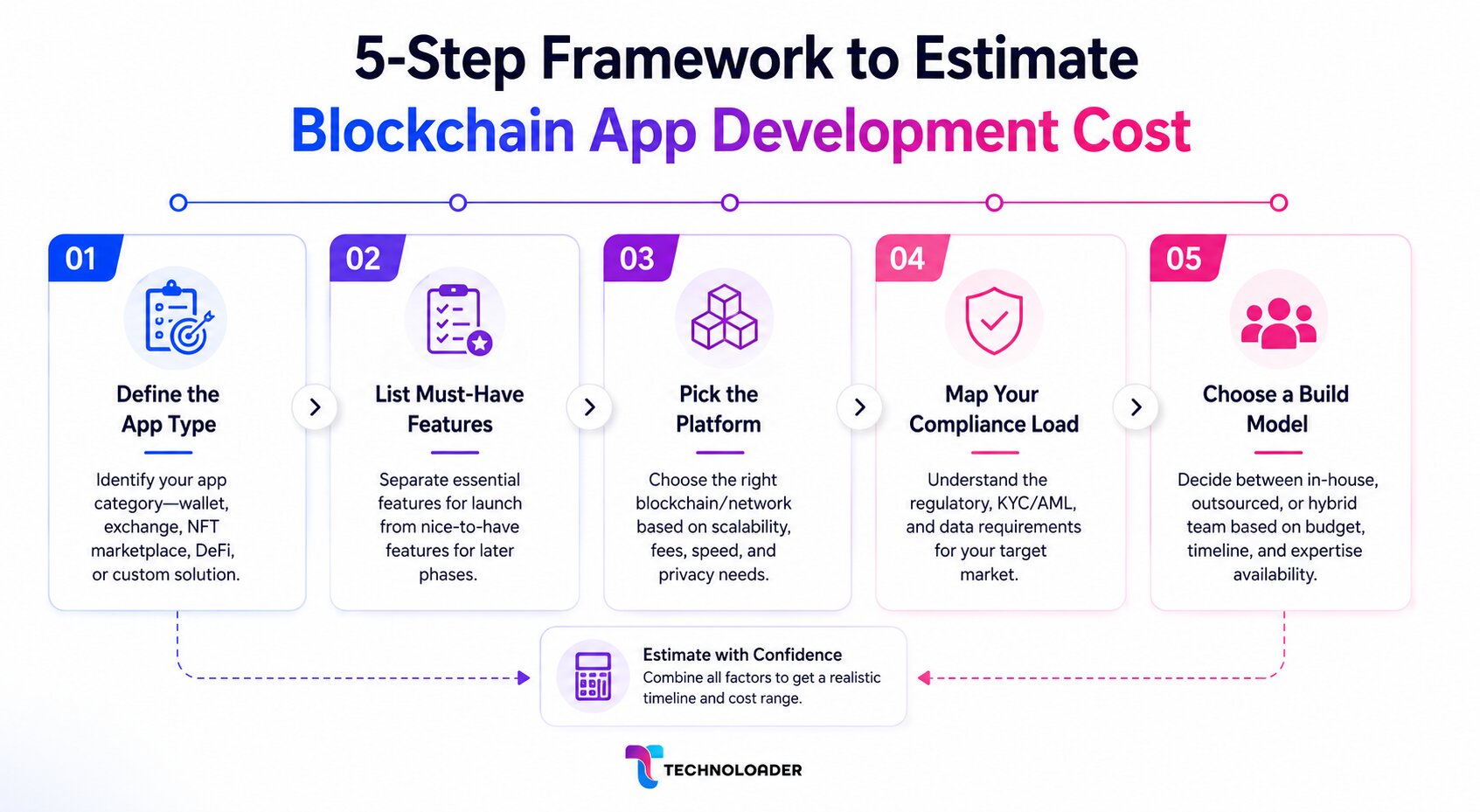
Here is the simple framework I use with my clients:
- Define the app type. Crypto wallet app, exchange, NFT marketplace, DeFi, or something custom
- List the must-have features. Separate launch features from later ones
- Pick a platform. Match the network capacity, fees, and privacy to your use case
- Map your compliance load. Know which rules apply in your specific market
- Choose a build model. Consider an in-house, outsourced, or hybrid team
This graphic lays out the five-step estimate framework:
Once you have a clear estimate, it’s time to select a partner.
An internal blockchain team gives you full control. But it comes with high hiring, training, management, and infrastructure costs. Outsourcing reduces these expenses and speeds up delivery.
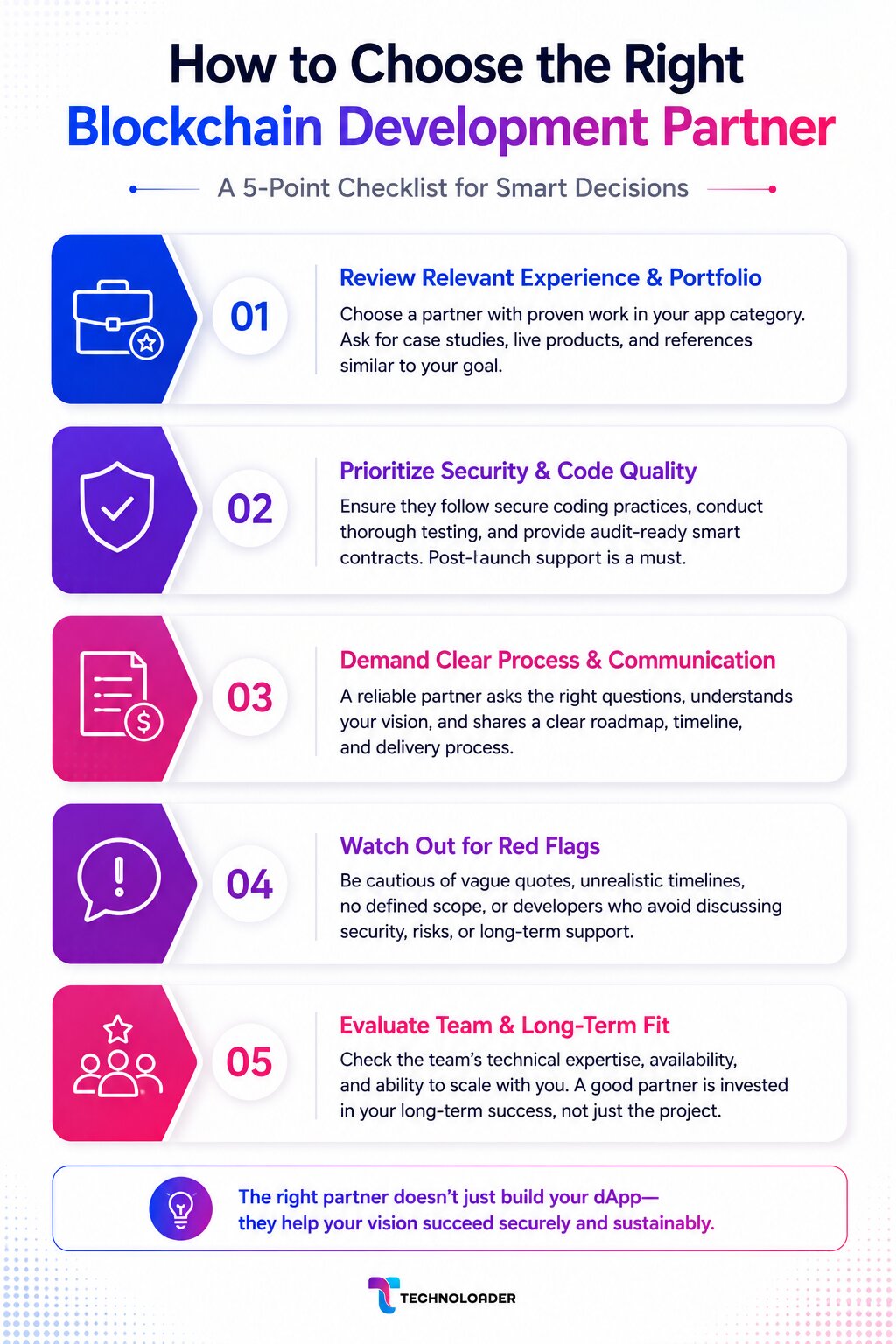
Look for a real portfolio in your app category. Ask to see audited contracts and live products. Check how the developer handles app security, testing, and post-launch support.
A few red flags are worth watching. Be wary of a quote with no scope behind it.
Be cautious if security and audits are not mentioned. A serious partner asks questions before naming a price.
Use this checklist when you compare blockchain development partners:
At Technoloader, our blockchain development work is founder-led. We’ve delivered 450+ projects across DeFi, NFTs, gaming, and tokenization.
We are also government-certified and Clutch-rated, and we scope every project against your real budget. That experience turns a rough estimate into a plan you can trust.
How do I estimate the cost of my blockchain app?
Scope your app type, must-have features, platform, and compliance needs first. Share those with a proven partner, and you will get a realistic estimate instead of a guess.
You May Also Like:
Why Cost Estimates Vary So Widely
Blockchain app cost ranges look very different online. That’s mainly because there is no universal standard for project scope, region, and quality.
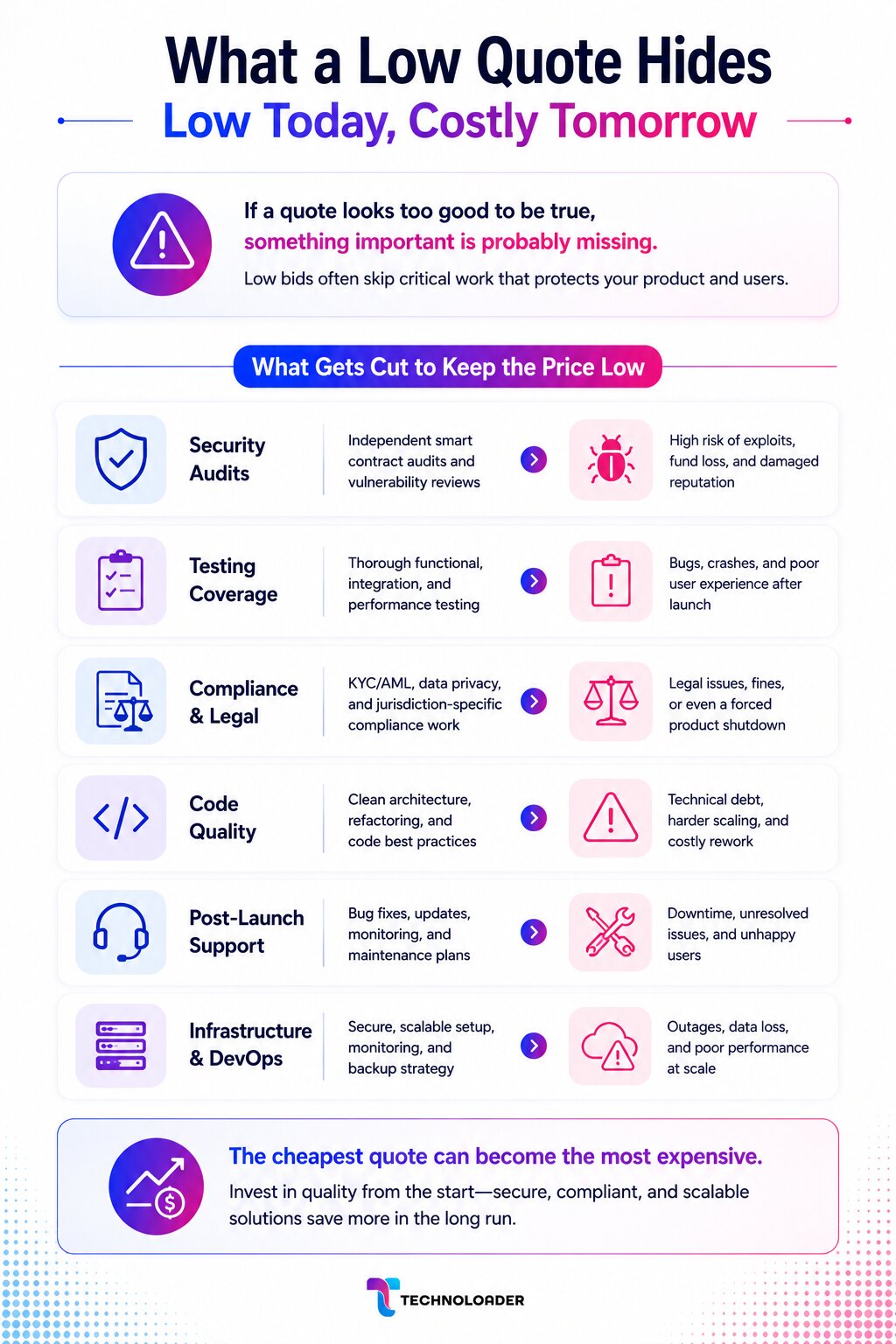
A $20,000 quote and a $200,000 quote can both be honest. They simply describe different builds. The trick is knowing what each price includes.
Be cautious with any quote that’s too low. A low bid often skips audits, testing, or compliance.
Those gaps surface later as security incidents or rework. They cost far more than the initial savings.
The graphic below shows what a suspiciously low quote often leaves out:
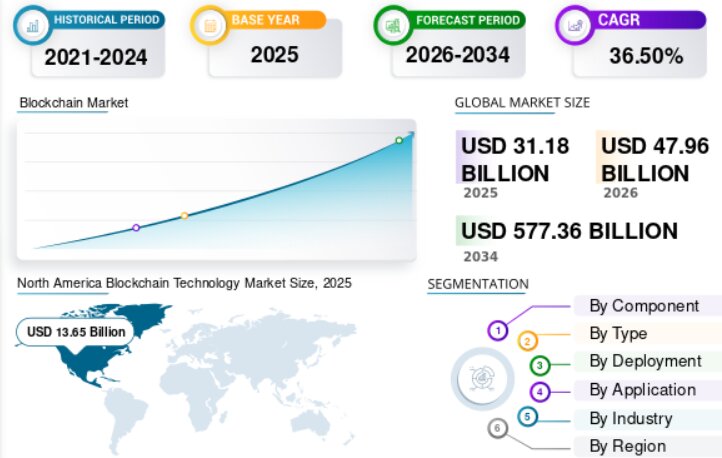
The demand behind these apps is real and growing. Fortune Business Insights values the global blockchain market at about $47.96 billion in 2026. It’s projected to reach $577.36 billion by 2034.
Another report from Grand View Research projects even higher growth. The global blockchain market value is $108.3 billion in 2026, and is expected to reach $9,055.5 billion by 2033.
Either way, demand for skilled blockchain talent continues to rise. It’s part of why quality work holds its price.
This chart shows the projected growth of the blockchain market:
Why do blockchain app cost estimates differ so much?
Blockchain app development cost estimates vary because scope, region, and quality are not standardized. Two quotes can both be fair for different builds, so compare what each one includes, not just the headline number.
Frequently Asked Questions
How much does it cost to develop a blockchain app in 2026?
Blockchain app development cost in 2026 ranges from about $30,000 for a basic build to $300,000 or more for an audited enterprise platform. It depends on app type, features, consensus mechanism, and country. Simple apps cost far less than audited DeFi or gaming platforms.
How much does blockchain app development cost in India?
Blockchain app development cost in India generally runs from about $20,000 to $200,000, depending on scope. Indian rates of roughly $20 to $60 per hour are among the most competitive of any major hub. That is why many global companies build with India-based teams.
How long does it take to build a blockchain app?
A simple MVP can take one to three months. A mid-tier app usually takes three to five months. A complex, audited enterprise platform often takes six months or more. Timeline tracks feature depth, integrations, and the level of testing your app needs.
How much does smart contract development and a security audit cost?
A smart contract is self-executing code that runs when its conditions are met. Development and auditing are separate costs. A smart contract audit can range from $5,000 to $50,000 or more, based on complexity. Audits are essential for any app that holds value.
Is it more affordable to develop a blockchain app offshore or in India?
Offshore regions like India and Southeast Asia offer much lower hourly rates, often 30 to 50 percent below Western rates. A proven offshore team can reduce blockchain app development costs without lowering quality. Avoid hiring blockchain developers based on hourly rates alone. Check their portfolios, audits, and processes as well.
How much does a DeFi app or NFT marketplace cost to build?
A DeFi app usually ranges from about $40,000 to $300,000, and an NFT marketplace from about $30,000 to $150,000. Each needs custom smart contracts, integrations, and audits. Final cost depends on feature depth, integrations, and your compliance needs.
What is the cost difference between a public and a private blockchain app?
Public-chain apps can carry higher network fees but lower setup work, since the infrastructure already exists. Private or permissioned apps cost more to set up and run, but offer more control and privacy. The right choice depends on your throughput, privacy, and compliance needs.
Do I need Web3 features, and how do they affect cost?
If your app involves digital assets, user-owned data, or decentralization, Web3 features are worth it. They add wallet logic, token handling, and on-chain interactions, which increase build time. For simple use cases, a lighter feature set keeps your costs lower.
Conclusion
Blockchain app development cost is a set of choices, not a fixed price. Your app type, features, platform, security needs, and country decide the final number.
Budget for the full life of the app, including audits and maintenance. An MVP-first approach keeps your early spend under control.
The right partner turns a rough estimate into a plan you can build on. If you are scoping a project and want a clear, honest quote, talk to our team.
Get a custom blockchain quote, and let’s map your project together.
Have a question about your blockchain app development cost? Drop it in the comments, and I’ll answer.

Vipin Kumar
Vipin Kumar is the Founder & CEO of Technoloader, a Clutch Top 10 Blockchain Development Company for 2025. A serial technology entrepreneur and blockchain architect with a B.Tech background, Vipin has led the delivery of 450+ projects across DeFi, NFT marketplaces, AI/ML, and custom Web3 platforms for clients in the UAE, India, the US, and beyond. He also founded SALIQ (saliq.ai), an AI-driven conversational marketing platform.
Published in Blockchain Development