+91 7014607737
 info@technoloader.com





Table of Contents
Building a secure crypto wallet in 2026 means prioritizing strong security over UI or transaction speed, because a single breach can permanently damage user trust. With over USD 2.2 billion lost to crypto hacks, a secure wallet must protect private keys, prevent unauthorized access, and actively defend against phishing, fraud, and cyberattacks. Users ultimately choose wallets that guarantee asset safety, full ownership, and reliable Web3 security.
If you are developing a crypto wallet in 2026, you need to know that functionality is important, but security is everything.
It doesn’t matter how intuitive your UI is or how fast your transaction speeds are; if your users don’t feel their assets are secure, they won’t use your crypto wallet app. What’s more worse? One breach can destroy your app’s reputation.
And the risks are growing. According to TRM Labs, USD 2.2 billion was stolen in hacks and exploits. Thus, it is important that you build a secure crypto wallet that is resilient to hacks, thefts, and cyberattacks.
To help you out, we’ve curated a blog for you! In this, we’ll talk about some important features that your cryptocurrency must have to gain a competitive edge in the market.
But first, let’s begin with some basics!
An Overview of Crypto Wallets
A cryptocurrency wallet is a digital tool that allows users to store, send, and receive crypto assets securely. It basically stores private keys that grant access to a user’s digital assets.
Basically, these do not store the actual cryptocurrencies but interact independently with the blockchain network. It allows transactions by verifying the balances and transferring the cryptocurrencies with the private keys. This offers complete ownership of their funds and access when required.
Types of Cryptocurrency Wallets

The below-mentioned are some of the common types of crypto wallets:
- Mobile Wallets
Mobile wallets are apps that are installed on smartphones. They provide ease of use and allow you to quickly make payments, trade, or access your crypto assets anywhere and anytime.
- Web Wallets
Web wallets store your private keys on a server that a third party manages. It can be accessed from any device but requires a stable internet connection.
- Desktop Wallets
A desktop wallet is software that is installed on your computer. It stores private keys locally on your hard drive. Because of the fact that desktop wallets are not managed by a third party, they offer more security than web or mobile wallets.
- Hardware Wallets
Hardware wallets are physical devices that store private keys offline. These are the most secure, as they are not prone to online threats. To make a transaction, you must connect the wallet to your computer.
- Paper Wallets
Paper wallets allow for storing private and public keys in printed form or written on paper. Because these are offline, paper wallets are not prone to hacking, but can get damaged or lost.
Must-Have Features in a Cryptocurrency Wallet
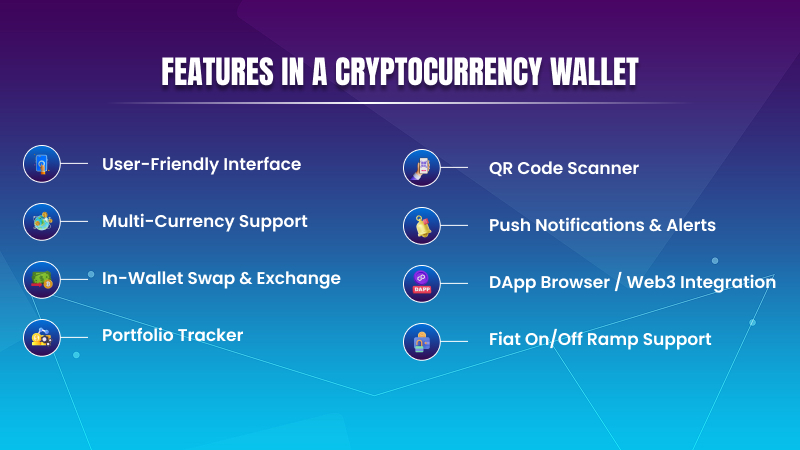
Now, let’s have a look at the key features that you must integrate into your secure crypto wallet app!
- User-Friendly Interface
An intuitive and clean design makes it easy for both beginners and experienced users to use the wallet, send or receive cryptocurrencies, and manage digital assets. A user-friendly interface builds trust, reduces errors, and enhances the overall user experience, which is important in a space where usability can make or break adoption.
- Multi-Currency Support
modern crypto wallets must support a wide range of digital assets, such as BTC, ETH, ERC-20 tokens, stablecoins, and NFTs. This would allow users to manage all their assets in one place, which reduces the need for multiple apps and improves convenience and user retention.
- In-Wallet Swap & Exchange
Ensure that you integrate token swap features in your crypto wallet. It allows users to exchange one crypto asset for another directly within the wallet. This saves time, reduces gas fees, and keeps users within your ecosystem instead of relying on external exchanges.
- Portfolio Tracker
Your crypto wallet must display real-time valuations of all assets, historical performance charts, and analytics to help users make informed decisions. It simplifies portfolio management and attracts both casual users and serious investors who are looking to track profits, losses, and the latest trends in one place.
- QR Code Scanner
You must integrate a QR code scanner in your wallet, as it enables fast and accurate sending or receiving of cryptocurrencies. This improves both user experience and transaction security, particularly during in-person transactions or quick mobile payments.
- Push Notifications & Alerts
Ensure that your crypto wallet app updates users with price changes in real time and gives instant transaction confirmations. This will help users monitor specific assets or events, which will improve engagement and trust in the wallet’s responsiveness.
- DApp Browser / Web3 Integration
Your app must allow users to connect with DeFi platforms, NFT marketplaces, and blockchain games. This feature is essential for interacting with the broader Web3 ecosystem and turns a wallet into a gateway for blockchain-based services.
- Fiat On/Off Ramp Support
You must allow users to buy or sell crypto using traditional currencies through credit cards, bank transfers, or UPI. Also, simplify onboarding for new users, which enables people to enter or exit the crypto market without using third-party exchanges.
Key Security Features in Your Crypto Wallet
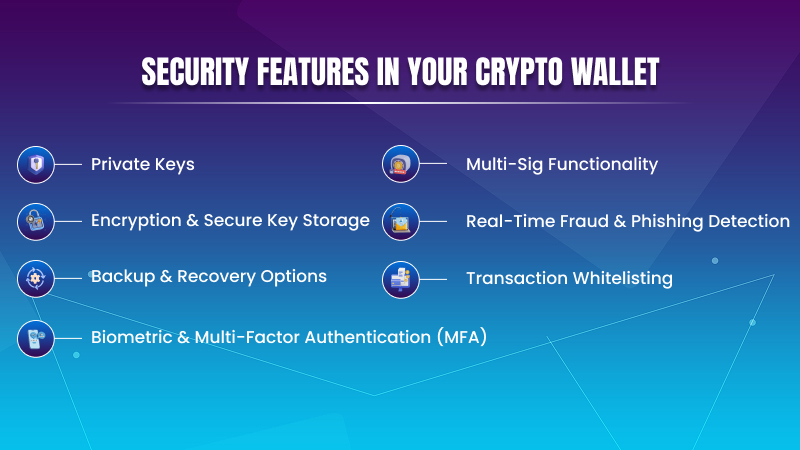
Apart from other features, you also need to include security features to make it robust, such as:
- Private Keys
Your wallets should give users complete control over their private keys. This ensures asset ownership lies with the user, not the wallet provider, and allows secure export or backup for recovery if the device is lost or replaced.
- Biometric & Multi-Factor Authentication (MFA)
Ensure that your cryptocurrency wallet app has fingerprint scans, face ID, or 2FA. These methods add extra verification steps that prevent unauthorized access. This will create a safer user experience without sacrificing convenience.
- Encryption & Secure Key Storage
You must implement advanced encryption standards in your wallet and utilize device-level security or hardware modules to store sensitive data. This ensures that private keys and credentials remain safe, even if the app suffers a breach.
- Backup & Recovery Options
Make sure that your secure crypto wallet offers reliable recovery methods such as seed phrase backups and optional encrypted cloud storage. This enables users to restore access to their wallet if a device is lost or damaged without compromising the security of their funds.
- Multi-Sig Functionality
Your crypto wallet must require multiple private keys to authorize a transaction, which adds an extra layer of control. This feature prevents single points of failure and enhances security for shared wallets.
- Real-Time Fraud & Phishing Detection
The wallet must detect unusual behaviour, scam tokens, or known malicious addresses and alert users in real time. This protection reduces the risk of falling victim to fraud, phishing attempts, or suspicious transfers.
- Transaction Whitelisting
Your crypto wallet must allow users to pre-approve trusted wallet addresses for sending funds. Transactions outside the whitelist can be blocked, which reduces the chances of sending crypto to the wrong or malicious addresses due to phishing or user error.
Final Thoughts
That’s it for this blog!
As the crypto space continues to evolve, users are now demanding wallets that are not just feature-rich but also secure, scalable, and user-friendly.
From multi-currency support to biometric security, developing a crypto wallet in 2026 means balancing innovation with trust. But remember, execution matters just as much as a strategy.

Vipin Kumar
Vipin Kumar is the Founder & CEO of Technoloader, a Clutch Top 10 Blockchain Development Company for 2025. A serial technology entrepreneur and blockchain architect with a B.Tech background, Vipin has led the delivery of 450+ projects across DeFi, NFT marketplaces, AI/ML, and custom Web3 platforms for clients in the UAE, India, the US, and beyond. He also founded SALIQ (saliq.ai), an AI-driven conversational marketing platform.
Published in Cryptocurrency Wallet Development