 +91 7014607737
 info@technoloader.com





Table of Contents
Quick Summary
Blockchain in real estate uses digital records and smart contracts to improve property transactions and ownership tracking. It enables real estate tokenization, so investors can buy fractional shares of properties through digital tokens. The process involves legal structures, compliance checks, token standards, and blockchain networks that support secure transactions.
Blockchain in real estate uses a shared, tamper-evident digital ledger to record property and enable fractional ownership. It can replace slow paperwork and manual checks with automated, verifiable records.
Two applications drive blockchain in real estate — trusted property records and property tokenization for fractional ownership.
Deloitte projects tokenized real estate could reach about $4 trillion by 2035, up from under $0.3 trillion in 2024. That is a large shift for a slow-moving industry.
In this guide, I’ll explain how blockchain in the real estate industry works and the rules that apply.
I run Technoloader, and we build tokenization platforms. So I will keep this practical and honest, not hyped.
What Is Blockchain in Real Estate?
Blockchain in real estate is the use of a shared digital ledger to record and move property rights. The ledger is copied across many computers, which makes the same information available to everyone with permission to access it.
A blockchain groups transactions into blocks. Every block is cryptographically linked to the one before it. That linking makes the transaction history tamper-evident, so edits are easy to detect.
It is important to understand that blockchain and cryptocurrency are not the same. To put it simply, blockchain technology is the system that stores and verifies records, while cryptocurrency is only one application built on it.
In the real estate market, the value of blockchain comes from secure record keeping and automation.
Across the 450+ projects we have delivered, I see the same pattern. Buyers, sellers, and lenders waste time verifying the same facts. A shared ledger lets real estate professionals check records once, together.
What does blockchain in real estate mean?
Blockchain in real estate involves a secure and shared record of property ownership. Its two main uses are maintaining trusted property records with automated transactions and enabling property tokenization for fractional ownership.
How Does Blockchain Improve Property Records and Transactions?
Blockchain enhances property records and transactions by creating a single, trusted source of information that all authorized parties can access. It also speeds up parts of the process by automating routine tasks with smart contracts, reducing delays caused by manual checks.
Property transactions involve buyers, sellers, banks, lawyers, as well as government agencies.
Every party needs to verify important property information. Blockchain lets them use the same verified record rather than check different databases and paper files.
A blockchain ecosystem creates a permanent record of a property’s ownership history. The record is difficult to alter after transaction confirmation.
Each approved transaction becomes part of a clear record of activity. Authorized parties can review this record when checking ownership.
The technology reduces fraud linked to forged documents or undisclosed liens, although it cannot prevent incorrect data from entering the system.
Smart Contracts in Real Estate
A smart contract is self-executing code that runs when set conditions are met. It is not a self-enforcing legal contract, so the legal agreement still sits in normal documents.
In practice, smart contracts can automate escrow, release funds, and record a transfer. They can also enforce checks, such as KYC and AML, before a transaction settles.
This automation is where much of the time savings comes from.
Some teams use this to build blockchain property management software. Smart contracts can automate rent collection, deposits, and lease renewals.
Title Verification and Land-Registry Records
Property records are often stored in different systems and paper files, which can make title checks slow and increase the risk of errors. Blockchain in real estate keeps property records in one shared digital ledger that authorized parties can view.
Each property transfer is added to the ledger in order. The full ownership history stays in one place, so one can check past records and confirm who owns the property. It also lowers the risk of fake documents, duplicate records, and ownership disputes.
As blockchain development continues, more land registries and property companies are using the technology to manage property records. But full legal recognition still varies by jurisdiction, so most deeds still record off-chain.
How does blockchain in real estate work?
Blockchain in real estate speeds up transactions in two ways . It gives authorized parties access to the same property records. It also uses smart contracts to automate key steps.
Also Read:
What Is Real Estate Tokenization?
Real estate tokenization means representing rights to a property as digital tokens on a blockchain. Each token stands for a share of the investment that investors can hold or trade.
Tokenization follows two different models — fungible and non-fungible tokens.
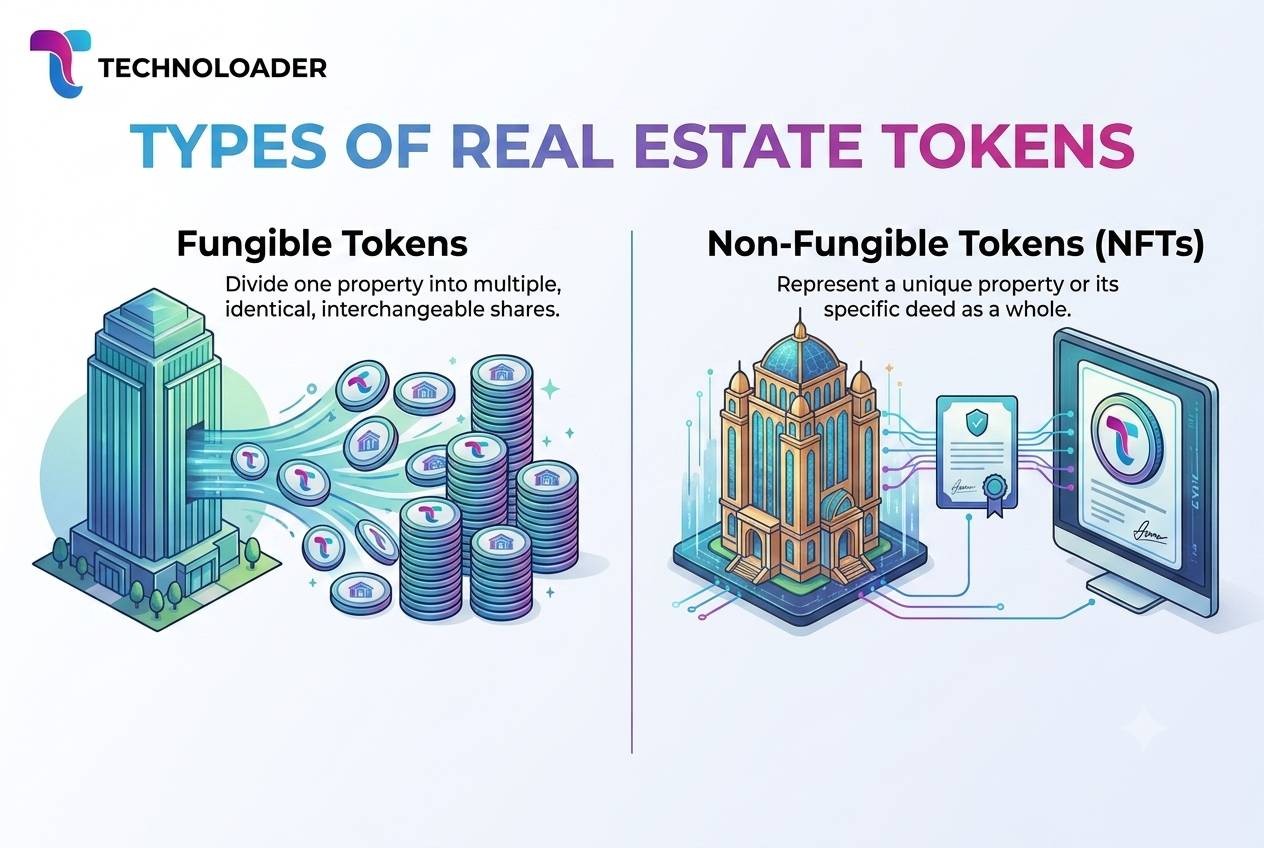
Fungible tokens divide a property into many equal and interchangeable shares. A non-fungible token (NFT) can represent a single property or its ownership record. This approach is often called NFT real estate.
Real estate tokenization makes fractional ownership possible. Instead of buying an entire property, investors can purchase a small share at a lower entry cost. The model opens property investment to a wider range of investors.
A digital token represents a legal right or financial interest in a property, not the physical building itself.
It is also different from a real estate investment trust (REIT). A REIT uses a different way to own and invest in property. In the next section, I’ll explain how tokenization works.
What is real estate tokenization?
Real estate tokenization converts property rights into digital tokens that investors can buy, hold, or trade. It involves either fungible or non-fungible tokens to represent ownership or investment interests in a property.
How Does Real Estate Tokenization Work? The SPV Model
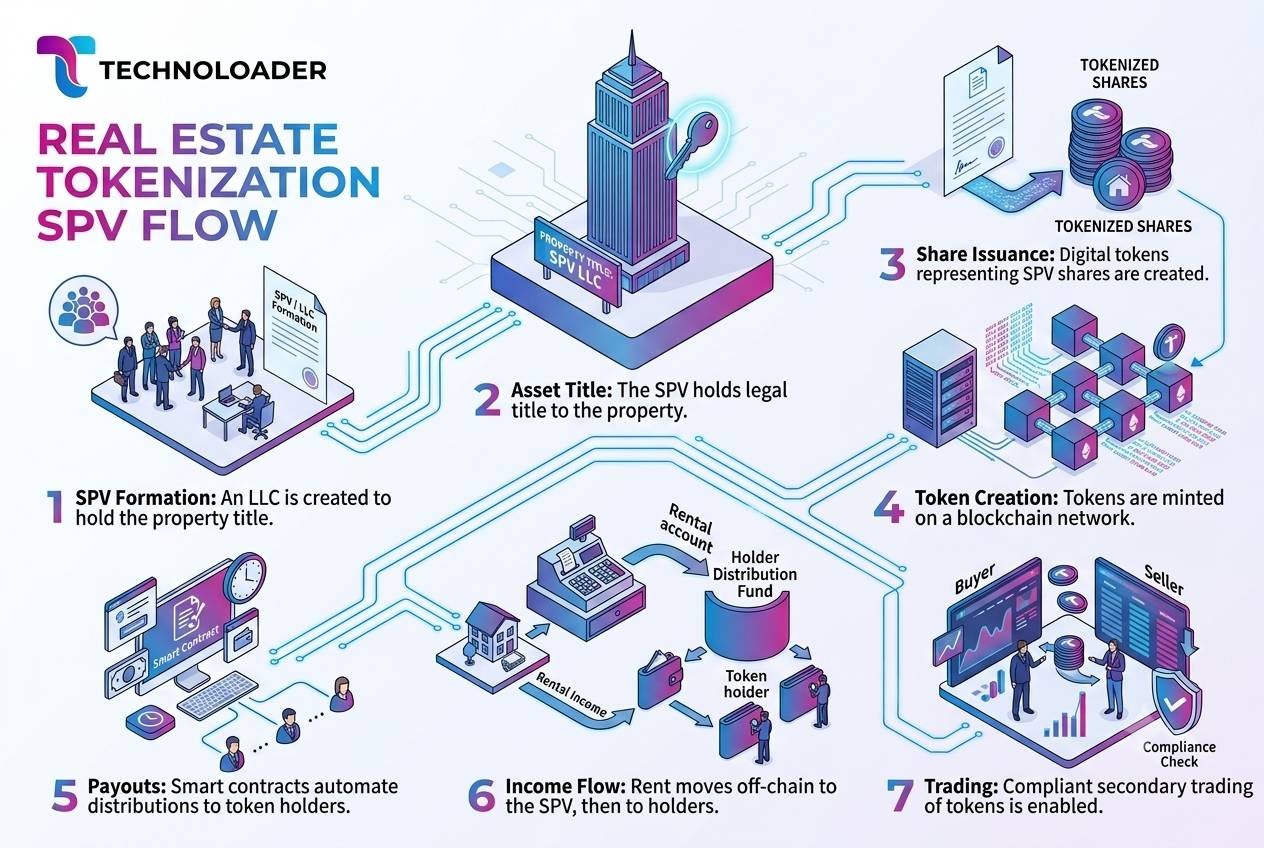
Real estate tokenization works through a Special Purpose Vehicle (SPV) that owns the property. For blockchain in real estate projects, investors receive digital tokens that represent shares or rights in the SPV. The tokens do not represent direct ownership of the property itself.
Here is the usual flow, step-by-step:
- A Special Purpose Vehicle, or SPV, is formed to own the property. This is usually an LLC.
- The SPV holds legal title to the building off-chain, in its own name.
- Tokens are issued that represent shares or economic rights in the SPV.
- The tokens are created on a blockchain, such as Ethereum or another chain.
- Smart contracts automate rent or dividend payouts to token holders.
- Rental income flows off-chain from tenant to manager to the SPV, then to holders.
- Tokens can trade on permitted secondary trading markets, which are subject to compliance rules.
What the Token Actually Represents
When you hold a property token, you usually hold an interest in the SPV. You do not hold the deed to the building.
Your rights come from the SPV’s operating agreement and the offering documents.
If a dispute arises, courts rely on the legal documents that support the investment rather than the blockchain record alone.
A token shows your interest in a property, but it does not make you the legal owner. Ownership is still decided by property laws and legal documents.
Real-world platforms using blockchain in real estate follow this pattern. For example, RealT streams rental income to holders on a weekly basis. Lofty uses per-property entities and distributes rent daily .Both platforms use blockchain with legal structures to manage ownership and investor rights.
How does real estate tokenization work?
In most deals, a legal entity called an SPV owns the property off-chain. Tokens then represent shares or economic rights in that entity. Smart contracts handle payouts and transfer rules, while the deed still records off-chain.
Also Read:
What Are the Benefits and Limits of Traditional vs Tokenized Real Estate?
Tokenized real estate can lower entry costs for investors and speed up transactions. It provides fractional ownership options that traditional property investment doesn’t offer.
However, it does not remove legal requirements, market risks, or the need for reliable buyers when investors want to sell.
Here is a fair comparison between traditional property investment and tokenized real estate.
| Dimension | Traditional Real Estate | Tokenized Real Estate |
| Typical minimum | High (full property or large stake) | Low (fractional shares) |
| Liquidity / exit | Slow — sales take months | Potentially faster, but often thin markets |
| Investor access | Local or accredited buyers | Broader, subject to eligibility rules |
| Settlement time | Days to weeks | Can be near real-time on-chain |
| Record transparency | Fragmented, paper-heavy | Shared, tamper-evident ledger |
| What you hold | Direct property title or fund ownership | An economic interest in an SPV |
| Intermediaries | Many parties | Fewer, but new ones (issuers, platforms) |
| Income distribution | Manual, periodic | Automated by smart contracts |
The advantages of blockchain in real estate extend beyond fractional ownership. Investors can enter the market with less capital. They can also receive automated income distributions and access more transparent records.
These advantages come with limits. Eligibility rules, Know Your Customer (KYC), and Anti-Money Laundering (AML) requirements still apply.
Smart contracts cannot replace legal agreements. They also do not remove the need for regulatory blockchain compliance. Like every investment model, blockchain in real estate depends on the legal framework that supports it.
Liquidity is one of the benefits of blockchain in real estate through tokenization, but the reality is more complex. Although tokens can trade like shares, active secondary markets are still limited.
In practice, secondary markets are early and often thin. Buyers can be scarce, and selling quickly at a fair price is not guaranteed.
For that reason, liquidity should be viewed as a potential benefit rather than a guaranteed outcome.
How does traditional property investment compare with tokenized real estate?
Tokenized real estate can lower entry costs and give more people access to property investments. It can also make transactions faster than traditional property investment. However, both models must follow legal requirements. Liquidity in tokenized real estate still depends on the strength of secondary markets.
Which Blockchains and Token Standards Power Real Estate Tokenization?
The token standard depends on the project’s purpose. But ERC-3643 and other security token standards are often preferred for blockchain in real estate projects because they support regulatory compliance.
Here are the common token standards.
| Standard / Layer | What It Is | Fungible? | Compliance Built In? | Typical Real-Estate Use |
| ERC-20 | The base fungible token interface | Yes | No | A base layer other standards build on |
| ERC-721/ERC-1155 | Non-fungible / multi-token standards | No | No | Deed-mirror NFTs; not for fractional equity |
| ERC-3643 (T-REX) | Permissioned security token with on-chain identity | Yes | Yes | Compliant fractional ownership |
| ERC-1400 family | Security-token suite with share classes | Yes | Yes | Regulated offerings, tranches |
| ERC-1404 | Simple restricted token | Yes | Yes | Transfer restrictions for compliance |
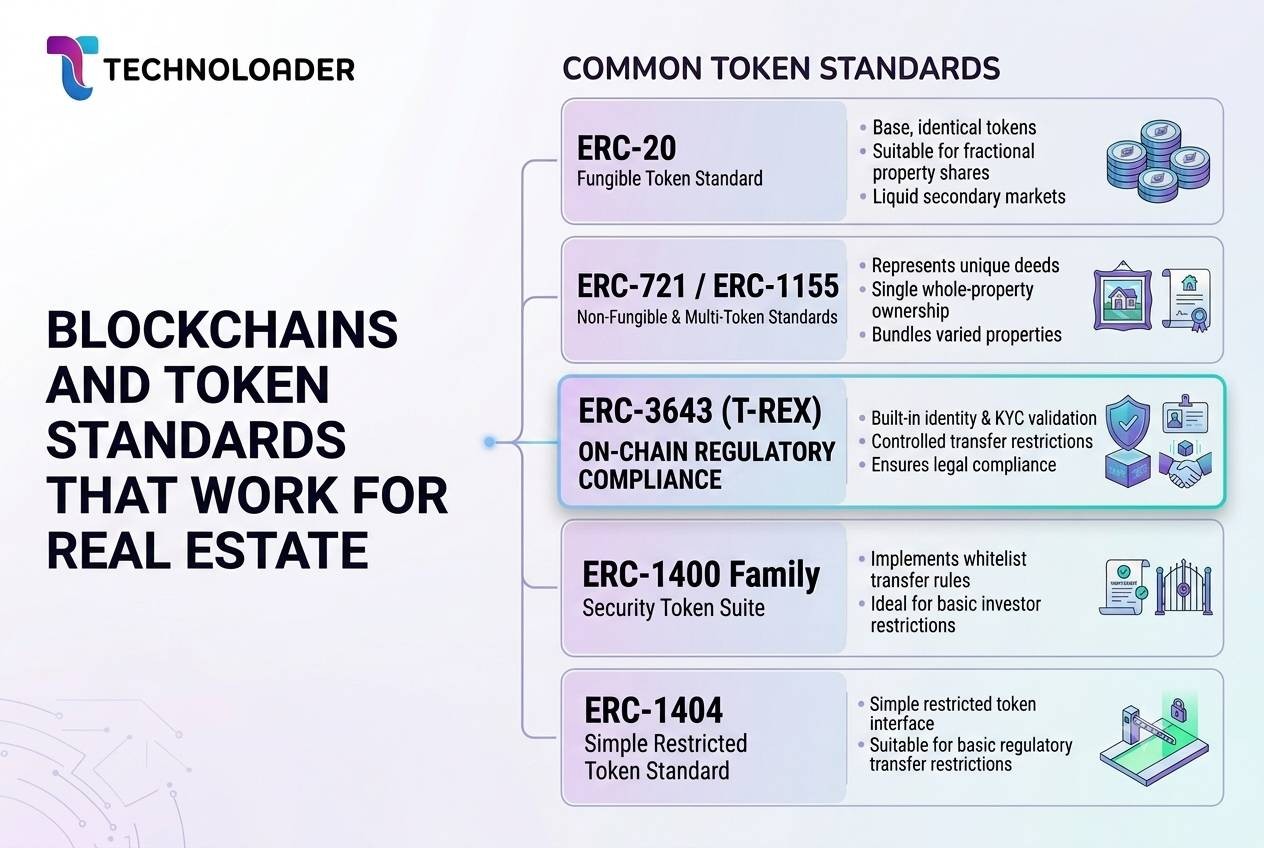
Different tokens on Ethereum and other blockchain networks meet different real estate needs.
Plain ERC-20 tokens are fungible but have no built-in compliance rules. An NFT can mirror a deed, but it is not a fractional-equity model.
ERC-3643, also called T-REX, is the common option for blockchain in real estate. It combines tokenization with on-chain identity and compliance controls.
Tokens can move only between KYC-verified, eligible wallets, which is what regulated offerings need.
Blockchain networks also differ in cost, security, and performance. Ethereum has remained a leading choice since its transition to Proof of Stake in 2022.
Blockchain in real estate deployments also use chains like Gnosis, Algorand, Stellar, and Polygon, whose token is POL. The choice depends on cost, chain type, and compliance support.
Fees, called gas, also vary by chain. Lower fees make frequent, small distributions more practical.
Real estate platforms also depend on oracles to provide external data, such as property valuations, to smart contracts. Accurate data feeds are needed because outdated information can affect investment decisions.
Which blockchain networks and token standards are used for real estate tokenization?
Most compliant real estate tokens use permissioned security-token standards, led by ERC-3643 (T-REX). These standards restrict transfers to verified, eligible wallets. A plain ERC-20 token or an NFT alone rarely meets the compliance requirements for regulated property offerings.
Also Read:
Is Tokenized Real Estate Legal? US Regulation and Compliance
Yes. Tokenized real estate is legal in the United States. It must comply with securities laws and regulatory requirements.
This section is mainly informational, not legal or investment advice. Always consult a qualified professional before you invest or issue tokens.
Blockchain in real estate falls under securities regulations when tokenized property interests meet the Howey test.
The Howey test determines whether an investment qualifies as a security under US law. If a tokenized property interest meets the test, it is classified as a security under US law. The offering then falls under the oversight of the US Securities and Exchange Commission (SEC).
Issuers can register the offering or get an exemption. Regulation D Rule 506(c) applies to accredited investors. Regulation S covers non-US investors. Regulation A+ permits broader participation with additional disclosure requirements.
Know Your Customer (KYC) and Anti-Money Laundering (AML) also apply to investors and token transfers. Permissioned networks enforce these requirements by restricting transfers to approved wallets.
A compliant structure also uses an SPV to own the property and define investors’ rights. If the property has a mortgage or other liens, those obligations remain with the SPV rather than the token holders.
Regulatory requirements also vary by jurisdiction. In the European Union, the Markets in Crypto-Assets (MiCA) regulation covers many crypto-assets. Security tokens remain subject to existing securities laws.
The UAE has also introduced property tokenization initiatives under its own regulatory framework. Compliance depends on local laws and regulations.
Is tokenized real estate legal in the US?
Yes. Most tokenized real estate interests are treated as securities. So, issuers must register them or rely on an exemption, while continuing to meet securities laws.
What are the Steps to Tokenize Real Estate?
Real estate tokenization follows a structured legal and technical process. Blockchain in real estate starts with the property and its legal structure. The process then moves to token creation, compliance, and secondary trading.
The process usually follows these steps:
- Identify and Value the Property: Confirm the property’s value and legal title.
- Set Up the Legal Structure: Form the SPV, prepare offering documents, and choose your exemption.
- Choose the Blockchain and Token Standard: Select a network and token standard that meet the project’s compliance requirements.
- Build and Audit the Smart Contracts: Complete an independent security audit before launch.
- Issue Tokens to Verified Investors: Run KYC and AML before distributing to approved crypto wallets.
- Automate Income Distribution: Use smart contracts to distribute rent or dividend payments.
- Enable Compliant Secondary Trading: List the tokens on approved trading venues that enforce transfer restrictions.
For investors who want to buy tokenized real estate, you’d need to create an account and pass identity checks. You can then purchase tokens through a compliant platform. The offering documents define investors rights, so you should review them before making any investment.
Every blockchain in real estate project project requires a secure compliance framework. Smart contracts, token standards, and legal documents must work together before the platform goes live.
What Challenges and Risks Should You Expect?
Blockchain in real estate has strong potential, but it also comes with legal challenges. The technology is ready, but legal rules, market conditions, and everyday operations can slow adoption.
The main risks include:
- Liquidity: Secondary markets are still small, so you may not find a buyer when you want to sell.
- Legal Enforceability: Your rights come from the SPV’s legal documents, not the blockchain.
- Valuation and Oracles: Token values depend on accurate and up-to-date property data.
- Regulation: Laws are different across countries and continue to change.
- Wallet Security: Losing your private keys can mean losing access to your tokens.
- System Integration: Connecting blockchain platforms with existing land registries takes time and investment.
As an investor, you should plan for inheritance. If tokenized assets remain in a private custom wallet, heirs need a legal and secure way to access them.
The future looks promising, but I expect steady progress rather than an overnight change. Clearer regulations and wider adoption will shape the next stage of real estate tokenization.
How can you tokenize real estate?
To tokenize real estate, you’ll have to follow a clear sequence. You value the asset, form a legal entity, and pick a compliant chain and standard. You build and test the smart contracts before issuing tokens to approved investors. The system can then automate income payments and support compliant trading.
Also Read:
Real-World Examples and Adoption
Real estate tokenization has moved beyond pilot projects. The best way to understand the technology is to look at how companies and governments already use it.
On the fractional-investment side, RealT and Lofty tokenize rental homes and stream income to holders. Propy focuses on whole-property transactions and uses an NFT to mirror the deed record.
One of the earliest large-scale examples came from the St. Regis Aspen Resort in Colorado. In 2018, the project raised about $18 million by selling security tokens. These tokens represented around 18.9% ownership of the hotel under Regulation D.
Commercial real estate has also entered the market. For example, RedSwan processed tokenized commercial properties worth $2 billion in 2020 by using security token platforms for qualified investors.
Governments are also testing the technology. Bergen County, New Jersey, started a five-year project to digitize and tokenize around 370,000 property deeds. The project covers properties with an estimated value of $240 billion on the Avalanche blockchain.
The county is working with Balcony to create a secure digital property record. The goal is to reduce deed processing times by 90% and improve protection against title fraud.
Dubai Land Department has also launched blockchain initiatives. These projects aim to modernize property records and support real estate transactions.
The market is still in its early stages. As Deloitte forecasts, tokenized real estate could reach US$4 trillion by 2035. The sector represents only a small share of the broader tokenized real-world asset market.
FAQ
Is real estate tokenization legal in the US?
Yes. Real estate tokenization is generally legal in the United States when it complies with securities laws. Most tokenized property interests qualify as securities under the Howey test. So, blockchain in real estate projects relies on exemptions such as Regulation D.
Do you own the property if you own the token?
Usually, you own an interest in the entity that owns the property, not the deed. Your rights come from the SPV’s operating agreement and offering documents.
What is a blockchain for real estate titles?
It is a shared ledger that records ownership history in a tamper-evident way. Governments are piloting it to reduce title fraud. In most places, the official deed still records off-chain.
How much does it cost to tokenize real estate?
The cost is different depending on legal structuring, chain, platform, and audit needs. Most of the cost of blockchain in real estate comes from legal and compliance work. Get quotes for your specific deal rather than assuming a fixed price.
What are the risks of tokenized real estate?
The main risks of blockchain in real estate are thin liquidity and off-chain legal enforceability. Others include valuation reliance, regulatory change, and wallet security. It’s important to read the offering documents carefully.
What blockchain is best for real estate tokenization?
There is no single best blockchain in real estate. The right choice depends on your investors, costs, and legal requirements. However, compliance-ready standards, such as ERC-3643, are commonly preferred.
Are real estate tokens securities?
In the US, they usually are. Recording a token on a blockchain does not remove securities-law duties. The structure and the investors’ expectations decide how the rules apply.
How big is the real estate tokenization market?
Deloitte projects tokenized real estate could reach about $4 trillion by 2035. The figure is a forecast, not a guarantee, but the market was valued at $300 billion in 2024.
Also Read:
Conclusion
Blockchain in real estate supports practical use cases across the property market. It gives the industry trusted records, automated transactions, and a new way to own property in fractions.
But blockchain technology also has limits. Liquidity, legal ownership, and regulatory compliance are important considerations for every project.
If you are exploring a blockchain in real estate project, start with the legal structure and the compliance layer. That is where good tokenization succeeds or fails.
Our team can help you plan and build a compliant tokenization platform built for real investors.
Want to talk it through? Reach out to our team for a practical, no-hype conversation about your idea.

Vipin Kumar
Vipin Kumar is the Founder & CEO of Technoloader, a Clutch Top 10 Blockchain Development Company for 2025. A serial technology entrepreneur and blockchain architect with a B.Tech background, Vipin has led the delivery of 450+ projects across DeFi, NFT marketplaces, AI/ML, and custom Web3 platforms for clients in the UAE, India, the US, and beyond. He also founded SALIQ (saliq.ai), an AI-driven conversational marketing platform.
Published in Asset Tokenization Development


