+91 7014607737
 info@technoloader.com





Table of Contents
Quick Summary
- Blockchain Protocols Set the Rules: They govern how nodes validate, record, and share data across networks
- Protocols Serve Different Roles: Base-layer, interoperability, and enterprise protocols solve diverse problems
- Consensus Shapes Network Behavior: Proof of Work and Proof of Stake affect speed, costs, and security
- Trade-offs Matter: Compare security, scalability, decentralization, and network performance beyond headline claims
- Fit Beats Hype: Choose a protocol based on your use case, not the token trending this quarter
Blockchain protocols are the rules that make a blockchain work. They determine how a network verifies, records, and shares data. Bitcoin is the top pick for storing value. Ethereum leads for smart contracts and decentralized apps, while Solana suits fast, low-cost applications.
These protocols differ in how they balance speed, security, and control. Their design affects transaction costs and network capacity, as well as the types of projects they support.
In this guide, you’ll find the top blockchain protocols and learn how these protocols work. You’ll also learn how to choose the right blockchain protocol for your needs.
What Is a Blockchain Protocol?
A blockchain protocol refers to the set of rules that governs how a blockchain network validates, records, and shares data. Think of it as the rulebook every computer on the network follows. It defines who can add blocks and how the network agrees on new data.
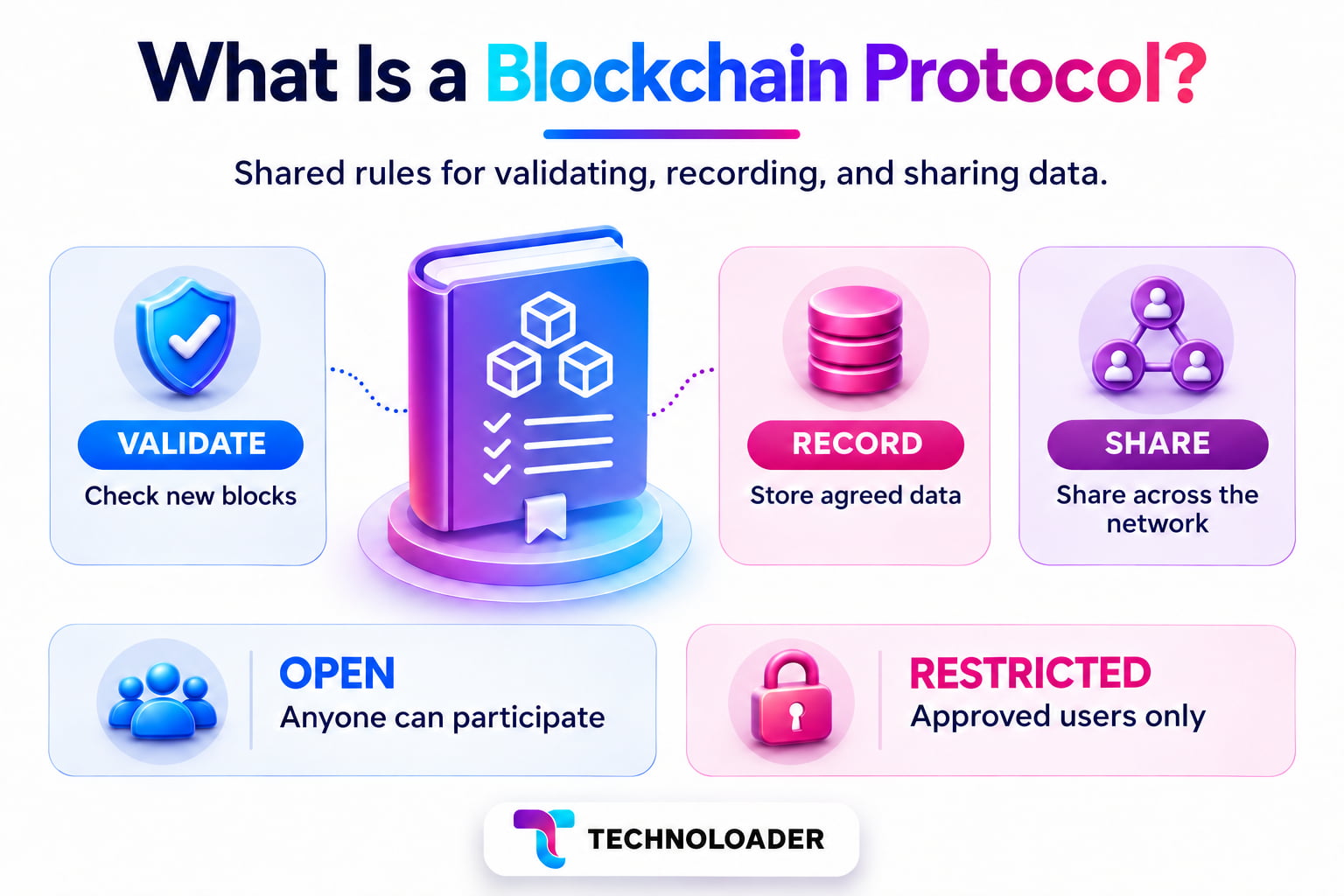
Some blockchain protocols are open to everyone. Others restrict access to approved users or groups.
Blockchain protocols are similar to TCP/IP. This is the protocol that lets the internet move data. However, blockchain protocols also define how networks agree on transactions and maintain shared records.
A protocol’s native coin, like ETH or SOL, pays for using the network. Tokens built on the network follow separate rules. The protocol is the foundation. Apps and tokens are built on top of it. For more on the basics, see our beginner’s guide to blockchain.
What Is a Blockchain Protocol?
A blockchain protocol is the shared rulebook for a network. It tells computers how to check, record, and share data without a middleman. It also defines who can participate and how the network operates.
How Do Blockchain Protocols Work?
Blockchain protocols work by letting independent computers agree on one version of the ledger. They group transactions into blocks, with each block cryptographically linked to the one before it. The network uses a consensus rule to accept new blocks. Nodes then update their own copies of the ledger.
This makes confirmed data hard to change. But it doesn’t mean that blockchains, which are tamper-resistant, are impossible to alter. Changing confirmed data is extremely difficult under normal network conditions. That’s why we say tamper-resistant rather than unhackable.
Core Components of a Blockchain Protocol
Blockchain protocols function through a shared ledger, consensus, nodes, and cryptography. Smart contracts, which are optional, extend functionality. These elements record information, verify transactions, and keep the network in sync.
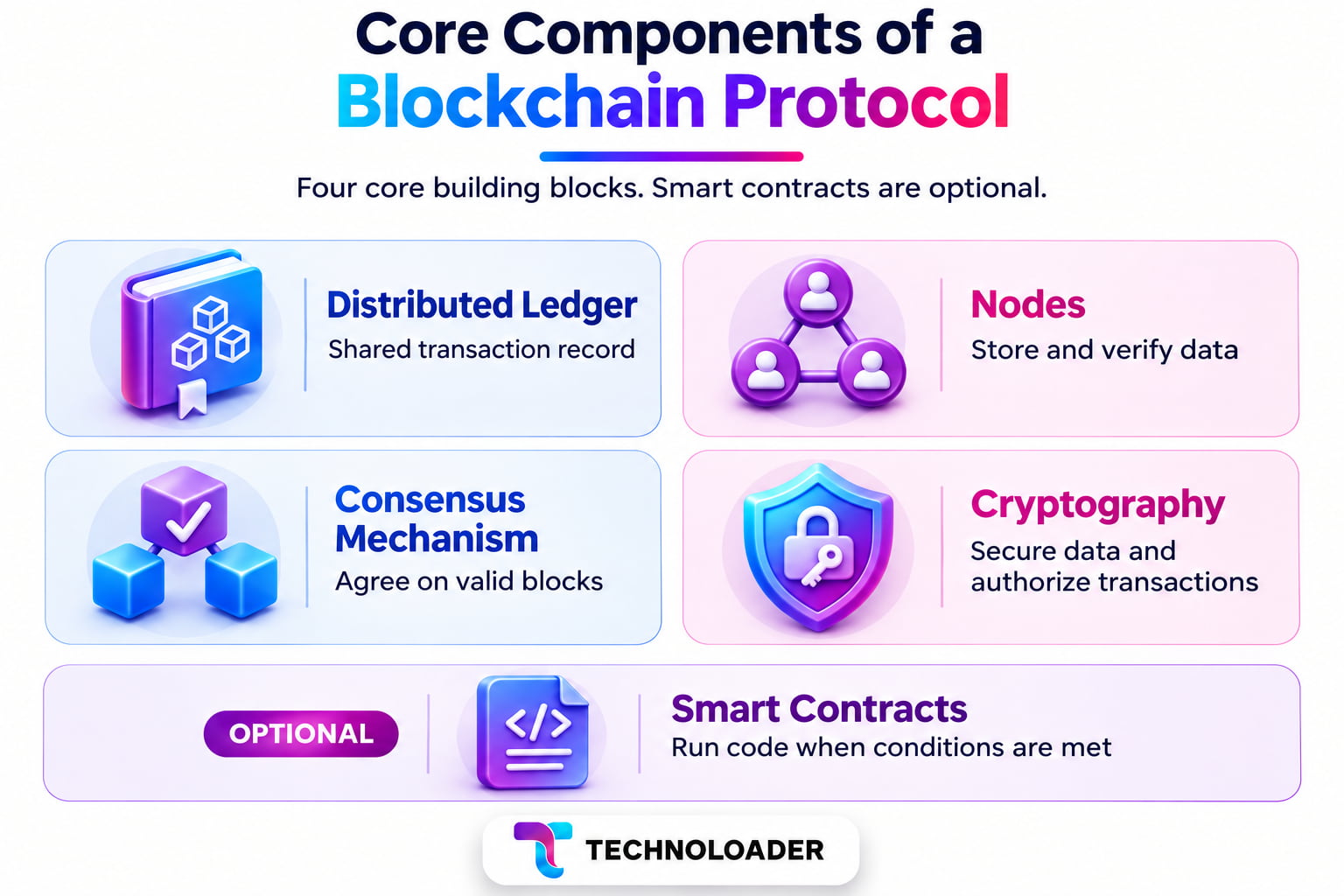
- Distributed Ledger: A shared record of every transaction, kept by all blockchain nodes
- Nodes: Computers that store the ledger and validate transactions
- Consensus Mechanism: Rules nodes use to agree on valid transactions and blocks
- Cryptography: Hashing links blocks, while public and private keys help verify ownership and authorize transactions
Some blockchain protocols also support smart contracts. This self-executing code runs when set conditions are met.
Consensus Mechanisms: Proof of Work, Proof of Stake, and Beyond
Consensus mechanisms help blockchain nodes agree on valid transactions without a central authority. Proof of Work (PoW) and Proof of Stake (PoS) are the two main types. PoW relies on computing power to propose blocks, while PoS uses staked tokens to support validators. Other blockchain protocols adapt these models.
| Mechanism | How It Secures the Network | Used By | Trade-off |
|---|---|---|---|
| Proof of Work (PoW) | Miners use computing power to propose blocks | Bitcoin | Secure and simple, but energy-heavy and slow |
| Proof of Stake (PoS) | Validators stake the coin and can be slashed for cheating | Ethereum, Cardano, Solana | Energy-light and faster, but stake can concentrate |
| Nominated Proof of Stake (NPoS) | Token holders nominate validators and back them with stake | Polkadot | Efficient, with fewer validators to trust |
| Proof of Staked Authority (PoSA) | A selected group of validators stakes tokens and produces blocks | BNB Chain | Fast block production, but fewer validators |
Worth noting is that Ethereum’s 2022 Merge switched its consensus system from Proof of Work to Proof of Stake. According to a CCRI estimate cited by ethereum.org, it cuts energy use by about 99.988%. However, it didn’t directly speed up transactions or lower gas fees. Those improvements depend on network upgrades and Layer 2 scaling.
How Do Blockchain Protocols Reach Agreement?
Blockchain protocols reach agreement through consensus. Nodes check transactions and use PoW or PoS to approve valid blocks. Each node then updates its ledger, so that all copies stay identical.
Also Read
What Are the Main Types of Blockchain Protocols?
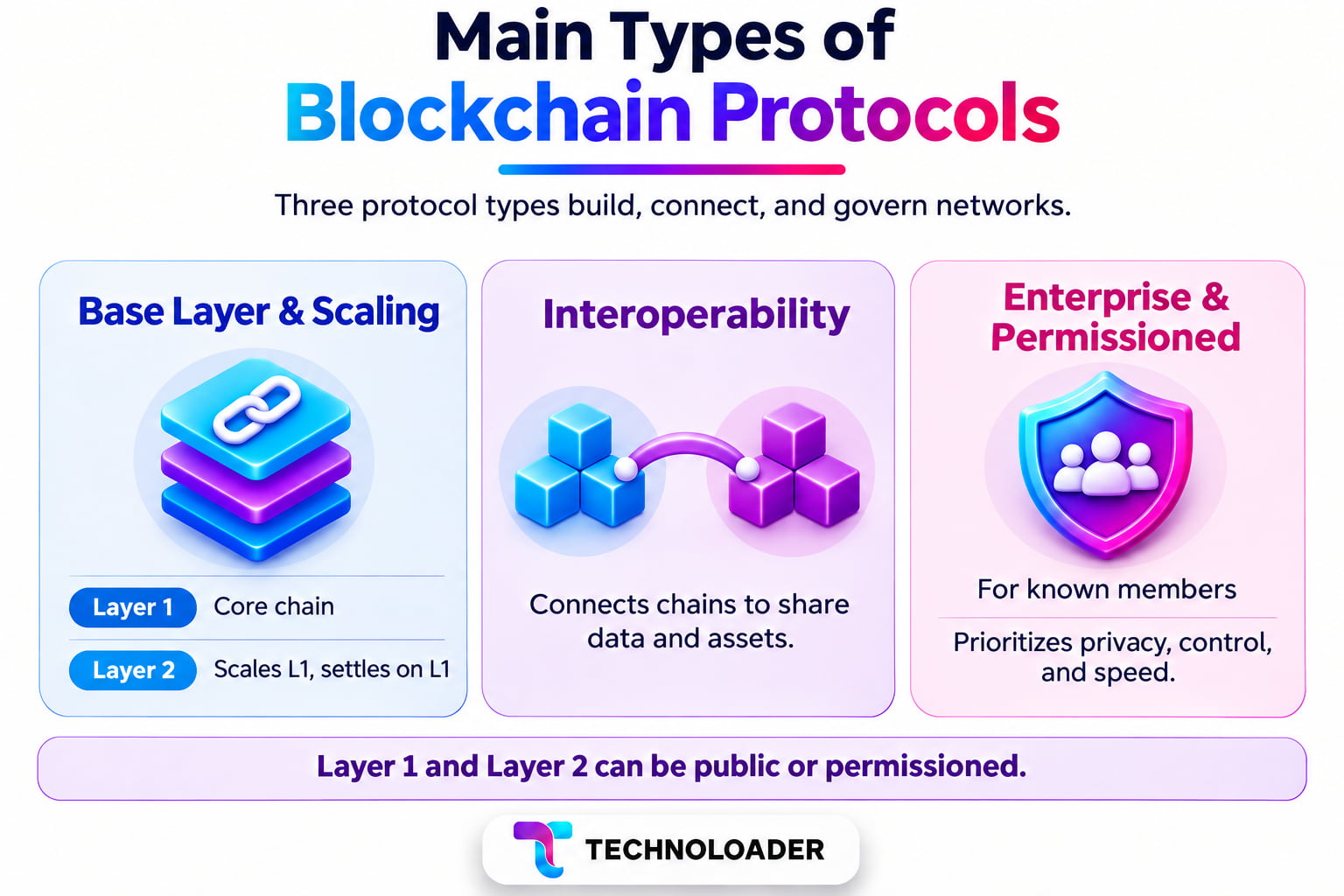
Among the main types of blockchain protocols are Layer 1, Layer 2, interoperability, and enterprise protocols. Some run or scale networks, while others connect separate chains or support private business networks. These categories can overlap as they describe different roles.
Base-Layer and Scaling Protocols (Layer 1 and Layer 2)
Layer 1 protocols are the main foundation chains. They process their own transactions and run their own security. Examples include Bitcoin, Ethereum, and Solana.
Layer 2 protocols are scaling networks built on top of a Layer 1.
They make transactions faster and cheaper by handling the bulk of the processing work. But they rely on Layer 1 protocols for final settlement and security. Arbitrum and Base are examples built on Ethereum.
Both layers can be public or permissioned (restricted to approved members).
Blockchain Interoperability Protocols
Separate blockchains don’t always work together. Interoperability protocols help them exchange data and assets across networks. They use different methods to verify messages:
- IBC (Cosmos): Uses math and code to let chains check each other’s proofs. No outside middleman is needed.
- XCM (Polkadot): Acts as a language format. It tells chains how to format data, but it doesn’t move the data itself.
- Chainlink CCIP: Uses an independent network of oracle nodes to check and approve messages. In CCIP 2.0, its default committee of 16 node operators requires at least nine of sixteen signatures.
- Wormhole: Relies on a specific group of 19 “Guardians.” At least 13 must sign off to approve a message.
- LayerZero: Lets applications choose their own verifier networks. These networks confirm cross-chain messages.
Light-client protocols like IBC rely on on-chain math. Committee-based protocols like CCIP and Wormhole rely on outside signer networks. This choice changes your security risks.
Enterprise and Permissioned Blockchain Protocols
Some businesses need blockchain networks with restricted access. Enterprise protocols meet this need by limiting participation to known members. This gives banks and supply chains greater control over their data and network activity, but with less decentralization.
Popular examples include:
- Hyperledger Fabric: An open-source, permissioned protocol. It protects data with private channels and private data collections, uses an execute-order-validate transaction flow, and needs no native cryptocurrency or gas fees.
- R3 Corda: A network built for business and finance. Parties deal directly with each other, and notary nodes check for fraud.
Permissioned systems also support some central bank projects, including Central Bank Digital Currencies (CBDCs). CBDCs are digital forms of official currency, not cryptocurrencies. China’s digital yuan (e-CNY) runs on a centralized system. Project mBridge uses a custom Ethereum-compatible ledger for payments between countries. The participating central banks have run it since the BIS stepped back in 2024.
What Are the Main Types of Blockchain Protocols?
Base-layer and scaling protocols build and scale the networks. Interoperability protocols connect separate chains so they can talk. Enterprise protocols run private networks for businesses.
Also Read
How Did I Choose the Blockchain Protocols in This Guide?
I reviewed nine blockchain protocols based on six factors that affect their performance and reliability. These were adoption, maturity, developer support, performance, security, and interoperability.
Working on 450+ projects at Technoloader has given me a practical understanding of what makes a blockchain suitable for different projects. My evaluation focused on:
- Adoption: How widely people use the network and how much value it secures.
- Maturity: How long each network had been running and how it handled periods of high stress.
- Developer Support: Available development tools, documentation, and skilled talent helped determine how practical each protocol was.
- Performance: Actual transaction speeds and finality rather than advertised performance figures.
- Security: How validators are distributed and whether the network has experienced security incidents.
- Interoperability: How easily the protocol connects and exchanges information with other networks.
Also Read
What Are the Leading Blockchain Protocols?
The leading blockchain protocols today are Bitcoin, Ethereum, Solana, BNB Chain, Cardano, Polkadot, Avalanche, Cosmos, and NEAR Protocol. They cover everything from digital payments and smart contracts to custom networks. The profiles below explain how each works, what it’s best for, and its trade-offs.
Here’s how the blockchain protocols analyzed compare, at a glance.
| Protocol | Network Design | Best For | Main Trade-off |
|---|---|---|---|
| Bitcoin | Layer 1 (Proof of Work) | Store of value and settlement | Slow transactions |
| Ethereum | Layer 1 (Proof of Stake) | Smart contracts and DeFi | Higher fees on the base layer |
| Solana | Layer 1 (Proof of Stake) | Fast consumer apps and payments | Hardware demands and validator concentration |
| BNB Chain | Layer 1 (Proof of Staked Authority) | Low-cost EVM apps | Smaller validator set |
| Cardano | Layer 1 (Ouroboros Proof of Stake) | Research-led projects | Lower on-chain activity |
| Polkadot | Relay chain and parachains (NPoS) | App-specific chains | Complex ecosystem |
| Avalanche | C-Chain and custom Layer 1s | Dedicated enterprise and gaming chains | Liquidity fragmentation across Avalanche L1s |
| Cosmos | App-chain ecosystem (CometBFT) | Interoperable app-chains | Ecosystem fragmentation |
| NEAR Protocol | Sharded Layer 1 (Proof of Stake) | Consumer apps and chain abstraction | Complex developer onboarding (WASM / Rust architecture) |
1. Bitcoin (BTC)
Bitcoin is the original blockchain protocol, and it’s still the biggest by market value. It uses Proof of Work to secure transactions. Miners compete to solve complex puzzles using computing power. Supply is capped at 21 million coins.
Builders get fewer built-in features with this protocol. It doesn’t support complex smart contracts natively. Layer 2 networks such as the Lightning Network, which enables fast, low-cost payments, let developers build extra features around it.
Best for: Storing value, making payments, and settling transactions where security matters more than speed.
Trade-off: Low transaction speeds make it less suitable for high-volume applications.
2. Ethereum (ETH)
Ethereum gives developers the tools to build smart contracts and decentralized finance (DeFi) apps. It switched to PoS in September 2022. But its main network has limits on how many transactions it can handle. Layer 2 networks take on extra activity to ease that pressure.
The Fusaka upgrade addressed part of this scaling challenge. Released on December 3, 2025, it introduced PeerDAS to expand data availability for rollups.
Best for: Smart contracts, DeFi, NFTs, and access to a broad developer ecosystem.
Trade-off: High demand can push up base-layer fees. Using several Layer 2 networks may also confuse users.
3. Solana (SOL)

Solana is a high-performance Layer 1 focused on speed and low transaction costs. It uses Proof of Stake. For most of its history, Solana also relied on Proof of History (POH), a cryptographic clock that ordered events. The Alpenglow upgrade, live on mainnnet since October 21, 2026, replaced its old voting system with a new one called Votor, moved validator votes off-chain, and stopped using PoH to pace block production. It targets finality of about 150 milliseconds, down from about 12.8 seconds.
Solana easily handles high transaction volumes. This makes it popular for fast consumer payments, decentralized finance, and games.
Best for: Apps that need fast confirmation speeds, high volume, and low transaction fees.
Trade-off: High hardware costs limit who can run validators, and the network has suffered past outages.
Also Read
4. BNB Chain (BNB)
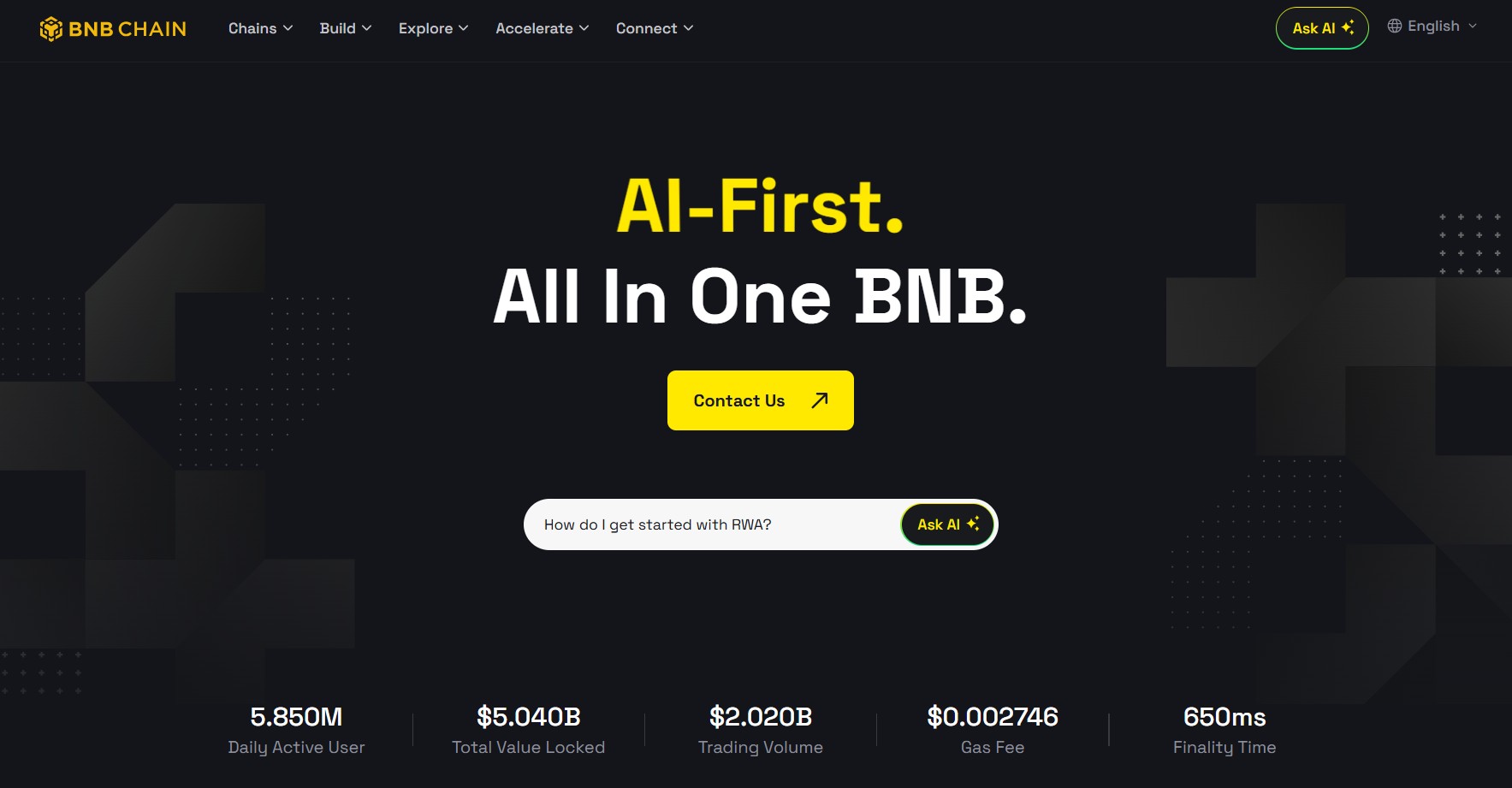
Speed is BNB Chain’s selling point. This blockchain protocol runs Ethereum-style smart contracts at low cost. Its Proof of Staked Authority model relies on a few top validators, so it’s less decentralized.
A major upgrade called the Maxwell hard fork (June 2025) cut its block time to 0.75 seconds, and the Fermi hard fork in January 2026 cut it again to about 0.45 seconds. It also runs opBNB, a Layer 2 network that lowers costs even further.
Best for: Low-cost, Ethereum-compatible apps and consumer products that need high speeds.
Trade-off: Fewer validators mean concentrated network control. Plus, it has suffered major bridge exploits in the past.
5. Cardano (ADA)
Cardano takes a research-first approach to blockchain design rather than focusing on speed. Its consensus system, Ouroboros, uses a peer-reviewed Proof of Stake model. Cardano also uses eUTXO, which handles transactions differently from Ethereum’s account-based structure.
Developers write smart contracts in Plutus. Teams that need strict security often favor this methodical approach.
Best for: Research-driven projects and builders who value slow, highly precise engineering.
Trade-off: Its app ecosystem and on-chain activity are smaller than those of the largest smart contract chains. However, a major scaling upgrade called Leios aims to boost its transaction speeds.
6. Polkadot (DOT)
Polkadot connects separate blockchains through a shared security system. Its main network is called the Relay Chain. This main chain protects smaller, custom networks known as parachains. Each parachain can serve a specific app or use case.
Chains talk to each other using a built-in language called Cross-Consensus Messaging (XCM). Agile Coretime lets teams rent block space instead of winning slot auctions.
Best for: Teams that want their own app-specific chain with built-in cross-chain messaging and shared security.
Trade-off: The multi-chain setup is highly complex, and the network lacks a large user base compared to its rivals.
Also Read
7. Avalanche (AVAX)

Avalanche is built for custom, app-specific chains. Its main C-Chain runs Ethereum-compatible smart contracts using Snowman consensus. Developers can also launch separate networks with their own rules and native fee tokens. These networks were previously called Subnets.
The Avalanche9000 upgrade renamed “Subnets” as “Avalanche L1s.” This upgrade cut the cost of launching one. This design suits businesses and apps that need more control over their blockchain setup.
Best for: Enterprises and games that want a dedicated chain with custom economics.
Trade-off: Having so many separate chains splits up liquidity and fragments the user base.
8. Cosmos (ATOM)
Cosmos is an ecosystem of independent blockchains built to connect through shared tools. Developers use the Cosmos SDK to build custom, app-specific chains. These separate chains connect and swap assets using the IBC protocol.
Unlike Polkadot, Cosmos chains manage their own security by default, though some can opt into Interchain Security from the Cosmos Hub. Plus, the ATOM token powers the central hub. Well-known chains built with the Cosmos SDK include dYdX, Osmosis, and Celestia.
Best for: Sovereign, custom blockchains that want to talk to other networks natively without giving up control.
Trade-off: The ATOM token has only limited links to activity on other Cosmos chains, since most don’t need it. Independent networks also fragment liquidity.
9. NEAR Protocol (NEAR)
NEAR is a Layer 1 blockchain that uses sharding to support large-scale consumer apps. Its PoS consensus and Nightshade sharding divide network activity across smaller parts. This helps the network handle more demand as usage grows.
NEAR also focuses on “chain abstraction.” This lets a single NEAR account control wallets and seamlessly move funds on other blockchains like Bitcoin or Solana. Builders can write smart contracts using common languages like JavaScript or Rust.
Best for: Consumer applications that need fast scaling and simple onboarding.
Trade-off: Developers unfamiliar with Rust, WebAssembly, or NEAR’s tools may face a learning curve.
10. Other Protocols Worth Knowing: Algorand and Tezos
Algorand uses a Pure Proof of Stake model designed for fast finality and low fees. It has been used in tokenization and payment projects that need predictable transaction costs.
Tezos is known for on-chain governance. Token holders vote on protocol upgrades, which the network adopts without hard forks splitting the community.
Which Blockchain Protocol Is the Best?
There’s no single best. Ethereum leads for smart contracts, Solana for speed, Bitcoin for store of value, and Cosmos or Polkadot for interoperable app-chains. Fit to your use case.
Also Read
How to Choose the Right Blockchain Protocol
The right blockchain protocol depends on what you’re building. A network suited to DeFi may not work for a private business system. Look beyond popularity and compare how each option handles access, speed, security, and cost. Use these steps to make a more informed choice:
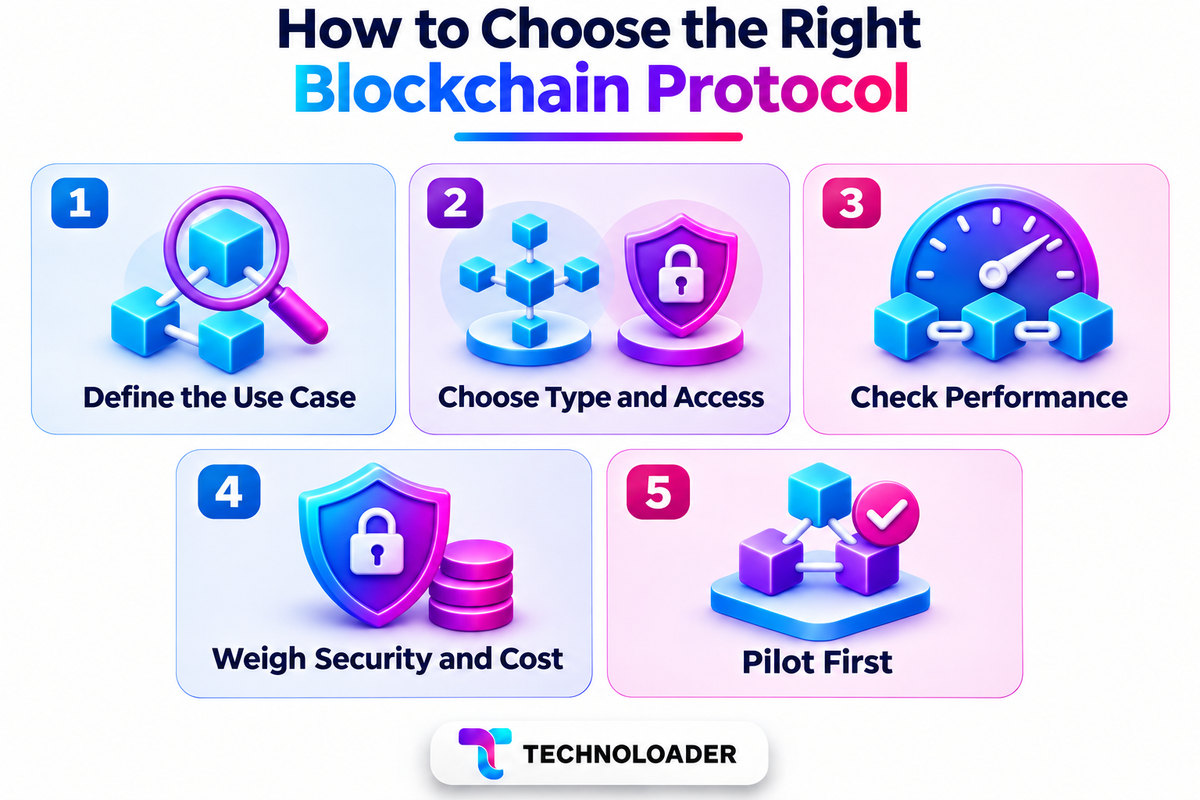
- Define the use case first. Payments, DeFi, a game, and a private consortium each point to different protocols.
- Pick the type and access model. Choose a base-layer chain, an interoperability protocol, or an enterprise framework. Then decide between public and permissioned.
- Check performance. Compare observed throughput and finality, not marketing maximums.
- Weigh security and cost. Look at validator spread, past incidents, fees, and developer talent.
- Pilot before you commit. Build a small proof of concept first.
Our guide on how to choose the right blockchain covers the decision in more detail.
How Do You Choose the Right Blockchain Protocol?
Start with your use case and access needs. Then compare protocol types, performance, security, and costs. Test your preferred option before committing.
Also Read
What Are the Risks and Trade-offs of Blockchain Protocols?
Every blockchain protocol makes trade-offs. The blockchain trilemma describes the challenge of balancing decentralization, security, and scalability. Improving one can put pressure on the others. No protocol maximizes all three elements without compromise. Be wary of claims that suggest otherwise.
Beyond the trilemma, blockchain protocols share a few recurring risks:
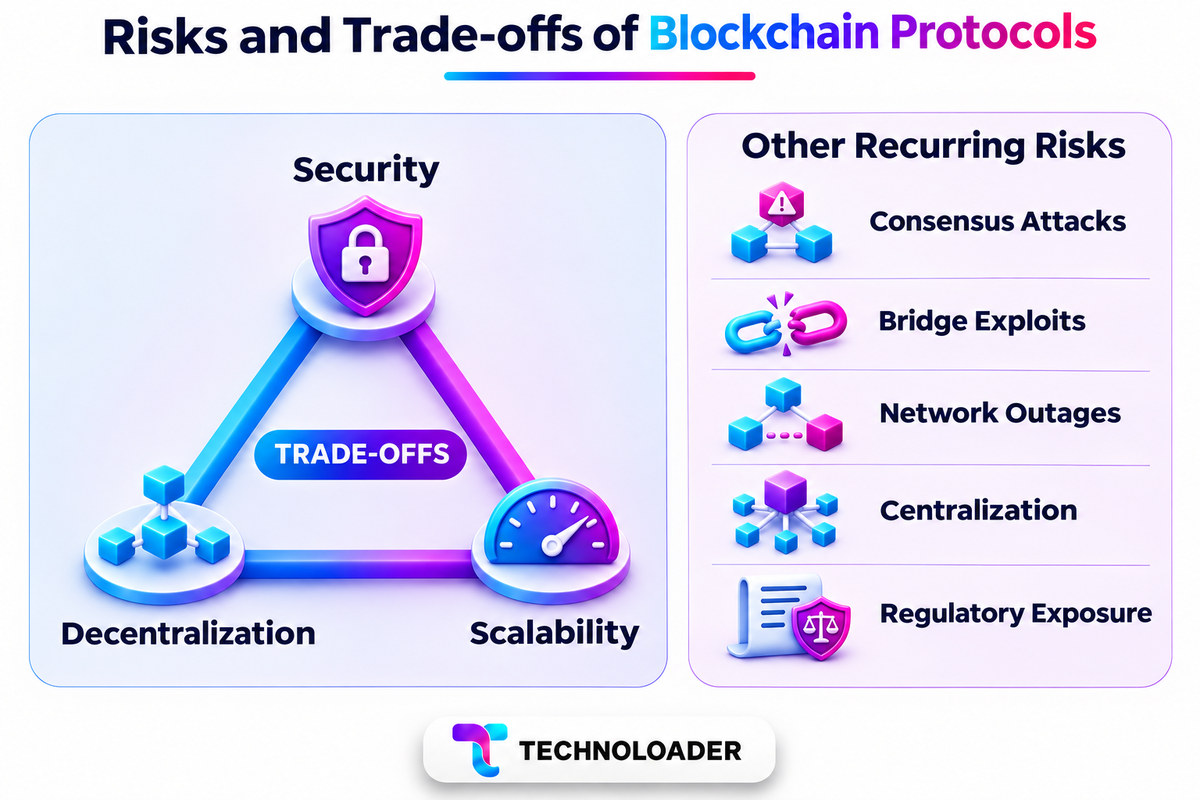
- Consensus Attacks: A 51% attack can let attackers reorganize recent blocks on smaller Proof of Work chains
- Bridge Exploits: Cross-chain bridges are a top hacking target, so the trust model matters
- Network Outages: Past outages show why network reliability and uptime history matter
- Centralization: A small validator set or high hardware demands can concentrate control
- Regulatory Exposure: Rules for tokens, financial services, and data vary across markets
These risks don’t mean you should avoid blockchain. Instead, understand a protocol’s limits before building on it.
What Are the Main Downsides of Using Blockchain Protocols?
Blockchain protocols trade off decentralization, security, and scalability, so none is perfect. They also face risks like consensus attacks, bridge exploits, network outages, centralization, and regulatory exposure. Check a protocol’s limits before you build on it.
Also Read
FAQ
1. What are the main kinds of blockchain protocols?
Blockchain protocols generally fall into three groups: base-layer and scaling protocols, interoperability protocols, and enterprise or permissioned protocols. Layer 1 networks form the base layer, while Layer 2 networks help scale them. Interoperability protocols connect chains, while enterprise protocols support controlled business networks.
2. What’s the difference between a blockchain protocol and a platform?
Blockchain protocols set the rules for how a network handles transactions and security. A platform, on the other hand, gives developers the tools to build and run applications. Some blockchains do both.
3. What is a blockchain interoperability protocol?
Interoperability protocols are akin to bridges between blockchains. They let what would otherwise be separate networks trade data, move assets, and send messages. Examples include IBC, Chainlink CCIP, LayerZero, and Wormhole. All secure cross-chain processes with different technical approaches.
4. Is NEAR Protocol a Layer 1 blockchain?
Yes. NEAR is a Layer 1 blockchain that uses Proof of Stake and Nightshade sharding. It runs its own consensus and settles transactions on its network. Aurora adds Ethereum compatibility through an EVM built on NEAR.
5. What consensus protocols do blockchains use?
Blockchains can use Proof of Work, Proof of Stake, or options like Nominated POS and Proof of Staked Authority. Bitcoin relies on PoW, while Ethereum and Cardano use PoS. Solana uses PoS, and since its Alpenglow upgrade in October 2026, a new voting system called Votor has replaced TowerBFT and Proof of History.
6. Which blockchain protocols are used for CBDCs?
Some central banks use permissioned platforms such as Hyperledger Fabric or R3 Corda. Others build systems around their own requirements, as China has done with e-CNY. Unlike cryptocurrencies and stablecoins, a CBDC is issued by a central bank.
7. Which blockchain protocol has the highest throughput?
Among the nine blockchain protocols covered in this guide, Solana usually processes the most transactions per second (TPS). Exact figures depend on whether validator votes are counted, and Solana moved votes off-chain with Alpenglow, so older TPS figures aren’t directly comparable. Check a live tracker such as Chainspect for current numbers.
8. Are blockchain protocols open source?
Most major blockchain protocols are open source. Even so, some still limit who can join their networks. Hyperledger Fabric, for instance, allows approved members to run permissioned networks. Public networks, by contrast, allow wider participation.
Among the nine blockchain protocols covered in this guide, Solana usually processes the most transactions per second (TPS). Exact figures depend on whether validator votes are counted, and Solana moved votes off-chain with Alpenglow, so older TPS figures aren’t directly comparable. Check a live tracker, such as Chainspect, for current numbers.
9. What sets the Bitcoin and Ethereum protocols apart?
Bitcoin is designed mainly as digital money and a store of value, secured by Proof of Work. Ethereum is a programmable network secured by Proof of Stake, so developers can run smart contracts and build DeFi apps, NFTs, and tokens on it.
10. Which blockchain protocols use the least energy?
Proof of Stake networks use far less energy than Proof of Work networks because they don’t rely on mining. Ethereum, Cardano, Solana, Algorand, and Tezos all use forms of Proof of Stake.
11. Which blockchain protocol is best for enterprises?
Many enterprises choose permissioned frameworks such as Hyperledger Fabric or R3 Corda, which limit participation to known members and keep data private. Others use public networks, or an Avalanche L1, when they need open access with more control over rules.
Also Read
Conclusion
Blockchain protocols are the foundation beneath every token, app, and network. The right one depends on your use case. Once you understand the main types and compare their trade-offs, the choice gets much clearer.
No protocol wins on decentralization, security, and speed all at once. So, identify the trade-off you can live with, then run a small proof of concept before committing. Start with the problem, not the trend.
If you’re weighing a protocol for a real project, our team can help. Explore our blockchain development services or reach out to talk it through.

Vipin Kumar
Vipin Kumar is the Founder & CEO of Technoloader, a Clutch Top 10 Blockchain Development Company for 2025. A serial technology entrepreneur and blockchain architect with a B.Tech background, Vipin has led the delivery of 450+ projects across DeFi, NFT marketplaces, AI/ML, and custom Web3 platforms for clients in the UAE, India, the US, and beyond. He also founded SALIQ (saliq.ai), an AI-driven conversational marketing platform.
Published in Blockchain Development