+91 7014607737
 info@technoloader.com





Table of Contents
Blockchain in banking is a shared, tamper-resistant digital ledger used to record and verify transactions. Instead of separate databases that can take days to reconcile, blockchain lets multiple parties access and verify transactions. This happens in near real-time.
This matters in 2026 because it helps reduce transaction costs. Banks can send and verify payment data with each other on the same shared ledger. Instead of sending it through multiple intermediary banks.
Fraud is also reduced with blockchain in banking because every transaction is permanently recorded. No single party can secretly change or remove records.
This article explains blockchain in banking, its use cases, benefits, and challenges. It also explores the types of blockchain banks use and real-world examples.
You’ll also understand what the emerging technologies, such as tokenized deposits, mean for the future of banking.
Key Takeaways
- Blockchain in banking lets you record and settle transactions on a shared, tamper-resistant ledger
- The top uses are cross-border payments, settlement, trade finance, KYC, and tokenization
- In 2026, banks like JPMorgan, HSBC, and Citi run live systems, not pilot blockchain systems
- Most banks use permissioned networks, but some issue assets on public chains too
- Tokenized deposits, CBDCs, and stablecoins are related, but they are not the same
- The challenges of blockchain in the beginning include scalability, regulation, privacy, and legacy integration
What Is Blockchain in Banking?
Blockchain in banking is a cryptographically secure and decentralized digital ledger that records transactions across a network of computers. Many banks share the same data. They update it based on agreed-upon rules rather than a single middleman.
Blockchain is one type of DLT (Distributed Ledger Technology). Think of DLT as a shared digital logbook. Blockchain is a specific type of DLT, but not all digital ledgers are blockchains.
Bitcoin and cryptocurrency aren’t the same as Blockchain. Bitcoin is a digital currency. Blockchain is the system that records and verifies transactions. Cryptocurrency is the broader category that includes Bitcoin.
Quick Answer : What is Blockchain in Banking?
Blockchain in banking is a decentralized and secure digital ledger used to record transactions. Banks that have access to the blockchain system can verify the same information.
How Does Blockchain Technology Work in Banking?
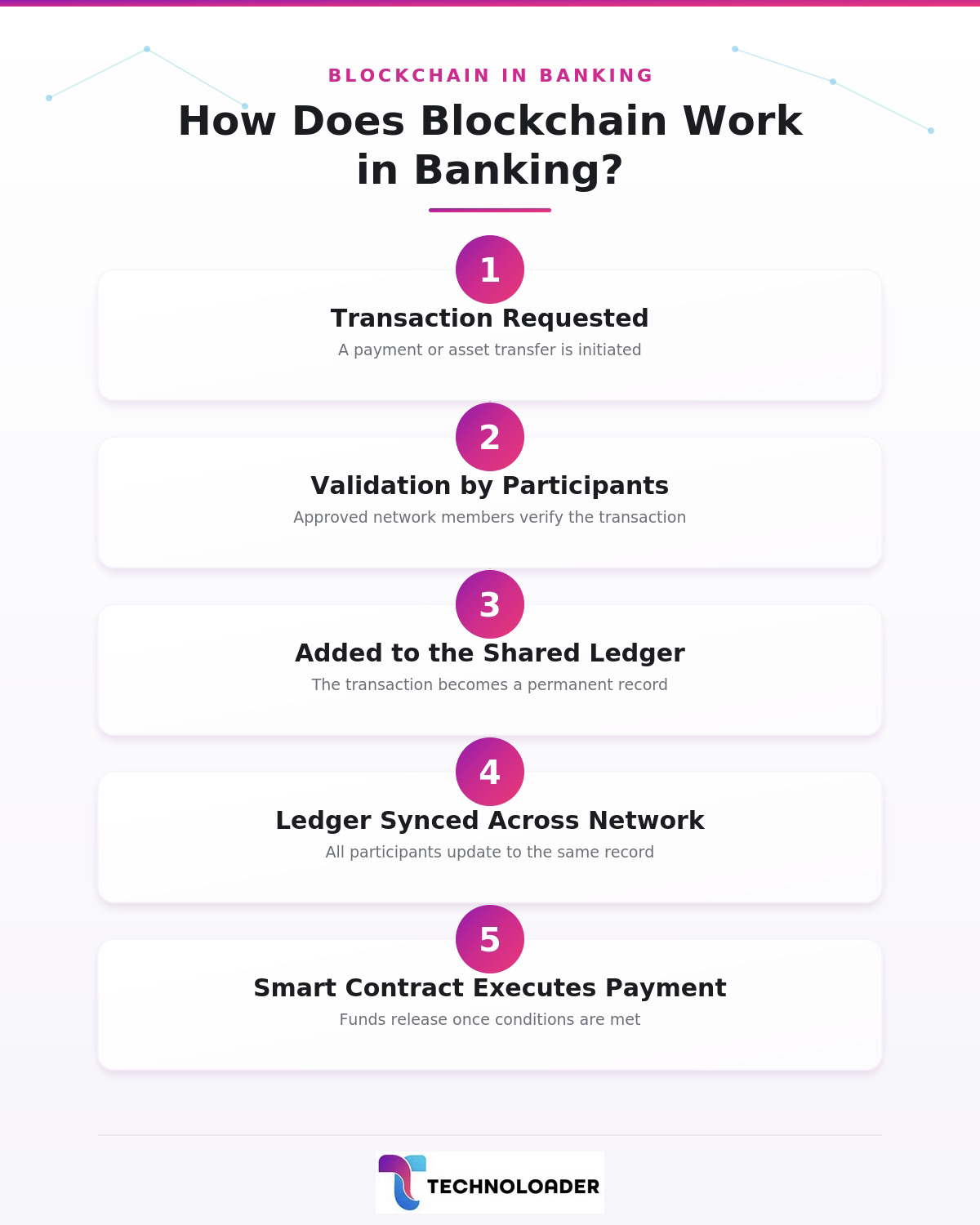
A typical blockchain transaction follows these steps:
- A payment or asset transfer is requested
- Depending on the blockchain, nodes, miners, or validators verify the transaction using the network’s consensus mechanism, like Proof of Stake
- The transactions are grouped into a block, which is added to the shared ledger
- All participants update the same record
- Smart contracts, which are programs that automatically carry out tasks, can release a payment after predefined conditions are met
Here’s a visual of the five steps of how blockchain in banking works:
Many banks use permissioned blockchain networks, where only approved members can access and update records. Selected participants validate transactions before they are added to the ledger.
Banks use permissioned blockchain networks to gain greater control over data and compliance. Some banks issue digital versions of financial products, such as bonds, on public blockchains like Ethereum.
For example, DBS announced it would tokenize notes on Ethereum in 2025. Tokenized notes are traditional investment notes represented as digital tokens on a blockchain.
Blockchain vs. Traditional Banking Systems: What’s the Difference?
Blockchain in banking uses a decentralized ledger where approved participants share and verify the same transaction record. Traditional banking is centralized. Banks hold customer funds and act as the sole gatekeepers of the databases that record money.
Here’s a visual comparison of traditional banking vs blockchain:
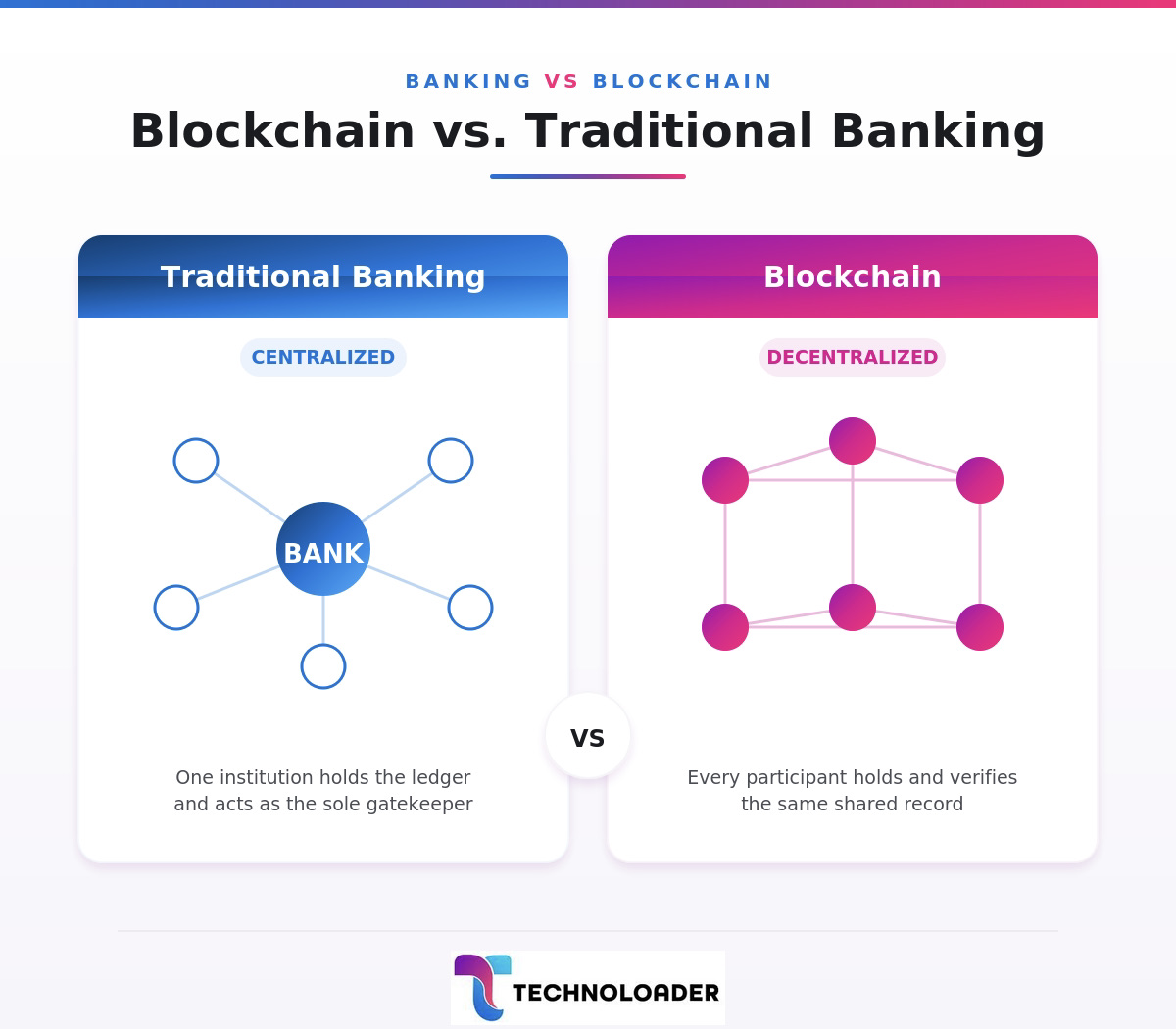
Take a look at this traditional banking vs blockchain comparison table:
| Dimension | Traditional System | Blockchain-Based Approach |
| Settlement Time | International payments take around one to two days | Near real-time |
| Reconciliation | Manual, across separate databases | One shared, automatically matched ledger |
| Transparency | Limited to each institution | Shared view for approved parties |
| Availability | Business hours | 24/7 |
| Settlement Risk | Parties exchange assets and cash at different times. If one party goes bankrupt, the other party might lose funds. | DvP (Delivery vs. Payment) ensures that payment and assets are exchanged at the same time |
You may also like:
What Are the Key Use Cases of Blockchain in Banking?
Blockchain in banking is used for cross-border transactions, securities settlement, and trade finance. It’s also used for KYC, AML, smart-contract automation, and asset tokenization. These are some of the blockchain applications in banking.
Cross-Border Payments and Remittances
Blockchain enables banks to send money across countries on a shared digital ledger. No need to rely on multiple intermediary banks. Transaction speed is near real-time, compared to days with traditional banking.
A remittance is the process of sending payments from one party to another. Usually, for migrant workers or their families at home. Blockchain helps reduce costs for migrant workers.
Blockchain also reduces the need for pre-funded accounts in international payments. Banks no longer need to lock up idle capital in overseas (nostro) accounts.
Here’s a blockchain cross-border payments visual:
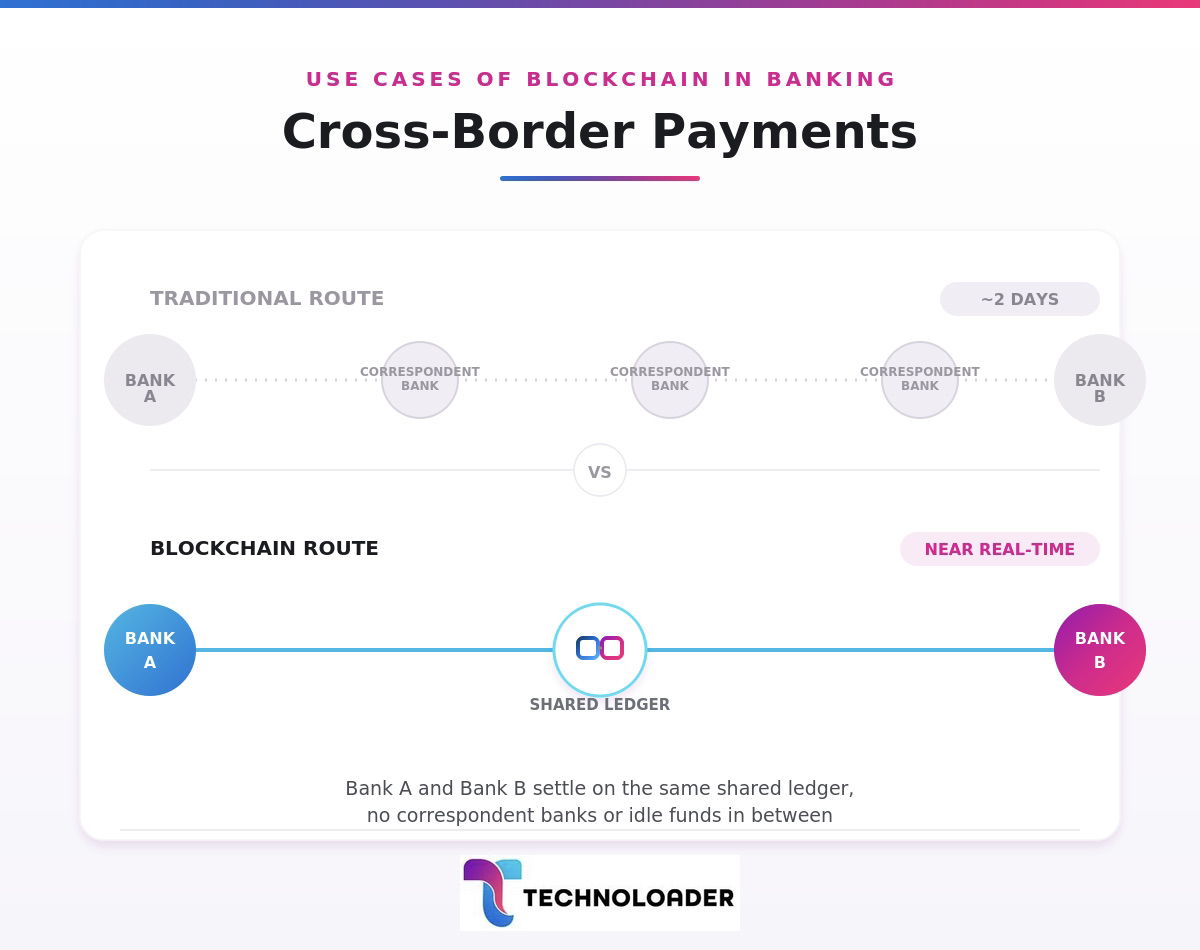
In fact, the BIS has advanced Project Agorá to real-value testing in May 2026. Project Agorá uses blockchain to unite major banks into one shared platform. Banks are testing this new system out with real money to ensure it’s secure.
Additionally, JPMorgan’s Kinexys platform is a bank-led blockchain network. The platform has processed over $3 trillion, averaging more than $5 billion daily.
Securities Settlement and Clearing
Blockchain helps major financial institutions settle trades faster and with less risk. It supports DvP. Meaning, cash and the assets are exchanged at the same time. Here’s how it works:
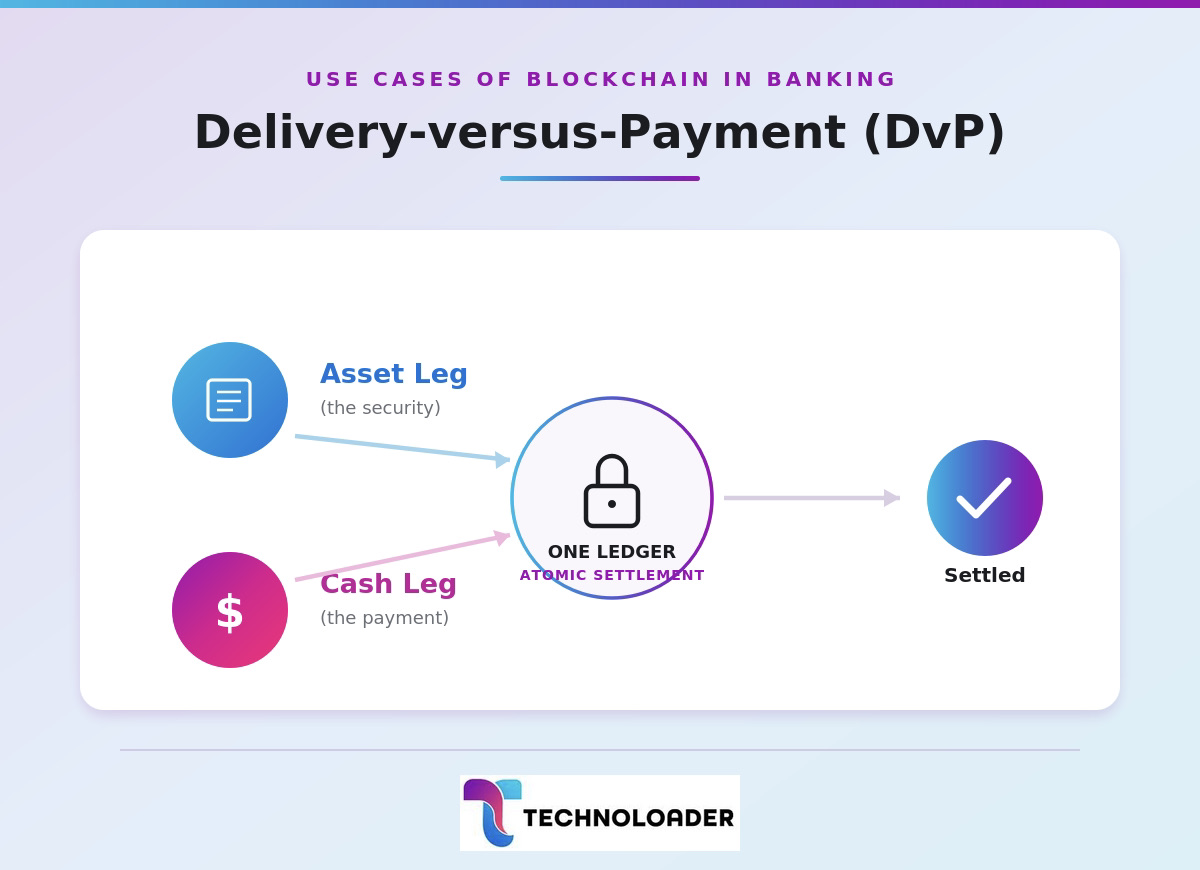
Some blockchain systems also support atomic settlement. Meaning, the entire transaction succeeds or fails as one unit.
This differs from T+1 settlement. Which means trades are completed one business day after they’re executed.
In fact, HSBC’s Orion platform has supported more than $3.5 billion in blockchain-based bonds. These are bonds that are issued and recorded directly on a blockchain rather than through traditional systems. Faster settlement also frees up money and assets that would otherwise remain tied up while trades are being finalized.
Trade Finance
Trade finance is paper-heavy and slow. A shared ledger keeps trade documents like invoices and letters of credit in one digital system.
Smart contracts can then automatically check trade documents and approve payments. Here’s how smart contract automation works in a blockchain system:
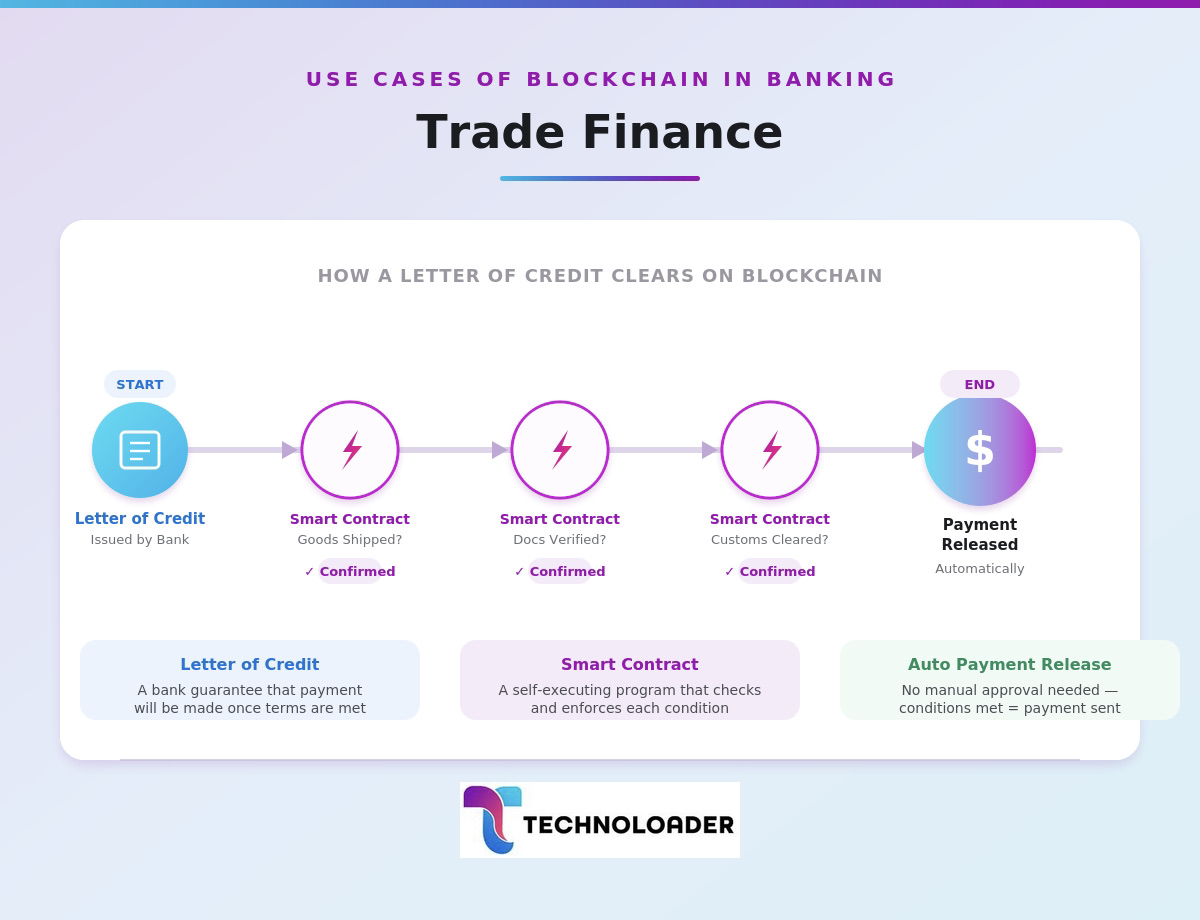
Blockchain can improve trade finance, but past attempts have not always succeeded.
Major blockchain trade finance projects failed or shut down. For example, we.trade closed in 2022, Marco Polo became insolvent in 2023, and Contour wound down in 2023. Komgo is the network that survived.
KYC, AML, and Digital Identity
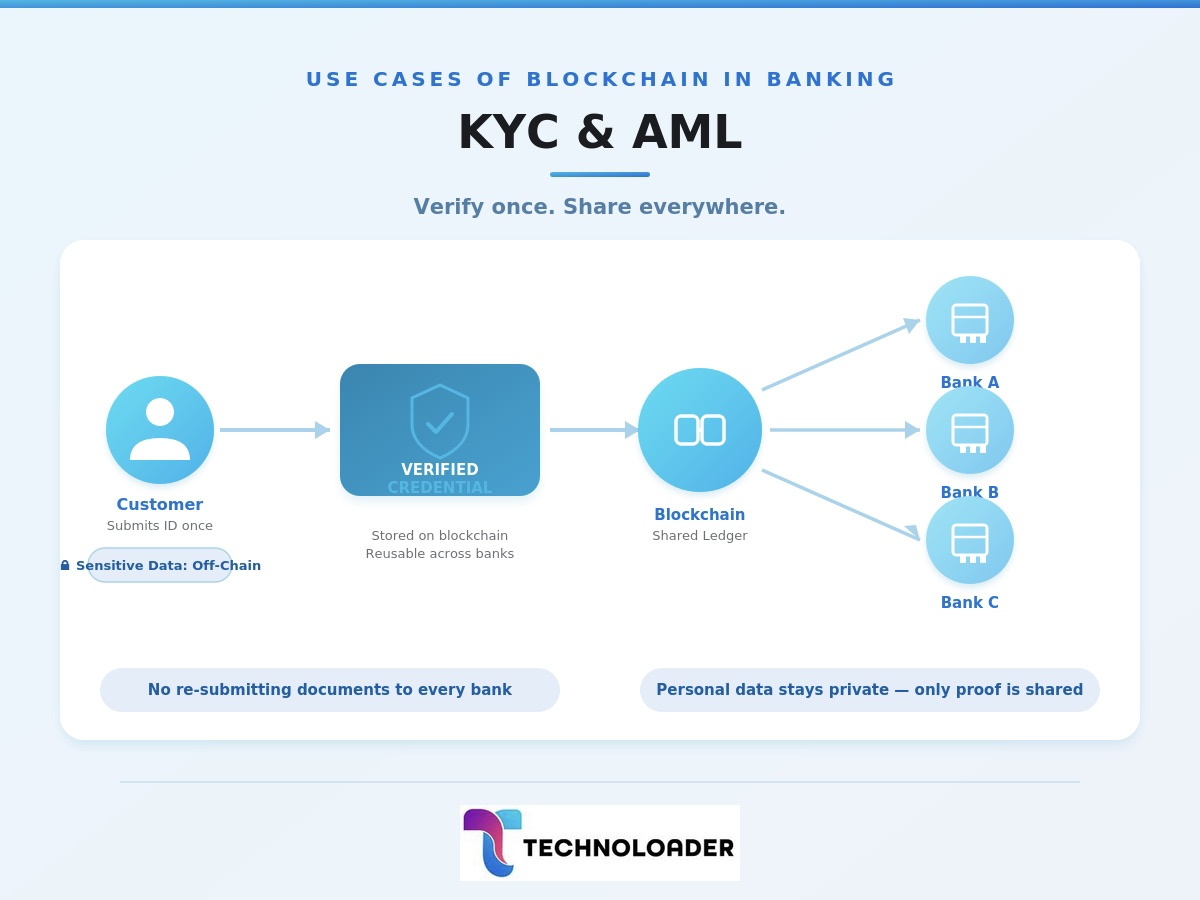
KYC (Know Your Customer), AML (Anti-Money Laundering), and digital identity are financial compliance and verification systems. They’re used to confirm user identity and prevent money laundering and fraud in banking. They also enable secure digital access to banking services.
Traditionally, each bank verifies the same customer, even if another bank has already done so.
Blockchain in banking lets banks share trusted identity verification results instead of repeating the process. This reduces duplicate onboarding and speeds up compliance.
Sensitive identity data usually stays off-chain. Only hashes or pointers sit on the ledger. Meaning, the blockchain stores encrypted references (proofs), not actual personal data. Here’s how it works:
Smart Contracts and Lending Automation
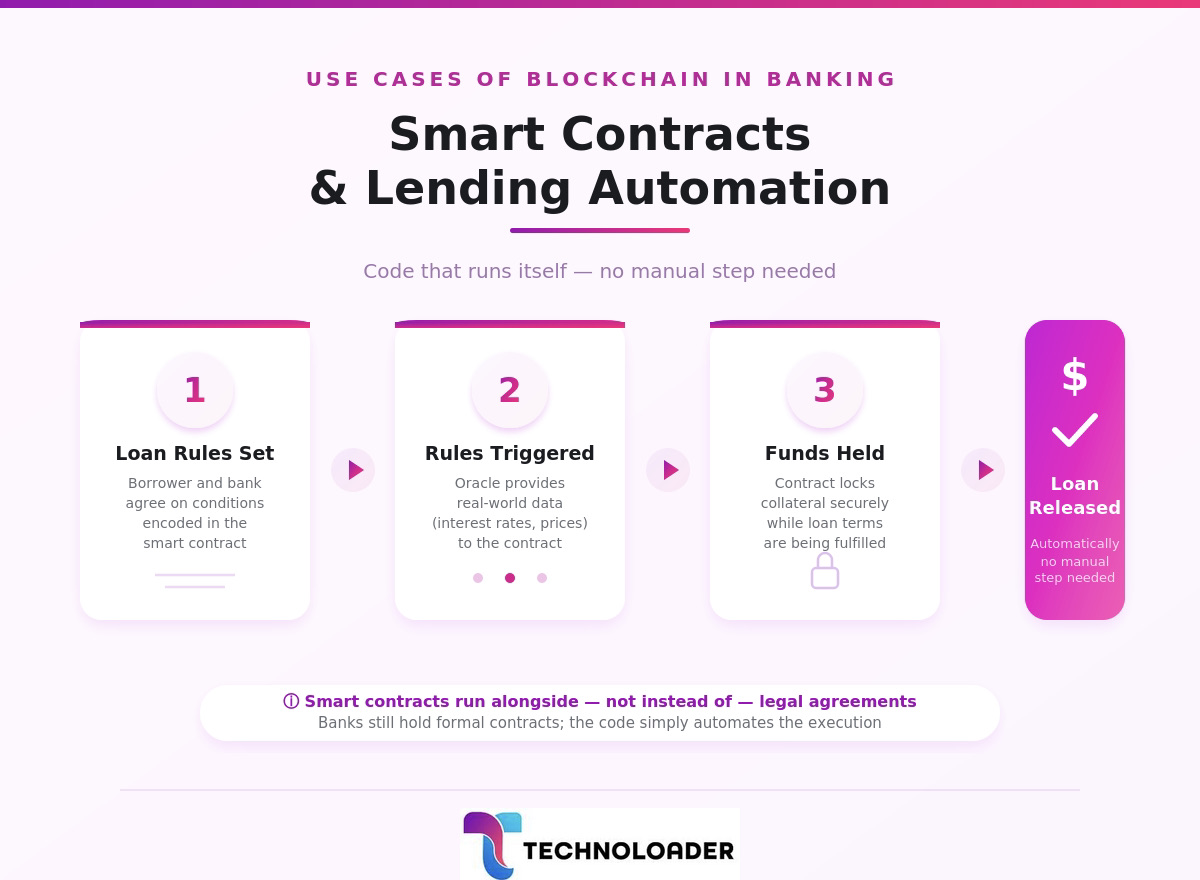
For example, a smart contract is a program that executes actions on its own when rules are triggered. Smart contracts can automatically hold funds, manage loan security, and release loans without bank staff doing each step.
Even though a smart contract runs automatically, it’s still software. It doesn’t replace a legal agreement. Banks still use formal contracts that set the legal terms of loans or trades.
They also use oracles for off-chain data, like prices, interest rates, or settlement data. Here’s how a lending workflow looks:
Asset Tokenization and Deposit Tokens
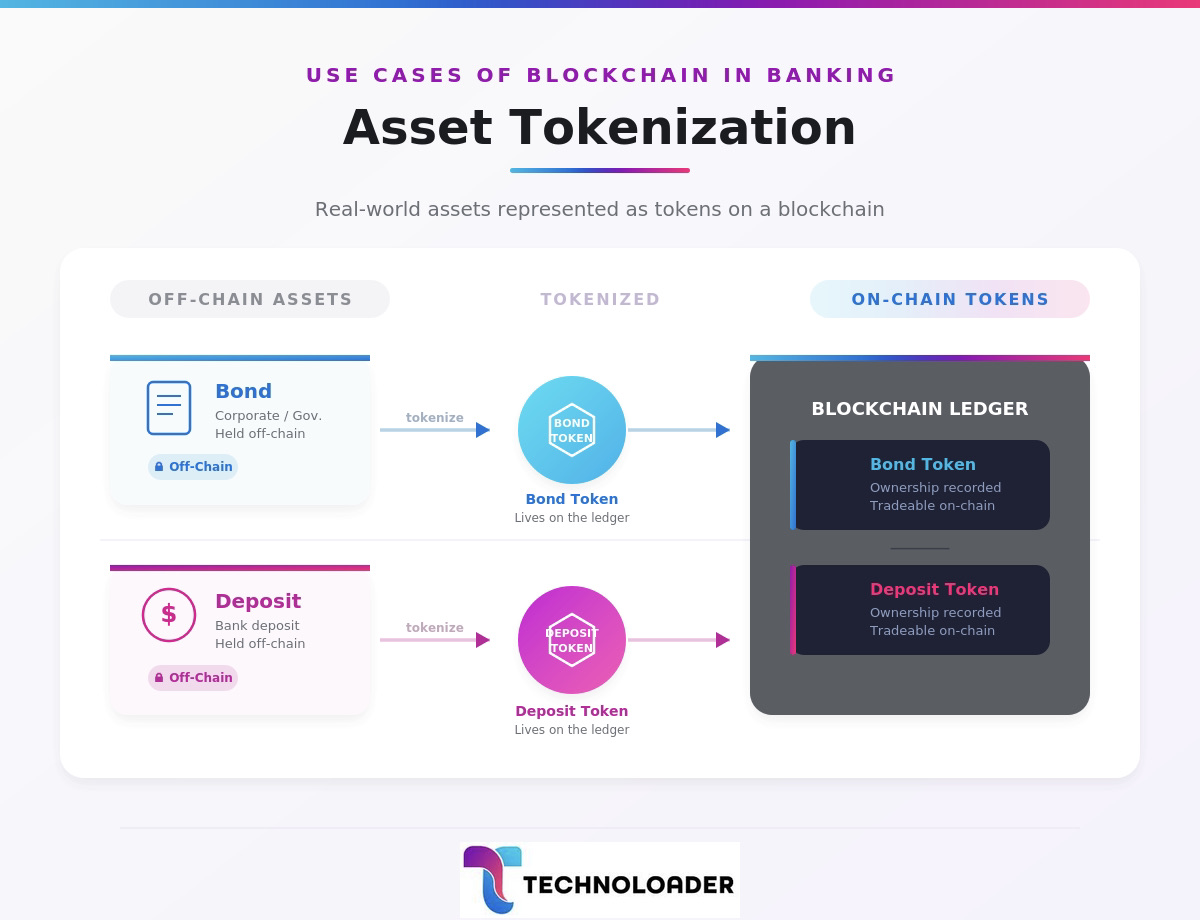
Tokenization means turning real assets, like bonds or deposits, into digital records on a blockchain. The real asset is still kept off-chain by a bank or custodian. Here’s how this works in practice:
According to RWA.xyz, the total value of real-world assets represented on blockchains is around $32.2 billion. BlackRock’s BUIDL fund holds around $2.37 billion as of June 2026.
You may also like:
What Are the Benefits of Blockchain in Banking?
Benefits of blockchain in banking include faster settlement, lower costs, transparency, and security. They also include availability and auditability:
- Faster settlement: Transactions can settle in near real-time
- Lower cost: Shared records reduce reconciliation and manual work by bank employees
- Transparency: Every approved party sees the same data at the same time
- Security: Records are tamper-resistant and cryptographically secure
- Availability: Settlement can run 24/7
- Auditability: Regulators and auditors can trace transaction data history easily
A 2025 State Street survey highlighted key benefits of digital assets. Transparency was ranked as the top benefit at 52%. Faster trading was 39%, and lower compliance costs were 32%.
Across the platforms I have helped build, the audit and reconciliation savings show up first. Normally, banks each keep their own records of the same transaction.
They then send spreadsheets to each other to compare and “match” records. Blockchain removes this because all banks see the same shared record.
Benefits of Blockchain in Banking
Banks gain faster settlements, lower operating cost, and better transparency. Settlements can run 24/7. The ledger is tamper-resistant, though never risk-free. Banks can also trace transaction history a lot faster than traditional banking.
Types of Blockchain: Which Ones Do Banks Use?
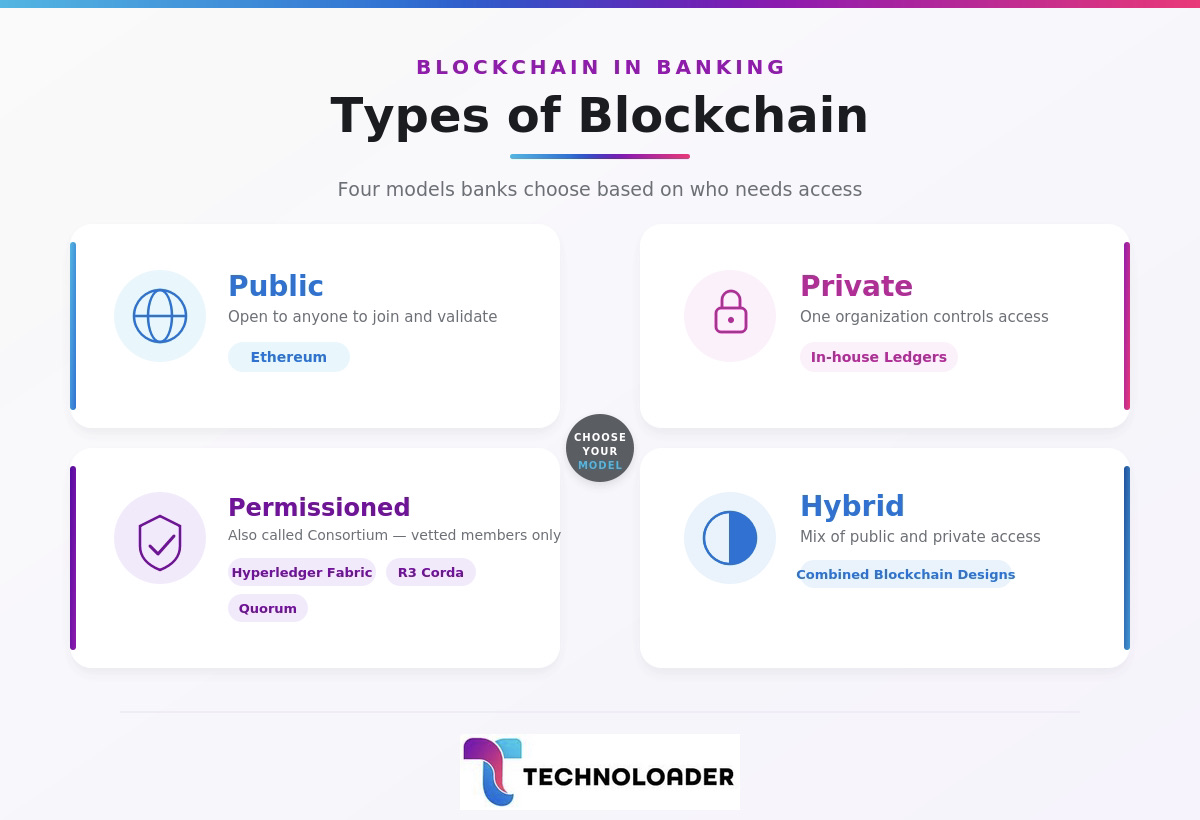
There are four main types of blockchain. Public, private, permissioned (consortium), and hybrid. Banks mostly use permissioned networks. These give them control and privacy.
Here’s how blockchain types compare at a glance:
Below is a comparison table of types of blockchain, who can join, platform examples, and best fit:
| Type | Who Can Join and Validate? | Platforms Examples | Best Fit in Banking |
| Public | Anyone | Ethereum | Tokenized assets that can reach open markets |
| Private | One organization | In-house ledgers | Internal banking records and testing blockchain systems |
| Permissioned/Consortium | Vetted members only | Hyperledger Fabric, R3 Corda, Quorum | Interbank payments, shared settlement, and trade finance systems |
| Hybrid | Mixed public and private | Combined blockchain designs | Used when banks need public verification |
When I advise regulated clients, compliance comes before trends. A permissioned network is one of the best choices. Banks can share control over the rules, system updates, and transaction approval.
I also consider scalability early. Meaning, whether a base blockchain (Layer 1) is enough. Or, if an added scaling layer (Layer 2) is needed to keep transactions fast and efficient. Read more on Layer 1 and Layer 2.
Types of Blockchain for Banks
Public chains are open to anyone. A permissioned or private blockchain network limits who can join and validate transactions. A hybrid blockchain combines private and public networks.
You may also like:
Blockchain Adoption: What Are Some of the Best Examples in 2026?
As of 2026, some of the biggest banks run live blockchain systems, not pilots. The table below shows real blockchain in banking examples:
| Bank or Body | Program | Use Case | Status | Source |
| JPMorgan | Kinexys (formerly Onyx) | Payments, deposit tokens | Live | JPMorgan, Apr 2026 |
| Citi | Citi Token Services | Tokenized deposits, 24/7 clearing | Live | Citi, 2025 |
| HSBC | Orion | Digitally native bonds | Live | HSBC, 2026 |
| BNY | Tokenized deposit service | Payments, collateral | Live | Binance, 2026 |
| DBS | DBS Token Services | Settlement, tokenized notes | Live | DBS, 2025 |
| BIS + Seven Central Banks | Project Agorá | Cross-border settlement | Experimental | BIS, May 2026 |
| Multi-Central-Bank | mBridge | Wholesale cross-border CBDC | Live | Atlantic Council, 2026 |
A few headline moves stand out. JPMorgan rebranded its blockchain unit from Onyx to Kinexys in late 2024. Kinexys serves clients across five continents, from central banks to global firms.
The BIS-led Project Agorá remains experimental. Citi, BNY, and DBS now run live services for institutional clients.
Four US banks, JPMorgan, Citi, Bank of America, and Wells Fargo, are planning a shared tokenized-deposit network. The target is for early 2027, according to Yahoo Finance.
SWIFT is also building a blockchain-based shared ledger.
Blockchain in Banking Examples
JPMorgan, Citi, HSBC, BNY, and DBS already run blockchain in production. Central banks are testing shared settlement through the BIS. These blockchain systems are being used by real customers and processing real transactions.
You may also like:
CBDCs (Central Bank Digital Currencies), Tokenized Deposits, and Stablecoins: What Are They?
CBDC is the digital form of money issued directly by a central bank. This means the central bank carries the liability. A tokenized deposit is a digital representation of traditional bank money. It’s backed by the issuing bank’s assets.
A stablecoin is issued by a private company and is backed by reserves or assets held by the issuer. This creates issuer risk. Here’s a table that breaks this down:
| Attribute | CBDC | Tokenized deposit | Stablecoin |
| Issuer | Central bank | Commercial bank | Private company |
| Liability Of | The central bank | The issuing bank | The issuer |
| Backing and Risk | Sovereign | Bank balance sheet | Reserves, issuer risk |
| Inside Regulated Banking? | Yes | Yes | Often outside |
| Primary Use | Public or wholesale money | Bank payments, settlement | Crypto and payments |
Banks prefer tokenized deposits over stablecoins. This is because with tokenized deposits, banks can keep money inside the regulated banking system and remain fully responsible for it.
CBDCs are also growing. By May 2026, 146 countries were exploring CBDCs, and 41 had active pilots, according to the Atlantic Council:
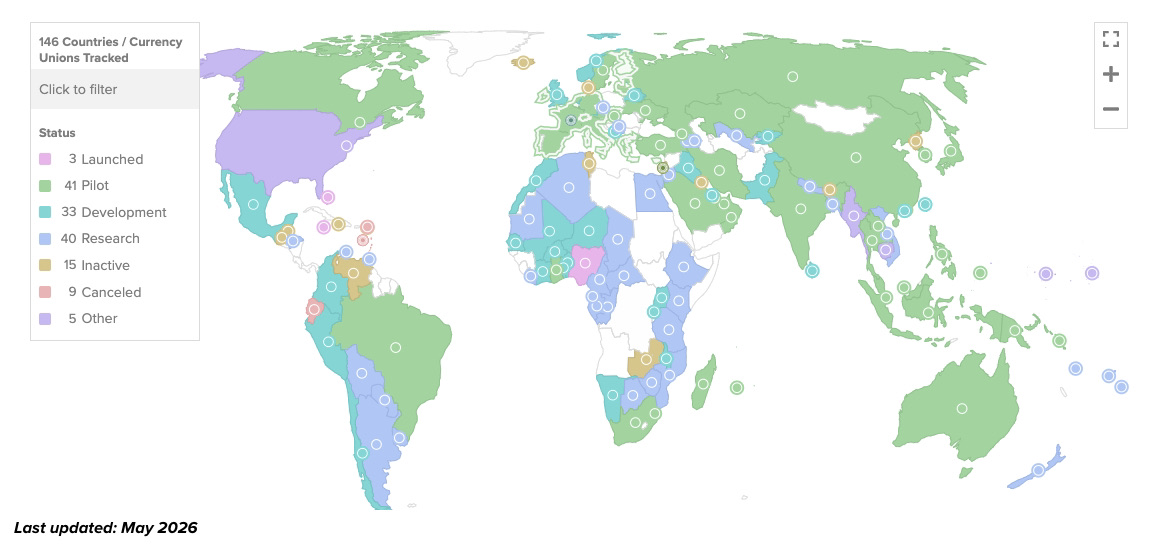
From advising banks on token models, I always start with one question. Who carries the liability? This determines whether a system is a CBDC, a bank deposit token, or a stablecoin.
CBDCs vs. Tokenized Deposits vs. Stablecoins
A CBDC is money issued by the central bank, in digital form. A stablecoin is privately issued. A tokenized deposit is a representation of money on a ledger. Only one of them is a direct central-bank liability.
What Are the Challenges, Risks, & Regulatory Considerations of Blockchain Implementation?
Some of the main challenges include scalability, data privacy, and security risks. Regulations and compliance can also pose legal challenges when not followed.
Key Challenges and Limitations
Blockchain in banking improves efficiency in some areas, but it doesn’t remove operational, legal, or security risk. Careful design, audits, and monitoring are still required. Here are the challenges and limitations:
- Scalability: Some blockchain systems can’t handle high banking transaction volumes
- Interoperability: Different blockchain systems and traditional bank systems don’t always connect easily
- Regulatory Compliance Uncertainty: Rules differ by country and keep changing, making it harder to legally govern blockchains
- Data Privacy: A tamper-resistant ledger can clash with the right to erasure, outlined by data protection laws like GDPR
- Change Resistance: Transitioning to blockchain requires retraining staff and vendor negotiations
- Security Risks: While cryptographically secure, smart contracts can be at risk of getting hacked, and if access keys are lost, funds may be permanently lost
Lessons From Early Blockchain Banking Projects
Several shared bank networks, such as we.trade, Marco Polo, Contour, and TradeLens were shut down in 2022–2023.
These blockchain projects did not fail because blockchain technology stopped working. When global banks share one platform, each bank must invest, follow shared rules, and get enough usage to justify the cost. A disagreement in one of these things may have led to the shutdown.
Single-bank blockchain in banking systems, like Kinexys and Orion, worked better. One bank controls the system. Updates, funding, and rollout are faster.
Regulation and Compliance
Regulation and compliance are some of the biggest external factors affecting blockchain in banking.
In the US, the OCC sets banking rules. It allows banks to leverage blockchain networks and hold small amounts of crypto for operations and testing.
The SEC states that some crypto tokens may be treated as investments. If so, they must follow investor protection and disclosure rules. The Bank Secrecy Act (BSA) requires banks to help detect and prevent money laundering and other financial crimes.
The GENIUS Act (2025) sets US rules for payment stablecoins and defines who can issue them and how they are regulated. In the EU, the MiCA framework governs crypto-asset services.
Quick Answer: Challenges, Risks and Regulatory Considerations for Blockchain in Banking
- The main challenges of blockchain in the banking sector are scalability, integration with legacy systems, regulatory uncertainty, and privacy
- Single-bank blockchain systems tend to work better than multi-bank
- You must follow rules set by the OCC, the SEC, the BSA, GENIUS Act, and MiCA (for EU)
You may also like:
How Can Banks Adopt Blockchain? A Practical Roadmap
Implementing blockchain in banking should begin by focusing on one real business problem, not the entire system at once. Here is the path I recommend to banks and fintechs:
- Identify a high-friction use case, such as payments, reconciliation, or trade documents
- Choose the network model, permissioned or public, based on compliance needs
- Pilot with a narrow scope and a clear success metric
- Plan an early connection to core banking systems and other blockchains
- Scale only when ownership is clear, rules are defined, and the system is properly monitored during use
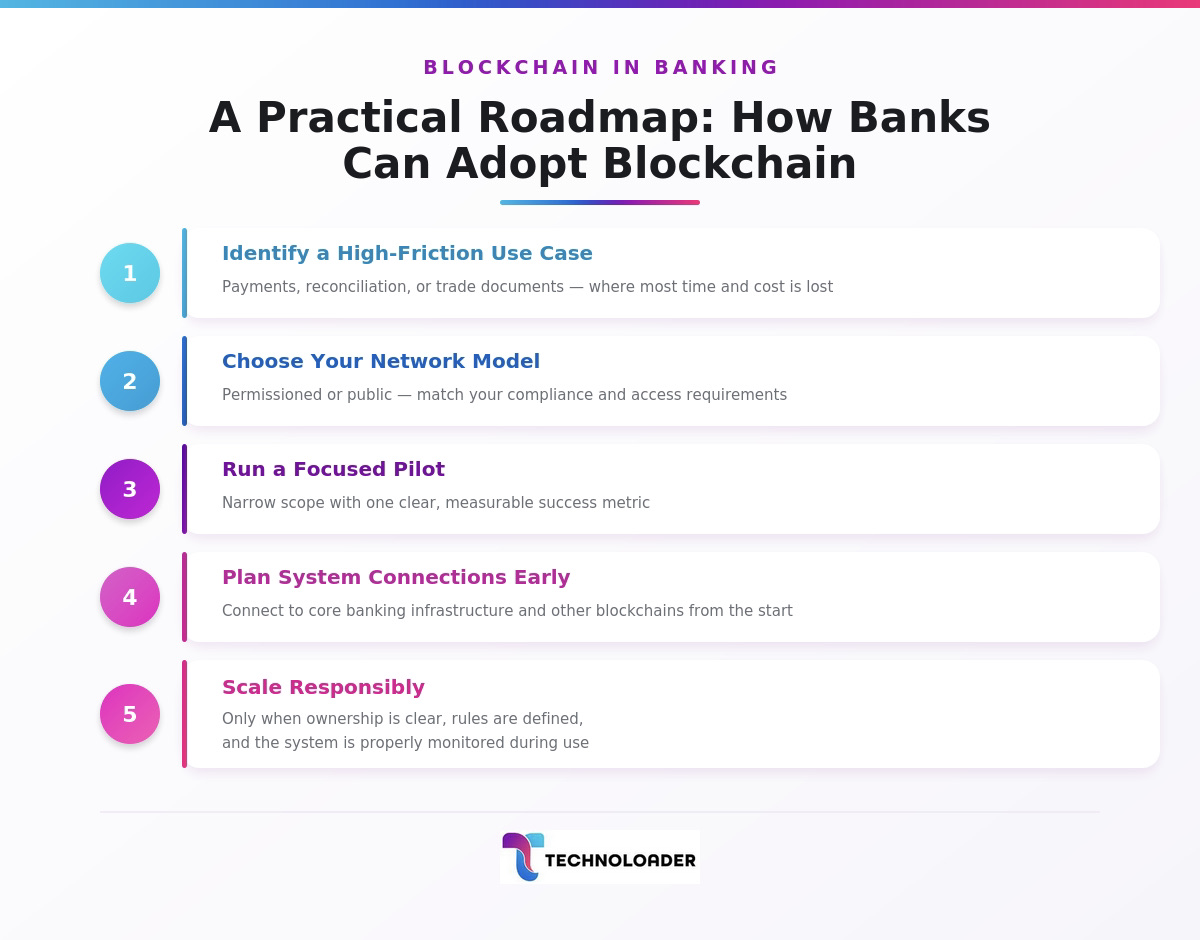
Once the pilot blockchain system shows clear results, such as faster settlement time, you can scale it across banking systems.
Banks usually have legacy systems. Any new technology must connect with those systems properly instead of replacing everything at once or causing downtime.
This is where the right technical partner becomes important. For example, at Technoloader, we’ve delivered 450+ projects. We help you move from pilot to full deployment through blockchain consulting and integration support.
Quick Answer: How Banks Can Adopt Blockchain
Start with one problem area like payments or reconciliation. Choose a permissioned or public network. Run a small pilot first. Then, connect it to existing banking systems.
What Is the Future of Blockchain in Banking?
The future of blockchain in banking is about banks using shared digital systems to move money and record transactions.
One key development is programmable money. This means banks can set conditions for payments. Money is only transferred when specific rules are met. For example, a payment can automatically go through once a trade is confirmed, without manual approval.
Another change is tokenized deposits. Bank deposits are converted into digital tokens. These tokens still represent real money.
Banks are also starting to test shared settlement networks like Project Agorá and SWIFT’s blockchain-based systems.
Interoperability is important. Money needs to move smoothly between blockchain systems and existing banking systems without delays or manual steps. In the systems I have worked on, the ones that plan for this connection early are the ones that scale.
AI and blockchain will also be used together. For example, AI can be used to detect fraud.
Quick Answer: What’s the Future of Blockchain in Banking?
Expect programmable money, more tokenized assets, and shared settlement networks. AI and blockchain can start to work together, not compete.
Conclusion
Blockchain in banking and finance is a shared digital ledger that lets banks record, verify, and settle transactions. One of the things broken down in this article is the use cases of blockchain in banking.
These include cross-border payments, securities settlement, and trade finance. They also include KYC, AML, digital identity, smart contracts, and asset tokenization.
Some of the key benefits of blockchain in banking are faster settlement and lower costs. Stronger transparency and 24/7 settlement availability are also benefits.
Blockchain in banking has moved from pilots to production. The clearest value sits in cross-border payments, fast settlement, and tokenized assets.
If you’re looking to explore this shift, you can talk to our blockchain development team to get started.
Frequently Asked Questions
What is blockchain in banking?
Blockchain technology in banking uses distributed ledger technology to record and settle transactions on a shared, tamper-resistant ledger.
How is blockchain used in banking?
Banks use it for cross-border payments, securities settlement, trade finance, KYC, AML, and identity. They also use it for smart-contract automation and asset tokenization.
What are the 4 types of blockchain?
The four types of blockchain are public, private, permissioned, and hybrid. Banks tend to use permissioned networks. This is because they can control who can join the network and see the data.
Which blockchains do banks use?
Banks mostly run permissioned networks such as Hyperledger Fabric, R3 Corda, and Quorum. Some also issue and distribute assets on the public Ethereum blockchain.
Is blockchain safe and secure for banking?
Blockchain in banking is tamper-resistant and cryptographically secure, but it is not unhackable. Risks come from weak smart contract code and stolen access keys. Banks manage this by using permissioned networks and regular security checks.
What is the difference between a CBDC and a stablecoin?
A CBDC is the digital form of money issued by a central bank, where the central bank carries the liability. A stablecoin is issued by a private company and is backed by reserves held by the issuer.
Will blockchain replace traditional banking?
No. Blockchain in banking technology offers a modern infrastructure behind banking, not replacing banks. Banks use the ledger to increase settlement speed and cut reconciliation costs.
How long does it take to withdraw money from blockchain?
It can take minutes because transactions settle almost instantly. However, timing can vary depending on the blockchain network and bank processing rules.

Vipin Kumar
Vipin Kumar is the Founder & CEO of Technoloader, a Clutch Top 10 Blockchain Development Company for 2025. A serial technology entrepreneur and blockchain architect with a B.Tech background, Vipin has led the delivery of 450+ projects across DeFi, NFT marketplaces, AI/ML, and custom Web3 platforms for clients in the UAE, India, the US, and beyond. He also founded SALIQ (saliq.ai), an AI-driven conversational marketing platform.
Published in Blockchain Development