 +91 7014607737
 info@technoloader.com






Table of Contents
Quick Summary
- The Hemi Network blockchain is a Bitcoin Layer 2 that ties Bitcoin and Ethereum into one programmable network
- Its edge is a full Bitcoin node inside an Ethereum-style machine that reads Bitcoin directly
- The Hemi Network blockchain leans on Bitcoin’s own security by anchoring its state to Bitcoin through Proof-of-Proof
- The HEMI token pays for gas, staking, governance, and the miners that secure the chain
- The tech is credible, but the network is early and still centralized in key ways
The Hemi Network blockchain is a Bitcoin Layer 2 that brings Ethereum-style apps to Bitcoin. It runs those apps fast, then settles them onto Bitcoin for security.
Bitcoin holds most of the value in crypto, yet it was never built to run software. Ethereum runs the software but can’t borrow Bitcoin’s security.
Hemi tries to give you both, so you don’t have to choose.
That idea drew heavy funding and a team with deep Bitcoin roots. It also launched early, with some risks worth knowing before you commit. Here’s how it works and where it still falls short.
What Is the Hemi Network Blockchain?
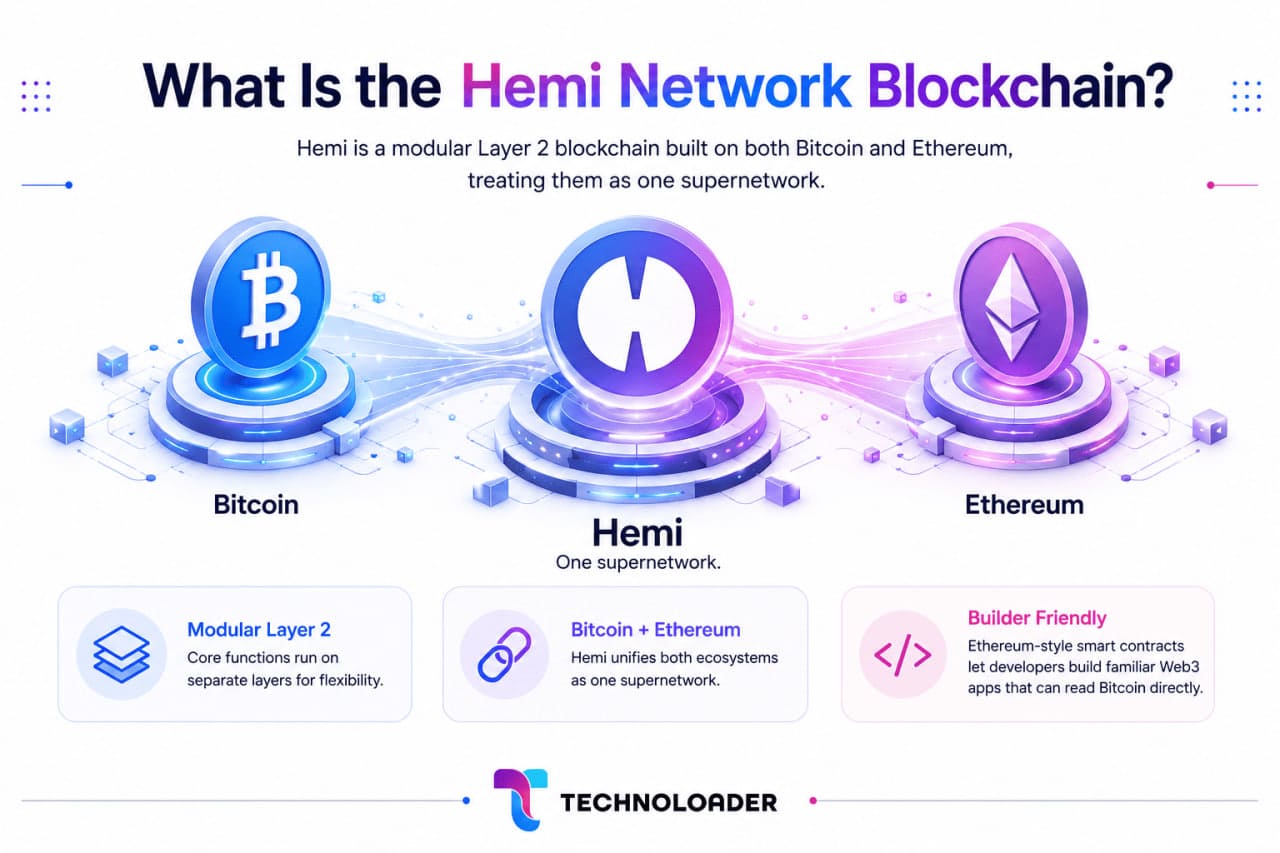
Hemi Network is a modular Layer 2 blockchain built on both Bitcoin and Ethereum. “Modular” here means its core jobs run on separate layers you can swap out.
Instead of picking one chain, the Hemi Network blockchain treats them both as a single supernetwork. Rather than build a new base chain, Hemi builds on the two biggest.
The team behind it is well known in Bitcoin circles. Jeff Garzik, an early Bitcoin core developer, co-founded Hemi Labs with Maxwell Sanchez and Matthew Roszak.
That track record helped Hemi raise about $30 million across two rounds, per The Block. Binance Labs led the first round, and YZi Labs led the second. The network’s mainnet went live on March 12, 2025.
Builders don’t have to learn a new system. Hemi runs Ethereum-style smart contracts, so existing skills carry over. Anyone doing Web3 development already knows the tools. You build apps the usual way, and they read Bitcoin directly.
What Is the Hemi Network Blockchain in Simple Terms?
The Hemi Network blockchain is a Bitcoin Layer 2 for Ethereum-style apps, secured by Bitcoin. That mix gives apps Bitcoin’s security without giving up Ethereum’s tools.
Also Read
How Does the Hemi Network Blockchain Work?
The Hemi Network blockchain works by running your transaction on a fast Layer 2, then recording it onto Bitcoin. That gives you low fees and quick confirmation up front, with Bitcoin-level settlement soon after.
Here’s the path a transaction takes, start to finish:
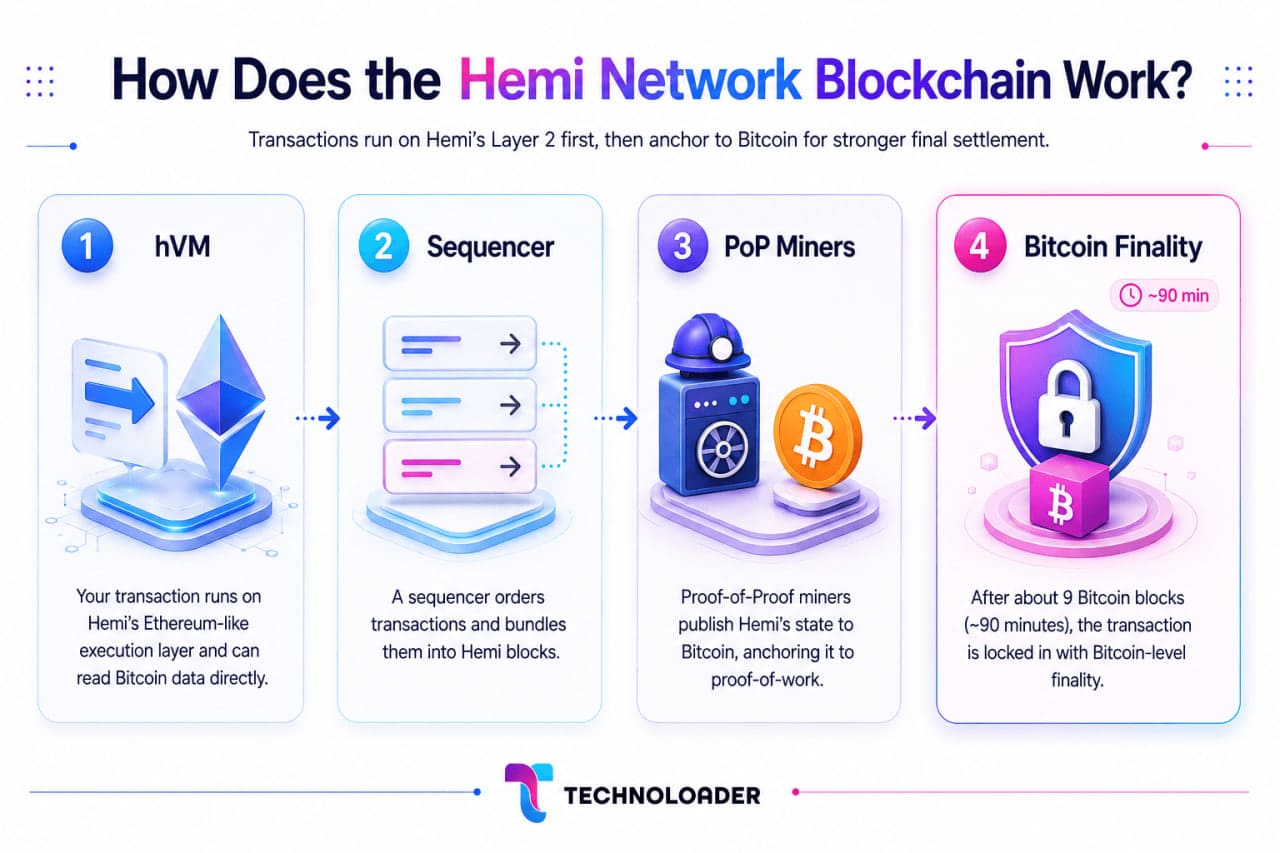
- You Transact on the hVM: You send a transaction to Hemi’s engine, the hVM. It behaves like Ethereum, so your wallet and apps feel normal. It also reads live Bitcoin data while it runs.
- A Sequencer Orders the Transactions: A sequencer collects transactions and puts them in order. It then bundles them into Hemi blocks. Right now, the Hemi team runs this role alone.
- PoP Miners Publish Hemi’s State to Bitcoin: Special nodes called Proof-of-Proof (PoP) miners take a snapshot of Hemi’s state. They write that snapshot into a Bitcoin transaction. This ties Hemi’s history to Bitcoin’s proof of work. The miners earn HEMI tokens for the job.
- Bitcoin Finality Locks It In: After about nine Bitcoin blocks, roughly 90 minutes, the state reaches Bitcoin finality. To undo it, someone would have to rewrite Bitcoin itself. That’s the security Hemi is built to inherit.
Those four steps power the Hemi Network blockchain. The blockchain nodes that anchor to Bitcoin do the hard part. Hemi refined this flow on an incentivized testnet before mainnet.
How Does the Hemi Network Blockchain Work?
Hemi runs apps on a quick Layer 2, then writes their state onto Bitcoin. You get speed up front and Bitcoin-grade settlement once it’s anchored.
What Are the Core Components of the Hemi Network Blockchain?
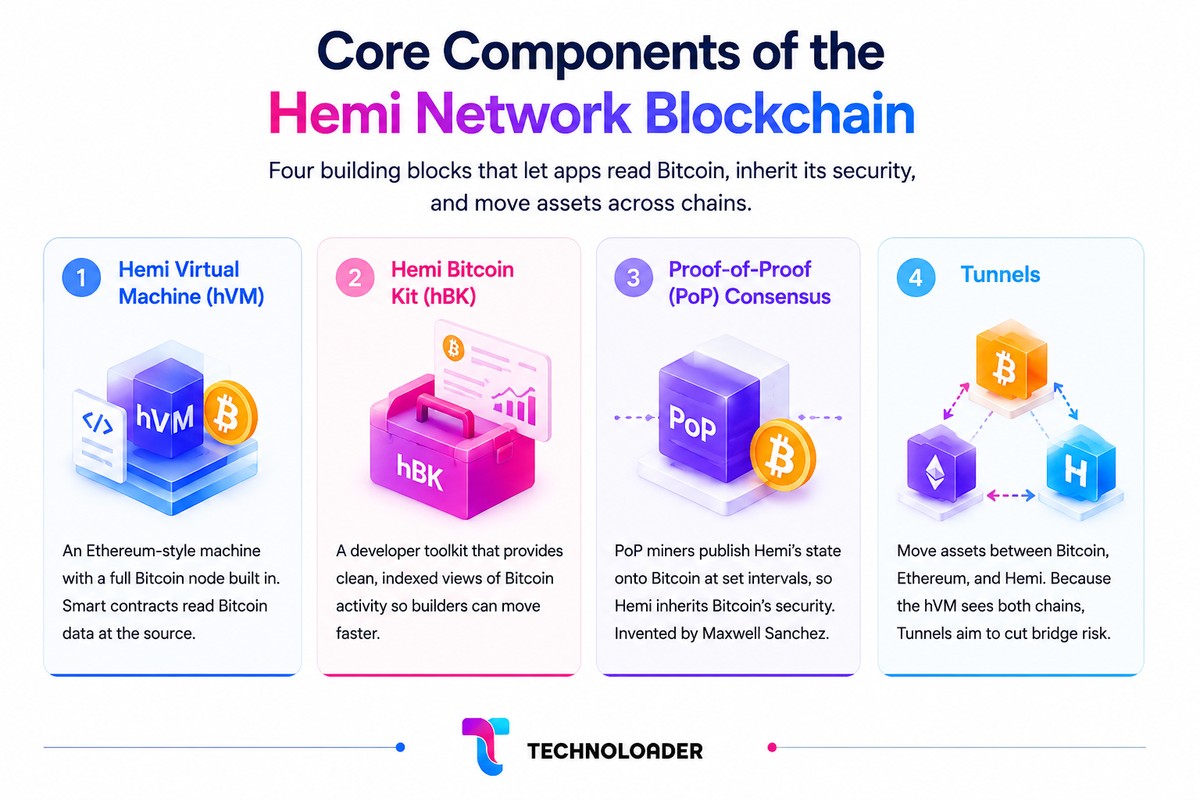
The Hemi Network blockchain runs on four parts: the hVM, the hBK, Proof-of-Proof, and Tunnels. Each one has a single job, and together they let apps read Bitcoin, borrow its security, and move assets across chains.
1. Hemi Virtual Machine (hVM)
This is an Ethereum-style machine with a full Bitcoin node built in. A smart contract on Hemi can read Bitcoin data at the source. Most chains only infer Bitcoin’s state through external nodes and providers.
2. Hemi Bitcoin Kit (hBK)
This developer toolkit makes Bitcoin data easy to use. It hands contracts clean, indexed views of Bitcoin activity. This way, builders skip the heavy custom code.
3. Proof-of-Proof (PoP) Consensus
This is how Hemi inherits Bitcoin’s security. PoP miners publish Hemi’s state onto Bitcoin at set intervals. Maxwell Sanchez is credited with inventing the method.
4. Tunnels
These move assets between Bitcoin, Ethereum, and Hemi Network. Because the hVM sees both chains, Tunnels aim to cut bridge risk. Their contracts can still be upgraded, so they need thorough smart contract audits.
Together, these four parts make the Hemi Network blockchain more than a copy of Ethereum.
What Are the Main Parts of the Hemi Blockchain?
Four parts run the Hemi Network blockchain: the hVM, the hBK, Proof-of-Proof, and Tunnels. The hVM runs the apps, and the rest feeds it Bitcoin data and security.
Also Read
What Are the Key Benefits of the Hemi Network Blockchain?
The Hemi Network blockchain pairs Bitcoin-grade security with Ethereum-style flexibility.
That mix is hard to find in one place, and it shapes every benefit below:
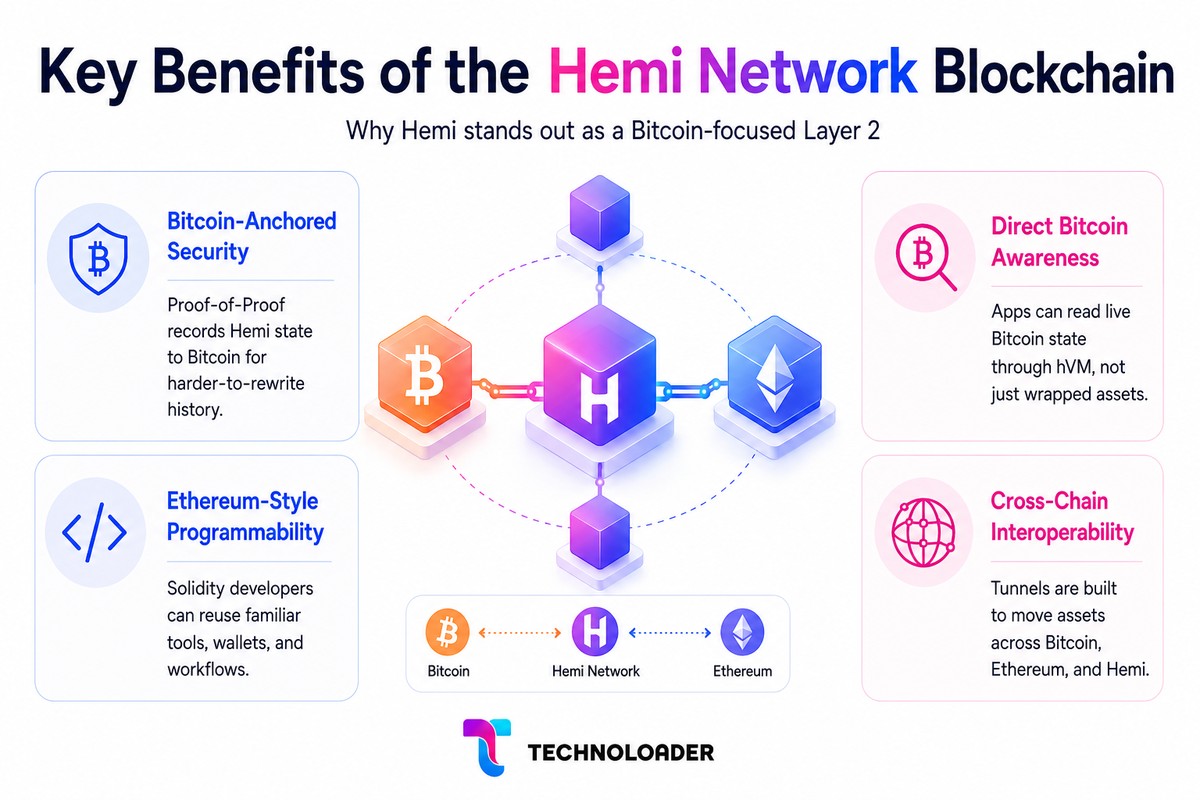
- Bitcoin-Anchored Security: Hemi writes its state onto Bitcoin through Proof-of-Proof. Once settled, that history is difficult to rewrite or alter. No live network is fully safe, but this is strong protection.
- Ethereum-Style Programmability: Hemi runs an Ethereum-style machine, so Solidity developers feel at home. This way, they reuse the tools, wallets, and patterns they already know. That makes smart contract development on Bitcoin faster.
- Direct Bitcoin Awareness: Apps can read Bitcoin’s state directly through Hemi’s hVM. A lending app can confirm a live Bitcoin deposit, not a wrapped copy. That supports designs older bridges couldn’t handle safely.
- Cross-Chain Interoperability: Tunnels aim to move assets across Bitcoin, Ethereum, and Hemi. The goal is fewer intermediaries and less bridge risk.
For builders, the Hemi Network blockchain lowers the cost of Bitcoin-connected apps.
Why Does the Hemi Network Blockchain Matter?
It makes Bitcoin useful for apps, not just for holding. And it borrows Bitcoin’s security instead of trying to replace it.
How Does the Hemi Network Blockchain Compare to Other Bitcoin Layer 2s?
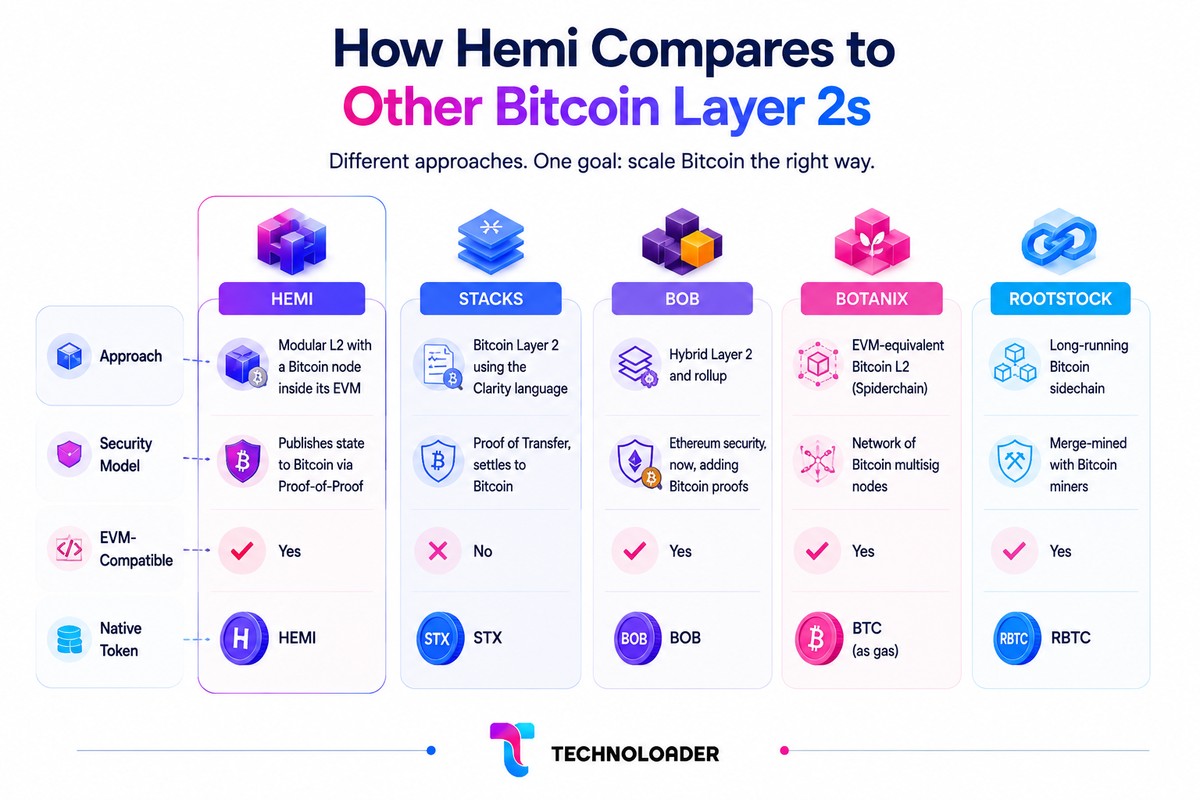
The Hemi Network blockchain differs by running a Bitcoin node inside its own machine. Rivals like Stacks, BOB, Botanix, and Rootstock connect to Bitcoin from the outside.
Here’s how they stack up:
| Project | Approach | Security Model | EVM-Compatible | Native Token |
|---|---|---|---|---|
| Hemi | Modular L2 with a Bitcoin node inside its EVM | Publishes state to Bitcoin via Proof-of-Proof | Yes | HEMI |
| Stacks | Bitcoin Layer 2 using the Clarity language | Proof of Transfer, settles to Bitcoin | No | STX |
| BOB | Hybrid Layer 2 and rollup | Ethereum security now, adding Bitcoin proofs | Yes | BOB |
| Botanix | EVM-equivalent Bitcoin L2 (Spiderchain) | Network of Bitcoin multisig nodes | Yes | BTC as gas |
| Rootstock | Long-running Bitcoin sidechain | Merge-mined with Bitcoin miners | Yes | RBTC |
Stacks and Rootstock are the veterans here, and both keep Bitcoin at arm’s length. Stacks settles through its own Clarity language, while Rootstock has merge-mined with Bitcoin miners since 2018.
BOB hedges by running on Ethereum security first and folding in Bitcoin proofs over time.
What separates the Layer 2 networks is where each one puts Bitcoin. For every rival, it stays outside the app layer, reached through a bridge or an oracle.
Hemi pulls it inside, and that’s the core selling point of the Hemi Network blockchain. Reading Bitcoin at the source removes a failure point that has drained plenty of bridges. The trade-off is that it’s harder to build, a challenge common to scalable Web3 applications.
Here’s an image that quickly summarizes how Hemi compares with the Bitcoin Layer 2s.
How Is the Hemi Network Blockchain Different from Other Bitcoin Layer 2s?
Most Bitcoin Layer 2s read Bitcoin through outside tools. The Hemi Network blockchain runs a full Bitcoin node inside its machine, so apps read Bitcoin directly.
What Is the HEMI Token and How Does Its Tokenomics Work?
The HEMI token (or Hemi coin) is the native asset of the Hemi Network blockchain. The token launched in September 2025 and was listed on Binance. Its structure follows standard token development, with a fixed maximum supply.
The HEMI crypto token pays for gas, secures the chain through staking, and drives governance votes. Its public debut paired the Binance listing with a HODLer airdrop.
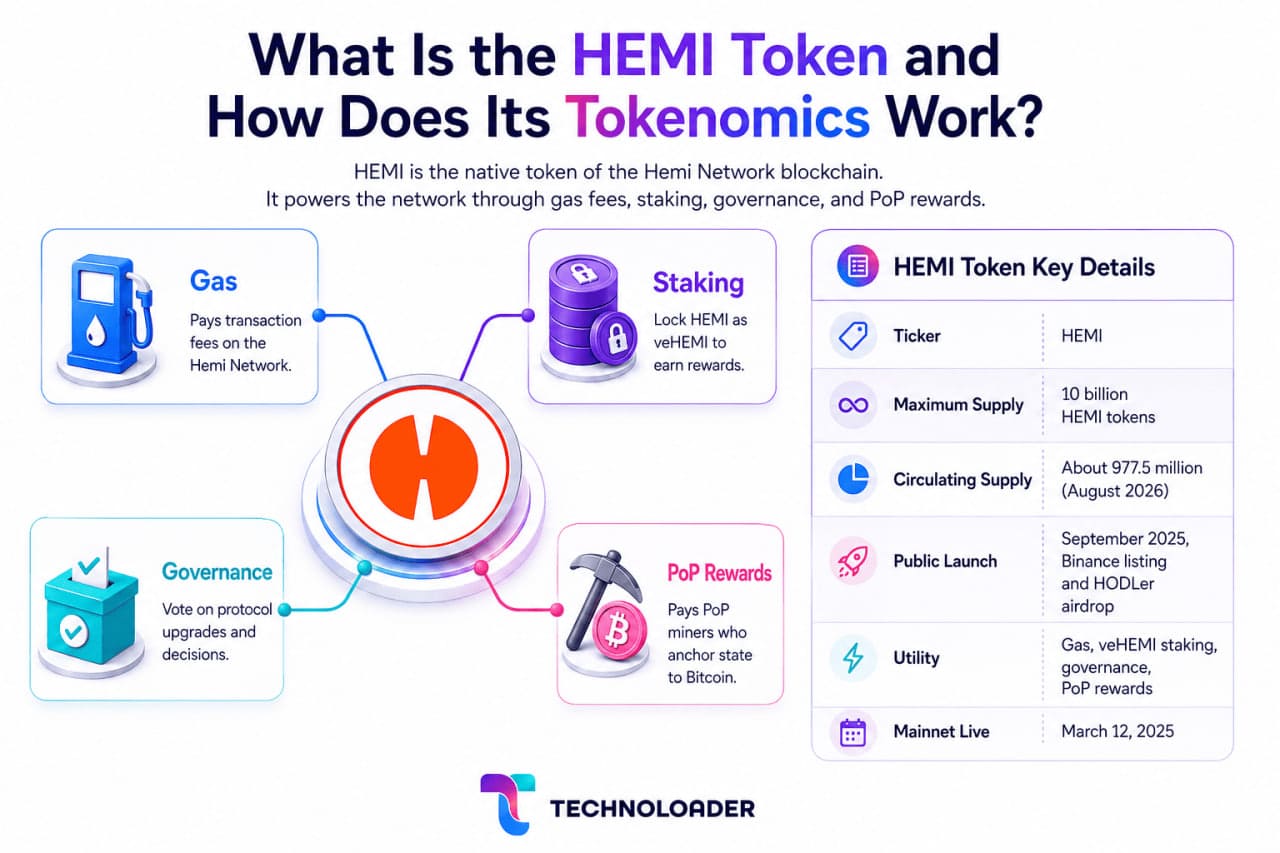
Here are some of the key details of HEMI, as per CoinMarketCap (August 2026).
| Metric | Detail |
|---|---|
| Ticker | HEMI |
| Maximum Supply | 10 billion HEMI tokens |
| Circulating Supply | About 977.5 million (August 2026) |
| Public Launch | September 2025, Binance listing and HODLer airdrop |
| Utility | Gas, veHEMI staking, governance, PoP rewards |
| Mainnet Live | March 12, 2025 |
Staking works through a model called veHEMI. You lock your HEMI in a crypto wallet for a set term. Terms run from a few weeks to a few years. The longer you commit, the more reward weight and voting power you get.
Those rewards come from network activity, so they rise and fall with it and are never guaranteed. Locking is also what earns you a say in governance decisions on the chain.
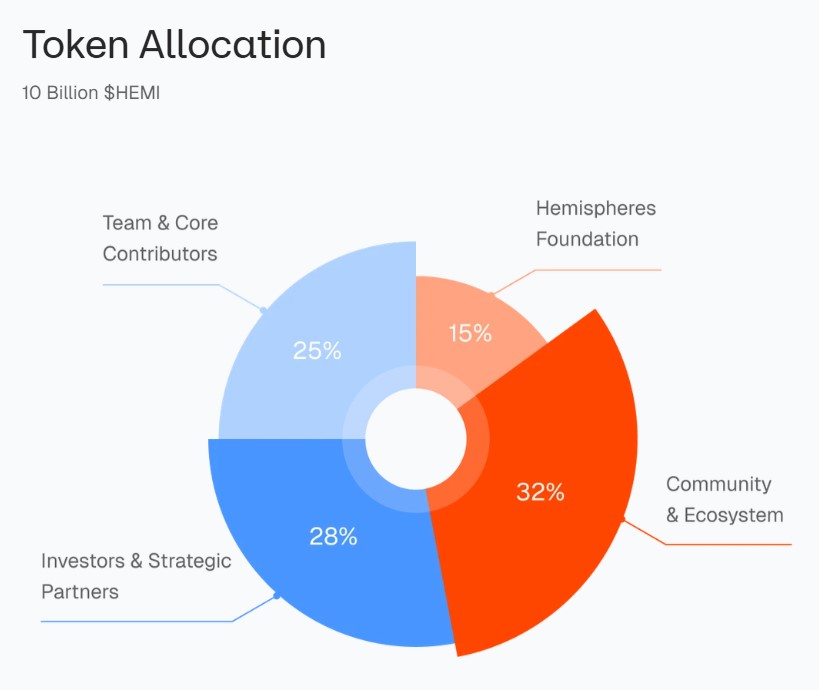
The reported allocation favors the community, at roughly 32%, with investors, the team, and a foundation taking most of the rest:
Only a slice of the 10 billion total circulates today, and fresh tokens keep unlocking on a schedule. This Messari chart highlights the vesting schedule clearly:
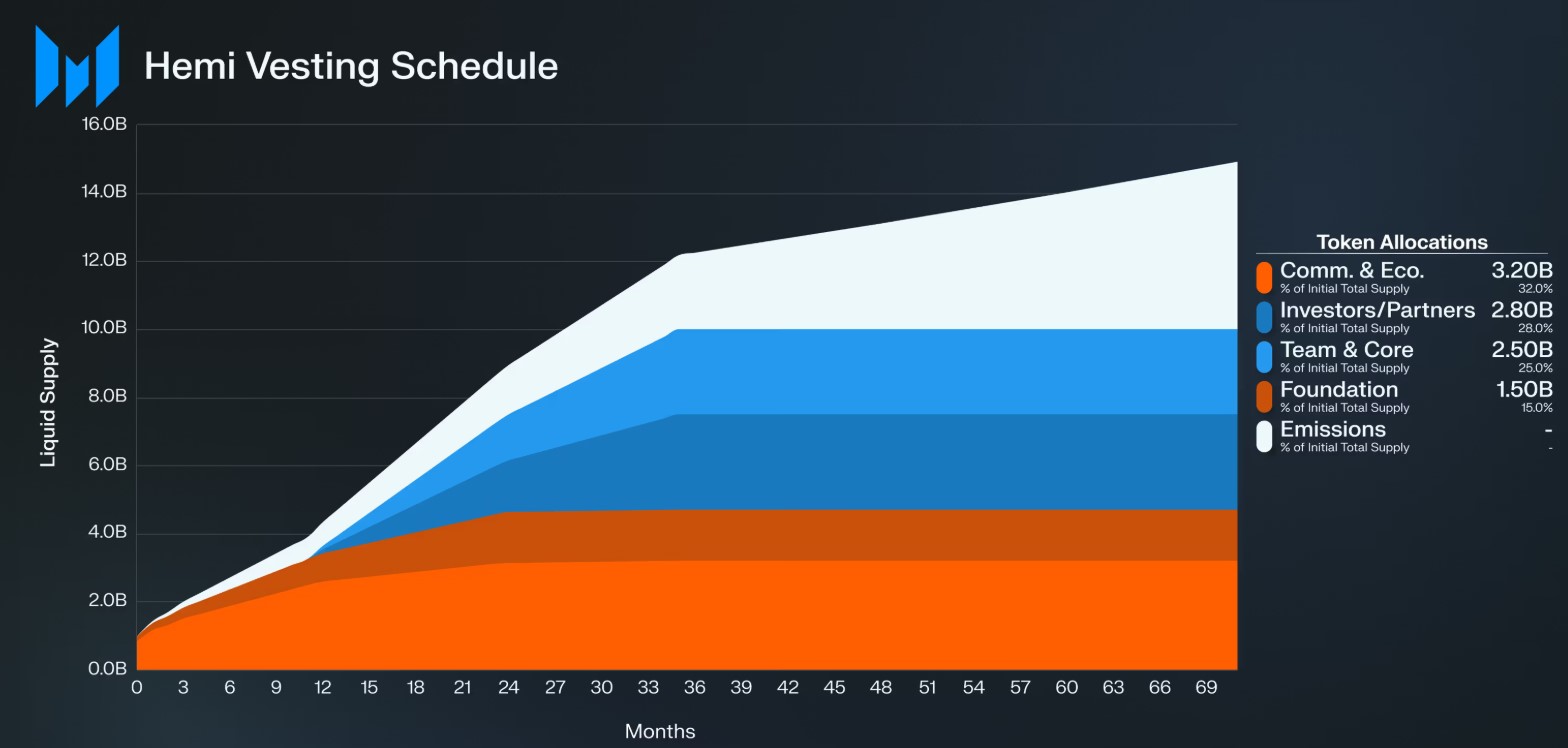
Each unlock adds supply, which can weigh on the HEMI coin price even when nothing else changes. This supply effect sits at the center of its token economics.
What Is the HEMI Token Used For?
HEMI pays gas on the Hemi Network blockchain. You can stake it as veHEMI for rewards and votes, and it rewards the PoP miners that anchor the chain to Bitcoin.
Also Read
What Is HEMI Priced at Today?
According to CoinMarketCap data, the HEMI price is about $0.0064 as of August 16, 2026, far below its 2025 high. Here’s where the token stands at the moment:
| Metric | Figure |
|---|---|
| HEMI Price | ~ $0.0064 |
| Market Cap | ~ $6.24 million |
| All-Time High | $0.1926 on September 24, 2025 |
| All-Time Low | $0.0041 on July 1, 2026 |
The token opened high, then fell through 2026. It’s down roughly 97% from that September 2025 peak:
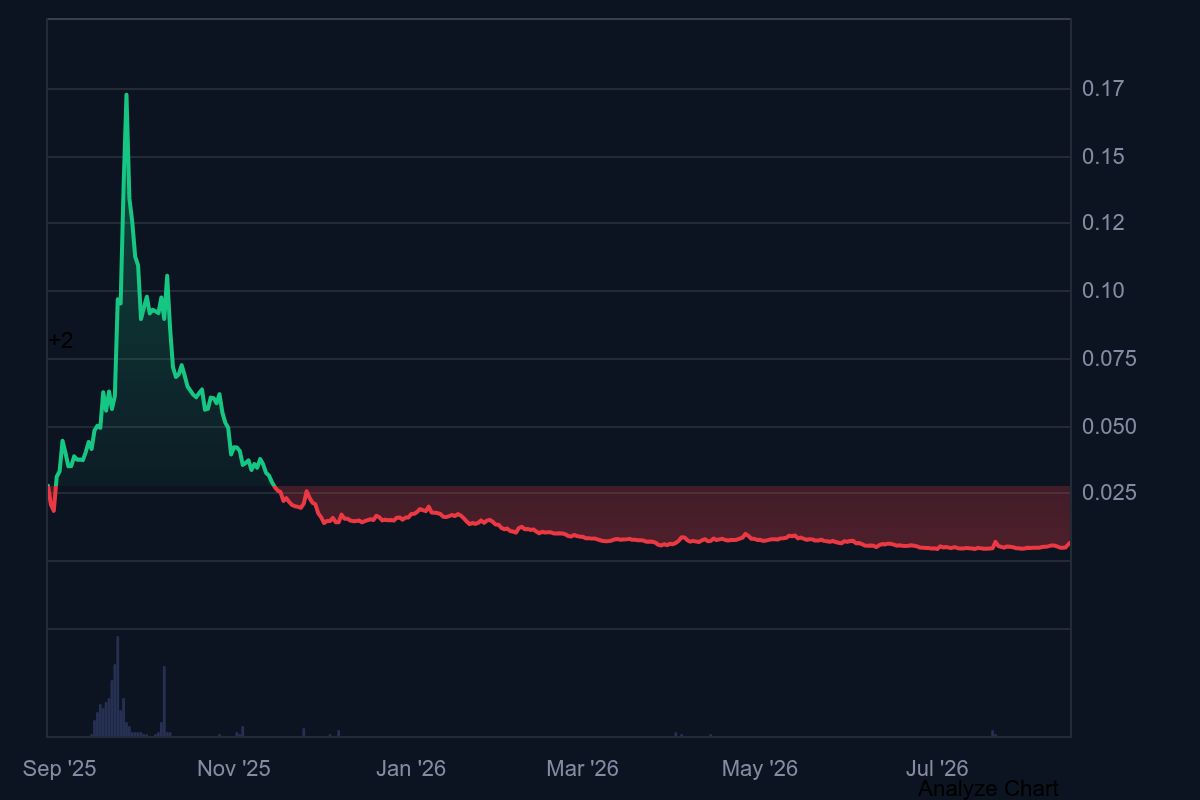
Two things drove that drop. First, steady token unlocks kept adding supply, while the wider market stayed flat. Also, thin trading volume made each swing sharper, which is common for new tokens.
You’ll also find plenty of HEMI price prediction pages out there. Most run on automated models, and they miss more than they’re accurate.
A forecast won’t tell you how the Hemi Network blockchain performs day to day. Your time is better spent weighing its tech, its adoption, and its risks.
To get the current HEMI price, check a live source like CoinGecko or CoinMarketCap yourself. Where you hold and trade HEMI also matters, so it helps to know the difference between crypto wallets and exchanges.
What Is the Current Price of HEMI?
The HEMI price is about $0.0064 as of August 16, 2026, well under its 2025 high. Price moves every minute, so confirm it on a live data site before you act.
Also Read
What Are the Real-World Use Cases of Hemi?
The Hemi Network blockchain brings DeFi and everyday apps to Bitcoin, without weakening its security. Most Bitcoin just holds value in wallets, doing little else. Hemi puts it to work while keeping the safety holders expect.
Here are some of Hemi’s top use cases.
Bitcoin-Native DeFi
Apps can lend, borrow, and trade against live Bitcoin balances, not wrapped copies. A loan contract can confirm the correct Bitcoin deposit before it moves anything. This is where Bitcoin yield comes in, though any yield varies and carries risk.
Cross-Chain Apps
Builders can pull Bitcoin and Ethereum assets into a single app. Tunnels handle the movement between the two chains. That opens up smart contract use cases that need settlement on Bitcoin.
A New Bitcoin App Layer
Over time, Hemi wants a full set of Bitcoin-aware Web3 apps. Dozens of protocols run on it today, backed by 70+ ecosystem partners. Some of these apps use Hemi’s own Bitcoin asset, which people search for as “Hemi Bitcoin.”
The common thread across these use cases is “putting Bitcoin to use.” For builders, the Hemi Network blockchain converts dormant Bitcoin into working capital. Earlier Bitcoin L2s already cover lending, trading, and yield, a lineup that keeps expanding across the blockchain ecosystem.
What Can You Build on the Hemi Network Blockchain?
Mostly Bitcoin-connected DeFi and cross-chain apps that read live Bitcoin state. You can also build tools that move assets between Bitcoin, Ethereum, and Hemi.
What Are the Risks and Challenges of the Hemi Network Blockchain?
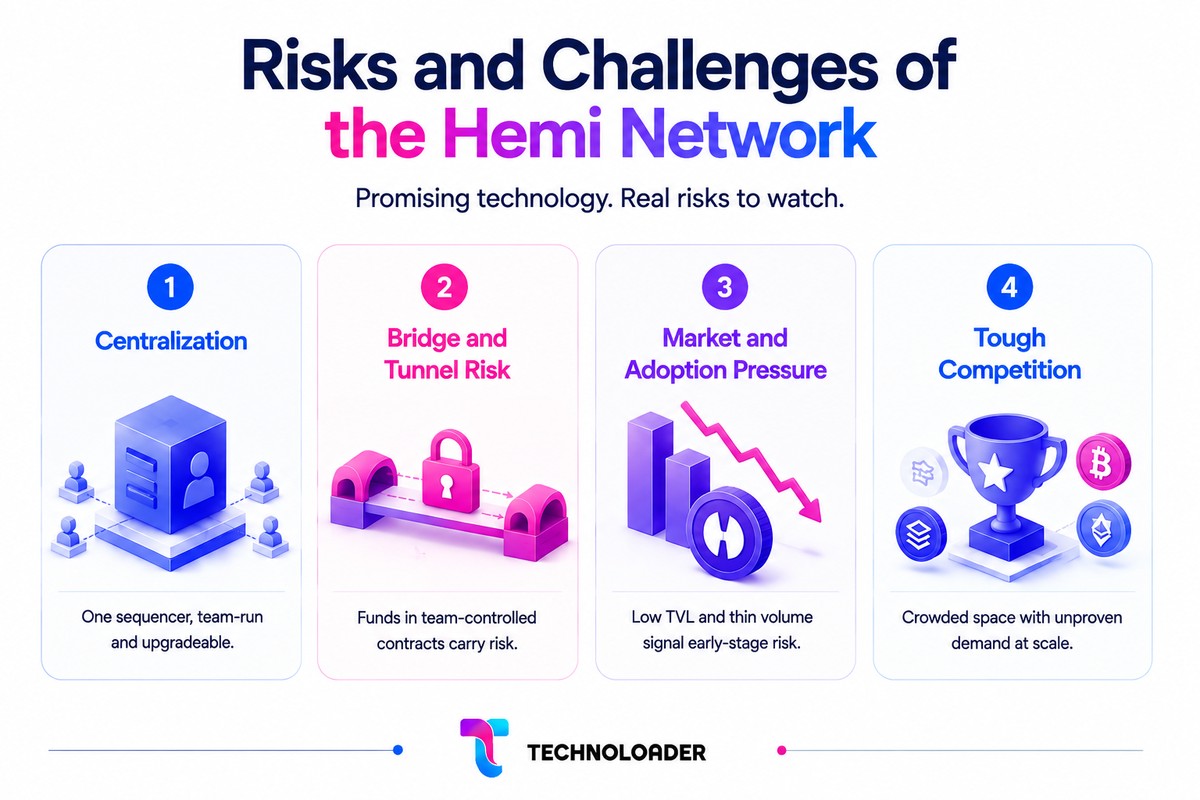
The Hemi Network blockchain has strong tech, but it’s early, still centralized, and thin on liquidity. That doesn’t cancel the promise, but the risks deserve as much attention as the selling points. Here are a few:
Centralization
One sequencer orders every transaction today, and the Hemi team runs it. Its core contracts can be upgraded quickly, with no user exit window. For that reason, L2BEAT’s Hemi review rates it below Stage 0. For now, you’re trusting the team more than the code.
Bridge and Tunnel Risk
Cross-chain transfers are among the most attacked targets in crypto. Hemi Tunnels aim to tackle that risk, but the funds are still held in contracts the team can interact with. Good blockchain app security helps, though it never removes the risk entirely.
Market and Adoption Pressure
Hemi’s total value locked (TVL) has fallen to about $2.8 million as of August 2026, according to DeFiLlama. This is down from roughly $329.5 million in June 2025:
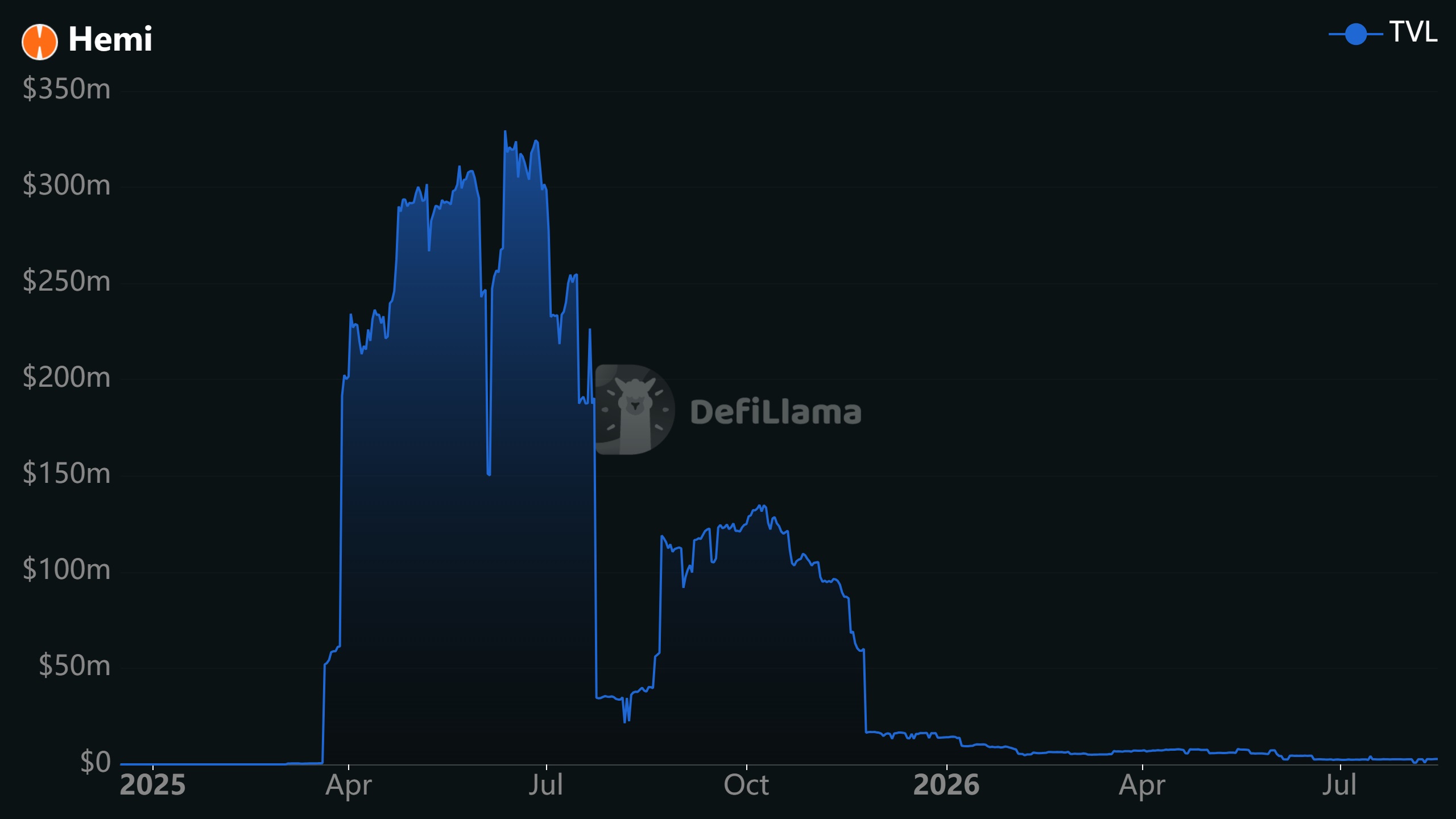
Hemi’s daily volume is also thin, which can cause the price to swing even on modest trades. These are typical markers of an early, high-risk asset.
Tough Competition
Bitcoin programmability is a crowded field, and rival Layer 2s keep launching. Demand for Bitcoin apps is still unproven at scale. Hemi has a genuine edge in the market, but that doesn’t guarantee a win. Its plan to decentralize the sequencer also has to hold up.
Is the Hemi Network Blockchain Safe to Use?
Hemi’s Bitcoin anchoring is strong, but the network is early and centralized. Treat it as a high-risk, experimental system, not an established system.
Also Read
FAQ
1. What Is the Hemi Network Blockchain in Simple Terms?
The Hemi Network blockchain is a modular Bitcoin Layer 2 that adds Ethereum-style smart contracts to Bitcoin. It runs apps quickly and inexpensively, then records their state onto Bitcoin. The aim is Bitcoin’s security with Ethereum’s flexibility in one system.
2. Is Hemi Network a Bitcoin Layer 2?
Yes, Hemi is a Bitcoin Layer 2, though it also connects to Ethereum. It settles security on Bitcoin through Proof-of-Proof, and it posts data for availability. Its own team calls it a modular Layer 2 and a supernetwork.
3. Who Founded the Hemi Network Blockchain?
Hemi comes from Hemi Labs. Its co-founders are Jeff Garzik, an early Bitcoin core developer, and Maxwell Sanchez. Sanchez invented the Proof-of-Proof method that anchors Hemi to Bitcoin. Matthew Roszak also co-founded the project.
4. What Is the HEMI Token Used For?
The HEMI token pays gas fees on the network. You can stake it as veHEMI to earn rewards and vote on governance. It also rewards the PoP miners that anchor Hemi to Bitcoin.
5. Where Can You Buy the HEMI Token?
The HEMI token (or Hemi coin) was listed on Binance in September 2025. It trades on several crypto exchanges and features on data aggregators like CoinMarketCap. Watch volume and liquidity first, since thin markets tend to be volatile.
6. How Is Hemi Different from Other Bitcoin Layer 2s?
Most Bitcoin Layer 2s read Bitcoin through outside bridges or oracles. Hemi runs a full Bitcoin node inside its virtual machine. So its apps read Bitcoin data at the source, which is its main technical edge.
7. Is “Hemi” the Same as the Hemi Engine?
No. The Hemi engine is a car engine from another industry. The Hemi Network blockchain is a separate crypto project. They only share a name, so don’t confuse the two when you search.
8. Is the Hemi Network Blockchain Safe to Use?
Hemi’s Bitcoin anchoring is strong, but the network is still early. It uses a central sequencer, and its contracts can be upgraded quickly. Treat it as experimental, and never risk more than you can afford to lose.
9. Is the Hemi Network Blockchain EVM-Compatible?
Yes. The Hemi Network blockchain runs an Ethereum-style machine called the hVM. So Solidity code, wallets, and common Ethereum tools work with little change. A team can port an existing Ethereum app onto Hemi without starting over.
10. Can You Earn Bitcoin Yield on the Hemi Network Blockchain?
Yes, you can earn Bitcoin yield through Bitcoin-native DeFi apps on Hemi. These apps let you lend or stake against live Bitcoin, not a wrapped copy. Yields vary and carry risk, so it’s not guaranteed.
Also Read
Is the Hemi Network Blockchain Worth Watching?
The Hemi Network blockchain is worth watching, as long as you weigh its risks as seriously as its promise.
It’s a modular Bitcoin Layer 2 that brings Ethereum-style apps to Bitcoin, then anchors its records to Bitcoin for security. Still, the network is early, and its risks matter as much as its promise.
If you’re weighing a Bitcoin or Web3 build, keep that balance in view. Study the design, test the trust assumptions, and size any position with care.
Planning a Bitcoin or Web3 project of your own? Our team can help you build it the right way. Talk it through with us on our blockchain development company page.

Vipin Kumar
Vipin Kumar is the Founder & CEO of Technoloader, a Clutch Top 10 Blockchain Development Company for 2025. A serial technology entrepreneur and blockchain architect with a B.Tech background, Vipin has led the delivery of 450+ projects across DeFi, NFT marketplaces, AI/ML, and custom Web3 platforms for clients in the UAE, India, the US, and beyond. He also founded SALIQ (saliq.ai), an AI-driven conversational marketing platform.
Published in News and Updates


