 +91 7014607737
 info@technoloader.com





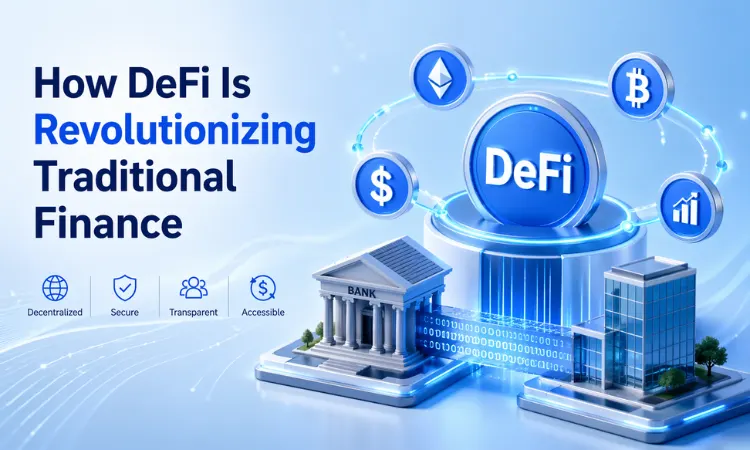
Table of Contents
Key Takeaways:
- Decentralized Finance (DeFi) is a blockchain-based financial system that works without requiring any banks or traditional intermediaries.
- With DeFi, people can manage their own money directly through crypto wallets without having to rely on centralized institutions.
- Financial activities like lending, borrowing, and trading happen peer-to-peer using smart contracts, cutting costs and delays.
- Anyone with an internet connection can use DeFi services without involving paperwork, approvals, or credit checks.
- Blockchain networks handle DeFi transactions, which makes payments and transfers much faster than regular banking.
- By removing intermediaries, DeFi significantly reduces transaction fees compared to banks and payment processors.
- All DeFi transactions are recorded on public blockchains, which lets users check what has happened and build trust.
- Smart contracts automatically execute financial actions, reducing human errors and improving efficiency.
- DeFi and traditional finance are evolving, making the financial system more open, efficient, and welcoming to everyone.
Over the years, the traditional financial system has continued to influence people in terms of making payments, saving habits, and access to loans. In all this, banks, financial institutions, and middlemen have played a very big role in managing all these services effectively.
This system has supported global economic growth, but it has also caused problems like high fees, slow transactions, limited access, and a lack of trustworthiness. Therefore, due to strict rules and regulations and centralized control, many people around the world still struggle to use basic financial services.
This is where decentralized finance is having a bigger effect. Built on blockchain technology, DeFi removes the need for banks and middlemen by using smart contracts to automate financial activities.
It gives users full control over their money and lets them lend, borrow, trade, and earn money directly through digital platforms. Open to anyone with an internet connection, DeFi is making financial systems more inclusive, open, and efficient.
In this guide, we’ll learn everything related to DeFi. How DeFi is revolutionizing traditional finance and reshaping the future of money.
What Is Traditional Finance (TradFi)?
Traditional Finance (TradFi) refers to the conventional, long-established financial system that manages the majority of the world’s money, payments, loans, and investments. This financial system includes regulated businesses, including commercial banks, investment banks, insurance companies, and stock exchanges that act as centralized middlemen under close government custody.
In TradFi, banks and financial institutions act as middlemen. They decide how money is recorded, transferred, and approved. For example, when you send money, apply for a loan, or invest, a bank or third party verifies and processes everything.
In traditional finance, most of the transactions are done in a central location and require permission. This means that getting approval can take a long time, cost you more, and access may be limited, especially for those who don’t have the proper papers, credit history, or bank accounts.
Slow transactions, high fees, lack of transparency, restricted access, and dependence on centralized authorities are some of the big problems of the traditional financial system. These are some challenges that DeFi aims to improve. So, you know what TradFi is. Now let’s talk about what DeFi is.
What Is Decentralized Finance (DeFi)?
Built on blockchain technology, decentralized finance (DeFi) is a modern financial system that doesn’t need banks or intermediaries. Instead of centralized control, DeFi platforms work on decentralized networks where users can interact directly with financial applications.
At the core of DeFi are smart contracts. They are self-executing programs that do things automatically when certain predefined conditions are met. These smart contracts handle things like lending, borrowing, trading, and interest payments without any help from people, making the process smoother and more reliable.
Using crypto wallets, DeFi offers users full control over their funds. This means there is no need for any paperwork, credit checks, or approvals from banks. In addition to this, all the DeFi transactions are recorded on public blockchains, which makes them safe and transparent.
This open system is better than traditional finance because it lowers the risk of manipulation and builds trust through verifiable data. DeFi’s total value locked (TVL) has crossed $100 billion at its peak, showing how quickly people are moving toward decentralized financial systems.
Limitations of Traditional Finance
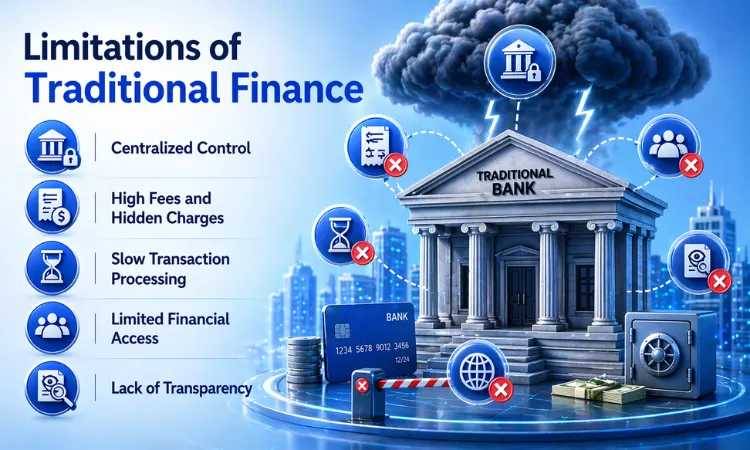
For decades, traditional finance has been the backbone of the world economy. But it also has a lot of problems that affect people all over the world. This includes:
Centralized Control
In traditional finance, banks and institutions control users’ accounts and transactions. They can even delay payments, freeze the funds, or limit access, leaving users with minimal control over their own money.
High Fees and Hidden Charges
Banks apply many hidden charges in terms of account maintenance, transfers, loans, and international payments. This increases the cost of using financial services.
Slow Transaction Processing
Banks usually take hours or even days to process a transaction, especially if it’s an international payment. The main reason for the delay is that the transaction has to go through a lot of middlemen and be verified several times, which slows down the whole process and makes it less efficient.
Limited Financial Access
Traditional finance excludes many people who lack proper identification, credit history, or access to nearby banking services. This prevents them from accessing basic financial services.
Lack of Transparency
Users are not aware of how banks handle their money. This limited visibility forces people to rely on trust rather than clear and verifiable information.
How DeFi Is Transforming the Financial System
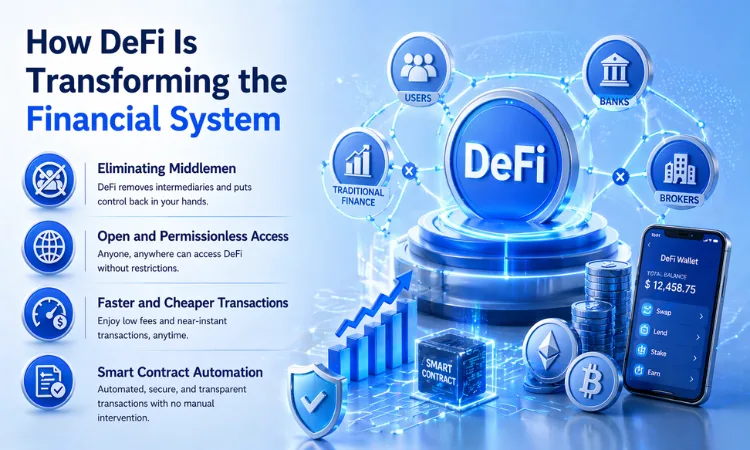
Traditional finance works in the same manner – banks control all the funds, processes are slow, and access is limited. But DeFi has completely changed this system by making financial services faster, more transparent, and under the control of users.
Eliminating Middlemen
Traditional finance needs third parties to handle transactions, which can make them take longer and cost more. But DeFi removes all these layers by letting people use smart contracts to trade directly with each other.
This allows users to manage their finances directly without depending on external entities. As a result, transactions become faster, affordable, and efficient, while users retain full access to their assets.
Open and Permissionless Access
Conventional financial services involve various requirements and processes that can even limit access for people around the world. But, DeFi manages this by letting anyone with basic online access and a crypto wallet participate, without relying on traditional systems or formal procedures.
As there is no permission required, DeFi is an ideal option for those who lack access to traditional financial services. It gives them the opportunity to use financial tools that were previously out of reach.
Faster and Cheaper Transactions
Traditional financial transfers, especially across borders, can take days and often come with high fees. Therefore, DeFi transactions are executed on decentralized systems, which typically complete within a period of minutes or even seconds.
In addition, DeFi has very low transaction fees, which makes it a good option for sending money around the world and for doing everyday financial tasks, especially in places where banks are slow or quite expensive.
Smart Contract Automation
Smart contracts are self-executing programs that automatically carry out financial actions when conditions are met. In DeFi, they replace manual processes used by banks, such as loan approvals, interest calculations, and settlements.
This automation cuts down on mistakes made by people, speeds up work, and gets rid of bias. Users know the rules ahead of time, and transactions happen exactly as planned, which makes financial services more reliable and efficient.
Major DeFi Use Cases Replacing Traditional Finance
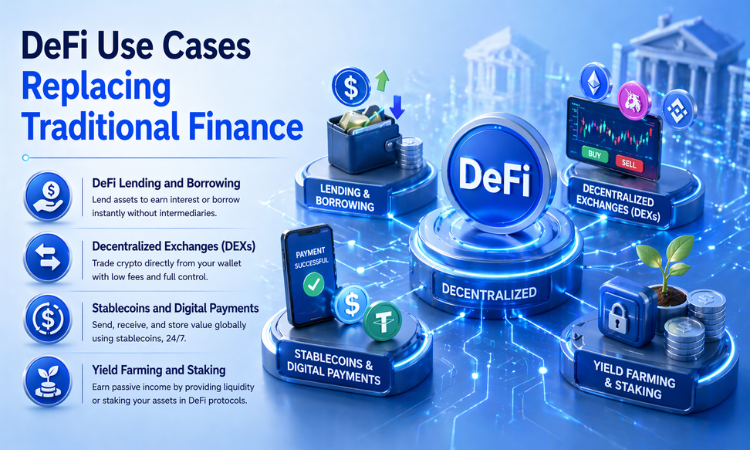
Now that you know how DeFi is changing traditional finance, let’s look at some of the best DeFi use cases. It is more than just an idea; it’s actually taking the place of many services that banks and other financial institutions offer.
DeFi Lending and Borrowing
In traditional finance, banks control lending and borrowing, set interest rates, and require lengthy approval processes. DeFi changes this by enabling people to lend or borrow funds directly through smart contracts.
Lenders earn interest by providing liquidity, while borrowers can access loans instantly by providing crypto as collateral. There are no bans, no paperwork, and no credit checks, making the complete process faster, transparent, and globally accessible.
Platforms like Aave and Compound are popular examples where anyone can lend or borrow crypto instantly without a bank.
Decentralized Exchanges (DEXs)
Traditional exchanges act as a mediator that holds users’ funds and control trades. Decentralized exchanges remove this middle layer by empowering peer-to-peer trading from users’ wallets.
Users always have full control over their assets. Using smart contracts, trades are executed automatically, which helps in reducing the chances of unfair practices, hacks, or withdrawal restrictions that are commonly seen on centralized trading platforms.
Uniswap is one of the biggest decentralized exchanges where users can trade crypto directly from their wallets.
Stablecoins and Digital Payments
Traditional payments depend on banks, payment gateways, and clearing systems, which can be slow and costly. Stablecoins offer a DeFi-based alternative that gives you digital currencies that are linked to real-world currencies like the dollar.
They enable fast global transfers with minimal fees and no extra layers involved. This makes stablecoins very useful for sending money, making payments online, and keeping value safe from market swings.
Yield Farming and Staking
In traditional banking, savings accounts offer very low interest rates. DeFi introduces yield farming and staking as ways to earn passive income. Users lock their crypto assets into DeFi protocols to support network operations or provide liquidity.
In exchange, they get rewards or interest, which is often higher than what you get on a bank savings account. This model gives users more control over their idle assets and more chances to make money with them.
DeFi vs Traditional Finance: A Quick Comparison
Both Traditional Finance (TradFi) and Decentralized Finance (DeFi) provide financial services, but they do so in very different ways.
Control
Banks and other financial organizations have full authority over user accounts, transactions, and money in traditional finance. They set the rules for approval, limits on transactions, and the hours of operation.
But in DeFi, users are in charge. People can take care of their own money with crypto wallets and smart contracts, without having to depend on a central authority. This user-first approach gives people more control over their money and freedom.
Accessibility
Traditional finance requires official documents, bank accounts, and sometimes a credit history, which can make it challenging for people worldwide.
Therefore, DeFi removes all these problems and lets people use financial services as long as they have an internet connection and a digital wallet. There is no need for approvals or paperwork, which makes DeFi better for people who don’t have bank accounts.
Speed and Cost
Due to manual processing and multiple intermediaries, bank transactions usually take longer, especially for cross-border transfers.
DeFi uses decentralized technology to process transactions quickly and cheaply. This makes it a good choice for handling financial activities around the world.
Trust Model
Traditional finance widely depends on trusting banks, governments, and financial institutions to act responsibly.
DeFi replaces this trust with smart contracts and open-source code. Transactions are carried out automatically based on predefined conditions, lowering dependency on human judgment and centralized control while increasing reliability and fairness.
Why DeFi Is a Better Choice
By removing traditional barriers created by banks and financial institutions, decentralized finance offers new ways to manage money. The benefits mentioned below explain how DeFi is more beneficial than traditional finance.
Financial Freedom and Control
With DeFi, users have full control over their money because they can use their own crypto wallets. Unlike banks, no one can freeze your account or limit transactions. Users are in charge of their own money and can talk to financial services directly without needing anyone else to approve.
Global Accessibility
Traditional finance often excludes people due to strict documentation and banking requirements. Meanwhile, anyone with a digital wallet can use DeFi. This makes financial services accessible to everyone, even if they don’t have bank accounts. This is a step toward true financial inclusion that doesn’t depend on where you live.
Lower Costs and Better Returns
With lower returns on savings, traditional systems also charge high fees for loans, transfers, and account maintenance. In contrast, DeFi makes transactions affordable and allows users to earn higher returns through lending, staking, and yield farming.
Transparency and Trust
DeFi runs on public blockchains, on which people can see how their money is moving, how smart contracts are working, and other movements of their funds. This openness removes fraud and hidden practices, and builds trust in open systems rather than relying on institutions without question.
Faster and Automated Services
Traditional banking processes are commonly slow and manual. But in DeFi, all the things like lending, borrowing, and trading are automated by smart contracts. This automation speeds up processes, reduces mistakes made by humans, and ensures that services keep running without delays or operational downtime.
Challenges and Risks of DeFi
DeFi offers many benefits, but it is not risk-free. Since this technology is still new, everyone has to be aware of the problems that they face. These include:
Security Risks and Hacks
DeFi platforms are powered by smart contracts. If their code contains bugs or security holes, then it can lead to loss of money. Unlike banks, there is no customer service or insurance to get back lost money. This creates a big security issue.
Smart Contract Vulnerabilities
Smart contracts do their tasks on their own, and once they’re deployed, it’s hard to change them. So, somehow, if errors are written badly or tested poorly, it can lead to money loss.
Regulatory Uncertainty
There aren’t any clear rules for DeFi. Governments are still deciding how to regulate decentralized platforms. Sudden legal changes, bans, or restrictions can impact DeFi projects and users, creating uncertainty about long-term stability and compliance.
Market Volatility
Cryptocurrencies used in DeFi change value very quickly, which can lead to losses, liquidations, or returns that aren’t stable. This makes DeFi risky for people who are new to the market and don’t know how it works.
User Responsibility and Complexity
Users are responsible for their wallets, private keys, and transactions in DeFi. You can’t get your money back if you lose your private keys or send them to the wrong address. For beginners, the technical complexity can also be hard to understand and risky.
How Traditional Finance Is Adapting to DeFi
Earlier, traditional banks and financial institutions spotted DeFi as a threat. But today, many of them are learning from it. To stay relevant in a financial world, traditional finance is now adopting DeFi solutions.
Banks Exploring Blockchain Technology
A lot of banks are testing out blockchain to make things safe, clear, and more efficient. To ensure faster settlements, cross-border payments, and keep records, they are using private or permissioned blockchains. This helps banks in cutting down the costs while still getting the benefits of decentralization without giving up full control.
Adoption of Smart Contracts
Traditional banks and other financial institutions are using smart contracts to automate tasks like settling trades, making loan agreements, and filing insurance claims. Automation cuts down on paperwork, human errors, and transaction times. This method doesn’t completely decentralize banks, but it does help them make their services faster and more reliable.
Rise of Hybrid Finance (CeFi + DeFi)
Hybrid finance models combine traditional finance with some aspects of DeFi. Banks and fintech companies offer regulated platforms that use DeFi protocols behind the scenes. This lets people use blockchain’s benefits, like faster transactions and more openness, while still getting help, following the law, and protection from the law.
Growing Institutional Interest
Big companies, hedge funds, and asset managers are putting money into DeFi projects. They see DeFi as an opportunity for innovation, new revenue streams, and global reach. This institutional involvement is also helping bring credibility, liquidity, and more mature practices to the DeFi ecosystem.
Focus on Regulation and Compliance
Traditional finance is working closely with regulators to make sure that DeFi can be added to existing systems. Having clear rules related to safety, identity, and protecting consumers lowers risks. The goal of this regulatory involvement is to make DeFi more stable and reliable for regular users in the future.
Conclusion
DeFi is not just a new idea anymore; with time it is evolving and changing the way the world’s financial system works. By eliminating third-party dependency and using blockchain, DeFi offers faster transactions, more openness, and wider access to financial services.
It empowers users with full control over their assets and opens the door to financial services for individuals who were previously excluded from traditional banking. However, traditional finance is not going away. Banks and financial institutions are continuously adapting blockchain solutions and experimenting with smart contracts.
This change shows that the future of finance is evolving, instead of completely replacing it. At Technoloader, we follow how DeFi and TradFi are evolving together and work with businesses to build DeFi solutions that are practical and built for real growth.
Let’s get in touch and work together to make the future of decentralized finance.
Frequently Asked Questions
How is DeFi different from traditional finance?
DeFi is different from traditional finance by replacing centralized intermediaries like banks with automated smart contracts on public blockchains. It offers permissionless, 24/7 global access, high transparency, and user custody of assets; on the other hand, TradFi relies on regulated centralized institutions with limited hours and higher barriers to entry.
Can DeFi replace traditional banks?
DeFi is unlikely to replace traditional banks because both of these systems work differently. While DeFi offers efficient, decentralized alternatives to traditional banking services, traditional institutions are increasingly adopting blockchain technology and smart contracts to enhance speed, transparency, and efficiency. In future, there will probably be hybrid models that will use both of these systems.
Is DeFi safe to use?
DeFi can be safe, but it comes with risks. A DeFi platform with smart contract bugs, hacks, and price volatility can lead to losses. As a beginner, it’s advisable to research the platform carefully, start with tiny amounts, and most importantly, understand how wallets and security work.
What financial services does DeFi offer?
Using DeFi, users can lend and borrow money, trade cryptocurrencies, make stablecoin payments, stake coins, and earn interest. These services are the same as banks, but they don’t need middlemen and give users complete control, along with better returns.
Who can use DeFi platforms?
DeFi platforms can be used by anyone with an internet connection. For using these platforms, you don’t require a bank account, paperwork, or credit checks, making DeFi accessible to people globally.

Kanak Badaya
Kanak Badaya is a Technical Content Writer at Technoloader with over 3 years of experience translating complex technology into content that actually makes sense. He works closely with emerging domains like Blockchain, Web3, AI, and DeFi, turning intricate technical concepts into clear, structured, and engaging narratives that help businesses communicate with confidence. Rather than just writing for search engines, Kanak focuses on writing for people. He combines in-depth research with a practical understanding of the industry to create blogs, website content, and technical guides that inform, educate, and build credibility. His goal is simple - make advanced technology feel approachable while helping Technoloader strengthen its authority in the digital space.
Published in DeFI Development


