+91 7014607737
 info@technoloader.com





Table of Contents
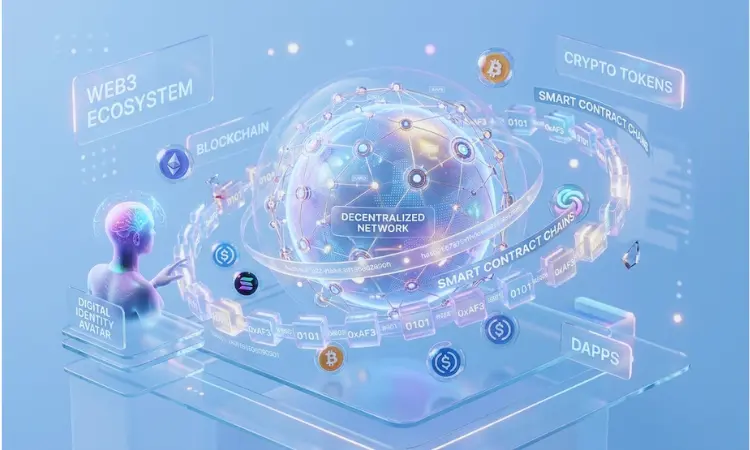
To build Web3 applications, you need to connect a web frontend to a crypto wallet. Your core logic then moves on-chain into smart contracts. Those contracts run on a public blockchain like Ethereum or Solana.
That shift, from a private server to a public network, changes how you design and ship.
The market behind that shift is growing fast. Estimates for 2026 range from $4.97 billion to $12.61 billion, according to Mordor Intelligence and Research and Markets.
This guide walks through Web3 application development end-to-end. We’ll cover everything from architecture and stack to chain choice, cost, and the mistakes that sink projects.
Key Takeaway
- A Web3 app runs its core logic on-chain in smart contracts, not on a private server
- The core parts are a frontend, a wallet connection, smart contracts, a blockchain, and decentralized storage
- The chain you choose depends on the use case, since cost, speed, and security vary across Ethereum, its Layer 2s, and Solana
- Building a Web3 application is repeatable, moving from scope and setup through code, testing, audit, deployment, and monitoring
- Security comes first, since audits and tested patterns protect user funds, and skipping them is the costliest mistake
What Is a Web3 Application?
A Web3 application is an app whose core logic runs on a blockchain, within smart contracts, rather than on a company’s private server. Users sign in with a crypto wallet and keep control of their data.
People often call these apps dApps, short for decentralized applications, because no single company holds the database or the accounts.
Web3 itself is the broader concept of a decentralized internet. A Web3 app is where that idea meets real users, reading and writing to a public ledger anyone can verify.
How Do Web3 Apps Differ From Web2 Apps?
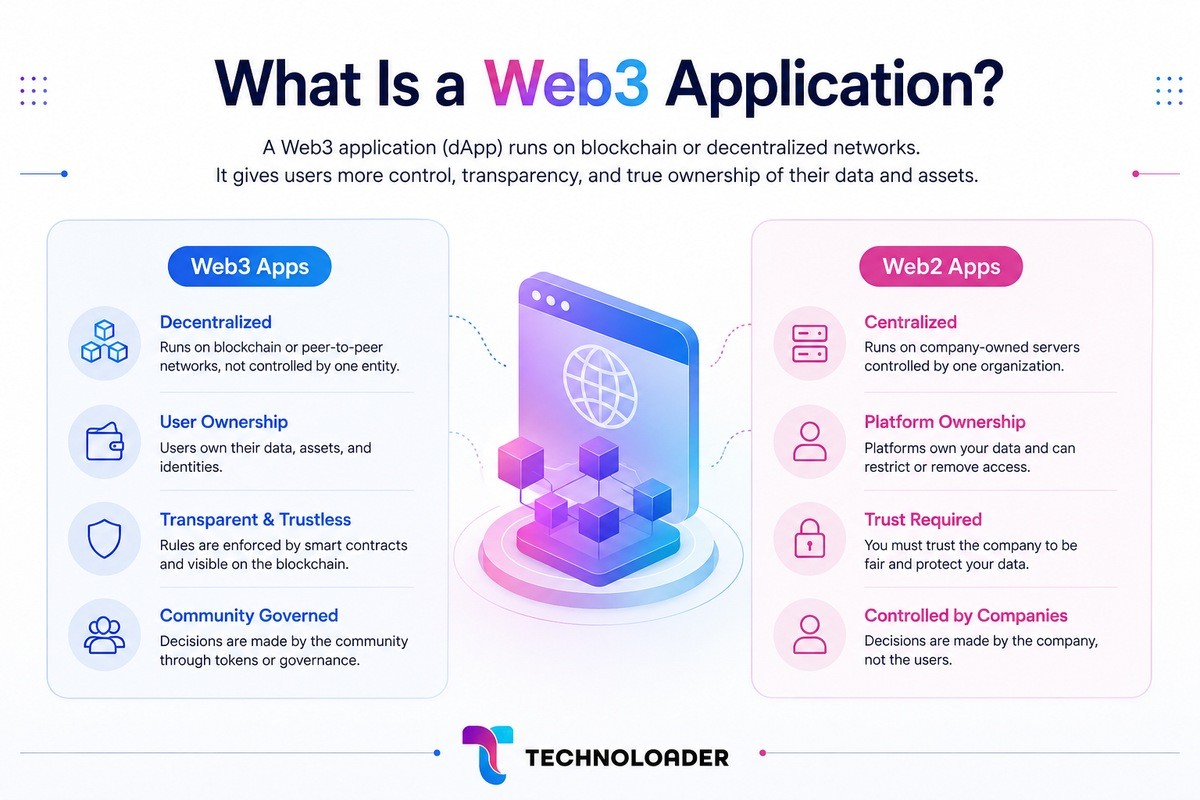
The main difference between Web2 and Web3 is storage. A Web2 app stores your data on servers owned by the company. A Web3 app stores state on a shared, public chain. That single difference affects accounts, payments, and trust.
The table below breaks down the practical differences and why building Web3 applications looks new:
| Dimension | Web2 App | Web3 App |
|---|---|---|
| Data Control | The company owns the data | Users own their data and assets |
| Backend Logic | Private servers and databases | Smart contracts on a blockchain |
| Accounts | Email and password | A crypto wallet |
| Payments | Card and bank rails | Tokens and stablecoins |
| Trust Model | Trust the provider | Trust open, verifiable code |
Blockchain web development doesn’t throw away your Web2 skills. You still use React or Next.js for the frontend, then add a wallet, a contract, and a chain. This is where Web2 and Web3 really diverge.
Here’s a quick illustration of how these two differ.
What Are the Core Traits of a Web3 App?
A real Web3 app shows three traits:
- Decentralization (to spread control across many nodes, not one server)
- Ownership (which sits with users, whose assets live in their own wallet)
- Transparency (since the contract code and transactions stay public)
These traits bring trade-offs, which I’ll cover later. When you build Web3 applications, you build on infrastructure that no single party controls.
Teams already build Web3 applications at scale. Decentralized apps drew around 18.7 million daily active wallets in the third quarter of 2025, per DappRadar.
What Is a Web3 Application?
It’s an app whose core logic runs on-chain in smart contracts. Users log in with a wallet, own their data, and use a public ledger rather than a private server.
Also Read
How Do Web3 Applications Work?
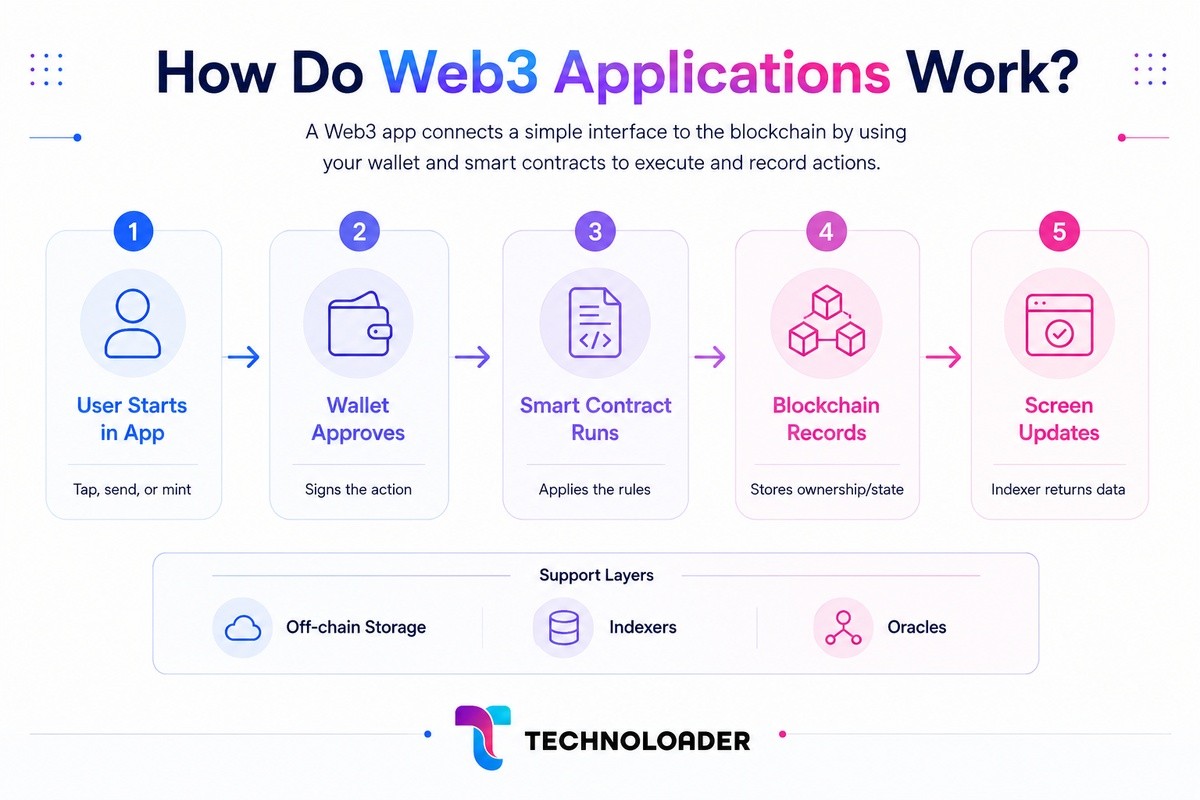
To build a Web3 application, you connect a standard frontend to a blockchain through a wallet. In sequence, a user acts in the app, the wallet signs it, a contract runs, and the chain records it. An indexer then feeds the result back to the screen.
Here’s how Web3 apps work.
Frontend and Wallet Connection
The frontend is standard web or mobile code. Most teams use React, Next.js, or a mobile framework, with a library connecting that UI to the chain.
The wallet handles login and signing. So, tools like MetaMask or WalletConnect let users approve actions. Nothing happens on-chain until the user signs.
Smart Contracts and On-Chain Logic
A smart contract is a program stored on the blockchain that runs when its conditions are met. It replaces much of the Web2 backend, handling ownership and transactions.
Contracts cost gas — the fee paid in the chain’s token for computing. So, efficient code keeps that fee low for users.
The Blockchain Network
The blockchain records balances, ownership, and contract results. Every blockchain node keeps a copy, which makes the record hard to tamper with.
You’ll pick a Layer 1 base chain or a faster Layer 2 on top, and the trade-offs between Layer 1 and Layer 2 come down to security, cost, and speed.
Decentralized Storage, Indexing, and Oracles
Storing large files on-chain is slow and costly. So teams store files off-chain and keep a verifiable pointer on-chain. Tools like IPFS, Arweave, and Filecoin handle this.
An indexer like The Graph makes on-chain data fast to query, and an oracle like Chainlink feeds outside data, such as prices, into a contract.
How Does a Web3 App Work?
A user acts in the frontend, and the wallet signs the action. A smart contract executes the logic and records the result on the blockchain. Off-chain storage holds large files, while an indexer returns data to the screen.
Also Read
What Tech Stack Do You Need to Build a Web3 App?
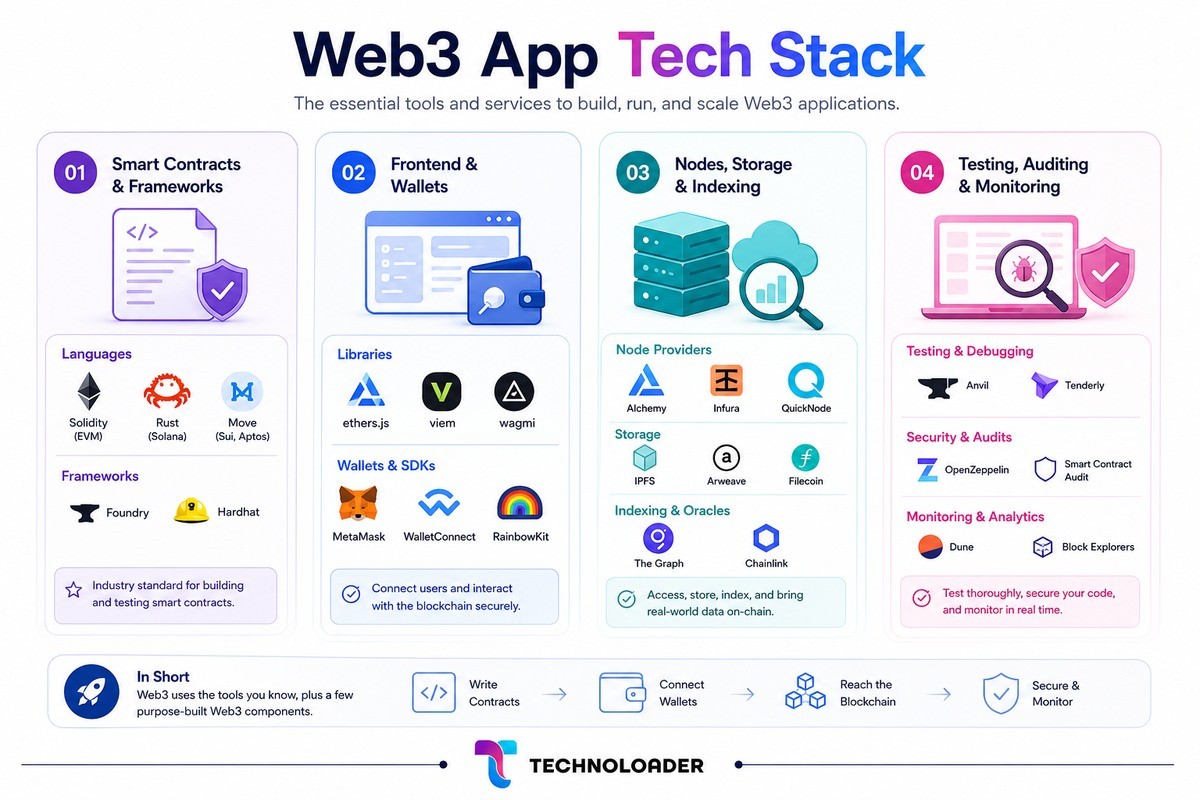
A Web3 stack is mostly a familiar Web2 stack, with a few Web3 development tools layered on for the on-chain side. You add a smart contract language, a wallet library, and a way to reach the chain, while the rest of your frontend works much as before.
At Technoloader, our stack centers on Solidity and Rust for contracts and is built and tested with Foundry and Hardhat. It reflects the tooling most teams rely on to build Web3 applications today.
Here’s a quick summary of the tech stack you’ll need to build Web3 applications.
Smart Contract Languages and Frameworks
Choosing a blockchain also means choosing its language. Solidity is the default for Ethereum and EVM networks. Rust is the preferred option for Solana, and Move is used for Sui and Aptos.
For building and testing, most teams use Foundry or Hardhat. ConsenSys discontinued the older Truffle and Ganache toolkits in 2023 and redirected developers to Hardhat.
Frontend Libraries and Wallet SDKs
On the frontend, a library like ethers.js, viem, or wagmi is what connects your UI to the chain. These libraries read on-chain data and send transactions, replacing the API calls you would otherwise make in Web2.
For sign-in, MetaMask and WalletConnect are the standards. A software development kit like RainbowKit simplifies the connect button. A clean wallet flow lifts your Web3 user experience.
Node, Storage, and Indexing Services
Your app also needs a way to reach the chain. Top node providers like Alchemy, Infura, and QuickNode give you that access without having to run your own node.
For storage, large files live off-chain on IPFS, Arweave, or Filecoin, keeping only a pointer on-chain. The Graph then indexes that data for fast queries, and a Chainlink oracle pulls in external data, such as prices.
Testing, Auditing, and Monitoring Tools
Testing is one step you can’t afford to skip when you build Web3 applications. Tools like Anvil and Tenderly let developers simulate real-world conditions and debug contracts. This helps prevent costly mistakes.
Security relies on OpenZeppelin’s audited contract templates and a formal audit ahead of launch. And once the app is live, Dune dashboards and block explorers monitor activity.
| Category | Example Tools | What It Does |
|---|---|---|
| Contract Languages | Solidity, Rust, Move | Write the on-chain logic |
| Frameworks | Foundry, Hardhat | Compile, test, and deploy contracts |
| Frontend Libraries | ethers.js, viem, wagmi | Connect the UI to the chain |
| Wallet Connection | MetaMask, WalletConnect, RainbowKit | Let users sign in and approve actions |
| Node and RPC | Alchemy, Infura, QuickNode | Read from and write to the chain |
| Storage | IPFS, Arweave, Filecoin | Hold files off-chain, verified on-chain |
| Indexing and Data | The Graph, Chainlink | Query on-chain data and feed in external data |
| Testing and Audit | Anvil, Tenderly, OpenZeppelin | Simulate, debug, and secure contracts |
What Tech Stack Do You Need to Build a Web3 App?
You need a contract language like Solidity or Rust. You also need a framework like Foundry or Hardhat, plus a library like ethers.js or wagmi. Add a node provider, decentralized storage, and an indexer to round out what you need to build a Web3 application end-to-end.
Which Blockchain Should You Build On?
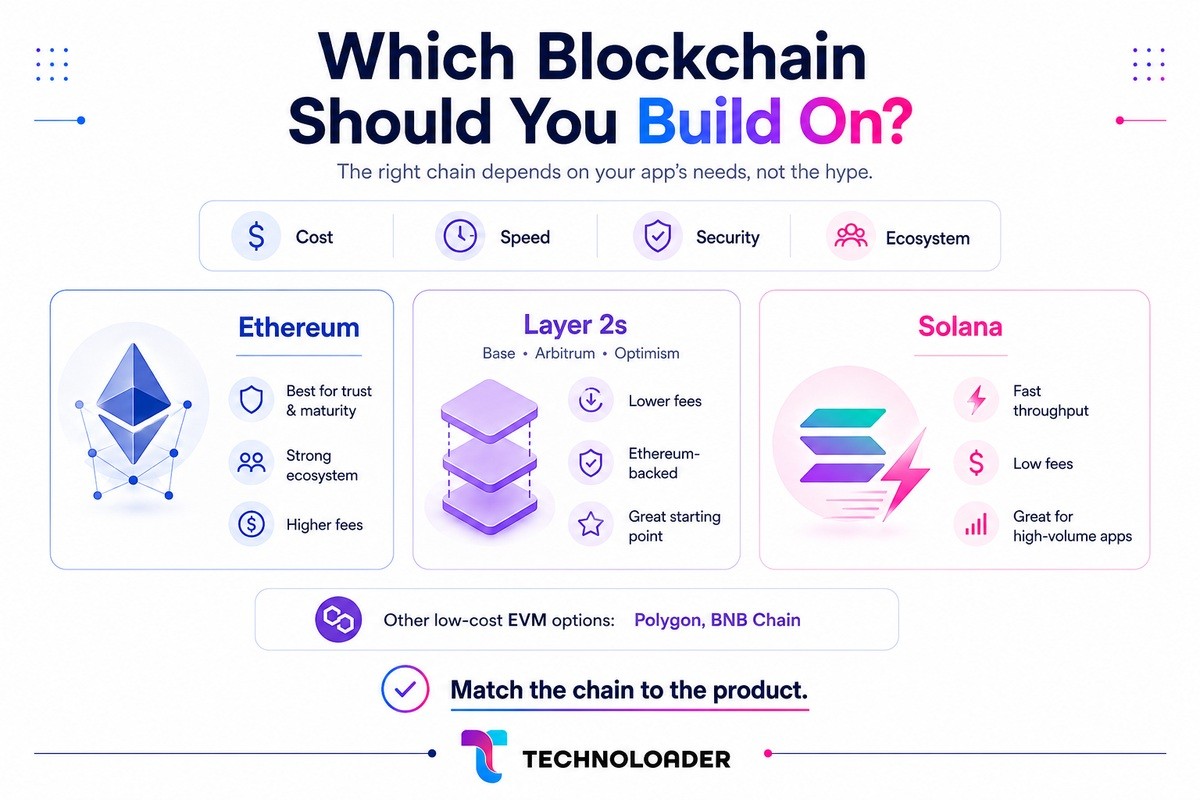
The safest way to choose a blockchain is by use case, not by hype. When you build Web3 applications, the right chain for a game is rarely the right chain for a bank. Weigh cost, speed, security, and ecosystem against what your app does.
Even in a down market, capital keeps consolidating on Ethereum. It held about 54.4% of all value locked in DeFi as of mid-2026.
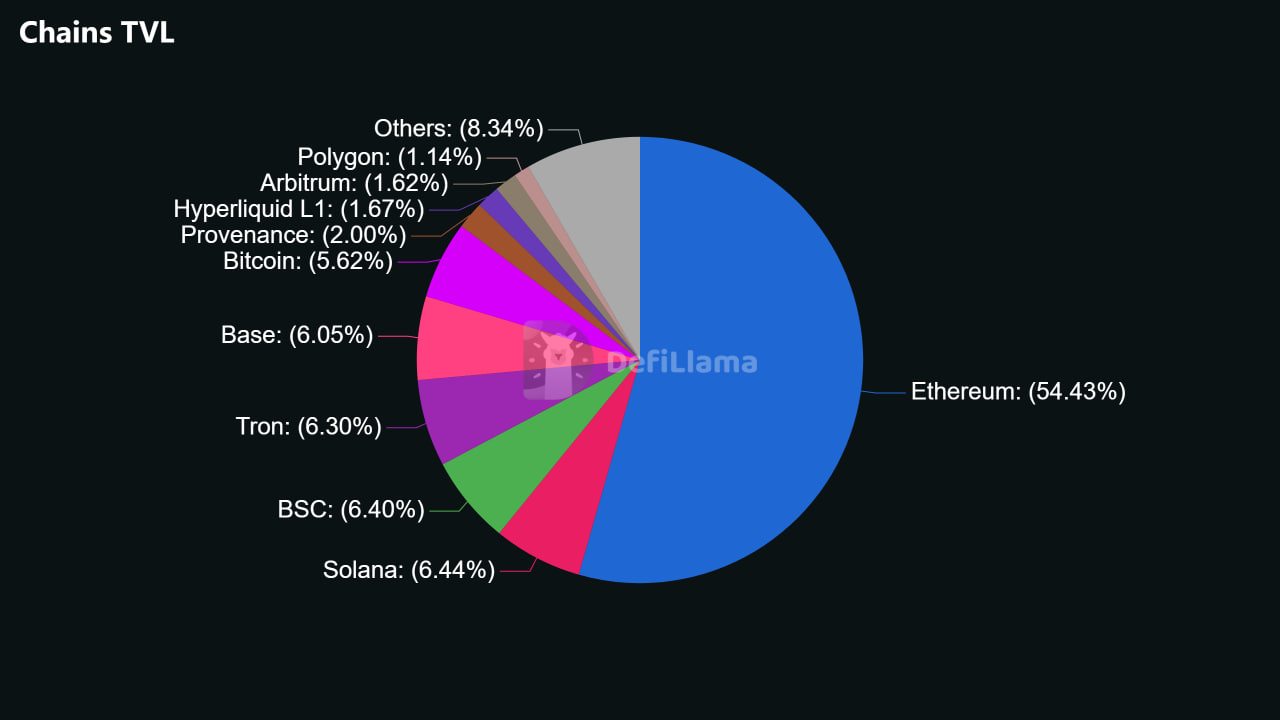
Liquidity is getting more concentrated, not less. That’s the practical case for starting on Ethereum or one of its Layer 2s rather than chasing a newer chain. But high-frequency consumer apps still lean toward Solana.
Our own projects run mostly on Ethereum, Solana, Polygon, and BNB Chain.
Ethereum and Layer 2 Networks
Ethereum is the most secure and widely used smart contract chain, running on Proof of Stake (PoS) since its 2022 upgrade. Its main trade-off is cost, as fees climb sharply when the network gets busy.
Layer 2 networks like Base, Arbitrum, and Optimism solve most of that cost. They process transactions off the main chain and settle back to it, keeping Ethereum’s security at far lower fees.
Solana and Other High-Throughput Chains
Solana takes the opposite approach to Ethereum by optimizing for speed and very low fees. It runs Proof of Stake alongside Proof of History (PoH), which orders transactions before consensus.
In real-world conditions, it sustains about 1,000 to 4,000 transactions per second. While that’s far below its 65,000 ceiling, it’s well ahead of most chains.
There’s also an honest caveat around finality. A transaction confirms in under a second, yet full finality still takes about 12 to 13 seconds. Polygon, by contrast, suits low-cost EVM apps.
A Simple Way to Decide
When you build Web3 applications, a short rule helps narrow the field. Match the chain to what your app values most:
| Platform | Type | Consensus | Fees | Full Finality | Best For |
|---|---|---|---|---|---|
| Ethereum | Layer 1 | Proof of Stake | High at peak | ~13 min | Security, DeFi, high-value settlement |
| Base, Arbitrum, Optimism | Ethereum Layer 2 | Optimistic rollup | Low | Minutes | Low-cost apps with Ethereum security |
| Polygon (POL) | EVM chain | Proof of Stake | Very low | Seconds | EVM apps, fast time to market |
| Solana | Layer 1 | PoS with Proof of History | Sub-cent | ~12 to 13s | High-frequency, consumer apps |
| BNB Chain | Layer 1 | Proof of Staked Authority | Low | Fast | Broad EVM ecosystem, retail reach |
These figures reflect real-world performance, so confirm current fees and speed before you commit.
Which Blockchain Should You Build on?
Choose by use case. Ethereum and its Layer 2s are well-suited to secure, DeFi-heavy apps, while Solana is well-suited to fast, low-cost consumer apps. Polygon and BNB Chain are well-suited to affordable EVM builds.
Also Read
How to Build a Web3 Application in 9 Steps
Building a Web3 app follows nine clear steps, each with a job to do and a reason behind it. It’s the same Web3 development process we follow to build Web3 applications for clients. And it reads like a practical Web3 tutorial you can reuse.
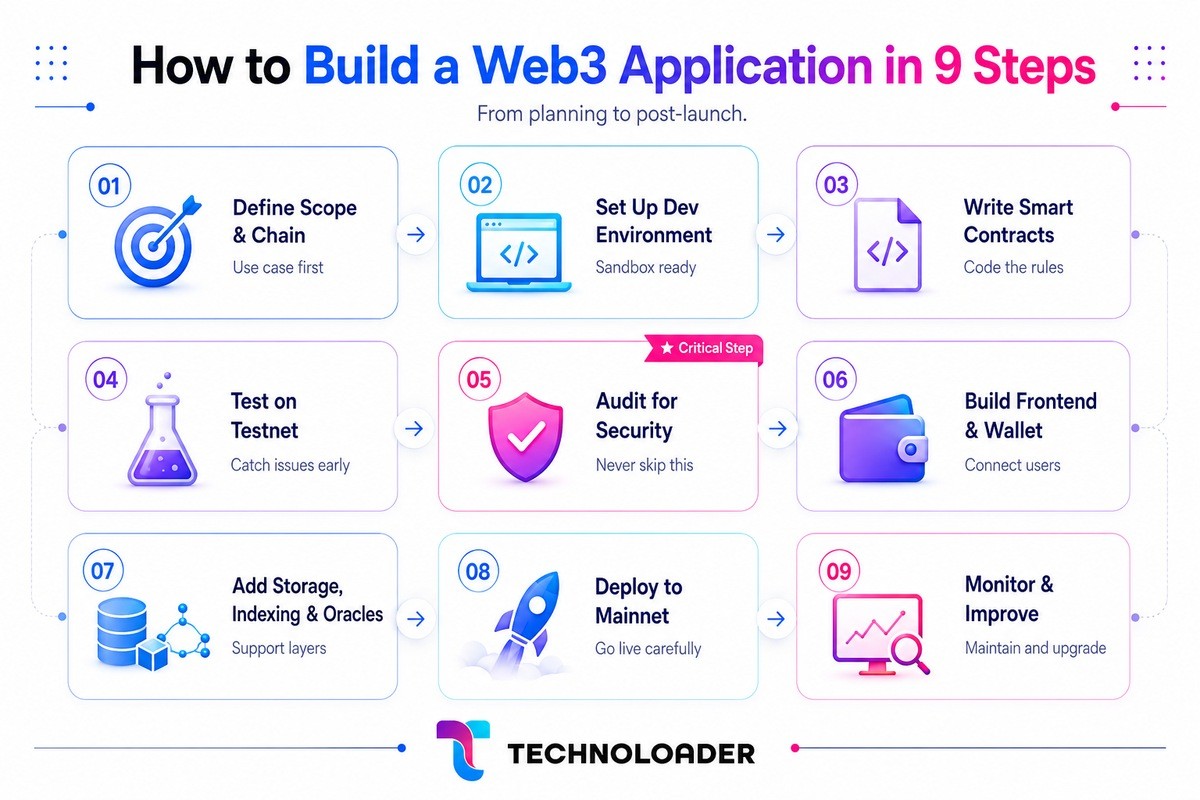 Skip one step, especially the audit, and you usually pay for it later.
-
- Define the Scope and Pick a Chain: Don’t choose a blockchain first. Start with your application, then find the chain that best matches its needs.
- Set Up the Development Environment: Once you have a plan, prepare your workspace. Most developers use Node.js with Foundry or Hardhat. A testnet gives you a safe place to build and test before going live.
- Write the Smart Contracts: Now it’s time to write your smart contracts. Most Ethereum projects use Solidity, while Solana developers use Rust. You can also build on trusted OpenZeppelin contracts and customize them where needed.
- Test on a Testnet: Run your contracts on a test network first and check every function and edge case. Fixing bugs here costs nothing, which is exactly why this step matters.
- Audit the Code for Security: Have the contracts reviewed for flaws before launch, because a formal audit is what protects user funds. This is the one step you never skip.
- Build the Frontend and Connect the Wallet: Build the user interface in React or Next.js, then wire it to the chain with ethers.js or wagmi. Finish with a clean WalletConnect flow so users can approve actions without hassle.
- Add Storage, Indexing, and Oracles: Store large files on IPFS or Arweave, and add The Graph to query on-chain data fast. If the app needs external data, such as prices, connect to an oracle like Chainlink.
- Deploy to Mainnet: Deploy the audited contracts to the live network, then set up your node access and hosting. Double-check every address and setting before you go live.
- Monitor, Maintain, and Improve: Watch activity with dashboards and alerts, fix issues fast, and plan upgrades as you go. A Web3 app needs consistent care after launch and not just at launch.
How Do You Build a Web3 Application Step-by-Step?
Define the scope, pick a chain, and set up your environment. Write, test, and audit the smart contracts, build the frontend, then deploy to mainnet and monitor the live app.
What Are the Biggest Challenges in Building Web3 Apps?
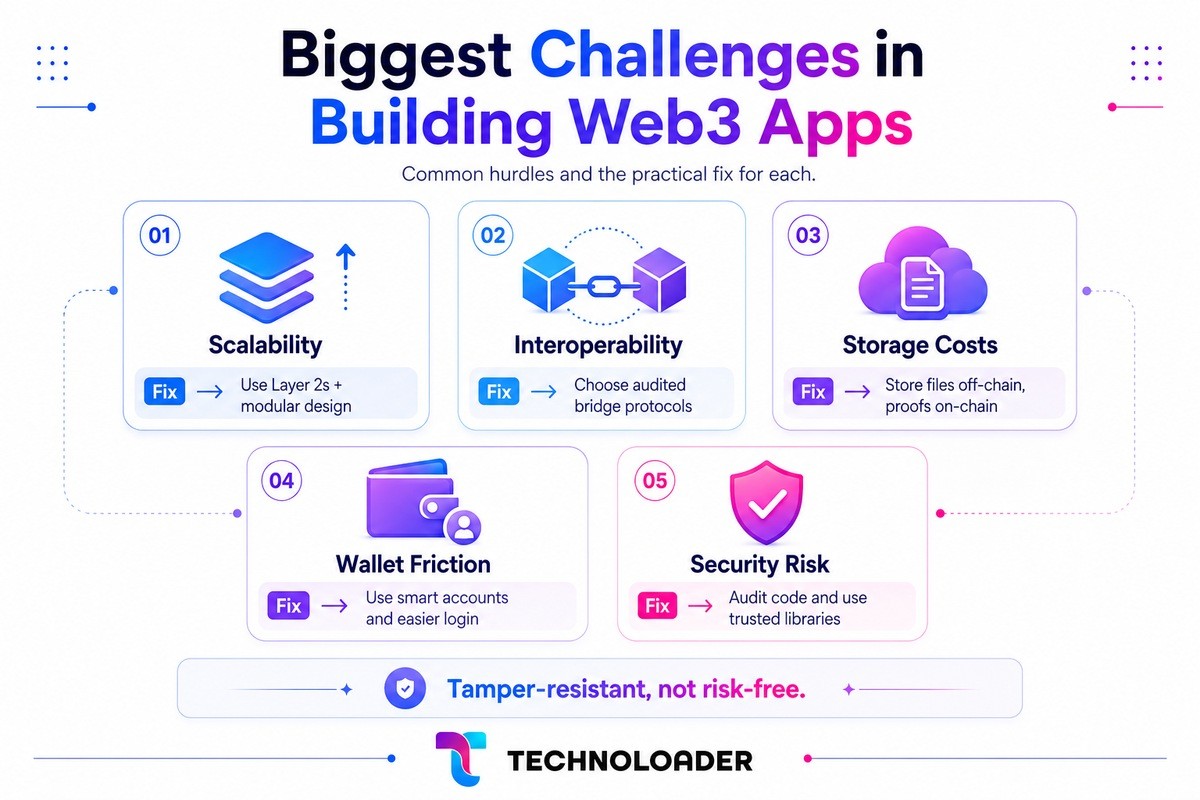
Building Web3 applications on public blockchain platforms brings real hurdles, from scalability to interoperability. Each one has a known fix, though. These are the five I hit most when I build Web3 applications, with the way through each.
Scalability and Network Congestion
A blockchain can only handle so much traffic at one time. When demand grows, users often pay more and wait longer.
Layer 2 networks like Arbitrum and Optimism help take some of that pressure off. Modular platforms like Celestia and Avail also make it easier to support more users as an app grows.
Interoperability Across Chains
Many apps now run across several chains, and moving digital assets between them needs a bridge. That’s a real exposure, since bridges have been a frequent target of major hacks.
Stick to audited interoperability protocols like Axelar or Wormhole, and avoid unaudited or centralized bridges. It also helps to add fallback checks in case a bridge endpoint fails.
Data Storage and On-Chain Costs
Storing files on-chain is slow and costly. But off-chain storage gives up the trust benefit. The practical solution is to adopt a hybrid model. Keep the file itself on IPFS or Arweave, and store only a hash or pointer on-chain that anyone can verify.
User Experience and Wallet Friction
Seed phrases and constant pop-ups scare off new users. That friction is one of the main reasons why Web3 apps lose users.
Account abstraction is the current fix. The ERC-4337 standard, live since 2023, enables smart accounts, social login, and sponsored gas.
A 2025 Ethereum upgrade (Pectra) added EIP-7702, which brings the same features to regular wallets. Tools like Web3Auth and Magic also make adoption easier.
Security and Smart Contract Risk
Smart contract bugs can be expensive. Once the code is on the blockchain, fixing it isn’t always simple. Attackers probe live code for weak spots, and a single flaw can allow them to drain a pool.
That’s why developers use trusted tools like OpenZeppelin to secure the apps. They also ask security experts to review the code before it goes live.
Keep the framing honest: good security makes a system tamper-resistant, not unhackable.
What Are the Biggest Challenges in Building Web3 Apps?
The main ones are limited scalability, cross-chain interoperability, costly on-chain storage, wallet friction, and security risk. Layer 2 rollups, audited bridges, hybrid storage, account abstraction, and formal audits solve them in turn.
Also Read
How Much Does It Cost to Build a Web3 Application?
The cost to build a Web3 application depends on scope, chain, and security needs. A simple app and a DeFi platform sit far apart, so treat any single number with care.
The ranges below are 2026 industry estimates, not fixed quotes. The biggest swing factor is smart contract complexity and audit scope.
Cost by App Type
Simpler projects cost less because they rely on fewer contracts and integrations. Financial apps cost more because security is non-negotiable. The table below gives realistic bands to plan against:
| App Type | Typical Range (USD)* | Main Cost Driver |
|---|---|---|
| MVP dApp | $25,000 to $50,000 | Narrow scope, single-chain contracts |
| Standard dApp | $50,000 to $120,000 | Features and integrations |
| NFT Marketplace | $80,000 to $200,000 | Minting, royalties, trading engine |
| DeFi Platform | $100,000 to $300,000 | Security and financial logic |
| Enterprise dApp | $350,000+ | Compliance, scale, custom chain |
*These bands are July 2026 industry estimates for planning only, not Technoloader quotes.
What Drives the Cost (and How to Reduce It)
A few factors move blockchain app development costs the most. Contract complexity leads the way, since audits scale with it. Chain choice matters too, because Ethereum can run higher than Layer 2s, and multi-chain support adds even more.
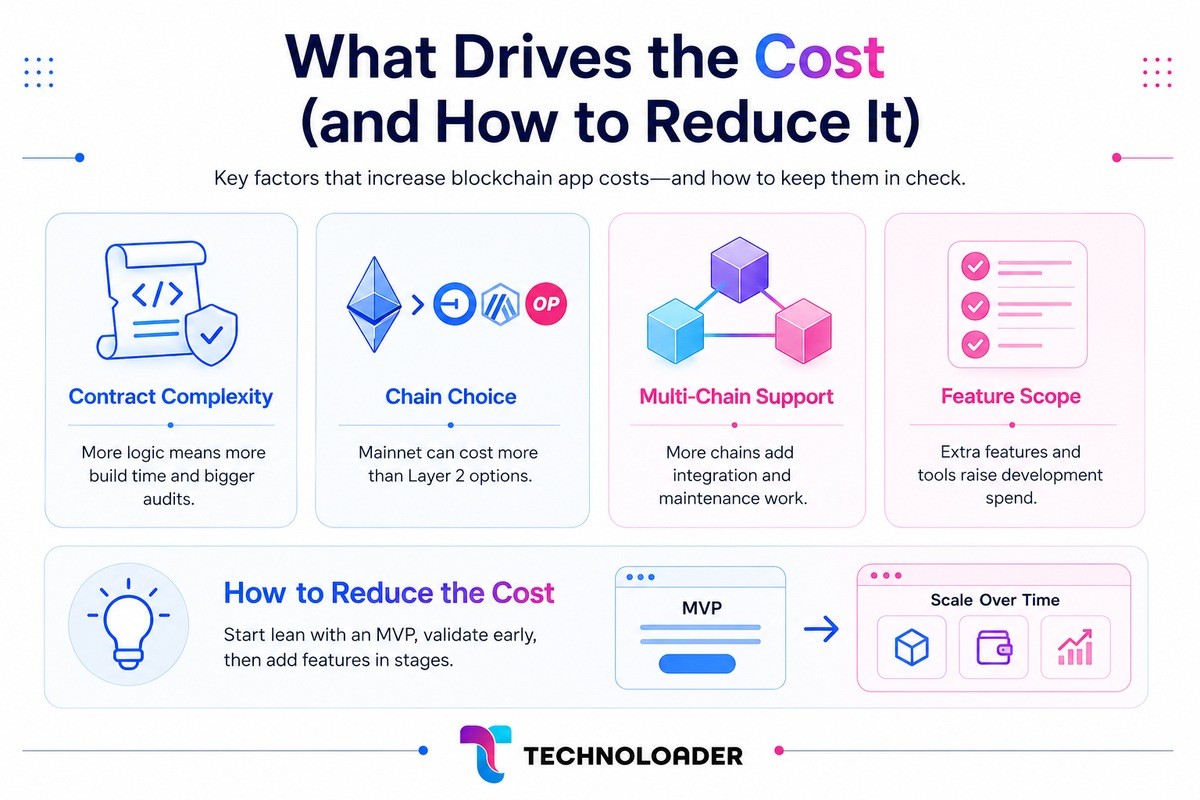
You can still control the costs of building a Web3 application by starting with a lean MVP and adding features later. That cuts early spend and gives you data before investing more.
How Much Does It Cost to Build a Web3 App?
A simple MVP dApp often runs $25,000 to $50,000, while a DeFi platform can reach $300,000 or more. Contract complexity and audit scope drive most of the cost, so an MVP-first plan keeps early spend low.
What Are the Best Practices for Building Web3 Apps?
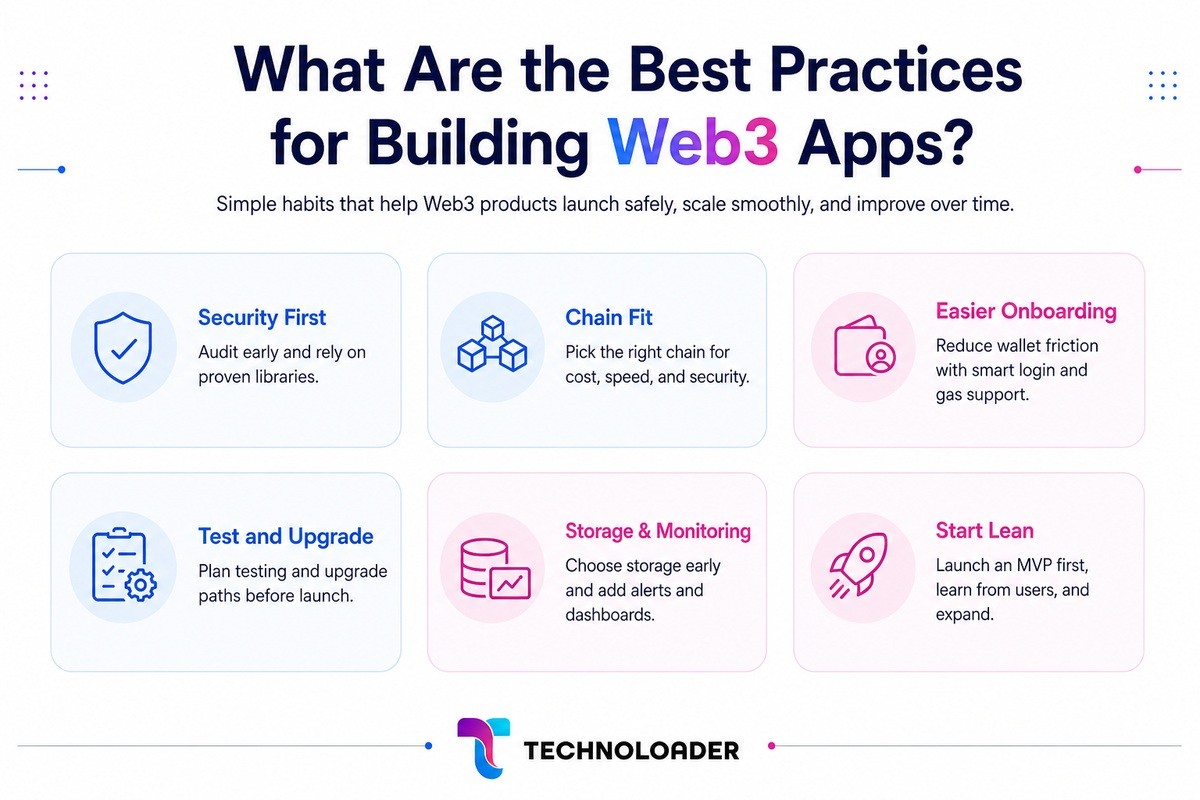
Habits like designing for security and reducing wallet friction determine whether you build Web3 applications that scale or stall. Apply them from the first sprint, not after launch.
- Design for Security from Day One: Treat the audit as a milestone rather than an afterthought. Review every contract with tested libraries.
- Choose the Chain by Use Case Rather than Hype: The best blockchain is the one that fits your product. Look at cost, speed, security, and user needs before you pick the right chain.
- Reduce Wallet Friction with Account Abstraction: Offer social login and sponsored gas where you can.
- Plan for Upgrades and Testing Early: It’s much easier to plan upgrades now than fix problems later. Think ahead before your contracts go live.
- Build Storage and Monitoring Early: Good monitoring helps you catch problems early. Set up storage, dashboards, and alerts before launch instead of after.
- Start with an MVP: Focus on solving one problem well and create a minimum viable product. Add more features once you know they’re needed.
What Are the Best Practices for Building Web3 Applications?
Put security first and audit every contract. Choose the chain for your use case and reduce wallet friction with account abstraction. Plan upgrades, test on a testnet, add monitoring early, and start with an MVP.
When Should You Hire a Web3 Development Company?
You don’t have to build a Web3 application alone. You can build in-house or bring in a Web3 development company. The right call depends on your team and timeline.
Build Web3 applications in-house when you already have blockchain engineers. Hire a partner when you need audited patterns, deep chain expertise, and a faster, safer path to mainnet.
A specialist team has already made the expensive mistakes, so you don’t have to.
At Technoloader, our portfolio covers 450+ Web3 app development projects across DeFi, NFTs, and custom platforms, built over 8+ years.
We build Web3 applications using a milestone-based process with dedicated QA and consistent client communication. This keeps delivery on schedule and ensures accountability.
We’re also a government-certified company and a 2025 Clutch Top 10 blockchain firm, and you work directly with the founder throughout.
Should You Hire a Web3 Development Company?
Build Web3 applications in-house if you have blockchain engineers and time to spare. Hire a company when you want audited code, proven chain expertise, and a faster, safer route to mainnet.
FAQ
What is a Web3 application?
A Web3 application is an app whose core logic runs on a blockchain, inside smart contracts. Users sign in with a crypto wallet and own their data and assets. The app reads and writes to a public ledger instead of a private server.
How do you build a Web3 application?
To build a Web3 application, you scope the app, pick a chain, and set up your environment. Then write and test the smart contracts, audit them, build the frontend, and deploy to mainnet.
How much does it cost to build a Web3 app?
The budget to build Web3 applications can range from about $25,000 for an MVP to $300,000 or more for a complex platform. Starting with the core features helps you control costs without slowing down development.
How long does it take to build a Web3 app?
It depends on complexity and the blockchain technology used. At Technoloader, a simple Web3 app usually takes one to two months and a medium project two to four. Anything large enough to need a full audit cycle runs longer.
Which blockchain is best for building a Web3 app?
There isn’t one best blockchain — different chains come with varying advantages and downsides. Ethereum and its Layer 2s are the safe answer for DeFi and anything holding real value. Solana wins on speed and cost for consumer apps. Polygon and BNB Chain are where teams go for EVM compatibility on a budget and a quick launch.
What language are Web3 apps written in?
Smart contracts use Solidity on Ethereum and EVM chains, Rust on Solana, or Move on Sui and Aptos. The frontend uses standard JavaScript or TypeScript with React or Next.js.
Do you need to know how to code to build Web3 applications?
For anything custom, yes. Someone on the team has to write contract code. No-code and low-code builders will get you a basic mint or a simple token, but the moment your logic stops being standard, you need developers.
What is the difference between a Web3 app and a dApp?
The terms overlap. A dApp is specifically an app whose logic runs on-chain in smart contracts. “Web3 app” is the broader term for any app built on decentralized networks.
Is it safe to build on Web3?
It is, if you follow the right best practices to build Web3 applications. Blockchains are tamper-resistant, but they aren’t unhackable. Audits, tested libraries, and strong key management significantly reduce the risk.
Also Read
Ready to Build Web3 Applications That Scale?
Knowing how to build Web3 applications comes down to connecting a solid frontend to audited smart contracts on the right chain. The path stays repeatable, from scope and build through testing, auditing, deploying, and monitoring.
Security and chain choice, more than anything, decide whether the app lasts. So plan the architecture early, pick your network by use case, and never skip the audit.
If you’d rather build Web3 applications with an experienced team, explore our Web3 development services or contact us for a free consultation.
About the Author
Vipin Kumar is the Founder & CEO of Technoloader, a Clutch Top 10 Blockchain Development Company for 2025. A serial technology entrepreneur and blockchain architect with a B.Tech background, Vipin has led the delivery of 450+ projects across DeFi, NFT marketplaces, AI/ML, and custom Web3 platforms for clients in the UAE, India, the US, and beyond. He also founded SALIQ (saliq.ai), an AI-driven conversational marketing platform.

Vipin Kumar
Vipin Kumar is the Founder & CEO of Technoloader, a Clutch Top 10 Blockchain Development Company for 2025. A serial technology entrepreneur and blockchain architect with a B.Tech background, Vipin has led the delivery of 450+ projects across DeFi, NFT marketplaces, AI/ML, and custom Web3 platforms for clients in the UAE, India, the US, and beyond. He also founded SALIQ (saliq.ai), an AI-driven conversational marketing platform.
Published in Web 3.0