 +91 7014607737
 info@technoloader.com


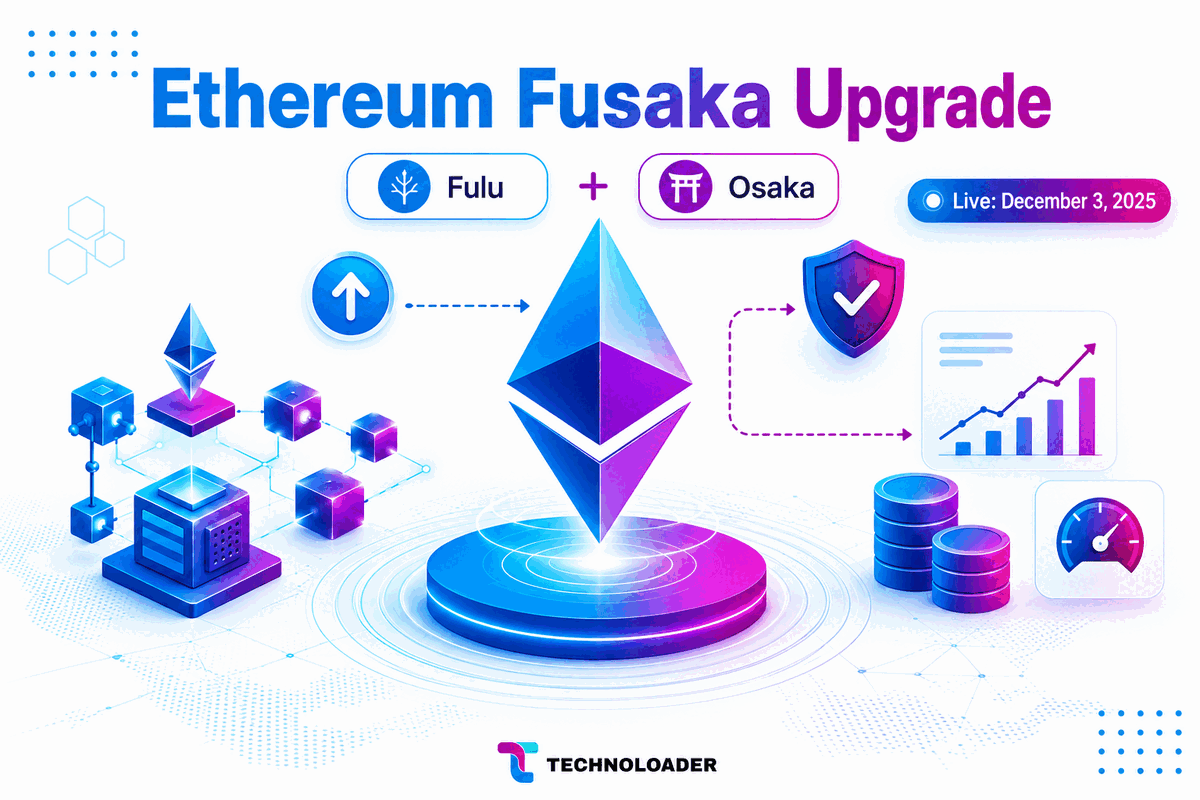
Table of Contents
Quick Summary
- The Ethereum Fusaka upgrade expands blob data capacity for Layer-2 rollups through a new sampling method called PeerDAS. It went live on December 3, 2025.
- Its main feature, PeerDAS, lets nodes sample blob data instead of storing all of it.
- More blob capacity lowers data costs for Layer-2 rollups over time.
- Fusaka doesn’t directly cut Ethereum mainnet gas fees, and it keeps Ethereum’s Proof of Stake security model.
- Most holders and users don’t have to do anything. Wallets, exchanges, and rollups handled the change.
The Ethereum Fusaka upgrade is a network hard fork that went live on December 3, 2025. It expands how much data Ethereum can handle for Layer-2 rollups.
Its centerpiece is Peer Data Availability Sampling (PeerDAS), a smarter way for nodes to check blob data.
The Ethereum Fusaka upgrade doesn’t change how Ethereum runs at its core. It builds on the Dencun and Pectra upgrades before it.
It sounds technical, and parts of it are. The core idea is simple, though: more room for rollup data.
I lead a blockchain development company called Technoloader, and my teams build on Ethereum every week. So, I’ll keep this practical, not academic.
By the end, you’ll know what the Ethereum Fusaka upgrade is, how it works, and what it means for you. I’ll also explain how the Fusaka upgrade doesn’t change how Ethereum runs at its core.
What Is the Ethereum Fusaka Upgrade?
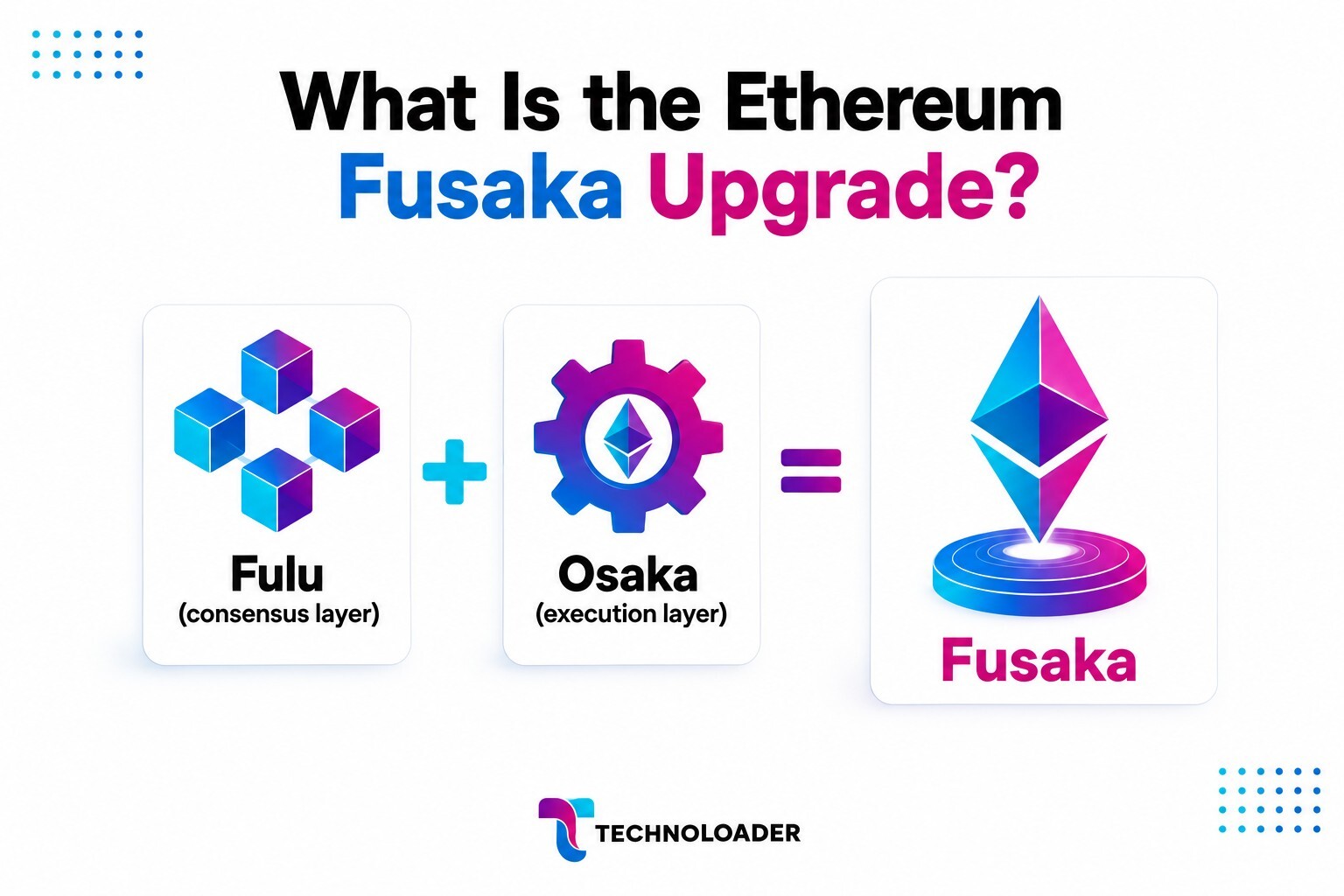
The Ethereum Fusaka upgrade is a network hard fork that went live on December 3, 2025. It bundles two coordinated upgrades: Fulu on the consensus layer and Osaka on the execution layer.
The centerpiece of the Ethereum Fusaka upgrade, PeerDAS, expands how much data-availability capacity Ethereum can safely handle for Layer-2 rollups.
The name follows Ethereum’s naming style. Consensus-layer upgrades use star names, so this one is Fulu.
Execution-layer upgrades use past Devcon host cities, so this one is Osaka. Put them together, and you get Fusaka.
Under the hood, the Ethereum Fusaka upgrade bundles 13 improvements called EIPs. That count comes from the meta proposal EIP-7607, per the Ethereum Improvement Proposals.
Most of them target one job: scaling data for rollups.
Here are some key terms you must understand early on:
- Hard fork: A coordinated network upgrade that all nodes must adopt
- Blob: A low-cost, temporary data slot that rollups use to post their transaction data. Each blob holds about 128 KB and is pruned after roughly 18 days.
- Data availability: Involves making sure that blob data is published so anyone can check it
- Layer-2 rollup: A network built on top of Ethereum. (For example, Arbitrum, Base, Optimism, and zkSync).
What’s the difference between Layer-2 versus Layer-1? The Layer-2 rollup bundles many transactions and posts their data back to Ethereum. Meanwhile, Ethereum itself is the base layer, or Layer-1, that settles and secures everything.
Data availability sits at the heart of the Ethereum Fusaka upgrade. Rollups stay safe only if their data is public and verifiable.
Fusaka makes publishing that data easier at scale.
What Is the Ethereum Fusaka Upgrade?
Fusaka is Ethereum’s December 2025 hard fork. It raises blob capacity with a new sampling method called PeerDAS, so rollups get more room at lower cost.
Also Read
Where Does Fusaka Fit in Ethereum’s Roadmap?
The Ethereum Fusaka upgrade is the latest step in a long scaling plan, not a fresh start. Ethereum now ships upgrades on a roughly twice-a-year cadence. Fusaka arrived after Pectra and sets up the next upgrade, Glamsterdam.
Ethereum bundles many small changes into each named upgrade.
Why twice a year?
Smaller, regular upgrades are easier to test and safer to ship. Each change first runs on public testnets for weeks.
Only then does it reach mainnet. That cadence is now normal for Ethereum.
Here’s the short history. The Merge switched Ethereum to Proof of Stake on September 15, 2022, cutting energy use by over 99%
Dencun introduced blobs on March 13, 2024. Pectra improved wallets and staking on May 7, 2025.
The Ethereum Fusaka upgrade then landed on December 3, 2025.
I want to clear up one common mix-up here. Some early write-ups listed EIP-7702 and EIP-7251 as Fusaka features. Those two shipped with Pectra in May 2025, not Fusaka. Fusaka’s headline is PeerDAS, which I cover next.
The table below compares the three most recent upgrades. It shows what each one changed and who felt it.
| Upgrade | Date | Headline Change | Key EIPs | What It Meant |
|---|---|---|---|---|
| Dencun | March 13, 2024 | Introduced blobs | EIP-4844 | Cut Layer-2 data costs sharply |
| Pectra | May 7, 2025 | Wallet and staking upgrades | EIP-7702, EIP-7251, EIP-7691 | Smarter wallets; blobs set to 6 target / 9 max |
| Fusaka | Dec 3, 2025 | PeerDAS data availability scaling | EIP-7594, EIP-7892, plus 11 more | More blob room for rollups over time |
Where Does the Ethereum Fusaka Upgrade Fit in the Roadmap?
Fusaka follows the Merge, Dencun, and Pectra. It continues Ethereum’s rollup-first scaling plan and comes right before the next upgrade, Glamsterdam.
Also Read
How Does the Ethereum Fusaka Upgrade Work?
The Ethereum Fusaka upgrade changes how Ethereum handles blob data. Before Fusaka, every blockchain node had to download every blob.
That design is safe, but it limits how many blobs the network can carry. PeerDAS breaks that limit carefully.
The old model had a clear ceiling. If every node must store every blob, more blobs mean heavier nodes.
Heavier nodes push out smaller operators and hurt decentralization.
It helps to know what blobs replaced. Before 2024, rollups posted data as permanent calldata, which was expensive.
Dencun added blobs as a lower-cost, temporary store for that data. With the Ethereum Fusaka upgrade, it now lets the network carry many more of those blobs.
The mechanism has a few clear steps. Here’s how PeerDAS moves data through the network.
What Is PeerDAS (EIP-7594)?
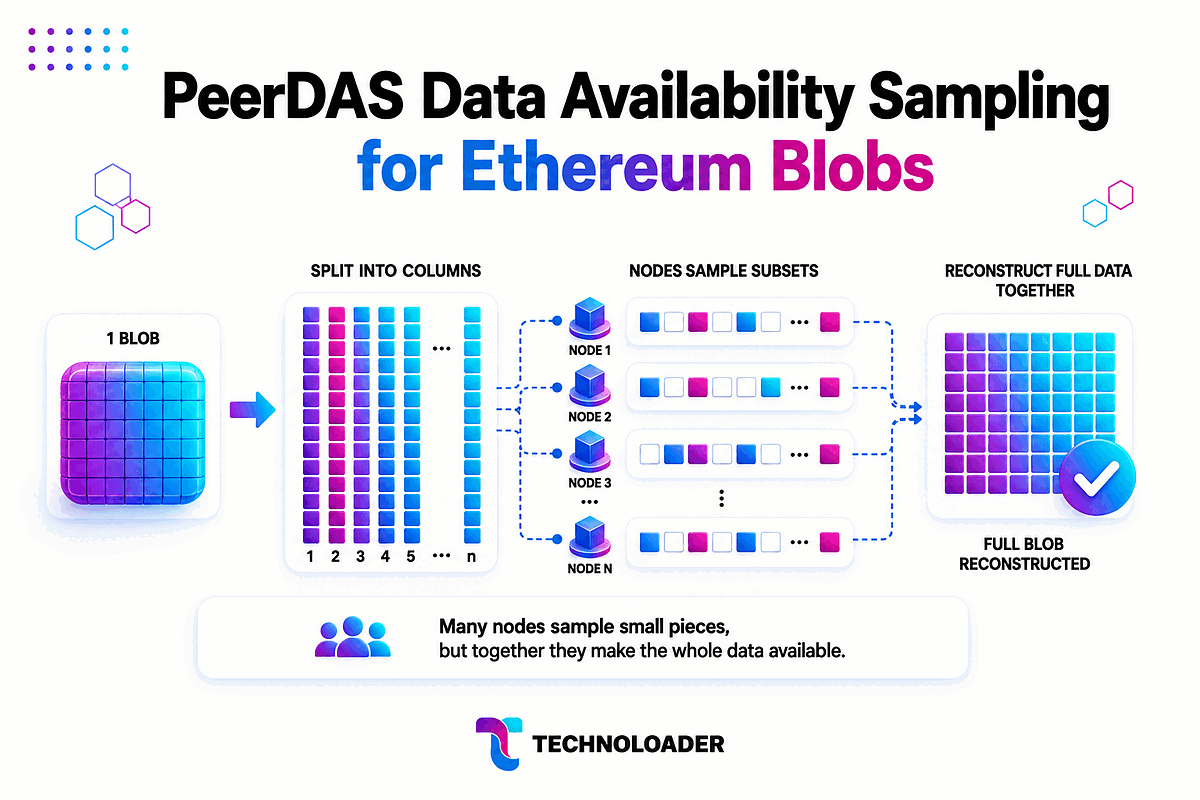
PeerDAS stands for Peer Data Availability Sampling. It lets each blockchain node check blob data by sampling a small slice instead of downloading all of it.
Nodes then reconstruct the full data from their peers when needed. This change lets Ethereum carry far more blobs.
Here’s the flow in plain steps:
- A rollup posts its transaction data to Ethereum as blobs.
- Each blob is erasure-coded, which means extra recovery data is added and split into columns.
- Every node stores and checks only a subset of those columns — around one-eighth. The share depends on node type: ordinary full nodes hold a fraction, larger validators hold more, and supernodes can hold them all.
- If data is missing, nodes rebuild it from at least half of the columns held by peers.
- The result is more blob capacity without forcing every node to store everything.
One caveat: PeerDAS is a step toward full Danksharding, Ethereum’s long-term data plan.
It’s not sharding, and it’s not full Danksharding yet. PeerDAS is an intermediate step toward full Danksharding. It brings data availability sampling to the live network, but not the complete design.
Blobs and the Blob-Capacity Increase
The Ethereum Fusaka upgrade raised blob capacity in stages, not all at once. At activation on December 3, the limits stayed at 6 target and 9 maximum blobs.
Two later mini-forks then raised those numbers on a schedule.
The image below shows the exact steps, per the Ethereum Foundation’s Fusaka announcement.
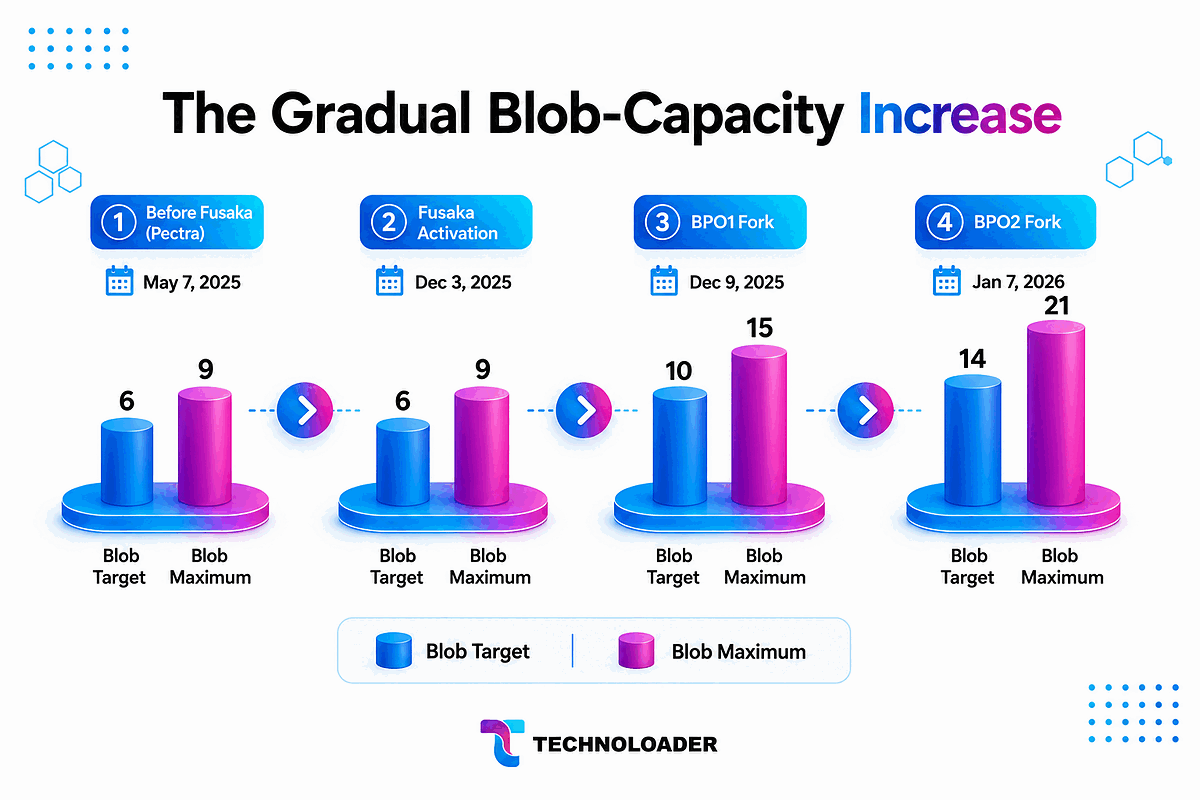
The blob maximum rose from 9 to 21 by early January 2026. That’s a real jump in room for rollups.
It arrived in careful phases so the network could absorb each step.
There’s also a fee attached to this. EIP-7918 sets a floor on the blob base fee, tied to execution cost.
That keeps blob pricing steadier when demand swings up and down. Steady pricing helps rollups plan their own costs.
What Are BPO (Blob-Parameter-Only) Forks?
BPO forks are small upgrades that change only blob numbers. The framework comes from EIP-7892.
It lets Ethereum raise the blob target and maximum without a full network upgrade each time. The Ethereum Fusaka upgrade used two of them — on December 9, 2025, and January 7, 2026.
This design is lighter than a full upgrade. Client teams change only a few blob numbers, not the whole protocol.
This way, Ethereum can scale blobs faster and more safely.
How Does the Ethereum Fusaka Upgrade Work, In Simple Terms?
Fusaka uses PeerDAS so nodes sample a slice of blob data instead of downloading all of it. That safely raises blob capacity, which two BPO forks then increased to 14 target and 21 maximum.
Also Read
What’s Inside Fusaka? The Key EIPs
The Ethereum Fusaka upgrade bundles 13 EIPs, listed in the meta proposal EIP-7607. They fall into three groups: scaling, execution, and quality of life.
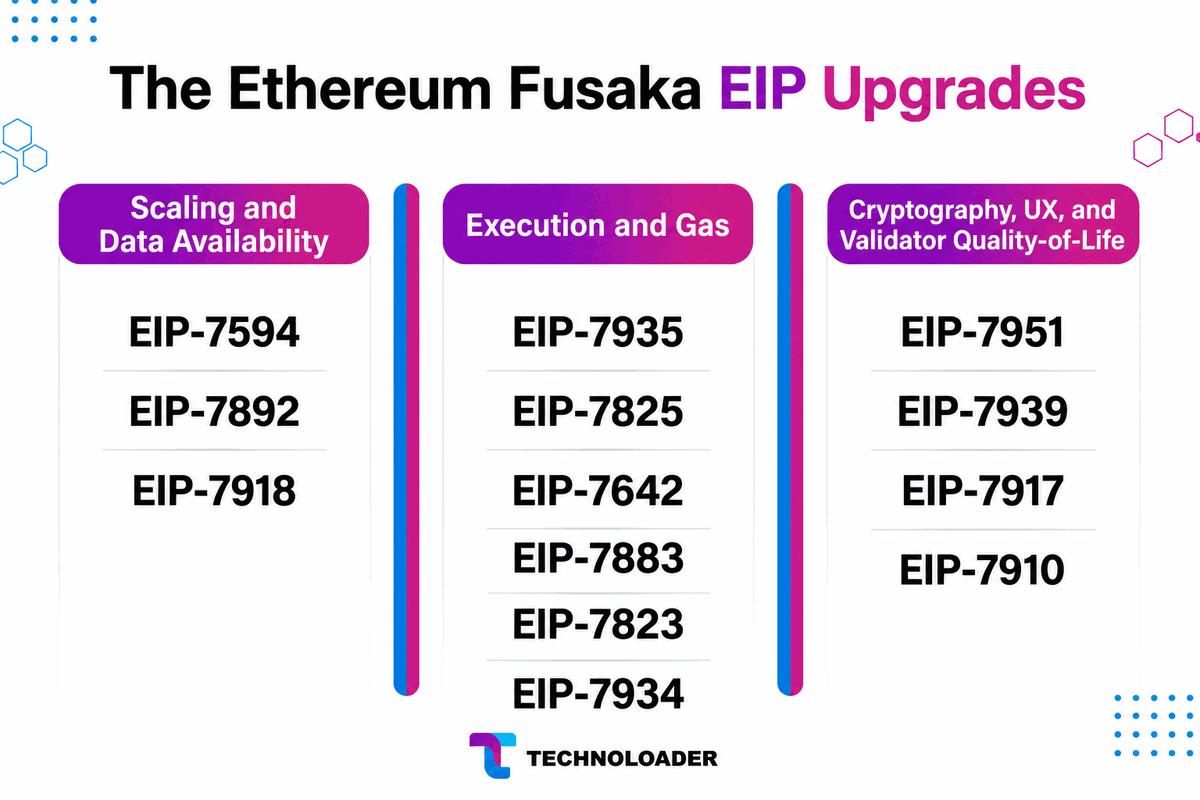
The 13 changes aren’t equally big. A few, like PeerDAS, reshape how Ethereum scales. Others are quiet tune-ups that mostly help developers and node operators.
The table below lists all 13, with one line on what each does.
| EIP | Name | What It Does |
|---|---|---|
| EIP-7594 | PeerDAS | Nodes sample blob data instead of downloading all of it |
| EIP-7892 | Blob Parameter Only forks | Lets Ethereum raise blob limits in small steps |
| EIP-7918 | Blob base fee bound | Sets a floor on the blob fee, tied to execution cost |
| EIP-7935 | Default gas limit to 60M | Raises the client default gas limit setting |
| EIP-7825 | Transaction gas cap | Caps any single transaction at 16,777,216 gas |
| EIP-7823 | ModExp upper bounds | Sets safe limits on the ModExp precompile |
| EIP-7883 | ModExp gas increase | Reprices the ModExp precompile upward |
| EIP-7934 | Block size limit | Caps the maximum encoded block size |
| EIP-7951 | secp256r1 precompile | Adds P-256 signature support for passkeys |
| EIP-7939 | CLZ opcode | Adds a count-leading-zeros opcode for developers |
| EIP-7917 | Proposer lookahead | Makes the block-proposer schedule predictable |
| EIP-7642 | eth/69 history | Trims old fields from the network protocol |
| EIP-7910 | eth_config method | Adds an RPC call to read the live chain config |
Scaling and Data Availability
This EIP group in the Ethereum Fusaka upgrade does the heavy lifting. PeerDAS (EIP-7594) enables sampling.
BPO forks (EIP-7892) raise blob limits in steps. The blob base-fee bound (EIP-7918) keeps blob pricing steadier when demand swings.
Together, these three set Ethereum’s data-availability engine for the next few years.
Execution and Gas
The Ethereum Fusaka upgrade changes how blocks run. EIP-7935 raises the client default gas limit to 60 million. That’s a default setting, and validators still vote on the real mainnet limit.
EIP-7825 adds a hard cap of 16,777,216 gas on any single transaction, which is 2 to the 24th power. That cap protects blocks from one oversized transaction.
ModExp is a math function that some smart contracts use for cryptography.
The repricing makes its cost reflect the real work involved. The eth/69 change, EIP-7642, also trims old data from node messages.
Cryptography, UX, and Validator Quality-of-Life
This group helps users, developers, and validators.
EIP-7951 adds support for the secp256r1 curve, which powers passkeys and phone-based signing. This support ships as a precompile, a built-in function for common cryptography.
EIP-7939 adds a small opcode that helps developers write more efficient code.
EIP-7917 makes the validator proposal schedule predictable, and EIP-7910 gives tools an easy way to read the live network config.
One note for readers who track the roadmap: An earlier feature called EOF was planned for the Ethereum Fusaka upgrade, then removed before launch.
EIP-7917 deserves a quick note for stakers. A predictable proposer schedule lets validators know their turn in advance.
That helps with pre-confirmations and smoother block building. The eth_config method, EIP-7910, then lets tools read the live fork settings directly.
What Is Inside the Ethereum Fusaka Upgrade?
The Ethereum Fusaka upgrade contains 13 EIPs, led by PeerDAS for scaling. Gas rules, passkeys, and config tools round out the set.
Also Read
Why Does the Ethereum Fusaka Upgrade Matter?
The Ethereum Fusaka upgrade matters because it makes Ethereum’s rollup-first plan work better. It gives Layer-2 networks more room to post data.
It does this without changing Ethereum’s security or its Proof of Stake design. In the projects we deliver on Ethereum and its rollups, data cost is often the real constraint.
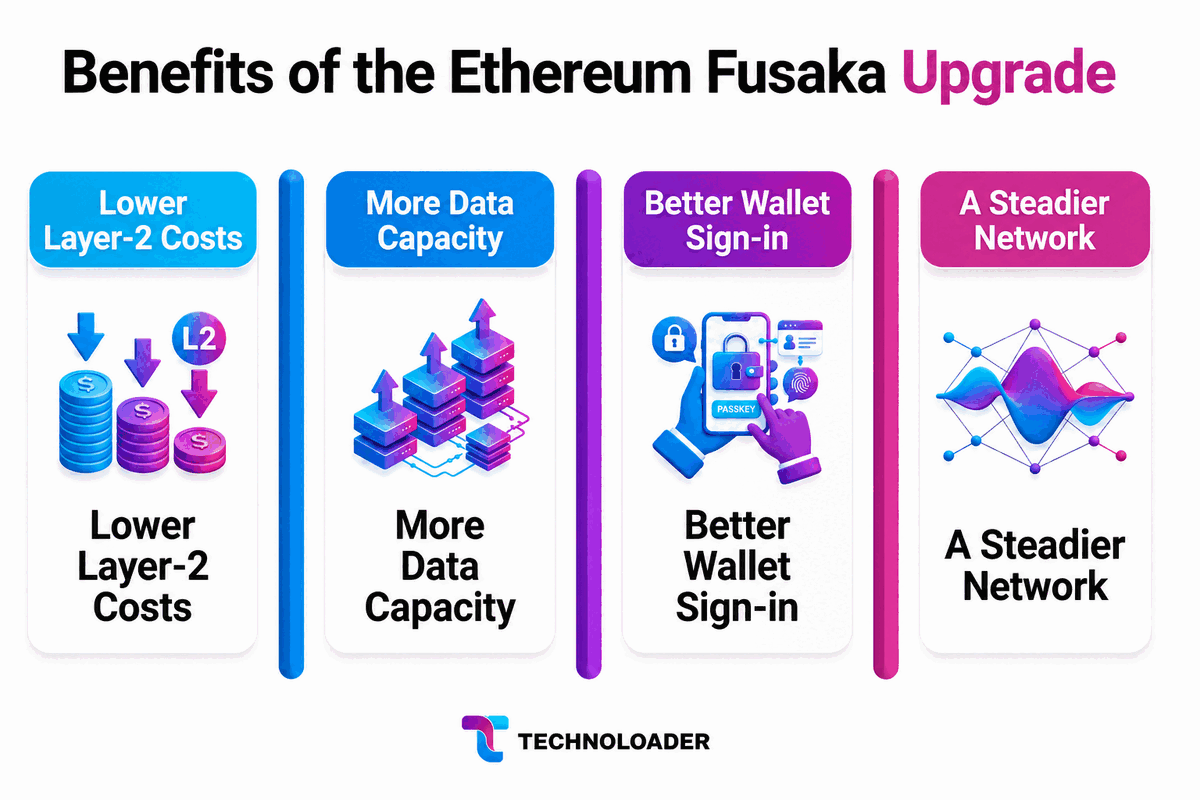
Lower Layer-2 Costs Over Time
More blob capacity tends to reduce the data-availability cost that rollups pay. That’s the cost rollups face when they post data to Ethereum.
It’s a separate fee market from mainnet gas. The benefit shows up on Layer-2, not on Ethereum’s base layer.
We have seen this pattern before. The Dencun upgrade introduced blobs in 2024, and Layer-2 fees fell sharply after it.
The Ethereum Fusaka upgrade extends that same idea with far more blob capacity.
There’s a catch, though. Early 2026 MigsLabs analysis showed rollups weren’t using all the blob space available to them, which limited the immediate benefit of adding more. Actual savings vary by rollup and demand, and it may take time to lower costs.
Treat any single percentage you read as a rough guide, not a promise. The direction is clear: more blob space eases pressure on rollup data costs.
More Scalable Data Availability
PeerDAS raises how much data Ethereum can serve safely. This is the groundwork for full Danksharding later.
More blobs mean rollups compete less for the same space. Ethereum’s plan leans on rollups for scale, not on bigger base-layer blocks.
That’s the rollup-centric roadmap in action. The Ethereum Fusaka upgrade gives that roadmap the data room it needs.
Better Wallet and Developer Experience
The secp256r1 precompile lets apps use passkeys and device-based sign-in. This can make wallet access smoother for everyday users.
Developers also get the CLZ opcode and the eth_config method. Both make some code simpler to write and check.
More Predictable, Resilient Network
The Ethereum Fusaka upgrade adds guardrails that keep the network steady. The per-transaction gas cap blocks a single giant transaction from clogging a block.
The predictable proposer schedule helps validators and builders plan ahead. A steadier schedule also helps staking pools coordinate their work.
None of this weakens Ethereum’s security model. Validators still secure the chain through Proof of Stake.
The Ethereum Fusaka upgrade changes data handling, not the rules that keep the network honest.
How Does the Ethereum Fusaka Upgrade Help?
The Ethereum Fusaka upgrade gives rollups more data room, which eases their costs over time. It also improves wallet sign-in and network stability, all without touching Ethereum’s Proof of Stake security.
What Does the Ethereum Fusaka Upgrade Mean For You?
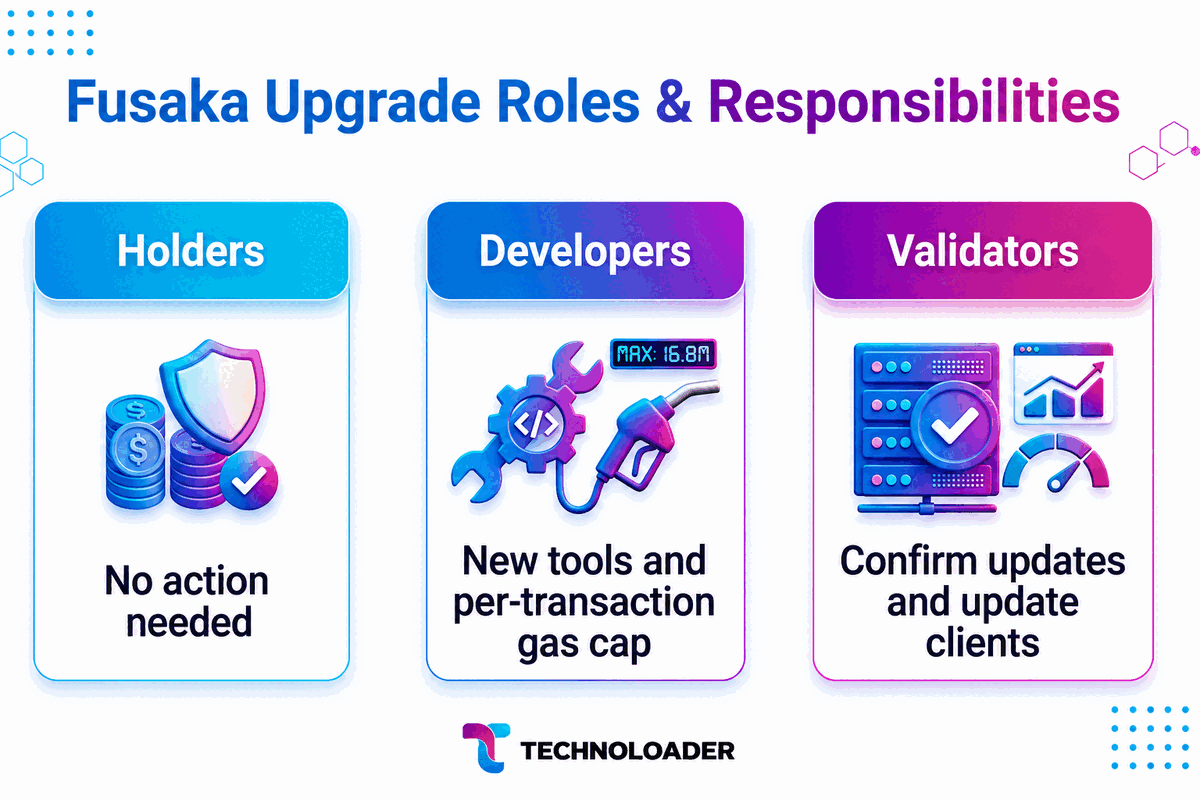
For most people, the Ethereum Fusaka upgrade needs no action. Crypto wallets, exchanges, and rollups handled the upgrade for you.
Still, what it means depends on how you use Ethereum. I break it down by role below.
For ETH Holders and Users
If you hold ETH or use apps, you don’t need to do anything for the Ethereum Fusaka upgrade. Your coins and your smart contracts work the same as before.
Wallets and exchanges are updated on their side. You may simply notice steadier or lower fees on some Layer-2 networks over time.
This is educational information, not financial advice. If you use a Layer-2 network, you may see the benefit sooner.
Lower data costs there can mean lower fees for you over time.
For Developers
With the Ethereum Fusaka upgrade, developers get a few new tools. The secp256r1 precompile supports passkey-style sign-in.
Passkeys let users sign with a phone or a security key. That can reduce reliance on seed-phrase steps where apps and wallets support passkeys.
The CLZ opcode and the eth_config method round out the set. There’s also a new per-transaction gas cap of 16,777,216 gas. Most apps will not hit that cap in normal use. It mainly affects very large, complex transactions.
Test any heavy contract against the new limit before you ship.
For Stakers, Validators, and Node Operators
This group had the most to do. PeerDAS changed how nodes handle blob data, so operators had to prepare.
Bandwidth matters most here, not raw storage. If you run a node or validator, here’s the short checklist:
- Confirm your execution and consensus clients were updated before December 3, 2025.
- Check that your node has enough bandwidth for column sampling.
- Watch your setup through the BPO forks since blob limits rose afterward.
- Keep clients current because blob parameters can change again in future forks.
What Should You Do About the Ethereum Fusaka Upgrade?
Most holders and users needed to do nothing. Developers got new tools to adopt, and node operators had to update their clients before December 3, 2025.
Also Read
FAQ
1. When did the Ethereum Fusaka upgrade go live?
The Ethereum Fusaka upgrade went live on Ethereum mainnet on December 3, 2025. Two follow-up BPO forks then raised blob limits on December 9, 2025, and January 7, 2026. All three are now active on the network.
2. Does the Fusaka upgrade lower Ethereum gas fees?
Not on the mainnet directly. The Ethereum Fusaka upgrade raises blob capacity, which helps lower data costs for Layer-2 rollups over time. Blob fees are a separate market from mainnet gas. So, base-layer transaction fees aren’t cut by design.
3. Do ETH holders need to do anything for the Ethereum Fusaka upgrade?
No. If you hold ETH or use apps, your coins and contracts are unaffected. Wallets, exchanges, and Layer-2 networks handled the upgrade on their side.
4. How does the Ethereum Fusaka upgrade affect layer-2 rollups?
Fusaka gives rollups more blob space to post their data. More space tends to ease the data-availability costs that rollups pay. That benefit shows up on Layer-2 networks, not on Ethereum’s base layer.
5. How many blobs can Ethereum handle after Fusaka?
At the launch of the Ethereum Fusaka upgrade, the limits stayed at 6 target and 9 maximum blobs. The BPO1 fork raised them to 10 and 15 on December 9, 2025. The BPO2 fork raised them again to 14 and 21 on January 7, 2026.
6. Which EIPs are included in the Ethereum Fusaka upgrade?
The Ethereum Fusaka upgrade includes 13 EIPs, listed in the meta proposal EIP-7607. The headline is EIP-7594, which is PeerDAS. Others cover blob forks, gas rules, ModExp repricing, passkey support, a new opcode, and validator scheduling.
7. Is Fusaka the same as Danksharding?
No. PeerDAS in Fusaka is a first step toward full Danksharding, not the finished design. It brings data availability sampling to the live network. Full Danksharding remains a later goal on Ethereum’s roadmap. Danksharding aims to let the network handle far more data than PeerDAS does today.
8. What is the next Ethereum upgrade after Fusaka?
The next planned upgrade is called Glamsterdam. Ethereum now ships upgrades on a roughly twice-a-year cadence. Exact scope and timing can shift. So, treat any date you read as tentative until the Ethereum Foundation confirms it.
9. Is Fusaka the same as Pectra, and does it include EIP-7702?
They’re separate upgrades, and EIP-7702 was part of Pectra, not Fusaka. That update gave regular Ethereum wallets access to certain smart account features. Fusaka focuses on scaling instead, using PeerDAS and increased blob capacity to support Layer-2 networks.
10. Did Fusaka make Ethereum faster?
Fusaka helps Ethereum scale, but it doesn’t automatically make every transaction faster or cheaper. Its main feature, PeerDAS, allows more blob data to be processed without requiring every node to download everything. This creates room for Layer-2 networks to handle more transactions.
11. What is the blob target vs. maximum?
Ethereum doesn’t need to fill every block with the maximum number of blobs. It aims for 14 per block but allows up to 21. This gives the network some breathing room when Layer-2 activity increases and more transaction data needs to be posted.
12. Does Fusaka change staking or the 32 ETH limit?
No, Fusaka doesn’t change the 32 ETH requirement for running your own Ethereum validator. That part of staking stays the same. Pectra introduced a separate change that lets eligible validators earn rewards on larger balances, up to an effective balance of 2,048 ETH.
Conclusion
So, what is the Ethereum Fusaka upgrade? It is Ethereum’s December 2025 hard fork that scales blob data with PeerDAS.
It gives rollups more room and improves wallet sign-in without changing Proof of Stake.
If you build on Ethereum or a Layer-2, now is a good time to plan around the extra blob capacity. My team can help you design, build, and scale that kind of Web3 product.
Explore our blockchain development services or contact us to talk through your project.

Vipin Kumar
Vipin Kumar is the Founder & CEO of Technoloader, a Clutch Top 10 Blockchain Development Company for 2025. A serial technology entrepreneur and blockchain architect with a B.Tech background, Vipin has led the delivery of 450+ projects across DeFi, NFT marketplaces, AI/ML, and custom Web3 platforms for clients in the UAE, India, the US, and beyond. He also founded SALIQ (saliq.ai), an AI-driven conversational marketing platform.
Published in News and Updates


