 +91 7014607737
 info@technoloader.com





Table of Contents
Quick Summary
- A smart contract is a small program on a blockchain. It follows a set of rules and acts when someone meets the conditions.
- Say a player wins a tournament. Instead of asking an admin to send the prize, the game can use a smart contract to make the payment.
- Developers use smart contracts in gaming for things like this, as well as item sales, NFT ownership, and player trades.
- But blockchain doesn’t need to power every part of a game. Fast actions, such as movement and combat, usually stay on regular servers.
- Getting that balance right is one of the main decisions developers face.
Game developers use smart contracts in gaming to control how players earn, trade, and own digital items. These programs run on a blockchain and follow rules written in their code. For example, a contract can send an item to a player’s wallet or release a tournament prize.
This gives players a way to check transactions and hold certain assets outside the game.
Studios can also use smart contracts in gaming to run marketplaces and manage rewards. But they need to choose which features belong on-chain. Running the whole game on a blockchain can make it slow and costly.
Put simply, smart contracts power blockchain gaming by handling the parts of a game that players need to own, trade, or verify.
I’m Vipin Kumar, Founder and CEO of Technoloader. I’ve led the delivery of 450+ projects across blockchain, DeFi, AI/ML, and NFT marketplaces. This work has involved building Web3 products for clients in different markets.
In this guide, I’ll explain how game studios can use smart contracts and what the process involves.
What Are Smart Contracts and How Are They Used in Gaming?
A smart contract is a program stored on a blockchain that carries out an action when someone meets the conditions written in its code. Game developers use smart contracts in gaming to create digital items, process trades, and send rewards without manual approval.
Nick Szabo described the idea in the 1990s. Ethereum made it practical in 2015. Since then, developers have used these contracts to give players more control over in-game assets and transactions.
Players and developers can inspect the rules and check transaction records on the blockchain. This is one key difference from traditional contracts.
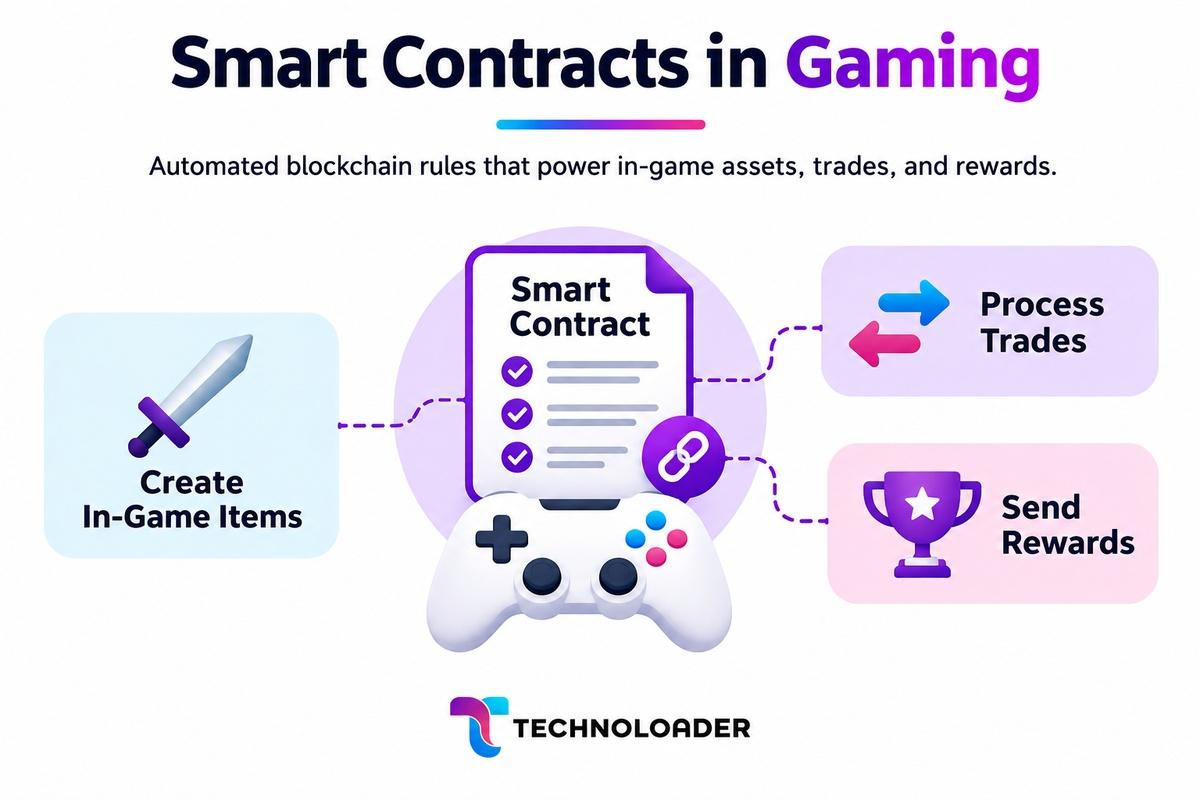
How a Smart Contract Works in a Game
A smart contract runs when a transaction triggers its code and meets the conditions written into it. The blockchain’s validators process the transaction and agree on the result before recording it. This lets developers use smart contracts in gaming without asking a central team to approve every action.
Think of a reward contract for a tournament. It holds the prize pool. The contract releases funds to the winner once the final score is verified. If the condition fails, nothing moves.
This matters because the rules execute the same way every time. Players don’t have to trust the studio to pay out. They trust code they can audit. When the game needs outside information, an oracle brings it to the blockchain.
On-Chain vs Off-Chain: How Blockchain Games Split the Work
Most blockchain games don’t run entirely on a blockchain. They use regular servers for things that need to happen quickly, such as player movement, physics, and matchmaking.
The blockchain handles things players may need to own or verify, including items, currencies, trades, and payouts.
This setup makes sense for a practical reason. Every on-chain action costs gas and takes time to process. Putting every move or game event on the blockchain would make the game slower and more expensive to play.
So, studios keep the gameplay on their servers and use the blockchain for ownership and transactions. Knowing what belongs where is a key part of designing a Web3 game.
Fully On-Chain Games: When the Whole Game Is on a Blockchain
Some projects go further and put the game’s state and core rules in smart contracts instead of on a server. These “fully on-chain” games often use frameworks such as MUD on EVM chains or Dojo on Starknet.
Anyone can read the game state, and other developers can build mods or tools on top of it. The trade-off is cost and latency, which is why this model suits turn-based and strategy games more than fast action titles. Most commercial games still use the hybrid model described above.
How Do Smart Contracts Power Blockchain Games?
A smart contract checks whether the required conditions are met before carrying out an action. For example, it can release a tournament prize after an oracle verifies the winner. Since blockchain transactions cost gas and take time, most studios use regular servers for gameplay and the blockchain for assets and payments.
Also Read
Why Do Smart Contracts Matter for Blockchain Games?
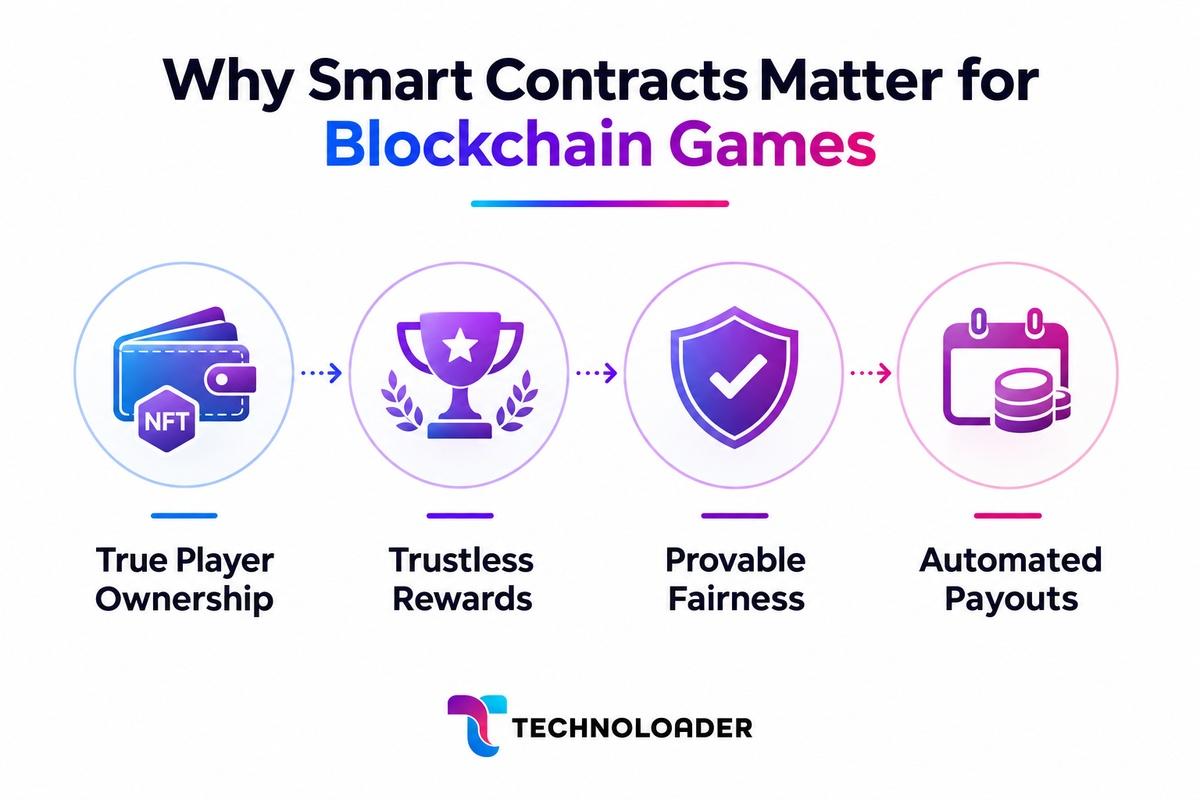
The role of smart contracts in gaming is to move three jobs from the studio to code. Those jobs are ownership, rewards, and rules. Players own assets they can trade anywhere. Payouts happen automatically, and the rules are public and the same for everyone.
That shift helped make gaming one of Web3’s busiest categories. In DappRadar’s final gaming report for Q3 2025, games drew about 4.66 million daily active wallets, roughly a quarter of all dapp activity it tracked. DappRadar stopped publishing in November 2025, so treat this as the last snapshot from that source.
True Player Ownership of In-Game Assets
Smart contracts give players real ownership by issuing in-game assets as tokens that the player holds in a wallet. Once issued, the contract’s rules decide what can happen to them. If the contract has no admin burn function or unlimited minting, the studio can’t remove or copy them. Unique items usually use the ERC-721 standard. Mixed batches use ERC-1155.
The blockchain stores a verifiable ownership record. The art and metadata usually live off-chain, referenced by the token.
This is a genuine change from traditional games. In most games, your skins live on a company server forever. If the servers close, the items vanish. With a token standard, the item is yours to keep, sell, or move.
Creators can also earn on resales. A royalty standard called EIP-2981 lets a contract publish the royalty rate and recipient for each item. Marketplaces that support it pay that royalty on secondary sales, which turns a one-time sale into ongoing revenue. It does not force payment, so studios that rely on royalties choose marketplaces that honor it or add rules to their own trading contracts.
Trustless Rewards and Play-to-Earn Economies
Smart contracts enable trustless rewards by paying players straight from code when they meet a goal. There’s no support ticket and no waiting on a studio. This is the engine behind play-to-earn economies, where players can earn tokens or items through play.
Be honest with players about this model. In play-to-earn, players may earn, but rewards vary and carry real risk. They are never guaranteed. This is information, not investment advice. Designing the token flow is its own discipline, which we cover in blockchain gaming tokenomics.
Provable Fairness and Transparency
Players don’t have to take a game’s word for everything. Smart contracts make the rules behind certain actions visible on the blockchain. Anyone can inspect the code that controls loot drops or match payouts and check whether the game follows those rules.
Random results need an extra layer of protection. A smart contract can’t generate secure randomness on its own because its code is public. That’s where a verifiable random function (VRF) comes in. Services like Chainlink VRF provide random numbers that anyone can verify later.
This gives players a way to check that random drops weren’t simply decided behind closed doors.
Automated Payouts, Marketplaces, and Tournaments
Smart contracts can take care of payments across a game’s marketplace and tournaments. When a player lists an item on a marketplace, the contract either holds it in escrow or gets approval to move it. When a buyer pays, the contract swaps the item and the payment in one transaction and can send the creator’s royalty at the same time. Neither side has to trust the other to go first.
Tournament prizes work in much the same way. Organizers can set the payout rules before a competition begins, then let the contract distribute the prize pool. Players know how payments will work, and studios have fewer transactions to manage themselves.
This also cuts the studio’s admin work. Payouts and trades that once needed a support team or an escrow agent can settle automatically, though gas, audits, and monitoring still cost money.
What is the Role of Smart Contracts in Gaming?
Developers use smart contracts in gaming to record ownership, process trades, and pay rewards when the agreed conditions are met. They can also make loot rules and tournament payouts easier to check.
Also Read
How to Use Smart Contracts in a Blockchain Game Step by Step
If you’re planning to use smart contracts in a game, start with the parts of the game that need blockchain support. Work out how those parts should function, build the contracts, and test them before players ever interact with them. You’ll also need to think about costs, security, and what happens after launch.
1. Define What Belongs On-Chain
You don’t need a blockchain for every little thing in your game.
Players may need to own their weapons, skins, or tokens and trade them with others. Those features make sense on-chain. But nobody needs a blockchain transaction every time a character jumps, runs, or enters a match. Keep those actions on your game servers, along with matchmaking and private player data.
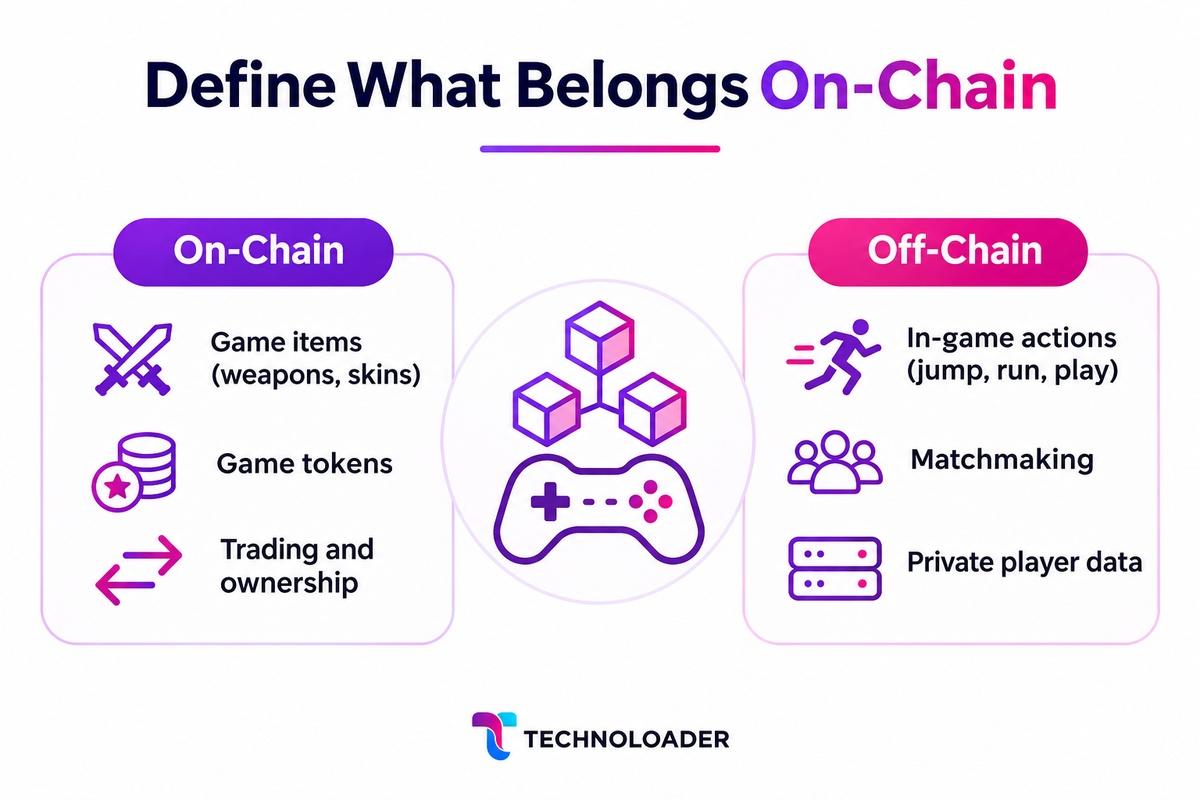
A useful way to make this call is to look at each feature separately. Would a player want to own it, trade it, or check its history? If yes, consider a smart contract. If not, a regular server will probably do the job.
2. Choose the Right Blockchain and Token Standards
Think about how players will use your game’s economy. Frequent trades and purchases need a network that can handle transactions without charging too much. Ethereum Layer 2 networks and gaming-focused chains are common choices for smart contracts in gaming.
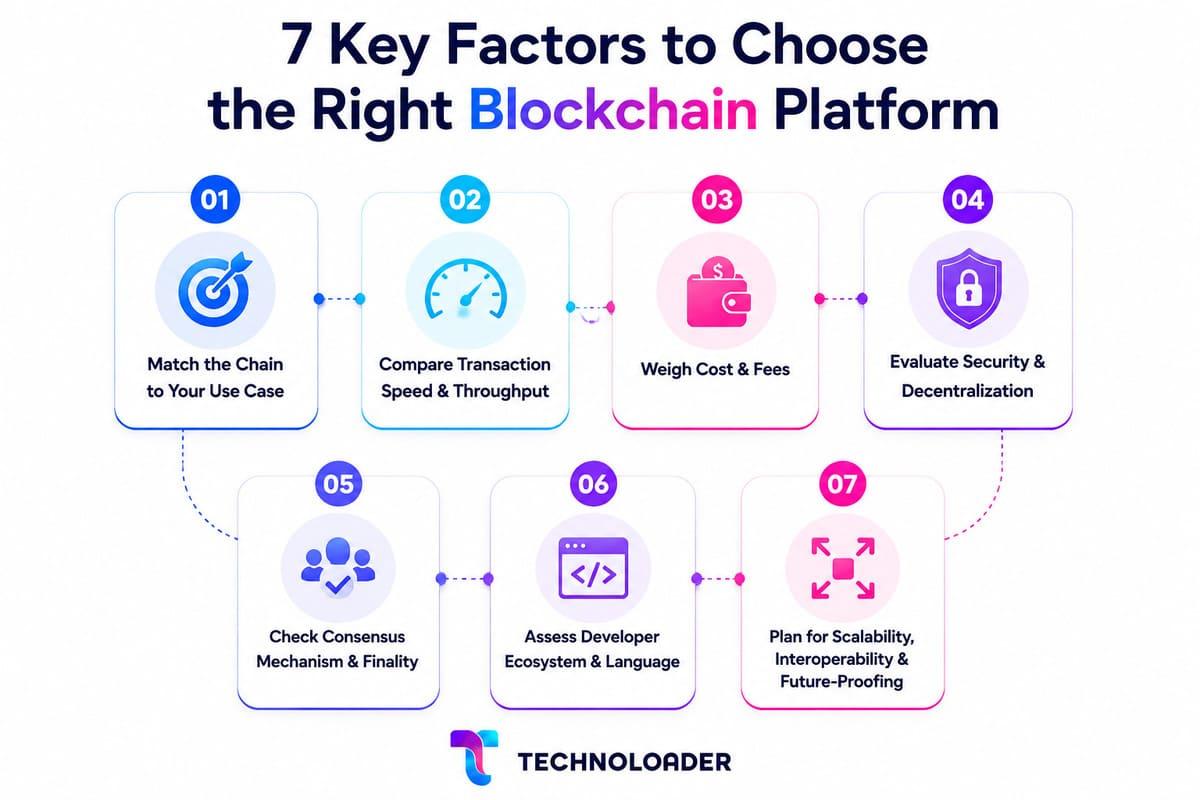
Before you choose a blockchain, compare its fees, transaction speed, security, and developer tools. Here are some factors you should consider when comparing.
- Fit with your game’s transaction pattern (frequent micro-trades vs occasional high-value items)
- Transaction speed and throughput
- Fees for players and for the studio
- Security and decentralization
- Consensus and time to finality
- Developer ecosystem and contract language
- Scalability, interoperability, and long-term support
You’ll also need the right token standards for your assets. ERC-721 suits unique items. ERC-1155 supports different item types and quantities. ERC-20 suits in-game currencies on Ethereum-compatible chains. Solana uses its own token programs (SPL) for both fungible tokens and NFTs.
We, at Technoloader, help clients match these choices to their game mechanics and player needs.
3. Write and Structure the Contracts
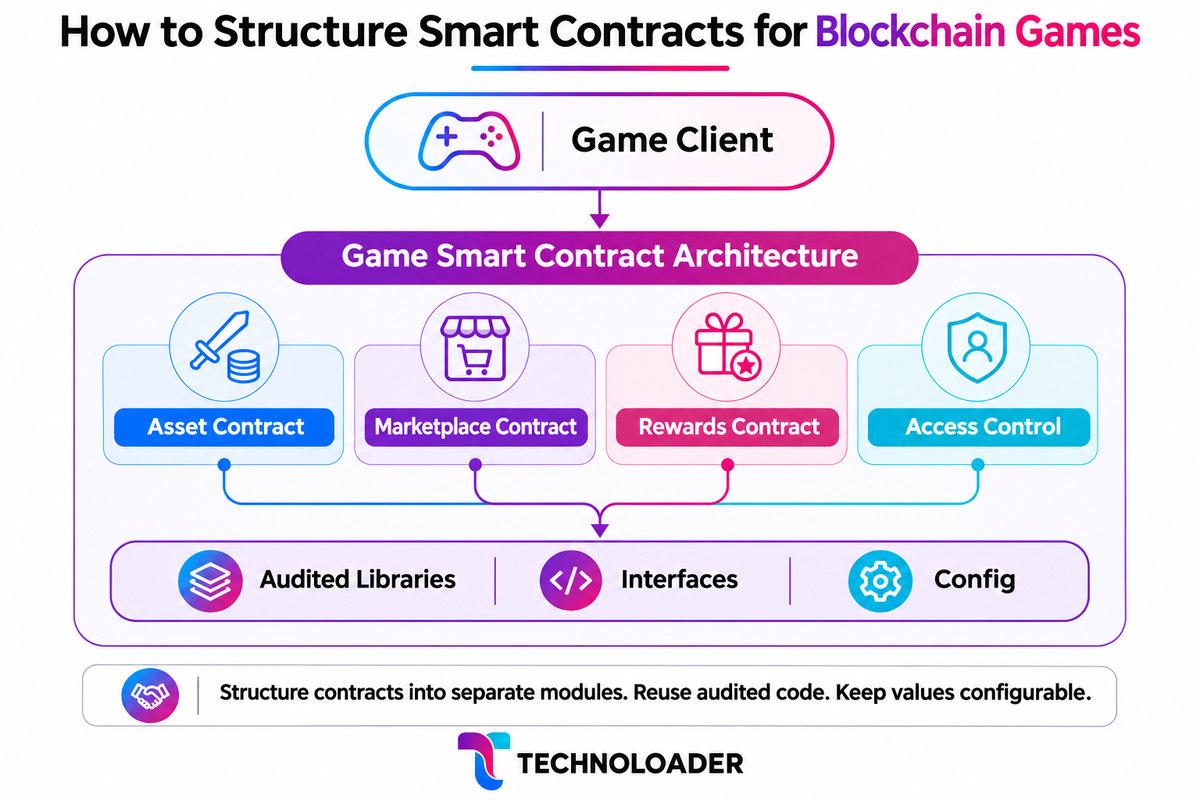
Think about the different things your game needs to do, such as issue assets, run a marketplace, and pay player rewards. Give each task its own contract instead of putting all the code in one place. This makes the system easier to review and update.
For common functions, use audited libraries, such as OpenZeppelin Contracts, rather than building everything yourself. Solidity is the main language used for contracts on Ethereum-compatible chains. Solana programs are usually written in Rust, often with the Anchor framework, and Sui and Aptos use Move. The language follows the chain, so settle the chain first. Our team works across these stacks.
Keep the code simple enough for another developer to follow. Document functions that move money or tokens, and avoid hard-coding values you’ll need to change later.
Here’s a visual that shows how to structure smart contracts in gaming.
4. Add Oracles and Verifiable Randomness
A game contract can’t check match results, prices, or outside events on its own. An oracle supplies that information. For features like random loot drops, use a VRF to generate numbers players can verify.
The data going into your contract matters as much as the code itself. A wrong feed can trigger the wrong action or payout. Choose reliable providers and test how your contract handles bad or delayed data.
5. Conduct Tests Before Launch
Don’t wait until launch to find problems in your contracts. Test every function, especially those that handle player funds or game items. Get an outside security team to check the code, too. Pay close attention to reentrancy, access control, and upgrade permissions. Solidity 0.8 and later checks arithmetic for overflow by default, but unchecked blocks and older code still need review. Games also face their own risks: bots farming rewards, replayed signatures on off-chain claims, and front-running on mints or limited drops. These mistakes can leave funds and items open to attack.
You also need to think about what happens when a bug shows up after launch. You can’t simply edit a deployed contract. A proxy lets you update its logic while keeping the same contract address. Decide who can approve these changes before the game goes live.
6. Handle Gas and Player Onboarding
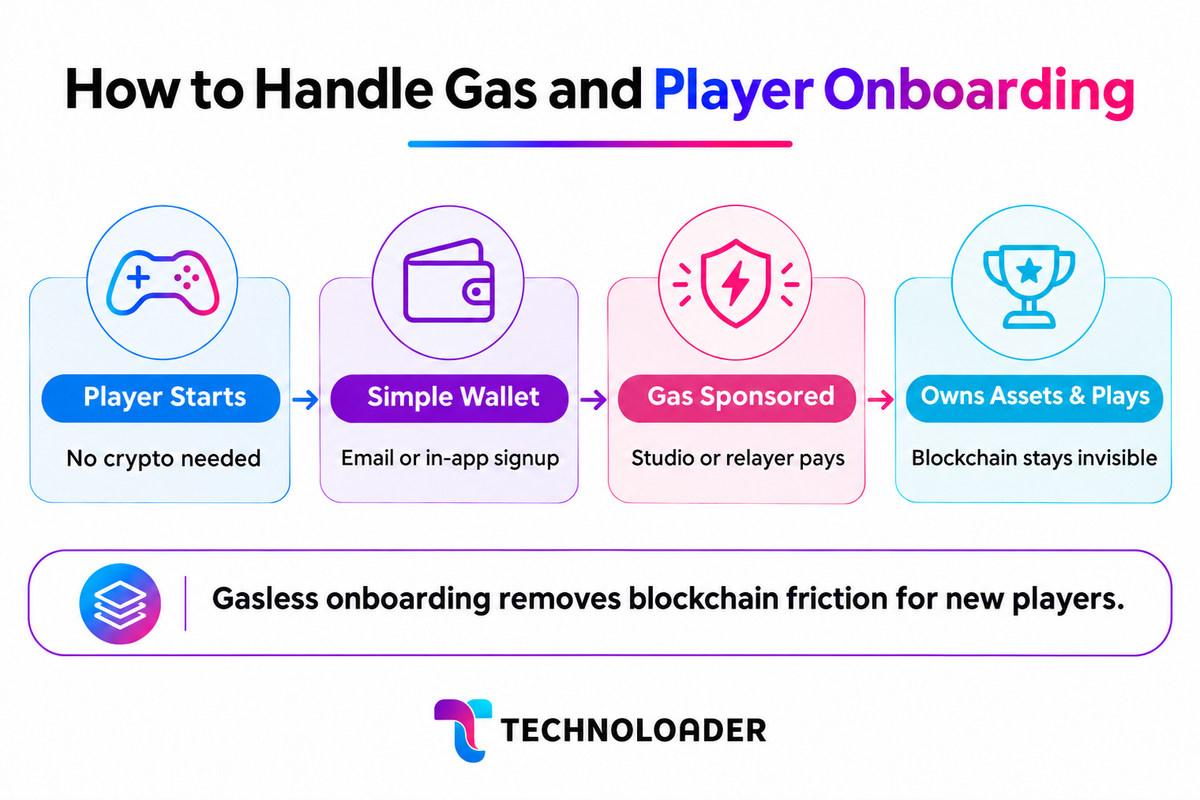
Buying a gas token before playing adds another step to the signup process. You can remove it by sponsoring fees. On EVM chains, this is usually done with ERC-4337 smart accounts and paymasters, or with EIP-7702, which lets a regular wallet act like a smart account. Session keys can then let a player approve a set of in-game actions once instead of signing every transaction.
Give players a simple way to create a wallet. Email and in-app wallets mean they don’t have to manage seed phrases themselves. They can start playing without learning how blockchain wallets work.
Here’s how the onboarding process works.
7. Deploy, Monitor, and Govern
Test everything on a testnet before you launch. Make sure trades, rewards, and other game actions work as expected. Then deploy to mainnet, the network where players use real assets.
Keep monitoring the contracts once players start using them. Set alerts for activity that looks unusual. Decide who can pause a contract and who can approve changes. Some games let players take on these decisions through a decentralized autonomous organization.
How Do You Use Smart Contracts in a Blockchain Game?
Building smart contracts for a game involves more than writing code. You need to choose what goes on-chain, pick the right blockchain, and decide how players will use their assets. Then build, test, deploy, and monitor the contracts.
Also Read
Which Blockchain is Best for Deploying Smart Contracts in Gaming?
You can deploy smart contracts on Ethereum, its Layer 2 networks, or other gaming-focused blockchains. Each option handles fees, transaction speed, and game activity differently.
The table below compares various blockchains you can choose from for deploying smart contracts in gaming.
| Platform | Token | Type and Consensus | Throughput (honest) | Finality | Gaming Fit |
|---|---|---|---|---|---|
| Ethereum | ETH | Layer 1, Proof of Stake | ~22 TPS | ~13 min | Security and settlement base; games scale via Layer 2s |
| Immutable | IMX | Ethereum Layer 2, zkEVM | N/A | N/A | Gaming-focused, with NFT and smart contract tools |
| Ronin | RON | Ethereum Layer 2 on the OP Stack (since May 2026) | N/A | N/A | Gaming-focused ecosystem with established games |
| Polygon | POL | EVM-compatible PoS sidechain | ~44 TPS | ~5 s | Low-cost, mature tooling, general-purpose |
| Solana | SOL | Layer 1, PoS with Proof of History | ~1,266 TPS | ~400 ms block | High-speed, high-frequency games |
| Avalanche | AVAX | Layer 1 with app-specific Avalanche L1s | ~3.3 TPS (C-Chain) |
~2s | Custom gaming chains with their own economies |
*TPS and finality figures from Chainspect, checked November 3, 2026. Solana finality reflects the Alpenglow upgrade, live since October 21, 2026.
Also Read
What are Some Use Cases and Examples of Smart Contracts in Gaming?
Smart contracts can take care of several transactions in a blockchain game. They can issue NFTs, transfer items between players, release rewards, and settle marketplace trades. CryptoKitties, Axie Infinity, Gods Unchained, and Decentraland show how games use these features.
| Game Feature | What the Smart Contract Does | Example |
|---|---|---|
| In-Game Items | Creates NFTs, records ownership, and allows players to transfer or trade them. | Gods Unchained: Players own trading cards on Immutable. |
| Player Rewards | Distributes tokens or other assets when players meet specific game conditions. | Axie Infinity: Uses player-owned Axies and an in-game token economy on Ronin. |
| Marketplace Trades | Handles asset transfers and payments when players buy or sell items. | Gods Unchained: Players can trade their NFT cards. |
| Tournaments and Esports | Records ownership and transfers of digital player cards. | Sorare: Fans buy, sell, and use NFT player cards in fantasy sports. |
| Governance | Records votes and applies decisions made by token holders. | Decentraland: Its DAO lets community members vote on platform decisions. |
Some of these ideas have been around for years. CryptoKitties launched in 2017 and gave players a way to own, breed, and trade digital cats on Ethereum. Axie Infinity later brought player-owned creatures to a much larger audience, reaching millions at its 2021 peak. It now runs on Ronin.
The same idea appears in other games, too. Gods Unchained gives players tradable NFT cards on Immutable. Sorare uses NFT player cards in its fantasy sports game, where fans can buy, sell, and play with them. These games show various use cases of smart contracts in gaming.
Also Read
What are the Challenges of Using Smart Contracts in Gaming?
Smart contracts in gaming come with a few limits that can affect how players use your game. High transaction fees, security flaws, legal rules, and poor onboarding can all cause problems. Cross-game asset support is another challenge developers need to consider.
Here are the main challenges of using smart contracts in gaming.
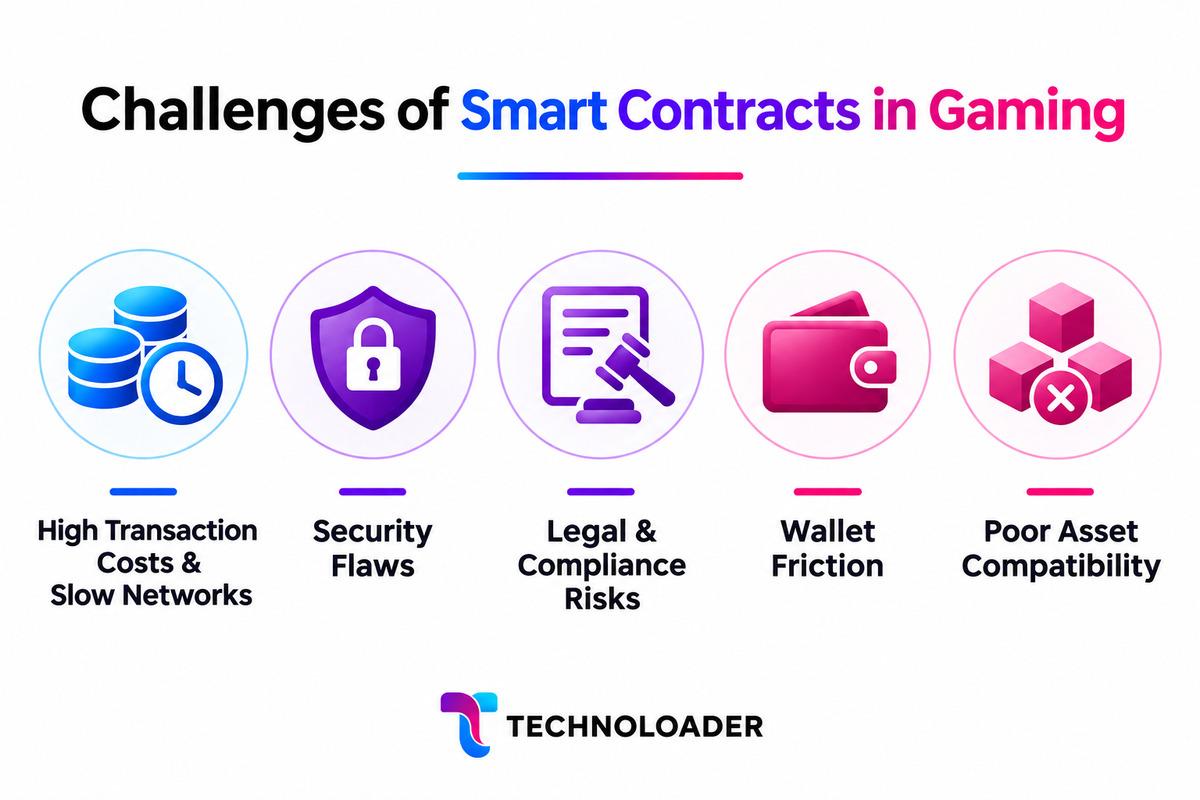
- High Transaction Costs and Slow Networks: Every on-chain action can cost gas and take time to process. Keep fast gameplay off-chain, use Layer 2 networks, and batch transactions where possible. You can also sponsor gas fees for players. Some studios use zero-knowledge proofs to improve gaming scalability and privacy.
- Security Flaws in Smart Contracts: A small bug can put player funds and game assets at risk. The 2016 DAO hack is a clear example. Attackers used a reentrancy flaw to drain funds. Use trusted contract libraries and get your code checked by an outside security team. Keep watching your contracts after launch, too. After launch, a bug bounty program can encourage security researchers to report flaws before attackers find them.
- Changing Laws and Player Protection: Rules for tokens, taxes, and gambling-like features vary by country. They can also change over time. Get legal advice before launch, explain the risks of earning tokens, and never promise players a steady income. Rewards can change in value and are never guaranteed. When real-money rewards or trading are involved, studios may also need KYC and age checks, depending on the market.
- Wallets That Put Players Off: Most gamers don’t want to deal with seed phrases or buy tokens just to start playing. Too many wallet prompts can make them leave. Give them an email login or an in-game wallet. You can also handle gas fees in the background.
- Poor Asset Compatibility: An item from one game may not work in another. Different blockchains and game systems make transfers difficult. Focus on your own game before adding cross-game features.
Most of these problems come down to choices you make while building the game. Decide which actions need the blockchain, test your contracts well, and remove wallet steps that players don’t need.
What are the Key Challenges of Using Smart Contracts in Gaming?
Developers must deal with network costs, contract security, and rules for token rewards. They also need to make wallets easier for players and work around limits on asset transfers between games.
What Affects the Cost and Timeline of Smart Contracts in Gaming?
There’s no fixed price for building smart contracts for a game. Cost and timeline depend mainly on factors like scope, chain, upgrades, integrations, and more.
- Scope: How many contracts you need (items, currency, marketplace, rewards, governance) and how complex their rules are.
- Chain Choice: A single EVM chain is simpler than a non-EVM chain or a multi-chain launch with bridges.
- Upgrade and Admin Design: Proxies, role permissions, and pause controls take extra design and testing.
- Integrations: Oracles, VRF, wallets, account abstraction, and marketplaces each add work.
- Security: External audits, fixes, and re-audits after changes. Audit firms often book weeks ahead.
- Testing and Launch: Testnet phases, load tests, and post-launch monitoring.
Our team can scope these items against your game design and give you an estimate before any code is written.
What’s Next for Smart Contracts in Gaming?
A few shifts are worth watching, including faster, cheaper networks, cross-game economies, and dynamic NFTs.
- Faster, Cheaper Networks: Layer 2s and upgrades such as Solana’s Alpenglow shorten confirmation times, so more in-game actions can move on-chain without hurting play.
- Dynamic NFTs: Items whose stats or look change as a player progresses, such as a sword that grows stronger after each challenge. Contracts can update an item’s metadata, and ERC-4906 lets marketplaces know when that happens.
- Larger Studios Testing the Model: Ubisoft has released its own blockchain titles, and the Epic Games Store lists some Web3 games. Most big publishers are still cautious.
- Cross-Game Economies: Shared token standards make it possible for an item to work in more than one game, but only when each game chooses to support it.
Smart Contracts in Gaming: FAQ
1. What are smart contracts and how are they used in gaming?
A smart contract is a program that carries out specific game actions on a blockchain. It can give players items, transfer ownership, process trades, or release rewards. Since the code and transactions are recorded on-chain, players can check what happened.
2. How do smart contracts work in blockchain games?
When a player takes an action that involves a smart contract, the blockchain processes the transaction. Its validators execute the contract and confirm the result before adding it to the blockchain. An oracle provides outside information when the contract needs data it cannot access itself.
3. Can a smart contract be changed or updated after it is deployed?
Most deployed contracts stay as they are. That’s why developers need to think about future changes while building them. A proxy pattern can help update the code later, provided the team has set up the right permissions.
4. Can smart contracts in games be hacked?
Yes, and player assets can be at risk if a contract has a flaw. The issue often comes down to a coding mistake or poorly set permissions. Developers should test the code, get it audited, and keep an eye on contract activity after launch.
5. Do all blockchain games use smart contracts?
No. Most blockchain games still use regular servers for gameplay. Smart contracts usually handle assets, token transfers, trades, and rewards. This keeps actions like movement and combat off-chain, where they don’t need to wait for blockchain transactions.
6. Do players really own their in-game assets?
Players can own their digital items when games issue them as NFTs. The token sits in the player’s wallet, and the blockchain records each transfer. But owning an NFT doesn’t always mean owning the artwork or having the right to use it in another game.
7. How do players earn rewards in blockchain games?
Players don’t receive rewards simply for spending time in a blockchain game. They usually need to complete tasks, win matches, or meet other conditions set by the game. Developers can use smart contracts in gaming to check these conditions and distribute tokens or items. The rewards may have value, but that value can change.
8. Which blockchains are best for smart contract games?
Ethereum, Immutable, Ronin, and Solana are common options, but they aren’t interchangeable. A game built around NFT trading may suit Immutable or Ronin. A project that needs Ethereum compatibility may favor an Ethereum Layer 2. Solana is another choice for games with frequent transactions.
9. How much does gas cost for a gaming smart contract?
There’s no fixed gas fee for a gaming transaction. It changes with the network, the type of transaction, and demand at that time. When using smart contracts in gaming, developers often choose Layer 2 networks to avoid high fees. Some also sponsor transactions so players don’t have to pay.
Conclusion
When using smart contracts in gaming, developers can give players more control over their assets and automate parts of the game economy. But putting everything on-chain isn’t the answer. You need to decide which features belong on the blockchain, choose a network that fits, and test the contracts before launch.
If you’re planning a Web3 game, start with that decision. Our team has worked on games and smart contracts for studios worldwide. We can help you figure out what your project needs.
Ready to build a blockchain game the right way? Talk to our team about your idea.

Vipin Kumar
Vipin Kumar is the Founder & CEO of Technoloader, a Clutch Top 10 Blockchain Development Company for 2025. A serial technology entrepreneur and blockchain architect with a B.Tech background, Vipin has led the delivery of 450+ projects across DeFi, NFT marketplaces, AI/ML, and custom Web3 platforms for clients in the UAE, India, the US, and beyond. He also founded SALIQ (saliq.ai), an AI-driven conversational marketing platform.
Published in Blockchain Game Development


