+91 7014607737
 info@technoloader.com





Table of Contents
Key Takeaways:
-
-
-
- Blockchain solves real-world business problems such as fraud, slow payments, data breaches, and a lack of transparency by providing a secure, decentralized, and tamper-proof infrastructure.
- Traditional systems often rely on intermediaries, which increase costs, delays, and risks, while blockchain enables direct, transparent, and efficient transactions.
- Cross-border payments, supply chain management, identity verification, healthcare data security, and real estate transactions are among the top areas where blockchain is already delivering measurable improvements.
- Blockchain’s immutable ledger and cryptographic security reduce fraud, prevent data manipulation, and improve trust between businesses, partners, and customers.
- Blockchain also enables new opportunities such as asset tokenization, decentralized identity, transparent donations, and secure digital ownership.
- Companies or businesses that adopt blockchain technology early gain a competitive advantage by building more secure, efficient, and future-ready digital systems.
-
-
Just think about how many systems today rely on trust. Banks to process payments, intermediaries to verify contracts, and centralized platforms to store sensitive data.
But in reality, these systems often create delays, increase costs, and expose businesses to risks such as fraud and data breaches. In fact, according to a TransUnion report, businesses worldwide lose an average of 7.7% of their annual revenue to fraud, totalling an estimated $534 billion.
This is where blockchain technology is changing the equation!
Blockchain is no longer just associated with Bitcoin or cryptocurrency. It has evolved into a powerful infrastructure technology that solves real-world business problems by creating secure, transparent, and tamper-proof systems.
And the adoption of blockchain is rising rapidly. Another report by Fortune Business Insights projected the growth of the blockchain market from USD 47.96 billion in 2026 to USD 577.36 billion by 2034.
This shows how businesses worldwide are actively investing in blockchain solutions. And it is now becoming a practical solution to real-world problems that modern businesses face.
Are you curious to learn how? Here’s a blog for the same!
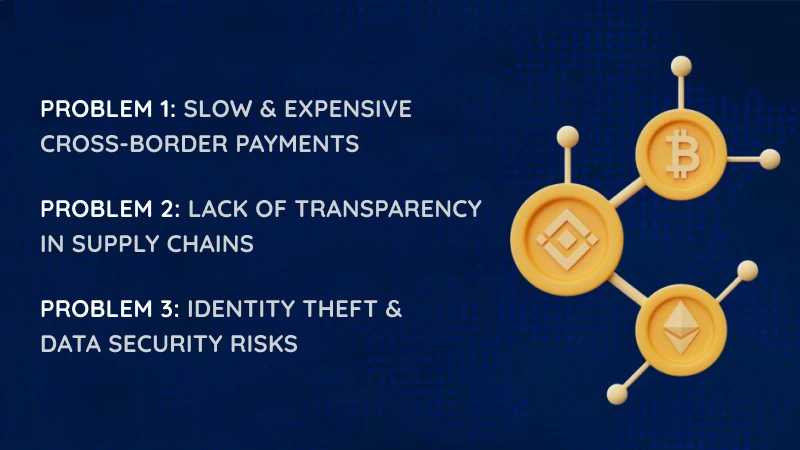
Problem 1: Slow & Expensive Cross-Border Payments
International payments are important for modern businesses. Be that it is paying overseas suppliers, managing remote teams, or serving global customers, companies regularly move money across borders. However, cross-border payment systems are often slow, expensive, and inefficient. Let’s discuss each problem!
- Delays: Traditional international transfers rely on banks and financial intermediaries. This involves multiple verification steps, bank approvals, and currency conversions. As a result, these payments can take 2 to 5 business days to settle.
- High Costs: Businesses incurred fees such as bank charges, intermediary fees, foreign exchange margins, and processing costs. According to the World Bank, the global average cost of sending money internationally is 6.49% of the amount sent, which is quite expensive.
- Lack of Transparency: In addition to the above-mentioned cons, businesses often cannot track exactly where their money is during the transfer process. This leads to uncertainty and operational inefficiencies.
Here’s how blockchain technology solves every problem:
- Blockchain eliminates the need for multiple intermediaries by enabling direct transactions on a decentralized network. Transactions are verified by the network and recorded on an immutable ledger.
- Blockchain-based payments can settle within seconds or minutes. And transaction fees are also lower because there are fewer intermediaries involved.
- Blockchain also provides complete transparency. Every transaction can be tracked in real time, which gives businesses full visibility and improves trust between parties.
Major financial institutions, including Santander and American Express, have already adopted blockchain-based payment solutions to improve speed and efficiency.
Problem 2: Lack of Transparency in Supply Chains
Supply chains are the backbone of global commerce. From raw materials to finished products, goods pass through multiple manufacturers, suppliers, distributors, and retailers before reaching customers.
However, in traditional supply chain systems, data is stored in centralized databases. These systems are not always connected, which creates information gaps and reduces visibility across the entire supply chain.
This leads to several issues, such as:
- Difficulty verifying the origin of products
- Increased risk of counterfeit goods
- Fraud and manipulation of records
- Lack of accountability between suppliers and partners
- Delays in identifying and resolving issues
According to the OECD, global trade in counterfeit and pirated goods has reached USD 467 billion, which highlights the scale of the problem. For businesses, this results in financial losses, damaged brand reputation, and reduced customer trust.
Blockchain provides a shared and immutable ledger where every transaction and the movement of goods can be recorded and verified in real time. Using blockchain in supply chain management can allow participants to add data securely, and once recorded, the information cannot be altered or deleted. This creates a single, transparent source of truth that all parties can trust.
With blockchain, businesses can:
- Track products from origin to final delivery
- Verify authenticity and ownership
- Monitor product handling conditions
- Prevent record tampering and fraud
- Improve accountability across the supply chain
Major global companies like Walmart, IBM Food Trust, and De Beers are already using blockchain to improve supply chain transparency.
Problem 3: Identity Theft & Data Security Risks
Today, identity verification is required for everything from opening a bank account to using online platforms to accessing financial services. However, these identity management systems rely on centralized databases, which often become targets for cybercriminals.
Most organizations store sensitive personal data, such as names, addresses, government IDs, and financial information, on centralized servers. These systems create single points of failure. If the system is hacked, millions of user records can be exposed at once.
Additionally, users have very little control over how their personal data is stored, shared, or used. Once data is submitted to an organization, it can be duplicated, shared, or misused without the user’s full visibility.
Now, let’s understand how blockchain solves these issues:
Blockchain enables the concept of self-sovereign identity, where users have full control over their personal information. Instead of storing sensitive data in centralized databases, blockchain allows identity information to be securely encrypted and controlled by the user.
Blockchain improves identity security by:
- Eliminating centralized data storage, reducing hacking risks
- Allowing users to control access to their personal data
- Using encryption to protect identity information
- Providing tamper-proof verification of identity
Several organizations, like Microsoft and Estonia, and governments are already adopting blockchain-based identity systems to improve security, privacy, and efficiency.
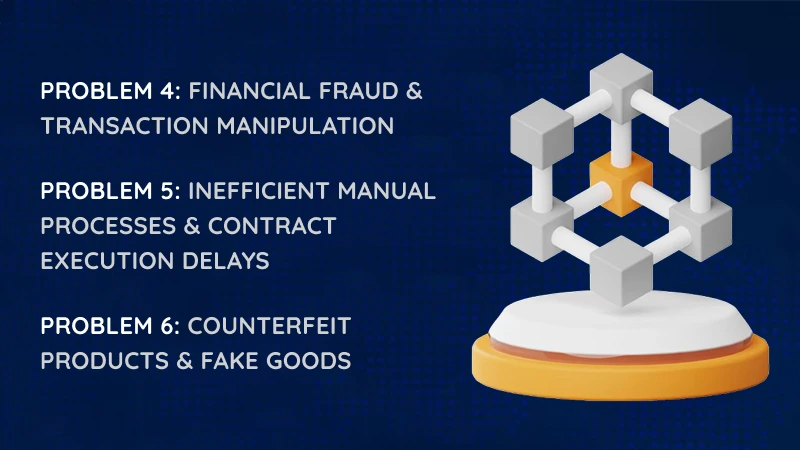
Problem 4: Financial Fraud & Transaction Manipulation
Financial systems process trillions of dollars every day, yet remain vulnerable to fraud, manipulation, and human error. Traditional financial infrastructure, such as banks, payment processors, and other institutions, relies on centralized authorities and manual verification, which can lead to fraud and reduce transparency.
This leads to several major risks:
- Unauthorized transaction manipulation
- Internal fraud or data tampering
- Hidden transaction records
- Delayed fraud detection
- Lack of real-time transparency
Now, let’s see how blockchain solves this problem!
Blockchain creates a tamper-proof and transparent ledger in which every transaction is permanently recorded and cannot be altered once confirmed. Each transaction is verified by the network and cryptographically secured. This makes manipulation extremely difficult.
Key security benefits of blockchain include:
- Immutable transaction records that cannot be changed
- Transparent and verifiable transaction history
- Real-time transaction tracking
- Decentralized validation that removes single points of failure
- Cryptographic security that protects data integrity
Because all transactions are permanently recorded and visible on the blockchain, fraud attempts can be detected immediately. Major financial institutions like JPMorgan and Visa are also integrating blockchain to improve transaction security and transparency.
Problem 5: Inefficient Manual Processes & Contract Execution Delays
Most businesses rely on contracts to define agreements between parties. These govern payments, services, ownership transfers, insurance claims, and other transactions. However, traditional contract execution is often slow, expensive, and dependent on manual processes and intermediaries.
Other than that, traditional contracts require multiple steps to execute. Also, in many cases, third parties such as lawyers, brokers, or banks are involved in verifying and executing these contracts.
This creates several inefficiencies, such as
- Delays in contract execution
- High administrative and legal costs
- Risk of human error
- Lack of real-time execution
- Dependency on intermediaries
Here’s how blockchain solves this problem:
Blockchain introduces smart contracts, which are self-executing programs stored on the blockchain. These contracts automatically execute predefined actions when specific conditions are met.
Because smart contracts run on the blockchain, they cannot be altered once deployed, which ensures secure and reliable execution. It also provides other benefits, like:
- Automatic execution without intermediaries
- Faster processing and settlement
- Reduced administrative costs
- Elimination of manual errors
- Transparent and tamper-proof execution
Ethereum is one of the most widely used blockchain platforms for smart contract execution.
Problem 6: Counterfeit Products & Fake Goods
Counterfeit products are a problem that’s affecting industries such as luxury goods, pharmaceuticals, electronics, and consumer products. Fake goods not only cause financial losses for businesses but also pose serious safety risks to consumers, especially in industries such as healthcare and automotive parts.
In traditional systems, verifying whether a product is genuine or fake can be difficult. Supply chains involve multiple manufacturers, distributors, and retailers, and records are often stored in separate systems that are not fully transparent. This creates opportunities for counterfeit products to enter the supply chain unnoticed.
And businesses suffer major losses due to:
- Revenue loss from fake products
- Damage to brand reputation
- Loss of customer trust
- Legal and compliance risks
This is how blockchain solves this problem:
Blockchain enables businesses to create a secure and transparent record of a product’s entire lifecycle. Each product can be assigned a unique digital identity stored on the blockchain, which cannot be altered.
This allows businesses and customers to verify product authenticity instantly. Also, customers can scan a QR code or product ID and instantly verify whether the product is genuine.
Blockchain provides:
- Tamper-proof product records
- Complete traceability from origin to delivery
- Real-time verification of authenticity
- Transparent supply chain tracking
Many global companies, such as De Beers and luxury brands, are already using blockchain to combat counterfeiting.
Problem 7: Healthcare Data Management & Medical Record Security
The healthcare industry generates and manages vast amounts of sensitive patient data, which includes medical histories, test results, prescriptions, and insurance records. However, traditional healthcare data management systems are often fragmented, insecure, and inefficient, which imposes risks to patients and healthcare providers.
In most healthcare systems, patient records are stored in centralized databases controlled by individual hospitals, clinics, or healthcare providers. These systems are often not connected, which makes it difficult to share patient data securely and efficiently.
This leads to several major problems:
- Patient records scattered across multiple systems
- Difficulty accessing the complete medical history
- Risk of data breaches and unauthorized access
- Lack of patient control over personal health data
- Delays in diagnosis and treatment due to incomplete information
Now, let’s check out how blockchain solves this problem:
Blockchain provides a secure, decentralized, and tamper-proof system for storing and sharing medical records. Instead of storing data in isolated databases, blockchain creates a unified and secure record accessible only to authorized parties.
Blockchain in healthcare helps by:
- Securing patient data with encryption
- Preventing unauthorized modifications
- Enabling secure data sharing between healthcare providers
- Giving patients control over their medical records
- Creating a reliable source of truth
Because blockchain records cannot be altered without authorization, it significantly reduces the risk of data tampering and breaches.
Healthcare organizations such as Pfizer and Chronicled are already adopting blockchain solutions to secure healthcare records.
Problem 8: Lack of Transparency & Trust in Voting Systems
Voting is an important process in governments, organizations, and institutions. Whether it is national elections, corporate voting, or digital governance, the transparency of voting systems is essential. However, traditional voting systems often face challenges related to trust, security, and transparency.
Traditional voting systems, including paper-based and electronic voting, have vulnerabilities. These systems are often controlled by centralized authorities, which creates concerns about data manipulation and fraud. And it imposes several risks, such as:
- Risk of vote tampering or manipulation
- Lack of transparency in vote counting
- Difficulty verifying voting results independently
- Limited auditability and accountability
- Low voter trust in the system
In electronic voting systems, centralized databases can be targeted by hackers, while paper-based systems are slow, costly, and difficult to audit. These challenges reduce confidence in the voting process and can lead to disputes and mistrust.
Here’s how blockchain solves this problem:
Blockchain provides a secure, transparent, and tamper-proof voting system where every vote is recorded on an immutable ledger. Once a vote is recorded on the blockchain, it cannot be altered, deleted, or manipulated.
Blockchain improves voting systems by:
- Creating permanent and tamper-proof voting records
- Enabling transparent vote tracking and verification
- Preventing unauthorized changes or manipulation
- Ensuring accurate and trustworthy vote counting
- Allowing independent verification of results
Corporate governance platforms use blockchain for secure shareholder voting and further improve security, transparency, and trust.
Problem 9: Real Estate Fraud & Inefficient Property Ownership Systems
The real estate industry is one of the largest sectors in the world. According to a report by IBEF, India’s real estate sector recorded Rs. 25,375 crore in property transactions in Q3 2025.
However, traditional real estate systems are often slow, complex, and vulnerable to fraud due to reliance on manual processes, paper-based records, and multiple intermediaries. Also, property ownership records are typically stored in centralized government databases. These records can be outdated, manipulated, or difficult to access. Other challenges come in the way, including:
- Fake ownership claims and document forgery
- Manual verification processes that take weeks or months
- Lack of transparency in ownership history
- High transaction costs due to intermediaries
- Risk of data loss or record tampering
Let’s check out how blockchain solves this problem!
Blockchain provides a secure, transparent, and immutable record of property ownership. Every property transaction is recorded permanently on the blockchain, creating a clear and verifiable ownership history.
Using blockchain in real estate systems helps by:
- Creating tamper-proof ownership records
- Enabling transparent property transaction history
- Reducing dependence on intermediaries
- Accelerating property transfer processes
- Preventing fraud and ownership disputes
Blockchain also enables the tokenization of real estate, which allows properties to be divided into digital tokens. This makes it easier for investors to buy, sell, and manage property ownership digitally.
Several governments and companies, like Dubai Land Department, Propy, and Sweden’s land registry, are already adopting blockchain for real estate.
Problem 10: Lack of Transparency in Charity & Donation Systems
Charities and donation-based organizations play an important role in supporting social causes. However, one of the biggest challenges in traditional donation systems is the lack of transparency in how funds are used and distributed.
In traditional donation systems, once a donor contributes money, they often have limited visibility into where the funds actually go. Donations typically pass through multiple intermediaries, administrative layers, and organizations before reaching the intended beneficiaries.
This creates several concerns:
- Lack of transparency in fund usage
- Risk of fund mismanagement or misuse
- High administrative costs
- Limited accountability
- Reduced donor trust and confidence
Here’s how blockchain helps solve this problem:
Blockchain creates a transparent and traceable record of all transactions, which allows donors to track their contributions in real time. Every donation is recorded in an immutable ledger and ensures that funds cannot be altered, hidden, or misused without detection.
Blockchain improves donation systems by:
- Providing full transparency of fund movement
- Enabling real-time tracking of donations
- Preventing fraud and misuse of funds
- Increasing accountability for organizations
- Building trust between donors and charities
Some organizations, such as UNICEF, Binance Charity, and The Giving Block, are already using blockchain to improve transparency in donations.
Wrapping Up
That’s a wrap for this blog!
As businesses continue to digitize and operate in an increasingly global environment, the limitations of traditional systems are becoming more obvious. Slow payments, fraud risks, lack of transparency, and data breaches are not simple problems; they directly affect growth, trust, and profitability.
This is exactly where blockchain is making a real difference!
It provides a secure, transparent, and tamper-proof infrastructure that allows businesses to operate with greater efficiency, stronger security, and higher trust. Also, it is solving problems that traditional systems have struggled with for decades.
However, implementing blockchain successfully requires the right strategy, architecture, and development expertise. At Technoloader, we help businesses build secure and scalable blockchain solutions tailored to their specific needs.
If you’re ready to explore how blockchain can solve real problems for your business, we are here to help you take the next step. Get in touch!
FAQs
Why are businesses adopting blockchain technology in 2026?
Businesses are using blockchain to reduce fraud, increase transparency, lower transaction costs, and eliminate middlemen. As cybersecurity threats grow and business processes become less efficient, blockchain provides a secure, tamper-proof system that builds trust and speeds up business operations.
Can blockchain reduce fraud and financial losses for companies?
Yes, blockchain records can’t be changed and are easy to see, which makes it very hard to change transactions. This helps stop financial fraud, document tampering, counterfeiting, and unauthorized changes, which cuts down on the money lost due to fraud.
Which industries benefit the most from blockchain solutions?
Blockchain solutions are most useful for businesses in finance, supply chain, healthcare, real estate, and government. It improves payment speed, product traceability, medical data security, property ownership transparency, and secure digital voting systems.
Can blockchain eliminate intermediaries in business transactions?
Yes, in many cases. Blockchain makes it possible for people to trade directly with each other and for smart contracts to run on their own. This reduces the need for intermediaries and operational costs, speeds up settlements, and minimizes human error.
Is blockchain suitable for small and medium-sized businesses?
Yes, blockchain solutions are becoming easier to use and more scalable. SMEs can use blockchain for secure payments, supply chain tracking, smart contracts, and fraud prevention without having to spend a lot of money on infrastructure.

Deepa Manwani
Deepa Manwani is a Technical Content Writer at Technoloader with over 7 years of experience creating high-quality content across Blockchain, Web3, AI, and fintech. She specializes in translating complex technical concepts into clear, engaging, and informative content that helps businesses, developers, and users better understand emerging technologies. Her expertise includes writing technical blogs, technical documentation, whitepapers, platform guides, and in-depth content for crypto exchanges, DeFi platforms, trading systems, and enterprise software solutions. At Technoloader, she contributes to developing strategic content that supports product growth, strengthens brand credibility, and educates users about next-generation technologies shaping the future.
Published in Blockchain Development