 +91 7014607737
 info@technoloader.com






Table of Contents
Will 2026 be the year to witness the comeback of ICOs?
With the passage of time, the ICO (Initial Coin Offering) has undergone a complete transformation. And as we’re moving closer to 2026, ICO launches are not only just about raising funds; they’re often about building trust, real utility, and long-term value.
From AI-powered launch platforms to community-driven funding models, the future of ICOs is filled with new opportunities. So, without waiting for more, let’s break down the top ICO launch trends that will define the future of crypto funding in 2026.
Current Market Sentiment Towards ICOs
From the year 2017 to 2026, ICOs have gained massive attention in the crypto blockchain ecosystem.
Initially, blockchain-based startups discovered a new way to raise funds without relying on traditional banks or venture capitalists. Anyone, from anywhere in the world, could invest in a project using cryptocurrency. This openness boosted innovation and has created significant challenges.
Over time, many ICOs launched with little oversight. Whitepapers were often unclear, smart contracts were not properly audited, and investor protection was minimal. Scams, failed projects, and market crashes continue to damage the trust in ICOs.
Nevertheless, ICOs have continued to evolve. Today, they remain one of the most disruptive capital-raising mechanisms, especially for projects focused on blockchain and emerging technologies.
This widespread adoption of digital assets across the globe has formed a fertile environment for ICOs to thrive. Unlike traditional funding channels, ICOs enable faster capital inflow, enabling projects to close funding rounds in weeks rather than months.
Key Reasons Why ICOs Can Still Be Able to Stand Out
- Inclusive Funding: ICOs provide investment opportunities to a wider global audience through online participation.
- Immediate Liquidity: As soon as ICO tokens are issued, they can be traded on a number of exchanges, giving investors quick access to liquidity.
- Transparent Transactions: Blockchain’s immutable ledger ensures that every token transaction is recorded, enhancing trust and accountability.
Emerging ICO Launch Trends in 2026
Since the crypto funding landscape continues to mature far beyond the speculative frenzy of the past, a new blueprint for token launches is emerging. Which include:
The Compliance-First Launch Strategy
The era of “launch now & explain later” is finally coming to an end. In 2026, founders are entering a space where regulatory compliance is the foundation of a project’s legitimacy.
- On-Chain KYC/AML: Identity verification is no longer part of a separate website process. It’s now integrated directly into the token’s smart contract. Which means tokens now remain locked or non-transferable. Until a user’s wallet passes real-time compliance checks.
- Regulatory Green Zones: Projects are now drawn to countries with well-defined frameworks that offer a “safe harbor” for the lawful issuance of tokens, like the EU, Hong Kong, and the UAE.
RWA Tokenization: Real-World Asset Backing
One of the most disruptive trends of 2026 is the shift toward Real-World Assets. Investors are now demanding tokens backed by tangible value rather than just ecosystem utility.
- Fractionalized Ownership: ICOs are increasingly launching tokenized assets like real estate, energy credits, treasury bills, and intellectual property.
- Hybrid Value Models: These tokens combine traditional yield from underlying assets with crypto-native utilities such as governance rights or protocol access.
AI-Driven Tokenomics and Auditing
AI (Artificial Intelligence) has become the “secret sauce” behind the success of ICOs. And the primary reason is:
- AI Risk Scoring: Investors now rely on AI tools to scan whitepapers and smart contracts for red flags, generating instant transparency and risk management before committing funds.
- Automated Market Simulation: Launching teams are using AI to simulate thousands of economic scenarios, ensuring their token’s supply and demand curve is sustainable under market stress.
Multi-Chain Launchpads as Gatekeepers
Single-chain launches (on platforms like Ethereum or Solana) are becoming less common. The new standard, Multi-Chain Launchpad, is enabling projects to raise capital across multiple Layer-1 and Layer-2 simultaneously.
- Fully-Service Ecosystems: Modern launchpads act as accelerators, offering bundled services such as audits, liquidity planning, and marketing support.
- Milestone-Based Funding: This helps investors to easily release smart contracts once the predefined roadmap milestones are achieved.
Programmable Stablecoins as the Default Rail
While earlier ICOs accepted volatile assets like ETH or SOL, in 2026, launches are increasingly using stablecoins.
- Dynamic Pricing Models: Token prices can adjust in real time based on demand, with transactions settled instantly in stablecoins to reduce volatility risks.
- Smart Disclosures: Regulatory-friendly stablecoins enable “smart disclosures,” wallet-level labels, similar to nutrition facts, that display a token’s risk profile before purchase.
Utility-First & Revenue-Generating Token Models
The time of tokens that are just for fun and have no real use is coming to an end. In 2026, ICOs are meant to be useful right away and create long-term value.
- Built-In Use Cases: You will need tokens from the start to use the platform, pay protocol fees, take part in governance, and get premium features.
- Revenue Participation: Many projects are now giving token holders a share of the ecosystem’s revenue through staking rewards, fee distribution, or yield-based incentives.
Investor Protection Through Smart Contract Architecture
In the success of ICOs, trust plays a very important role. Projects do not just make promises; often, they put protections for investors right into smart contracts.
- Auto Vesting & Lockups: Team and advisor tokens are locked for a set amount of time by default, which stops people from selling them too soon and makes sure that everyone’s long-term goals are the same.
- Fail-Safe Mechanisms: Some ICOs have clauses that let them pause, refund, or release funds based on milestones if development goals aren’t met. This makes things clearer and more accountable.
DAO-Native Fundraising Models
Decentralization starts at the fundraising stage in 2026, not after the token launch.
- Community-Governed Treasuries: Token holders can vote on how the money that is raised is spent, from grants for the ecosystem to budgets for development.
- Launch-as-a-DAO: Many projects skip the usual corporate structures and launch as DAOs right away, with fully open on-chain governance from the start.
Privacy-Preserving Investor Verification
While regulatory compliance is mandatory, privacy is still a core value in crypto. ICOs are widely adopted privacy-first verification frameworks that balance both.
- Zero-Knowledge KYC: Investors can show they meet regulatory requirements without even putting their personal information on-chain, which lowers the risk of identity theft and data leaks.
- Selective Disclosure Wallets: Wallet-based controls that allow users to choose what information is shared, when, and with whom.
Memecoins: From Hype Assets to Community Economies
Although memecoins are still feasible in 2026, they’ve progressed beyond pure conjecture.
- Utility-Enabled Memecoins: Successful memecoins now offer practical applications like social tipping, gaming rewards, DAO governance, and NFT access.
- Community-First Launches: Fair distribution models, transparent tokenomics, and minimal insider allocation are critical to building trust and long-term engagement.
Challenges & Risks in Future ICO Launches
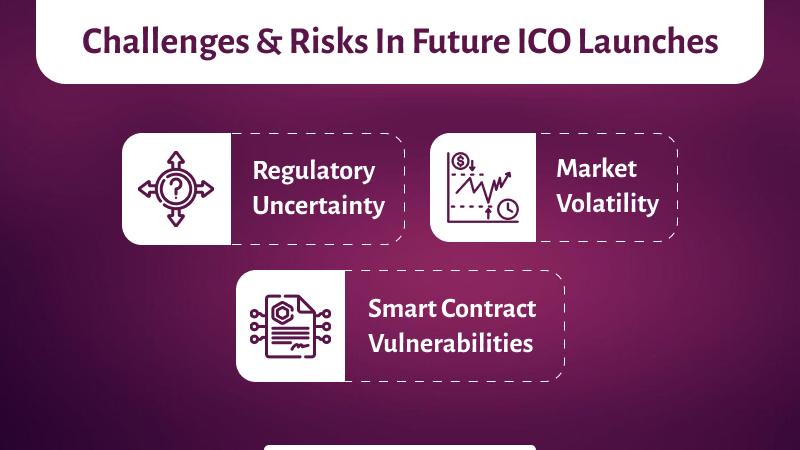
Even though ICOs are becoming more advanced and structured by 2026, they’re not completely risk-free. Projects are still facing several challenges that might come out as a major factor in the success.
- Regulatory Uncertainty: Crypto regulations differ from country to country and keep changing. A project that is compliant in one region may face restrictions in another. Sudden regulatory changes can delay launches, limit investor participation, or even cause projects to shut down if compliance is ignored.
- Market Volatility: The crypto market is highly volatile. Token prices can fluctuate rapidly due to market sentiment, macroeconomic factors, or industry news. This volatility can impact fundraising outcomes and investor confidence during an ICO.
- Smart Contract Vulnerabilities: Smart contracts power ICOs, but poorly written or unaudited code can lead to hacks, fund losses, or exploits. Even a small vulnerability can damage a project’s credibility and result in financial loss.
Best Practices for Launching a Successful ICO in 2026
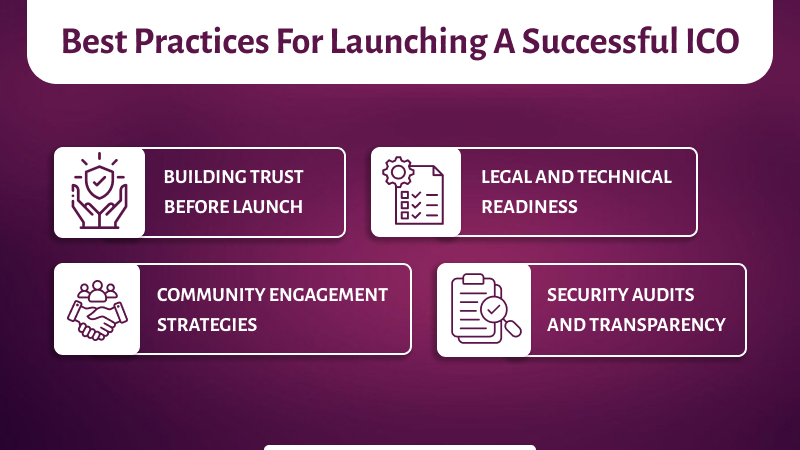
In this competitive market, you’re likely to stand out and be the top preference of users, so here are some best practices you must follow in 2026; all these practices will help in building trust, security, and long-term value.
- Building Trust Before Launch: Trust always plays a crucial role in the token sale. Consider keeping clear documentation, a strong ICO whitepaper, transparent team details, and a clear roadmap to help investors feel confident about the project’s vision and credibility.
- Legal and Technical Readiness: Legal compliance and technical stability are very crucial. This can include KYC/AML implementation, regulatory consultation, and deploying secure, scalable smart contracts that can manage real-world usage.
- Community Engagement Strategies: In every ICO development, a strong and active community plays a vital role. This will help engage new users from social media, AMAs, Discord, and governance opportunities, helping build long-term support rather than short-term hype.
- Security Audits and Transparency: Regular third-party audits, open-source contracts, and transparent fund usage reports reassure investors that their funds are safe. Here, transparency strengthens credibility and reduces fear of scams or misuse.
Conclusion
Here comes the end of this comprehensive guide. Throughout the blog, we’ve shared all the essential information related to top ICO launch trends to watch in 2026. Through a compliance-first launch strategy, RWA tokenization, AI-driven tokenomics, and multi-chain launchpads, ICO will undoubtedly bring about significant changes.
In contrast, if you plan to implement these approaches, then Technoloader can help you launch future-ready ICOs by combining regulatory-compliant frameworks, secure smart contracts, advanced tokenomics, and end-to-end ICO launch support. With more than 8+ years of experience in blockchain development, we empower projects to move beyond hype and build ICOs that deliver real value, credibility, and sustainability.
In short, 2026 isn’t just the year of ICO revival; it’s the year of ICO reinvention. Let’s partner with us and build an ICO that can be part of the next generation of trusted, scalable crypto funding.

Kanak Badaya
Kanak Badaya is a Technical Content Writer at Technoloader with over 3 years of experience translating complex technology into content that actually makes sense. He works closely with emerging domains like Blockchain, Web3, AI, and DeFi, turning intricate technical concepts into clear, structured, and engaging narratives that help businesses communicate with confidence. Rather than just writing for search engines, Kanak focuses on writing for people. He combines in-depth research with a practical understanding of the industry to create blogs, website content, and technical guides that inform, educate, and build credibility. His goal is simple - make advanced technology feel approachable while helping Technoloader strengthen its authority in the digital space.
Published in ICO Development Services


