 +91 7014607737
 info@technoloader.com





Table of Contents
In this fast-paced world, blockchain and AI (artificial intelligence) are among the most revolutionary technologies shaping the modern digital landscape.
While AI is focusing on building intelligent decision-making and automation, blockchain is ensuring transparency, decentralization, and security.
When we combine AI and blockchain technology, we build a powerful ecosystem where data is trusted, analyzed, and used intelligently, from improving transaction security to automating smart contracts and improving scalability. The integration of these two technologies is redefining digital innovation.
If we look at the global AI for blockchain market, it was valued at USD 657 million in 2025 and is anticipated to grow to USD 843 million in 2026, reaching USD 3,460 million by 2034.
These numbers do not just define the market growth; they clearly reflect the rising demand for smarter, more secure, and data-driven blockchain systems powered by artificial intelligence.
In this guide, we will uncover the core role of AI in blockchain development, real-world use cases, and so forth.
What Is Blockchain Technology?
Blockchain is a digital record-keeping system that stores information in a secure and transparent way.
Instead of saving data in one central place (like a traditional database), blockchain stores data across many computers connected to a network. Once data is added, it cannot be easily changed or deleted.
Let’s understand how blockchain works
Blockchain technology usually works by grouping data into blocks. Each block contains transaction details and is connected to the previous block, forming a chain.
- Blocks store data like transactions or records
- Nodes are computers that keep a copy of the blockchain
- Decentralized means no single authority controls the data
When a new transaction happens, it is verified by the network and then added as a new block, making the system secure and trustworthy.
Key Features of Blockchain Technology
- Decentralization: Blockchain does not rely on a single server or organization. Data is shared across multiple nodes, which reduces the risk of failure, hacking, or manipulation.
- Transparency: All transactions recorded on a blockchain are visible to network participants. This openness helps build trust because data can be verified by anyone on the network.
- Security: Blockchain uses encryption and consensus mechanisms to protect data. Each block is securely linked to the previous one, making unauthorized changes extremely difficult.
- Immutability: Once data is recorded on the blockchain, it cannot be altered or erased. This ensures data integrity and prevents fraud or tampering.
Common Real-World Uses of Blockchain
In 2026, blockchain technology is widely used in many industries, including:
- Cryptocurrencies and digital payments
- Secure healthcare record management
- Supply chain tracking and logistics
- Smart contracts and decentralized applications (dApps)
- Digital identity verification
As you’re clear with what blockchain technology is, now let’s understand what artificial intelligence is.
What Is Artificial Intelligence (AI)?
Artificial Intelligence (AI) refers to machines or software that can think, learn, and make decisions like humans. Instead of following fixed instructions, AI systems analyze data, recognize patterns, and improve their performance over time. This makes AI useful for automatically solving complex problems. Businesses are increasingly adopting AI solutions to automate processes, analyze data, and build intelligent applications.
As we’re discussing AI, some people are quickly confused between AI, ML (Machine Learning), and DL (Deep Learning). So, you must know that these technologies are not the same.
- AI is the broader concept of making machines intelligent.
- Machine learning is a part of AI where systems learn from data instead of being manually programmed.
- Deep learning is a subset of ML that uses neural networks to process large amounts of data, similar to how the human brain works.
In short: AI → Machine Learning → Deep Learning
How AI Systems Learn From Data
AI systems learn by analyzing large amounts of data and finding patterns. Firstly, they connect data and process. Then, algorithms are trained to make predictions or decisions. And with time, AI improves its accuracy by learning from past results and correcting mistakes.
Here are some everyday examples of AI
AI is already part of daily life; it’s helping us as:
- Recommendation systems suggest videos, products, and music.
- Chatbots answer customer questions instantly.
- Fraud detection systems identify suspicious banking or crypto transactions.
- Voice assistants like smart speakers understand and respond to commands.
Why Do Blockchain and AI Need Each Other?
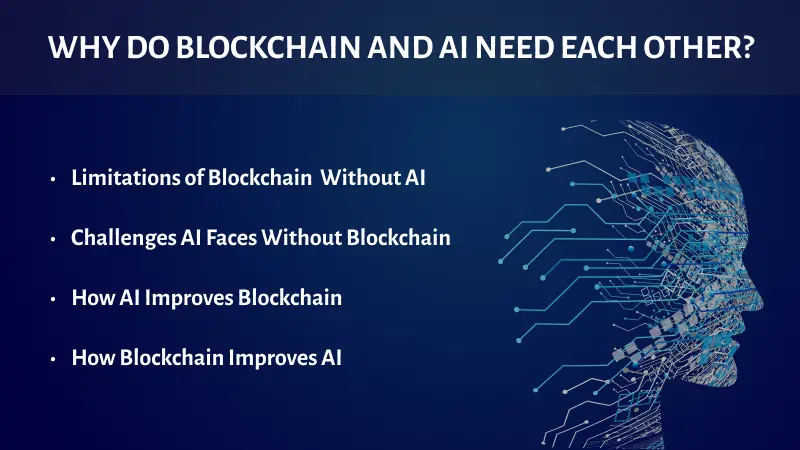
As blockchain ensures data integrity and high security, artificial intelligence can help analyze and interpret data for better decision-making. Together, they can solve each other’s weaknesses and make the system smarter, safer, and more efficient.
Limitations of Blockchain Without AI
Blockchain is very secure and transparent, but it lacks intelligence. It can store and verify data, but it cannot analyze patterns, predict risks, and make smart decisions on its own.
Managing large blockchain networks, detecting fraud manually, or optimizing performance can become slow and complex. Without AI, blockchain systems depend heavily on human input, which limits automation, scalability, and real-time problem-solving.
Challenges AI Faces Without Blockchain
AI works on data, but the biggest issue is data trust. If the data used to train AI is altered, biased, or fake, AI decisions become unreliable. Without blockchain, it is difficult to verify data sources or track changes.
This creates transparency and security problems. AI systems may make correct calculations but still produce wrong outcomes because the underlying data cannot always be trusted.
How AI Improves Blockchain
AI adds intelligence and automation to blockchain systems. It helps analyze large volumes of blockchain data, detect suspicious transactions, and predict network issues before they occur.
AI can also optimize smart contracts, reduce transaction delays, and improve scalability. By automating complex processes, AI makes blockchain networks faster, more efficient, and easier to manage without constant human monitoring.
How Blockchain Improves AI
Blockchain strengthens AI by providing secure, transparent, and tamper-proof data. It ensures that the data used by AI models is authentic and unchanged. Blockchain also records AI decisions and actions, making them traceable and accountable.
This improves trust in AI systems, especially in sensitive industries such as finance and healthcare, where data accuracy, security, and transparency are critical.
As you’ve understood why blockchain and AI need each other, it’s now time to understand AI’s role in blockchain.
Role of AI in Blockchain Development
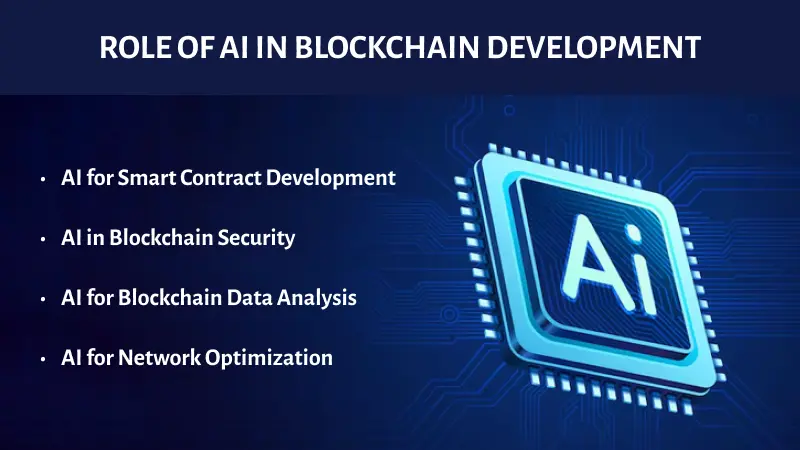
Blockchain technology is widely recognized for its security and transparency, but on its own, it also follows certain fixed rules and lacks intelligence. This is where AI plays a powerful role. By integrating AI into blockchain systems, they become smarter, faster, and more efficient.
Meanwhile, AI helps automate processes, analyze large amounts of data, improve security, and optimize network performance. Together, they form advanced solutions that go beyond basic data storage and enable intelligent decision-making.
Here’s how AI helps in blockchain:
AI for Smart Contract
AI helps developers create better and safer contracts. It can automatically check contract codes for errors, bugs, or security loopholes before deployment.
AI tools also help optimize contract logic, making execution faster and more cost-efficient. For beginners, consider AI to be a smart assistant that reviews smart contracts, reduces human mistakes, and ensures contracts behave exactly as intended on the blockchain.
AI in Blockchain Security
AI plays a major role in protecting blockchain networks from fraud and attacks. It continuously monitors transactions and user behavior to identify suspicious activities, such as hacking attempts or fake transactions.
Unlike manual checks, AI can detect threats in real time. This improves overall network safety, prevents financial losses, and strengthens trust, especially in crypto exchanges, DeFi platforms, and blockchain-based financial systems.
AI for Blockchain Data Analysis
Blockchain networks generate vast amounts of data, which is difficult to analyze manually. AI helps by analyzing blockchain data, identifying patterns, and predicting trends. It can track transaction behavior, network performance, and user activity.
This helps businesses and developers make better decisions, improve system efficiency, and understand how users interact with blockchain applications more meaningfully.
AI for Network Optimization
AI improves the speed, scalability, and performance of blockchain networks. It helps manage network traffic, optimize resource usage, and reduce transaction delays. AI can also predict congestion and adjust operations automatically.
This results in lower transaction fees, faster confirmations, and smoother performance. Overall, AI makes blockchain networks more efficient and capable of handling large numbers of users simultaneously.
How AI Improves Smart Contracts
Smart contracts are self-executing programs that run on blockchain, but they usually have fixed rules. AI makes smart contracts more intelligent and flexible. With AI, smart contracts can analyze data, detect errors, and respond to real-world situations automatically. This reduces manual work, improves accuracy, and makes contracts more reliable for complex use cases like finance, healthcare, and supply chains.
- Makes Smart Contracts More Intelligent: AI allows smart contracts to move beyond fixed rules. They can analyze data, recognize patterns, and make better decisions automatically. This helps contracts handle complex situations like pricing changes, risk evaluation, and dynamic agreements.
- Automates Contract Execution Using Real-World Data: AI enables smart contracts to use real-time data such as market prices, delivery updates, or user behavior. Contracts can then execute actions automatically when conditions change, making them more practical, responsive, and efficient.
- Improve Smart Contract Security and Accuracy: AI scans smart contracts to detect bugs, logic errors, and security risks before deployment. This breaks down human mistakes, prevents potential losses, and ensures contracts work correctly and securely on the blockchain.
- Simplifies Auditing and Maintenance: AI helps audit smart contracts by continuously monitoring performance and transactions. It detects unusual activity early, helps maintain contract health, and reduces the need for manual checks, saving time and effort.
AI in Decentralized Applications (dApps)
AI helps dApps become smarter and more interactive. It allows applications to analyze user behavior, automate tasks, and make decisions in real time. This improves performance and makes dApps more useful than traditional rule-based blockchain applications.
- Personalized and Better User Experience: AI enables dApps to offer personalized experiences. It can suggest relevant features, content, or services based on users’ preferences and past activity. This makes decentralized apps easier to use, especially for beginners who may find blockchain platforms complex.
- AI-Powered Recommendations in dApps: With AI, dApps can recommend tokens, NFTs, games, or financial options to users. By analyzing data patterns, AI helps users discover better opportunities. This is commonly used in DeFi platforms, NFT marketplaces, and Web3 gaming applications.
- Use Cases of AI-Powered dApps: AI-powered dApps are widely used in DeFi, blockchain gaming, and NFTs. In DeFi, AI helps manage risks and predict trends. In gaming and NFTs, it creates smarter characters, dynamic assets, and more engaging user experiences.
Role of AI in Blockchain Mining and Consensus
AI helps mining systems work more efficiently by optimizing hardware usage and mining strategies. It can predict the optimal time and method for mining blocks, reduce errors, and improve overall performance without constant manual adjustments.
- Energy Optimization Using AI Algorithms: Blockchain mining consumes a lot of energy. AI algorithms analyze power usage and adjust operations to reduce waste. This helps mining systems use electricity more efficiently, lowering energy consumption while maintaining stable and secure blockchain operations.
- AI in Proof-of-Work and Proof-of-Stake Systems: In Proof-of-Work, AI optimizes computing power to reduce unnecessary calculations. In Proof-of-Stake, AI helps select validators more efficiently by analyzing network data. This improves speed, security, and fairness in consensus mechanisms.
- Reducing Costs and Environmental Impact: By optimizing energy usage and system performance, AI helps lower mining costs. Reduced power consumption also decreases carbon emissions, making blockchain networks more environmentally friendly and sustainable for long-term growth.
Real-World Use Cases of AI in Blockchain
AI and blockchain are not just theoretical technologies; they’re already being used together in real industries. From finance to healthcare, this powerful combination is solving real-world problems by improving security, automation, and decision-making. Here are some real-world use cases of blockchain:
AI + Blockchain in Finance
In finance, AI and blockchain work together to enhance security, automate processes, and improve decision-making. AI analyzes transaction patterns to detect fraud, predict risks, and optimize trading strategies.
Blockchain ensures all financial data is secure, transparent, and tamper-proof. This combination is widely used in crypto exchanges, DeFi platforms, lending systems, and automated trading, making financial services safer, faster, and more reliable for users.
AI + Blockchain in Healthcare
AI helps analyze medical data, while blockchain in healthcare ensures that this data remains secure and unchanged. It can assist doctors with diagnosis and treatment predictions, and blockchain safely stores patient records.
This ensures privacy, data accuracy, and controlled access. Together, they help healthcare providers share data securely, reduce errors, and give patients more control over their medical information.
AI + Blockchain in Supply Chain
In supply chains, blockchain tracks products from origin to delivery, ensuring transparency. AI analyzes this data to predict delays, manage demand, and optimize logistics. Businesses can identify problems early, reduce losses, and improve efficiency.
This combination is especially useful in food safety, manufacturing, and global logistics, where trust and real-time insights are critical.
AI + Blockchain in Cybersecurity
AI detects threats by identifying unusual behavior or attack patterns, while blockchain secures identities and access records. Blockchain stores authentication data safely, and AI continuously monitors systems for risks.
This helps prevent hacking, identity theft, and data breaches. Together, they create stronger, smarter security systems for digital platforms and Web3 applications.
Benefits of Using AI in Blockchain
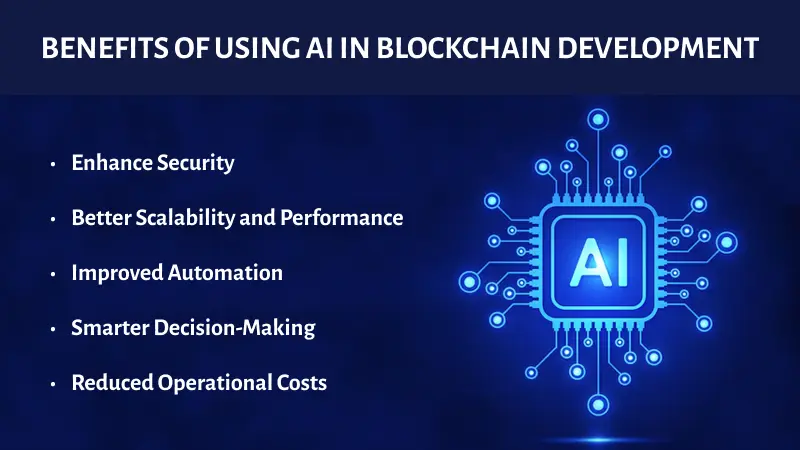
- Enhance Security: AI detects fraud, suspicious transactions, and network threats in real time, making blockchain systems safer and more reliable for users and businesses.
- Better Scalability and Performance: AI optimizes network traffic and resource usage, helping blockchain platforms handle more transactions faster without performance issues.
- Improved Automation: AI automates smart contracts, monitoring, and decision-making processes, reducing manual work and improving system efficiency.
- Smarter Decision-Making: By analyzing blockchain data, AI provides valuable insights that help businesses make informed, data-driven decisions.
- Reduced Operational Costs: AI improves efficiency and automation, lowering development, maintenance, and operational costs over time.
Challenges of Integrating AI with Blockchain
- Higher Development Complexity: Combining AI with blockchain requires advanced technical skills, making development and integration more complex and time-consuming.
- Data Privacy Concerns: Handling sensitive data across AI and blockchain systems raises privacy and compliance challenges if not managed properly.
- Scalability Limitations: Both AI processing and blockchain networks require high computational resources, which can affect performance and scalability.
- High Costs of AI Models: Developing and maintaining AI models can be expensive due to infrastructure, training, and ongoing optimization needs.
- Lack of Skilled Professionals: There is a shortage of experts with knowledge of both AI and blockchain, slowing adoption and increasing hiring costs.
Conclusion
The merging of AI and blockchain is a big step forward in the growth of technology.
While blockchain ensures that all things are clear and safe, AI is adding automation, adaptability, and predictive intelligence. Combining their work makes the decentralized system trusted, improved, and easy to use.
In today’s time, businesses need to adopt AI-driven blockchain not because it’s new but because it’s necessary to stay competitive. So, to implement these solutions, all you need is the right partner.
So, with 8+ years of experience and over 450 successful project creations, Technoloader is here to provide you with the ideal solution.
FAQs
What is the role of AI in blockchain?
AI plays an important role in blockchain by making systems smarter and more efficient. It helps detect fraud, improve security, analyze blockchain data, automate smart contracts, and optimize network performance. Making blockchain more reliable and scalable.
How does AI improve blockchain security?
AI improves blockchain security by monitoring transactions and network activity in real time. It can quickly detect unusual patterns, fraud attempts, and potential cyberattacks. Helping prevent data breaches and protecting user funds and information.
Can AI make smart contracts smarter?
Yes, AI can make smart contracts smarter by helping them analyze data, detect errors, and respond to real-world conditions automatically. This makes smart contracts more flexible, accurate, and useful for complex applications.
Is AI-blockchain integration secure?
Yes, AI-blockchain integration can be secure when it is implemented properly. Blockchain protects data with transparency and encryption, while AI monitors systems for risks and unusual activity, helping improve overall security, reliability, and trust.
What industries benefit most from AI and blockchain?
Industries like finance, healthcare, supply chain, and gaming benefit the most from AI and blockchain. AI helps analyze data and automate processes, while blockchain ensures secure, transparent, and reliable data management across these sectors.
Is AI necessary for future blockchain platforms?
AI is rapidly becoming essential rather than merely optional for the future of blockchain platforms. While blockchain offers a decentralized, secure, and immutable foundation, it faces limitations in scalability, data analysis, and user experience. This integration of AI brings the necessary intelligence to automate and optimize these networks, driving them toward a more functional, high-performance future.

Kanak Badaya
Kanak Badaya is a Technical Content Writer at Technoloader with over 3 years of experience translating complex technology into content that actually makes sense. He works closely with emerging domains like Blockchain, Web3, AI, and DeFi, turning intricate technical concepts into clear, structured, and engaging narratives that help businesses communicate with confidence. Rather than just writing for search engines, Kanak focuses on writing for people. He combines in-depth research with a practical understanding of the industry to create blogs, website content, and technical guides that inform, educate, and build credibility. His goal is simple - make advanced technology feel approachable while helping Technoloader strengthen its authority in the digital space.
Published in AI Development and Blockchain Development


