 +91 7014607737
 info@technoloader.com





Table of Contents
Imagine earning money by just playing your favourite video games! Sounds fun, right? Well, that’s the exact promise that blockchain games make!
With the global blockchain gaming market expected to grow from USD 4.12 billion in 2023 to a staggering USD 898.9 billion by 2033, this isn’t just a trend but a revolution. Backed by a projected compound annual growth rate (CAGR) of 71.35%, blockchain gaming is becoming a place for serious gamers.
You may ask, how can video games incorporate something like blockchain technology? And why is everyone suddenly talking about blockchain games?
Let’s get answers to these through this blog!
The Evolution of Gaming: From Traditional to Blockchain
A video game is an electronic game with an interface designed for human interaction on a video device, such as a TV or computer screen. Video games are used by researchers, scientists, the military, and people like you. Their evolution is spread across arcades, consoles, computers, mobile phones, tablets, and all kinds of other electronic media consumption devices.
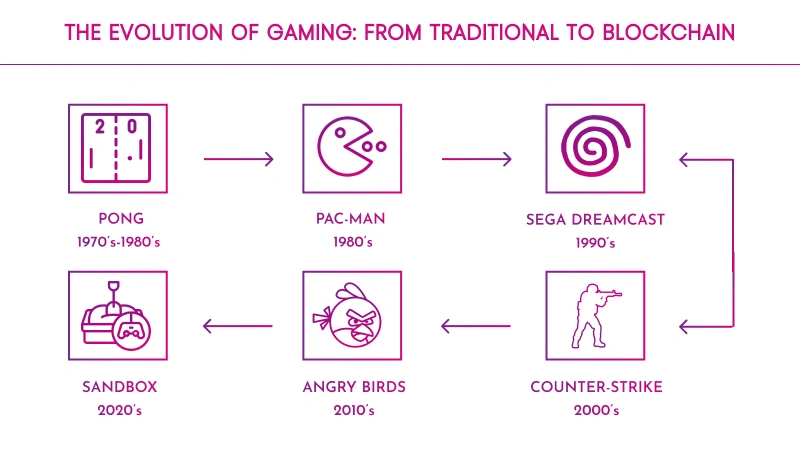
1970s-1980s: Early Video Game Era
- Atari released its first ever arcade game called Pong, and it was the first ever commercially successful video game.
- Games were greyscale or of a monotone.
- Only single-player games dominated the market.
1980s: Golden Age of Arcade
- Pac-Man was launched this decade, and it is still a video game cult favourite.
- The first video games came with colour and a storyline, wherein, in this era, Donkey Kong by Nintendo is one example.
1990s: The Home Game Console Revolution
- During this decade, the home gaming console players, like the Sega Dreamcast in 1996, Nintendo 64 (1996), and Sony PlayStation (1994), made their entry into the market.
- Moved to more immersive gameplay with intensive graphics and support for multiple players to enjoy playing simultaneously.
2000s: Online Era of Gaming
- Titles like Counter-Strike and Call of Duty were released in this era.
- Saw the inception of esports with video games like Counter-Strike and League of Legends.
2010s: Best Year in Gaming
- With the introduction of the first iPhone, we saw a big rise in mobile gaming and titles like Angry Birds in 2009, Cut the Rope (2010), and Fruit Ninja (2010).
- In this year came the concept of freemium apps with in-app purchases for microtransactions for digital assets.
2020s: The Breakthrough of Blockchain with Gaming
- This year came the merger of blockchain technology with online gaming, offering ownership to the in-game items with NFTs.
- Games like The Sandbox, Splinterlands, and Decentraland are some of the most popular blockchain games that incorporate play-to-earn, where players can earn cryptocurrency or other digital assets.
An Overview of Blockchain Games
Blockchain is needed for games because it enables true ownership of in-game assets, allowing players to securely own, trade, and transfer items without relying on a centralized authority. It ensures transparency and fairness through immutable records, preventing fraud and manipulation. Blockchain also supports play-to-earn models, giving players real-world value for their in-game achievements.
The basic idea of blockchain in gaming is that you can start playing for free or pay a small upfront cost, often in crypto, to play the game, and as you play, you earn in-game assets in the form of NFTs. In case you don’t know what an NFT is, it is like crypto and stored on a blockchain, but unlike crypto, each NFT is unique.
So there are often artworks, songs, or even memes. For gaming, NFTs are in-game items like equipment, keys, crafting material, cosmetics, or other collectibles.
But you may wonder, how exactly is this different from the more familiar system of earning items in games through play or microtransactions with regular in-game currency? Well, probably the biggest difference is that because the assets are stored on a public blockchain, with Ethereum being particularly popular, players own the assets that they earn.
Even if something happens to the game server or even if developers decide to remove the game, your item will still exist on the blockchain, still having value as long as there is demand. This is one of many benefits of blockchain in online gaming.
How is Blockchain Used in Gaming?
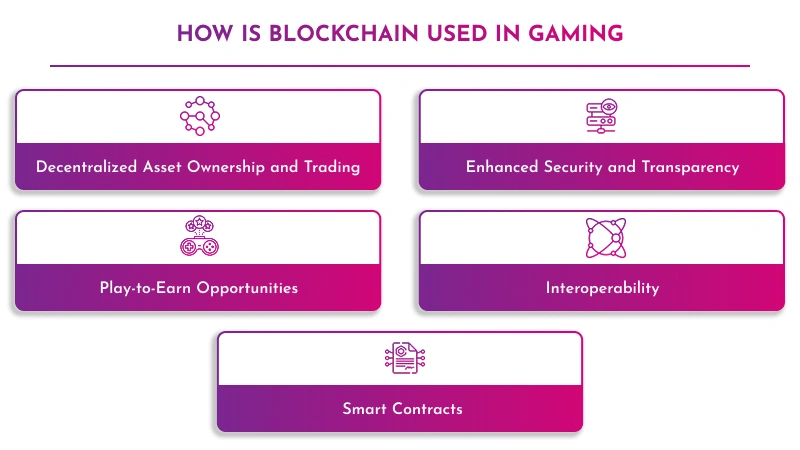
Blockchain is transforming gaming by introducing transparency, decentralized ownership, secure transactions, and a new monetization policy along with security. Let’s see how the gaming industry is using blockchain:
Decentralized Asset Ownership and Trading
- Blockchain has enabled players to truly own their in-game items in the form of NFTs, which they retain ownership of even if the game is pulled from the internet by developers.
- These NFTs can be bought and sold on a decentralized platform, either inside the game or outside on the blockchain.
- You can even use these assets inside other blockchain games by different developer studios.
Enhanced Security and Transparency
- Blockchain improves security and transparency in internet games by using its decentralized servers and immutable ledger.
- This makes the environment safe and more reliable by drastically reducing the chances of fraud, asset duplication, and cheating.
Play-to-Earn Opportunities
- Blockchain games are often incorporated with a “play-to-earn’ model, where players are rewarded with in-built NFT assets or cryptocurrency.
- This creates an opportunity for players to monetize their gaming skills and earn
- For example, players can earn cryptocurrency for clearing a difficult level or winning an esports tournament.
Interoperability
- Blockchain protocols allow NFTs to be recognized by various platforms and games.
- Players could possibly use their assets from one game in the other games, hence making a more connected ecosystem.
Smart Contracts
- Smart contracts are self-executing programs that are stored on a blockchain; they allow developers to automate in-app purchases, enforcing the rules of a game or transactions.
- These enable trustlessness and transparency in the interaction, ensuring that all these are executed without the need for intermediaries.
Key Benefits of Blockchain in Gaming
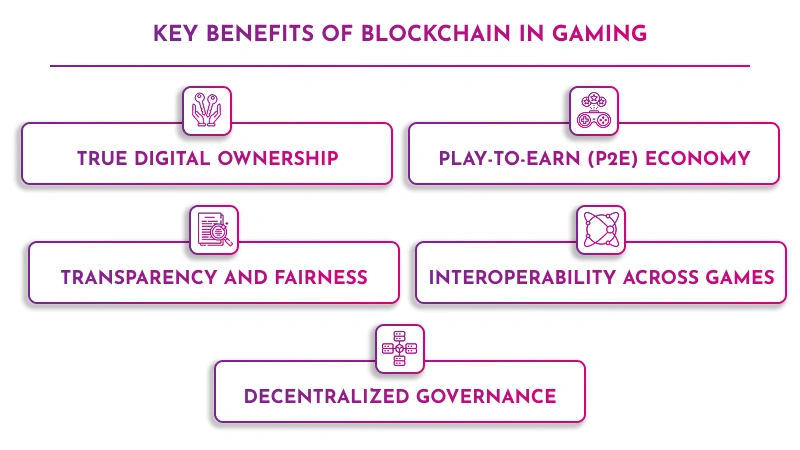
- True Digital Ownership
True digital ownership in blockchain games refers to players having verifiable and permanent ownership of in-game titles, secured as non-fungible tokens (NFTs) on a blockchain. This means that players can actually own, trade, and transfer their digital assets between different games, unlike traditional games, where this is tied to a single platform.
- Play-to-Earn (P2E) Economy
The play-to-earn games allow players to have true ownership, transparency, and new monetization opportunities for players. By allowing players to own, trade, and potentially earn real-world value from in-game assets.
- Transparency and Fairness
Through decentralization and immutable ledgers, it enables players to independently confirm game results and transactions. Blockchain technology has vastly improved transparency and fairness in gaming.
- Interoperability Across Games
The ability for players to move and utilize their digital assets, such as NFTs, between games and platforms is known as interoperability in blockchain games. This implies that a virtual piece of land could act as a hub for different game experiences or that a player skin acquired in one game might be used in another.
- Decentralized Governance
Decentralized governance refers to giving the authority to players and the community, rather than a single corporation or developers, to make decisions about how a game will evolve. This is usually done through decentralized autonomous organizations (DAOs).
Real-World Examples of Blockchain Games
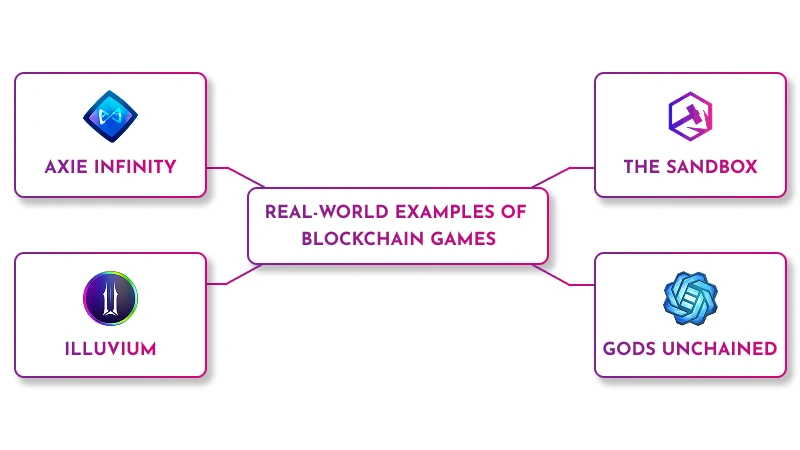
1. Axie Infinity: Axie Infinity is one of the most famous NFT games of all time, which was developed by the Sky Mavis game studio. It promises a player controlled economy facilitated through blockchain technology. Axie Infinity peaked in popularity in 2021, with almost 3 million players per month.
2. The Sandbox: This is one of the most liked versions of a constantly expanding collection of metaverses and has partners like Adidas, Snoop Dogg, and Atari, to mention a few. Here players can build, own, and monetize their gaming on the Ethereum blockchain.
3. Illuvium: Illuvium was initially announced in early 2021, with a promised full release in 2023. Illuvium is more than a game; it is an IBG (Interoperable Blockchain Game). The game sold over $120 million in virtual land and NFTs for this unreleased game, which does not include the additional $60 million they secured from the venture capital investors.
4. Gods Unchained: Gods Unchained is a digital trading card game, opened for public release in 2019, giving players true ownership of their collection, play for keeps, or even trade on the open market.
Cost of Blockchain Game Development

The video game industry generates a revenue of an estimated $455 billion U.S. dollars in 2024. You cannot ignore such a big market with a cash pool of that size, and so studios and game developers are always on the lookout for new technologies to use that would give them the leverage of bringing something new to the market. That is why games like Axie and Illuvium are so successful.
The average cost of developing a blockchain game is estimated to be in the range of $50,000 to $500,000+. Some other factors influencing the cost of development are as follows:
Game Complexity
A very basic and clean NFT game can cost $20,000 to $40,000, while a high-end AAA game, along with a custom blockchain, can easily exceed $500,000.
Blockchain Platform
Ethereum, while being the most popular blockchain, can be more expensive due to high platform fees compared to other platforms like Binance Smart Chain.
Smart Contracts
Developing and auditing smart contracts adds to the cost, with basic contracts costing in the range of $5,000 to $10,000 and more complex ones potentially costing more.
Backend and Frontend Development
Integrating the blockchain backend with the game’s frontend (e.g., Unity or Unreal Engine) usually ranges from $15,000 to $40,000.
Development Team
Depending on the complexity, you will need a team of developers, as well as a time duration in which the game needs to be completed. The size and expertise of the development team will impact costs.
The Future Of Blockchain Gaming

As blockchain technology continues to evolve, so will its impact on the future of gaming with blockchain technology. Here is a list of where things are headed:
Metaverse
The metaverse in blockchain gaming refers to persistent, shared virtual worlds where users can interact, play games, and trade digital assets using blockchain technology.
AI Integration
Blockchain technology and AI are integrating. We expect this fusion to greatly enhance gameplay, personalize user experiences, and create new lucrative models within the metaverse.
VR/AR Integration
Blockchain games are increasingly incorporating virtual and augmented reality. As with Apple’s Vision Pro and Facebook’s Oculus AR, which is the future.
Mobile Accessibility
Focus is shifting towards mobile-friendly blockchain games, targeting a wider audience and increasing mainstream adoption.
Conclusion
The impact of blockchain on gaming ecosystems is a significant departure from how they are being played, integrating a whole new layer of experience with owning our in-game character and rewards forever, getting monetized, and exchanging rewards with other cryptocurrencies.
We are a known blockchain game development firm and boast a team of certified game developers that will help you bring game ideas into reality. Whether you are just exploring the future of gaming with blockchain technology or want to fully develop a blockchain game, we have the required expertise to handle any game project, so you can always reach out to us.

Vipin Kumar
Vipin Kumar is the CEO of Technoloader, a leading blockchain development company. With deep expertise in emerging technologies, he drives innovation in Web3, gaming, and crypto solutions. He is passionate about delivering robust and scalable tech that transforms businesses in the digital age.
Published in Blockchain Game Development


