 +91 7014607737
 info@technoloader.com





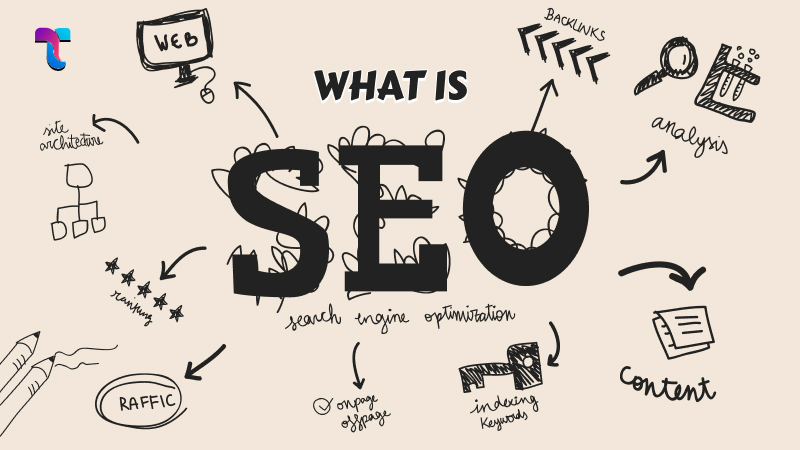
Table of Contents
Today, SEO looks nothing like it did a few years ago. The tricks that once helped boost rankings, such as stuffing keywords or creating more backlinks, barely help now.
In 2026, SEO has evolved into a smarter and behavior-driven system powered by AI, user intent, structured data, and experience signals across platforms and devices.
Do you ever wonder why that even matters? Studies show that 68% of online experiences begin with a search engine. This means if people can’t find you in search, you are practically invisible to them.
Be it that you run a blog, an online store, or a growing business website, knowing how SEO works can help you show up when customers are looking.
So, let’s understand what SEO actually means in 2026!
What is Search Engine Optimization (SEO)?
SEO basically stands for Search Engine Optimization. It helps search engines understand your website’s content and connect it with users by delivering results based on their queries.
The aim of SEO is to help websites rank on the first page of SERPs (Search Engine Result Pages) for the most relevant keywords. This brings qualified traffic to your website.
SEO is a major part of digital marketing. It helps improve a site’s overall visibility on search engines, such as Google and Bing. No matter whether your website promotes products, offers any kind of services, or shares knowledge on a particular topic, SEO can help drive traffic and boost online visibility.
The more visible your website’s pages are in search results, the more likely your targeted audience is to find and visit them.
Types of SEO

SEO involves different strategies that help improve visibility and trust. Here are the types of SEO that can help any website grow online:
On-Page SEO
On-page SEO includes all elements within your website, such as strategic keyword placement, effective use of heading tags, well-structured internal links, and optimized meta tags.
Off-Page SEO
Off-page SEO enhances your website’s credibility through quality backlinks, guest blogging, and digital PR, all of which play an important role in search engine ranking.
Technical SEO
Technical SEO makes sure your website can be easily crawled and indexed. Key factors include mobile-first design, core web vitals, website speed, and schema markup.
AI-Driven SEO
In 2026, optimization extends just beyond Google. You need to optimize your website for Answer Engine Optimization (AEO) and Generative Engine Optimization (GEO). These help prepare the content for AI platforms and conversational search.
How Does Search Engine Optimization (SEO) Work?
Whenever someone types a question into Google, Bing, or any other search engine, they are looking for the most accurate and useful answer. In the background, complex algorithms power search engines.
These algorithms analyze thousands of signals to decide which pages deserve to appear at the top. That’s why even small algorithm updates can affect website traffic.
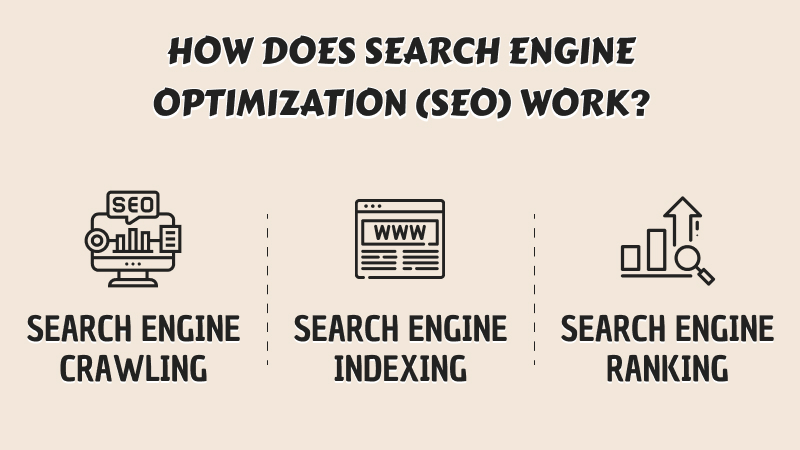
Basically, SEO work is done in three main steps. Let’s check them out below!
Step 1: Search Engine Crawling
Crawling is the discovery phase. Search engines send web crawlers, which are also known as spiders, bots, or Googlebots, to find new and updated web pages. These crawlers constantly explore the internet to:
- Discover new pages.
- Revisit the existing pages to check for updates.
- Understand how pages are interconnected.
Crawlers move across the web by following links. For example, if your homepage links to a blog post, a bot that crawls your homepage can easily find and crawl that blog post too.
Step 2: Search Engine Indexing
After a page is crawled, the next step is indexing, where a search engine evaluates the content and decides whether to store it in its database.
If a page provides unique, useful, and relevant information, it is added to the search engine’s index. However, not every page is indexed. The reasons include:
- The content is duplicated elsewhere.
- The content is low-quality or spammy.
- The page couldn’t be properly crawled.
- The page or site lacks internal or external links.
Step 3: Search Engine Ranking
Ranking is the final step of SEO. After a page is crawled and indexed, search engines decide where it should appear in search results for a specific query. Some of the common ranking signals that search engines use include:
- Whether the target keyword appears in the title and content
- Page loading speed and mobile responsiveness
- Website authority and trustworthiness
- The quality and relevance of backlinks
- Overall content usefulness and relevance
- Mobile-friendliness of pages and images
The Evolution of SEO: Key Changes Leading Up to 2026
SEO didn’t change overnight. It evolved step by step as search engines became smarter and user expectations grew. What started as simple keyword matching has now become a complex system focused on intent, experience, and trust.
To understand SEO in 2026, let’s take a look at how we got here!
History of Major SEO Algorithm Updates
Google Panda (2011)
Panda was one of the first major updates that changed SEO forever. It targeted low-quality content, thin pages, and content farms. Websites with copied, shallow, or keyword-stuffed content saw massive ranking drops. This update pushed creators to focus on originality and value.
Google Penguin (2012)
Before the Google Penguin update, many websites were ranked by building spammy backlinks. This update penalized unnatural and manipulative link-building practices. From this point on, backlink quality mattered far more than quantity.
Google Hummingbird (2013)
The Hummingbird update shifted Google from matching keywords to understanding the meaning behind searches. It allowed Google to interpret conversational queries and context, and laid the foundation for modern intent-based search.
Google BERT (2019)
BERT helped Google understand natural language better, especially longer and more conversational queries. It improved how search engines interpret prepositions, sentence structure, and real-world meaning. This made content relevance more important than exact keyword matching.
Page Experience & Core Web Vitals (2021)
Google officially made user experience measurable. Metrics such as loading speed, interactivity, and visual stability have now become ranking signals. This meant a slow, unstable, or poorly designed page could lose ranking, even if the content was good.
Product Reviews Updates (2021–2023)
During this period, Google repeatedly updated its product review systems. Fake or affiliate-focused reviews were downgraded, while experience-based reviews were rewarded.
MUM: Multitask Unified Model (2021)
With MUM, Google took a major leap in understanding complex user intent. It could interpret text, images, and context together and move closer to answering why a user is searching, not just what they typed.
Helpful Content System (2022)
The update aimed at penalizing content that was created mainly to rank, rather than to help users. Sites that used excessive AI-generated, rewritten, or click-based content saw declines, while the ones with useful content gained visibility.
March 2024 Core & Spam Updates
This was one of Google’s most impactful updates in years. It combined core ranking changes with spam systems and targeted low-value content.
AI Overviews in Search (2024)
Google introduced AI-generated summaries directly in search results. This changed how users interact with content and focused more on authority, structure, and clarity.
Site Reputation Abuse Policy (2024)
Google began cracking down on “parasite SEO”, where third-party content was published on high-authority sites to manipulate rankings. This reinforced that domain authority cannot be borrowed.
Fake & Manipulated Content Controls (2024)
New systems were added to detect misleading content. Trust, authenticity, and source credibility became stronger ranking considerations.
2025 Core & Spam Updates (Ongoing)
Throughout 2025, Google continued refining its core systems:
- Prioritizing relevance over tactics
- Rewarding consistency and long-term value
- Aggressively suppressing spam and low-effort content
The Rise of AI and Machine Learning in SEO
As search engines evolved, artificial intelligence and machine learning have become important to ranking systems. Instead of relying on fixed rules, search engines now learn from user behavior like how people click, scroll, stay, or leave pages. In 2026, AI-driven systems continuously adjust rankings based on real-world engagement signals.
Shift Towards User Experience (UX) and Intent
SEO is no longer just about ranking; it’s about user satisfaction. Search engines prioritize pages that solve user problems quickly and clearly. Content that matches search intent, loads fast, and is easy to navigate consistently performs better than content written only for algorithms.
E-E-A-T (Experience, Expertise, Authoritativeness, Trustworthiness)
E-E-A-T has become one of the most important quality signals. Google increasingly favors content created by people with real-world experience, credible knowledge, and transparent authorship.
Core Web Vitals
Page speed, visual stability, and responsiveness are now ranking considerations. Core Web Vitals measure how fast pages load, how quickly users can interact, and how useful the content is to users. Poor performance leads to poor user experience and, thus, lower rankings.
Mobile-First Indexing
Search engines now primarily evaluate the mobile version of a website for ranking and indexing. If your site performs poorly on mobile devices, it will struggle to rank, no matter how good the desktop version looks.
Mobile-First & Voice Search Optimization
With smart assistants and voice-enabled devices becoming common, searches are more conversational than ever. Users ask full questions instead of typing short phrases. This shift has made natural language content, FAQs, and intent-driven answers essential for modern SEO.
Crucial Factors That Impact SEO Rankings in 2026
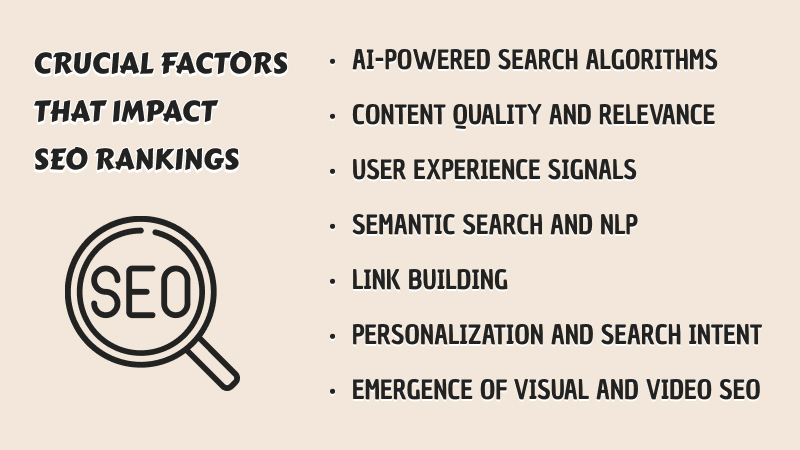
SEO rankings in 2026 are influenced by far more than just keywords and backlinks. Let’s understand the most important factors that affect rankings today!
AI-Powered Search Algorithms
AI plays a central role in how search engines understand and rank content. Modern algorithms analyze context, semantics, and user behavior rather than relying on rigid rules. They learn from how users interact with search results, such as clicks, engagement, time, and continuously refine rankings to help rank the most helpful content.
Content Quality & Relevance
Content remains the foundation of SEO, but the standards are higher than ever. Search engines prioritize content that is authoritative, well-researched, and closely aligned with search intent. Pages that genuinely answer user questions, provide depth, and demonstrate expertise outperform other content.
User Experience Signals
User experience is now a direct ranking factor. Some of the metrics, like Core Web Vitals, site speed, mobile usability, and smooth interactivity, help search engines determine how enjoyable a page is to use. Slow-loading pages or poor mobile experiences can significantly hurt visibility, even if the content is strong.
Semantic Search & NLP
Search engines no longer focus on individual keywords. Instead, they use semantic search and Natural Language Processing (NLP) to understand the meaning behind queries. This allows them to interpret synonyms, context, and conversational language. As a result, content written naturally for humans performs better than keyword-heavy pages.
Link Building
Link building is still important, but the focus has shifted entirely to quality. A few relevant and authoritative backlinks from trusted sources carry far more value than hundreds of low-quality links. Natural mentions, editorial links, and topic relevance now matter more than volume.
Personalization & Search Intent
Search results are increasingly personalized based on user location, device, search history, and behavior patterns. This means rankings are no longer identical for everyone. Understanding user intent and tailoring content to specific audiences improves visibility across different search contexts.
Emergence of Visual & Video SEO
Search engines now index and rank visual content more effectively than ever. Optimized images, videos, thumbnails, and structured data help content appear in image search, video carousels, and rich results. Video SEO plays an increasing role in discoverability and engagement.
Common SEO Challenges in 2026 & How to Overcome Them
SEO in 2026 is more advanced, but it also comes with new challenges. Here are some of the most common SEO challenges and how to deal with them:
Dealing with Constant Algorithm Updates
Search engines update their algorithms frequently to improve result quality. These updates can impact rankings overnight, which causes sudden traffic drops or gains.
How to overcome it:
To overcome this challenge, you need to focus on long-term practices instead of chasing for updates. Also, prioritize high-quality content, strong user experience, and technical SEO. Other than that, stay informed through official blogs and industry updates, and regularly audit your website to adapt to changes quickly.
Balancing Automation with Human Creativity
AI tools now play a major role in content creation and SEO workflows. While automation improves efficiency, overuse can result in generic and repetitive content that lacks authenticity.
How to overcome it:
You can use AI as a support tool and not as a replacement. Use AI tools for handling research, outlines, and optimization, while humans add insights, real experience, and brand voice.
Fighting Spam & Black Hat SEO
Even in 2026, some websites try to manipulate rankings through spammy backlinks, keyword stuffing, or hidden content. These tactics may offer short-term gains but often lead to penalties.
How to overcome it:
It is important to stick to search engine guidelines and ethical SEO practices. You need to focus on natural link building, valuable content, and transparent optimization. Regularly monitor backlinks and remove harmful links to protect your site’s credibility.
Data Privacy & SEO
With evolving privacy regulations and reduced third-party tracking, data-driven SEO has become more challenging. Limited user data makes personalization and measurement harder.
How to overcome it:
You need to use consent-based analytics, server-side tracking, and aggregated performance metrics. Focus on content relevance and intent rather than invasive tracking methods, aligning SEO strategies with privacy-friendly practices.
It’s A Wrap
That’s it for this blog!
SEO in 2026 isn’t just about chasing algorithms anymore; it’s about understanding people. Search engines have grown smarter, users have grown more demanding, and the brands that win are the ones that focus on real value and not shortcuts.
And, you don’t need to “hack” SEO to succeed. When you create helpful content, optimize for real intent, and stay aligned with best practices, search engines naturally work in your favor.
If you need a partner who can help you achieve rankings on search engines, Technoloader can help you! We are a known SEO company with a team of specialists who can help your business turn search into growth with smart, ethical, and result-driven solutions.
Get in touch with us now!

Deepa Manwani
Deepa Manwani is a Technical Content Writer at Technoloader with over 7 years of experience creating high-quality content across Blockchain, Web3, AI, and fintech. She specializes in translating complex technical concepts into clear, engaging, and informative content that helps businesses, developers, and users better understand emerging technologies. Her expertise includes writing technical blogs, technical documentation, whitepapers, platform guides, and in-depth content for crypto exchanges, DeFi platforms, trading systems, and enterprise software solutions. At Technoloader, she contributes to developing strategic content that supports product growth, strengthens brand credibility, and educates users about next-generation technologies shaping the future.
Published in SEO


