 +91 7014607737
 info@technoloader.com





Table of Contents
Key Takeaways:
-
- ICOs and IDOs both are blockchain fundraising methods that differ intransparency, liquidity, and platform structure. ICOs are conducted directly by project teams, while IDOs are launched through decentralized exchanges.
- ICOs played a major role in popularizing crypto crowdfunding, raising billions of dollars globally and helping blockchain startups secure funding without relying on traditional financial institutions or venture capital firms.
- Basically, IDOs use DEXs and smart contracts. Thus, they provide great transparency and security than ICOs. This ensures that token distribution, liquidity creation, and transactions are automatically executed on the blockchain.
- Instant liquidity is one of the biggest advantages of IDOs. Unlike ICOs, where investors may wait for exchange listings, IDOs allow tokens to be traded immediately after the token sale through liquidity pools.
- ICOs provide startups with easier access to global capital. It lets projects get funding and connect with investors from all over the world without worrying about where they’re located.
- Both ICOs and IDOs come with their own risks. There is the chance of market ups and downs, potential scams, unclear regulations, and issues with smart contracts. So, it’s really important for investors to do their homework before jumping into any token sale.
If you were around during the 2017–18 crypto boom, you may recall ICOs dominating headlines. Overnight token launches, tremendous excitement, and investors flooding in for the next 100x. At the peak, ICOs raised an estimated $6.88 billion in funds in a single year. This proves how powerful blockchain crowdfunding could be.
Fast forward to today, and the momentum has only risen. Crypto businesses raised over $50.6 billion in 2025 alone.
But that same hype cycle exposed a serious problem, that is, lack of accountability. Many projects disappeared after raising money, and investors were left holding worthless tokens.
That’s where IDOs enter the picture!
Instead of trying to get noticed on private websites and crossing fingers for exchange listings, projects these days are going straight to decentralized exchanges to raise funds. This way, they get instant liquidity and transparent smart contracts.
As fundraising models evolve, understanding how IDOs differ from ICOs is important. It is essential knowledge for anyone investing in or launching a blockchain project today.
Let’s check it out!
What Is An Initial DEX Offering (IDO)?
IDO, or Initial DEX Offering, is becoming popular in cryptocurrency. As the name suggests, these are conducted on decentralized crypto exchanges (DEXs) platforms rather than traditional platforms. It offers several benefits, which include enhanced security, transparency, and accessibility.
In an IDO, the tokens are offered directly on a DEX platform. Participants can get these tokens by using cryptocurrencies or stablecoins. What makes IDO stand out is the concept of liquidity pools, which allow participants to provide liquidity to the project in exchange for tokens
Benefits of IDOs
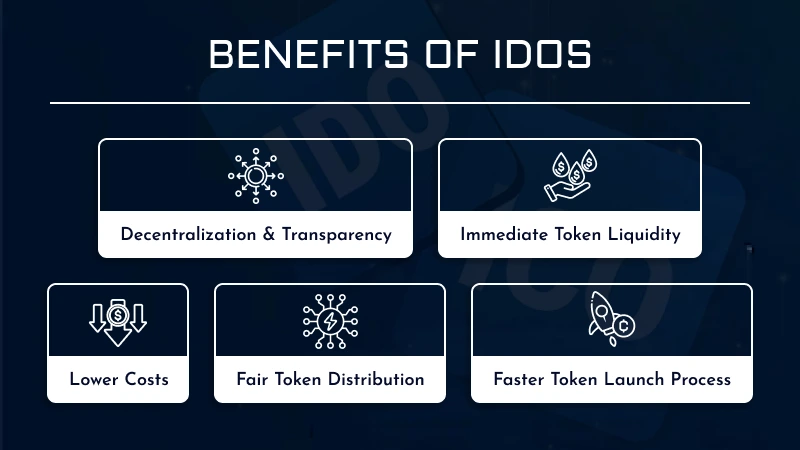
IDOs are gaining popularity due to their wide range of benefits over other crypto fundraising methods. The below are some of them:
- Decentralization & Transparency
One of the great advantages that IDO provides is its decentralized nature. Instead of relying on a centralized organization to manage fundraising, IDOs are conducted on decentralized exchanges using smart contracts.
These smart contracts execute token sales and record every transaction on the blockchain. Because ledgers on blockchain are publicly verifiable and immutable, investors can verify token distributions themselves. This reduces the risk of hidden token allocations, manipulation, and fraudulent activities.
- Immediate Token Liquidity
IDOs provide quick liquidity through liquidity pools. Once the token sale is complete, liquidity is automatically provided to the decentralized exchange, allowing investors to trade tokens right away.
This removes the uncertainity regarding whether tokens will ever be listed. Instant liquidity provides investors with flexibility and confidence because they can enter or exit positions at any time based on market conditions rather than being trapped into holding periods.
- Lower Costs
Launching an IDO is generally more cost-saving than ICO. In ICOs, projects must invest heavily in building secure fundraising infrastructure, managing investor onboarding, and paying high listing fees to exchanges.
IDOs use existing decentralized exchange infrastructure, which decreases technical and operational costs. This allows new entrepreneurs and small blockchain projects to raise funds without needing huge budgets.
- Fair Token Distribution
IDOs promote fair participation by allowing investors to buy tokens from DEX platforms. Many launchpads use whitelisting, tiered allocation systems, and capped purchase limits to prevent big investors from dominating the token sale.
This ensures a fair token distribution between members. By reducing the influence of early comers and big investors, IDOs create more opportunities for small investors to participate in blockchain projects.
- Faster Token Launch Process
IDOs ease out the token launch process by combining raising funds, crypto token distribution, and liquidity creation into one automated process. Smart contracts also manage token distribution, liquidity pool creation, and investor transactions without needing any interruption of humans.
This lowers the time needed to launch a token as compared to other fundraising ways. Also, projects can move from development to public fundraising much faster than thought.
Risks of IDOs
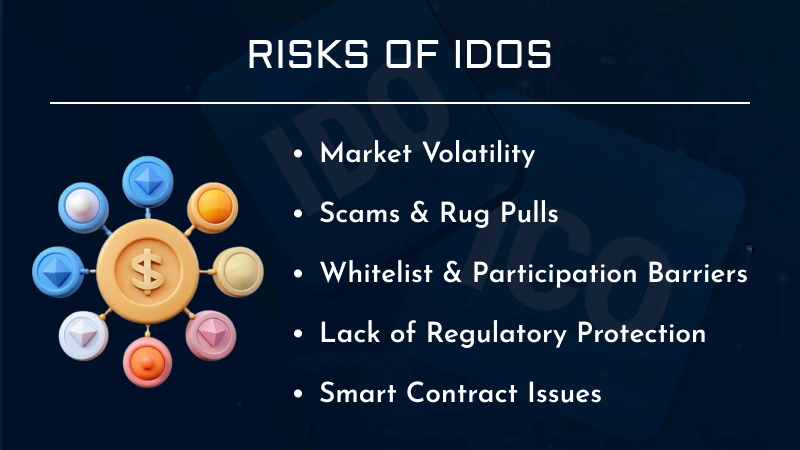
No matter IDOs provide certain benefits, they also come with risks to watch out for. These include:
- Market Volatility
Crypto markets are highly volatile, and IDO tokens are more vulnerable to price fluctuations after launch. Because IDOs provide instant liquidity, many investors consider selling off their tokens to secure profits quickly. This can result in sudden price drops.
This makes prices shift in ways that are hard to forecast, especially at the start of trading. The value of a token can change based on how people feel about the market, how many people want to buy it, and how the crypto market is doing.
- Scams & Rug Pulls
No matter IDOs are more transparent than ICOs, they still carry risks of fraudulent projects and rug pulls. In some cases, developers also launch a project, raise funds, and leave it without delivering the promised product.
Because blockchain transactions are irreversible, thus, recovering lost funds becomes extremely difficult. Although IDO launchpads provide basic project verification, they do not guarantee full safety.
- Whitelist & Participation Barriers
Many IDOs use whitelisting systems to handle investor participation and ensure fair token distribution. However, these systems can create limitations for some members.
Launchpads require users to fulfill tasks such as holding specific tokens, joining communities, or more. Due to high demand, only a limited number of users are chosen. This makes participation quiet competitive.
- Lack of Regulatory Protection
IDOs usually operate in decentralized environments with minimal regulatory compliance. Unlike traditional markets, there are fewer legal protections for investors. If a project fails or engages in dishonest conduct, investors may have limited legal options for recovery.
This increases financial risk. The lack of regulatory compliance makes it important for people to do research properly and invest only in credible projects.
- Smart Contract Issues
IDOs rely on smart contracts to handle token distribution and liquidity. If these smart contracts contain coding issues or security vulnerabilities, they can get attacked very easily.
Even though many projects conduct security audits, vulnerabilities can still exist. Investors and project owners should keep platforms on priority with audited smart contracts to reduce security risks.
What Is An Initial Coin Offering (ICO)?
An ICO, or Initial Coin Offering, is a fundraising way used by companies or projects to raise capital. It basically involves issuing a new cryptocurrency or token to investors in exchange for their financial investment in the project. ICOs became popular during the 2017 crypto boom and are now a leading fundraising method in this space.
During an ICO, investors can buy tokens using cryptocurrencies. These basically represent a share or stake in the project. The funds that are raised through ICO are further used to develop the project.
Benefits of ICOs
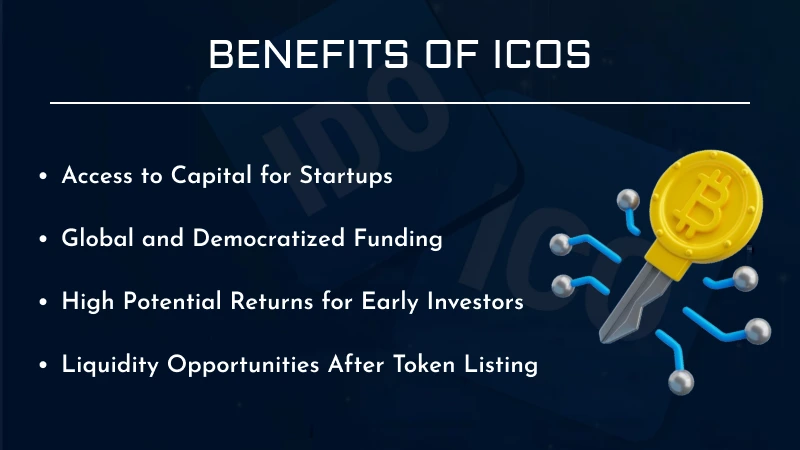
Let’s check out the benefits linked with ICOs and why so many blockchain projects choose this fundraising model!
- Access to Capital for Startups
ICOs provide startups with a fast and efficient way to raise funds without relying on traditional ways. That’s because those ways involved lengthy approval processes, regulatory compliance, and high listing costs.
ICOs overcome many of these challenges by allowing startups to raise funds directly from investors. This helps new project owners get the required funds for development, marketing, and growing their business.
Global and Democratized Funding
One of the main benefits of ICOs is their ability to attract investors from all over the world. Individuals from anywhere in the world can engage in an ICO simply by having an internet connection and a cryptocurrency wallet.
This creates a global investment opportunity and removes the limitations of traditional financial systems. Besides that, ICOs are great for helping projects connect with people all over the world, and they also give investors a chance to invest in new innovative projects.
- High Potential Returns for Early Investors
ICOs provide early investors with the opportunity to purchase tokens at lower prices before they are listed on exchanges. If the project becomes successful and gains market popularity, the value of token raises.
This creates the potential for high returns on investment. Many successful blockchain projects have provided profits to early ICO participants. But returns depend on project success, market demand, and crypto market conditions.
- Liquidity Opportunities After Token Listing
After an ICO is completed, tokens are generally listed on crypto exchange platforms. This provides liquidity, which enables investors to buy or sell tokens based on market demand.
Unlike traditional investments like Venture Capitals that can lock up your money for years, you can trade ICO tokens way sooner. This gives investors more control over how they manage their investments.
Risks of ICOs
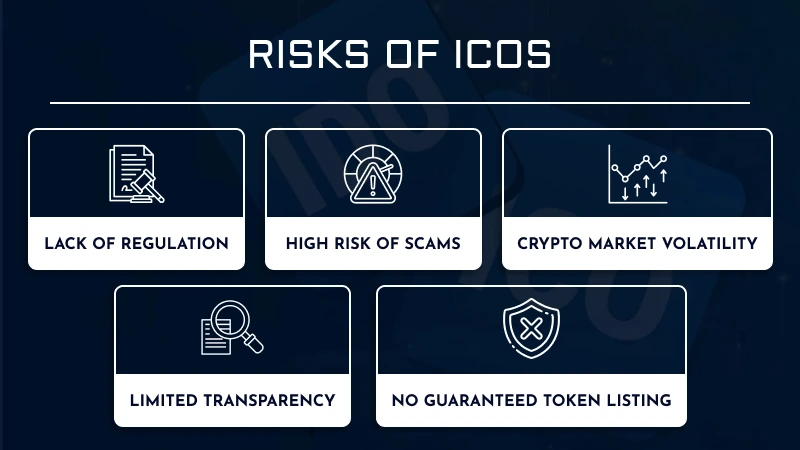
While ICOs offer some exciting opportunities for investors and startups, they also come with some risks. These include:
- Lack of Regulation
ICOs raise funds without strict regulations or investor protection policies. This means that if a project fails, delays development, or misuses funds, investors may have no or limited legal options for recovery.
The absence of regulation increases uncertainty and risk, which makes it important for investors to carefully evaluate the credibility and legitimacy of projects before participating.
- High Risk of Scams
The ICO boom attracted many genuine projects, but it also created opportunities for fraudulent projects and rug pulls. Some developers have gathered funds through token sales and then just disappeared without actually providing what they promised.
Since blockchain transactions are irreversible, recovering lost money is next to impossible. Investors must rely on the project’s transparency, team credibility, and technical documentation to assess legitimacy. If not done, participants risk investing in projects that may never deliver real value.
- Crypto Market Volatility
Cryptocurrency markets are very volatile, and ICO tokens are prone to sudden price changes. After a token is listed on exchanges, prices can rise due to demand or fall sharply due to quick market changes, low adoption, or lack of investor confidence.
A token may not increase in value after the ICO ends. Investors could lose all their invested funds if the project doesn’t succeed or market conditions decline.
- Limited Transparency
In ICOs, investors often rely on whitepapers, project websites, and promotional materials to check the project. Sometimes, this information might not have everything you need, could sound too good to be true, or just be missing some of the technical details.
Without proper disclosure of financial plans, development progress, and team information, it becomes difficult to check the project’s true potential. This may increase the risk for investors.
- No Guaranteed Token Listing
In many ICOs, tokens are not listed on exchanges right after fundraising ends. This could make it difficult for investors who want to trade or sell their tokens.
In some of the cases, tokens may never get listed on the platform due to a lack of exchange partnerships or project failure. This situation generates liquidity risk, which makes it difficult for investors to liquidate their positions.
Key Differences Between ICO and IDO
Although both ICOs and IDOs aim to generate capital, they still carry distinct differences. Let’s discuss them one by one!
Marketplace Model
ICO:
In an ICO, the team handles the token sale on their website or through a smart contract. Investors send funds directly to the project, and they get tokens immediately or at the end of the sale. In an ICO, there is no marketplace. So, the project handles the full fundraising process.
IDO:
In an IDO, the token sale happens through a decentralized exchange or launchpad. It automates fundraising, token allocation, and liquidity pool creation. Investors get tokens instantly through on-chain swaps, and trading becomes available immediately, which makes the process more transparent and decentralized.
Liquidity Availability
ICO:
After an ICO, tokens are not always tradable immediately. Investors may have to wait weeks or even months for the token to get listed on an exchange. In some cases, a listing never occurs, which doesn’t enable investors to sell or liquidate their tokens.
IDO:
In an IDO, liquidity pools are created instantly once the sale ends, which allows tokens to be traded right away. This gives investors confidence because they can enter or exit positions immediately without depending on centralized exchange listings.
Trust and Verification
ICO:
During the ICO boom, many projects raised funds without proper checks, which led to numerous scams and failures. Due to the lack of third-party verification, investors depended only on project claims and whitepapers, leading to significant uncertainty and risk.
IDO:
IDOs offer a basic level of credibility since launchpads usually review project details before approving token sales. Although not foolproof, this screening process helps filter out unreliable projects and increases investor trust compared to ICOs.
Cost and Accessibility for Projects
ICO:
Running an ICO can be expensive because the team handles the token sale infrastructure, investor onboarding, security, and post-sale exchange listings. Marketing costs are quite high, as the project must attract investors without the support of a platform.
IDO:
IDOs reduce launch costs because projects rely on decentralized exchanges for liquidity and distribution. Listing fees are eliminated, and launchpads provide access to existing investor communities, which lowers marketing overhead and simplifies the token launch process.
Investor Participation
ICO:
ICO participation was often unfair, as early insiders and private investors received large allocations at discounted prices. By the time public sales opened, retail users generally faced higher prices on tokens, smaller quotas, or limited availability. This makes it harder for regular investors to enter the market fairly.
IDO:
IDOs enable wider participation of investors since anyone with a compatible wallet can access the sale on decentralized platforms. This reduces dependency on private investment rounds and even creates a more open entry path for the public.
Real-World Examples of Successful ICOs and IDOs
Now, let’s have a look at examples of successful ICOs and IDOs, as this will help investors and businesses better understand the impact and effectiveness of each fundraising model!
Successful ICO Examples:
- Etherem (ETH)
Ethereum conducted its ICO in 2014 and raised approximately $18.4 million in Bitcoin. At the time, Ethereum tokens (ETH) traded around $0.30 each.
It shows how blockchain startups could raise capital globally and build revolutionary decentralized ecosystems.
- EOS
EOS launched its ICO between 2017 and 2018 and raised over $4.1 billion, which makes it one of the largest ICOs in crypto history.
This example highlights how ICOs enabled large-scale fundraising without relying on traditional venture capital.
Successful IDO & Decentralized Launch Examples:
PancakeSwap (CAKE)
PancakeSwap launched its token (CAKE) through a decentralized exchange on the BSC. By leveraging decentralized liquidity pools and automated token distribution, it became one of the most popular decentralized exchanges.
Today, it handles billions of dollars in trading volume and has a large global user base. Its IDO-based launch helped build trust, liquidity, and rapid adoption.
Polkastarter (POLS)
Polkastarter conducted its token launch using decentralized exchange and quickly became one of the most recognized IDO platforms. It allows blockchain projects to raise funds through decentralized token pools.
It has helped numerous Web3 projects successfully raise capital, which shows the effectiveness of IDOs as a modern fundraising model.
SushiSwap (SUSHI)
SushiSwap launched its token, which allows users to participate directly through decentralized exchanges. The project quickly gained traction due to its transparent token distribution and decentralized governance model.
It became one of the leading decentralized finance (DeFi) platforms, which shows how IDOs can support fast adoption and strong community growth.
Note: Although PancakeSwap and SushiSwap both don’t follow a traditional IDO model, yet their decentralized token distribution approach is linked with IDO principles. This makes them perfect examples of decentralized token launches in the DeFi space.
Conclusion
That’s it for this blog!
Crypto fundraising has evolved a lot from the early days of ICOs.
ICOs opened global investment opportunities but exposed trust and liquidity issues, which resulted in the industry to adopt more transparent models like IDOs. Today, IDOs enable quicker token launches, provide instant liquidity, and allow wider participation via decentralized platforms.
Choosing between an ICO or an IDO for a project comes down to what the project aims to achieve, how it needs to follow the rules, and the overall plan for launching. It’s important for both the founders and investors to get a good grasp of each model so they can make smart choices.
If you’re thinking about launching your own token, setting up liquidity pools, or creating a whole fundraising setup, Technoloader has got you covered. We offer full ICO and IDO development services from start to finish.
Get in touch with us to discuss your requirements!
FAQs
What is an IDO in crypto?
An Initial DEX Offering (or IDO) is a crypto fundraising mechanism in which blockchain projects launch their tokens directly on DEX platforms. Instead of raising funds through private websites, projects use smart contracts and liquidity pools to distribute tokens to members. This allows investors to purchase and trade tokens immediately after launch.
What is an ICO in crypto?
An Initial Coin Offering (ICO) is basically a fundraising method used by blockchain startups and entrepreneurs to raise capital by selling new tokens to early investors in exchange for cryptocurrencies. It offers early project access but also carries high risks of fraud.
How does an IDO differ from an ICO?
The main difference between an IDO and an ICO lies in how and where the token sale is conducted. ICOs are managed by the project team on their own website, while IDOs are launched through decentralized exchanges.
Why are IDOs becoming more popular than ICOs?
IDOs are gaining popularity because they offer improved transparency, lower launch costs, and instant token liquidity. Since IDOs operate on decentralized exchanges using smart contracts, they reduce the risk of manipulation and ensure fair token distribution.
Are IDOs safer than ICOs?
IDOs are generally considered safer than ICOs because they use decentralized exchanges and smart contracts to manage token sales. This ensures transparent token distribution and reduces reliance on centralized control. However, IDOs still carry risks such as smart contract vulnerabilities and fraudulent projects. It is important for investors to conduct research on the project team, roadmap, and audit reports before participating in any token sale.
Which fundraising method is better: ICO or IDO?
The choice between ICO and IDO depends on the project’s goals and strategy. ICOs may be suitable for projects seeking more control over fundraising, while IDOs offer faster launches, instant liquidity, and improved transparency.

Deepa Manwani
Deepa Manwani is a Technical Content Writer at Technoloader with over 7 years of experience creating high-quality content across Blockchain, Web3, AI, and fintech. She specializes in translating complex technical concepts into clear, engaging, and informative content that helps businesses, developers, and users better understand emerging technologies. Her expertise includes writing technical blogs, technical documentation, whitepapers, platform guides, and in-depth content for crypto exchanges, DeFi platforms, trading systems, and enterprise software solutions. At Technoloader, she contributes to developing strategic content that supports product growth, strengthens brand credibility, and educates users about next-generation technologies shaping the future.
Published in IDO Development


