 +91 7014607737
 info@technoloader.com






Table of Contents
Local SEO for hotels helps your property appear in high-intent searches like “best hotel near me” or “resort in [destination],” where travelers are ready to book. By optimizing your Google Business Profile, local keywords, maps visibility, and guest reviews, hotels can attract nearby, mobile-first users and drive more direct bookings. Strong local SEO also reduces reliance on OTAs by making your hotel easy to find at the exact moment guests are searching.
When someone searches “best hotel near me” or “resort in (destination)”, they are not just browsing; they are ready to book.
In fact, over 76% of people who search for something local on their phone visit a business within 24 hours. For hotels, that search is a booking that you either capture or lose.
Do you know what the problem is? Most hotels invest heavily in their website, but completely ignore local SEO. That means even if your property is perfect, travellers won’t find you. And more than 50% of travellers now use their smartphones to search and book hotels, visibility in local search results is more important than ever.
Local SEO is what helps your hotel show up exactly where people are searching. When done right, it can drive direct bookings, reduce dependency on OTAs (Online Travel Agencies), and put your hotel in front of guests who are already nearby and ready to stay.
In this guide, we’ll talk about everything you need to know about local SEO and how it works specifically for hotels.
Let’s get started!
What is Local SEO?
Before we talk about local SEO, let’s first understand SEO.
SEO (Search Engine Optimization) is the process of improving your online presence so search engines can easily find, understand, and rank your website for relevant searches. It can help your business appear in front of people who are already looking for what you offer.
Now, local SEO is basically the process of optimizing your online presence so that search engines bring your property for location-based search. For example, one searches for these terms on Google:
- “hotels near me”
- “best hotel near [destination]”
- “best boutique hotel in [city]”
- “family-friendly hotels [destination]”
These search terms trigger Google’s local pack, which includes the map listings and top results that travellers consider seeing first. If your hotel property isn’t optimized for particular search terms, your guests won’t be able to find you and book another hotel.
Why is Local SEO Important for Hotel Businesses?
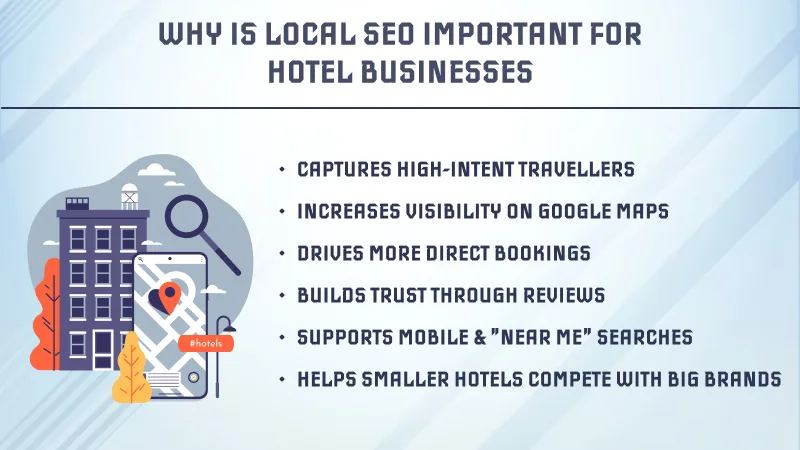
After understanding what local SEO is, it is now time to understand its importance for hotel businesses. Here we go!
It captures high-intent travellers
Local searches like “hotel near airport,” “resort in (destination),” or “best stay near city center” come from people who are already planning or traveling. Local SEO helps your hotel appear in front of these high-intent users, which increases the chances of direct bookings.
It increases visibility on Google Maps
Most travelers don’t scroll endlessly. They choose from the top results shown on Google Maps or the local 3-pack. A well-optimized local SEO setup ensures your hotel shows up with photos, reviews, prices, and directions. This makes it easier for guests to choose you over competitors.
It drives more direct bookings
Online Travel Agencies charge hefty commissions. Local SEO helps guests find your hotel directly through search, maps, and local listings, which leads them to your website or direct call option. Over time, this reduces reliance on OTAs and improves your profit margins.
It builds trust through reviews
Hotels with strong local SEO usually have better review visibility, accurate information, and consistent branding across platforms. When travelers see positive reviews, updated photos, and clear location details, trust increases and trust converts into bookings.
It supports mobile & “near me” searches
A large percentage of hotel searches happen on mobile devices, often while travelers are already on the road. Local SEO ensures your hotel appears for “near me” and voice searches, which helps you attract last-minute bookings.
It helps smaller hotels compete with big brands
You don’t need a massive marketing budget to win locally. With the right local SEO strategy, boutique hotels, homestays, and independent resorts can outrank large chains within a specific area by being more relevant, more local, and more optimized.
Local SEO vs. On-Page and Off-Page SEO
Local SEO is often confused with SEO, but it connects your online presence to your hotel’s physical location. To understand how it works, it helps to look at how local SEO fits alongside on-page and off-page SEO.
On-Page SEO
On-page SEO focuses on optimizing everything within your website. For hotels, this includes keyword research, optimizing page content, using schema markup, improving mobile friendliness, and ensuring fast loading times.
Off-Page SEO
Off-page SEO refers to all activities outside your website that build trust and authority. This includes link building, PR, social media presence, and brand mentions across the web.
Where Local SEO Fits In
Local SEO acts as the bridge between on-page and off-page SEO. It combines website optimization with location signals like Google Maps, reviews, citations, and proximity.
In simple terms, local SEO ties your digital presence directly to your hotel’s real-world location. This helps travelers discover your property exactly when they are ready to book.
Key Search Terms Guests Use to Find Hotels Nearby
Now that you understand why local SEO is so important for hotels, the next step is knowing how guests actually search for places to stay. This is where many hotel businesses get it wrong. They optimize for generic terms, while travelers use location-driven searches.
Below are some of the most common search terms guests use when looking for hotels nearby, along with the intent behind each search:
| S.No. | Keywords | Search Intent |
| 1 | hotels near me | User is looking for hotels close to their current location, often with immediate booking intent. |
| 2 | best hotels in [City Name] | User wants top-rated or highly recommended hotels in a specific city. |
| 3 | affordable hotels in [Location] | User is searching for budget-friendly accommodation options. |
| 4 | family-friendly hotels in [City] | The user is planning a family trip and wants suitable amenities. |
| 5 | [Hotel Name] booking | User is ready to book a specific hotel directly. |
| 6 | luxury hotels in [City] | User is looking for premium or high-end accommodations. |
| 7 | pet-friendly hotels in [City] | The user needs a hotel that allows pets. |
| 8 | hotels near [Famous Landmark] | User wants to stay close to a popular attraction or landmark. |
| 9 | hotels with free Wi-Fi in [City] | User is filtering hotels based on amenities. |
| 10 | best beach hotels in [Region] | User is searching for hotels near beaches or coastal areas. |
How Google Ranks Hotels in Local Search Results?
Google doesn’t randomly rank hotels in local search results. Every time a traveller searches for a hotel, Google evaluates multiple signals to determine which properties are relevant and useful.
Here are the factors:
Relevance
Relevance refers to how closely your hotel matches what the user is searching for. Google looks at your hotel’s online information to understand if your property fits the traveller’s intent.
This includes:
- Keywords used on your website and Google Business Profile
- Your primary and secondary business categories
- Hotel descriptions, amenities, and services listed online
For example, if someone searches for “luxury resort in Goa” and your hotel is optimized with detailed descriptions and luxury-related keywords, Google will likely show your property. On the other hand, a generic listing with minimal information may not appear, even if the hotel is located in Goa.
Distance
Distance measures how close your hotel is to the searcher’s location. If a traveler searches “hotels near Baga Beach Goa”, Google prioritizes properties located closest to that area.
Unlike other factors, distance cannot be changed. You can’t move your hotel closer to the guest, but what you can do is optimize everything else so that when the distance is similar, your hotel stands out.
Accurate address details, correct map pin placement, and consistent location data across platforms help Google understand exactly where your hotel is located.
Prominence
Prominence reflects how well-known and trusted your hotel appears online. Google uses prominence to determine whether your property is popular, credible, and worth recommending.
Prominence is influenced by:
- The number and quality of online reviews
- Your overall ratings and how frequently guests leave feedback
- Mentions of your hotel on travel websites, directories, and local blogs
- Backlinks from authoritative and local websites
Hotels with strong reviews, active online mentions, and a well-optimized website are more likely to rank higher.
Tips to Improve Local SEO for Hotels
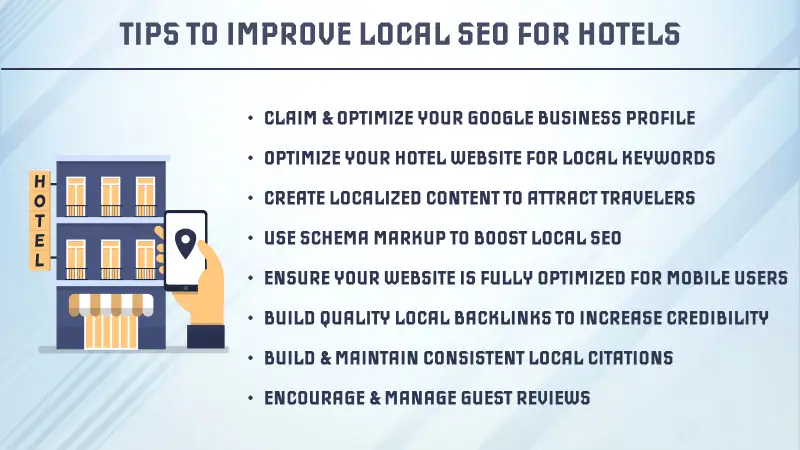
To attract more guests and stand out in local search results, you should implement a strong local SEO strategy for your hotel. Here are some tips that can help you out!
Claim & Optimize Your Google Business Profile
Claiming and fully optimizing your Google Business Profile ensures your hotel appears in Google Maps and local search results. Add accurate contact details, correct categories, amenities, photos, and business descriptions. Ensure that you update it regularly, as it can help improve visibility in search results.
Optimize Your Hotel Website for Local Keywords
Use location-based keywords naturally across your website, including page titles, headings, meta descriptions, and content. You need to focus on terms travelers actually search for, such as city names, landmarks, and hotel types. This helps search engines connect your hotel with relevant local searches.
Create Localized Content to Attract Travelers
Publishing content about nearby attractions, local experiences, travel tips, and seasonal events helps your hotel rank for long-tail local searches. Localized content positions your property as a helpful travel resource and attracts guests who are planning trips to your destination.
Use Schema Markup to Boost Local SEO
Schema markup helps search engines better understand your hotel’s details, such as location, ratings, amenities, and pricing range. Implementing hotel and local business schema improves search visibility and increases the chances of enhanced listings in search results.
Ensure Your Website Is Fully Optimized for Mobile Users
Most travelers search and book hotels on mobile devices. A mobile-friendly website with fast loading speed, easy navigation, and a smooth booking process improves user experience, reduces bounce rates, and positively impacts local search rankings.
Build Quality Local Backlinks to Increase Credibility
Earning backlinks from local tourism websites, travel blogs, event organizers, and business directories signals trust and authority to search engines. High-quality local backlinks strengthen your hotel’s online credibility and improve its ability to rank in local search results.
Build & Maintain Consistent Local Citations
Local citations include your hotel’s name, address, and phone number listed across directories, OTAs, and review platforms. Keeping this information consistent helps search engines verify your location and improves your hotel’s trustworthiness in local search rankings.
Encourage & Manage Guest Reviews
Positive guest reviews play a major role in local SEO and booking decisions. Encourage satisfied guests to leave reviews and respond professionally to all feedback. Active review management builds trust, improves prominence, and increases your hotel’s visibility in local searches.
Wrapping Up
That’s a wrap for this blog!
Local SEO might sound technical at first, but it’s simply about making sure your hotel shows up when travelers are actively searching for a place to stay. Today’s guests rely on Google to make quick decisions, and if your property isn’t visible in local search results, those bookings are going to someone else.
The good news is that with the right local SEO efforts, you can increase your visibility and attract more direct bookings.
If you want expert help to get your local SEO strategy right and turn local searches into real bookings, Technoloader provides dedicated local SEO services for hotels and resorts. This way, you can stand out in search results and connect with travelers who are ready to book.
So, get in touch with us now!

Deepa Manwani
I’m Deepa Manwani, a technical content writer with 4+ years of experience, including 3+ years in blockchain. I enjoy simplifying complex technical and blockchain concepts into clear, practical, and reader-friendly content that’s easy to understand.
Published in SEO


