 +91 7014607737
 info@technoloader.com





Table of Contents
Key Takeaways:
-
-
-
- SEO helps businesses attract customers who are actively searching online, making it one of the most effective long-term growth strategies.
- Unlike paid advertising, SEO builds sustainable visibility and continues generating traffic without ongoing per-click costs.
- Modern SEO focuses on user intent, content quality, technical performance, and trust signals rather than just keyword placement.
- SEO supports every stage of the sales funnel, from awareness and consideration to final purchase decisions.
- A strong SEO strategy includes content planning, technical optimization, on-page improvements, and off-page authority building.
- SEO reduces customer acquisition cost over time while increasing lifetime customer value.
- Business growth through SEO can be measured using metrics like organic traffic, keyword rankings, conversions, and revenue contribution.
-
-
Today, almost every customer starts their journey online. When people need a product, service, or solution, they search on Google. If your business does not appear in those results, you’re missing valuable opportunities.
Here, Search Engine Optimization (SEO) helps your website rank higher in search results so potential customers can easily find you. It helps your business to connect with people who are already searching for what you offer. This makes SEO one of the most powerful and cost-effective ways to grow.
Unlike paid advertisements, which stop bringing traffic once the budget finishes, SEO works continuously. It builds long-term visibility, trust, and credibility for your brand. And with time, higher rankings lead to an increase in website traffic, better leads, and high-margin sales growth.
SEO connects your business directly with high-intent customers, turning search visibility into measurable revenue opportunities. In this guide, you’ll learn how SEO supports business growth and why investing in it is truly worthwhile.
Understanding SEO Beyond the Basics
In 2026, SEO is no longer just about adding keywords to a webpage.
Earlier, ranking was easier if you simply repeated certain words. But today, things have changed completely, and search engines are much smarter.
Modern SEO focuses on helping users first. Search engines try to understand what a user is truly looking for and show the most helpful result. This means your content must answer real questions, solve problems, and provide clear information.
Today, SEO is all about:
- Understanding user intent
- Creating helpful and detailed content
- Providing a smooth website experience
- Building trust and authority
In simple terms, SEO now is about being truly useful, not just technically optimized.
How Search Engines Work
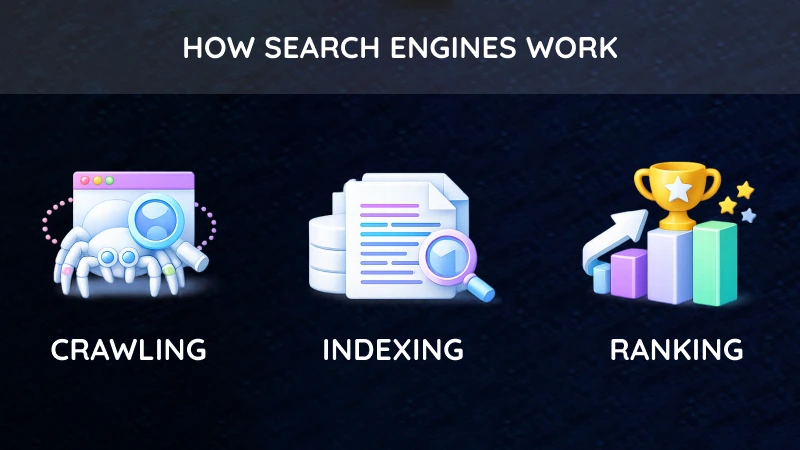
Do you have any ideas related to how search engines actually work? Well, it works very systematically in three main steps:
- Crawling – Search engines use bots to scan websites and discover new pages.
- Indexing – They store and organize this information in their database.
- Ranking – When someone searches, the engine shows the most relevant and useful pages at the top.
Search engines rank pages based on factors such as:
- Relevance to the search query
- Content quality
- Website speed
- Mobile friendliness
- Trust and backlinks
The better your website performs in these areas, the higher it can rank.
Key Ranking Factors That Impact Businesses
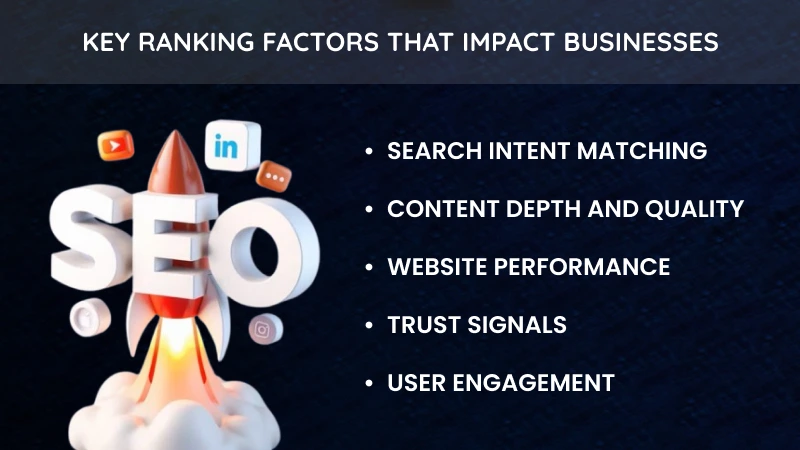
For businesses, certain ranking factors are especially important. These include:
- Search Intent Matching:
Search engines support content that clearly matches what users are looking for. Whether they want information, comparisons, or to make a purchase, if your page aligns with their purpose, then search engines will improve visibility and ranking potentially.
- Content Depth and Quality:
Search engines appreciate content that explains topics clearly and completely. Well-organized, detailed information builds authority, answers user questions properly, and encourages visitors to stay longer on your website.
- Website Performance:
A fast, mobile-friendly website creates a better user experience. If pages load slowly or don’t work properly on smartphones, users leave quickly, which can even negatively affect your search ranking.
- Trust Signals:
Secure websites using HTTPS, positive customer reviews, and backlinks from reputable sources signal to search engines that your business is credible, reliable, and safe for visitors.
- User Engagement:
When users spend more time on your site, click through pages, or interact with content, search engines see this as a positive signal. This often helps improve your overall rankings.
Why SEO is the Foundation of Sustainable Business Growth
If we discuss why SEO is the core foundation of sustainable business growth, then here’s what you need to know.
SEO helps businesses grow in a steady and long-lasting way. Instead of depending only on ads or social media, SEO helps you get customers from Google when they’re actively searching. This helps make your business growth more stable, affordable, and scalable over time. Let’s understand the logic behind it:
SEO as a Revenue Channel
- Organic Traffic vs Paid Traffic
With SEO, organic traffic comes from search results naturally. You don’t pay Google for every visitor. Paid traffic comes from ads (PPC). You pay for every click, and traffic stops the moment you stop spending. So SEO becomes a revenue channel because it keeps bringing visitors and leads without daily ad costs.
- Lifetime Customer Acquisition Value
SEO often brings in customers who stay longer and come back because they found you while looking for something they really needed. SEO helps you make more money from a customer over time, not just from one sale. For example, if a customer buys from you multiple times over months or years, SEO helps you make more money from that customer.
- Compounding Growth Effect
When done correctly, SEO creates content that keeps bringing visitors and potential customers for months or even years. As you publish more helpful content, your website gains authority. That means your newer pages can rank faster, too.
SEO Lowers Customer Acquisition Cost
Customer Acquisition Cost means how much it costs to get one customer.
- Cost Comparison With PPC
With PPC, you keep paying for every click. If competition increases, your ad cost goes up.
With SEO, the upfront effort might take time, but you don’t pay per click. As organic traffic increases, your cost per customer usually goes down.
- Long-Term ROI Modeling
SEO may look slow at first, but over months, the value grows.
For example, if a blog brings 1,000 visitors every month and even 2% convert, that becomes a steady flow of leads. The longer it ranks, the higher the return on your original work.
SEO Builds Brand Visibility and Authority
- Repeated Search Exposure
When people repeatedly see your business name in search results, they start remembering it. Even if they don’t click the first time, visibility builds familiarity. - Trust Psychology in Rankings
Most of the time, people trust the top results from Google more. A lot of people think that websites that are on the first page are more trustworthy than those that are on the third or fourth page. When your site ranks higher, people may automatically trust it more. - Industry Thought Leadership
When your website publishes helpful guides, comparisons, and expert insight, people start seeing your brand as knowledgeable. This makes customers more likely to choose you over competitors.
SEO Generates High-Intent Leads
High-intent leads are people who are closer to buying.
- Informational vs Transactional Keywords
Informational keywords: “what is a crypto exchange” and “how to launch a white label crypto exchange.” These keywords are generally searched for learning and researching purposes.
Transactional Keywords: “cost to build crypto exchange” and “White label crypto exchange pricing.” These keywords are searched by users with strong buying intent.
Both are useful, but comparatively, transactional keywords bring faster sales.
- Buying-Stage Optimization
SEO helps you create content for every stage:
- Early stage: educational blogs
- Middle stage: comparisons and best lists
- Final stage: service pages, pricing pages,
Therefore, by covering all these stages, you capture customers throughout their journey and convert more leads into sales.
How SEO Impacts Every Stage of the Sales Funnel
Before someone becomes your customer, they usually go through a decision-making process. This journey is often called the sales funnel. It has different stages, from discovering a problem to finally making a purchase.
Not every visitor is ready to buy immediately. Some are just learning. Some are comparing options. Others are ready to take action.
At every stage, SEO helps your business gain visibility, which increases your chances of turning visitors into paying customers. Let’s understand how SEO is creating impact at every stage:
a. Top of Funnel – Awareness Stage
This is the earliest stage. At this point, people are aware that they’ve a problem, but they may not know the solution yet.
For example:
- Why is my website traffic low?
- How to increase online sales?
- What is digital marketing?
At this point, users are generally looking for information, not services yet.
Educational Blog Content
Creating helpful blog posts helps your business to answer these early questions. When users find useful information on your website, they begin to trust your brand.
Problem-Based Search Queries
Sometimes people look for things based on their problems rather than the product names. You can get people to your site early in their buying process if your content is about solving real problems.
b. Middle of Funnel – Consideration Stage
At this stage, users understand their problem and are actively looking for solutions. They start comparing options. For example:
- SEO vs Google Ads
- Best SEO company for small business
- Top marketing tools for startups
Comparison Pages
Comparison content helps users analyze options clearly. When you explain the difference between services or strategies, you guide them in decision-making. This builds authority and increases trust.
Service Explainer Pages
Users want to understand how your service works. Clear explanations of your process, benefits, features, and results reduce confusion and increase confidence.
Case Studies and Success Stories
Showing examples of how you helped other clients proves your credibility. SEO makes your service feel less risky and more reliable.
c. Bottom of Funnel – Decision Stage
This is the final stage, where users are ready to take action. They know what they want and are searching for specific providers.
For example:
- Best digital marketing company near me
- SEO services company
- Request SEO consultation
These searches show high buying intent.
Location + Service Keywords
People who type in “best digital marketing company near me” or “SEO services company” are very likely to buy. When people search for these keywords and are ready to hire, optimizing for them helps your business show up.
Service and Consultation Pages
When users search “Request SEO consultation,” they’re prepared to connect directly. Clear service pages explaining your expertise, process, and benefits help build confidence and encourage them to take action.
Optimized Landing Pages
Decision-stage visitors need clear direction. Strong call-to-action buttons, simple contact forms, testimonials, and highlighted benefits help increase conversions and turn ready-to-buy visitors into paying customers.
Core Pillars of SEO That Drive Business Expansion
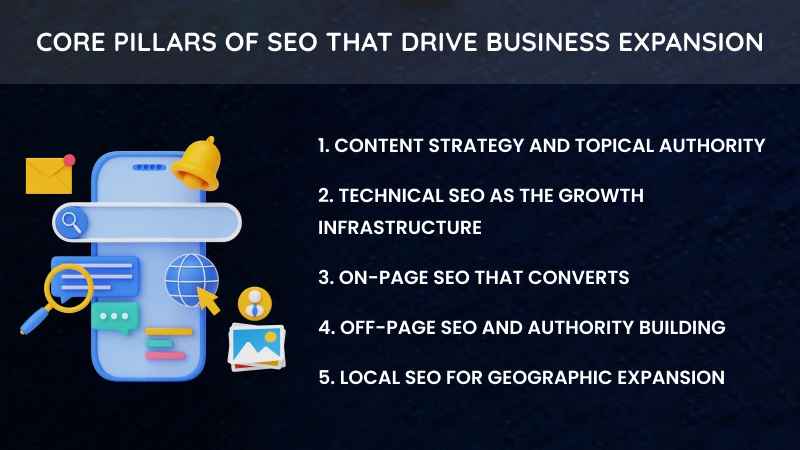
SEO works well when all its major parts function together. These pillars form the foundation that helps businesses grow visibility, traffic, and revenue consistently.
-
Content Strategy and Topical Authority
Content is the key to SEO. But random blog posts are not enough; you typically need a clear and structured content plan.
- Topic Clusters: Instead of writing isolated articles, you create multiple related pieces around one main topic. This helps search engines understand your expertise in that subject area and improves rankings.
- Pillar Pages: A pillar page is a detailed, comprehensive guide on a broad topic. It links to smaller related articles. This structure improves authority and makes navigation easier for users.
- Internal Linking Architecture: Linking related pages within your website helps search engines crawl your content better. It also guides visitors to explore more pages, increasing engagement and conversions.
- Evergreen vs Trend Content: Evergreen content stays relevant for years, like “What is SEO?” Trend content focuses on current topics. A balance of both ensures steady traffic and timely relevance.
-
Technical SEO as the Growth Infrastructure
Technical SEO ensures your website functions properly for both users and search engines.
- Website Speed Optimization: Fast-loading websites improve user experience and rankings. Slow websites increase bounce rates and reduce conversions.
- Secure HTTPS: A secure website builds trust. Search engines prioritize secure websites because they protect user data.
- Structured Data: Structured data helps search engines understand your content better. It can also enhance search listings with rich results like reviews, ratings, and FAQs.
- XML Sitemaps: An XML sitemap tells search engines which pages exist on your website, helping them crawl and index content more efficiently.
- Crawl Budget Optimization: Search engines allocate a limited time to crawl your site. Optimizing your website ensures important pages get indexed properly.
-
On-Page SEO That Converts
On-page SEO focuses on optimizing individual pages for both ranking and conversion.
- Keyword Placement Strategy: Keywords should appear naturally in titles, headings, and content. Proper placement helps search engines understand your topic without overstuffing.
- Semantic SEO: This means using related terms and variations around your main keyword. It improves content relevance and matches user intent better.
- Optimized Headings: Clear headings improve readability and structure. They also help search engines understand content hierarchy.
- Meta Titles & Descriptions: These appear in search results. A compelling title and description improve click-through rates.
- Conversion-Focused Content Structure: Content should guide users toward action. Clean benefits, testimonials, and calls to action increase conversion rates.
-
Off-Page SEO and Authority Building
Off-page SEO builds your website’s reputation outside your own domain.
- Backlink Strategy: When reputable websites link to you, search engines see your site as trustworthy and authoritative.
- Digital PR: Publishing news, insights, or expert opinions on authoritative platforms increases brand visibility and credibility.
- Guest Posting: Writing for industry websites builds authority and generates quality backlinks.
- Brand Mentions: Even when your brand is mentioned without a link, it helps improve recognition and authority signals.
- Niche Citations: Being listed in industry directories and trusted platforms strengthens local and industry-specific credibility.
-
Local SEO for Geographic Expansion
Local SEO helps businesses attract customers in specific locations.
- Google Business Profile Optimization: An optimized profile improves visibility in local search and Google Maps results.
- Near Me Searches: Optimizing for location-based keywords helps you appear when users search for services nearby.
- Reviews & Local Citations: Positive reviews build trust. Consistent business information across directories improves local rankings.
- Multi-Location SEO Strategy: For businesses operating in multiple areas, creating dedicated location pages improves visibility in each target region.
SEO vs Paid Advertising: Growth Strategy Comparison
|
Factor |
SEO (Search Engine Optimization) |
Paid Advertising (PPC) |
|
Speed of Results |
Takes time to show results. Rankings improve gradually over months. |
Delivers immediate visibility once campaigns are launched. |
|
Cost Structure |
Requires an upfront investment in content and optimization, but no cost-per-click. |
You pay for every click. Traffic stops when the budget ends. |
|
Long Term Growth |
Builds sustainable, long-term traffic and authority over time. |
Provides short-term traffic but does not build a lasting organic presence. |
|
Customer Acquisition Cost |
Decreases over time as organic traffic grows. |
Can increase due to competition and rising ad costs. |
|
Dependency Risk |
Less dependency once strong rankings are achieved. |
Highly dependent on continuous spending and platform algorithms. |
|
Brand Trust |
High rankings build credibility and long-term trust. |
Users may trust organic results more than ads |
|
Best Use Case |
Ideal for businesses focused on sustainable growth and authority building. |
Best for quick promotions, product launches, or immediate lead generation. |
|
Ideal Strategy |
Works best as a long-term growth engine. |
Works best when combined with SEO for a balanced strategy. |
Real Business Impact: How SEO Drives Measurable Results
SEO delivers real business outcomes, not just higher rankings. It increases traffic, generates leads, and contributes directly to revenue growth. The impact can be tracked and measured, making SEO a reliable long-term investment.
- Traffic Growth: SEO builds steady and compounding traffic over time. As your website gains authority, rankings improve, and organic visitors increase consistently without additional ad spend.
- Revenue Contribution: Organic traffic can be tracked from the first visit to the final sale. This helps businesses measure conversions, calculate return on investment, and understand how SEO supports revenue growth.
- Market Expansion: By outranking competitors and targeting niche keywords, businesses capture more search visibility. This increases market share and strengthens brand authority within the industry.
Measuring SEO Performance and ROI
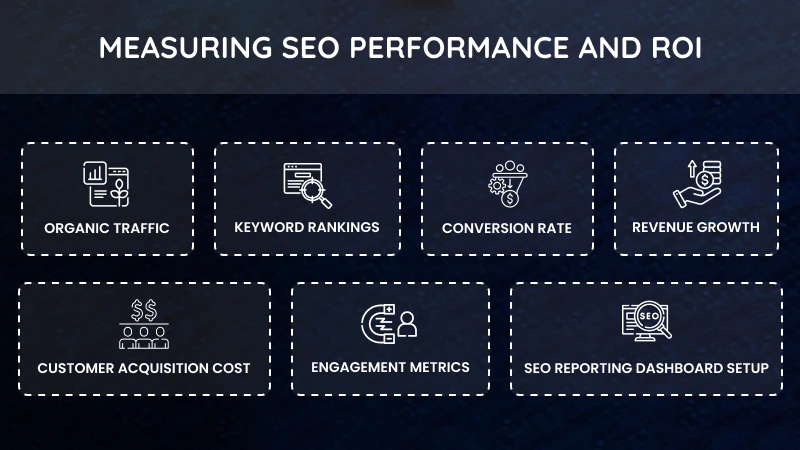
To understand whether your SEO efforts are truly driving business growth, it’s important to measure the right performance metrics regularly.
- Organic Traffic: The number of visitors to your website from search engines without paid ads. If organic traffic increases, your SEO is working well.
- Keyword Rankings: This shows where your website appears in search results for specific keywords. Higher ranking usually means more visibility and traffic.
- Conversion Rate: The percentage of visitors who take action, such as filling out a form or making a purchase. Good SEO should improve conversions, not just traffic.
- Customer Acquisition Cost: This is how much it costs to get one customer. If SEO is effective, your cost per customer decreases over time.
- Revenue Growth: SEO should contribute to increasing sales and business income through consistent organic leads.
- Engagement Metrics: These include time spent on your website, pages visited, and bounce rate. High engagement shows users find your content helpful.
- SEO Reporting Dashboard Setup: This is a tool that tracks all your SEO performance data in one place, helping you measure results and make better decisions.
Conclusion
SEO is very important for businesses to grow in today’s digital world. People trust the websites that come up first when they search online. SEO makes your business easier to find, brings in the right customers, and brings in good leads.
It helps lower marketing costs in the long run and builds brand trust over time. SEO keeps working after the first effort, unlike paid ads. Companies that spend money on SEO build a strong base for steady growth.
However, if you want to get real results and improve your online presence, working with a company like Technoloader that has been around for a while can make a big difference.
Let’s connect and take your business growth to the next level.
Frequently Asked Questions
How long does it take to see results from SEO?
SEO is a long-term strategy. Most businesses start seeing noticeable improvements within 3 to 6 months. However, strong and stable growth usually happens over a longer period as authority and rankings improve.
Is SEO better than paid advertising?
SEO and paid advertising serve different purposes. Paid ads deliver quick results, while SEO builds sustainable, long-term visibility. For consistent growth, many businesses combine both strategies effectively.
Can small businesses benefit from SEO?
Yes, SEO is especially beneficial for small businesses. It helps them compete with larger companies by targeting local and niche keywords. With the right strategy, small businesses can generate quality leads without a huge advertising budget.
How does SEO bring in good leads?
SEO focuses on people who are actively looking for certain goods or services. When your website ranks for these high-intent keywords, people are more likely to buy something from you.
Does SEO really lower the cost of getting new customers?
Yes, SEO brings in natural traffic over time, unlike paid ads, where you pay for every click. When your rankings go up, the cost per lead goes down, which makes it a better value for money in the long run.
What are the most important parts of a good SEO plan?
A good SEO plan includes creating high-quality content, optimizing the site’s technical aspects, doing keyword research, building backlinks, and keeping an eye on how well the site is doing. All of these things work together to help rankings and growth.

Kanak Badaya
Kanak Badaya is a Technical Content Writer at Technoloader with over 3 years of experience translating complex technology into content that actually makes sense. He works closely with emerging domains like Blockchain, Web3, AI, and DeFi, turning intricate technical concepts into clear, structured, and engaging narratives that help businesses communicate with confidence. Rather than just writing for search engines, Kanak focuses on writing for people. He combines in-depth research with a practical understanding of the industry to create blogs, website content, and technical guides that inform, educate, and build credibility. His goal is simple - make advanced technology feel approachable while helping Technoloader strengthen its authority in the digital space.
Published in SEO


