 +91 7014607737
 info@technoloader.com





Table of Contents
Imagine a marketing system where everyone is rewarded fairly, payments occur instantly, and trust isn’t an issue. Sounds mesmerizing? Well, that’s exactly where marketing is heading.
For years, multi-level marketing has been driven by personal networks and ambitious individuals. It has been offering a wide range of unique opportunities that allow people to earn through referrals and community-driven sales.
But over the period, the model began to crack, and the reason behind this was a lack of transparency, centralized control, and an unfair reward distribution pattern. However, with the rise of decentralized networks, a significant shift is taking place; businesses are now actively exploring blockchain-based MLM software to build transparent, automated, and trustless marketing ecosystems.
By utilizing blockchain technology, marketing is becoming cross-border, transparent, and community-driven. So, if you’re likely to learn more about this, then continue to browse through this comprehensive guide.
Understand The Traditional MLM Model
Traditional multi-level marketing was especially designed to grow through personal connections.
People typically promote products to their friends, family, and networks. In return, they earn commissions from both direct sales and the sales generated by those they’ve recruited.
In simple words, it was like a win-win. But as MLMs scale, the system has become complex and often unfair. Those who are at the top level are earning aggressively, while newcomers or lower-level participants struggle to see valuable returns.
Additionally, manual tracking of referrals is becoming increasingly complicated, while central authorities, typically companies, struggle to manage everything from payouts to policies. This result meant that participants had to trust the system blindly, even if it was not always transparent.
Why It Was Necessary to Change
If we discuss why traditional MLMs were necessary to change, then we live in a digital era where users expect transparency, speed, and fairness. And centralized systems, whether in marketing, finance, or governance, are increasingly questioned.
People are avoiding participation; they also request proof that the system works fairly for everyone. However, with their closed systems and reliance on manual verification, traditional MLMs are no longer aligned with these expectations.
The modern marketer is now demanding automation instead of paperwork, verifiable transactions instead of vague statements, and equal opportunity instead of hierarchy. This growing demand for openness and equality has pushed businesses to evaluate the difference between centralized and decentralized MLM systems before adopting new models.
Introducing Decentralized MLM
A decentralized network uses blockchain to turn marketing participation into measurable, transparent, and automated actions. Instead of relying on manual commissions, participants earn digital tokens or cryptocurrency that represent value.
These tokens can be used, traded, or held, just like any other digital asset. They’re distributed based on real contributions, like sales, referrals, or community engagement. Most importantly, they’re managed through smart contracts, meaning the system executes rewards automatically without human interference.
Here’s how decentralized MLMs stand apart:
- Transparency: Every transaction and reward is recorded on a public blockchain, ensuring that nothing can be hidden or altered.
- Automation: Smart contracts handle all calculations and payments, eliminating delays.
- Decentralization: No single authority controls the network; power is distributed evenly.
- Global Reach: Anyone with a crypto wallet can participate, regardless of location.
In short, decentralized networks make marketing a global, open system where everyone follows the same rules.
How Blockchain Reinvents the MLM Model
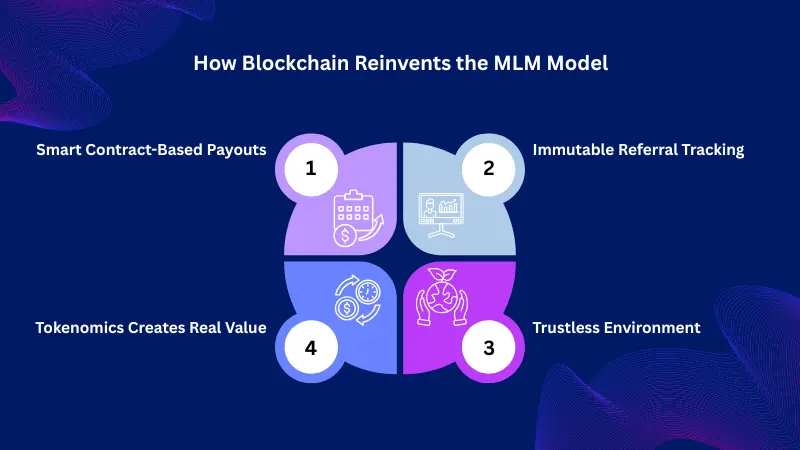
Traditional MLM systems completely rely on a central company to track sales, verify referrals, and make other payouts, which often leads to delays, errors, and manipulation. Blockchain has completely fixed these problems; here’s how:
1. Smart Contract-Based Payouts:
These are the self-running programs on the blockchain that execute tasks automatically.
In a decentralized MLM, when a sale occurs, a new user joins, or someone completes a referral, a smart contract instantly calculates the reward and sends it.
Result? Everything is automatic and error-free. However, ignoring technical planning can lead to common mistakes in MLM software that impact scalability and long-term performance.
2. Immutable Referral Tracking:
Blockchain records every referral, sale, and team structure permanently, ensuring that no one can create fake IDs, delete or alter referral data, or manipulate the downline structure.
Meanwhile, in traditional systems, fraud and manipulation are common, but blockchain makes it tamper-proof.
3. Tokenomics Creates Real Value:
In decentralized MLM, rewards come in the form of tokens; this means participants not only earn money, but they also often own a piece of the ecosystem.
Whereas traditional MLM rewards generally disappear if the company shuts down, decentralized tokens can be easily traded, stored, or sold at any time.
4. Trustless Environment
The biggest change in decentralized multi-level marketing is that there is no central company controlling rewards, access, or data. The system operates completely independently, and participants don’t need to trust anyone; rather, it’s the code that is functioning fairly.
Herein, traditional MLM failures are often attributed to human error, mismanagement, or manipulation; however, blockchain removes humans from the reward process entirely.
Key Benefits of Decentralized Marketing Models
Traditional and decentralized marketing models are gaining traction fast because they fix many long-standing problems. Here’s why they’re redefining the landscape:
- Every transaction is triggered automatically by smart contracts, meaning no manual calculations, no delays, and no uncertainty.
- Everyone has access to the same opportunities, ensuring fairness and equality with no favouritism or manipulation by central authorities.
- Immutable blockchain records prevent the creation of fake sales reports or the manipulation of rewards.
- Users earn real digital assets, giving them a stake in the ecosystem’s success.
- Decentralized systems operate across borders, opening marketing opportunities to a global audience.
- By removing middlemen and automating processes, companies save big on administration and payouts.
- Transparency builds credibility, a significant advantage in industries often criticized for their opaque operations.
Together, these features transform marketing into a community-powered economy, where participation equals ownership.
Conclusion
The journey from traditional MLM to decentralized networks represents more than a technological shift; it’s a complete rethinking of how trust, value, and collaboration work in marketing.
Traditional MLMs built the foundation. But blockchain is building the future, where fairness replaces authority, automation replaces guesswork, and transparency replaces blind trust.
In this new era of decentralized marketing, participants are no longer just promoters; they’re often partners connected by technology and empowered by ownership. Thus, the future of marketing isn’t centralized; it’s community-driven, tokenized, and unstoppable.

Vipin Kumar
Vipin Kumar is the Founder & CEO of Technoloader, a Clutch Top 10 Blockchain Development Company for 2025. A serial technology entrepreneur and blockchain architect with a B.Tech background, Vipin has led the delivery of 450+ projects across DeFi, NFT marketplaces, AI/ML, and custom Web3 platforms for clients in the UAE, India, the US, and beyond. He also founded SALIQ (saliq.ai), an AI-driven conversational marketing platform.
Published in MLM Software Development


