 +91 7014607737
 info@technoloader.com





Table of Contents
Blockchain technology has completely transformed the way we think about money, ownership, and digital trust. But as more people started using blockchain, a major problem that users faced was that they’re slow and expensive to use at scale.
High transaction fees and network congestion make everyday usage very challenging, especially for popular networks like Ethereum. This is where zero-knowledge rollups come into play!
ZK rollups are a smart way to make blockchains faster and cheaper without compromising security. They process transactions more efficiently and still rely on the main blockchain for trust and verification. As a result, ZK rollups are becoming one of the most important technologies for building scalable blockchain applications.
In this blog, we’ll explore what ZK rollups are, how they work, their future, and much more.
Understanding Zero-Knowledge Proofs (Foundation of ZK Rollups)
Before breaking down the key details regarding ZK rollups, first, let’s understand zero-knowledge proofs.
A zero-knowledge proof is a method that allows someone to prove that something is true without revealing the actual details. In simple words, it’s like proving you know the answer to a question without saying the answer out loud. Even if they never see the information, they can be confident that you are correct.
In blockchain systems, zero-knowledge proofs are typically used to verify transactions without revealing all the transaction data or rechecking every step on the main network. Instead of processing every transaction one by one, the blockchain only checks cryptographic proof that confirms that everything was done correctly.
Meanwhile, the two most common types of zero-knowledge proofs used in blockchain are:
- zk-SNARKs, which are small and quick to verify
- zk-STARKs, which are more scalable and highly secure
By using these proofs, blockchains can stay secure, reduce workload, and protect user data excellently.
What is a ZK Rollup?
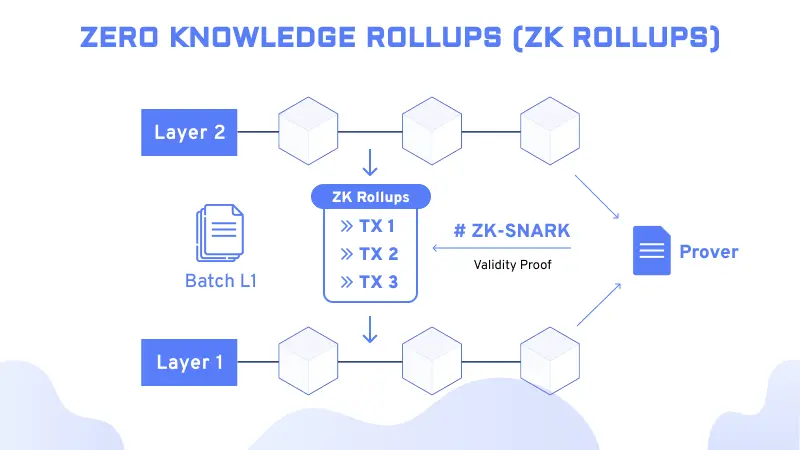
A ZK Rollup is a Layer-2 scaling solution that enables blockchains to process transactions faster and at a lower cost without sacrificing security. Instead of handling every transaction directly on the main blockchain (Layer-1), ZK Rollup moves most of the work off-chain.
Typically, it collects hundreds or even thousands of transactions, processes them together, and in the end submits a single zero-knowledge proof to the main blockchain. This proof confirms that all transactions are valid and were executed correctly.
The primary advantage of a ZK Rollup is trust. The main blockchain does not need to “trust” the rollup operator; often, it only accepts updates that come with valid cryptographic proofs. If the proof is correct, the transactions are approved, and if it’s not, they’re rejected automatically.
Because of this approach, ZK Rollups lower network congestion, reduce transaction fees, increase transaction speed, and obtain the complete security of the main blockchain.
How ZK Rollups Work
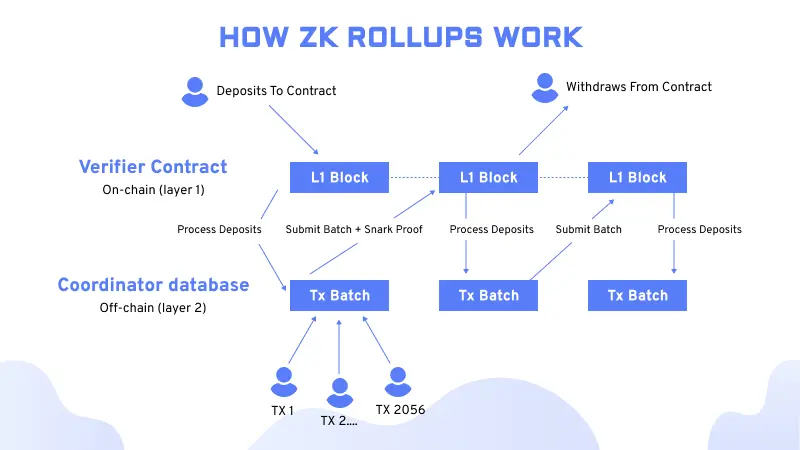
Now, if we discuss the ZK Rollups working process, then it typically consists of two core components: on-chain contracts and off-chain virtual machines.
1. On-Chain Contracts
On-chain contracts are smart contracts that handle security and verification. They usually include:
- A main rollup contract that stores rollup blocks, tracks user deposits and withdrawals, and updates the rollup’s state.
- A verifier contract that checks zero-knowledge proofs to confirm that all off-chain transactions are executed correctly.
These contracts make sure that only valid state updates are accepted on the main blockchain.
2. Off-Chain Execution
Off-chain components manage the actual transaction execution. This is where most of the work happens. They:
- Process hundreds or thousands of transactions off-chain.
- Generate zero-knowledge proofs that validate the transactions.
- Submit these proof and minimal data back to the on-chain contracts.
Even though transactions are processed off-chain, they remain secure because the main blockchain verifies every update using cryptographic proofs and ensures data availability.
Why This Makes ZK Rollups Safer
Since Ethereum verifies every update using zero-knowledge proofs, it immediately invalidates transactions that cannot be added, even if the off-chain operator acts maliciously.
This is why ZK Rollups are considered safer than purely off-chain solutions like sidechains, which are dependent on their own independent security models.
Why ZK Rollups Are Highly Scalable
Wondering why ZK rollups are highly scalable? Then the core reason behind this is that ZK Rollups reduce the amount of work done on the main blockchain.
Instead of processing every transaction on-chain, they execute transactions off-chain and handle hundreds or thousands in a single batch. This batch is then verified on the main blockchain using a small zero-knowledge proof.
Because the blockchain only checks one proof instead of many transactions, network congestion is reduced, and transaction fees become much lower. ZK Rollups also compress transaction data, which helps in saving space and gas costs.
Another major advantage is fast finality, which means transactions are confirmed quickly once the proof is verified and submitted to the main blockchain, without the long waiting periods required by other solutions.
Security Model of ZK Rollups
The security model of ZK Rollups varies based on validity proofs, which makes them one of the safest Layer-2 scaling solutions. Every batch of off-chain transactions is accompanied by a zero-knowledge proof that mathematically proves that all transactions were executed correctly. However, the main blockchain accepts updates only if this proof is valid.
In addition, ZK Rollups inherit the full security of the Layer-1 blockchain, such as Ethereum. This means users do not need to trust the rollup operator or any third party. Even if an operator acts maliciously, they cannot submit an invalid state because the proof would fail verification.
Another key advantage is instant finality. Since correctness is proven upfront, there is no challenge or dispute period, ensuring a strong, fast confirmation and reliable fund protection.
ZK Rollups vs Others
Once you’re clear about Zero Knowledge Rollups, their working process, and others, then now, it’s time to simplify the core difference between ZK Rollups vs. others:
- ZK Rollups vs Other Scaling Solutions
ZK Rollups differ from other blockchain scaling solutions in that they use validity proofs to ensure transaction correctness. Unlike other methods that rely on trust or delayed verification, ZK Rollups verify everything before updating the blockchain. - ZK Rollups vs Optimistic Rollups
Optimistic Rollups assume transactions are valid unless challenged, which introduces a waiting period for finality and withdrawals. ZK Rollups verify transactions immediately using zero-knowledge proofs, offering faster finality and stronger security. - ZK Rollups vs Sidechains
Sidechains operate with their own independent security models, meaning users must trust the sidechain validators. ZK Rollups inherit security directly from the main blockchain. - ZK Rollups vs State Channels
State channels work well for simple, repeated transactions but are limited in scope. ZK Rollups support complex smart contracts and large-scale applications, making them more suitable for long-term scalability.
ZK Rollups in the Ethereum Ecosystem
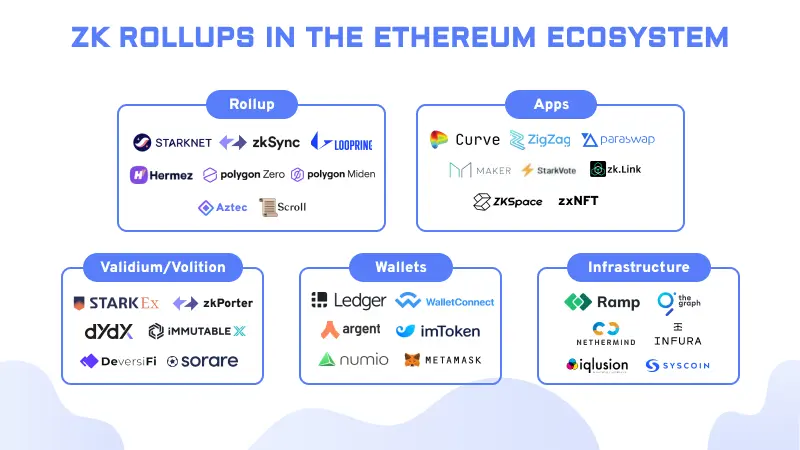
ZK Ethereum’s long-term scalability strategy relies heavily on rollups. As Ethereum usage grows, high gas fees and network congestion have demonstrated that most activity cannot take place directly on Layer-1. ZK Rollups address this issue by moving transaction execution off-chain while maintaining Ethereum as the secure settlement layer.
With the development of zkEVMs, developers can deploy Ethereum smart contracts on ZK Rollups with little or no code changes. This makes adoption easier and allows users to benefit from lower fees and faster transactions without leaving the Ethereum ecosystem.
Ethereum’s roadmap strongly supports ZK-based scaling, and over time, ZK Rollups are expected to handle the majority of transactions while Ethereum focuses on security, decentralization, and final settlement.
Challenges and Current Limitations
While ZK Rollups offer powerful scalability and security benefits, they’re still an evolving technology and come with certain challenges that need to be addressed for wider adoption.
- High Computational Cost for Proof Generation: Generating zero-knowledge proofs requires significant computing power, increasing infrastructure costs for rollup operators.
- Advanced Infrastructure Requirements: Running ZK Rollups often demands specialized hardware and optimized systems, making setup more complex.
- Complex Development Experience: Building and maintaining applications on ZK Rollups is more challenging than on traditional Layer-1 blockchains.
- Evolving Tooling and Documentation: Developer tools and resources are improving, but also remain less mature compared to Ethereum Layer-1.
- Smart Contract Compatibility Limitations: Some ZK Rollups do not yet fully meet EVM standards, requiring code adjustment.
- Ecosystem Maturity: ZK Rollup ecosystems are still growing, with fewer users, dApps, and liquidity than established networks.
- User Learning Curve: New users may find Layer-2 concepts like bridging and network switching confusing at first.
The Future of ZK Rollups
The future of ZK Rollups looks very promising as blockchain technology continues to grow. Ongoing improvements in zero-knowledge proofs are making transactions faster, cheaper, and more efficient than before. As a result, ZK Rollups are becoming easier to use and more practical for everyday applications.
Development of ZK Rollups is also getting simpler. Better tools, improved zkEVM compatibility, and clearer documentation are helping developers build and deploy applications without deep technical knowledge. This will encourage more projects to adopt the technology.
In the future, most blockchain transactions are expected to run on ZK Rollups, while main blockchains focus on security and settlement. This approach will support mass adoption and smoother user experiences.
Final Thoughts
ZK Rollups are transforming the way blockchains grow. Instead of forcing networks to choose between speed, cost, and security, they bring all three together in a smarter way. By moving heavy processing off-chain and using zero-knowledge proofs to guarantee correctness, ZK Rollups make blockchain technology more practical for everyday use.
As tools improve and adoption increases, ZK Rollups are quietly becoming the backbone of modern blockchain systems. At Technoloader, we use ZK Rollups to build solutions that actually work in the real world. As more projects start using this technology, it is becoming the quiet engine behind things like DeFi apps, NFTs, payments, and business platforms.
They’re not just a technical upgrade, often helping make blockchain simpler, more reliable, and easier for everyone to use.

Kanak Badaya
Kanak Badaya is a Technical Content Writer at Technoloader with over 3 years of experience translating complex technology into content that actually makes sense. He works closely with emerging domains like Blockchain, Web3, AI, and DeFi, turning intricate technical concepts into clear, structured, and engaging narratives that help businesses communicate with confidence. Rather than just writing for search engines, Kanak focuses on writing for people. He combines in-depth research with a practical understanding of the industry to create blogs, website content, and technical guides that inform, educate, and build credibility. His goal is simple - make advanced technology feel approachable while helping Technoloader strengthen its authority in the digital space.
Published in Blockchain Development


