 +91 7014607737
 info@technoloader.com





Table of Contents
Blockchain technology is evolving beyond its initial application in digital currencies. As more users and businesses are adopting blockchain solutions, the need for faster, cheaper, and easier-to-use systems has become clear. To meet these demands, blockchains are built in layers, in which each layer is especially designed to improve performance and usability.
If you’re familiar with the crypto world, you may have already heard about Layer 1 and Layer 2 blockchain, but Layer 3 is the blockchain’s next level of evolution. This layer focuses widely on building practical, application-specific solutions on top of existing networks.
Layer 3 also helps developers in creating smooth user experiences, enabling better cross-chain communication, and making blockchain more accessible for everyday use.
In this guide, you will learn what Layer 3 blockchain is, how it works, and much more.
Understanding Blockchain Layers
To understand Layer 3 blockchain clearly, you first need to know how blockchain layers work together. Think of blockchain as a multi-layer system where each layer has its specific role to make the entire network faster, more scalable, and user-friendly.
Layer 1 is the base layer of a blockchain; it is the primary network where all the transactions are processed and recorded. Popular examples include Bitcoin, Ethereum, and Solana. This layer focuses on security and decentralization, but it often struggles with its slow transaction speeds and high fees when usage increases.
To solve scalability problems, here comes Layer 2, built on top of Layer 1. It manages transactions off the main chain and then sends the final data back to Layer 1 for security. This helps in reducing congestion, lowering fees, and improving speed.
And now comes Layer 3 that sits above both Layer 1 and Layer 2. Instead of focusing on transactions or scaling, Layer 3 is mainly designed for applications and user experience. It allows developers to build customized blockchain apps, improve cross-chain communication, and create smoother, more flexible solutions without worrying about the complexities of the underlying layers.
In short,
Layer 1 = Security and core blockchain
Layer 2 = Speed and scalability
Layer 3 = Applications, interoperability, and usability
Together, these layers work as a complete system that helps blockchain technology scale and support real-world use cases.
What Is Layer 3 Blockchain?
Layer 3 blockchain is the application layer of the blockchain ecosystem. It sits on top of Layer 1 and Layer 2 and is mainly designed to make blockchain technology more usable, flexible, and practical for real-world applications.
While Layer 1 focuses on security and decentralization and Layer 2 on scalability and speed, Layer 3 focuses on building and running applications. It provides a framework where developers can create customized decentralized apps, middleware, and interoperability protocols without even worrying about the technical complexities.
In simple words, Layer 3 acts as a bridge between blockchain technology and end users. It helps improve user experience, enables cross-chain communication, and supports application-specific logic. This means users can interact with blockchain apps more smoothly, while developers can build faster, more efficient, and more specialized solutions.
Examples of Layer 3 include application-specific blockchains, cross-chain protocols, and platforms designed to support advanced dApps such as DeFi platforms, blockchain games, and enterprise Web3 solutions.
How Layer 3 Blockchain Works
Layer 3 blockchain works by building application-focused networks on top of Layer 2 and Layer 1 blockchains. Instead of handling basic security or scaling, Layer 3 focuses on how blockchain applications function and interact with users.
Here’s a simple breakdown of how it works:
First, Layer 1 acts as the foundation. It provides core security, decentralization, and final transaction settlement. All important data ultimately relies on Layer 1 to stay secure and tamper-proof.
Next, Layer 2 sits above Layer 1 and manages scalability. It processes transactions faster and at a lower cost by bundling or executing them off the main chain, then sending the final result back to Layer 1 for confirmation.
Finally, Layer 3 operates on top of Layer 2. This layer is where applications, protocols, and user-facing solutions are built. Layer 3 uses the speed and low fees of Layer 2 while still inheriting the security of Layer 1. It allows developers to customize logic for specific use cases like DeFi apps, games, NFTs, and enterprise tools.
Layer 3 also enables cross-chain communication, meaning applications can interact with multiple blockchains at the same time. This makes it easier for users to move assets or data across networks without needing to understand what’s happening behind the scenes.
Together, these layers work as a complete system that makes blockchain more scalable, flexible, and user-friendly for everyday use.
Key Features of Layer 3 Blockchain
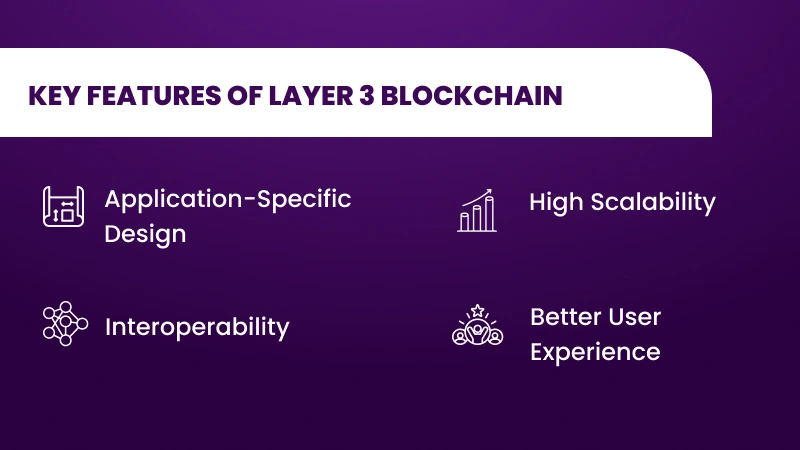
Here are the core features of the Layer 3 blockchain that help blockchain technology become more practical and usable, including:
- Application-Specific Design: Layer 3 solutions are built specifically for applications, not just transactions. Instead of using a one-size-fits-all blockchain, developers can create blockchains or protocols that are tailored for a specific use case. This helps make applications more efficient, reliable, and easier to scale.
- High Scalability: Layer 3 blockchains take advantage of Layer 2 scaling solutions that help in managing a large number of transactions efficiently and enable applications to remain fast even when user activity increases.
- Interoperability: One of the main strengths of Layer 3 is its ability to facilitate cross-chain communication. It allows applications to interact with multiple blockchains and enables users to transfer assets or data seamlessly across different networks without switching platforms or handling complex procedures.
- Better User Experience: Layer 3 hides blockchain’s technical complexity from users. As a result, transactions feel smoother, interfaces are more user-friendly, and interactions are seamless, even for non-technical users.
Benefits of Layer 3 Blockchain
Talking about the benefits of Layer 3 blockchain, these networks offer ultra-low transaction costs by focusing on specific applications, enhancing infrastructure, and maximizing efficiency.
They offer high throughput and near-instant transaction finality by streamlining operations for targeted use cases.
Custom governance and tokenomics encourage businesses to use unique voting systems, token distributions, and economic promotions.
Tailoring interfaces improves the user experience and helps bridge the gap between traditional web applications and blockchain technology.
By simply redirecting targeted traffic from main chains, Layer 3 solutions ease network congestion, benefiting the entire blockchain ecosystem.
Real-World Use Cases of Layer 3 Blockchain
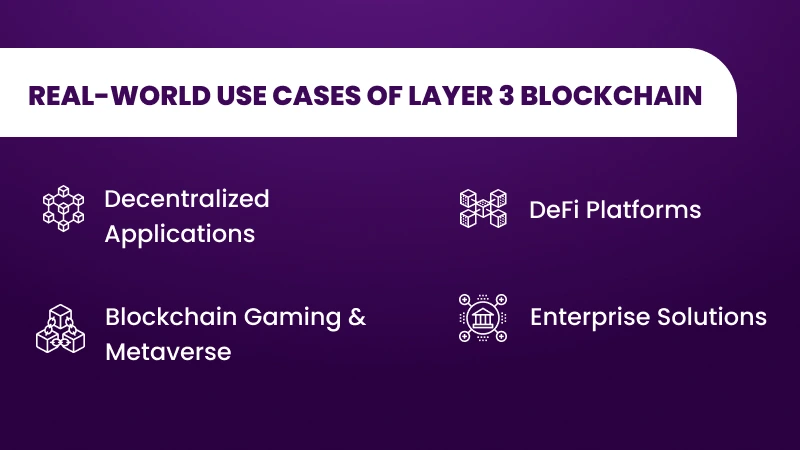
Layer 3 blockchain is widely used to build practical, real-world applications that need speed, flexibility, and a smooth user experience. Here are the most common real-world use cases:
Decentralized Applications (dApps)
Layer 3 allows developers to create custom dApps that run efficiently without any performance issues. Since Layer 3 sits on top of scalable networks, these applications load faster, cost less to use, and feel more user-friendly. This makes dApps easier to adopt by everyday users, not just crypto experts.
DeFi Platforms
In decentralized finance (DeFi), speed and low transaction costs are critical. But here Layer 3 helps platforms by offering faster trading, lending, staking, and yield farming. Resulting in smoother transactions, lower fees, and a better experience for users managing their assets.
Blockchain Gaming & Metaverse
Games and metaverse platforms typically require real-time interaction, quick responses, and the ability to handle many users at once. Layer 3 provides a low-latency and scalable environment, making it ideal for players to enjoy seamless gameplay without delays or high gas fees.
Enterprise Solutions
Businesses use Layer 3 to build custom blockchain systems for supply chain tracking, digital identity, data sharing, and internal workflows. This helps enterprises to create secure, scalable, and application-specific solutions without exposing users to blockchain complexity.
Layer 3 vs Layer 2: Key Differences
Here we have shared a table that places all the key differences between Layer 2 and Layer 3.
| Factor | Layer 2 | Layer 3 |
| Primary Role | Scalability and performance optimization | Application-level customization and domain-driven logic. |
| Examples | Rollups, state channels, sidechains | App-specific chains, customized token layers, specialized execution environments |
| Scalability | High | Depends on the underlying L2 |
| Customization | Moderate | Very high |
| Use Case | Scaling and cost reduction | Specialized applications, governance, compliance, and token behaviour |
| Security Source | Inherits security from Layer 1 | Inherits security from Layer 2 and Layer 1 |
| Typical Users | Users needing faster, cheaper transactions | Enterprises, developers building custom ecosystems |
Challenges and Limitations of Layer 3 Blockchain
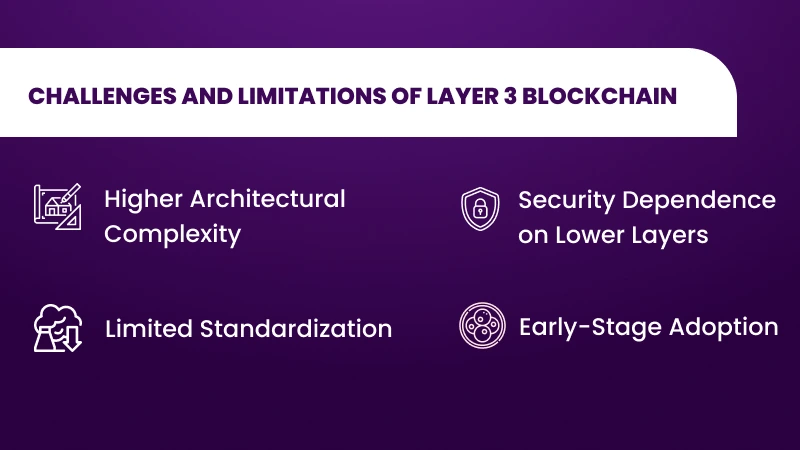
While Layer 3 blockchain offers many benefits, it also comes with a few challenges that beginners should be aware of. This involves:
Higher Architectural Complexity
Layer 3 adds another layer on top of Layer 1 and Layer 2, making system design more complex and requiring deeper technical knowledge from developers to manage integrations effectively.
Security Dependence on Lower Layers
Layer 3 does not secure itself independently and relies heavily on Layer 2 and Layer 1 for security, which means any weakness in lower layers can affect applications built on top.
Limited Standardization
Layer 3 technology lacks universal standards, causing different implementations across platforms, which can lead to compatibility issues and slower ecosystem growth and collaboration.
Early-Stage Adoption
Layer 3 is still new, with limited real-world adoption, fewer tools, and evolving best practices; it makes businesses cautious about completely relying on it for critical applications.
Conclusion
Here comes the end of this comprehensive guide!
Throughout this guide, we have shared in-depth information related to Layer 3 blockchain. We’ve highlighted its core features, benefits, and also discussed the differences between Layers 2 & 3.
Understanding Layer 3 blockchain helps businesses and developers make better decisions when building scalable, user-focused and future-ready blockchain applications. It provides the flexibility, interoperability, and performance needed to support real-world use cases and growing Web3 demands.
Furthermore, if you’re looking forward to implementing advanced blockchain solutions, Technoloader can help you turn your ideas into reality. Being a leading blockchain development company, we support enterprises in building secure, scalable, and high-performing blockchain applications powered by the latest technologies.

Kanak Badaya
Kanak Badaya is a Technical Content Writer at Technoloader with over 3 years of experience translating complex technology into content that actually makes sense. He works closely with emerging domains like Blockchain, Web3, AI, and DeFi, turning intricate technical concepts into clear, structured, and engaging narratives that help businesses communicate with confidence. Rather than just writing for search engines, Kanak focuses on writing for people. He combines in-depth research with a practical understanding of the industry to create blogs, website content, and technical guides that inform, educate, and build credibility. His goal is simple - make advanced technology feel approachable while helping Technoloader strengthen its authority in the digital space.
Published in Blockchain Development


