 +91 7014607737
 info@technoloader.com





Table of Contents
Key Takeaways:
-
-
- A cryptocurrency wallet does not store your coins directly; it manages your private and public keys, which give you access to your assets on the blockchain.
- Your public key (or wallet address) is safe to share, but your private key and recovery phrase must remain confidential at all times.
- Hot wallets offer convenience for daily transactions, while cold wallets provide stronger security for long-term storage and large holdings.
- Custodial wallets are easier for beginners but require trust in a third party. Non-custodial wallets provide full ownership and control but demand greater responsibility.
- Before choosing a wallet, consider your purpose, security needs, ease of use, supported cryptocurrencies, backup options, and provider reputation.
- Always protect your recovery phrase and double-check wallet addresses before sending funds, as blockchain transactions are irreversible.
- Setting up and using a crypto wallet is simple, but maintaining security awareness is critical for protecting your digital assets.
-
If you have just stepped into the crypto space, you would have probably heard the term again and again – crypto wallet.
But what exactly is it?
Is it like a digital version of your physical wallet?
Does it actually “store” your Bitcoin or Ethereum?
And why does everyone say, “Not your keys, not your coins“?
Here’s something interesting. Crypto wallets are no longer niche tools used by tech enthusiasts. As of July 2025, the biggest crypto wallet apps recorded 23.6 million monthly downloads, according to Statista. That number shows how rapidly digital wallets are gaining popularity.
With the increasing rate of downloads, understanding what a cryptocurrency wallet is and how it works is important. Whether you plan to invest, trade, send payments, or explore NFTs, a crypto wallet is the core of everything.
Here’s the surprising part: a crypto wallet doesn’t actually store your coins the way a regular wallet stores cash. Instead, it manages the cryptographic keys that give you access to your assets on the blockchain.
Sounds technical? Don’t worry!
Here’s a blog for you that will help you understand everything about crypto wallets. Let’s start from the basics!
An Overview of Cryptocurrency Wallets
A crypto wallet is basically a digital tool that allows users to store and interact with other cryptocurrencies and assets. It enables users to buy, transfer, and manage crypto assets such as Bitcoin, Ether, USDT, and more.
These also allow you to store and manage NFTs. Typically, these are essential tools for interacting with blockchain-based networks, and several on-chain actions, such as buying or selling crypto assets, trading, connecting with dApps, and more, require a cryptocurrency wallet.
When cryptocurrency was first introduced, sending it was a tedious, manual task that often required entering long keys. Today, modern cryptocurrency wallets make it easy.
The first crypto wallet was built by Bitcoin’s developer, Satoshi Nakamoto. And the second wallet belonged to Hal Finney and corresponded to Nakamoto’s wallet. Satoshi sent him 10 Bitcoins as a test, and since then, the cryptocurrency craze began.
How Does a Cryptocurrency Wallet Work?
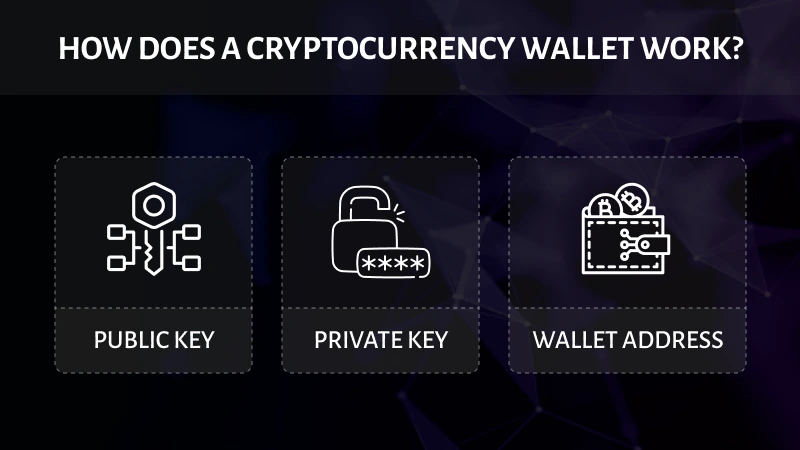
Understanding how a cryptocurrency wallet works becomes much easier once you know the basic concept of private key vs public key and wallet address. Let’s understand them one by one!
Public Key
A public key is used to generate your wallet address. It acts like your bank account number.
You can safely share your public key with others when you want to receive cryptocurrency. It is typically represented as a long string of letters and numbers.
Private Key
The private key is a secret code that gives you complete control over the funds associated with your wallet.
It proves ownership of your crypto assets. If someone gains access to your private key, they can transfer your funds without your permission.
Wallet Address
Your crypto wallet address is the part you share with others when you want to receive cryptocurrency.
It is often displayed as a string, such as 0x3fa2…b9C1. This is the address others use to send you crypto.
Now, when you send or receive crypto, your wallet does the following:
- Creates the transaction: including sender, receiver, and amount.
- Sign it with your private key: it verifies that you have the authority to move the funds.
- Broadcasts it to the blockchain: where it is validated and permanently recorded by the network.
Types of Cryptocurrency Wallets
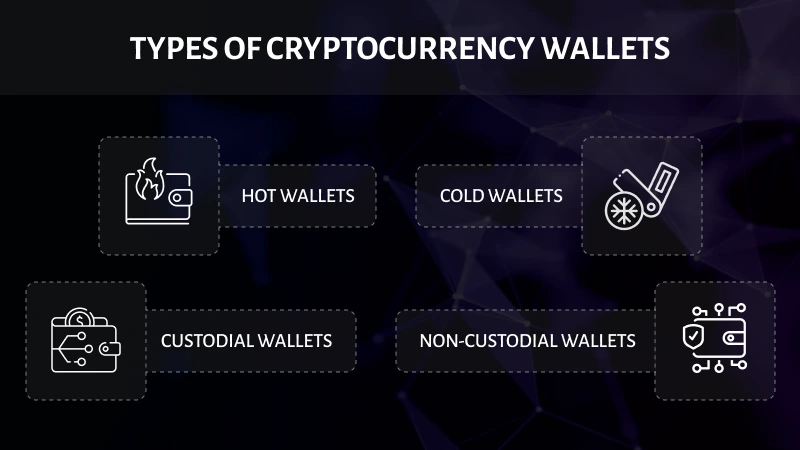
Cryptocurrency wallets are categorized in two different ways:
- Based on internet connectivity (Hot vs Cold wallets)
- Based on who controls the private keys (Custodial vs Non-Custodial wallets)
Let’s understand these two classifications separately, as it helps you grasp the concept more clearly!
Wallet Types Based on Internet Connectivity
It focuses on whether the crypto wallet is connected to the internet.
Hot Wallets (Online Wallets)
Hot crypto wallets are connected to the internet. Since they operate online, they allow quick access to your funds and are convenient for regular transactions. They are commonly used for trading, sending/receiving payments, and everyday crypto use.
These are then divided into:
Mobile Wallets
Mobile wallets are basically crypto wallet apps installed on smartphones. They allow users to store, send, and receive cryptocurrencies directly from their mobile devices. These are popular because they are easy to use, portable, and convenient for daily transactions.
Most mobile wallets include features such as QR code scanning, transaction history, and security options like PIN or biometric authentication. These are ideal for beginners, everyday crypto payments, and managing small to moderate amounts of cryptocurrency.
Desktop Wallets
Desktop wallets are software programs installed on a computer or laptop. They offer greater control and functionality compared to many mobile wallets. These are typically used by traders, advanced users, and users who prefer working on a larger screen.
Although they are more secure than web wallets, they are still connected to the internet. Thus, system security, like antivirus, firewall, and updates, is very important.
Web Wallets
Web wallets operate directly through a web browser. They do not require software installation and can be accessed from any device with internet access. These wallets are convenient, easily accessible, and suitable for quick access.
However, web wallets are dependent on browser security. If a user accesses them on an unsafe device or network, there is a higher risk of phishing or hacking.
Exchange Wallets
Exchange wallets are provided by cryptocurrency trading platforms. When you create an account on a crypto exchange and deposit funds, your crypto is stored in the exchange’s wallet system. These wallets are highly convenient for trading and include built-in trading features.
Other than that, exchange wallets are perfect for active traders, beginners who prefer simplicity, and users who frequently buy and sell crypto.
While hot wallets are easy to use, they are more exposed to cyber risks because they remain connected to the internet. For this reason, they are best suited for smaller amounts or active trading.
Cold Wallets (Offline Wallets)
Cold wallets are not connected to the internet. They store your private keys offline, which reduces the risk of hacking. These are typically used for long-term storage, holding large amounts of cryptocurrency, and investment purposes.
These are then divided into:
Hardware Wallets
Hardware wallets are physical devices specifically designed to store private keys offline securely. They look similar to small USB devices and are built with secure chips that protect sensitive information from cyber threats.
Hardware wallets are ideal for long-term investors, holding large amounts of cryptocurrency, and users who prioritize maximum security. Although they offer strong protection, they require careful handling. Losing the recovery phrase can result in permanent loss of access.
Paper Wallets
A paper wallet is a printed document that contains your public and private keys, usually represented as QR codes or long strings of characters. Since it exists entirely on paper and is not connected to any digital device, it is completely offline.
These were common in the early days of cryptocurrency but are less popular today due to practical risks. Those risks include physical damage, loss or theft of paper, and errors during key generation.
Wallet Types Based on Private Key Control
It focuses on who controls the private keys.
Custodial Wallets
In custodial wallets, a third party (usually a crypto exchange or service provider) controls your private keys on your behalf. This means you do not directly manage your private keys; the service provider secures your funds, and account recovery is usually easier.
These are typically found in exchange platforms and are suitable for beginners, users who prefer convenience over full control, and traders who frequently use exchanges.
Non-Custodial Wallets
In non-custodial wallets, you control your private keys. No third party has access to them. Some of the examples include mobile software wallets and browser-based wallets like MetaMask.
These types of wallets are perfect for users who give priority to full control, privacy, and decentralization. This means you have complete ownership of funds.
How to Choose the Right Cryptocurrency Wallet
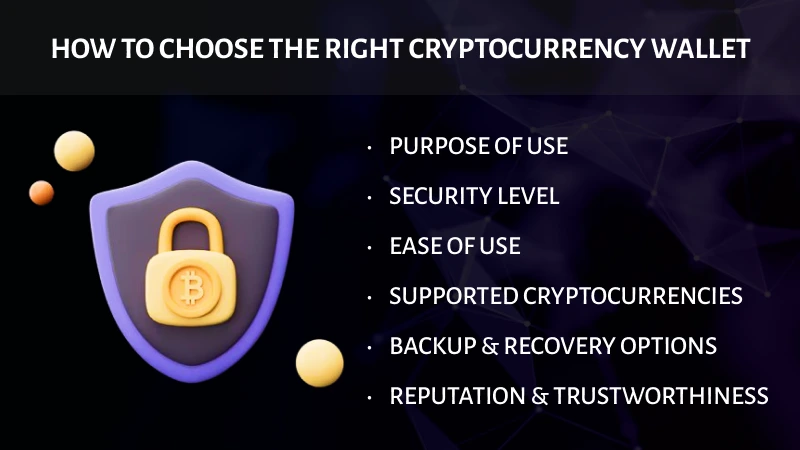
Choosing the best crypto wallets for beginners is an important first step in managing your digital assets securely and effectively. Here are some key factors that you must consider:
- Purpose of Use
The first step in choosing a crypto wallet is understanding why you need it. If you plan to trade frequently, an exchange wallet may offer speed and convenience. If you are investing for the long term, a hardware wallet provides better protection.
For users exploring DeFi platforms, NFTs, or Web3 applications, a non-custodial wallet is usually necessary. Clearly defining your purpose helps you avoid selecting a wallet that does not match your usage pattern.
- Security Level
Security is one of the most important factors when selecting a crypto wallet. If you plan to store a large amount of cryptocurrency, cold wallets offer stronger protection because they store private keys offline. Hot wallets are convenient but more exposed to online risks.
It is important that you always evaluate the level of risk you are willing to take and whether you are comfortable managing your own private keys securely.
- Ease of Use
A wallet should match your technical comfort level. If you are a beginner, you should look for wallets with a simple interface, clear instructions, and an easy backup process. Complicated setups may increase the risk of mistakes, especially when managing private keys or recovery phrases.
Going ahead with user-friendly wallets reduces confusion and improves confidence. If you are new to crypto, prioritize simplicity and accessibility over advanced features you may not need right away.
- Supported Cryptocurrencies
Not all wallets support every cryptocurrency or blockchain network. Thus, before you choose a crypto wallet, verify that it supports the specific coins or tokens you plan to use. If you intend to hold multiple assets, go ahead with choosing a multi-currency crypto wallet.
Other than that, you must check whether the wallet supports NFTs or DeFi applications if those features are important to you. This ensures smooth transactions and avoids unnecessary migration later.
- Backup & Recovery Options
Reliable backup and recovery options are essential when using a crypto wallet. Non-custodial wallets typically provide a mnemonic phrase (also known as a seed or recovery phrase) that allows you to restore access if your device is lost or damaged.
It is important to store this phrase securely and offline. Without proper backup, losing access to your wallet can result in permanent loss of funds, since blockchain transactions are irreversible.
- Reputation & Trustworthiness
Before choosing any wallet, research the provider’s reputation. Look for reviews, community feedback, and past security history. Established wallets with a strong track record are generally more reliable than newly launched or unknown options.
Transparency in security practices and regular software updates are also positive indicators. In the crypto space, trust and reliability are extremely important because users are fully responsible for protecting their assets.
How to Obtain and Use a Cryptocurrency Wallet?
Once you have understood the different types of crypto wallets and chosen one that fits your needs by following the above-mentioned tips, the next step is to obtain and set it up correctly. This stage is important because many beginners fall victim to fake websites and phishing scams.
Here’s how you can do that:
Step 1: Install the Wallet
Download the wallet application from the official source. Depending on the wallet type, this could be a mobile app (iOS or Android), a desktop application, a browser extension, or a hardware wallet software.
If you are using a hardware wallet, follow the manufacturer’s instructions to connect it to your computer and install any required software.
Step 2: Create or Import a Wallet
When you open the wallet for the first time, you will usually see two options:
- Create a new wallet
- Import an existing wallet
If you are creating a new wallet, the system will generate a public address, a private key, and a recovery phrase.
If you already have a wallet, you can import it using your recovery phrase or private key.
Step 3: Secure Your Recovery Phrase
This is the most important step.
Your recovery phrase is a set of words that allows you to restore your wallet if your device is lost, damaged, or stolen. Write it down immediately and store it in a safe and offline location.
It is important to understand that you must not take screenshots, store them in cloud storage, or share them with anyone. That’s because anyone with access to your recovery phrase can access your funds.
Step 4: Explore the Wallet Interface
Before transferring any cryptocurrency, you must take enough time to understand the wallet interface. Familiarize yourself with:
- Sending funds
- Receiving funds
- Viewing transaction history
- Checking network fees
- Adjusting security settings
Understanding these features reduces mistakes when making real transactions.
Step 5: Fund Your Wallet
To receive cryptocurrency, locate your wallet’s public address. This is usually displayed as a long string of letters and numbers or a QR code.
You can share this address with someone sending you crypto or use it to transfer funds from another exchange or wallet.
Always double-check the address before confirming a transaction. Even a small mistake can result in permanent loss of funds.
Step 6: Sending Cryptocurrency
When you send crypto, your wallet:
- Creates the transaction
- Signs it using your private key
- Broadcasts it to the blockchain network
The digital signature confirms that you are the rightful owner of the funds. Always review transaction details carefully before approving them, which include the recipient address, amount, and network fees.
Blockchain transactions are irreversible once confirmed.
Safety Tips for Using Crypto Wallets
Cryptocurrency wallets give users complete control over their digital assets. But with that control comes the responsibility of maintaining security. Here are some of the crypto wallet safety tips that you must follow:
- Backup Your Recovery Phrase Securely
When you log into a crypto wallet, you are given a 12 or 24-word recovery phrase. This is your only way to restore access to your wallet if your device is lost, damaged, or stolen. It is important to write it down and store it offline.
- Never Share Your Private Keys
Your private keys and recovery phrase are the keys to your crypto wallet. If you share it with anyone, you can put your funds at risk. Scammers often pose as support agents or wallet providers, but keep in mind that no genuine company will ever ask for your seed phrase. Ensure that you keep it confidential at all times.
- Use Strong Authentication & Passwords
To add an extra layer of protection, use strong and unique passwords and enable 2FA if your wallet or exchange supports it. For mobile wallets, enable biometric security features such as fingerprint or facial recognition along with a PIN or passcode. Also, avoid using the same password across different accounts or platforms.
- Download Wallets from Official Sources Only
It is important that you download crypto wallet applications or extensions directly from the official website or verified app stores. That’s because fake apps can compromise your private keys and result in the loss of your funds. Before downloading, check reviews, verify URLs, and use a genuine version.
- Keep Your Device Secure
The security of your wallet also depends on the security of the device on which it is stored. You must regularly update your operating system and wallet software to protect against known vulnerabilities. Also, use reputable antivirus software, avoid installing suspicious apps, and never access your wallet over public Wi-Fi networks.
- Double-Check Recipient Wallet Addresses
Before you send crypto, keep in mind that you should double-check the recipient’s wallet address. That’s because malicious software can change copied addresses to redirect funds. Also, consider using QR codes or the wallet’s address book feature for recurring transactions to minimize errors and avoid costly mistakes.
- Be Cautious of Scams & Phishing Attacks
Scams and phishing attacks are common in the crypto space. Thus, you must be aware of unknown emails, fake giveaways, and suspicious links. Always double-check URLs and never enter your wallet details on unfamiliar websites. Also, bookmark official sites to avoid falling victim to lookalike domains.
- Keep Wallet Software Up to Date
Crypto wallet developers frequently release updates to fix bugs and patch security vulnerabilities. It is important that you keep your wallet software up to date so you benefit from the latest security enhancements and compatibility improvements.
The Future of Crypto Wallets
As the cryptocurrency space evolves, so do the wallets that support it. It just started as simple tools for storing Bitcoin, but it has now transformed into robust gateways. The future of crypto wallets is set to redefine user experience, security, and accessibility on a global scale.
Here’s what its future holds:
- Account Abstraction
One of the most promising developments is Account Abstraction, especially on Ethereum and other EVM-compatible blockchains. This innovation enables wallets to behave like smart contracts, which enables gasless transactions and bridges the gap between usability and security for mainstream adoption.
- MPC & Biometric Security
Security remains one of the top priorities in the crypto space. Now, crypto wallets are shifting toward MPC (Multi-Party Computation) and biometric authentication, which mitigates the need for users to manage private keys or seed phrases.
- Cross-Chain & Multi-Chain Interoperability
As users diversify across multiple blockchains, such as Ethereum, Solana, Polygon, Bitcoin, and more, the need for cross-chain support becomes more important. The next-gen wallets will offer unified dashboards to manage assets across chains and seamless token swaps.
- Embedded & Web2-Like Wallet Experiences
Wallets are increasingly integrating email logins, social authentication, and seamless onboarding. Embedded wallets are helping Web3 applications offer familiar user experiences while maintaining decentralized ownership.
The Bottom Line
That’s it for this blog!
Undoubtedly, cryptocurrency wallets are the core of secure and independent digital asset management.
We hope our blog has helped you clear up doubts about how they work, how to choose the right one, safety tips, and more. This will surely help you protect your investment and navigate the crypto space confidently.
Other than that, if you are a business or an entrepreneur looking to build a secure, scalable, and feature-rich crypto wallet according to your needs and goals, Technoloader is your go-to partner!
So, get in touch with us, and let’s bring your vision to life!
FAQs
What is a cryptocurrency wallet?
A cryptocurrency wallet is a digital tool that allows users to store, send, and receive cryptocurrencies by managing public and private keys. It provides access to assets recorded on the blockchain. Without a wallet, you cannot interact with blockchain networks or manage your crypto holdings.
Does a crypto wallet actually store cryptocurrency?
No, a crypto wallet does not store cryptocurrency in the traditional sense. Your crypto assets exist on the blockchain. The wallet stores your private keys, which give you access to your funds and allow you to authorize transactions.
What is the difference between a public key and a private key?
A public key is used to generate your wallet address and can be shared to receive cryptocurrency. A private key is a secret code that proves ownership and allows you to spend your crypto. Anyone who has access to your private key can control your funds.
What is the safest type of crypto wallet?
Cold wallets, especially hardware wallets, are considered the safest because they store private keys offline. Since they are not connected to the internet, they are less vulnerable to hacking compared to hot wallets.
What is the difference between custodial and non-custodial wallets?
In custodial wallets, a third party (such as a crypto exchange) controls your private keys. In non-custodial wallets, you control your own private keys and have full ownership of your funds. Non-custodial wallets offer greater control but require more responsibility.
Can crypto be stolen from a wallet?
Yes, cryptocurrency can be stolen if someone gains access to your private key, recovery phrase, or login credentials. Using strong passwords, enabling two-factor authentication, and storing recovery phrases offline can significantly reduce this risk.
What happens if I lose my recovery phrase?
If you lose your recovery phrase in a non-custodial wallet, you may permanently lose access to your funds. There is no central authority that can reset or recover your wallet. This is why securely backing up your recovery phrase is critical.
Are crypto wallets free?
Many software wallets are free to download and use. However, hardware wallets require the purchase of a physical device. Additionally, all blockchain transactions involve network fees, regardless of the wallet used.
How do I choose the right crypto wallet as a beginner?
Beginners should consider security, ease of use, supported cryptocurrencies, and their intended purpose. For learning and small transactions, an exchange or mobile wallet may be suitable. For long-term storage, a hardware wallet is recommended.

Deepa Manwani
Deepa Manwani is a Technical Content Writer at Technoloader with over 7 years of experience creating high-quality content across Blockchain, Web3, AI, and fintech. She specializes in translating complex technical concepts into clear, engaging, and informative content that helps businesses, developers, and users better understand emerging technologies. Her expertise includes writing technical blogs, technical documentation, whitepapers, platform guides, and in-depth content for crypto exchanges, DeFi platforms, trading systems, and enterprise software solutions. At Technoloader, she contributes to developing strategic content that supports product growth, strengthens brand credibility, and educates users about next-generation technologies shaping the future.
Published in Cryptocurrency Wallet Development


