 +91 7014607737
 info@technoloader.com





Table of Contents
Key Takeaways:
- Launching a DeFi project in 2026 needs proper planning, secure development, and long-term community trust, not just smart contract deployment.
- Successful DeFi projects begin with strong market research to solve real financial problems and validate actual user demand.
- Choosing the right blockchain, Layer 2 solution, and tech stack creates direct effects on scalability, transaction costs, and user experience.
- Well-designed tokenomics play a critical role in sustainability, governance, and aligning user incentives.
- Testnet deployment and replication help find technical and user experience problems before launching on the mainnet.
- Community building and educational marketing are key drivers of user adoption and long-term protocol growth.
- Depending on the features, security, and scope of the project, it will cost between $45,000 and $100,000 to build a DeFi project in 2026.
- Post-launch monitoring, upgrades, and maintenance are necessary to keep DeFi platforms secure, stable, and competitive.
Introduction
Launching a DeFi project in 2026 is not just about deploying smart contracts or creating a token. Instead, it needs careful planning, technical choices, security measures, and thinking about the long term.
In today’s fast-growing decentralized finance (DeFi) space, many projects fail not because their ideas are weak. But because their execution is rushed or poorly planned.
Before making anything, a successful DeFi project needs to understand a real market problem and make sure there is demand for it. Then it goes through important steps such as picking the right blockchain, making tokenomics that last, developing secure smart contracts, and so on.
However, beyond the technical side, building trust, transparency, and a strong community is just as important for long-term adoption. This guide will show you how to start a DeFi project in a clear and organized way.
We will cover all the important steps, from ideation and development to testing, mainnet launch, and post-launch strategies. Whether you’re starting your first DeFi platform or expanding an existing idea, this guide will help you make a safe, reliable, and sustainable DeFi project.
Is Launching a DeFi Project a Smart Move?
When planning to launch a DeFi project, the first question that usually comes to mind is whether it’s truly a smart move. Well, in 2026, it’s absolutely a noteworthy investment.
A DeFi project is a blockchain-based financial platform that lets people access financial services without having to rely on banks or centralized institutions. Instead of intermediaries, DeFi projects use smart contracts that automatically carry out transactions when certain conditions are met.
These platforms allow users to trade cryptocurrencies, lend or borrow funds, earn interest, or stake assets directly from their wallets. Looking at the current situation, the DeFi market size stood at USD 238.54 billion in 2026 and is anticipated to surpass USD 770.56 billion by 2031, expanding at a 26.43% CAGR.
These data show huge potential, and if we discuss why launching a DeFi project is a smart move, then:
- Growing Demand for Decentralized Finance: To avoid high fees, slow processes, and the restrictions of traditional finance, users are increasingly moving toward decentralized platforms. This growing demand creates strong opportunities for new DeFi projects that offer better solutions.
- Global and Permissionless Access: Anyone with an internet connection and a crypto wallet can access DeFi platforms. There are no geographical barriers or approval requirements, enabling projects to reach a worldwide audience from day one.
- Lower Operational Costs: Because DeFi projects use smart contracts, they don’t need intermediaries, manual processes, and big terms to run. This helps founders lower long-term costs while still being efficient.
- User-Controlled Assets: In DeFi, users retain full control of their funds rather than relying on a centralized authority. This increases transparency and builds trust, which is essential for long-term adoption.
- Multiple Revenue Opportunities: There are many ways for DeFi projects to make money. They can earn from transaction fees, staking mechanisms, liquidity pools, or governance models. When designed correctly, they can be financially stable.
- Long-Term Growth Potential: More and more people are using blockchain technology. Well-designed DeFi projects have a lot of room to grow, and they can stay important in the changing financial ecosystem for a long time.
Keep this in mind: if you’re ready to launch your DeFi project, and choose to follow the below-mentioned step-by-step guide below accordingly.
Step-by-Step Guide to Launch Your DeFi Project
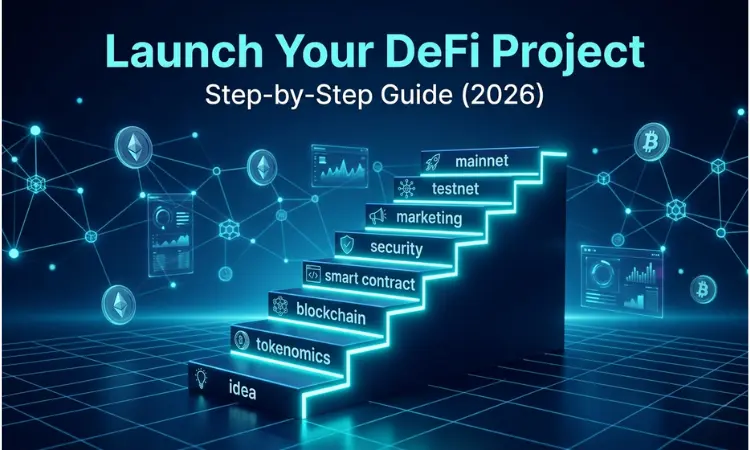
Launching a DeFi project requires a clear, step-by-step process that moves from validating your idea to ensuring long-term protocol stability and growth. Each step in this process plays a very crucial role in reducing risk, building trust, and creating a sustainable decentralized product. Let’s understand the launching process easily:
Step 1: Ideation and Market Research
Begin your launching process with ideation and market research. Both are core components of any successful DeFi project. Before writing code or choosing a blockchain, it is very important to clearly understand what problem your project is solving.
Generally, DeFi platforms fail because they focus on features instead of real user needs. At the beginning, you must be clear about what issues your DeFi platform is trying to solve. These issues could include high transaction fees, a complex user experience, poor liquidity, or a lack of transparency.
By looking at other people’s work, you can figure out what’s already out there and what needs to be better. However, this does not mean you copy others; it means you learn from what they do well and what they do badly.
Market research is also part of market research. You can do this by observing community discussions, tracking how users act, and looking at on-chain data. A strong idea backed by real demand not only reduces risk but also drives growth. But it also makes sure that your DeFi project is built to last, not just for the hype of the moment.
Step 2: Planning and Tokenomics Design
As soon as you know what your research is about, you can start planning and designing the tokenomics.
This will help you make your DeFi idea into a project that is well-structured and useful. At this point, the main goal is on figuring out how your platform will work and how value will flow within the ecosystem.
Without proper planning, even strong ideas can fail due to confusion, bad incentives, or growth that can’t last.
When you plan, you usually start by figuring out what the most important parts of your DeFi platform are. You need to be very clear about what users can do on the first day. For example, using your platform, users will be able to trade tokens, lend assets, or get rewards.
How they will move through the platform while keeping the initial scope simple helps avoid delays and technical issues.
Tokenomics design is the process of figuring out if your project needs a token and, if so, what it will do. You can use a well-designed token for governance, staking, rewards, or paying platform fees. You also need to carefully plan the supply, distribution, and vesting of tokens to avoid inflation, dumping, or giving unfair advantages.
Strong planning and balanced tokenomics build a stable foundation, align user incentives, and support long-term sustainability for your DeFi project.
Step 3: Choosing the Blockchain and Tech Stack
Choosing the right blockchain and tech stack plays a crucial role in the success of a DeFi project. It creates an impact on the speed of transactions, the cost, security, user experience, and how easily the platform can grow in the future. Choosing technologies that have been tested and are widely used can help lower risks and make development easier.
When it comes to blockchain networks, Ethereum is still the most popular choice for DeFi. It is very secure, has a large community of developers, and has a well-developed ecosystem. But high gas prices can be a problem.
To fix this, many projects use Layer 2 solutions like Polygon or Arbitrum. These solutions offer lower fees and faster transactions, and maintain compatibility with Ethereum. Solana is also a good choice for high-speed, low-cost apps, especially for DeFi platforms that care about performance.
In terms of tech stack, Solidity is the most frequently used smart contract language. It is supported by frameworks like Hardhat and Foundry for development and testing.
Frontend applications are usually built with React or Next.js, while wallet integrations are handled through tools like MetaMask, WalletConnect, or Web3 libraries, such as ethers.js or web3.js.
Using a reliable blockchain and a modern, well-supported tech stack ensures smoother development, stronger security, and better long-term growth for your DeFi project.
Step 4: Smart Contract Development
Smart contract development is the most important part of any DeFi project. These are the self-executing programs that run on the blockchain that define how your platform works. They don’t require middlemen to control actions such as deposits, withdrawals, swaps, rewards distributions, and governance.
At this stage, the project’s rules and logic are turned into code. Which means, they will decide how the funds will move, the fee calculation, and rewards for users.
Since smart contracts directly handle user funds, the logic must be clear and correct. Developers usually write smart contracts using secure and widely tested programming languages and frameworks.
Reusing audited libraries and following standard design patterns helps reduce vulnerabilities and development errors. Access controls, permissions, and ownership roles must be clearly defined to prevent misuse or unauthorized changes.
Because smart contracts are hard to modify once deployed, it is important to plan ahead, write clean code, and keep good records. Well-built smart contracts ensure reliability, transparency, and trust, making them the backbone of a successful DeFi project.
Step 5: Security Audits and Testing
One of the most critical things to do before starting a DeFi project is to check for security holes and run tests. Because DeFi platforms deal with real money, even a small bug or flaw can cost a lot of money and make users lose trust. This process is all about finding and fixing problems before the platform goes live.
Testing usually starts inside the company, where developers check smart contracts for logic errors, wrong calculations, and behavior that isn’t expected. This includes unit testing, integration testing, and simulating different user actions to make sure the system works as it should in a variety of situations.
After internal testing, most DeFi projects undergo third-party security audits. Independent audit firms review the smart contract code to identify vulnerabilities such as reentrancy attacks, access control issues, or flash loan risks. Audit reports help teams find and fix problems, which makes contracts safer overall.
In addition to audits, some projects have bug bounty programs that reward developers for responsibly reporting issues. Proper security audits and thorough testing reduce risks, protect user funds, and build confidence in your DeFi project before launch.
Step 6: Community Building and Marketing
In the success of a DeFi project, community building and marketing play an important role. Even a well-built platform can struggle if people don’t understand it or trust it.
This step focuses more on spreading awareness, along with building credibility and a loyal user base. Some channels like Twitter (X), Discord, Telegram, and forums are some of the best community-building channels you can start with.
All of these platforms let teams talk to each other directly, share news, and explain how the project works. In the DeFi space, being open and honest is really crucial, and regular contact helps with that.
Marketing in DeFi is less about aggressive promotion and more about education. Explaining the problem your project solves, how it works, and why it is safe helps users feel confident using the platform. Content marketing, blogs, documentation, and clear announcements are highly effective.
A strong community not only brings in new users but also gives feedback, spreads the word naturally, and helps the business grow over time. Users are more likely to trust and support a project over time if they feel involved and informed.
Step 7: Testnet Deployment and Iteration
Testnet deployment is the stage where you can test your DeFi project in a real blockchain environment, and that too without using real money. It works on the main blockchain, but users test tokens, enabling teams and users to connect with the platform safely.
This step is very important to find problems before the project goes live. During testnet deployment, smart contracts are set up, crypto wallets are linked, and users can do things like make deposits, withdrawals, swaps, or staking.
This helps mimic real-world use and find problems that might not show up during internal testing, like problems with the user experience, failed transactions, or contracts that don’t work as expected.
Iteration is the improvement process based on testnet feedback. Developers fix bugs, optimize performance, improve UI/UX, and refine smart contract logic. Community feedback is especially valuable because it helps highlight confusing features or usability problems.
Thorough testnet testing and iteration reduce launch risks, improve reliability, and ensure the platform is stable, secure, and ready for mainnet deployment.
Step 8: Mainnet Launch and Post-Launch Strategies
The mainnet launch is the last step when your DeFi project goes live, and real users start interacting with it using real funds. At this point, smart contracts are deployed on the main blockchain network, liquidity is added, and the platform becomes publicly accessible.
A smooth and well-prepared launch is critical, as any issues at this point can affect user trust and project credibility. Before launching, teams usually complete a final checklist that includes contract verification, security confirmation, liquidity readiness, and clear user documentation.
Many projects prefer a soft or phased launch, enabling a limited number of users to join first and reducing the risk of sudden failures. Meanwhile, post-launch strategies are just as important as the launch itself.
This includes monitoring platform performance, tracking transactions, responding quickly to bugs or security issues, and communicating updates transparently with the community.
Teams also work on adding new features, making the platform bigger, and adding rules or rewards over time. A successful mainnet launch followed by active post-launch management helps ensure stability, user confidence, and long-term growth for a DeFi project.
Following these steps will help you launch your DeFi project as you want it to be. But other than these steps, there are some other essential things everyone should be aware of. To understand it, continue to scroll through and learn about common mistakes that can slow down your DeFi platform from being successful.
Common Mistakes to Avoid in DeFi Projects
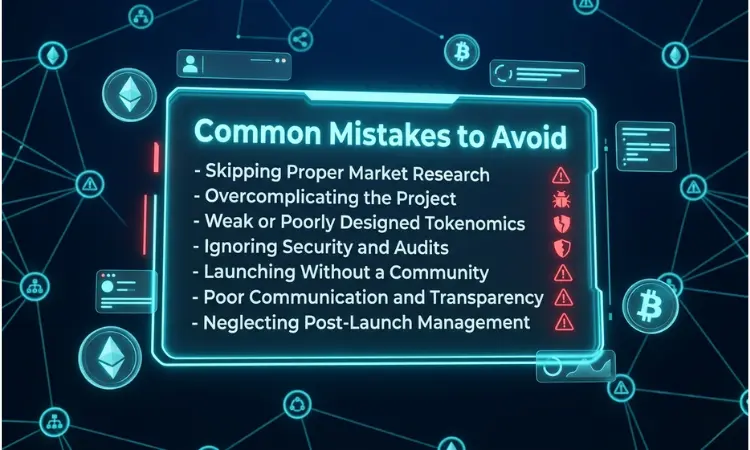
There are a lot of moving parts to starting a DeFi project, and even small mistakes can cause big problems later on. Teams can avoid taking unnecessary risks and build a more stable, trusted platform by knowing about common mistakes.
Skipping Proper Market Research
One of the biggest mistakes is starting a DeFi project without validating real demand. Instead of fixing real user problems, a lot of teams work on trendy features. Without proper research, the platform might not get users, even if it doesn’t do enough research.
Overcomplicating the Project
Adding too many features at once often leads to delays, bugs, and poor user experience. It’s harder to keep and protect complex systems. Starting with simple, clear core functionality makes the project easier to launch and scale.
Weak or Poorly Designed Tokenomics
Unbalanced token supply, unclear utility, or unfair distribution can harm long-term sustainability. Bad tokenomics often leads to early dumping, loss of trust, and incentives that don’t keep users.
Ignoring Security and Audits
It’s very dangerous to rush to launch without doing the right tests or getting third-party audits. DeFi platforms deal with real money, and even small weaknesses can be used against them. Always put security first, not as an afterthought.
Launching Without a Community
Some projects focus entirely on development and forget to build a community. Without early users, feedback, and trust, even well-built DeFi platforms struggle to gain traction after launch.
Poor Communication and Transparency
Not getting regular updates, having unclear documentation, or making decisions that aren’t clear can quickly make users lose faith. To build long-term trust in DeFi, there needs to be open communication and honesty.
Neglecting Post-Launch Management
Many teams think the job is done after launch. In reality, to keep the platform stable, safe, and up to date, it needs to be watched all the time, improved all the time, and have user support.
By avoiding these common mistakes, you can lower your risk, boost user trust, and raise your chances of creating a successful and long-lasting DeFi project.
Cost, Timeline, and Team Considerations
Launching a DeFi project requires proper planning around budget, time, and people. Many projects fail not just because of their bad ideas, but also because of poor management. Let’s understand it:
Cost Considerations:
- Development Costs: Development costs include making smart contracts, the website or app, backend systems, and wallet connections. Adding more features costs more money, but good planning and clean development can help you avoid problems later.
- Security Audit Costs: Security audit costs involve experts checking smart contracts for bugs and risks. Audits may cost more at the start, but they help prevent hacks, money loss, and trust issues after launch.
- Infrastructure Costs: These costs include blockchain nodes, APIs, servers, and tools for monitoring. These are costs that happen all the time to keep the platform running smoothly as more people use it and more transactions happen.
- Testing and Development Costs: Testing and deployment costs come from using test networks, fixing bugs, and launching on the main blockchain. Multiple testing rounds are needed to ensure the platform works safely and correctly.
- Marketing and Community Costs: Marketing and community costs include content creation, social media activity, community support, and launch promotions. Clear communication and education help attract users and build trust over time.
- Maintenance Costs: Costs for maintenance and upgrades include fixing bugs, adding new features, and keeping an eye on security after the product is launched. These ongoing efforts are required to keep the platform useful, safe, and stable.
| Component | Estimated Cost (USD) |
| Idea Validation & Strategy | $3,000 – $6,000 |
| Tokenomics Design | $2,000 – $4,000 |
| Smart Contract Development | $10,000 – $20,000 |
| Frontend & Backend Development | $12,000 – $25,000 |
| UI/UX Design | $3,000 – $7,000 |
| Smart Contract Audits | $5,000 – $15,000 |
| Testnet Launch & QA | $2,000 – $4,000 |
| Community Building & Marketing | $5,000 – $15,000 |
| Post-Launch Maintenance (Monthly) | $3,000+ per month |
| Total Estimated Cost | $45,000 – $100,000 |
Timeline Considerations
- Research and Planning: Research and planning involve understanding user needs, studying competitors, and deciding core features. Spending enough time here helps avoid wrong decisions and saves time during development.
- Development Phase: The development phase includes writing smart contracts, building the user interface, and setting up systems. This stage usually takes several months, depending on project size and complexity.
- Testing and Audits: These are checks for mistakes, security holes, and performance problems on the platform. This step is important to make sure the platform is safe before people start using real money.
- Testnet Iteration: Allows users to test the platform using test tokens. Feedback from this stage helps fix bugs, improve usability, and prepare the project for a smooth mainnet launch.
- Mainnet Launch Preparation: This includes final checks, adding liquidity, writing guides, and informing users. Good preparation reduces launch problems and improves user confidence.
- Post-Launch Activities: Post-launch activities include examining the platform, fixing issues, updating features, and supporting users. Continuous improvements help keep the project running smoothly and growing.
Team Considerations
- Blockchain Developers: Blockchain developers create and manage smart contracts that handle user funds and platform rules. To avoid mistakes or security risks, their work has to be correct and safe.
- Frontend Developers: Design the platform interface so users can easily connect wallets and use features. A simple and clear design helps users avoid mistakes and feel comfortable using the platform
- Security Experts: Security experts focus on finding risks, improving safety, and monitoring threats. Their role is important for protecting user funds and maintaining trust before and after launch.
- Product and Project Managers: These people are in charge of planning tasks, keeping track of deadlines, and making sure teams work together. They help keep development organized and ensure the project moves forward smoothly.
- Community and Marketing Managers: Community and marketing managers communicate with users, give them updates, and answer their questions. Their work helps people trust them, get new users, and grow an active community.
- In-House Team vs. External Partners: In-house teams give more control and long-term stability, while external partners offer faster development and experience. The right choice depends on budget, timeline, and technical knowledge.
Conclusion
Building a DeFi project in 2026 has a lot of potential, but requires careful planning, technical know-how, and work to build a community. From launching smart contracts to finding unique financial use cases and putting governance all together.
Partnering with an experienced DeFi development company like Technoloader can help you minimize risks and fast-track success. We offer full-spectrum services from blockchain consulting and smart contract creation to DeFi marketing and post-launch support.
Frequently Asked Questions
How long does it take to launch a DeFi project?
It usually takes 3 to 6 months to launch a DeFi project, depending on how complicated the smart contracts are, how long the audits take, and how many features your project has. It’s possible to make MVPs faster, but launching a full-scale product takes a lot of planning, development, testing, and security checks.
Can I build a DeFi project without knowing blockchain programming?
Yes, you can make a DeFi project without even having any coding knowledge. You can do it by connecting with a professional blockchain development company. They will handle all coding-related activities like smart contracts, UI/UX, backend, testing, and deployment, allowing you to focus on vision, strategy, and business operations.
What are common DeFi security vulnerabilities?
Some of the common DeFi security vulnerabilities include flash loan attacks, reentrancy bugs, front-running, and oracle manipulation. If these problems are not addressed, then they can cause major losses. To overcome this, choose to review your code regularly, conduct third-party audits, and use real-time monitoring.
What is the difference between DeFi and CeFi?
DeFi uses smart contracts to automate financial transactions without requiring any middlemen, ensuring transparency and permissionless access. Whereas CeFi, or Centralized Finance, works on trusted institutions like exchanges or banks, which manage custody, user data, and compliance manually or through centralized systems.
Does Technoloader provide post-launch support?
Technoloader provides end-to-end post-launch support, including platform upgrades, multichain integration, DAO implementation, performance optimization, and user support. Their expert team ensures that your DeFi project grows with the market and remains secure, scalable, and effective even after deployment.

Kanak Badaya
Kanak Badaya is a Technical Content Writer at Technoloader with over 3 years of experience translating complex technology into content that actually makes sense. He works closely with emerging domains like Blockchain, Web3, AI, and DeFi, turning intricate technical concepts into clear, structured, and engaging narratives that help businesses communicate with confidence. Rather than just writing for search engines, Kanak focuses on writing for people. He combines in-depth research with a practical understanding of the industry to create blogs, website content, and technical guides that inform, educate, and build credibility. His goal is simple - make advanced technology feel approachable while helping Technoloader strengthen its authority in the digital space.
Published in DeFI Development


