 +91 7014607737
 info@technoloader.com





Table of Contents
We understand launching a trading platform is an exciting endeavor, but it’s also well known that entering the fintech and cryptocurrency space requires careful financial planning. This is not like you’re new to the market, but even the most advanced trading platform idea may encounter delays, inefficiencies, or even failure if it doesn’t have a well-structured budget.
However, more than just cost estimation, there are certain things that budget planning typically involves, such as prudent resource allocation, setting priorities for necessary features, and contingency planning. So, to help you streamline your launch process, this guide will walk you through a systematic process that will greatly help you define your specific budget.
Why Budget Planning is Crucial for Your Trading Platform
Before we talk about the numbers, first, it’s necessary to learn why budget planning matters:
- It helps in avoiding cost overruns for software development, compliance, and marketing costs.
- Helps allocate funds for tech development, security, legal compliance, marketing, and maintenance.
- Creating a transparent budget that shows preparedness, attracting potential investors or partners.
- Helps in predicting major challenges and building a buffer for unexpected expenses.
Let’s Simplify the Step-by-Step Budget Planning Process
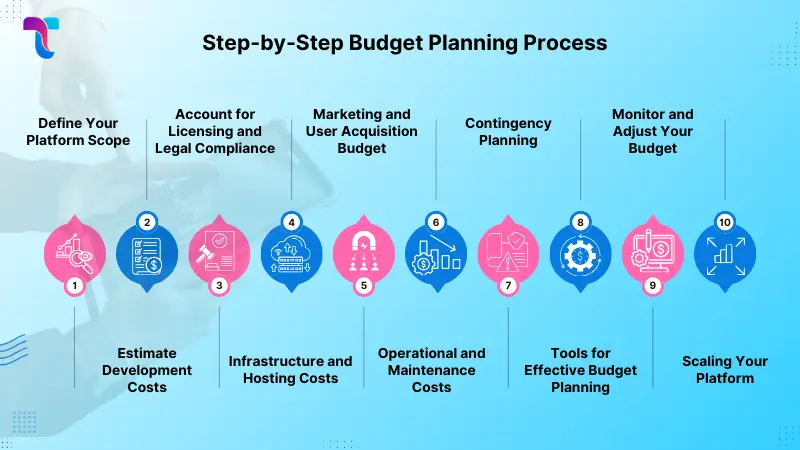
Once you’ve got the overview of why budget planning is important, it’s time to unwind the step-by-step budget planning process.
Step 1: Define Your Platform Scope
In the budget planning, your first step is to define the scope of your trading platform. Your budget widely varies depending on the platform’s complexity. Such as:
- What is your trading type: stock trading, forex, crypto, commodities, or a multi-asset platform?
- The platform’s primary highlights: Real-time trading, charts, market analysis tools, notifications, and payment gateways.
- Determine Target Market: Retail traders, institutional investors, or both.
Step 2: Estimate Development Costs
Development is the backbone of any trading platform, and figuring out these costs involves
Frontend Development:
The front end covers the user interface and user experience. Its costs slightly depend on:
- Custom designs vs. template-based UI
- Mobile app development, for both iOS and Android
- Web platform design
Backend Development:
The backend development handles data processing, trading logic, and server management.
- Real-time trading engine
- API integration with financial data providers
- Database management
Security & Compliance:
Security is non-negotiable for trading platforms.
- SSL, two-factor authentication
- Data encryption and GDPR compliance
- Anti-fraud and anti-money laundering systems
These are the key considerations on which costs are determined; however, they typically vary from $50,000 for a basic platform to over $500,000 for a feature-rich trading ecosystem.
Step 3: Account for Licensing and Legal Compliance:
Trading licensing and legal compliance are two of the most crucial components of your trading platform budget. Consider:
- Licenses: It typically varies by region; you may need licenses for stock trading, forex, or crypto operations.
- Legal Counsel: Drafting terms of service, privacy policies, and compliance documentation.
- Regulatory Fees: Costs vary by jurisdiction, e.g., SEC in the US, FCA in the UK, and SEBI in India.
Step 4: Infrastructure and Hosting Costs:
Your platform’s performance depends on reliable infrastructure. Budgeting here involves:
- Servers and Cloud Hosting: AWS, Google Cloud, or dedicated servers for high-frequency trading.
- Bandwidth & Storage: Real-time data feeds require scalable bandwidth.
- `Ensure uptime and data integrity.
However, the infrastructure costs can range from $2,000 to $10,000 monthly, depending on traffic and data load.
Step 5: Marketing and User Acquisition Budget:
To attract users, even the best crypto exchange development needs a robust marketing strategy. Budget allocation here includes:
- Digital Marketing: Crypto exchange SEO strategy, social media campaigns, PPC ads, and influencer collaborations.
- Content Marketing: Blogs, tutorials, and webinars to educate potential users.
- Referral Programs: Incentivizing early adopters to bring in new traders.
However, for marketing and user acquisition, you are often required to set your budget range from 10 to 20% of total funding.
Step 6: Operational and Maintenance Costs:
Once your platform is launched, you are required to make an ongoing investment to ensure your platform operates smoothly.
Customer Support: Live chat, ticketing systems, and support staff.
Platform Maintenance: Bug fixes, updates, and server monitoring.
Data Management: Maintaining databases and ensuring secure data storage.
As for its cost, you’re commonly required to allocate at least 15% of your budget annually for operations and maintenance.
Step 7: Contingency Planning:
Even with the best planning, there will always come some unexpected costs. So, to manage those costs, experts recommend keeping aside 10-15% of your total budget as a contingency fund. This cost can cover sudden regulatory changes, server outages or cyberattacks, and unforeseen development delays.
However, it is highly recommended that the contingency fund be treated as untouchable unless it is absolutely necessary. Treat it as your safety net against unforeseen circumstances.
Step 8: Tools for Effective Budget Planning:
There are multiple modern tools available to simplify the budget process:
- Excel/Google Sheets: For detailed cost breakdowns and projections.
- Project Management Tools: Asana, Trello, and Jira are used to track development milestones.
- Financial Tools: QuickBooks, Zoho Books, or Xero for expense tracking and reporting.
Thus, if you choose to use these tools, then you’ll be able to make transparent, accountable, and better decisions throughout the launch process.
Step 9: Monitor and Adjust Your Budget:
Budgeting is not just a one-time task; it typically requires regularly monitoring expenses against your projections:
- Track Spending: Identify areas of overspending or underutilization.
- Adjust Forecasts: Update your budget based on market trends, regulatory updates, and platform growth.
- Investor Reporting: Keep investors or stakeholders informed about budget adjustments and resource allocation.
Step 10: Scaling Your Platform:
Lastly, once your platform gains traction, its scaling is inevitable. Budget planning should consider:
- Adding New Features: Advanced charting tools, AI trading assistants, or new asset classes.
- Expanding Infrastructure: More servers, higher bandwidth, and global access.
- Marketing Expansion: Targeting new regions or demographics.
In order to ensure seamless expansion without putting undue strain on operations, scaling typically necessitates a separate growth budget, 20–30% of your initial launch cost.
Conclusion
Launching a trading platform is a significant financial and strategic undertaking. By executing step-by-step budget planning, you can simply be able to minimize risks and avoid unnecessary costs, ensure smooth development and operational efficiency, and attract investors and build credibility in a competitive market.
Further, to implement these practices, you are often required to partner with fine fintech solution providers who can provide you with a seamless development process while reducing the unexpected costs. For instance, Technoloader specializes in providing end-to-end support for trading platform launches, helping startups and established businesses to achieve their vision without worrying about finances.

Kanak Badaya
Kanak Badaya is a Technical Content Writer at Technoloader with over 3 years of experience translating complex technology into content that actually makes sense. He works closely with emerging domains like Blockchain, Web3, AI, and DeFi, turning intricate technical concepts into clear, structured, and engaging narratives that help businesses communicate with confidence. Rather than just writing for search engines, Kanak focuses on writing for people. He combines in-depth research with a practical understanding of the industry to create blogs, website content, and technical guides that inform, educate, and build credibility. His goal is simple - make advanced technology feel approachable while helping Technoloader strengthen its authority in the digital space.
Published in Cryptocurrency Exchange


