 +91 7014607737
 info@technoloader.com





Table of Contents
Key Takeaways:
- Crypto trading bots are powerful but not automatically secure. Their safety depends on how well you configure them.
- API key security is the most important protection layer. You must always restrict its permissions, disable withdrawals, and IP whitelisting to reduce the risk of fund theft.
- Risk management of the bot is a part of security. Stop-loss limits, position sizing, and daily loss caps protect you from both market volatility and bot errors.
- Many real-world incidents, like the AIXBT bot hack, the MEV bot exploit, the Binance theft, and more, prove that weak configurations lead to financial loss. Thus, the bots must be configured well before deploying.
- Never trust unknown trading bots or unrealistic return promises. You must always verify credibility and transparency before granting API access.
So, you have set up your crypto trading bot. It’s running 24/7, scanning the market, and placing trades faster than any human ever could. Sounds like a dream, right?
But here’s the thing: just because your bot is smart doesn’t mean it’s safe.
Here’s something that proves why security matters more than ever. According to Chainalysis, individual wallet compromises rose to over 158,000 incidents in 2025 alone. It has resulted in $713 million stolen due to access vulnerabilities and security weaknesses.
Be it you are a beginner testing your first trading logic or a pro trader using advanced algorithms, security should never be ignored.
So, are you looking to protect your crypto trading bot? Well, that’s what this blog is all about!
In this, we’ll talk about the top security measures for crypto trading bots that every crypto trading bot user must know to protect their API keys, trading accounts, and funds.
Let’s get to know before someone else gets into your wallet!
Why Security Is Important When Using Crypto Trading Bots
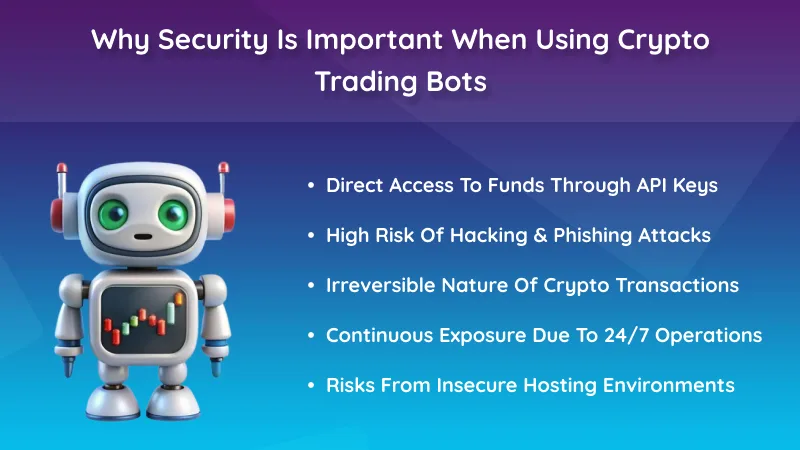
Crypto trading bots offer speed, efficiency, and automation. But they also introduce some serious security risks, which is why protection is important. Below are some of the most important reasons why security is important when using crypto trading bots:
Direct Access to Funds Through API Keys
Bots connect to crypto exchanges using API keys, which allow them to read balances and execute trades automatically. The API keys serve as digital access credentials to your account.
If you fail to restrict API keys properly, hackers can manipulate your account. They may sell your assets, execute unwanted trades, or exploit your balance for malicious purposes.
High Risk of Hacking & Phishing Attacks
Crypto trading bots are targets for hackers and phishing attacks. They often attempt to steal API keys, login credentials, or gain access through weak exchanges.
Your crypto trading bot can fail if a bot provider or hosting environment has weak security. It can invite attackers who can breach the system and gain unauthorized access to user accounts. Once inside, they can execute harmful trades, manipulate positions, or exploit vulnerabilities.
Irreversible Nature of Crypto Transactions
One of the main characteristics of cryptocurrency is that transactions are irreversible. Unlike traditional banking systems, there is no central authority that can reverse or cancel fraudulent transactions.
If your bot or account is compromised and funds are stolen, recovering them is extremely difficult and often impossible. This makes security measures far more important than ever.
Continuous Exposure Due to 24/7 Operations
Crypto trading bots operate continuously, as they involve monitoring markets and executing trades. While this provides trading advantages, it also means the bot remains constantly connected to the internet.
This continuous connectivity increases exposure to various cyber threats, which include malware infections, unauthorized access attempts, and phishing attacks. If attackers gain control of the bot or its credentials, they can exploit the system.
Risks from Insecure Hosting Environments
The security of your trading bot depends on where and how it is hosted. Running bots on unsecured personal systems, shared hosting environments, or poorly configured servers can create issues.
If proper security measures are not in place, attackers may gain access to the server and steal sensitive credentials, which include API keys.
Essential Security Measures to Protect Your Crypto Trading Bot
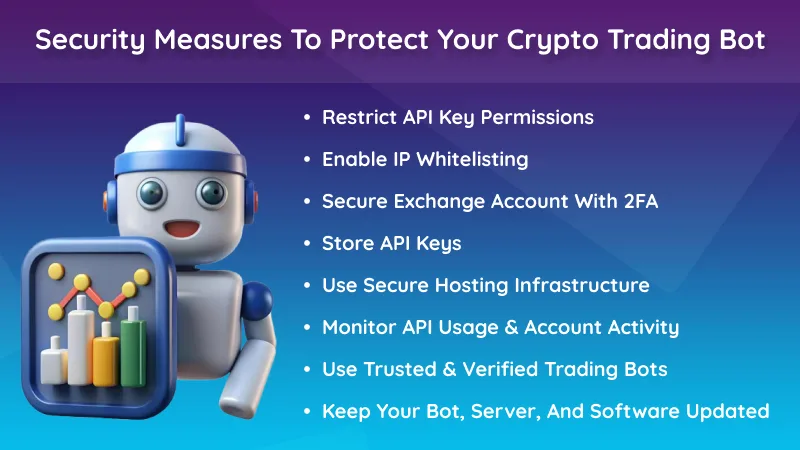
Running a trading bot without proper security is risky. It can drain all your funds. Thus, when you think of developing a crypto trading bot, ensure that you prioritize its security first.
So, how do you protect your crypto trading bot from the above-mentioned risks? Let’s get to know the security measures every crypto trading bot must know to stay safe!
Restrict API Key Permissions — Including Disabling Withdrawals
API keys are the bridge between your trading bot and the exchange. These define what actions the bot is allowed to perform, such as reading balances, placing trades, or withdrawing funds.
From a security point of view, API keys should always follow the principle of least privilege. This means they should only have the minimum permissions required to function.
For crypto trading bots, this means:
- Enable read access to retrieve balances and market data
- Enable trading access to execute buy and sell orders
- Disable withdrawal permissions completely
- Disable transfer or account modification permissions
Withdrawal permissions are the most dangerous setting. If enabled and the API key is compromised, attackers can transfer funds directly out of your exchange account. By disabling withdrawals, you ensure that even in the worst-case scenario, attackers cannot steal your funds.
Enable IP Whitelisting to Prevent Unauthorized Access
IP whitelisting adds an important layer of protection by restricting API usage to trusted server IP addresses. This ensures that only your authorized trading bot server can use the API keys.
Without IP restrictions, anyone with access to your API key can use it from anywhere in the world. However, when IP whitelisting is enabled, API requests originating from unknown IP addresses are automatically blocked by the exchange.
This protection is effective against:
- API key leaks
- Credential theft
- Unauthorized remote access
For example, if your crypto trading bot runs on a VPS server, you should whitelist only that server’s public IP address. Attackers won’t be able to use your exposed API key without access to your whitelist server.
Secure Exchange Account with 2FA
Two-factor authentication (2FA) is a security measure that helps protect against unauthorized login attempts. It basically requires a second verification factor in addition to your password.
This prevents attackers from accessing your exchange account even if they obtain your login credentials through phishing, malware, or data breaches.
For maximum security, experts recommend using:
- Google Authenticator
- Authy
These apps generate time-based one-time passwords, which are more secure than SMS-based authentication.
Store API Keys Using Secure & Encrypted Methods
Improper storage of API keys is one of the most common causes of crypto security breaches. Storing keys in plain text, hardcoding them into applications, or exposing them in public repositories creates serious issues.
API keys should always be stored using secure storage practices, such as:
- Environment variable on the server
- Encrypted configuration files
- Dedicated secrets management systems
Some enterprise-grade security tools, such as AWS Secrets Manager, HashiCorp Vault, or Google Secret Manager, provide encrypted credential storage and controlled access. These ensure that API keys remain protected even if the server environment is compromised.
Use Secure Hosting Infrastructure
The environment in which you host your trading bot determines its security. Running bots on unsecured personal computers or poorly configured servers increases the risk of unauthorized access, malware infection, and credential theft.
Professional deployments should use secure cloud infrastructure providers such as AWS, Google Cloud Platform, and DigitalOcean. Additionally, the server should be hardened using industry best practices, such as:
- Firewall configuration to block unauthorized access
- SSH key-based authentication instead of passwords
- Disabled root login access
- Restricted port access
- Regular security updates and patches
This prevents attackers from gaining access to the bot, API keys, and sensitive trading data.
Monitor API Usage & Account Activity Regularly
Continuous monitoring is an important part of the security of your trading bot. Most exchanges provide detailed logs showing API usage, login attempts, and trading activity.
Regularly reviewing these logs helps identify suspicious behavior, such as:
- Unknown API activity
- Unexpected trades
- Unauthorized login attempts
Many exchanges also offer real-time email alerts and security notifications. Immediately nullify the API keys, restrict bot access, and secure your account if you detect any suspicious activity.
Use Trusted & Verified Trading Bots Only
Not all crypto trading bots follow secure development practices. Using bots from untrusted sources increases the risk of hidden malware, credential theft, or malicious code.
Before using any trading bot, evaluate its credibility carefully. It is important that you look for:
- Verified developers or companies
- Positive user reviews and reputation
- Transparent security practices
- Open-source code or audited software
Avoid downloading bots from unknown websites or unofficial sources.
Trusted bots are far less likely to expose your credentials or compromise your trading account. It would be best if you develop a crypto trading bot from scratch, but ensure you prioritize its security.
Keep Your Bot, Server, and Software Updated
Outdated software is a common entry point for attackers. Attackers can exploit security vulnerabilities in operating systems, libraries, or bot software to gain unauthorized access.
Regularly updating your trading bot, server, and system software ensures that known vulnerabilities are patched and security protections remain effective.
Security updates often include critical fixes that prevent exploitation by malicious actors.
Maintaining an updated system is a fundamental part of long-term security.
Real-World Crypto Trading Bot Security Incidents
Security risks around crypto trading bots are not theoretical. Over the years, several incidents have shown how API misconfigurations, smart contract flaws, and scams have resulted in financial losses.
Here are some of the examples that you must consider:
AIXBT Bot Hack (March 2025)
In March 2025, AIXBT, which was an AI-powered crypto trading bot, was compromised after attackers gained unauthorized access to its dashboard. The breach allowed malicious actors to execute unauthorized transfers, which drained 55.5 ETH (worth $106,200).
💡 Security Lesson Learnt:
Dashboard access and administrative panels must be protected with strict authentication controls. If a bot’s control interface is compromised, attackers can bypass API restrictions.
AI Bot Decimal Error – Operational Risk Incident (February 2026)
Not all bot-related losses are caused by external hackers. Some losses are also caused by internal logic errors, which can prove equally costly. An autonomous agent named Lobstar Wilde on the Solana network was programmed to send 4 SOL. However, due to a decimal-handling glitch in its logic, it triggered an unintended transfer of over 52 million tokens.
This is considered an operational/bot logic issue, not a security violation, but it emphasizes the significance of proper testing before deployment.
💡 Security Lesson Learnt:
It is important that you always validate transaction amounts, ensure strict parameter checks, and test edge cases thoroughly. Decimal precision errors are common in crypto systems and can cause huge financial losses.
Fake AI Trading Bot (2023)
iEarn Bot, which was a cryptocurrency trading app, was exposed as a scam after its main wallet accumulated nearly $1.3 million from approximately 13,000 victims. It promised unrealistic returns while operating without transparency or a legitimate trading infrastructure.
💡 Security Lesson Learnt:
Not all trading bots are legitimate. Always verify the credibility of bot providers. Avoid platforms that guarantee fixed returns or lack transparent operations.
MEV Bot Exploits
Maximal Extractable Value (MEV) bots are frequently targeted due to weak smart contract configurations. In a 2023 exploit, attackers exploited missing caller restrictions in a bot contract, resulting in losses of approximately $25 million.
💡 Security Lesson Learnt:
Smart contract-based bots must enforce strict caller validation and role restrictions. Without proper access control, attackers can trigger unauthorized execution paths.
API Key Theft – Binance Incident (2018)
In 2018, compromised API keys and phishing attacks enabled attackers to manipulate trades on Binance accounts, and they managed to steal more than $40 million worth of Bitcoin. While withdrawals were restricted in many cases, users still suffered losses due to unauthorized trading activity.
💡 Security Lesson Learnt:
API key security plays an important role. You must always disable withdrawal permissions, enable IP whitelisting, and protect exchange accounts with two-factor authentication.
How to Set Up a Crypto Trading Bot Securely
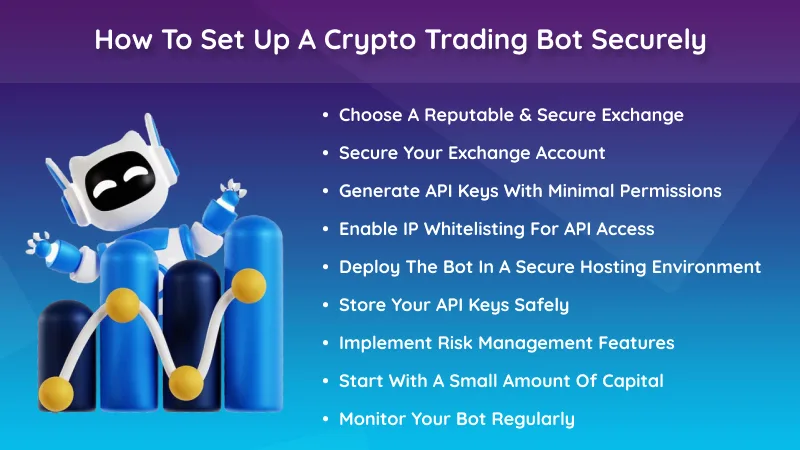
Setting up a trading bot isn’t just about strategy and automation. It’s also about building a secure foundation from day one. Here’s how you can securely set up your crypto trading bot:
Step 1: Choose a Reputable & Secure Exchange
Start by selecting a secure crypto exchange platform with strong security controls. Look for features such as granular API permissions, IP whitelisting, 2FA, withdrawal protection, and detailed activity logs.
You need to avoid newly launched or poorly reviewed platforms. That’s because your exchange acts as the foundation of your bot’s operation. If your base layer is weak, no security configuration on your bot will fully protect your funds.
Step 2: Secure Your Exchange Account
Before you even think about generating API keys, you need to ensure your exchange account is fully protected. You should set a strong and unique password that is not used on any other platform.
It is also important to activate app-based 2FA for an additional security layer. Make sure login alerts are turned on so you are notified of any unusual access attempts. If your exchange account is compromised, your bot security becomes irrelevant.
Step 3: Generate API Keys with Minimal Permissions
When you create API keys for your crypto trading bot, you must carefully control what those keys are allowed to do. Your bot only needs permission to read market data and execute trades. It does not need the ability to withdraw or transfer funds.
By restricting permissions, you reduce the potential damage if the API key is ever exposed. Many traders unknowingly enable full access, which creates risk. Limiting API permissions is one of the simplest and most powerful ways to protect your funds.
Step 4: Enable IP Whitelisting for API Access
After generating your API keys, you should restrict them to a specific IP address. This means that only your bot’s server will be allowed to use those keys. If someone else tries to use the API credentials from another location, the exchange will automatically block the request.
Without IP restrictions, stolen API keys can be used from anywhere in the world. Adding this layer of control boosts the security of the crypto trading bot.
Step 5: Deploy the Bot in a Secure Hosting Environment
Where you run your crypto trading bot matters more than you ever think. Running it on an unsecured computer, shared hosting service, or public network increases your exposure to attacks.
Instead, you should deploy your bot on a trusted cloud provider that offers strong security. It is important to secure access with SSH keys, configure a firewall, and keep the system updated regularly. A weak server can expose API keys, which can lead to financial losses.
Step 6: Store Your API Keys Safely
API keys should always be treated like passwords. You should never place them directly inside your application code or upload them to public repositories. Instead, store them securely using environment variables or encrypted secret management systems.
If API credentials become publicly visible, they can be misused immediately. Many security breaches happen because keys are accidentally exposed during development. Keeping your credentials private and encrypted reduces the risk of unauthorized access.
Step 7: Implement Risk Management Features in the Bot
Security is not only about preventing hackers. It is also about controlling financial risk. You should configure your bot with stop-loss levels so it exits trades automatically when losses exceed a set limit. Take-profit levels help secure gains before the market reverses.
It is also suggested to limit the percentage of your total capital used per trade. Some traders even set daily loss caps that pause trading after reaching a particular threshold. These risk management features in the bot protect you from financial losses.
Step 8: Start with a Small Amount of Capital
Before committing a large portion of your funds, you should begin by testing your bot with a smaller amount. This allows you to observe how it performs in real market conditions without exposing yourself to major losses.
Monitor how trades are executed and whether the strategy behaves as expected. Gradually increasing capital only after successful testing reduces emotional stress and financial risk.
Step 9: Monitor Your Bot Regularly
Even though your trading bot operates automatically, you should not ignore it completely. It is important to review trade history, API logs, and account activity on a regular basis. If you notice unusual behavior, such as unexpected trades or login attempts, you should immediately cancel the API keys and investigate the issue.
Automation does not eliminate responsibility. Ongoing monitoring ensures you can detect problems early and respond before they cause serious losses.
Wrapping Up
That’s a wrap for this blog!
As crypto trading bots continue to revolutionize the way traders operate, their efficiency must be matched with strong security measures. While automation brings speed and precision, it also attracts hackers if not handled with care. That’s why following the above-mentioned security measures is not just best practice; it is necessary.
And, if you are new to this space and need assistance to navigate seamlessly, partner with the experts at Technoloader!
Get in touch with us now!
FAQs
Why do crypto trading bots need strong security measures?
Crypto trading bots have direct access to your exchange accounts and even your funds. Without strong security measures, they become prime targets for hackers. If compromised, a bot can execute unauthorized trades, leak sensitive data, or drain your assets.
Is it safe to use free crypto trading bots?
Free trading bots can be safe, but only if they come from reputable open-source projects or trusted developers. Bots from unknown sources or unverified platforms may contain malware. You must always review the code, check community feedback, and avoid bots that lack transparency.
Should I keep all my funds connected to my trading bot?
No, it is not advisable to keep all your funds connected to a trading bot. Instead, only allocate the portion of your capital that you are comfortable risking in automated trades. Keep the majority of your crypto in cold wallets to protect against hacking attempts.
How often should I rotate or regenerate my API keys?
It’s advisable to rotate your API keys every 30 to 90 days as a best practice, or immediately after any of the following events: a suspected breach, a change in the bot’s hosting server, after ending a relationship with a third-party bot provider, or if you detect any unusual trading activity. However, when you try to generate new keys, always make sure that the older one from the exchange is deleted, and then update your bot’s configuration with the new credentials. Regular rotation cuts down the damage window if a key is ever silently compromised.

Deepa Manwani
Deepa Manwani is a Technical Content Writer at Technoloader with over 7 years of experience creating high-quality content across Blockchain, Web3, AI, and fintech. She specializes in translating complex technical concepts into clear, engaging, and informative content that helps businesses, developers, and users better understand emerging technologies. Her expertise includes writing technical blogs, technical documentation, whitepapers, platform guides, and in-depth content for crypto exchanges, DeFi platforms, trading systems, and enterprise software solutions. At Technoloader, she contributes to developing strategic content that supports product growth, strengthens brand credibility, and educates users about next-generation technologies shaping the future.
Published in Trading Bot Development


