 +91 7014607737
 info@technoloader.com





Table of Contents
Key Takeaways:
- Smart contracts are changing more than just cryptocurrencies. They are changing industries like healthcare, supply chain, insurance, real estate, government, energy, and international trade.
- A smart contract is a digital agreement that runs on a blockchain without the need for middlemen. It uses predefined “if-then” conditions to do this.
- Businesses use smart contracts to cut down the costs, automate repetitive tasks, and help businesses work smoothly.
- Smart contracts help in making things clearer, stop fraud, and build trust by maintaining records of transactions on decentralized blockchain networks.
- Some real-world uses of this smart contract are automated insurance payments, tracking the supply chain on the blockchain, transferring property, distributing royalties, and keeping track of ESG compliance.
- In 2026, businesses prefer hybrid models that combine smart contracts with traditional legal agreements for automation plus legal protection.
Introduction
Smart contracts are no longer just about crypto; they are transforming the way industries operate!
Usually, when people hear about smart contracts, they instantly think of cryptocurrencies like Ethereum. But these self-executing digital agreements are far more versatile today, and implementing smart contracts is becoming a transformative business strategy.
Think of them like digital contracts that work on their own when conditions are met, without the need for middlemen. Smart contracts are completely different from crypto, because you can use them to gain benefits like quick transactions, fewer errors, and more trust.
From healthcare and insurance to real estate and supply chains, every industry is stepping towards smart contracts due to their impressive real-world solutions. To gain a clear understanding, let’s explore the use cases of smart contracts beyond cryptocurrency and examine why they are important in today’s digital economy.
What Are Smart Contracts?
Smart contracts are digital contracts that are written in code and stored on a blockchain. They work systematically once predefined conditions are met. Instead of depending on a third party to enforce terms, the contract runs itself based on programmed rules.
Nick Szabo, a computer scientist, came up with this idea in the 1990s. It became useful later with blockchain systems like Ethereum.
For Example:
- If any is delivered to someone, then payment is released instantly on their own.
- That means no manual approval is needed.
How Smart Contracts Work
Smart contracts work using a simple “if-then” logic:
- If condition A happens
- Then action B will execute automatically at that same time.
Step-By-Step Process:
- Developers write the contract code.
- Then the code will be deployed on a blockchain network.
- After the deployment, the contracts wait for predefined conditions to be met.
- And once triggered, it executes by itself.
- This transaction is recorded permanently on the blockchain.
As they perform well on decentralized networks, no single entity can change the outcome.
Key Features Involve:
- Self-Executing: Once deployed, the contract will function automatically. No one needs to approve or process it manually.
- Immutable: After deployment, the contract code cannot easily be adjusted. This prevents tampering and increases reliability.
- Transparent: All the transactions are recorded on the blockchain. Participants can simply verify actions publicly depending on the network type.
- Trust-Minimized: Parties do not need to trust others. They only need to trust the code and the blockchain network.
Why Businesses Are Adopting Smart Contracts Beyond Crypto in 2026
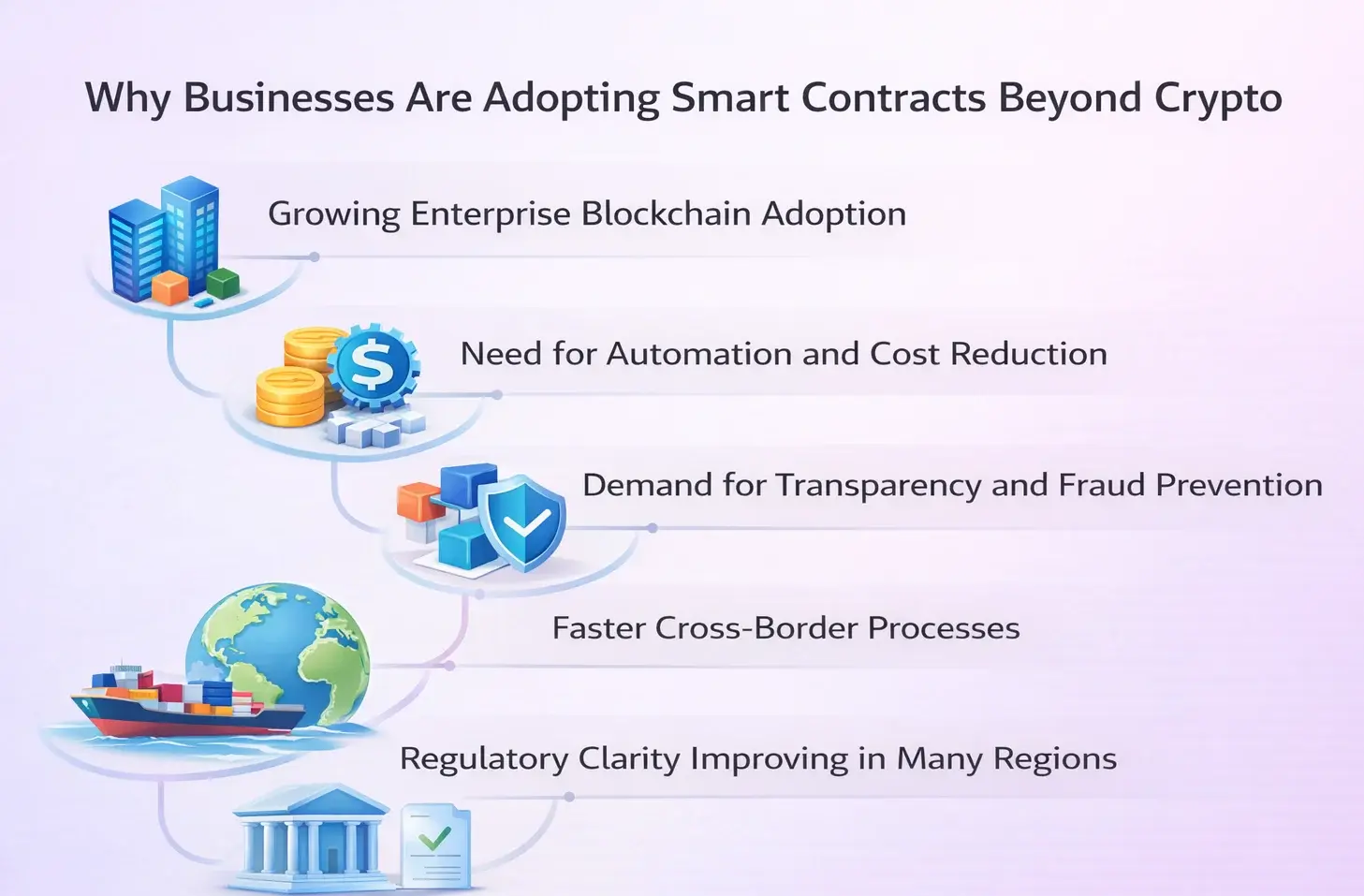
In 2026, smart contracts are no longer limited to cryptocurrency; today, they’re used in many real-world industries. Looking at the recent market data, the smart contracts market is growing rapidly, increasing from USD 2.69 billion in 2025 to nearly 3.39 billion in 2026, reflecting accelerating enterprise adoption.
Growing Enterprise Blockchain Adoption
Many large companies are putting money into blockchain technology, not only for cryptocurrency but also for business operations. They widely use it to store records safely, track products, and manage agreements.
As more companies adopt blockchain, they also start using smart contracts because they perform well on these networks. This naturally pushes smart contracts beyond just crypto-related uses.
Need for Automation and Cost Reduction
Businesses always look for different ways to save time and money. Smart contracts help by automating tasks that normally require people, paperwork, or third parties.
For example, instead of checking payments or approvals on your own, the contracts do it automatically. This cuts labor costs, speeds up processes, and lowers the chances of mistakes caused by humans.
Demand for Transparency and Fraud Prevention
In many industries, fraud and hidden information are serious problems. To address this, smart contracts record every action on a blockchain, so it cannot be changed in any way. This makes transactions more open and traceable.
Because rules are fixed in code, no one can easily cheat or manipulate the agreement. This transparency builds trust between businesses and customers.
Faster Cross-Border Processes
International transactions usually take a long time because they involve banks, legal checks, and crypto exchanges. Smart contracts can automatically carry out agreements once certain conditions are met, even if the people involved are in different countries.
This removes delays caused by manual approvals. As a result, payments, trade agreements, and service contracts can be completed within a short time.
Regulatory Clarity Improving in Many Regions
Earlier, many governments were confused about how to handle blockchain and smart contracts. Now, several countries are creating rules and legal frameworks. This gives businesses more confidence to use smart contracts safely.
Companies are more likely to use this technology for things other than cryptocurrency when they are sure they are following the law.
9 Real-World Use Cases of Smart Contracts Across Industries
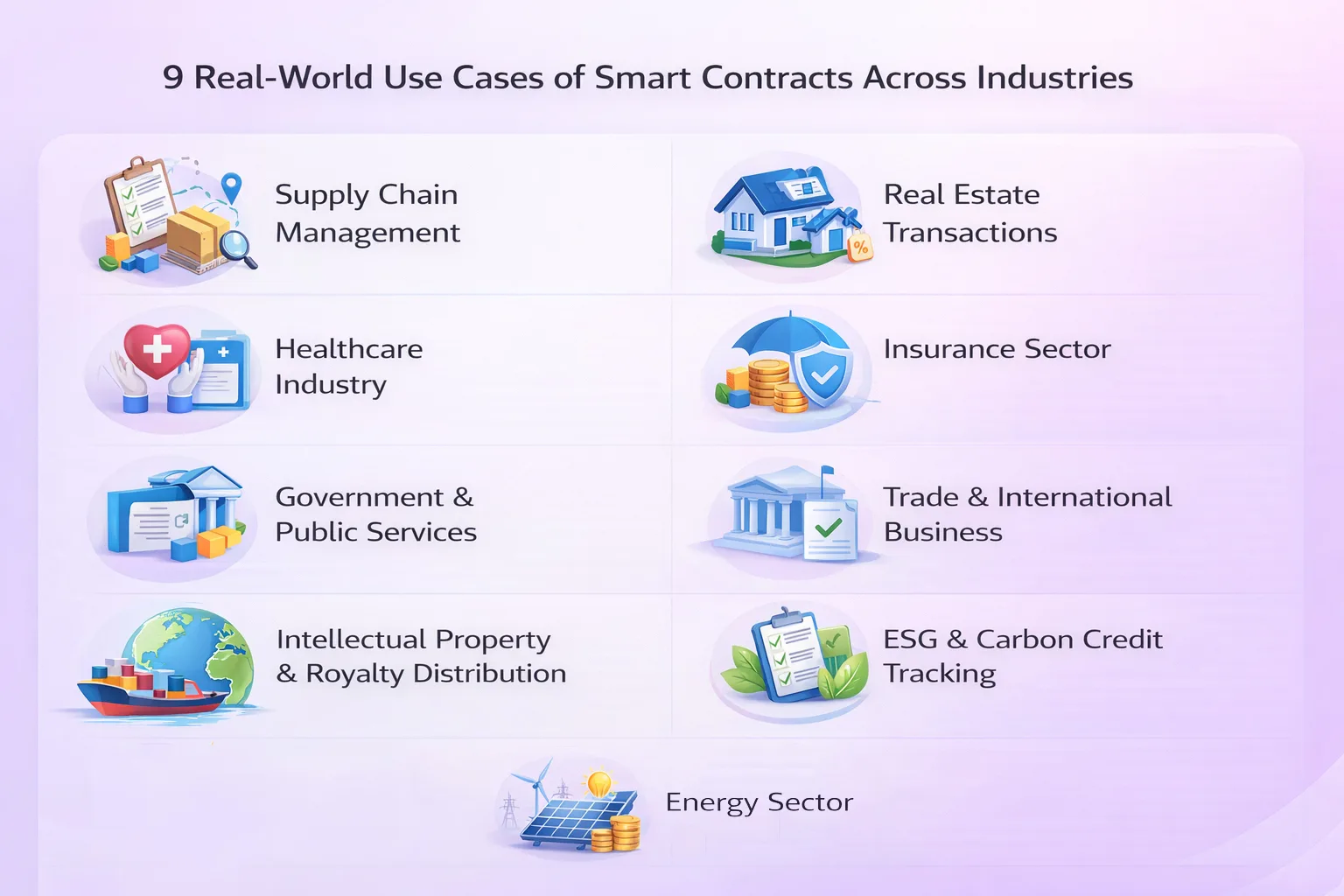
As you have understood what smart contracts actually are, now it’s time to understand real-world use cases. This includes:
Supply Chain Management
By recording every step of a product’s journey, from manufacturing to delivery, smart contracts typically ensure transparency across supply chains.
For instance, Walmart worked with IBM to set up a Hyperledger-based blockchain system for tracking food. Before, it took about 7 days to find out where a food product came from. Now, with blockchain technology, the company has cut that time down to just 2.2 seconds. Smart contract logic helps check product data at every step of the supply chain and raises standards for food safety, accountability, and transparency.
Its benefits:
- Reduces fraud
- Provide real-time tracking.
- Automates quality control and delivery verification
Real Estate Transactions
Generally, real estate deals involve lengthy paperwork, brokers, banks, and lawyers. So, here, the smart contracts play an outstanding role; they simply streamline this by automating property transfers. Thus, once the buyer makes the payment and its documents are validated, the contracts will transfer ownership automatically.
For example, when a buyer makes the payment, and the documents are verified, the smart contract transfers the property ownership automatically and releases funds to the seller.
Its benefits:
- Cuts intermediaries
- Reduces transaction costs and delays
- Provides transparent ownership
Healthcare Industry
In the healthcare industry, managing patient data is a complicated task. Privacy and data-sharing can be a restriction. Here, smart contracts help in storing and managing access to medical records safely and securely.
For example, a hospital has given temporary access to a patient’s information to an insurance company to proceed with the claim. Once the claim is settled, access will automatically be withdrawn.
Its benefits:
- Enhanced security for sensitive health reports.
- Better collaboration between hospitals and insurers.
- Reduces fraud in insurance claims.
Insurance Sector
If we see, then insurance claims are often slow and prone to disputes, but through smart contracts, their settlements are much faster.
For example, let’s imagine flight insurance. For some reason, if the flight gets delayed beyond a certain time, then smart contracts will cross-check the airline’s data and trigger an automatic payout to the passenger. And to understand it more specifically, a real-world case of this is AXA’s Fizzy flight delay insurance.
Its benefits:
- Faster claim processing
- Reduces fraudulent claims through automated verification
- Improves customer satisfaction and trust
Government & Public Services
Sometimes governments face some critical challenges like corruption, inefficiency, and lack of transparency. So, here, by utilizing smart contracts, they are able to automate welfare distribution, tax collection, and licensing.
For example, subsidies for farmers could be distributed directly via smart contracts, which ensures funds are distributed to the right person without any delays or misuse.
Its benefits:
- Reduces corruption and mismanagement
- Ensures fairness and accountability.
- Improves citizen trust in public administration.
Trade & International Business
In cross-border trade, there are multiple intermediaries involved, including banks, shipping companies, customs, etc. So, here, smart contracts make the complete process hassle-free. Now, trade financing is automated once goods are shipped and verified, resulting in faster processing.
For example, an exporter receives its payment instantly once all the shipping documents are confirmed on the blockchain.
Its benefits:
- Reduce paperwork and banking delays.
- Minimizes risk of fraud and disputes.
- Boost the speed and efficiency of international trades.
Intellectual Property & Royalty Distribution
Content creators like musicians, writers, and artists have to wait longer for payment or even get paid unfairly. Smart contracts solve this problem by automatically distributing royalties whenever content is used or sold. They automate the payment straight away based on set percentages, without the need for middlemen.
For example, when any song is streamed, revenue will be shared directly between the singer, composer, and producer.
Its Benefits:
- Automatic and fair payments
- No delays
- Transparent revenue sharing
ESG & Carbon Credit Tracking
Every business needs to show that it cares about the environment. To solve this, smart contracts simplify this by tracking carbon credits and storing sustainability data directly on the blockchain. The contracts further check and record whether a company accomplishes its previous targets.
For example, if a company reduces carbon emissions, it can receive verified carbon credits automatically.
Its Benefits:
- Transparent carbon credit tracking
- Prevents false claims
- Builds trust with investors and regulators
Energy Sector
More and more homes are getting solar panels, and smart contracts make it easier for them to sell additional electricity to others. Using this, individuals are receiving their payment automatically after the energy is delivered.
For example, a homeowner can sell extra solar energy to a neighbour, and a smart contract will send the money right away.
Its Benefits:
- Direct energy trading
- Less dependence on power companies
- Encourages the usage of renewable energy
Now that you know the best real-world usage for smart contracts outside of crypto, it’s time to explore their main benefits.
Key Benefits of Smart Contracts for Enterprises
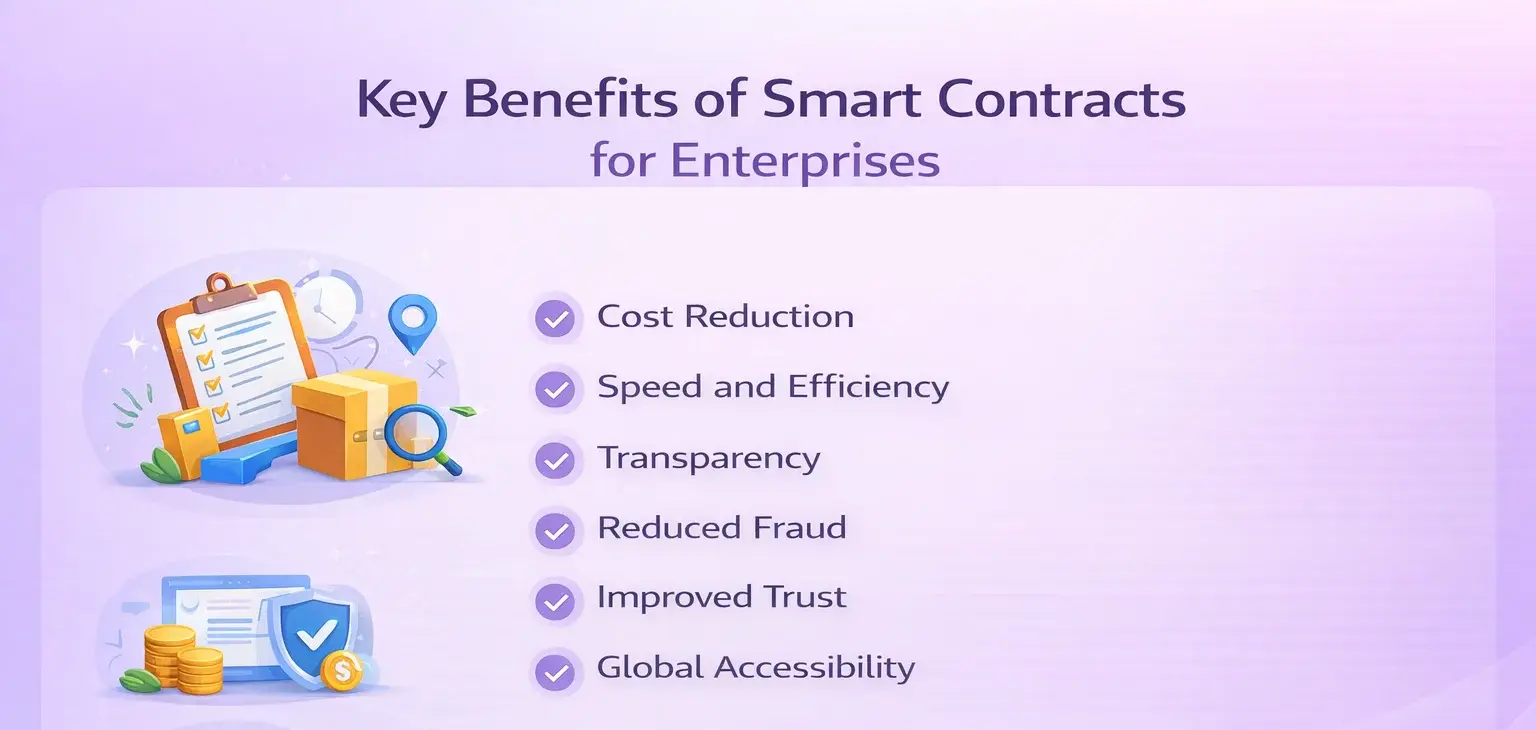
Over time, smart contracts have become useful tools for businesses across industries. They help companies in multiple ways, which include:
Cost Reduction
Smart contracts reduce costs by eliminating middlemen such as banks, brokers, and agents. Since the agreement works automatically, businesses spend less on paperwork, manual processing, and administrative staff. There are fewer delays and errors, which also saves money. Over time, this makes operations more affordable and efficient for companies.
Speed and Efficiency
Traditional processes usually take days or weeks because they require approvals, verification, and paperwork. But once the right conditions are met, smart contracts run on their own. This means that payments, approvals, and transfers happen instantly. Whereas faster processes help businesses complete deals and serve customers better without making any unnecessary delays.
Transparency
Smart contracts record transactions on a blockchain, where information cannot easily be changed or hidden. All the involved parties can see and verify what happened. This increases clarity and reduces misunderstandings. Because records are permanent, businesses can track actions easily and maintain proper data.
Reduced Fraud
Since smart contracts follow set rules written in code, no one can secretly change the terms. Transactions are verified by the network before they’re completed. This erases manipulation, false claims, and unauthorized changes. As a result, businesses face lower fraud risks than with manual systems.
Improved Trust
When agreements are automated and transparent, both parties feel secure. They don’t need to rely only on promises, as the system itself enforces the rules automatically. This creates stronger business relationships and reduces disputes. Trust increases because outcomes are determined by programmed conditions, not by personal control.
Global Accessibility
Smart contracts work on blockchain networks that are available worldwide. Businesses from different countries are able to connect without depending on any local banks or institutions. This makes cross-border agreements easier and faster to form.
Challenges and Limitations of Smart Contracts
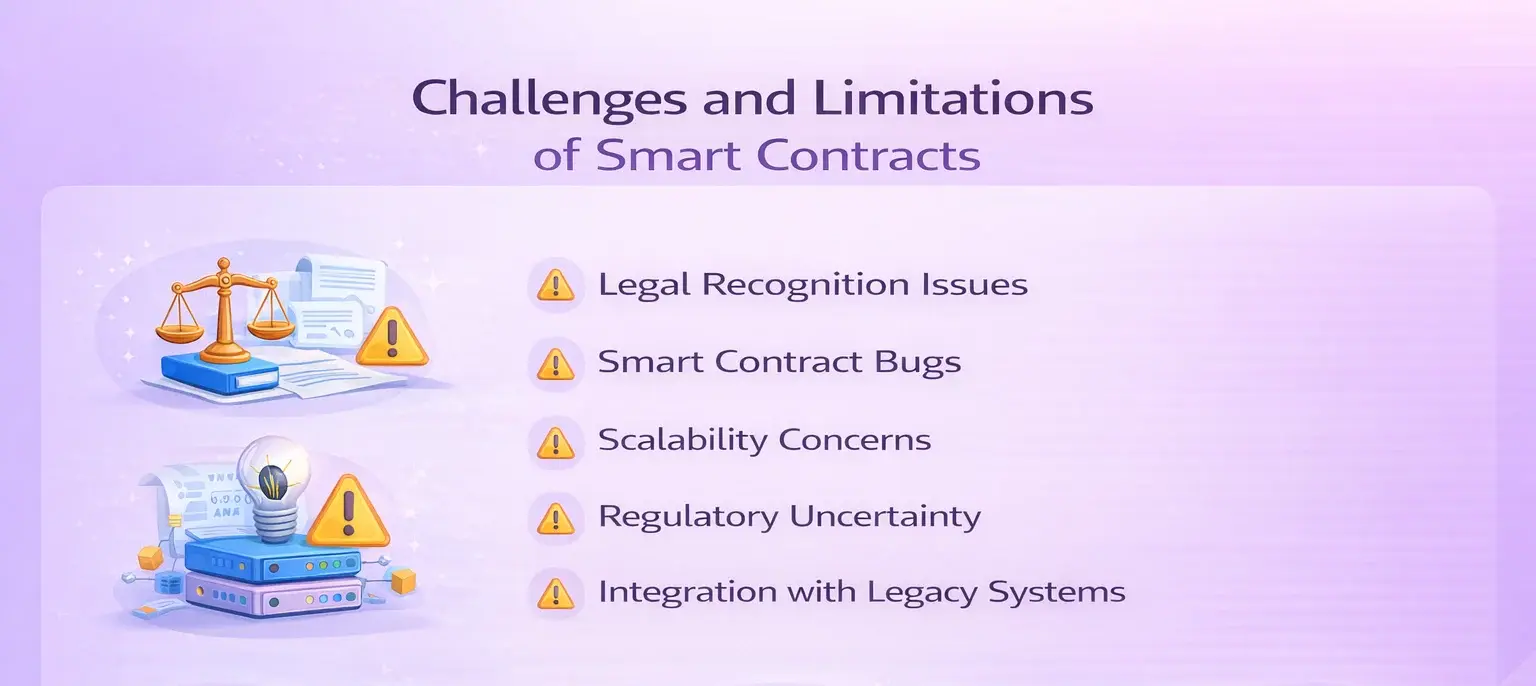
Even though smart contracts offer many advantages, they also pose certain challenges and limitations that every business must carefully consider before adopting them.
Legal Recognition Issues
In many countries, smart contracts are not fully recognized by the law. This means that if anything happens, courts may not know how to address things that happen. To manage this, businesses typically have to use both smart contracts and their traditional legal agreements to make sure that they’re protected by law.
Smart Contract Bugs
Smart contracts are written in code; if there is any mistake in the code, then it can lead to serious problems. Once deployed, they’re difficult to change. A small programming error led to serious financial losses or unexpected behavior. That is why proper testing and security audits are very important.
Scalability Concerns
When it comes to transactions, some blockchain networks might either slow down or cost a lot. This can change how fast and how much it costs to operate smart contracts. To get around this, companies need to pick the right blockchain platform to make sure everything works smoothly, especially when there are a lot of transactions.
Regulatory Uncertainty
In many regions, rules around blockchain and smart contracts are still in their maturing stage. Governments are still not confident in considering and creating policies. As a result, companies are confused about compliance requirements.
Integration with Legacy Systems
Many organizations use traditional software systems for managing operations. And connecting smart contracts with these current systems can be complicated and time-consuming. Businesses might require some technical upgrades and expert support to ensure smooth integration without upsetting their current workflows.
Hybrid Future: Smart Contracts + Traditional Legal Agreements
Talking about the future, smart contracts probably don’t replace traditional legal systems. The future will likely use both technologies and law to make reliable and practical agreements. Let’s understand the reason behind it:
Why Full Replacement Is Unlikely?
Smart contracts work well when it’s about automatic and rule-based tasks, but many agreements involve complex situations, human involvement, and legal interpretation. To manage this, courts are still needed to handle the situation. Due to this, traditional contracts will continue to play an important role alongside smart contracts.
Hybrid Enforceable Models
A hybrid model combines both a traditional written legal contract and a smart contract. The legal document explains rights and responsibilities, while the smart contract automates specific actions like payments. However, if something went wrong, the legal contract provides protection via the court system. This approach offers both automation and legal security.
Enterprise Adoption Trends
Almost every large company prefers hybrid models over fully replacing traditional contracts. They utilize smart contracts to automate their payments, tracking, and verification, while keeping legal agreements for compliance and dispute resolution. This balanced approach allows businesses to benefit from technology without losing legal protection.
After reading this, here’s the real question: how can businesses get started? Are you also struck by this? Let’s simplify this out!
How to Get Started With Smart Contracts: A Step-by-Step Guide
If any business wants to start using a smart contract, it should follow a clear and careful step-by-step approach instead of rushing into implementation.
Identify Repetitive Processes: Start with finding tasks that are repetitive, rule-based, and need human judgment. Such as recurring payments, approval workflows, or supply tracking. Smart contracts work best when their predefined conditions are met, and this helps businesses focus on further processes.
Choose the Right Blockchain Platform: Next, every business must choose the ideal blockchain network. Different platforms offer different speeds, costs, and security levels. The choice completely varies depending on business requirements, transaction values, and budget. Selecting the right platform also helps smart contracts run efficiently without high fees or performance issues.
Legal Consultation: Before implementation, it’s important to consult with legal experts. Smart contracts might not be fully recognized in all regions. At this time, a lawyer can help ensure the agreement complies with local laws and regulations. Many businesses combine traditional legal contracts with smart contracts to avoid future disputes or regulatory problems.
Smart Contract Development: Once all the planning is done, developers next write the code for the smart contract. During this, ensure that contracts clearly define all the set rules, conditions, and results. Here, accuracy is very important because even a small coding mistake can lead to major issues. Also, businesses should work with experienced developers to ensure reliability and security.
Testing & Audit: Before deployment, you need to thoroughly conduct the smart contract auditing. In this, developers check for errors, security risks, and behavior that isn’t expected. In many cases, third-party security audits are done. This stage is highly important since it is difficult to change.
Deployment Strategy: Lastly, the smart contract is deployed on the chosen blockchain network. Businesses must plan how it will be integrated with the existing systems and how users will interact with it. A proper launch strategy ensures smooth operation, user adoption, and long-term growth.
Conclusion
Smart contracts are no longer limited to cryptocurrency; today, they’re used to help businesses improve efficiency, reduce costs, and build a transparent system.
As long as they may not completely replace traditional contracts, they’re still evolving into powerful tools when they are combined with legal agreements. And as technology is advancing, many industries are learning about smart contracts to automate processes.
However, for success, every business needs to plan, build, and test security correctly. So, with the expert advice from Technoloader, businesses can confidently adopt smart contract solutions and find new prospects outside of cryptocurrency.
Frequently Asked Questions
Are smart contracts only used in cryptocurrency?
Other than cryptocurrency, smart contracts are used in many places. Businesses like supply chain, insurance, and digital content are continuously adopting it. Helping them automate their tasks and improve transparency.
How do smart contracts work in real-world businesses?
Smart contracts work in a well-organized manner. They follow a simple “if-then” rule, like if someone has delivered a parcel, then the payment will be released automatically once the parcel is delivered. This stops delays, paperwork, and manual approvals, enabling businesses to operate smoothly and efficiently.
Are smart contracts legally valid?
In many regions, smart contracts are legally valid, while in some, they’re not. The answer depends on the country you live in. In contrast to this, many businesses are starting to use smart contracts alongside traditional legal agreements to make sure they meet compliance and enforceability in case of any disputes.
Can smart contracts replace traditional contracts completely?
No, smart contracts can’t replace traditional contracts. Smart contracts perform best for automation rule-based tasks, whereas traditional legal systems are more capable of handling complex agreements, negotiations, and disputes. Both of them have their own advantages; no one can replace the other completely.
Which blockchain is best for smart contracts?
Ethereum is still the best choice for all businesses, but platforms like Solana, Cardano, Polkadot, and Hyperledger Fabric also have some big benefits when it comes to speed, security, interoperability, and privacy for businesses. Thus, the best choice depends on your specific use case, scalability needs, and regulatory requirements.

Deepa Manwani
Deepa Manwani is a Technical Content Writer at Technoloader with over 7 years of experience creating high-quality content across Blockchain, Web3, AI, and fintech. She specializes in translating complex technical concepts into clear, engaging, and informative content that helps businesses, developers, and users better understand emerging technologies. Her expertise includes writing technical blogs, technical documentation, whitepapers, platform guides, and in-depth content for crypto exchanges, DeFi platforms, trading systems, and enterprise software solutions. At Technoloader, she contributes to developing strategic content that supports product growth, strengthens brand credibility, and educates users about next-generation technologies shaping the future.
Published in Smart Contract Development


