 +91 7014607737
 info@technoloader.com





Table of Contents
Today’s customers don’t just browse businesses online; they live on their phones. From shopping and payments to learning and entertainment, almost everything happens through mobile apps.
And that shift has completely changed how businesses grow, scale, and retain customers over the long term.
Small businesses now use digital channels such as mobile apps 20 to 30% more often than analog ones. This change shows how fast things are changing. And if your business is still relying only on a website, ads, or social media platforms, you are missing out on something much bigger.
A mobile app is a long-term growth asset that keeps your brand close to customers, builds loyalty, and creates consistent engagement over time.
Want to know more reasons why a mobile app plays such an important role in long-term business growth?
Here’s a blog. Have a look!
Why Businesses Are Moving Beyond Websites & Ads
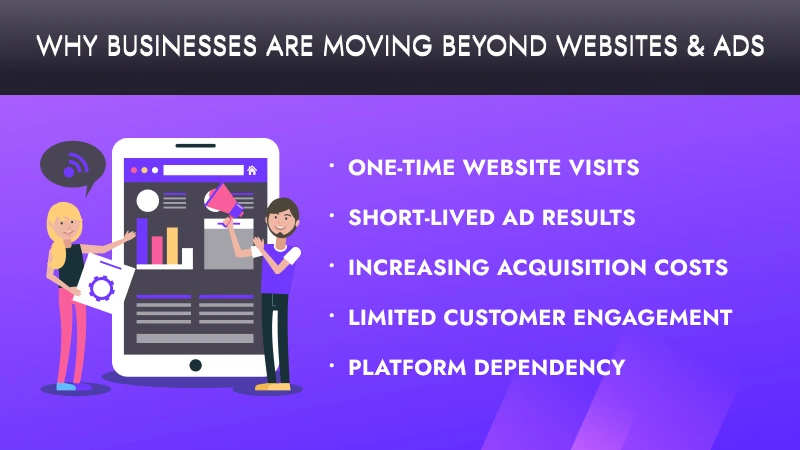
Here’s why businesses today are moving to develop mobile applications:
- One-Time Website Visits
Websites work only when users actively search for your business or click on a link. Once they leave, there is no guaranteed way to bring them back. Without continuous engagement, websites alone struggle to build long-term customer relationships or repeat interactions.
- Short-Lived Ad Results
Paid advertising delivers quick visibility, but only for as long as the budget runs. When campaigns stop, traffic and leads drop immediately. This makes ads a short-term solution rather than a sustainable growth strategy for long-term business success.
- Increasing Acquisition Costs
As more businesses compete for the same audience, digital advertising costs continue to rise. Acquiring customers through ads has become increasingly expensive, which reduces return on investment and makes it harder for businesses to grow profitably over time.
- Limited Customer Engagement
Websites and ads offer limited ways to engage customers after their initial interaction. Without features like personalized communication or regular touchpoints, businesses struggle to keep customers engaged and encourage repeat usage or long-term loyalty.
- Platform Dependency
Advertising and social media platforms control visibility through algorithms and policies. Any change in these systems can impact reach and performance overnight. Businesses that depend too much on these platforms face unpredictable growth risks.
Key Reasons Why a Mobile App Drives Long-Term Business Growth
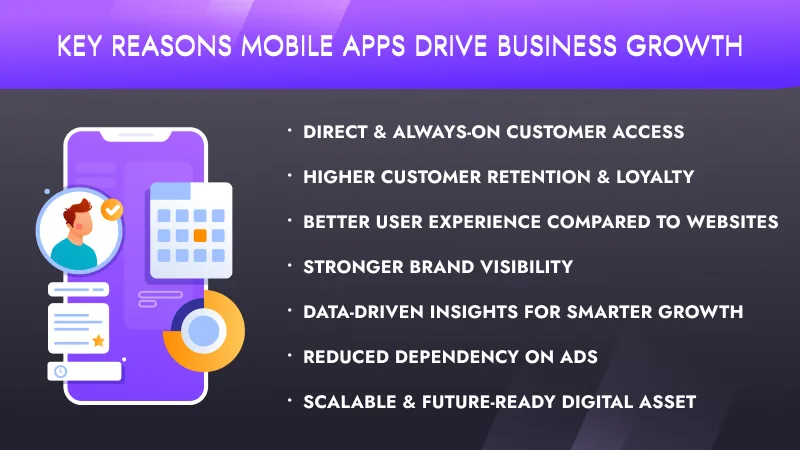
According to the latest stats by Backlinko, Android dominates the global smartphone market with a 72.77% share, while iPhone (iOS) has a 26.82% market share. This shows increasing adoption of smartphones worldwide, which makes apps one of the most powerful channels for businesses.
Let’s take a look at some more reasons!
Direct & Always-On Customer Access
A mobile app gives businesses a constant presence on customers’ smartphones, which allows direct access anytime. Unlike websites that depend on search intent or ads that rely on budgets, apps remain easily accessible with just one tap.
Businesses can communicate instantly through push notifications, in-app messages, and updates. This always-on connection helps maintain ongoing relationships, share timely offers, and keep customers engaged over the long term without repeated acquisition efforts.
Higher Customer Retention & Loyalty
Mobile apps are designed to encourage repeat usage through personalized experiences, saved preferences, and seamless navigation. When customers regularly interact with an app, it builds familiarity and trust with the brand.
Features like loyalty rewards, personalized content, and exclusive app-only benefits further strengthen customer relationships. Over time, this leads to higher retention rates and more revenue for businesses.
Better User Experience Compared to Websites
Apps provide a smoother and faster experience than mobile websites. They are optimized for performance, offer intuitive navigation, and support features like offline access and one-tap actions. Users don’t need to repeatedly log in or reload pages, which reduces friction.
A better user experience leads to longer session times, higher satisfaction, and an increased likelihood that customers will continue using the business’s services through the app.
Stronger Brand Visibility
A mobile app keeps your brand consistently visible through app icons, notifications, and regular usage. Every interaction reinforces brand recognition, making it easier for customers to remember and trust your business.
Unlike ads that disappear once campaigns end, apps maintain ongoing visibility without additional spending. Over time, this helps businesses stay top-of-mind when customers are ready to make purchasing decisions.
Data-Driven Insights for Smarter Growth
Mobile apps provide detailed insights into user behaviour, preferences, and interaction patterns. Businesses can track how customers use features, what content performs best, and where users drop off.
This data enables smarter decision-making, better personalization, and continuous improvement of products or services. By understanding customer needs more clearly, businesses can optimize strategies and support long-term growth.
Reduced Dependency on Ads
Relying heavily on ads and external platforms makes businesses vulnerable to rising costs and algorithm changes. A mobile app allows businesses to own their customer data and communication channels directly.
This reduces dependence on paid advertising and social media reach for engagement. Over time, businesses can lower customer acquisition costs, improve retention, and create a more stable growth model that is not controlled by third-party platforms.
Scalable & Future-Ready Digital Asset
A mobile app is a long-term digital asset that can grow alongside the business. New features, integrations, and automation can be added as customer needs evolve. Apps can support expansion into new services, markets, or revenue streams without rebuilding the entire system.
This scalability makes mobile apps a future-ready investment that continues to deliver value as the business grows and adapts to changing market demands.
Industries That Benefit Most from Mobile Apps
Mobile apps create measurable impact across industries by improving engagement, convenience, and operational efficiency. Here’s how different industries benefit from considering to develop mobile apps:
Retail
Retail apps help brands deliver a personalized and seamless shopping experience. With mobile commerce growing rapidly, apps drive repeat purchases and stronger customer loyalty.
Key benefits:
- Personalized product recommendations
- In-app exclusive offers and discounts
- Faster checkout and saved payment options
- Loyalty programs and rewards
- Real-time order tracking
Healthcare
Healthcare apps improve accessibility, communication, and patient experience. They reduce administrative overhead while making healthcare services more convenient for patients.
Key benefits:
- Appointment booking and reminders
- Teleconsultation and virtual care
- Digital prescriptions and reports
- Medication reminders
- Secure patient communication
Food and Hospitality
Apps in food and hospitality simplify reservations, orders, and guest engagement. They help businesses increase repeat visits and improve service efficiency.
Key benefits:
- Table or room reservations
- Online food ordering and payments
- Personalized offers and loyalty programs
- Guest feedback and support
- Faster service experience
Real Estate
Real estate apps make property discovery faster and more interactive. They help businesses manage leads better and speed up decision-making.
Key benefits:
- Property listings with images and videos
- Advanced search and filters
- Virtual tours and location maps
- Site visit scheduling
- Real-time alerts and updates
Education
Education apps enable flexible learning and better communication between institutions and learners. They support both academic delivery and administrative management.
Key benefits:
- Online classes and recorded sessions
- Course materials and assignments
- Progress and performance tracking
- Notifications and announcements
- Student–teacher communication
On-Demand Services
On-demand businesses rely heavily on mobile apps to deliver speed and convenience. Apps help manage real-time service delivery and customer expectations.
Key benefits:
- Instant booking and scheduling
- Live tracking and status updates
- In-app payments
- Service provider communication
- Ratings and reviews
The End Note
That brings us to the end of this blog!
Long-term business growth isn’t about chasing trends; it’s about choosing tools that keep working for you year after year. A mobile app does exactly that!
It helps you stay connected with customers, understand their behaviour better, and create experiences that bring them back again and again. More importantly, it gives you control over your data, your communication, and your growth strategy.
As customer expectations continue to move toward mobile-first experiences, businesses that invest in mobile apps now are setting themselves up for stronger engagement and success.
And if you are looking for the right partner to build a reliable and scalable mobile app, Technoloader can help you. Our team of expert mobile app developers can help you take that next step and turn your app into a long-term growth engine.
Get in touch with us now!

Deepa Manwani
Deepa Manwani is a Technical Content Writer at Technoloader with over 7 years of experience creating high-quality content across Blockchain, Web3, AI, and fintech. She specializes in translating complex technical concepts into clear, engaging, and informative content that helps businesses, developers, and users better understand emerging technologies. Her expertise includes writing technical blogs, technical documentation, whitepapers, platform guides, and in-depth content for crypto exchanges, DeFi platforms, trading systems, and enterprise software solutions. At Technoloader, she contributes to developing strategic content that supports product growth, strengthens brand credibility, and educates users about next-generation technologies shaping the future.
Published in Mobile App Development


