 +91 7014607737
 info@technoloader.com





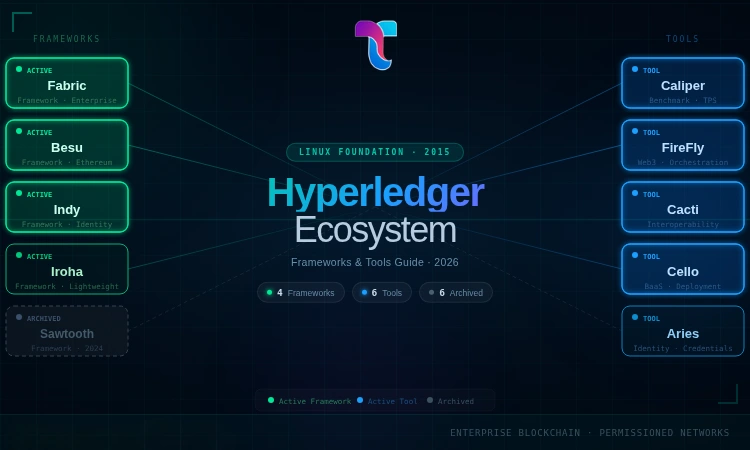
Table of Contents
Key Takeaways:
- Launched by the Linux Foundation in 2015, Hyperledger is an open-source blockchain initiative that mainly focuses on helping businesses build secure and permissioned blockchain networks.
- Most of the Hyperledger frameworks are permissioned, which makes them a good option for regulated industries that need privacy and controlled access.
- Among all the available frameworks, Hyperledger Fabric is the most used one because of its modular design and private communication channels.
- Hyperledger Besu is an Ethereum-compatible blockchain that allows businesses to run EVM-based smart contracts in enterprise environments.
- Hyperledger Indy, Aries, and AnonCreds focus on decentralized identity and privacy-preserving credential verification.
- As the ecosystem evolved, projects like Sawtooth, Burrow, Composer, and Quilt have been archived.
- Supporting tools such as Caliper, FireFly, Cacti, and Cello improve performance testing, interoperability, and network management.
Introduction
The use of blockchain in businesses is booming. According to industry reports, the global enterprise blockchain market is expected to exceed $100 billion by 2030, driven by demand for transparent business processes and secure data sharing. However, due to privacy, scalability, and regulatory compliance concerns, almost every business dislikes public blockchains.
To solve these problems, the Linux Foundation started Hyperledger, an open-source project focused on business blockchain solutions, in 2015. Hyperledger developed frameworks and tools are designed for specific business uses, not cryptocurrencies.
With time, the ecosystem has evolved and encompasses a variety of blockchain platforms and supporting utilities. Meanwhile, some projects remain active in 2026, while others have been archived or retired as technology has advanced.
In this guide, we’ll explore the complete list of Hyperledger frameworks and tools, clearly distinguishing between active and archived projects to give you a practical understanding of the ecosystem.
Hyperledger Frameworks
Let’s begin with Hyperledger frameworks!
All the following frameworks are the top blockchain platforms that enhance the Hyperledger ecosystem. These are the real distributed ledger technologies (DLTs) used to build organizational blockchain networks.
Unlike public blockchains, most Hyperledger frameworks are permissioned, which means only authorized participants can join and transact. This makes them a strong option for regulated industries and collaborative business models.
Below are the major Hyperledger frameworks:
Hyperledger Fabric
Hyperledger Fabric is the most popular enterprise blockchain framework within the Hyperledger ecosystem. Released in 2016, it was made for permissioned consortium networks where multiple organizations collaborate securely.
Fabric allows controlled network access through Membership Service Providers (MSPs) and supports smart contracts known as chaincode. One of its most powerful features is “channels,” which allow private communication between selected network participants.
- Best Suited For: Fabric is great for industries like supply chain, banking, trade finance, and healthcare, where privacy, regulatory compliance, and secure multi-party collaboration are critical.
- Key Strengths: It has a modular architecture, flexible consensus mechanisms, private data collections, and strong enterprise support, making it the leading Hyperledger framework in 2026.
Hyperledger Besu
Hyperledger Besu is an Ethereum-compatible blockchain client that became part of Hyperledger in 2019. It works with both public Ethereum networks and private permissioned deployments.
With Besu, businesses can run Ethereum smart contracts while still being able to control who can access and validate transactions on the network.
- Best Suited For: Besu is great for businesses that want Ethereum Virtual Machine (EVM) compatibility, tokenization capabilities, and decentralized application (dApp) development in a controlled enterprise environment.
- Key Strengths: It supports multiple consensus mechanisms such as IBFT and Clique, which integrate easily with Ethereum developer tools, and bridges enterprise and public blockchain ecosystems. In 2026, Besu is the primary Ethereum-based solution within Hyperledger.
Hyperledger Indy

Hyperledger Indy is a blockchain platform that is specifically designed for decentralized identification solutions. Instead of focusing on financial transactions, it handles decentralized identifiers (DIDs) and verifiable credentials.
It supports self-sovereign identification, which allows people to control and share their digital credentials securely.
- Best Suited For: Indy is best for government digital ID programs, academic credential verification, financial KYC systems, and enterprise identity platforms.
- Key Strengths: It offers strong cryptographic privacy features and works alongside tools such as Hyperledger Aries and AnonCreds. As digital identity adoption increases globally, Indy remains a core identity-focused framework in 2026.
Hyperledger Iroha

Hyperledger Iroha is a lightweight and business-oriented blockchain framework made for simplicity and ease of integration. It uses a command-based method that makes development more straightforward compared to more complex frameworks.
- Best Suited For: Iroha performs well for digital asset tracking, payment systems, loyalty programs, and smaller enterprise blockchain implementations.
- Key Strengths: It has easy-to-use APIs, efficient asset management features, and better compatibility with mobile and IoT applications. While not adopted as Fabric or Besu, Iroha still remains active in 2026 and is perfect for organizations seeking simpler blockchain deployments.
Hyperledger Sawtooth

Hyperledger Sawtooth was a modular enterprise blockchain framework designed to support scalability and flexible consensus models. It was introduced for advanced features like parallel transaction execution and the Proof of Elapsed Time (PoET) consensus algorithm.
- Best Suited For: Sawtooth was a great option for large enterprise deployments, especially supply chain and logistics systems that needed high throughput and modular configuration.
- Current Status: Due to falling community activity and ecosystem shifts, Sawtooth was officially archived in 2024. It is no longer actively maintained and is not recommended for new enterprise implementations.
Hyperledger Burrow

Hyperledger Burrow was one of the first permissioned blockchain frameworks that worked with the Ethereum Virtual Machine (EVM). It lets enterprises run Ethereum-style smart contracts within a private, permissioned environment.
- Best Suited For: Burrow was suitable for organizations seeking EVM functionality without operating on the public Ethereum network.
- Current Status: Burrow’s adoption has declined since Hyperledger Besu came into action. In 2022, it was officially archived and is no longer maintained, though it contributed to early enterprise EVM development.
Hyperledger Tools
While frameworks form the core blockchain networks, Hyperledger tools support development, integration, testing, deployment, and identity management.
None of these tools is a standalone blockchain; instead, they enhance how blockchain networks are built, operated, and connected. Some tools keep focus on performance benchmarking, while others focus on interoperability, identity verification, or infrastructure automation.
In 2026, understanding these tools is important because they help enterprises manage real-world blockchain deployments efficiently and securely.
Hyperledger Caliper

Hyperledger Caliper is a blockchain benchmarking and performance testing tool within the Hyperledger ecosystem. Even though it’s not a blockchain framework, it is a utility used to evaluate the performance of the distributed ledger networks such as Hyperledger Fabric and Besu.
Furthermore, Caliper allows developers and enterprises to test how a blockchain behaves under different workloads.
- Core Purpose: The main objective of Caliper is to measure key performance indicators like transaction throughput (TPS), latency, success rate, and resource usage. Before launching a blockchain in production, organizations need reliable data about system performance.
- How It Adds Value: Caliper generates structured performance reports that help businesses compare blockchain platforms and optimize configurations. It lowers deployment risks by identifying bottlenecks early.
- Relevance in 2026: As enterprise blockchain networks scale, performance validation remains essential. Caliper continues to play an important role in ensuring production readiness.
Hyperledger FireFly
Hyperledger FireFly is an enterprise Web3 orchestration platform that connects blockchain networks with off-chain systems, APIs, and enterprise applications. It is not a ledger itself but an integration layer that clarifies blockchain-based application development.
- Core Purpose: FireFly addresses one of the biggest challenges in enterprise blockchain projects: integration complexity. Many blockchain systems need to communicate with existing databases, applications, and messaging systems. FireFly coordinates these components efficiently.
- How It Adds Value: It provides built-in support for token management, messaging, data exchange, and API orchestration. This decreases development time and improves system scalability for multiple workflows.
- Relevance in 2026: With rising interest in tokenization and enterprise Web3 solutions, FireFly continues to remain relevant for organizations building scalable blockchain applications.
Hyperledger Cacti

Hyperledger Cacti is an interoperability framework built to connect different blockchain networks and enterprise systems. In modern enterprise environments, organizations that operate across multiple distributed ledgers, and Cacti enables secure communication between them.
- Core Purpose: Cacti solves the fragmentation issue in blockchain ecosystems. Without interoperability, blockchain networks operate in isolation. Cacti allows data sharing and transaction coordination across platforms.
- How It Adds Value: It adds value by providing standardized APIs and secure connectors that enable cross-chain workflows. This lets enterprises integrate blockchain networks without making any changes to their existing infrastructure.
- Relevance in 2026: As businesses increasingly adopt multi-chain strategies, interoperability becomes important. Cacti helps meet the growing need for connected blockchain environments in complex enterprise ecosystems.
Hyperledger Aries

Hyperledger Aries is a decentralized identity toolkit that provides sustainable components for building identity-based applications. These tools generally work alongside frameworks like Hyperledger Indy and support decentralized identifiers and credential exchange.
- Core Purpose: Aries primarily focuses on solving communication challenges in decentralized identity systems. It enables secure agent-to-agent messaging and standardized credential verification processes.
- How It Adds Value: It simplifies the development of digital identity applications by offering ready-to-use protocols and secure messaging layers. This reduces development complexity and speeds up identity solution deployment.
- Relevance in 2026: As governments and enterprises adopt identity systems, Aries remains important for implementing secure, privacy-focused identity infrastructures.
Hyperledger AnonCreds
Hyperledger AnonCreds is a privacy-preserving credential standard that is used in decentralized identity ecosystems. It allows organizations to issue and verify credentials while protecting user privacy through advanced cryptography.
- Core Purpose: AnonCreds’ main purpose is to solve the privacy challenge in identity verification. It only allows selective disclosure, which means users can prove certain attributes without revealing unnecessary personal data.
- How It Adds Value: It improves compliance with global data protection regulations and enhances trust between users and organizations. It reduces the risk of identity data exposure.
- Relevance in 2026: With the rising focus on data privacy and regulatory compliance, privacy-first credential standards like AnonCreds stay highly relevant in enterprise and government identity systems.
Hyperledger Cello

Hyperledger Cello is a Blockchain-as-a-Service (BaaS) and network management tool that helps organizations in deploying, managing, and monitoring blockchain networks efficiently.
- Core Purpose: Cello identifies operational challenges in enterprise blockchain deployment. By setting up nodes, managing permissions, and scaling networks, Cello automates many of these processes on its own.
- How It Adds Value: It reduces infrastructure setup time, supports multi-organization environments, and simplifies lifecycle management. This improves operational efficiency.
- Relevance in 2026: As enterprise blockchain networks grow in size and complexity, structured deployment and management tools like Cello remain valuable for maintaining stable infrastructure.
Hyperledger Composer

Hyperledger Composer was a tool for developers that made it easier to build applications for Hyperledger Fabric. It allows developers to model business networks using higher-level abstractions instead of having to deal with Fabric’s complicated configuration directly.
- Core Purpose: The primary goal of Composer was to make development more manageable and speed up the process of making blockchain prototypes.
- How It Added Value: It helps developers quickly design, test, and deploy early-stage Fabric applications, making it popular in academic and experimental environments.
- Relevance in 2026 As Fabric got older and native SDKs got better, Composer officially retired in 2019. It is no longer being worked on, but it is still important to the history of Hyperledger’s growth.
Hyperledger Quilt
Hyperledger Quilt was a tool that made it possible for different systems to work together by using the Interledger Protocol (ILP). The aim is to make it easier for people to talk to each other and make payments across different ledger systems.
- Core Purpose: To enable interoperability between different ledger systems using ILP and allow multiple networks to share and transfer value.
- How It Added Value: Quilt took care of the need for cross-chain transaction capabilities, especially in financial settings.
- Relevance in 2026: Development slowed down, and Quilt was put to rest around 2021 as focus shifted toward broader interoperability solutions like Hyperledger Cacti.
Hyperledger Explorer
Hyperledger Explorer is a web-based tool that lets users view and monitor blockchain network activity on Hyperledger Fabric. This tool provides an easy interface to explore blocks, transactions, smart contracts, nodes, and network data in a clear visual format.
- Core Purpose: To give users and administrators a simple way to inspect blockchain data and understand what is happening inside a Hyperledger Fabric network.
- How It Added Value: Explorer improved transparency by allowing organizations to track their transactions, verify blocks, and monitor network performance without deep technical commands.
- Relevance in 2026: In 2022, Hyperledger Explorer reached its End-of-Life (EOL) and is no longer actively maintained. However, some organizations still use it in their live Hyperledger Fabric, while others are stepping towards newly advanced monitoring and visualization tools.
Hyperledger Ursa
Hyperledger Ursa was a shared cryptographic library that was designed to provide secure and reusable cryptography tools for Hyperledger projects. It offered implementations of digital signatures, encryption, and zero-knowledge proofs for building secure blockchain and identity solutions.
- Core Purpose: It was created as a shared, modular cryptographic library that provides a centralized, secure, and reusable repository of cryptographic algorithms and other blockchain applications.
- How It Added Value: By offering standardized cryptographic components, Ursa improved security and efficiency that could be used across multiple Hyperledger projects.
- Relevance in 2026: The project was archived in 2023. Therefore, its cryptographic functions were integrated into other Hyperledger identity projects, so it remains important historically but is no longer actively developed.
Difference Between Frameworks and Tools
To understand the Hyperledger ecosystem in a better way, it is vital to clearly distinguish between frameworks and tools. The table below shows the main differences between Hyperledger tools and frameworks.
| Comparison Factor | Hyperledger Frameworks | Hyperledger Tools |
|---|---|---|
| Definition | Core blockchain systems are used to construct networks of distributed ledgers. | Supporting utilities that help manage, test, integrate, or enhance blockchain networks |
| Primary Role | Provide the main infrastructure for transactions, consensus, and smart contracts | Assist in development, deployment, benchmarking, interoperability, and identity management |
| Functionality | Handle transaction validation, network governance, data storage, and consensus mechanisms | Offer performance testing, system integration, credential management, and infrastructure automation |
| Used For | Creating and running blockchain networks | Supporting and optimizing existing blockchain implementations |
| Technical Scope | Full distributed ledger system | Operational, testing, or integration layer |
| Deployment Need | Mandatory to build a blockchain network | Optional but highly recommended for enterprise efficiency |
| Business Impact | Enables decentralized collaboration between organizations | Improves scalability, performance, interoperability, and operational management |
How to Choose the Right Hyperledger Framework / Tool
When it comes to picking the right Hyperledger solution, it usually depends on your business goals, technical needs, and industry regulations. Since frameworks and tools serve different purposes, your selection should start by determining what you’re trying to build.
Step 1: Identify Your Core Objective
Your search starts with a straightforward question. What are you really trying to build? A blockchain network, or are you supporting an existing one?
- If you’re building a new blockchain network, you need a framework.
- If you’re integrating, testing, or managing a network, you need a tool.
Step 2: Choosing the Right Framework
There are numerous frameworks available, including the following:
- Choose Hyperledger Fabric if you need a permissioned network where multiple organizations collaborate securely. It helps with data privacy, governance control, and flexible architecture, which are important. Fabric often used in the supply chain, banking, trade finance, and healthcare.
- Choose Hyperledger Besu when you need Ethereum compatibility and EVM smart contract support. It is suitable for tokenization, digital assets, and enterprise Ethereum projects that may operate on public or private blockchain networks.
- Choose Hyperledger Indy when your focus is on digital identification. It is designed for decentralized identifiers and credential verification systems.
- Choose Hyperledger Iroha if you want a simpler and lightweight blockchain solution. It works well for asset tracking, payment systems, and smaller enterprise deployments.
Step 3: Choosing the Right Tool
It’s very important to pick the right tool, and you can do so based on your needs:
- Use Hyperledger Caliper if you need to check how your blockchain is working. It helps you find out transaction speed (TPS), latency, and scalability before you use it in real life.
- Use Hyperledger FireFly if you want to build enterprise Web3 applications and need to connect blockchain networks to business systems easily.
- Use Hyperledger Cacti if your organization operates across multiple blockchain networks and requires secure cross-chain communication.
- Use Hyperledger Aries and AnonCreds if you’re creating identity-based solutions where privacy, credential verification, and secure authentication are major concerns.
- Use Hyperledger Cello if you need automated blockchain deployment and good infrastructure management, especially when handling multi-organization blockchain networks.
Step 4: Make Final Decision
Lastly, when it comes to making the final call, instead of selecting based on popularity, choose on the basis of:
- Business model
- Regulatory requirements
- Integration needs
- Scalability goals
- Identity or interoperability requirements
In simple terms, a framework is what makes your blockchain work. Tools are what you use to manage, test, or connect to it. Making the right selection ensures long-term scalability, compliance, and operational efficiency in enterprise blockchain projects.
Conclusion
The blog simplifies how Hyperledger provides a powerful foundation for businesses to use blockchain. It has a lot of frameworks, tools, and libraries that are useful for businesses in the real world.
Hyperledger has modular solutions that support scalability, security, privacy, and interoperability, so you don’t have to use just one blockchain platform. Because of this, it works great in areas like finance, supply chain, healthcare, and identity management.
By combining performance-focused tools with permissioned network structures, Hyperledger makes it easier for businesses to enter the blockchain industry. For businesses planning to adopt Hyperledger-based solutions, Technoloader can help you design, develop, and deploy secure, scalable, and industry-specific blockchain applications effectively.
Frequently Asked Questions
What is the difference between Hyperledger frameworks and Hyperledger tools?
Hyperledger frameworks are the main blockchain platforms used to build distributed ledger networks. They handle transactions, smart contracts, and consensus. On the other hand, Hyperledger tools support these frameworks by helping with testing, deployment, interoperability, monitoring, and identity management.
Which Hyperledger framework is best for enterprise blockchain development?
Hyperledger Fabric is considered to be the best framework for enterprise blockchain development because of its modular architecture, permissioned network approach, and support for private data channels. It is commonly used in industries like supply chain, finance, healthcare, and trade networks.
Can Hyperledger frameworks support Ethereum smart contracts?
Yes, some Hyperledger projects can work with Ethereum. For example, Hyperledger Besu is an Ethereum client that can run Ethereum Virtual Machine (EVM) smart contracts. This enables businesses to make dApps while still working in controlled enterprise environments.
Are all Hyperledger projects still actively maintained?
No, not every Hyperledger project is actively maintained. Some of the projects, like Hyperledger Composer, Burrow, Sawtooth, Quilt, Explorer, and Ursa, are no longer active or have been archived. While key frameworks like Fabric, Besu, Indy, and Iroha continue to be actively maintained.
Why do enterprises choose Hyperledger over public blockchain platforms?
Enterprises prefer Hyperledger because it supports permissioned networks where every participant is verified, and their access is under control. This helps businesses maintain privacy, all while complying with regulations and managing governance, along with benefiting from blockchain features like transparency and immutability.

Vipin Kumar
Vipin Kumar is the CEO of Technoloader, a leading blockchain development company. With deep expertise in emerging technologies, he drives innovation in Web3, gaming, and crypto solutions. He is passionate about delivering robust and scalable tech that transforms businesses in the digital age.
Published in Hyperledger Blockchain Development


