 +91 7014607737
 info@technoloader.com






Table of Contents
Are you thinking of launching your own crypto exchange platform, but don’t want to spend a month building everything from scratch? Here’s a blog for you!
In 2026, more entrepreneurs are entering the crypto exchange business using a smarter, faster approach: white-label crypto exchange platforms. Do you know why? That’s because they let you launch your exchange in weeks.
And honestly, it is a growing opportunity. According to a Research and Markets report, the cryptocurrency exchange platform market was valued at approximately $63.38 billion in 2025 and is expected to reach $150.1 billion by 2029.
This is exactly why launching a white-label exchange is an excellent option if your goal is to enter the market quickly and start onboarding users without investing enterprise-level capital at the outset.
But it’s not as simple as it looks. Launching an exchange using a prebuilt solution is not just buying software and putting your logo on it. To make it successful, you still need to consider several things.
Want to know what? That’s exactly what this blog will help you with.
Let’s get started!
What Is a White Label Crypto Exchange?
In general, white-label refers to customizable products or services built by one company and sold to another, which then rebrands them to appear as their own.
A white-label crypto exchange is a pre-built software solution that enables businesses to create customizable crypto trading platforms. It offers features such as buying and selling crypto, fiat-crypto conversion, trading, staking, and holding crypto. These features can be customized to meet the specific needs of the business.
Using a white-label solution allows businesses to quickly kickstart their own crypto exchange platform without the cost and time-intensive task of building one from scratch.
White Label Exchange vs Custom Exchange
Well, both options to build an exchange are good, but they work best for different goals, budgets, and timelines. Let’s understand the difference in a simple way!
| Factor | White Label Exchange | Custom Exchange |
| Launch Time | Fast (2–6 weeks) | Longer (3–12 months) |
| Initial Cost | Lower | Higher |
| Customization | Limited | Full flexibility |
| Ownership & Control | Depends on the provider | Complete ownership |
| Scalability | Medium | High (enterprise-level) |
| Advanced Features | Restricted/paid add-ons | Fully possible |
| Best Use Case | Quick entry + MVP | Long-term growth |
Key Benefits of Launching a White Label Crypto Exchange
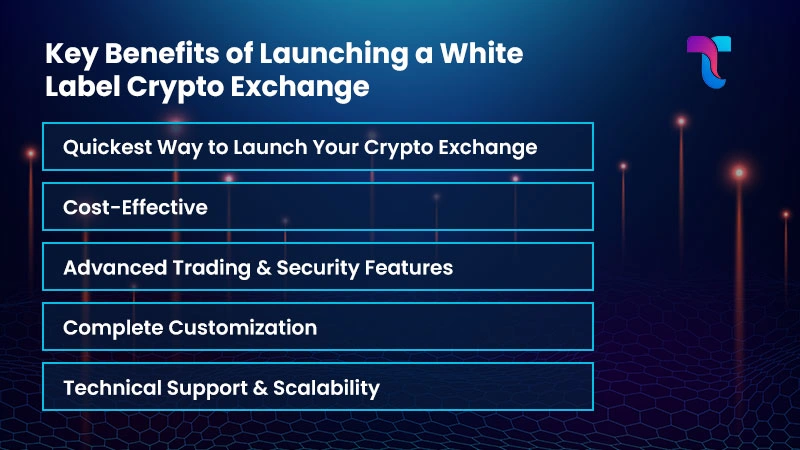
Now, let’s take a look at some of the benefits of choosing a white-label solution over building from scratch!
Quickest Way to Launch Your Crypto Exchange
The process of building a crypto exchange from scratch can take anywhere between a couple of months or can even extend up to a year. That’s because a lot of back-testing is involved to ensure all the features work as intended. White-label crypto exchanges offer a solution for a business looking to launch a cryptocurrency exchange without waiting too long.
Cost-Effective
Considering launching an exchange using a white-label solution is much more cost-effective than building from scratch. For instance, a business may spend between $40,000 and $100,000 to make an exchange, whereas a white-label software solution costs between $10,000 and $30,000. The ultimate cost depends on customization, features, and the type of exchange you require.
Advanced Trading & Security Features
Security is one of the most important features for ensuring the success of any crypto exchange platform. Since exchanges handle large volumes of user funds and sensitive data, implementing crypto exchange security best practices is critical to prevent hacking attempts, fraud, unauthorized access, and operational risks. White-label exchanges allow businesses to access secure crypto exchanges like Binance, built on the safest encrypted databases and authentication processes. Also, you can benefit from the robust architecture and advanced trading features that are already in place.
Complete Customization
White-label cryptocurrency exchanges offer a high degree of customization to entrepreneurs. The platform’s user interface, design, and functions can be easily customized to match their brand and requirements. The operational efficiency of a pre-built system can be maintained while creating a unique market presence.
Technical Support & Scalability
As your user base grows, your platform must grow too. White-label crypto exchanges can scale easily, which means that you can manage a rise in traffic or trading volumes. In addition, white-label crypto exchange providers offer 24/7 support to track performance, resolve issues, and implement updates quickly.
Steps to Launch a White Label Crypto Exchange Platform
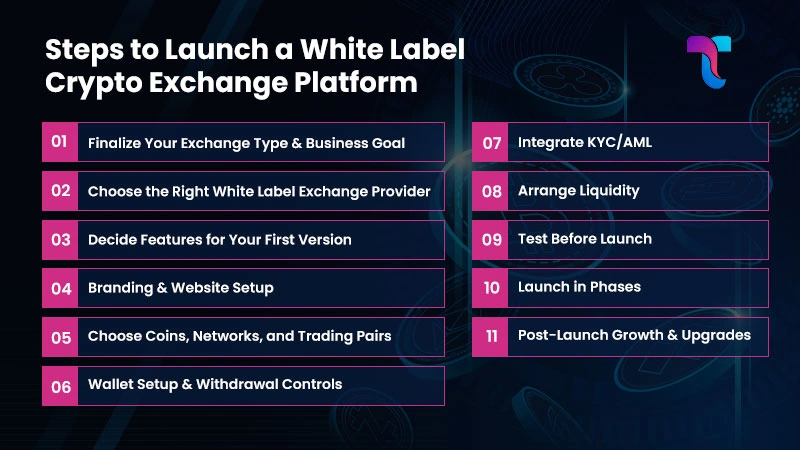
Launching a crypto exchange platform sounds like a complex task, and honestly, it is. But if you are using a white-label solution, the technical part becomes easier because the core system is already built for you.
However, you still need to plan certain things. Here are some steps that will help you along the way:
Step 1: Finalize Your Exchange Type & Business Goal
The first and most important step is to decide what kind of exchange you want to launch. That’s because it decides the entire system setup. For example, ask yourself:
- Do you want to build a spot exchange like Binance Spot (users buy/sell coins)?
- Do you want to build a P2P exchange like Binance P2P (where users trade with each other via bank transfers)?
- Do you want to build a hybrid exchange (spot + P2P)?
- Do you want to target only your country or global users?
Clearing this on this spot is important because a spot exchange needs a wallet system, an order book, and a matching engine. At the same time, a P2P exchange needs an escrow system, dispute management, and payment methods.
Step 2: Choose the Right White Label Exchange Provider
Next, you need to choose the right white label crypto exchange software provider. But don’t choose a provider just because they are cheap. Because if the platform is weak, your exchange may face security issues, downtime, slow order execution, and wallet risks.
So before selecting a company, verify things clearly. Ensure the platform includes wallet infrastructure, an admin panel, a KYC module, and a trading module. Check if the provider offers:
- Technical support after launch
- Bug fixing and maintenance
- Upgrade option for future features
Here’s a bonus tip for you: If you are confused about whom to reach out for white-label exchange software, Technoloader can be the best partner for you!
Step 3: Decide Features for Your First Version
Most beginners make one big mistake: they want everything in the first version, that is, spot, futures, copy trading, staking, and bots. This becomes expensive and even delays launch.
Instead, launch an MVP with only the required features, such as registration/login, 2FA, KYC verification, a wallet, a spot trading module, and an admin dashboard.
Once your exchange starts attracting users, you can add a referral system, staking, futures or margin trading, crypto trading bots, and more.
Step 4: Branding & Website Setup
Once your white-label system is ready, you can customize it with your brand. This step includes:
- Exchange name
- Logo and theme colours
- Domain setup (example: yourdomain.com)
- Email templates (OTP, verification emails)
- Basic pages (about us, terms & conditions, privacy policy, risk disclosure)
Step 5: Choose Coins, Networks, and Trading Pairs
This is another mistake most people make: launching the exchange with 100 coins on day one. More coins mean:
- More wallet integrations
- Higher risk
- More customer support issues
- More maintenance costs
A beginner-friendly launch should start with popular coins, such as BTC, ETH, and USDT; popular networks, such as ERC20 (Ethereum), TRC20 (Tron), and BEP20 (Binance Smart Chain); and keep limited trading pairs, such as BTC/USDT and ETH/USDT.
Step 6: Wallet Setup & Withdrawal Controls
Wallet management is the backbone of any crypto exchange platform. If wallets are not secure, you are risking user funds. Usually, exchanges use a 2-level setup: hot wallets and cold wallets.
Also, you must configure security rules, like:
- Withdrawal limit per user per day
- Manual approval for high withdrawals
- Withdrawal whitelist option
- Multi-admin approval (for big transactions)
Step 7: Integrate KYC/AML
In 2026, KYC and AML are important even for beginner exchanges because they reduce fraud, increase trust, and support later payment partnerships. A basic KYC setup for an exchange includes:
- ID proof upload
- Biometric verification
- Admin approval workflow
And, AML is directly linked with checking suspicious activity, such as:
- Repeated deposits from suspicious wallets
- Risky withdrawal patterns
Step 8: Arrange Liquidity
This is one of the steps that most entrepreneurs ignore, and that’s why they fail so early. A crypto exchange without liquidity means no buy/sell orders, a wide spread, and users leave immediately.
To solve this, ensure that your exchange uses:
- Liquidity providers
- Market maker bots
- Liquidity aggregation from external exchanges
Step 9: Test Before Launch
Before you launch your exchange to the public, you must test everything properly to ensure everything works as intended. Some important testing includes:
- Deposit test on each coin/network
- Withdrawal test (small + large amount)
- Order placement (limit & market)
- Order cancellation
- Wallet balance updates after trades
- Fee deductions
- Security (2FA, brute force protection)
- KYC approval system
- Coin/pair addition
- Withdrawal controls
Step 10: Launch in Phases
Instead of opening to everyone directly, launch in steps:
Phase 1: Soft Launch
- Invite limited users (50–200)
- Run live trading tests
- Fix bugs and performance issues
Phase 2: Public Launch
- Open signup
- Start marketing
- Run referral campaigns
Step 11: Post-Launch Growth & Upgrades
Once your exchange is stable, the next goal is scaling. You can now:
- Add more coins and pairs
- Enable referral/affiliate program
- Launch Android/iOS apps
- Integrate fiat payment methods
- Introduce premium modules like staking, copy trading, and futures trading.
Planning to scale your exchange beyond MVP and add advanced trading modules?
How Much Does It Cost to Launch a White Label Crypto Exchange?
If you are planning to launch a crypto exchange platform quickly, a white-label solution is the best option. It gives you a ready-made exchange that you can customize and launch in weeks.
But the white-label exchange’s cost is not fixed. It depends on the exchange type and several other factors. Let’s discuss them!
White Label Exchange Cost by Type
The major cost of a white-label exchange depends on the type chosen. Here it goes:
| White Label Exchange Type | Estimated Cost (2026) |
| White Label Spot Exchange | $15,000 – $60,000 |
| White Label P2P Exchange | $12,000 – $50,000 |
| White Label DEX Platform | $20,000 – $80,000 |
| White Label Hybrid Exchange (Spot + P2P) | $35,000 – $120,000+ |
Factors Affecting the Cost of Launching a White Label Crypto Exchange
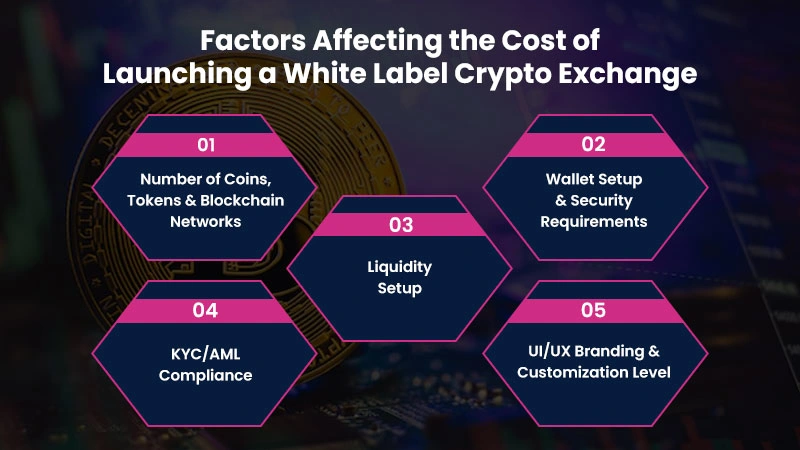
Before deciding on your budget, it is important to understand the key factors that influence the overall cost of launching a white-label crypto exchange. Those include:
Number of Coins, Tokens & Blockchain Networks
Many entrepreneurs believe that launching an exchange with more coins and tokens will attract more users. While that may be true, it also increases development, setup, and maintenance costs.
Each additional blockchain network, such as ERC20, BEP20, and TRC20, requires wallet handling, deposit confirmation rules, withdrawal monitoring, and network-specific security checks. That’s why the cost increases when you list more tokens and add support for multiple blockchain networks.
Wallet Setup & Security Requirements
Wallet management is one of the most important parts of any crypto exchange. A basic white label wallet setup may be enough for smaller exchanges. But if you want a safer and more professional setup, you need to consider additional security architecture.
For example, many exchanges use a hot wallet and cold wallet structure, where only a limited amount of funds remains online while most funds are stored securely offline. And if you add features like withdrawal limits, manual approval, a withdrawal whitelist, and suspicious activity monitoring, that also increases the cost.
Liquidity Setup
Many beginners ignore liquidity while budgeting, but liquidity is what makes an exchange actually usable. Without liquidity, your order book will look empty, spreads will be high, and users will struggle to place or fill trades.
To solve this, exchanges typically integrate liquidity providers or market makers to maintain active buy/sell orders. While liquidity integration adds to development costs, market-making is often a recurring monthly operational expense.
KYC/AML Compliance
In 2026, compliance is becoming a standard requirement for crypto platforms. Most exchanges implement KYC (Know Your Customer) to verify user identity and AML (Anti Money Laundering) checks to monitor suspicious behaviour.
The cost increases when you integrate third-party KYC providers, implement identity workflows, and build compliance dashboards for admin monitoring. While this may increase the budget, it also improves platform trust and helps in scaling legally in the long term.
UI/UX Branding & Customization Level
One of the main reasons people choose white-label exchanges is that the platform’s UI is already designed. However, costs increase when you want deeper customization.
If you want a more premium and unique user experience, such as advanced trade screens, chart integrations, customized themes, or multi-language support, this requires additional development effort. It increases the total launch cost for exchanges.
Timeline: How Long Does It Take to Launch a White Label Crypto Exchange?
One of the biggest reasons entrepreneurs choose a white label crypto exchange is the speed of launch. A well-planned exchange can be launched within 30 working days. Here’s how things are managed:
- Planning and Requirement Finalization (1-5 Days)
The first week is dedicated to properly planning the exchange. This includes confirming the type of exchange (spot/P2P/hybrid), finalizing the feature list for the MVP, selecting supported coins and networks, and setting admin control requirements.
- Platform Setup and Branding Customization (6–10 Days)
Next, the exchange is customized with your brand identity. This includes applying the exchange name, logo, domain setup, theme colours, and user interface customization. Pages like Terms & Conditions, Privacy Policy, and Risk Disclosure are also added along with email templates and notification settings.
- Wallet Setup and Coin/Network Integrations (11–15 Days)
Once customization is complete, coins like BTC, ETH, and USDT are configured, and the required blockchain networks (e.g., ERC20/TRC20/BEP20) are enabled. Also, deposit confirmations, withdrawal flow, and core wallet security rules are implemented in this phase.
- KYC/AML Integration and Compliance Setup (16–20 Days)
Next, security layers are finalized to make the exchange production-ready. This includes enabling 2FA, setting withdrawal limits, implementing anti-phishing protections, configuring device/IP login controls, and implementing admin risk monitoring rules.
The KYC module is configured with identity verification workflows and admin approval settings. If third-party KYC tools are required, integration is completed here.
- Liquidity Integration and Market Making Setup (21–25 Days)
After the platform is ready, liquidity becomes the next major requirement. Without liquidity, the exchange will look empty, and users will not trade. This phase includes integrating liquidity providers, setting up market-maker bots, and ensuring order-book depth.
- Testing, Bug Fixing, and Final Launch (26–30 Days)
Before going live, proper testing must be done to avoid failures after launch. This includes testing deposits, withdrawals, order placement, order matching, KYC flow, admin controls, and security rules such as 2FA and withdrawal limits. Load testing and basic security scans are also recommended.
After testing is successful, the exchange can be launched in beta and then opened for public onboarding.
Mistakes to Avoid While Launching a White Label Crypto Exchange
Launching a white-label crypto exchange can be fast, but many still fail. Since user trust is everything in the crypto space, even small mistakes can lead to low adoption and operational issues after launch.
Here are some of the mistakes you should avoid while launching your white label exchange:
Launching Without Liquidity
This is the most common mistake beginners make. Without liquidity, the exchange order book appears empty, spreads widen, and users are unable to execute trades smoothly. Even if your platform is live, it will feel “dead,” and users will leave quickly. Thus, it is always important to plan liquidity integration before launching your exchange publicly.
Thinking White Label Means “No Work”
Many founders assume white label exchanges are plug-and-play. But launching successfully still requires planning for wallets, coins, KYC, admin controls, compliance, security rules, and testing. White label reduces development time, but it does not remove business setup responsibilities.
Listing Too Many Coins at the Start
Launching with 50–100 coins may look attractive, but it increases operational complexity. More coins mean more wallet maintenance, more customer support issues, more security monitoring, and a higher risk of errors. A safer approach is to start with a limited set of popular coins and expand gradually.
Ignoring Security & Risk Controls
Security is not optional, especially for an exchange platform. Many exchanges focus on UI and marketing but forget core security features like 2FA, withdrawal limits, withdrawal whitelist, device/IP verification, and admin approval rules. A weak security setup can result in fund loss and damage to reputation.
Skipping Proper Testing
Some exchanges launch quickly without properly testing deposits, withdrawals, order placement, and admin workflows. This leads to user complaints such as “deposit not credited” or “withdrawal stuck,” which erodes trust. Complete testing plays an important role before public launch.
No Compliance Planning (KYC/AML)
Even if you are launching a small exchange, ignoring KYC and compliance can create serious problems later. It can lead to fraud, scamming users, and restrictions on partnerships, such as payment gateways. Planning compliance early helps in smoother growth and better credibility.
The Bottom Line
That brings us to the end of this blog!
Launching your own crypto exchange might sound like a big challenge at first, but with a white label solution, it becomes much simpler and faster.
The best part is that you don’t need to spend months building everything from scratch. With the right white-label solution, you can launch your exchange in 30 days, go live with a strong MVP, and begin onboarding users quickly.
But at the same time, it’s important to remember one thing that success is not just about launching the platform; it’s about launching it the right way.
If you focus on the essentials like:
- A clean and trusted UI
- Secure wallet and withdrawal controls
- Proper KYC setup
- Strong liquidity planning
- Complete testing before launch
… you’ll already be ahead of most beginners in this market.
So, if you are serious about entering the crypto exchange business in 2026, a white label exchange is honestly one of the smartest ways to start.
And if you want expert guidance to launch a secure, scalable, and business-ready crypto exchange platform, Technoloader is here to help you!
So, reach out to us now!

Deepa Manwani
Deepa Manwani is a Technical Content Writer at Technoloader with over 7 years of experience creating high-quality content across Blockchain, Web3, AI, and fintech. She specializes in translating complex technical concepts into clear, engaging, and informative content that helps businesses, developers, and users better understand emerging technologies. Her expertise includes writing technical blogs, technical documentation, whitepapers, platform guides, and in-depth content for crypto exchanges, DeFi platforms, trading systems, and enterprise software solutions. At Technoloader, she contributes to developing strategic content that supports product growth, strengthens brand credibility, and educates users about next-generation technologies shaping the future.
Published in Cryptocurrency Exchange


