 +91 7014607737
 info@technoloader.com





Table of Contents
Key Takeaways:
- Crypto trading bots automate buying and selling decisions using predefined strategies, APIs, and real-time market data.
- A successful crypto trading bot requires strong strategy logic, real-time execution, advanced risk management, and continuous monitoring.
- Some key parts of a crypto trading bot are signal generation, risk allocation, execution engine, API integration, and performance analysis.
- Security is critical, and protections such as encrypted API keys, IP whitelisting, and circuit breakers are important.
- Advanced crypto trading bots now incorporate AI optimization, smart order routing, and risk control at the portfolio level.
- Building a production-ready crypto trading bot in 2026 typically costs between $12,000 and $30,000, depending on features and complexity.
Introduction
Crypto markets never take a nap. Prices change 24/7, volatility hits without warning, and opportunities appear and disappear within seconds.
For traders, keeping up manually is almost impossible. That’s why crypto trading bots have become one of the most important tools, and demand for them is increasing more than ever.
And this isn’t just hype. The latest report by Business Research Insights states that the global market for crypto trading bots is worth USD 54.07 billion in 2026. It is anticipated to reach USD 200.27 billion by the end of 2035.
Instead of staring at charts all day, traders now rely on automated crypto trading bots that monitor the market, analyze real-time data, and execute trades in milliseconds.
And the truth is, you can easily build your own crypto trading bot from scratch. But for that, you need to become well-versed in the core building blocks. Once you understand them, creating a crypto trading bot becomes less about complexity and more about structured implementation.
Don’t worry, here’s a complete blog for you that will guide you every step of the way.
Let’s begin!
What is a Crypto Trading Bot?
A crypto trading bot is basically a software program that automatically buys and sells cryptocurrencies once predefined conditions are met. These analyze market data, execute trades, and manage portfolios without human intervention.
Using a crypto trading bot helps reduce emotional decision-making and even boost precision. Many bots are configured to perform actions such as arbitrage, market-making, or technical analysis-based trading.
Today, traders rely on automated systems to optimize performance, especially in high-frequency trading environments. By integrating APIs from crypto exchange platforms like Binance or Coinbase, users can now set up real-time trading bots.
How Do Crypto Trading Bots Work?
Crypto trading bots typically work on three basic functions. These include:
- Signal Generator: It is a function that helps bots find and follow possible trades using market data and technical signals. Based on the data it gathers, it then generates a buy or sell signal.
- Risk Allocation: It gets the buy or sell signal from the signal generator and decides how much of a crypto asset to buy or sell. It is responsible for making trading decisions based on predefined rules and parameters.
- Execution: This function then conducts the actual buying and selling of crypto assets. It basically converts signals into API key requests that crypto exchange platforms can only understand and process.
Why Do You Need Crypto Trading Bots in 2026?
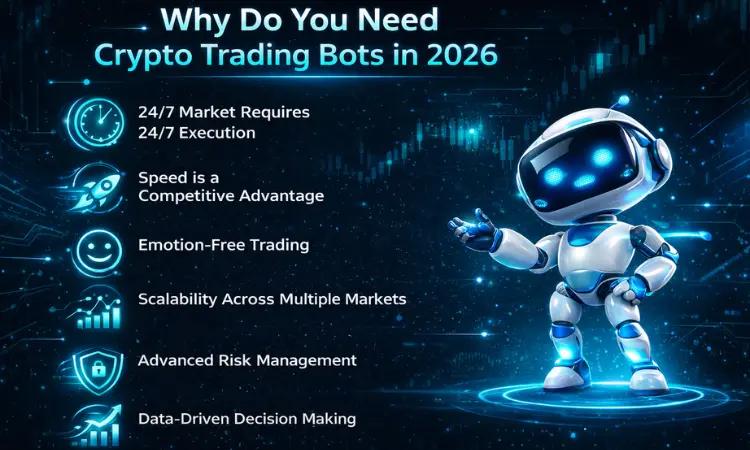
The crypto market in 2026 is not the same as it was a few years ago. Institutional involvement has grown, algorithmic trading leads the order books, and volatility cycles have become quicker and more intense. So, competing manually in such an environment is no longer a practical choice anymore.
Here are a few reasons why crypto trading bots are more important these days:
24/7 Market Requires 24/7 Execution
The crypto market runs non-stop, with no weekends off or closing hours. Also, there is no pause in trading activity. Price movements can occur at any time due to global news, macroeconomic events, or large transactions by institutional investors.
A crypto trading bot keeps an eye on trading opportunities that appear and disappear with the blink of an eye. It conducts trading as per predefined conditions even when you are offline, asleep, or unavailable. This allows you to participate in market movements without constant manual intervention.
Speed is a Competitive Advantage
In modern crypto markets, price fluctuations happen within milliseconds. Large traders and algorithmic systems execute high-frequency strategies that react instantly to market changes. Manual trading cannot match this execution speed.
Crypto trading bots use live data from APIs and WebSockets to analyze trading signals in real-time and execute orders immediately. This fast response lowers slippage, gives better entry and exit points, and makes trades more efficient.
Emotion-Free Trading
Emotional decision-making is one of the main reasons why traders suffer losses. Fear may cause premature exits, and greed may lead to holding positions longer than planned.
A crypto trading bot helps you avoid emotional choices by following specific rules. It conducts trades based on predetermined logic, indicators, and risk parameters. It helps traders stick to their strategy, and thus improving long-term performance and reducing emotional decisions.
Scalability Across Multiple Markets
Tracking multiple trading pairs across various exchanges manually is operationally complex. Every pair might have its own level of liquidity, volatility, and price changes. A crypto trading bot can observe dozens of assets at one time and apply strategies across multiple markets.
This scalability enables portfolio diversification without increasing workload. It also allows traders to explore opportunities in spot, futures, and derivatives markets, giving them greater market exposure and helping them make better use of their capital.
Advanced Risk Management
Crypto trading is not only about profit generation, but also about risk control. Crypto trading bots include risk management features such as stop-loss limits, take-profit triggers, trailing stops, position-sizing algorithms, and maximum drawdown thresholds.
These help protect capital at a time when market conditions worsen. Automated risk controls help ensure that exposure remains within predefined limits and reduce losses. This improves long-term viability and even reduces the likelihood of damaging the portfolio.
Data-Driven Decision Making
Crypto trading bots operate based on quantitative analysis rather than speculation. They rely on historical data, technical indicators like RSI, MACD, and moving averages, as well as order book depth and volatility metrics to create trading signals.
Crypto trading strategies can be backtested using past market data to check its performance before deployment. This boosts decision accuracy and allows continuous optimization. Over time, traders can optimize algorithms using performance analytics.
Prerequisites for Setting Up a Cryptocurrency Trading Bot
Before building a crypto trading bot, it is important to keep in mind that automation doesn’t replace knowledge. A trading bot performs instructions and doesn’t make independent decisions. A bot works based on the strategy and logic created by the person using it.
Below are some of the prerequisites you must keep in mind before you begin setting up a crypto trading bot:
Understanding the Crypto Market
A trading bot does not have its mind to think. It follows the instructions given by the trader. Thus, you need some understanding of how crypto markets move and operate. No bot will function well if the logic behind it does not function according to the current market scenario.
- Market Trends & Price Behavior: Prices keep moving due to sudden events such as government news, investor choices, or sudden buying patterns. At times, prices rise quickly when demand increases. And sometimes they fall when traders lose confidence. People who are aware of such patterns have a better chance of integrating strategies into a crypto trading bot.
- Technical Analysis Indicators: Several tools are available to help analyse prices. They help traders understand if the price of a coin will go up or down. Some common tools are RSI, which tells if the market is too high or too low. Another one is MACD, which shows when the price is likely to change. This will help you instruct the bot correctly.
- Basic Programming Skills: To create a crypto trading bot from scratch, you need to know the basics of the programming languages needed. While many ready-made bots are available in the market, building one from scratch offers greater flexibility and customization options.
Accounts On Crypto Exchanges
A trading bot cannot operate independently. It must connect to a crypto exchange platform where assets are bought and sold. Not every exchange allows you to use trading bots. Thus, you must choose a platform that supports them.
- API Integration Requirements: Crypto trading bots interact with the exchange platform using the API. It helps the bot check prices, place buying and selling orders, and view balances. To create this connection, the exchange provides API keys that must be kept safe, as anyone with them can control the bot.
- Supported Exchanges: Some of the crypto exchanges offer bot support. At the same time, some exchanges don’t support bots or have tight limits that even block bots. Some popular platforms that support bots are Binance, Kraken, Coinbase, and a few others.
Access To Essential Tools
Building a bot is not just about coding. A full trading ecosystem requires tools for testing, monitoring, and risk control.
- Algorithmic Trading Platforms: For users who prefer not to build from scratch, several platforms provide bot-building environments with strategy templates and configuration dashboards. Some examples are HaasOnline, Cryptohopper, and 3Commas. These platforms make set-up easier, but they might restrict how much you can customize them.
- Backtesting Tools: Any bot must be thoroughly tested before deployment in live markets. Backtesting checks how a trading strategy would have performed under the past market conditions. Some tools, such as TradingView and QuantConnect, help simulate trades and improve trading limits. This increases confidence before real capital is kept at risk.
- Risk Management Frameworks: Crypto markets are highly volatile. A robust risk framework is essential to protect capital. These rules must cover stop-loss mechanisms, position sizing rules, maximum daily loss limits, and portfolio diversification logic. This way, the losses stay low even during a bad market phase.
Step-by-Step Crypto Trading Bot Development Process

A crypto trading bot should be developed with a proper process to ensure better functionality and to achieve expected outcomes. Here’s how you can build a crypto trading bot from scratch:
Step 1: Define your Goals
The first and most important step in developing a crypto trading bot is to decide the kind of trading goal. You must decide whether the bot will manage short-term trades and long-term investments, focus on high-speed trades, or look for small price gaps across different exchanges.
Doing this planning at the beginning helps you define the bot’s operational model. When ideas are crisp and clear, the built crypto trading bot will function as intended.
Step 2: Choose a Programming Language
The strength of a bot is closely tied to the programming language chosen. Most crypto trading bot developers choose Python because of the ease it offers during development, and because it provides access to a wide library that helps handle market data effectively.
Other than that, Java provides a stronger foundation for building high-performing bots. Though C++ is way more difficult, it offers better control when high-speed order placing is important. The final choice of programming language depends on the team’s skill level and how you want the bot to operate.
Step 3: Select the Right Trading Platform
To run and execute trades, a bot must be connected with a crypto exchange. You need to select a platform that provides safe access through clear APIs and robust asset liquidity management.
Exchange platforms such as Binance have a wide market reach and high trading volume. And, Kraken is known for its security and regulatory compliance. However, Coinbase offers developers a seamless experience. Reliability should be your top goal because, regardless of how effective your trading technique is, your execution quality will suffer if the API is unstable or there is little liquidity.
Step 4: Develop Main Features
Once you’ve nailed down the goals and exchanges, the next step is to start working on the key features of the crypto trading bot. It should be able to understand the market well and determine whether to go ahead with a trade or not. It should review price charts and use tools such as RSI and MACD for technical analysis.
Or the other way, you can even add a feature in which bots learn from price behavior using historical data and give bot signals to buy or sell. These signals must prompt immediate action by placing an order without any further delay. Also, add features like stop-loss and take-profit, as they can help protect you gains in a fluctuating market.
Step 5: Add AI for Advanced Functionality
AI can help in making decisions without depending on any third parties. AI trading bots for cryptocurrency are becoming increasingly popular. They use deep learning tools to analyze the market and predict future changes.
However, AI models require high-quality data, careful evaluation, and robust risk controls, as overfitting is common in trading. It’s key to think of AI as an extra layer rather than the base, unless you really know ML well and have a solid testing process in place.
Step 6: Secure Your Keys and Funds
Security is a must. Most exchanges don’t need to “set up a wallet” within the bot. Instead, they use exchange API keys to trade on your account.
Thus, it is most important to store API keys in a secrets manager, use IP whitelisting where supported, disable withdrawal permissions, and add rate-limit protection. And if you are building an on-chain bot, wallet security (MPC, hardware signing, contract permissions) becomes even more important.
Step 7: Test Your Bot Thoroughly
Don’t ever put a crypto trading bot right into a live trading environment. It is important to start with backtesting, in which the strategy is run on historical data to evaluate logic and risk behavior. Next, conduct paper trading in which orders are simulated with live market data without real funds.
Lastly, go ahead with small capital live testing and use a controlled amount to validate execution under real conditions. Ensure you test not only for profitability but also for stability, as it should handle network failures, exchange downtime, partial fills, price spikes, and unexpected market conditions.
Step 8: Monitor, Maintain, and Improve Regularly
Crypto markets change quickly. Strategies that worked last month may underperform today. A trading bot is not a “set and forget” tool. It is a system that needs ongoing tuning and monitoring.
Once deployed on the exchange, keep a close check on your crypto trading bot. You must track its performance, add alerts for failures, review execution quality regularly, and keep up with exchange API changes.
Features to Incorporate in Crypto Trading Bot
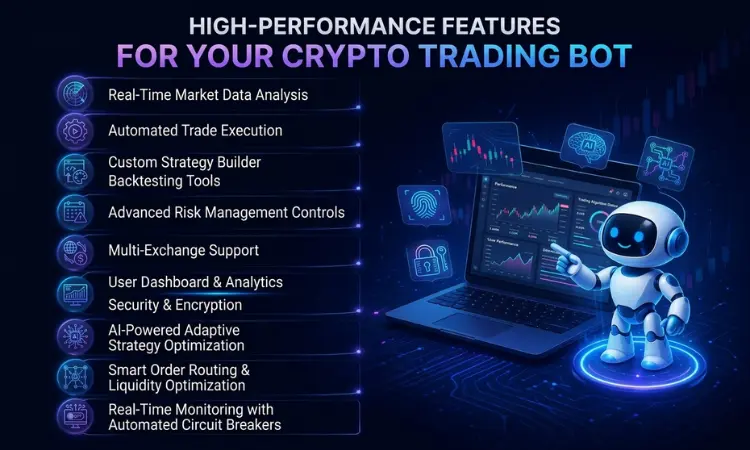
In 2026, a crypto trading bot is not just an automation script. Instead, it is a structured trading system. The below are the essential and advanced features that you must integrate into your crypto trading bot:
Real-Time Market Data Analysis
A crypto trading bot must work continuously market data in real time. It needs to monitor price changes, trading volume, order book depth, and volatility in real time. Also, it must respond quickly to market changes. In highly volatile crypto markets, even minor delays can impact profitability, so real-time data handling is important.
Automated Trade Execution
Automated execution allows the bot to place buy and sell orders instantly based on predefined rules. This takes away the influence of emotional decision-making. In 2026, bots will need to manage slippage control, partial fills, and retry mechanisms to make sure orders are executed properly. This helps traders capture opportunities during sudden price movements.
Custom Strategy Builder
A flexible strategy builder allow users to create and deploy personalized trading logic. Traders should be able to define entry and exit conditions, combine technical indicators, and adjust risk settings without modifying core code. This feature benefits both newbies and experienced traders.
Backtesting Tools
Before deploying any strategy into a live market, these must be tested using historical data. Backtesting helps evaluate how a plan would have performed under past market conditions. Advanced systems also include forward testing and performance metrics such as win rate, drawdown, and risk-reward ratio. This reduces uncertainty before real capital is revealed to volatile crypto markets.
Advanced Risk Management Controls
Risk management plays an important role in cryptocurrency trading due to high volatility. A crypto trading bot should include crucial risk controls like stop-losses, take-profit targets, trailing stops, position-sizing rules, and maximum-loss limits. Portfolio-level exposure control is also important in 2026 as it prevents over-allocation to one asset.
Multi-Exchange Support
Connecting to multiple exchange platforms allow traders to spread risk and gain better liquidity. Multi-exchange functionality enables broader market participation and supports arbitrage strategies by identifying price differences across platforms. This minimizes dependence on a single platform and improves flexibility in fast-changing market conditions.
User Dashboard and Analytics
An intuitive dashboard allows users to monitor real-time performance, open positions, portfolio value, and trade history. Advanced analytics help measure profitability, risk exposure in the market, and trade execution quality. Clear visualization also improves decision-making and allows users to improve strategies over time.
Security and Encryption
Security is non-negligible for any crypto trading bot. API keys must be encrypted and stored securely. Features like two-factor authentication (2FA), IP whitelisting, activity logging, and emergency stop options help keep user funds safe. These security measures in crypto trading bots are very important, especially since they run all the time and deal with sensitive account information across different exchanges.
AI-Powered Adaptive Strategy Optimization
In 2026, advanced AI-powered crypto trading bots are moving beyond fixed rules. It enables the trading bot to adjust its strategies based on changes in market conditions. For example, it can increase indicator sensitivity during periods of high volatility or decrease position sizes when the market is uncertain.
Smart Order Routing and Liquidity Optimization
Modern crypto trading bots also come with smart order routing features. This means that they check multiple exchange platforms to get the best price and liquidity before making an order. This helps minimize slippage and enhances the quality of trade execution, particularly for larger trades.
Real-Time Monitoring with Automated Circuit Breakers
A crypto trading bot that’s ready for 2026 should have automated circuit breakers and real-time monitoring features as well. If any worse conditions occur, such as extreme volatility, API failure, sudden losses, or execution errors, the bot can automatically pause trading. This prevents unexpected losses and even protects capital.
Tips to Optimize Your Crypto Trading Bot
Building a crypto trading bot is only the starting. To achieve the desired results, you must regularly optimize and improve it. The below are practical tips to help you improve your bot’s performance, stability, and long-term profitability:
- Adjust Your Strategy Regularly: Market conditions keep changing. A strategy that performs well in a trending market may not work in sideways or highly volatile conditions. You must regularly review your bot’s performance metrics, such as win rate, drawdown, and average returns. Make small adjustments instead of sudden changes.
- Consider Trading Fees and Slippage: Trading fees and slippage can decrease profit without even noticing. If your trading bot is placing a lot of trades, even small fees can add up quickly. Always calculate net profit after fees. You must use limit orders where necessary to reduce costs. This makes sure your crypto trading strategy stay profitable even in real market conditions.
- Improve Execution Speed: Speed is everything in crypto trading space. Delays in making orders can change the buying and selling prices of crypto assets. Use real-time data feeds instead of relying only on slower API calls. Hosting your bot on a reliable cloud server can also reduce latency. Faster trading helps get better results and also find better chances to trade.
- Strengthen Risk Management Rules: One of the reasons why many trading bots fail is that they aren’t built to protect funds, but only to generate profits. This results in unexpected losses. Thus, set daily loss limits, define maximum exposure per asset, and implement automatic stop conditions.
- Avoid Overfitting During Backtesting: Backtesting is useful, but depending solely on historical data can be misleading. A strategy that works perfectly on historical data may also fail in current markets. Before launching your bot, you must test it in different market conditions.
- Monitor Performance: Track more than just profits. You must monitor metrics like drawdown, trade consistency, and risk exposure. Use dashboards and alerts to stay informed about system performance. Monitoring helps you identify problems early and refine your trading plan before small issues turn into big losses.
How much does it cost to build a crypto trading bot?
The crypto trading bot development cost relies on various factors such as complexity involved, features included, technology stack used, and the development team’s expertise and experience. Most business owners should plan to spend between $12,000 and $30,000 on a crypto trading bot that is ready for production and has basic automation features by 2026. At the same time, advanced bots with real-time analytics, AI integration, and multi-exchange support will cost more.
For traders with specific needs and strategies, choosing customized solutions over pre-built ones can help you earn more profits.
The End Note
That brings us to the end of this blog!
Building a crypto trading bot in 2026 is no longer a tough task. With the right understanding of market behavior, strong risk management, and a structured development approach, anyone with the right mindset can build a bot that yields profits.
A trading bot is not a miracle worker. It works based on the plan, setup, and risk management behind it. The secret of a successful crypto trading bot is good planning, testing, security, and improvements.
If you’re really looking to launch a crypto trading bot, teaming up with pros in the field is the way to go.
At Technoloader, we are experts in building scalable, secure, and performance-driven crypto trading bot solutions according to your business goals.
If you are ready to build your own crypto trading bot, now is the time to start!
Frequently Asked Questions
Is it profitable to build a crypto trading bot?
If a crypto trading bot’s strategy is well-researched and tested, it can help you make profits. However, market conditions, risk management, execution speed, and capital allocation all affect profitability.
Do I need coding knowledge to build a crypto trading bot?
Basic programming experience is useful if you are creating a custom trading bot from scratch. However, users can use visual strategy builders to build bots on a number of low-code and no-code platforms.
Is it legal to use crypto trading bots?
In most of the countries, using a crypto trading bot is legal. Regulations differ by region, and traders must comply with local laws and exchange policies before using them. Prior to deployment, it is crucial to examine the exchange terms of service and legal requirements.
What are the risks of using a crypto trading bot?
Some risks include market volatility, poor strategy design, API failures, slippage, and overfitting during backtesting. Bots can even result in losses if risk is not managed properly.
How much time does it take to develop a cryptocurrency trading bot?
Depending on its complexity, a simple trading bot can be built in three to six weeks. It could take 8 to 16 weeks for advanced systems with AI, multi-exchange integration, and comprehensive dashboards. Also, development time depends on features, testing depth, and infrastructure requirements.
Can AI improve crypto trading bots?
Yes, by examining past data, observing latest trends, and adjusting logics in response to market conditions, AI can help improve trading bots.

Deepa Manwani
Deepa Manwani is a Technical Content Writer at Technoloader with over 7 years of experience creating high-quality content across Blockchain, Web3, AI, and fintech. She specializes in translating complex technical concepts into clear, engaging, and informative content that helps businesses, developers, and users better understand emerging technologies. Her expertise includes writing technical blogs, technical documentation, whitepapers, platform guides, and in-depth content for crypto exchanges, DeFi platforms, trading systems, and enterprise software solutions. At Technoloader, she contributes to developing strategic content that supports product growth, strengthens brand credibility, and educates users about next-generation technologies shaping the future.
Published in Trading Bot Development


