 +91 7014607737
 info@technoloader.com





Table of Contents
Key Takeaways:
- DeFi cuts down intermediaries by using smart contracts, eliminating banks and enabling direct peer-to-peer financial transactions globally.
- Anyone with an internet connection can access DeFi services without needing KYC verification, bank accounts, or credit history.
- Comparatively, transactions in DeFi are faster and cheaper than traditional finance, especially for cross-border payments and transfers.
- Users have complete control over their funds through non-custodial wallets, cutting reliance on institutions and reducing the risk of account restrictions.
- DeFi platforms generally provide higher returns on assets compared to traditional savings accounts by directly passing returns from lending, staking, and liquidity provision activities.
- All transactions are transparent and recorded on public blockchains, letting anyone verify data in real time, unlike opaque traditional financial systems.
- DeFi comes with risks like smart contract vulnerabilities, market volatility, and no consumer protection, but it is rapidly evolving alongside traditional finance toward a hybrid future.
Introduction
What if you could earn higher returns than your bank offers, send money across borders within seconds for almost nothing, and access loans without a single piece of paperwork, all that without needing a bank account in the first place? That is not a hypothetical situation; it’s DeFi, and it is already happening at scale.
Decentralized Finance is reshaping how people interact with money by removing middlemen, cutting costs, and opening up financial services to anyone with an internet connection. With over $130 billion locked in DeFi protocols as of early 2026, the question is no longer whether this technology is noteworthy. The question is how fast it will gradually transform the systems we have relied on for decades.
In this blog, we break down the real difference between DeFi and traditional finance; just keep scrolling through this comprehensive guide and discover which system truly works for your financial goals.
What Is DeFi and How Is It Actually Different from Traditional Finance?
Before comparing the two systems, it helps to understand exactly what each one is built on, because the differences run deeper than most people think.
Traditional Finance: Built on Institutions
Traditional Finance, commonly called TradFi, is the system most of us grew up with. Banks, brokerages, insurance companies, and stock exchanges all sit between you and your money. Every transaction you make, whether depositing a cheque, transferring funds, or buying a stock, passes through at least one institution that verifies it, processes it, takes a fee, and operates on its own schedule.
This intermediary layer is what TradFi is built on. It creates trust, but it also creates friction, cost, and gatekeeping.
Decentralized Finance: Built on Code
Smart contracts in DeFi replace institutions that manage your money in traditional finance. These are self-executing programs that live on a blockchain and automatically carry out financial transactions when preset conditions are met.
There is no bank approving the transaction. No broker is routing the order. No clearinghouse settled it two days later. The code runs, the transaction executes, and the result is recorded permanently on a public ledger.
The service is built on top of these smart contracts, like lending platforms, exchanges, and savings protocols, which are called decentralized applications, or dApps. Anyone with a crypto wallet can access them, regardless of their location, income, or credit history.
How DeFi Actually Works: Step by Step
Here is the step-by-step process of how DeFi works when someone uses it:
- Set up a wallet: A non-custodial crypto wallet like MetaMask or Phantom acts as your identity and account on the blockchain. That means you no longer need to sign up for a form or provide ID verification.
- Fund it: Transfer crypto from an exchange into your wallet. This puts you in direct control of your assets. No third party holds them on your behalf.
- Connect to a protocol: Visit a DeFi platform such as Aave for lending and connect your wallet. The platform reads your wallet balance and displays what you can do with it.
- Execute a transaction: Choose to lend, borrow, or swap. A smart contract handles the entire process instantly, automatically, and without any humans in the loop.
- It settles on-chain: The transaction is recorded publicly on the blockchain. You can simply verify it, audit it, or track it. No black box, no waiting for a statement.
The Core Difference
Traditional finance asks: Can we trust this person? On its behalf, they run credit checks, require identity documents, and restrict access based on geography and income.
DeFi asks a completely different question: Does the code execute correctly? If it does, then the transaction happens no matter who is on the other end.
DeFi vs Traditional Finance: Top Dimensions That Actually Matter
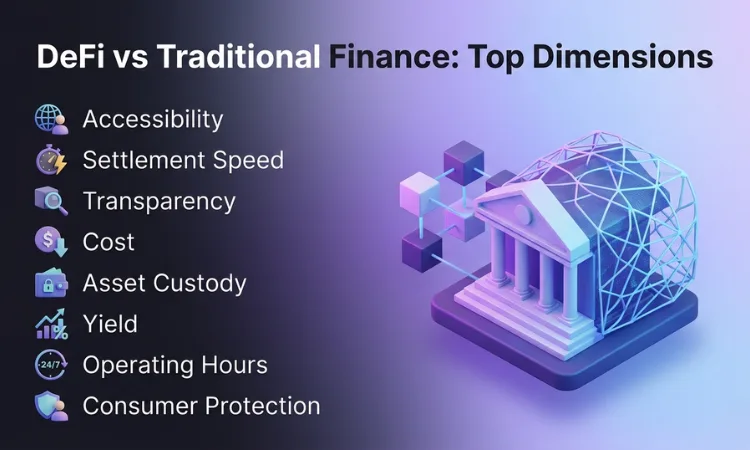
Now that both systems are defined, here is how they compare across the dimensions that affect real users every day.
Accessibility
Opening a bank account in most parts of the world requires a government-issued ID, a physical address, proof of income, and sometimes an in-person visit to a branch. But DeFi doesn’t require any of that.
No minimum balance, no eligibility criteria, no application that can be approved or rejected. The same leading protocol available to an investor in Singapore is equally available to a first-time user in India.
Settlement Speed
An international bank transfer typically takes 1 to 5 business days to settle, and that is on a business day with no public holidays in the way.
DeFi transactions finalized on-chain occur in seconds; that gap is not an improvement in speed; instead, it is a fundamental rethink of what settlement can look like when you remove every intermediary handoff from the process.
Transparency
Every transaction on a DeFi protocol is recorded on a public blockchain. Anyone in the world can easily audit interest rates, liquidity levels, loan histories, and protocol reserves in real time, and that too without requesting a report or waiting for a quarterly disclosure.
Traditional finance institutions work in the opposite direction. Their books, risk exposures, and fee structures are internal and shared only with regulators, on their own schedule and terms.
Cost
According to the World Bank’s Q1 2025 report, traditional banks charge an average of 6.49% for sending $200 internationally. DeFi-based transfers bring that down to as low as 1%.
This difference is not just about numbers; for millions, this difference means more money for food, healthcare, and education.
Asset Custody
When you deposit money into a bank, the bank holds it. You have a legal claim to those funds, but the institution controls them, and they can freeze, restrict, or lend them without your permission.
In DeFi, your assets sit in your own wallet at all times. Even when you deposit into a protocol, the smart contract governs the rules, and you retain full ownership. No institution can block access to your funds or decide what you are allowed to do with them.
Yield
A standard savings account at a traditional bank across most of the world offers between 0.5% and 4% annually, depending on the country and the rate environment. DeFi lending and liquidity protocols are generating 5% to 20% APY on stablecoins through real economic activity like lending, borrowing, and liquidity provision.
That gap exists because DeFi passes returns directly to users rather than capturing the spread inside an institution.
Operating Hours
Stock markets close in the afternoon. Banks are closed on weekends. Cross-border payments are delayed over public holidays. But if we look at DeFi protocols, they run continuously, every hour of every day, with no downtime, no maintenance windows, or national holidays.
A transaction submitted at 3 am on a Sunday typically settles within seconds to a few minutes, depending on the blockchain.
Consumer Protection
This is where traditional finance holds a genuine and important privilege. Bank deposits in most countries are insured up to a fixed limit. Credit card transactions carry chargeback rights. Regulated brokers are subject to oversight and compensation schemes if something goes wrong.
DeFi has none of these protections. If a smart contract is exploited or you send funds to the wrong address, there is no regulator to appeal to and no mechanism for recovery. The same system that removes the middleman will also dismiss the middleman’s accountability.
What DeFi Actually Let You Do
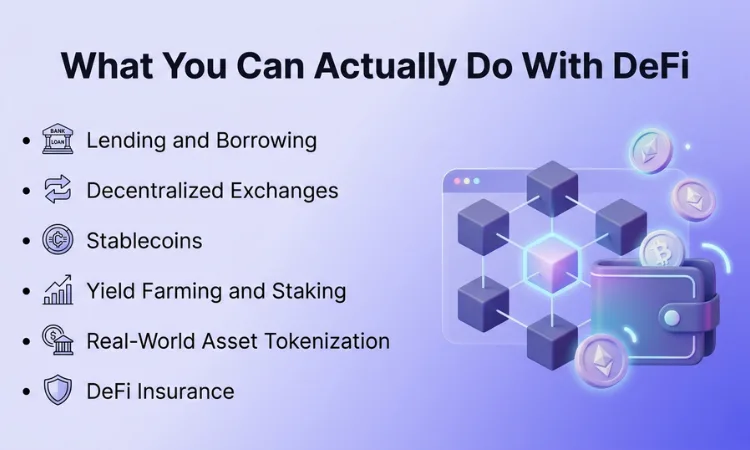
DeFi is not just crypto; it is a complete financial service, using which users can lend, trade, save, and invest. Let’s simplify what DeFi actually allows:
Lending and Borrowing (Replaces: Bank Loans)
Deposit crypto as collateral, borrow against it instantly. No credit score, no underwriter, no waiting. As the dominant leading protocol, Aave recently crossed $1 trillion in cumulative lending volume, making it a first in DeFi history and currently holds $27.2 billion in TVL with $83.3 million in monthly fees. DeFi also introduced flash loans: uncollateralized loans borrowed and repaid within a single transaction. No TradFi equivalent exists.
Decentralized Exchanges (Replaces: Stock and Crypto Exchanges)
Automated market makers replace centralized order books entirely. Connect your wallet, swap tokens, settle on-chain in seconds. That means, no account, no identity check, no withdrawal queue.
Stablecoins (Replaces: Bank Account for Value Storage)
Dollar-pegged tokens like USDC and DAI let users hold and move value inside DeFi without exposure to crypto volatility. They are the base currency of the ecosystem and, for users in countries with weak local currencies, access to a dollar-stable asset via a smartphone is genuinely transformative.
Yield Farming and Staking (Replaces: Savings Accounts)
Deposit assets into liquidity pools or share with validator nodes to earn returns from real borrowing and lending activity. Savings and yield farming account for 36.5% of total DeFi application revenue, which is the single largest use case in the ecosystem.
Real-World Asset Tokenization (Replaces: Brokerage Access)
Physical assets like government bonds and real estate are represented as on-chain tokens, with fractional ownership opening access beyond institutional investors. MakerDAO holds close to $1B in tokenized US Treasuries, while total RWA value on-chain is already above $20B and evolving continuously, anticipating massive expansion in the coming years.
DeFi Insurance
Coverage against smart contract exploits and protocol failures, assessed and paid out through decentralized governance. Lower premiums, faster claims, fully transparent on-chain. Still early, but it completes the full financial services stack that DeFi is building from scratch.
Honest Risks: Where DeFi Still Falls Short
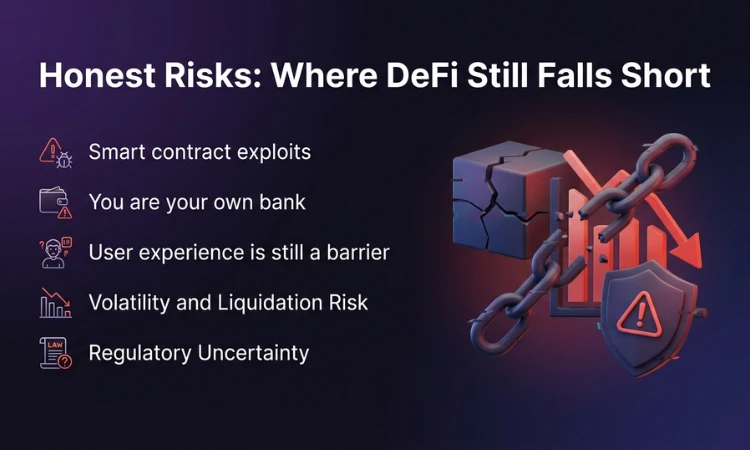
DeFi has real advantages, but it also has real risks. Understanding both is what separates a good decision from a bad one.
Smart contracts exploits
Every DeFi protocol runs on code. If that code has a vulnerability, attackers can drain it completely. There is no fraud team to call, no authority to appeal to, and no mechanism to recover funds. This is not a theoretical risk; it has happened frequently, and it will happen again. So, before using any protocol, always check when the smart contract audit was last performed for security purposes.
You are your own bank, and that is harder than it sounds
Losing your seed phrase or sending funds to the wrong crypto wallet address means the money is permanently gone. No support ticket, no reversal. The same feature that gives you full custody of your assets also gives you full responsibility for protecting them.
User experience is still a real barrier
Gas fees, wallet setup, network bridging, and protocol interfaces are generally complex for most people. The gap with traditional banking apps is closing, but it has not closed yet. For non-technical users, the learning curve is real.
Volatility and Liquidation Risk
If you borrow against crypto collateral and the market drops sharply, your position can be automatically liquidated before you have time to react. DeFi has no circuit breakers, no trading halts, and no one to call. Positions are managed by code, and the code does not negotiate.
Regulatory Uncertainty
DeFi currently operates without the consumer protections that traditional finance provides by law. Regulations are being written across most major jurisdictions right now. What that framework ultimately looks like will shape how DeFi develops. This is not necessarily a threat, but it is an unknown that anyone participating in DeFi should be aware of.
What Is Actually Happening In DeFi Right Now
If you look at the current scenario, decentralized finance is not about projections; it’s about what is live and verifiable today.
Institutions are no longer watching from the sidelines
BlackRock has launched tokenized funds on blockchain platforms. Institutional interest in DeFi protocols like Aave is increasing. Major banks are running live pilots in on-chain settlement, tokenized collateral, and digital syndicated loans.
All these are not just experiments; they’re operational decisions that are made by institutions managing trillions of dollars. The question of whether DeFi is legitimate has been answered by the people whose job it is to be conservative.
Regulation is arriving, not retreating
In 2025, the US GENIUS Act established the first federal stablecoin framework. The CLARITY Act is working through the Senate to define the broader digital asset market structure. More than forty countries have established active DeFi regulatory sandboxes.
This is the opposite of a breakdown. It is the infrastructure being built to bring DeFi into the mainstream financial system on defined terms.
The user base has crossed from early adopters to early majority
Unique DeFi users overtook twenty million in 2025, up from under one million in 2021. That growth did not happen because of hype. It happened just because the products work, the yields are real, and the accessibility is genuine. For many users, it offers advantages over traditional banking.
Cross-chain infrastructure is finally mature
The early DeFi ecosystem was fragmented. Each blockchain was an individual network. That has changed. Cross-chain protocols now allow assets to move seamlessly across networks, and AI-driven tools are actively managing liquidity, risk, and user onboarding at a level of automation that no traditional institution can even match at the same cost.
DeFi vs Traditional Finance: Side-by-Side
Now, as you’ve understood what DeFi and TradFi are, it’s time for their side-by-side comparison. This will help you understand the difference better:
| Dimension | Traditional Finance (TradFi) | Decentralized Finance (DeFi) |
| Control | Institutional control | User self-sovereignty |
| Innovation Speed | Slow, regulatory-dependent | Rapid, community-driven |
| Intermediaries | Multiple, costly | Minimal to none |
| Accessibility | KYC, credit required | Open, permissionless |
| Transparency | Opaque process | Fully traceable on blockchain |
| Custody | Held by firms | User-held through wallets |
| Settlement | Delayed (T+2, T+3) | Instantaneous with transaction finality |
| Programmability | Limited automation | Fully programmable through smart contracts |
| Fees | High fees and hidden costs | Minimal fees with gas and incentives |
| Risk Profile | Centralized counterparty risk | Smart contract and oracle risk |
Who Should Actually Use DeFi in 2026?
Right now, DeFi is not for everyone, but here is a list of individuals who can use DeFi in 2026:
Individuals Looking For Better Yield
If your savings account is paying under 2% and you’re comfortable managing a crypto wallet, then stablecoin lending protocols offer significantly higher returns on the same dollar price. The risk profile is different, but so is the return.
Freelancers and Cross-Border Workers
Receiving payment in stablecoins settles in seconds and costs a bit less than what a bank wire charges. For anyone regularly sending or receiving money across borders, DeFi is already a practical and significantly cheaper option.
Small and Medium Businesses
DeFi lending allows businesses to receive working capital without a credit history, collateral appraisals, or weeks of waiting for approval. For SMBs in markets where traditional business lending is slow or restrictive, this is a genuine unlock.
Investors Seeking Portfolio Diversification
Tokenized real estate, government bonds, and commodities are now accessible on-chain with fractional ownership. These are asset classes that were previously only accessible through brokerages with high minimums and geographic restrictions.
Developers and Founders
No other infrastructure in financial services allows a small team to build and deploy a lending protocol, exchange, or payments product in weeks with no licensing or permission required. The speed of iteration in DeFi has no equivalent in traditional finance.
Conclusion
DeFi is not here to burn banks down; it is here to do what banks used to do, faster, cheaper, and without asking for permission first. The institutions that once dismissed it are now building on its infrastructure. The regulators that once ignored it are now praising it and writing rules for it.
Meanwhile, the future of finance is not DeFi or traditional finance alone. It is the mixture of both systems that converges into something more open, more efficient, and more accessible than either could build on its own.
If you’re looking to establish a presence in this space, Technoloader is an ideal DeFi development company that helps businesses design, develop, and deploy DeFi solutions smoothly. From smart contracts to DEX platforms and lending protocols, we will ensure the best solutions for your project.
Frequently Asked Questions
What is the difference between DeFi and traditional finance?
To manage and move money, traditional finance relies on banks, brokers, and institutions. Whereas DeFi removes those intermediaries, and by using smart contracts on a blockchain, they execute financial transactions automatically. The result is a system that is faster, cheaper, and open to anyone with an internet connection, but without the consumer protections that regulated institutions provide.
Is DeFi safe to use?
DeFi risks are real. Smart contract vulnerabilities, market volatility, and the absence of consumer protection mean users are fully responsible for their funds. Therefore, it is also said that established and independently audited protocols like Aave and Uniswap have strong security track records. It is advisable to start with small amounts, using audited platforms, and never depositing more than you can afford to lose.
Can DeFi replace traditional banks?
Not completely, and at this moment, there are no chances. Mortgages, large institutional loans, and pension management are likely to remain in traditional finance for years. What DeFi is replacing right now is the layer of financial services that are slow, expensive, and geographically restricted. Currently, the more likely outcome is merging, not replacement.
Do I need a bank account to use DeFi?
No. That is one of DeFi’s most significant features. All you need is a crypto wallet and an internet connection. If you have this, then you’ll be able to lend, borrow, trade, and earn without ever interacting with a traditional bank, which is why DeFi is particularly relevant for the over one billion adults worldwide who remain unbanked.
How do I earn money with DeFi?
There are multiple ways to earn money with DeFi, but the three most common ways are lending your assets on protocols like Aave to earn interest, providing liquidity to decentralized exchanges to earn trading fees, and staking assets with validator nodes to earn staking rewards. Each of these methods carries a different risk and return profile. Starting with stablecoin lending is generally considered the most straightforward entry point.
What is the biggest risk of DeFi compared to a bank?
The absence of consumer protection. Bank deposits in most countries are secured. Credit card transactions can be reversed. However, if something goes wrong in DeFi, whether through a hack, an error, or a failed protocol, there is no regulator to appeal to and no recovery mechanism. This is the most important distinction between the two systems for everyday users to understand.

Kanak Badaya
Kanak Badaya is a Technical Content Writer at Technoloader with over 3 years of experience translating complex technology into content that actually makes sense. He works closely with emerging domains like Blockchain, Web3, AI, and DeFi, turning intricate technical concepts into clear, structured, and engaging narratives that help businesses communicate with confidence. Rather than just writing for search engines, Kanak focuses on writing for people. He combines in-depth research with a practical understanding of the industry to create blogs, website content, and technical guides that inform, educate, and build credibility. His goal is simple - make advanced technology feel approachable while helping Technoloader strengthen its authority in the digital space.
Published in DeFI Development


