 +91 7014607737
 info@technoloader.com





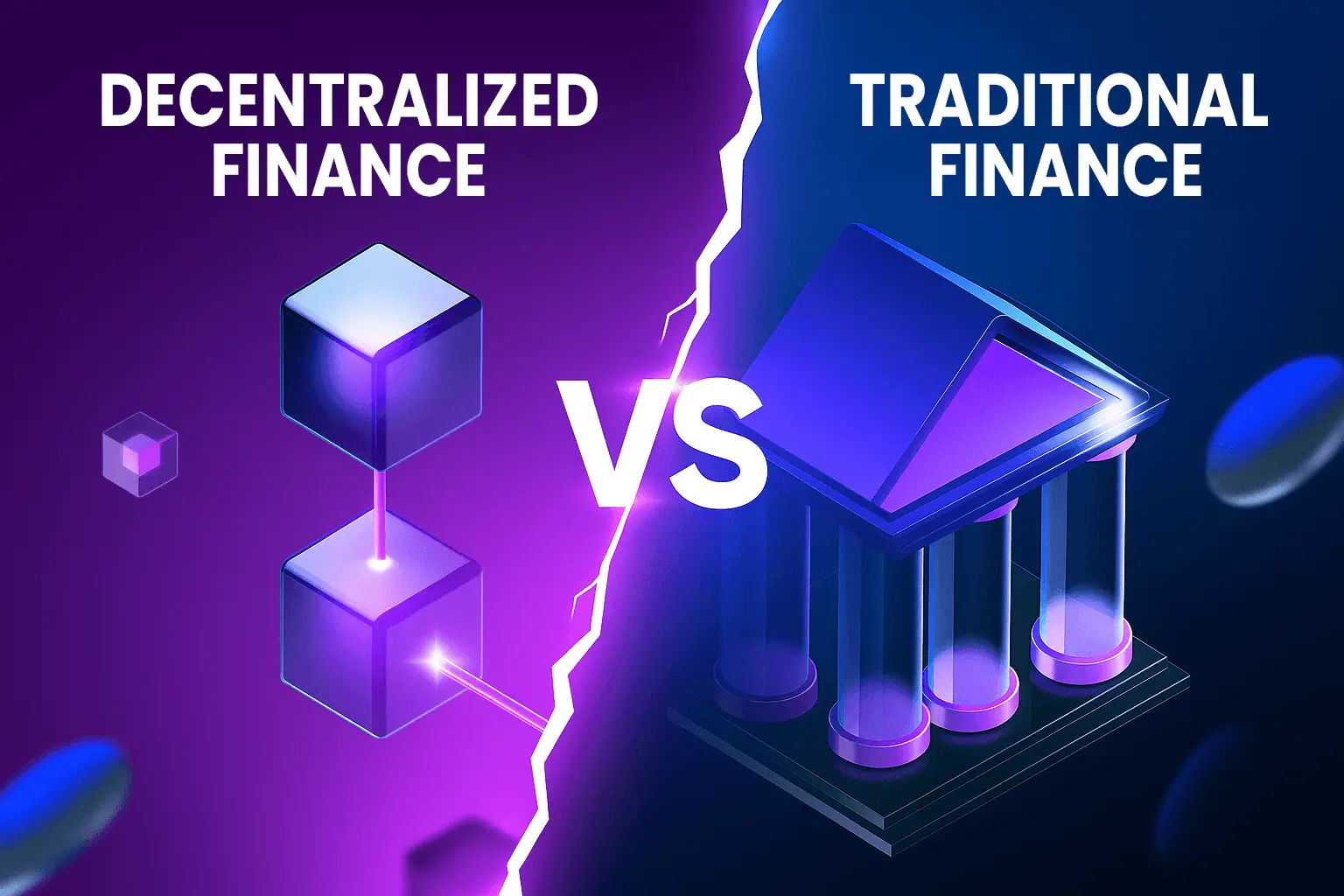
Table of Contents
Decentralized Finance (DeFi) is revolutionizing how we bank, lend, trade, and invest, completely reshaping the traditional financial landscape. Whereas conventional finance relies on centralized institutions like banks, brokerages, and clearinghouses, DeFi leverages blockchain technology to offer transparent, programmable, and interoperable financial services.
As of 2025, DeFi has grown tremendously, surpassing over $100 billion in total value locked (TVL), powered by innovation in lending, yield farming, insurance, and more.
This blog explores the ongoing disruption: comparing DeFi and Traditional Finance (TradFi), how DeFi platforms are transforming the future, their advantages and limitations, practical use cases, and what lies ahead.
Whether you’re a crypto enthusiast, developer, investor, or policymaker, understanding DeFi’s promise and its challenges is essential to prepare for a financial world that’s accelerating toward decentralization.
What Is Traditional Finance (TradFi)?
Traditional Finance, also known as TradFi, represents the legacy financial ecosystem comprising regulated banks, securities exchanges, insurance firms, asset managers, and payment processors. It offers a wide range of services—savings accounts, loans, mortgages, brokered investments, derivatives, and insurance products.
Key characteristics of TradFi
- Centralized Control & Trust
Financial institutions act as trusted intermediaries, holding users’ assets, executing transactions, and enforcing compliance.
- Regulation & Oversight
Governed by regulatory bodies such as the Federal Reserve, the SEC, and the EU’s ESMA to ensure consumer protection, market stability, and anti‑money‑laundering (AML) standards.
- Legacy Infrastructure
Heavy reliance on intermediaries, audits, and manual reconciliations creates latency, friction, and high operational costs.
- Limited Accessibility
Individuals in unbanked or underbanked regions face barriers to accessing credit, launching savings accounts, or participating in global markets.
- High Operational Costs
Branches, labour-intensive processes, and proprietary platforms all contribute to elevated fees and lower profitability.
- Lack of Programmability
Financial services follow preset rules with limited flexibility, customization, or automation for end users.
While TradFi remains robust and trusted, its centralized nature comes with inefficiencies, a lack of innovation, and barriers to inclusion that paved the way for DeFi’s disruptive ascent.
What Is DeFi?
Decentralized Finance (DeFi) is a financial movement that uses blockchain protocols, smart contracts, and tokenization to replicate and extend TradFi services. Built primarily on public blockchains like Ethereum, BNB Chain, and Solana, DeFi platforms enable peer-to-peer transactions, lending, derivatives, yield generation, and more, without traditional intermediaries.
Core attributes of DeFi are as follows:
- Smart Contracts
Self-executing, programmable agreements that automate financial logic collateralization, interest calculation, and liquidation—without manual oversight.
- Open & Permissionless Access
Anyone with an internet connection and a crypto wallet can participate; no credit checks, KYC, or bank access needed.
- Interoperability
DeFi protocols are composable—assets like stablecoins, LP tokens, and derivatives can move fluidly across platforms.
- Transparency & Permissionless Auditing
Every transaction, contract, and reserve is visible on-chain public auditability empowers users to verify assets and code.
Decentralized Platforms Fueling the Future of Business
Below are some of the decentralized platforms that are ruling the world and giving businesses a better opportunity for their growth and expansion.
- Decentralized Exchanges (DEXs) like Uniswap and PancakeSwap are for peer-to-peer asset trading.
- Lending & Borrowing platforms like Aave and Compound, enabling interest‑bearing deposits and collateralized loans.
- Yield Farming & Liquidity Mining to incentivize participation and bootstrap liquidity.
- Synthetic Assets & Derivatives, such as Synthetix, Mirror Protocol to offer exposure to real-world assets.
- DeFi Insurance like Nexus Mutual, covering smart‑contract and protocol risk.
DeFi blends transparency, accessibility, and composability, challenging TradFi by offering advanced financial tools directly to users, intermediaries with no permission requirements, and no central gatekeepers.
Key Differences: DeFi vs Traditional Finance
DeFi eliminates intermediaries by using blockchain and smart contracts, whereas traditional finance relies on centralized institutions. This section explores core differences in accessibility, transparency, control, and infrastructure that make DeFi a disruptive force in the financial landscape.
| Feature | DeFi | Traditional Finance (TradFi) |
| Custody | Self-custody via wallets (MetaMask, Ledger) | Third-party custody (banks, brokers) |
| Access | Permissionless | Permissioned, regulated |
| Intermediaries | None | Banks, brokers, clearinghouses, custodians |
| Transparency | On-chain, public | Limited, private |
| Operational Hours | 24/7, global | 9–5 (regional), weekdays |
| Programmability | Smart contracts automate workflows. | Manual, standardized processes |
| Compliance | Emerging, partial KYC, on-chain traceability | Well-established regulations |
| Settlement Speed | Instant, final settlement | Delayed (T+2, T+3); SWIFT |
| Costs | Generally low transaction/gas fees | Higher fees (commissions, spreads, custody) |
| Innovation Speed | Rapid iteration and upgrades | Slow, regulatory approvals required |
| Credit & Risk | Collateralized, over-collateralized | Credit-rated, under-collateralized |
| Security Model | Code-centric with audits, but subject to hacks | Regulated, insured, but centralized fraud is possible |
Also Read: Layer 1 vs Layer 2 Blockchain
How DeFi Platforms Are Transforming the Future?
DeFi platforms are revolutionizing finance by enabling global, 24/7 access to lending, borrowing, staking, and trading without banks. This section outlines how DeFi reshapes legacy systems with automation, decentralization, and user empowerment through blockchain technology.
Financial Inclusion & Accessibility
DeFi empowers users worldwide, especially those without access to banks, to participate in savings, lending, and investment services. All that’s needed is internet access and a wallet, effectively offering financial services to remote or underbanked communities previously excluded.
Disintermediation & Cost Efficiency
Removing intermediaries reduces overhead, enabling lower fees for users. Peer-to-peer lending platforms offer competitive interest rates by cutting out the middlemen. Automated market makers (AMMs) democratize liquidity provision, opening yield opportunities previously reserved for institutions.
Programmable & Automated Finance
Smart contracts enable auto-compounding, conditional payouts, flash loans, and dynamic collateral adjustments—empowering users with advanced financial products executed with precision and transparency.
Rapid Innovation & Composability
DeFi is built as “money legos” – where protocols can interconnect. Projects like Yearn Finance or Curve use this composability to create novel yield strategies, combining lending, trading, and staking for sophisticated financial engineering.
Trustless Settlements & Real-Time Finality
Peer-to-peer agreements settle instantly upon meeting conditions. No counterparty risk—your funds go where they should, without needing banks or escrow agents.
Cross-Border Financial Services
DeFi blurs geographic boundaries by enabling anyone, anywhere, to access global finance. There’s no SWIFT delay or forex spread—sending assets across borders is swift and cost‑effective.
Transparent Auditing & On-Chain Provenance
Every transaction is publicly visible, allowing real-time auditing. Users can independently verify loan pools, protocol reserves, treasury holdings, and sources of collateral, promoting trust and robust decentralized governance.
Real-World DeFi Use Cases of DeFi Platforms
DeFi is being used in areas like lending protocols, decentralized exchanges, stablecoins, yield farming, and insurance. This section highlights real-world applications and how individuals and institutions are leveraging DeFi for financial services without relying on centralized authorities.
Decentralized Exchanges (DEXs)
DeFi based exchange like Uniswap, SushiSwap, and PancakeSwap rely on AMMs rather than order books. They offer low-latency token swaps and enable anyone to provide liquidity and earn fees.
Lending & Borrowing
Aave and Compound let users deposit assets to earn interest or borrow against collateral. Rates are dynamically adjusted based on supply and demand—no credit checks or banks involved.
Yield Farming & Liquidity Mining
Participants deposit tokens in pools to earn yield and reward tokens. This bootstrap method has unlocked high returns (APR) and fueled protocol growth.
Synthetic Assets & Derivatives
Platforms like Synthetix mint derivative tokens backed by collateral that mirror real-asset performance, letting users gain exposure to stocks, commodities, or indices on the blockchain.
Insurance & Risk Management
Decentralized insurance products—Nexus Mutual, Cover Protocol—protect users from smart contract hacks or oracle failures, decentralizing risk-sharing and payout decisions.
Stablecoins
Dollar-pegged tokens like USDC, DAI, and USDT are crucial to DeFi infrastructure. They enable collateralized lending, cross-chain payments, and serve as a store of value in volatile markets.
Challenges & Risks of DeFi Platforms
Despite its promise, DeFi comes with risks like smart contract bugs, regulatory uncertainty, price volatility, and rug pulls. This section examines the critical challenges users and developers must consider when participating in or building DeFi platforms.
Smart Contract Vulnerabilities
Bugs or security flaws in smart contracts can cause exploits—case in point: The DAO hack, $600M in crypto lost on Ronin Bridge in 2022. Thorough audits and formal verification are critical.
Liquidity & Price Slippage
Thin liquidity on smaller pools leads to slippage, affecting user returns or execution price. DeFi protocols manage this via liquidity incentives and dynamic pools.
Regulatory Uncertainty
DeFi operates in a patchwork of regulatory environments, with concerns over money laundering, tax evasion, and investor protection. Future laws may impose stricter KYC, token classification, or protocol constraints.
Oracle Risks
Price oracles feed off-chain data into DeFi smart contracts. Malicious or faulty oracle data can trigger incorrect liquidations or pricing, undermining protocol stability.
User Experience & Education
Non-technical users must manage private keys and understand gas, slippage, and impermanent loss, potentially alienating mainstream users unless interfaces improve.
Governance & Protocol Attacks
Decentralized governance offers autonomy but can be exploited via token-based voting, leading to rug pulls or protocol manipulation if majority control is gained by bad actors.
Best Practices for Building Future-Proof DeFi Platforms
To ensure security, scalability, and longevity, developers must adopt practices like code audits, robust tokenomics, regulatory alignment, and user education. This section outlines essential guidelines for launching reliable and sustainable DeFi platforms in today’s evolving market.
Security First: Audits & Formal Verification
Adopt multi-audit strategies from firms like CertiK, Quantstamp; complement with formal verification tools like MythX and Slither to fortify smart contracts.
Higher-Level Abstractions for Safety
Integrated vesting, timelocks, multi-sig wallets, and limit orders help prevent hacks and malicious admin behaviour.
Gas Optimization & Layer-2 Adoption
Deploy on scaling solutions like Optimism, Arbitrum, or zkSync to lower fees and improve user experience, —critical during high network demand.
Oracles: Decentralized & Reliable
Use trusted oracles like Chainlink or Band Protocol to feed verified data; use fallback and medianized pricing to enhance reliability.
UX & Wallet Integration
Seamless wallet onboarding, guided flows, and educational tooltips are vital for increasing adoption beyond crypto-savvy users.
Governance Design & Decentralization
Craft governance with quorum thresholds, timelock delays, and modular upgrade paths to balance adaptability and community security.
The Future Outlook of DeFi Platforms in 2025
DeFi in 2025 is poised for mainstream adoption with enhanced regulations, cross-chain interoperability, institutional involvement, and AI integration. This section explores future trends that will shape how decentralized finance will coexist with or outpace traditional finance.
Cross-Chain & Multi-Chain Growth
Interoperability protocols (e.g. Wormhole, Anyswap) connect DeFi across ecosystems, enabling capital flow and new user liquidity across Ethereum, Solana, BNB, Avalanche, and beyond.
Institutional Adoption
Major financial firms and asset managers are beginning limited custodial and regulated DeFi services, signalling an industry shift.
Composability & Modular Products
DeFi will evolve into Lego-like building blocks—lending, liquidity, insurance, and streaming tools become composable modules for customizable financial offerings.
Real-World Assets On‑Chain (RWA)
Tokenization will extend to bonds, real estate, and equities—unlocking institutional-grade yield and compliance for DeFi protocols.
RegTech & AML Integration
Next-gen DeFi platforms will embed compliance checks—on-chain identity systems, risk ratings, and on-demand audits to satisfy regulators.
Social DeFi & Tokenized Communities
DAO-based lending circles, social collateral pools, and token-governed financial services will enable local communities to cooperate financially with transparency.
DeFi vs TradFi: Quick Comparison Table
This section offers a side-by-side comparison of DeFi and traditional finance across key metrics like control, speed, cost, accessibility, and innovation. It helps readers quickly grasp why DeFi is gaining momentum in the financial ecosystem.
However, for more better understanding, you can consult with the leading blockchain solutions provider.
| Dimension | Traditional Finance (TradFi) | Decentralized Finance (DeFi) |
| Control | Institutional control | User self-sovereignty |
| Innovation Speed | Slow, regulatory-dependent | Rapid, community-driven |
| Intermediaries | Multiple, costly | Minimal to none |
| Accessibility | KYC, credit required | Open, permissionless |
| Transparency | Opaque process | Fully traceable on blockchain |
| Custody | Held by firms | User-held through wallets |
| Settlement | Delayed (T+2, T+3) | Instantaneous with transaction finality |
| Programmability | Limited automation | Fully programmable through smart contracts |
| Fees | High fees and hidden costs | Minimal fees with gas and incentives |
| Risk Profile | Centralized counterparty risk | Smart contract and oracle risk |
Conclusion
DeFi and traditional finance offer fundamentally distinct approaches to financial services. While TradFi has built a trusted infrastructure over decades, it also bears legacy inefficiencies, high costs, restricted access, and limited innovation.
In contrast, DeFi introduces programmable, open, transparent, and interoperable financial systems that promise faster evolution, radical cost reduction, and greater accessibility.
Yet, DeFi still faces critical hurdles security vulnerabilities, regulatory clarity, usability, and oracle reliability. Overcoming these challenges with rigorous audits, protocol design, UI improvements, institutional collaboration, and compliance frameworks will be key to realizing DeFi’s full potential.
The future of finance will likely be hybrid, with TradFi institutions tapping DeFi rails and DeFi protocols adhering to select regulations to serve mainstream users.
The next few years will determine how quickly DeFi matures and integrates, paving the way for a more inclusive, efficient, and resilient financial ecosystem.
Whether you’re building, investing, or regulating, understanding DeFi’s mechanics, benefits, and limitations is essential. If you’d like help building a secure, compliant DeFi platform, let’s hire Technoloader, as they are a leading DeFi development company. We have the best team of developers that possesses extensive experience and expertise.
So, let’s hire us and attain the competitive edge in your business domain!

Vipin Kumar
Vipin Kumar is the CEO of Technoloader, a leading blockchain development company. With deep expertise in emerging technologies, he drives innovation in Web3, gaming, and crypto solutions. He is passionate about delivering robust and scalable tech that transforms businesses in the digital age.
Published in DeFI Development


