 +91 7014607737
 info@technoloader.com






Table of Contents
Key Takeaways:
- The cost of crypto exchange development varies based on platform complexity. In 2026, starting a basic MVP crypto exchange usually costs between $40,000 and $60,000. On the other hand, exchanges for businesses with high-level security might cost more than $80,000.
- The type of crypto exchange platform you decide to build affects the total development cost. For example, a CEX spot exchange can cost around $40,000 to $60,000, while a CEX with futures trading may cost $61,000 to $80,000. A DEX platform usually ranges between $40,000 to $50,000, whereas a P2P exchange can cost around $20,000 to $30,000.
- In 2026, a white-label crypto exchange typically costs around $15,000 to $30,000, which makes it perfect for startups that want a quick launch. On the other hand, custom exchanges cost $40,000 to $80,000+, depending on features like futures trading, security layers, and advanced infrastructure.
- Some of the core components, such as the matching engine, wallet system, security layers, and liquidity setup, contribute to the major expenses. These are important for performance, user trust, and platform stability.
- For startups, getting started with an MVP is the smartest strategy. Getting ahead with basic features such as spot trading, user wallets, and an admin panel allows them to enter the market faster and scale as required.
- Beyond development, operational costs such as liquidity providers, hosting infrastructure, security audits, and customer support must also be considered. These are important for running a successful crypto exchange platform.
If you have been thinking of launching a crypto exchange in 2026, chances are the first thing that would pop into your mind is “How much will it cost?” That is a smart question.
That’s because building a crypto exchange platform isn’t like creating a normal website or app. You are building a platform where real money is involved, trades happen in milliseconds, security must be foolproof, and users expect a smooth experience like Binance or Coinbase.
Now here’s the interesting part: the cost of developing a crypto exchange platform can vary, depending on several factors.
Want to know more so you can make an informed decision? Here’s a blog for you!
Without further delay, let’s get started!
An Overview of the Crypto Exchange Market
The cryptocurrency exchange market size has grown exponentially in the past few years. According to a report by Research and Markets, it was somewhere around $63.38 billion in 2025 and will increase to $150.1 billion in 2029. Well, that’s something huge!
Currently, the three largest cryptocurrency exchanges by daily trading volume are evolving, which include Binance, Bybit, and Coinbase, and decentralized exchanges such as Uniswap, PancakeSwap, and Curve Finance are also at their peak.
This fast growth is being driven by excessive use of digital assets, institutional investments, and legislative improvements throughout the world. In addition to that, growing markets and smart trading techniques, which include AI-powered analytics and DeFi, are boosting the overall growth of the crypto exchange ecosystem.
That’s why this is the perfect time to launch your own crypto exchange platform. This blog will help you understand its costs and the factors involved, so you can successfully create your own crypto business.
Key Factors That Decide Crypto Exchange Development Cost
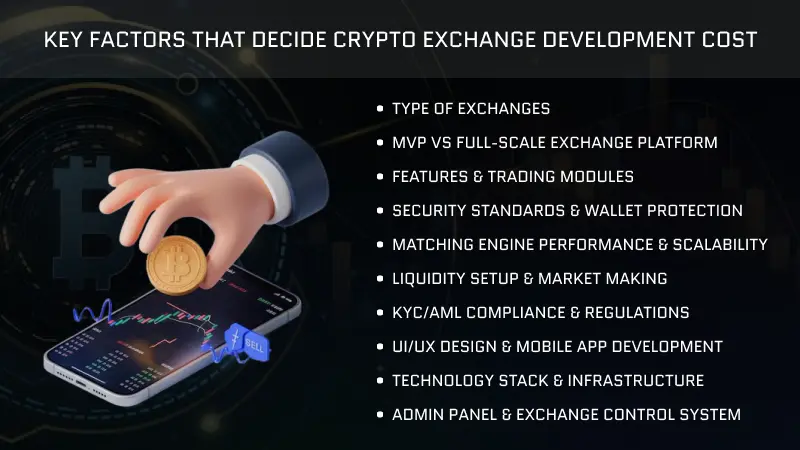
Before we jump into numbers, it’s important to understand that the cost of developing a crypto exchange platform is not fixed.
Two exchanges can look similar on the outside, but the technology, security, and scalability behind them can be completely different, and that’s where the price changes.
So, let’s look at the most important factors one by one!
Type of Exchange You Want to Build
The first and biggest cost-determining factor is the exchange model you want. If you wish to build a CEX or DEX, or P2P, this affects the overall cost.
- For example, a Centralized Exchange (CEX) works like Binance or Coinbase, where your platform manages user accounts, funds, order books, and withdrawals. It requires strong backend systems, wallet infrastructure, and a high-speed matching engine.
- On the other hand, a Decentralized Exchange (DEX) like Uniswap runs on smart contracts. Here, trades occur directly on the blockchain. This reduces the responsibility for custody but increases the complexity of smart contracts and requires audits.
- Similarly, P2P crypto exchanges require escrow workflows, dispute management, and payment method handling. Hybrid models combine multiple exchange types and thus require a larger budget.
Thus, the type of crypto exchange you choose directly affects the complexity and cost of your platform.
MVP vs Full-Scale Exchange Platform
Another one of the most important factors is whether you want to launch a basic version first or a complete product from day one.
- An MVP exchange usually includes essential modules such as sign-up/login, KYC, user wallet, deposits/withdrawals, spot trading, and an admin control panel. It is perfect for startups because it allows them to enter the market quickly and validate the business model.
- A full-scale exchange includes advanced modules such as futures, margin, copy trading, staking, launchpad, referral systems, analytics dashboards, and more.
The more complete your exchange is, the larger the team required, and the longer the development time.
Features & Trading Modules Included
In crypto exchange platforms, features are not just extra add-ons. Each module involves technical work and testing.
For example, spot trading is a must-have on most exchanges. But, if you add:
- Margin trading (borrowing + interest calculation)
- Futures trading (mark price, funding rate, liquidation engine)
- Options trading (complex pricing and expiry handling)
All this will increase the development effort. That’s why a simple spot exchange costs much less, while a futures exchange can cost 2 or 3 times as much, depending on the complexity.
Security Standards & Wallet Protection
Security is one of the most expensive parts of building a crypto exchange, but also the most important. Users trust exchanges only when security is strong. In 2026, a secure exchange is expected to have:
- 2FA authentication
- Withdrawal whitelist
- Anti-phishing security
- IP/device login detection
- Wallet locking & withdrawal limits
- Cold wallet & hot wallet system
- DDoS & brute force protection
Security isn’t just a development expense, but it is also a business survival requirement. Any loophole can result in huge losses and reputation damage.
Matching Engine Performance & Scalability
The matching engine is the core of any centralized crypto exchange platform. That’s because it manages:
- Placing orders
- Cancelling orders
- Matching buy/sell trades
- Updating order book
- Handling volatility & heavy traffic
If you want an exchange that supports a high number of orders per second with low latency, you need advanced architecture, proper queue handling, and performance optimization. And this would increase the cost significantly.
Liquidity Setup & Market Making
Most of the individuals ignore this, but liquidity is important. Even if you build the best exchange, users won’t trade if spreads are too high, order books look empty, and prices fluctuate heavily.
Thus, liquidity can be managed in crypto exchanges using:
- Market maker bots
- Liquidity provider integration
- Liquidity aggregation
- External exchange API integration
Adding liquidity not only increases development costs but also creates recurring operational costs, since market makers usually charge monthly fees.
KYC/AML Compliance & Regulations
Regulations in the crypto space are becoming stricter in 2026, and most regions require crypto exchanges to comply with regulatory requirements. This often includes:
- Identity verification
- AML checks
- Suspicious activity monitoring
- Geo restrictions
- User risk profiling
- Audit logs and reporting
Compliance requirements increase both development costs and third-party integration costs, but they play an important role in legal stability, partnerships, and support for a crypto payment gateway.
UI/UX Design & Mobile App Development
User expectations are very high now. People compare every platform to Binance, Bybit, and Coinbase. Your cost increases based on:
- Whether you want only web
- Or web + Android
- Or web + Android + iOS
- And whether you need a pro trading UI with charts, an order book, history, a portfolio, etc.
Better UI/UX improves overall conversions and retention, but advanced UI and apps add major time and cost.
Technology Stack & Infrastructure
Crypto exchange platforms require a stable, scalable architecture. The development cost depends on whether you use:
- Microservices or monolith structure
- Kafka/RabbitMQ for event-driven order management
- Redis caching for performance
- Scalable databases
- Cloud deployment with monitoring (AWS/GCP/Azure)
- CI/CD + DevOps
A scalable tech stack for a crypto exchange increases cost, but reduces system issues in production and helps you grow faster.
Admin Panel & Exchange Control System
A crypto exchange is not complete without a powerful admin panel. The admin panel handles:
- User control & verification
- Fee and commission settings
- Coin listing and pair management
- Manual/auto wallet operations
- Withdrawal monitoring
- Risk controls and reporting
- Referral and promotion management
A feature-rich admin panel increases cost, but it gives you complete control over exchange operations and business growth.
Estimated Cost to Develop a Cryptocurrency Exchange
Now comes the most-awaited part of the blog, that is, the actual cost.
If you are planning to launch a crypto exchange platform in 2026, the overall development cost can range from a basic MVP budget to an enterprise-grade investment.
We’ve divided the costs of crypto exchange development into three categories. Have a look!
| Exchange Type / Level | Best For | Estimated Cost (2026) |
|---|---|---|
| Basic MVP Crypto Exchange | Startups validating business ideas | $40,000 – $60,000 |
| Mid-Level Exchange Platform | Growing exchanges aiming for strong features | $61,000 – $80,000 |
| Enterprise-Grade Crypto Exchange | Large businesses targeting high volume, like Binance | $81,000+ |
Cost to Build a Basic MVP Crypto Exchange
An MVP crypto exchange is the preferred approach for new businesses because it allows you to enter the market quickly and start onboarding users without a huge upfront investment. A standard MVP typically includes:
- User registration/login
- 2FA security
- Basic KYC module
- Admin dashboard
- Wallet system
- Spot trading module
- Trade history and order management
- Basic reports & transaction logs
Estimated Cost: $40,000 – $60,000
Cost to Build a Mid-Level Crypto Exchange Platform
A mid-level exchange is perfect for founders who want stronger features and a better user experience, but still don’t want to spend like an enterprise exchange. This exchange level usually includes:
- Advanced admin controls
- Referral and commission system
- Multi-coin wallets
- Better UI/UX and performance
- Advanced security controls
- Liquidity provider integration
- Push notifications/email alerts
- Promotions, banners, and rewards module
Estimated Cost: $61,000 – $80,000
Cost to Build an Enterprise-Grade Crypto Exchange
Enterprise-grade exchanges are built for high traffic, massive liquidity, and advanced trading platforms, such as Binance, Bybit, or OKX. This includes everything from mid-level exchanges and:
- High-performance matching engine
- Futures/perpetual trading modules
- Liquidation engine
- Mark price and funding rate system
- Margin trading
- Advanced risk management
- Cold wallet/hot wallet automation
- Security audits + penetration testing
- Scalable microservices architecture
- Multiple server clusters + DevOps monitoring
Estimated Cost: $81,000+
Crypto Exchange Cost by Type
Many readers also want cost based on the exchange model, so here’s a simple comparison:
| Exchange Type | What it Includes | Estimated Cost |
|---|---|---|
| CEX Exchange (Spot) | Matching engine, crypto wallets, admin controls | $40,000 – $60,000 |
| CEX Futures Exchange | Spot + futures trading engine, liquidation system, funding rate mechanism | $61,000 – $80,000 |
| DEX Platform | Smart contracts, decentralized trading UI, security audits | $40,000 – $50,000 |
| P2P Exchange | Escrow system, dispute resolution module, payment workflows | $20,000 – $30,000 |
White Label vs Custom Crypto Exchange Development Cost
If you are planning to launch a crypto exchange in 2026, one of the biggest decisions you will make is: should you go for a white-label crypto exchange build a custom crypto exchange from scratch?
Both options are valid, but they suit different business goals, budgets, and timelines. Let’s understand its costs!
| Exchange Type | Cost Range |
|---|---|
| White Label Exchange | $15,000 – $30,000 |
| Custom Exchange (Spot) | $40,000 – $60,000 |
| Custom Exchange (Spot + Futures) | $61,000 – $80,000 |
Hidden Costs of Launching a Crypto Exchange in 2026
In 2026, crypto exchange businesses will be much more competitive and regulated. So, apart from development, there are several hidden costs that most people ignore, and later they face budget pressure or a delayed launch.
Here are some hidden costs you should know before launching:
Liquidity & Market Making
Liquidity is the core of any crypto exchange platform. Even if your exchange is technically perfect, users won’t trade if the order book looks empty, spreads are high, and trades don’t fill quickly.
That’s why exchanges need liquidity providers, market makers, or liquidity aggregation setups. This is not a one-time expense. Liquidity often becomes a recurring monthly cost that depends on your volume targets and the number of trading pairs.
Security Audits & Penetration Testing
Security is non-negotiable in the crypto space. Beyond basic features like 2FA and withdrawal OTP, you need professional security testing to identify vulnerabilities in your platform. This includes penetration testing, API security checks, and infrastructure audits.
If you are building a DEX, smart contract audits add additional cost. Spending on audits helps prevent hacks, which can otherwise destroy your exchange’s reputation overnight.
Compliance, Legal & KYC Costs
In 2026, regulations are stricter, and exchanges need to comply properly to operate smoothly. This includes legal documentation, AML workflows, and KYC verification tools.
Many KYC providers charge per verification, which means this cost increases automatically as your user base grows. Compliance may also be required to access banking support and build trust with institutional users.
Infrastructure, Hosting & DevOps Scaling
An exchange runs 24/7, so server stability becomes a major operational expense. Apart from hosting, you will need database optimization, monitoring systems, backups, DDoS protection, and auto-scaling infrastructure.
These are recurring costs, and as your user traffic grows, your infrastructure costs will increase as well. Many platforms struggle not because of poor development but because of weak infrastructure planning.
Marketing, Support & Post-Launch Maintenance
Launching the exchange is not enough. That’s because you need users and trading volume. That means investing in marketing such as SEO, influencer promotions, referral programs, partnerships, and community building.
Additionally, customer support is essential for handling login issues, KYC queries, and withdrawal concerns. Post-launch maintenance is also a continuous cost that every exchange must plan for.
How to Reduce Crypto Exchange Development Cost?
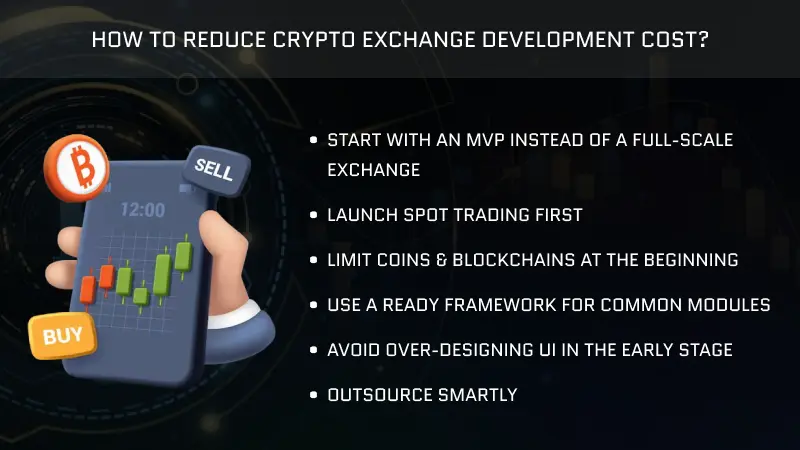
But do you know what the good news is? You don’t need to spend enterprise-level money from day one. You can reduce costs by building the exchange in a planned way.
Here are some strategies that can help you reduce overall costs without compromising quality:
Start with an MVP instead of a Full-Scale Exchange
One of the biggest mistakes entrepreneurs today make is to build “Binance-level features” in the first version. That is an impractical approach. You need to start with a strong MVP that focuses on only the essentials, such as:
- Secure login + 2FA
- KYC (basic)
- Wallet system (deposit/withdraw)
- Spot trading
- Admin panel
Once the MVP starts attracting users and trading volume, you can scale step by step into margin, futures, staking, and advanced analytics. This can reduce cost, speed up launch, and help you validate the business before scaling.
Launch Spot Trading First
Futures and margin trading are expensive modules because they require:
- Mark price system
- Funding rate logic
- Liquidation engine
- Complex risk management
Thus, if your goal is to launch quickly, you need to start with a spot exchange first. Spot trading is easier to build, test, and safer to operate in the early stages. You can introduce futures later as a premium upgrade once your user base grows.
Limit Coins & Blockchains at the Beginning
More coins in the exchange mean greater integration, more complex crypto wallets, and higher maintenance costs. Most of the exchanges launch with just a few popular blockchains, such as:
- Bitcoin (BTC)
- Ethereum (ERC20)
- BSC (BEP20)
- TRON (TRC20)
By starting with fewer chains, you reduce initial cost and avoid operational overload.
Use a Ready Framework for Common Modules
This is a smart cost-saving method used by many exchanges. You can use prebuilt or reusable frameworks for modules such as user management, KYC flows, notifications, admin CMS pages, and reporting dashboards.
But the important part is to keep the core exchange components strong, such as wallet security, trade ledger, order management, and matching engine performance. This reduces development time without compromising the exchange’s reliability.
Avoid Over-Designing UI in the Early Stage
A polished UI is important, but most startups waste too much budget on designing everything like a premium exchange from day one. Instead, you must build a clean and simple UI, focus on a smooth trading experience, and prioritize speed, responsiveness, and clarity.
Once your platform grows, you can upgrade UI/UX with better charts, themes, and advanced screens. This will save costs and help build user trust.
Outsource Smartly
If you want cost efficiency, it is important to choose a development partner with real experience in the field. One such company that you can go ahead with is Technoloader.
By any chance, if you choose the wrong approach, it will result in:
- Weak security architecture
- Unstable wallet system
- Buggy order matching
- Downtime issues
The Bottom Line
That brings us to the end of this blog!
So, if you have been wondering “How much does it cost to develop a crypto exchange in 2026?”, now you know the real answer: it depends on what you want to build.
A basic MVP exchange can be launched with a controlled budget, but if your goal is to build a high-performance platform with advanced modules, the cost increases. The best part is: you can start small, launch fast, validate the market, and then scale step-by-step based on user demand and business growth.
So, make a decision and reach out to us so that you can build a secure and scalable crypto exchange platform that fits your exact vision and budget!
FAQs
What is the minimum cost to launch a crypto exchange MVP?
A basic MVP crypto exchange with essential features such as wallets, spot trading, an admin panel, and security can be developed for around $40,000 to $60,000.
Why does crypto exchange development cost vary?
Crypto exchange cost varies because every project has different requirements, such as:
Type of exchange (CEX vs DEX vs P2P)
Trading modules (spot/margin/futures)
Number of coins/blockchains
Matching engine performance
Security layers and compliance needs
How much time does it take to develop a crypto exchange?
The timeline depends on project scope:
MVP spot exchange: 2 to 4 months
Mid-level exchange: 4 to 6 months
Enterprise exchange (spot + futures): 6 to 12+ months
How important is liquidity for a new exchange?
Liquidity is extremely important. Without liquidity, users will not trade, prices will be unstable, and spreads will be high. New exchanges often integrate liquidity providers or market makers to create an active order book from day one.
Who should I hire to build a crypto exchange?
You should work with a team that has real experience in developing crypto exchanges. They should also have wallet and blockchain integration expertise, prioritize security, and have matching engine knowledge. In that case, Technoloader stands out as the best firm.
Is white label crypto exchange development a good option?
Yes, white label exchanges are a good option if you want:
Quick launch
Lower upfront cost
Basic spot trading features

Deepa Manwani
Deepa Manwani is a Technical Content Writer at Technoloader with over 7 years of experience creating high-quality content across Blockchain, Web3, AI, and fintech. She specializes in translating complex technical concepts into clear, engaging, and informative content that helps businesses, developers, and users better understand emerging technologies. Her expertise includes writing technical blogs, technical documentation, whitepapers, platform guides, and in-depth content for crypto exchanges, DeFi platforms, trading systems, and enterprise software solutions. At Technoloader, she contributes to developing strategic content that supports product growth, strengthens brand credibility, and educates users about next-generation technologies shaping the future.
Published in Cryptocurrency Exchange


