 +91 7014607737
 info@technoloader.com





Table of Contents
Key Takeaways:
- Creating an NFT doesn’t have a fixed cost; it can be completely free or exceed $300+, it completely depends on your blockchain, platform, and minting approach.
- Gas fees are the highest and most unexpected cost, especially on Ethereum, where costs increase significantly during high network activity.
- Picking up the right blockchain is an important decision, as it directly decides whether you spend a few cents or hundreds of dollars.
- Lazy minting is the easiest way to start, allowing you to create NFTs with zero upfront cost while shifting minting fees to the buyer.
- Marketplace fees are relatively small and only apply after a successful sale, making them less risky compared to upfront minting costs.
- A lot of creators don’t think about hidden costs like funding a wallet, storing things, and deploying a smart contract, which can make the budget go up without warning.
- The best way to go about it is to start small, use a cheap blockchain to test it out, learn how it works, and only put more money into it when you know your NFT is worth it.
Introduction
In 2026, if you’re planning to create a non-fungible token, then this guide is for you!
Before that, do you know what NFTs are and how they work? In simple terms, NFTs are unique digital ownership certificates that are stored on a blockchain, proving who owns a specific item.
But once you understand the concept, the next big question is – how much does it actually cost to create an NFT? And to find it out, you start researching, and suddenly you find expenses like gas fees, minting costs, blockchain networks, and marketplace commissions.
So, if you also get confused with it, here is your honest answer! Creating an NFT in 2026 will cost anywhere from $0 to $300+. That’s a big range, but the prices completely vary based on three simple choices:
- The blockchain you use
- The platform you sell on
- When you decide to create your NFT
That’s it, once you’re clear with these things, the whole cost picture becomes clear. So, without waiting for more, let’s scroll through this guide and know exactly what your NFT will cost.
What is NFT Minting?
When you create an NFT, it’s called minting.
Understand it in this way – when a government makes a physical coin, they mint it. They stamp it, record it, and make it officially real. Creating an NFT works in the same way, just digitally.
When you mint an NFT, you’re taking your digital file, like your artwork, music, or video and officially registering it on a blockchain. The blockchain is typically a permanent, public record book that no one can tamper with. Once your file is on it, there’s a permanent record that says: this exists, you created it, and you own it.
That record is your NFT. Now, you might be wondering, why does it actually cost then?
So, adding anything to a blockchain needs computers around the world to process and verify that transaction. Those computers are run by real people, and those people get paid a small fee every time they process a transaction. That fee is what you pay when you mint.
This fee is called a gas fee, and it is the main cost you will encounter.
Meanwhile, the amount you pay as a fee depends on how busy the network is at that moment. Think of it like ride-sharing prices, during rush hour, prices go up, and on light traffic, prices drop. Blockchain networks work the same way.
Let’s understand this in a more detailed way.
The 3 Main Costs – What You Actually Pay
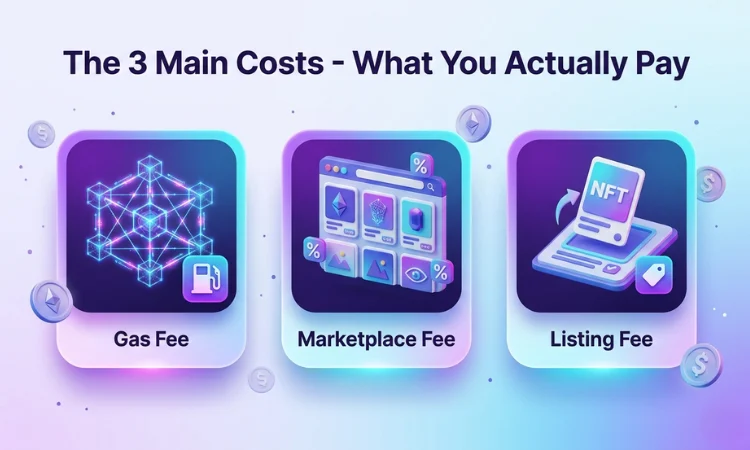
When you create and sell an NFT, there are three main types of costs you might run into. Not everyone pays all three; it depends on your choices, but you need to know all of them so nothing catches you off guard.
Let’s go through each one.
Gas Fee
This is the big one. A gas fee is the payment you make to the blockchain for processing your transaction. Every time something takes place on a blockchain, such as minting an NFT, transferring ownership, or making a sale, the network charges a small fee.
Think of it like a processing fee at a bank. You’re not paying the marketplace; instead, you are paying the network itself.
Therefore, gas fees are also the most unpredictable cost because they fluctuate based on how busy the network is. This is the fee most people are surprised by; always check it before you mint.
Marketplace Fee
Once your NFT is created, you’ll list it for sale on a marketplace, a platform like OpenSea, Rarible, or Magic Eden. When it sells, the marketplace takes a small portion of that sale as its cut.
This is called a marketplace fee or service fee, and it typically ranges from 1% to 2.5% of your selling price. So, if you sell an NFT for $100 and the platform charges 2.5%, then you’ll keep $97.50, and the platform takes $2.50. That’s all.
Here, the most important thing you need to note is that you usually don’t have to pay this fee upfront; you only pay it when your NFT actually sells. If it never sells, this cost is zero.
Listing Fee
Some NFT platforms charge a fee just to put your NFT up for sale, even before anyone buys it. This is called a listing fee.
However, not every platform charges this; many popular ones don’t. But some do, so it’s worth checking before you list.
On Ethereum-based platforms, this listing fee is usually paid in gas, which means it’s another blockchain transaction that costs you money. On other blockchains like Polygon and Solana, listing is usually free.
Cost By Blockchain – Which One Should You Use?
In the previous section, we discussed the gas fee. Well, that fee completely depends on which blockchain you choose. This is the main thing, the same thing for which you’re paying $100 on one blockchain versus literally $0.01 on another. So this is a decision worth getting right.
Here are some of the most used blockchains for NFTs today:
Ethereum
This is the original NFT blockchain with the most famous NFT collections in history, including the Bored Ape Yacht Club, CryptoPunks, and others. It has the largest community of collectors, the highest trading volumes, and the strongest reputation in the NFT world.
But this all comes at a cost. Minting a single NFT on Ethereum can cost you anywhere from $15 to $300+. If you’re confident in your work, then Ethereum makes sense and justifies the upfront cost.
Solana
Solana is the blockchain where a large number of NFT creators have moved in recent years. And the primary reason behind it is simple: it is fast, it works well, and minting an NFT costs around $0.01.
You can simply mint an entire collection of 100 NFTs on Solana for less than $2. For beginners, artists who want to experiment, or anyone creating large collections, for them Solana is one of the best options at this time.
Polygon

Built on top of Ethereum, Polygon is compatible with all the major Ethereum marketplaces, including OpenSea, which is one of the biggest NFT platforms in the world. But because Polygon is a separate layer on top of Ethereum, its fees are dramatically lower.
Minting on Polygon typically costs less than $1, and on many platforms, you can mint for completely free using something called lazy minting. For most of the beginners, Polygon is the most practical place to start. Low cost, easy access, and you’re still on a platform with millions of potential buyers.
Got confused? Here’s how you can pick your ideal blockchain
- Just starting out and want to keep costs low, go with Polygon or Solana.
- Creating high-value, premium art for serious collectors, Ethereum is worth the investment.
| Blockchain | Avg. Mint Cost | Best For |
| Ethereum | $15 – $200 | High-value art, serious collectors |
| Solana | $0.01 | Beginners, large collections |
| Polygon | Under $1 | Beginners, free minting |
Note: Costs may vary depending on network demand and market conditions.
Cost by Marketplace – Where You Sell Matters Too
Choosing a blockchain decides your gas fee. But choosing a marketplace decides the commission you pay on a sale, whether listing is free, and what kind of audience sees your work.
The good thing is that most of the marketplaces are free to join and list. You only pay when something sells, but the % they take and the extra fees they charge vary quite a bit from platform to platform.
OpenSea

It is one of the best NFT marketplaces in the world. If you’re new to NFTs, this is most likely to be the first platform you’ve heard about. It supports multiple networks, has millions of active users, and is relatively easy to use for beginners.
When your NFT sells, OpenSea takes 2.5% of the sale price; that’s it. No monthly charges, no subscription, no hidden charges.
Rarible

Rarible is another popular marketplace that supports multiple blockchains. It offers a feature called lazy minting, which means you can create your NFT for free, and the buyer pays the gas fee when they purchase it.
When your NFT sells on Rarible, the platform takes 1% to 2.5%, depending on settings. It’s a good option if you want lower fees and don’t mind a slightly smaller audience.
Magic Eden
Magic Eden is the go-to marketplace for Solana NFTs. If you decide to mint on Solana, this is where most of the buying and selling happens. It’s clean, fast, and built specifically for the Solana community.
Fees on Magic Eden are low, around 2% on sales, and the platform has expanded to support other networks too, so it’s growing beyond just Solana.
Quick Comparison:
| Marketplace | Best For | Sale Fee | Minting Cost |
| OpenSea | Beginners, a wide audience | 2.5% | Free on Polygon |
| Rarible | Low fees, lazy minting | 1.5% | Free with lazy mint |
| Magic Eden | Solana creators | 2% | Very low |
Can You Create an NFT for Free?
Yes, you can. But there’s a catch. And understanding it will save you from an awful surprise later.
Normally, when you mint an NFT, you pay the gas fee upfront. And the moment you hit “create,” the blockchain processes your transaction and charges you immediately.
But lazy minting flips that around.
With lazy minting, your NFT isn’t actually put on the blockchain when you create it. Instead, it sits off-chain, basically in a waiting room. The moment someone buys it, that’s when it gets minted. And here is the best part: the buyer pays the gas fee, not you.
So, being a creator, you pay nothing. Your NFT gets listed, people can browse it and buy it, and the minting cost is only triggered when a sale happens. That’s why it’s called lazy minting; the actual minting gets delayed until the last possible moment.
Where can you use lazy minting?
Two of the biggest platforms offer lazy minting:
- OpenSea: It lets you mint for free on Polygon using lazy minting. On this platform, you can create and list your NFT without paying a single cent. It’s the most popular option available and truly a great place for beginners to start.
- Rarible: This platform also offers free minting through the same concept. Your NFT stays off-chain until it sells, and the buyer covers the gas cost when they purchase.
So what’s the catch?
- You don’t get your own contract – your NFT is listed under the platform’s shared contract, not your personal brand identity.
- The buyer pays the gas fee – making your NFT more expensive, especially on Ethereum. Which may even impact buying decisions.
Is lazy minting right for you?
It can be the right choice for you if:
- You’re creating your first NFT and just want to test the process without spending a huge amount.
- You’re building a serious collection and want your own branded smart contract, or are targeting high-end collectors.
Hidden Costs Most People Forget
Other than the three main costs, there are a few extra expenses that quietly show up and catch creators off guard. This includes:
- A Funded Crypto Wallet: Setting up a wallet like MetaMask or Phantom is free of cost. But you need cryptocurrency already loaded into it before you can mint anything. On Polygon or Solana, this is just a few dollars. On Ethereum, you’ll need noticeably more to cover gas fees.
- Account Initialization Fee: On Ethereum, the very first time you list an NFT for sale, some platforms charge a one-time setup fee. It can cost $10 to $30 and only happens once. But it surprises a lot of first-time creators who weren’t expecting it. On Polygon and Solana, this doesn’t apply.
- File Storage: Your NFT lives on the blockchain, but your actual file gets stored separately. Most platforms handle this automatically for free, but some charge a small fee of $1 to $5 to store your file permanently. It’s worth checking before you sign up.
- Custom Smart Contract: If you want your own branded collection with your own rules and royalties, you will need a custom smart contract. On Ethereum, this can cost $50 to $500 in gas fees. On Solana and Polygon, it’s much cheaper. If you’re just creating one or two NFTs, you don’t need this at all; the platform will handle everything for you.
- Creating the Artwork: If you’re making the NFT yourself, this costs nothing but time. If you’re hiring someone, prices range from a few hundred dollars for a freelancer to several thousand for a large collection. Don’t forget to factor this in.
- Tax: Money earned from NFT sales is taxable in most countries. Keep records of every fee you pay; they may be deductible. When in doubt, choose to speak to an accountant who has a deep understanding of crypto.
Real Examples – What Will Your NFT Actually Cost?
Let’s look at what real creators in different situations actually spend. Find out the scenario that perfectly matches you, and you can use it as your starting budget.
Scenario A – The Complete Beginner
You’ve made one piece of digital art and want to try selling it as an NFT without spending any money.
- Platform – OpenSea
- Blockchain – Polygon
- Method – Lazy Minting
- Upfront Cost: $0
- Fee When It Sells: 2.5% of your sale price
This is the most accessible starting point for anyone. Zero risk, zero upfront investment. Perfect for testing the waters.
Scenario B – The Serious Digital Artist
You’ve built an audience, your work has real value, and you want to mint properly on Ethereum, where the serious collectors are.
- Platform – OpenSea
- Blockchain – Ethereum
- Method – Paid Minting
- Upfront Cost – $50 to $150
- Include – Gas Fee + One-time Account Setup + IPFS Storage
Higher upfront cost, but access to the largest collector base in the NFT world.
Scenario C – The 10,000-Piece Collection
You’re launching a full generative collection that includes thousands of unique NFTs with different traits combined algorithmically.
- Platform – Custom Website + OpenSea
- Blockchain – Ethereum
- Method – Custom Smart Contract
- Upfront Cost – $500 – $2,000+
- Includes – Smart Contract Deployment + Artwork Creation + Developer Costs
This is a serious business investment, so it’s important to plan your budget carefully before starting.
Simple Ways to Lower Your Costs
For creating a great NFT, you don’t need to spend a lot; simply follow the practical ways to keep your costs as low as possible.
- Start with Polygon or Solana: If you’re new, don’t directly start on Ethereum. Polygon and Solana give you the full NFT experience at a fraction of the cost. Get comfortable with the process first, then move to Ethereum if and when it makes sense for your work.
- Use Lazy Minting: If your platform offers lazy minting, use it. You pay nothing in advance, your NFT gets listed immediately, and you only incur costs when someone actually buys. It’s the smartest way to start with zero financial risk.
- Time Your Ethereum Mints: If you’re minting on Ethereum, timing matters the most. Gas fees are lower during off-peak hours, typically late at night or early morning UTC, and on weekends. Before you mint, check a gas tracker like Etherscan Gas Tracker and wait for a low-fee window. It can save you 20% to 50% on your gas costs. \
- Use a Standard Contract: Don’t pay for a custom smart contract unless you really need one. Standard contracts like ERC-721 on Ethereum are generally free to use on platforms like OpenSea and work very well for most creators. Save the custom contract for when your collection grows.
- Try Layer 2 Networks: Layer 2 networks like Arbitrum and zkSync sit on top of Ethereum and process transactions at a fraction of the cost, up to 90% cheaper than the Ethereum mainnet. While still connecting to the same ecosystem. If you want Ethereum-level credibility without Ethereum-level fees, Layer 2 is worth exploring.
- Mint One First: Before committing to a full collection, mint a single NFT first. It costs almost nothing on Solana or Polygon, and it teaches you everything you need to know about the process, wallets, platforms, fees, and listing, well before you invest real money into a larger project.
Conclusion
So, here comes the end of this comprehensive guide.
Throughout the blog, we’ve shared a complete picture of what it actually costs to create an NFT. In short, it can cost you nothing, or it can cost you hundreds of dollars. The difference is simple: the choice you make.
Start on a low-cost blockchain, use lazy minting, and pick the right marketplace so that your overall cost stays nearly zero. Don’t overthink it, pick up the right platform, create your first NFT, and learn by doing.
In addition to this, if you’re looking for expert support, you can also explore Technoloader. We are a leading NFT development company offering end-to-end NFT marketplace solutions that are secure, scalable, and easy to use.
It’s your turn to take the first step and bring your NFT idea to life.
Frequently Asked Questions
How much does it cost to create an NFT in 2026?
Creating an NFT in 2026 can cost you anywhere between $0 to $300 or more. The complete cost varies depending on factors like the blockchain you choose, the marketplace fees, and whether you use paid minting or lazy minting.
Can I create an NFT for Free?
Yes, you can create an NFT for free by using lazy minting. Using this method, your NFT is not minted on the network until someone buys it. This means you don’t pay any upfront gas fees, as the buyer themselves covers all the minting cost at the purchase.
What are gas fees in NFTs?
Gas fees are transaction charges that are paid to the blockchain network for processing and verifying actions like minting, buying, or transferring NFTs. These fees are not fixed and change as per the network congestion, making them the most unpredictable cost when creating or selling NFTs.
Which blockchain is cheapest for creating NFTs?
Solana and Polygon are the cheapest blockchains for creating NFTs. Solana offers quite low fees, around $0.01 per mint, while Polygon can offer free minting through lazy minting, making both of them ideal choices for beginners or low-budget creators.
Why does creating an NFT sometimes cost so much?
Creating an NFT can become expensive due to high gas fees on networks like Ethereum. Costs also increase with network congestion, smart contract deployment, and additional expenses like artwork creation or platform-related charges, especially when targeting high-value NFT markets.
What is lazy minting, and should I use it?
Lazy minting is a process in which your NFT is created, but it is not recorded on the network until it is purchased. It is a good option for beginners as it removes upfront costs. However, it shifts gas fees to buyers, which can sometimes impact their purchasing decisions.
Are there any hidden costs when creating an NFT?
Yes. There are several hidden costs to consider, like funding your crypto wallet, one-time account setup fees, file storage charges, and custom smart contract deployment. These costs are often missed but can be added, especially for first-time NFT creators.

Kanak Badaya
Kanak Badaya is a Technical Content Writer at Technoloader with over 3 years of experience translating complex technology into content that actually makes sense. He works closely with emerging domains like Blockchain, Web3, AI, and DeFi, turning intricate technical concepts into clear, structured, and engaging narratives that help businesses communicate with confidence. Rather than just writing for search engines, Kanak focuses on writing for people. He combines in-depth research with a practical understanding of the industry to create blogs, website content, and technical guides that inform, educate, and build credibility. His goal is simple - make advanced technology feel approachable while helping Technoloader strengthen its authority in the digital space.
Published in NFT Development Services


