 +91 7014607737
 info@technoloader.com






Table of Contents
Key Takeaways:
- MLM software is essential for managing network marketing operations like distributor networks, commission calculations, sales tracking, and payment processing. Developing a well-optimized system helps businesses maintain transparency and efficiency.
- An overly complicated commission structure can create confusion and technical errors. Always consider keeping your compensation plans simple and transparent, helping distributors understand their earnings and reducing system calculation issues.
- Scalability is essential for long-term MLM business growth. The software must be capable of handling increasing numbers of distributors, transactions, and data without affecting performance.
- A user-friendly interface improves distributor engagement. When participants can easily track their sales, team performance, and earnings, they remain more active and motivated within the network.
- Strong data security and compliance features help protect MLM platforms from fraud, data breaches, and legal risks while ensuring safe management of distributor and financial information.
Introduction
The success of an MLM business does not depend only on its products or marketing strategy, but also on the strength of its software system.
In 2026, developing multi-level marketing software is not at all easy; there are a number of important things you need to keep in consideration. Before that, were you aware of the role of MLM software?
Using MLM software, businesses can manage their distributor networks, calculate commissions, track sales, and ensure smooth communication across the entire organization. When software is well-designed, businesses are able to operate productively and can easily scale their network without any complications.
However, generally every company wants its project to be built within a short time, and they rush into development without ever creating proper planning or understanding of the technical and operational requirements. This often leads to common mistakes and creates a range of problems, such as system inefficiencies, inaccurate commission calculations, poor distributor experience, and scalability issues.
To build a reliable and future-ready MLM platform, businesses need to be aware of these problems early. In this blog, we will talk about everything related to common mistakes in MLM software development and how to avoid them.
8 Common Mistakes in MLM Software Development and How to Avoid Them in 2026
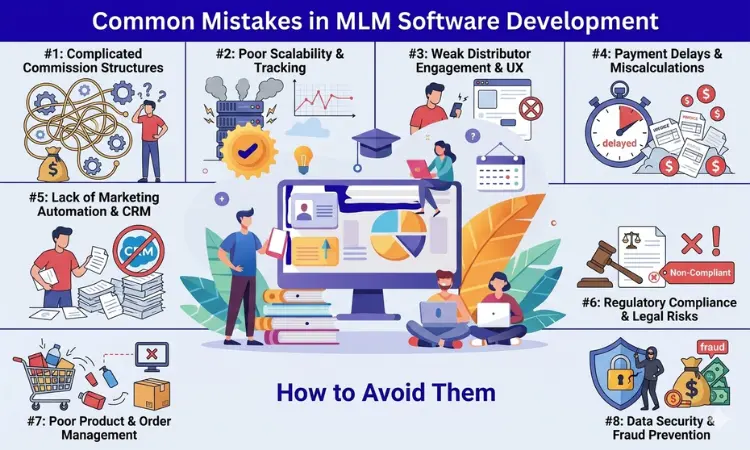
Mistake #1: Complicated Commission Structures
One of the most common mistakes businesses make is creating a commission structure that is too complicated. To attract users, many MLM projects try to include different bonus types, conditions, and payout levels that make compensation plans look more rewarding.
However, instead of being user-friendly, when too many rules are added, the system becomes difficult to manage. Here, a complex structure creates too much confusion for distributors who may also struggle to understand how their commissions are calculated. At the same time, the software also needs to process numerous calculations, which often increases the chances of technical errors.
In addition to this, another challenge is that complex commission plans are more challenging to maintain. When any business needs to make changes to the compensation model, developers have to make changes to several interconnected rules, introducing new problems into the system.
How To Avoid It
To solve these issues, businesses should consider designing a proper compensation structure that is simple, transparent, and easy to set up. From the start, you should be clear about your MLM plan type, such as Binary, Matrix, or Unilevel, before development begins.
By using an automated commission calculation method and testing different payout scenarios, you can make sure that the program is processing the proper incentives and works effectively for everyone.
Mistake #2: Poor System Scalability and Network Performance Tracking
Another mistake in making MLM software is not planning for the future while designing the system. MLM businesses generally start with small numbers, but as the network grows, the platform must be capable enough to handle thousands of users, transactions, and data records. If the software is built without considering scalability, performance problems can appear quickly.
A system with limited resources may experience slow loading times, delayed payment processing, or difficulty generating accurate reports. These issues can create problems for managers to observe network performance and understand how the distributor structure is growing. When failing to monitor team performance accurately, sales data and team performance are not tracked properly, and decision-making becomes less effective.
How To Avoid It
To solve these issues, develop your MLM software using a scalable architecture that can support continuous growth. For this, use a cloud-based infrastructure that will help your business to increase the system capacity as the distributor network expands.
It’s also important to have a system that can detect downline performance, sales activity, and commission flow in real time. Using optimized databases and doing regular performance tests can help keep the platform running smoothly as the MLM network grows.
Mistake #3: Weak Distributor Engagement and User Experience
Ignoring the overall experience of those participants who engage daily is another common mistake. Many systems only focus on their technical functions, like commission calculations and network structure, while keeping aside how easy and engaging the platform is for users.
When the user finds the interface difficult to navigate or important information hard to find, then they may struggle to track their progress, sales, or team performance. This can result in reduced motivation and make the platform feel less welcoming. Over time, a poor user experience can also result in lower activity levels and increased dropout rates.
Also, another issue that can occur is when distributors don’t receive updates on time, proper resources for training, or their performance insights. Without these features, they may feel disconnected from the businesses and doubtful about how they can improve their results.
How To Avoid It
You can solve this problem by designing your MLM software with a user-friendly interface where users can access performance easily. Building interactive dashboards can further help distributors view their earnings, team growth, and sales performance.
Other than this, including training materials, achievement rewards, and regular notifications can also encourage consistent participation. When the platform supports clear communication and provides useful insights, distributors are more likely to stay active and contribute to the growth of the network.
Mistake #4: Payment Delays and Commission Miscalculations
Another important part of an MLM system is how payments are handled. A single mistake in MLM software can fail to set up a reliable tool for calculating and distributing commissions. If the payout system isn’t set up in the right way, it can take longer or give the wrong amount of commissions.
These issues commonly occur due to weak automation, incomplete testing, or poorly integrated payment systems. When distributors find that their earnings are incorrect or payments are taking longer than usual, it can directly affect their confidence in the platform.
In addition to this, wrong calculations can also create accounting difficulties. Solving these errors afterwards may require manual adjustments, which can consume time and raise the risk of further failures.
How To Avoid It
To handle this, MLM software requires a good automated commission engine that can calculate the right amount on its own. Proper testing of the commission logic is also vital to ensure the system performs well in all situations.
Businesses should also think about using secure and reliable payment sources that can handle all the transactions quickly. Giving participants their real-time earning overview can also help them maintain transparency and make it easy to see and follow all payouts.
Mistake #5: Lack of Marketing Automation and CRM Integration
Another common mistake while making MLM software is not using the right tools for marketing and managing leads on the platform. Many MLM companies depend on finding new distributors and keeping relationships with possible leads. But when the software doesn’t have tools for handling leads or tracking referrals, it can be hard to plan recruitment activities effectively.
Without proper marketing automation, distributors often have to manage their prospects personally. This can result in missing opportunities, poor follow-ups, and unclear information. Additionally, when referral links or recruitment sources are not properly tracked, businesses may struggle to understand which are actually helping the network grow.
Therefore, the lack of CRM integration can also make it harder for companies to monitor distributor interactions and maintain long-term relationships with their network members.
How To Avoid It
To handle this, MLM software should have marketing automation tools that help distributors in managing leads more effectively. Referral tracking systems keep track of all new sign-ups and share useful information about how well your recruitment is going.
Setting up the platform with CRM solutions will help you in arranging customer and distributor information together. And when businesses combine lead monitoring, automated follow-ups, and clear recruitment data, it becomes easier to expand their network and keep strong connections.
Mistake #6: Regulatory Compliance and Legal Risks
Another common mistake in MLM software development is avoiding legal and regulatory requirements. Multi-level marketing commonly operates in different regions, and each region has its own rules for financial transactions, taxation, and distributor activities. So, if you develop the software without considering these legal regulations, then the platform may have to face some serious legal issues.
For example, to manage financial misuse, some countries may require identity verification, transaction monitoring, or proper record-keeping. When any of these features are missing, the system might have to face failure, which can often lead to penalties, operational restrictions, or sometimes even the suspension of the business platform.
Additionally, another concern is data protection; MLM systems store personal and financial information of distributors, and if this system is not optimized the way it has to be, then it can create privacy risks and legal issues.
How To Avoid It
To overcome compliance-related issues, MLM software should have built-in verification and monitoring features. Using this, people can verify their user authenticity and maintain transparent records.
The platform should also hold clear transaction histories and reporting tools that support regulatory requirements. Also, regularly updating the software and consulting with legal professionals can ensure the system continues to meet changing laws and industry guidelines.
Mistake #7: Poor Product and Order Management Integration
In certain MLM projects, distributors promote and sell their products directly through their networks. When the software system does not include proper product and order management features, it becomes tough to follow sales and manage transactions efficiently.
Without a well-organized system, distributors may also face difficulty in checking order status, confirming purchases, or monitoring their product sales. This lack of visibility can create big confusion, and customers may also experience delivery issues.
Other than this, when the commission plan doesn’t immediately connect to product sales, it also creates a major problem, which can even lead to commission errors and hurt distributor trust and overall business transparency.
How To Avoid It
MLM software should integrate an order management system that keeps records of every single transaction. Distributors should also be able to track their orders, review their sales history, and monitor product availability using a simple dashboard.
In the same way, connecting the product management system with the commission engine can also ensure that payouts are calculated based on confirmed sales. Real-time sales insight and automated tracking can help businesses maintain a smooth workflow and improve the overall experience for distributors and customers.
Mistake #8: Data Security and Fraud Prevention
MLM software has to handle a large amount of information, such as distributor details, financial transactions, commission records, etc. When any MLM platform’s security measures are not implemented properly, then the system becomes open to unauthorized access, data breaches, and fraudulent activities.
Weak protection in MLM software allows hackers to manage accounts, access personal information, or use payment processes. These activities not only lead to financial losses but also affect the business’s reputation.
Once a user starts losing trust in the platform’s security, it becomes very difficult to maintain distributor faith and long-term engagement.
How To Avoid It
You can easily avoid it by including strong data protection mechanisms in your MLM software. Encryption will help in protecting sensitive information during storage and transmission, while two-factor authentication adds an additional layer of account security.
To detect these unusual activities, the platform must monitor transactions and user activities. Regular security audits and system updates help identify possible vulnerabilities and ensure that the platform remains safe as the business grows. Meanwhile, following strict access controls and secure payment processing strengthens the overall system protection.
Conclusion
Developing a trustworthy multi-level marketing software needs careful planning, strong technical implementation, and a clear understanding of how network marketing systems operate. And when important aspects like commission structures, scalability, security, and distributor engagement are not properly addressed, then the platform may face operational difficulties, which can often affect business growth.
So, to help you out and ensure your platform works excellently without facing any complications, partnering with Technoloader can solve all of your issues. With years of experience, we specialize in building reliable, scalable, and feature-rich MLM software that is perfectly tailored to your business needs.
As a leading MLM software development company, we make sure that your MLM platform is capable enough to handle growing distributor networks and perform effortlessly while maintaining transparency and achieving long-term success.
Frequently Asked Questions
Why do many MLM software projects fail during development?
Many MLM software projects fail because businesses rush directly into development without making any proper planning. When technical requirements, compensation plans, and scalability needs are not clearly defined from the start, it may run into problems with operations, performance, and managing distributor networks.
How do commission calculation mistakes affect MLM platforms?
If commissions are calculated incorrectly, it can cause big trust problems between distributors. When payouts are delayed or calculated incorrectly, distributors might lose faith in the system. This can lead to disputes, fewer participants, and even distributors leaving the network.
What features should a good MLM software include?
A good MLM software should have commission management, distributor dashboards, real-time reporting, secure payment integration, CRM tools, and marketing automation features. Beyond this, it should also support different compensation plans and provide strong security to protect financial and user data.
How can businesses avoid mistakes in MLM software development?
Businesses can avoid mistakes by simply planning out their pay structure, building scalable systems, putting user experience first, ensuring secure payment processing, and following legal regulations. You can also avoid this by ensuring your system works reliably by connecting with an experienced MLM software development company.
What happens if MLM software ignores security and compliance?
Ignoring security and legal compliance can expose MLM platforms to fraud, data breaches, and regulatory penalties. Since MLM systems handle financial and personal information, strong data protection, verification systems, and compliance features are a must.

Kanak Badaya
Kanak Badaya is a Technical Content Writer at Technoloader with over 3 years of experience translating complex technology into content that actually makes sense. He works closely with emerging domains like Blockchain, Web3, AI, and DeFi, turning intricate technical concepts into clear, structured, and engaging narratives that help businesses communicate with confidence. Rather than just writing for search engines, Kanak focuses on writing for people. He combines in-depth research with a practical understanding of the industry to create blogs, website content, and technical guides that inform, educate, and build credibility. His goal is simple - make advanced technology feel approachable while helping Technoloader strengthen its authority in the digital space.
Published in MLM Software Development


