 +91 7014607737
 info@technoloader.com





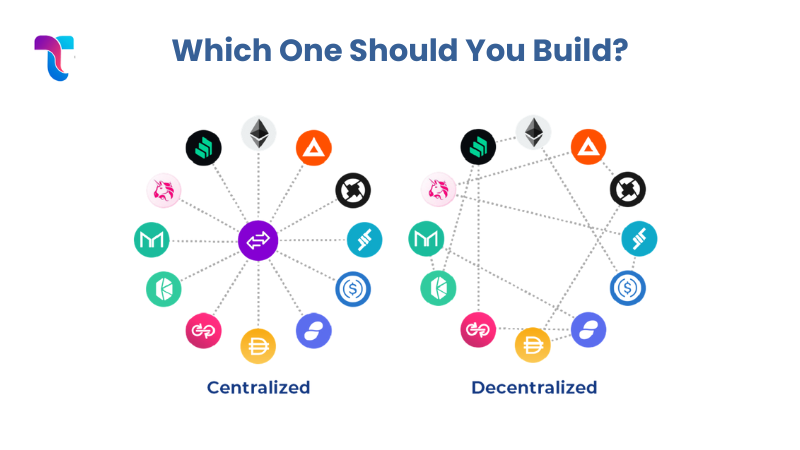
Table of Contents
Key Takeaways:
- Centralized Exchanges (CEX) are company-operated platforms that manage user funds, provide high liquidity, support fiat payments, and offer advanced trading features like margin and futures trading.
- Decentralized Exchanges (DEX) operate through smart contracts and allow wallet-to-wallet trading, giving users full control over their assets without relying on a central authority.
- CEX platforms use order books and matching engines for fast execution, while DEX platforms use liquidity pools and Automated Market Makers (AMM) to enable on-chain token swaps. However, many modern DEXs now use high-speed on-chain order books (like Hyperliquid or dYdX) to provide a CEX-like trading experience while maintaining decentralized security.
- Regulatory compliance is stricter for CEX platforms, requiring KYC, AML, and licensing, whereas DEX platforms operate with fewer onboarding requirements but face regulatory uncertainty.
- Revenue models differ significantly: CEX earns from trading fees, listing fees, withdrawals, and derivatives, while DEX primarily generates revenue from swap fees, protocol fees, and liquidity incentives.
- The right exchange model depends on your target audience, business goals, regulatory readiness, and whether you prioritize mainstream adoption or decentralized Web3 innovation.
Have you ever wondered where people actually buy and sell cryptocurrencies like Bitcoin or Ethereum? Or if you were to launch your own crypto exchange, would you build something like Binance or Uniswap?
That’s precisely where the biggest confusion begins.
Today, crypto exchanges are not just trading platforms; they’re the foundation of the entire crypto ecosystem. But when it comes to building one, you’ll face an important decision:
- Should you create a Centralized Exchange (CEX) that offers speed, liquidity, and a familiar user experience?
- Or should you develop a Decentralized Exchange (DEX) that provides transparency, user control, and complete Web3 freedom?
Both of these exchanges have their own strengths, challenges, technologies, and business potential.
So, if you’re a startup founder, entrepreneur, or blockchain enthusiast looking to understand which exchange type best fits your vision, you’re in the right place.
In this blog, we’ll discuss CEX vs. DEX. Covering how they work, how they differ, and most importantly, which one you should build in 2026 and beyond.
Let’s get started.
What is a Cryptocurrency Exchange?
Let’s first begin with what a crypto exchange actually is.
So, a cryptocurrency exchange is an online platform where people can buy, sell, and trade digital currencies. Just like a stock exchange allows trading of shares, a crypto exchange provides trading of cryptocurrencies.
Think of it like a digital marketplace, where:
- Buyers purchase crypto
- Sellers sell crypto
- The platform ensures smooth trading
It simply connects people who want to exchange one asset for another. For example, you can trade Indian rupees (INR) for Bitcoin, swap Ethereum for Solana, and so on.
However, people generally use these exchanges to:
- Invest in cryptocurrencies
- Trade assets for profit
- Convert fiat currency into digital assets
- Store and manage crypto funds
- Access advanced features like staking, margin trading, and derivatives
Without exchanges, it would be tough for users to enter the crypto world. Since you’re somewhat familiar with a crypto exchange, you should know that there are several types of crypto exchanges, and not all exchanges work in the same way.
Among all, here are the two main types of exchanges:
- Centralised Exchanges (CEX) – Managed by a company (like Binance or Coinbase)
- Decentralized Exchanges (DEX) – Powered by blockchain and smart contracts (like Uniswap)
And this is exactly what we’ll explore next.
What is a Centralized Exchange (CEX)?
A centralized cryptocurrency exchange is a digital marketplace that enables users to buy, sell, and trade cryptocurrencies through an intermediary platform. These exchanges are typically handled by a central organization that manages every transaction, liquidity, and security.
When we compare it to DEXs, CEXs offer an accessible user experience, quick transaction speeds, and customer support, which often encourage new and seasoned traders to choose CEXs over DEXs.
Some popular centralized platforms include Binance, Kraken, Coinbase crypto exchange, etc.
How Does a Centralized Exchange Work?
Centralized exchanges operate in a system similar to traditional financial platforms, such as stock exchanges. Here’s a step-by-step working process:
User Registration & Account Setup
To start trading on a centralized exchange, users are first required to sign up with an email/phone number. Set up their passwords and security, and complete their identity verification (KYC).
Deposit Funds (Crypto or Fiat)
After registration, users deposit funds, such as fiat currencies (INR, USD, EUR) or cryptocurrencies (BTC, ETH, etc.). In case you don’t know, centralized exchanges often support bank transfers, credit/debit cards, and crypto deposits.
Exchange Holds User Funds
This is one of the biggest features of a centralized exchange. The platform controls the user’s assets. Users don’t manage private keys directly; instead, the exchange stores crypto in hot wallets or cold wallets.
Order Placement (Buy/Sell Trading)
Next, users can place trading orders such as:
- Market order (instant buy/sell)
- Limit order (buy/sell at chosen price)
- Stop-loss order (risk management)
The exchange provides a trading interface with charts and tools.
Matching Engine Executes Trades
The core of every centralized exchange is the matching engine. It matches buyers and sellers through an order book system. Like: If someone wants to buy BTC at ₹50 lakh, and someone wants to sell BTC at ₹50 lakh, then the trade is executed instantly. This results in fast and high-volume trading.
Withdrawal of Funds
Lastly, once trading is complete, users can simply withdraw cryptocurrency to their wallet or fiat money back to their bank account. Meanwhile, in between, centralized exchanges charge withdrawal fees and follow compliance rules.
Pros & Cons of Building a Centralized Exchange
Before deciding to build a centralized exchange, it is essential to understand its key advantages and the challenges that come with it.
Pros of Building a CEX
- Easy for Beginners: Centralized exchanges offer a simple login-based system, user-friendly dashboards, and customer support, making them ideal for users new to crypto trading.
- Fast Transactions and High Liquidity: Since trades execute inside the exchange system, users get instant buying and selling with deep liquidity, especially when many traders are active. However, maintaining high liquidity in your crypto exchange is one of the most critical challenges every exchange owner must plan for from day one.
- Advanced Trading Features Available: CEX platforms offer professional tools such as margin trading, futures contract staking, lending, and copy trading. Before building these, it’s worth understanding the must-have features of a crypto exchange that attract and retain serious traders.
- Fiat Currency Support: Centralized exchanges can easily connect to banks and payment systems, enabling users to deposit and withdraw funds in INR and USD, by card or via bank transfer.
- Strong Revenue and Business Growth Model: Exchange owners earn through trading fees, withdrawal charges, token listing fees, premium accounts, and institutional partnerships, making it a profitable business.
Cons of Building a CEX
- Strict Regulations: A centralized exchange must comply with government rules, including KYC, AML, and licensing requirements, which can be complex and costly, depending on the country.
- High Security Risk: Because exchanges store user funds in custodial wallets, they are a significant target for hackers, and even a single breach can result in substantial losses.
- Central Point of Failure: Due to unforeseen circumstances, if the exchange server crashes, goes down, or is attacked, all users will be affected because the platform relies on a single central system.
- High Development and Maintenance: Building a CEX requires robust infrastructure, including matching engines, liquidity systems, administrative controls, and 24/7 technical support.
- Trust Dependency: Users don’t control their private keys, which means they must trust the exchange to protect their money, which goes against the decentralized philosophy of blockchain.
What is a Decentralized Exchange (DEX)?
A decentralized crypto exchange is a trading platform where traders can buy and sell cryptocurrencies using blockchain technology. Unlike centralized exchanges, DEXs don’t rely on a central entity; instead, they use smart contracts to facilitate trades. This method ensures users have complete control over their assets while reducing the risk of hacks or theft.
There are also a lot of new ideas that come out of the rise of DEXs. This includes their peer-to-peer nature, which doesn’t require any middlemen, allowing direct trades with each other. This feature also makes things more open, private, and secure while offering lower transaction fees.
However, some of the best decentralized exchanges include Hyperliquid, Uniswap, and PancakeSwap.
How Does a Decentralized Exchange Work?
Compared to CEX platforms, decentralized crypto exchanges operate in entirely different ways. Here’s the step-by-step working process:
Wallet Connection Instead of Account Creation
DEX platforms do not require user registration; instead, users simply connect wallets such as MetaMask, Trust Wallet, or Coinbase Wallet.
No Custody of Funds
This is the most prominent feature of DEX platforms. With this model, users can always control their private keys, crypto remains in their wallet, and exchanges never hold the funds. This removes the need to trust a central authority.
Smart Contracts Handle All Transactions
DEX platforms are powered by smart contracts, the self-executing blockchain programs that automatically process swaps, ensure fairness, and eliminate middlemen. So, trading becomes fully transparent and automated.
Liquidity Pools Replace Order Books
Most DEXs use an AMM (Automated Market Maker) model. So, instead of buyers and sellers matching orders, DEXs use liquidity pools where tokens are locked in smart contracts, allowing users to trade directly and instantly without any intermediaries.
Swapping Happens Instantly On-Chain
When a user swaps tokens, the smart contract automatically calculates the rate, exchanges tokens instantly, records the transaction on the blockchain, and credits the user’s wallet with the funds. Everything happens transparently without intermediaries.
Liquidity Providers Earn Fees
DEX platforms encourage users to provide liquidity. People who deposit tokens into pools are called liquidity providers. And by doing so, they earn rewards through trading fees, yield farming, and incentive tokens.
Pros & Cons of Building a Decentralized Exchange
Before choosing the DEX model, it’s essential to understand its significant benefits and limitations.
Pros of Building a DEX
- User Funds Stay Safe: Since the platform never holds assets, users retain complete control of their crypto, reducing custodial risks.
- No Central Authority Needed: Trading is peer-to-peer, eliminating reliance on a single company or intermediary.
- Full Transparency: Every transaction is recorded on the blockchain, making trading more open and verifiable.
- Global Accessibility: Anyone with a crypto wallet can trade instantly without signing up or facing trade barriers.
- Lower Operation Burden: No need to manage customer funds, banking infrastructure, or centralized servers like a CEX.
- Strong Fit for DeFi Ecosystem: DEX platforms integrate easily with yield farming, staking, and Web3 protocols.
Cons of Building a DEX
- Smart Contract Vulnerabilities: If the smart contract code contains flaws, hackers can exploit them, leading to significant losses.
- Lower Liquidity for New DEXs: New exchanges often struggle to attract liquidity, which can lead to failure and slower growth.
- Complex Experience for Beginners: Wallet setup, gas fees, and blockchain interaction can be confusing for non-technical users.
- Limited Fiat Support: DEX platforms typically do not support direct bank deposits or fiat withdrawals.
- Blockchain Fees & Speed Issues: Trading depends on network congestion and gas fees, which can make swaps expensive.
- Regulatory Uncertainty: Governments are still unclear about how DEX regulations will work, which typically leads to long-term challenges.
Business Models: How CEX and DEX Generate Revenue
Whether you choose to build a centralized or a decentralized exchange, the platform is not just for trading; it’s also a strong business opportunity. However, both types of exchanges have unique revenue models; let’s delve into how each one generates income:
How Centralized Exchanges (CEX) Generate Revenue
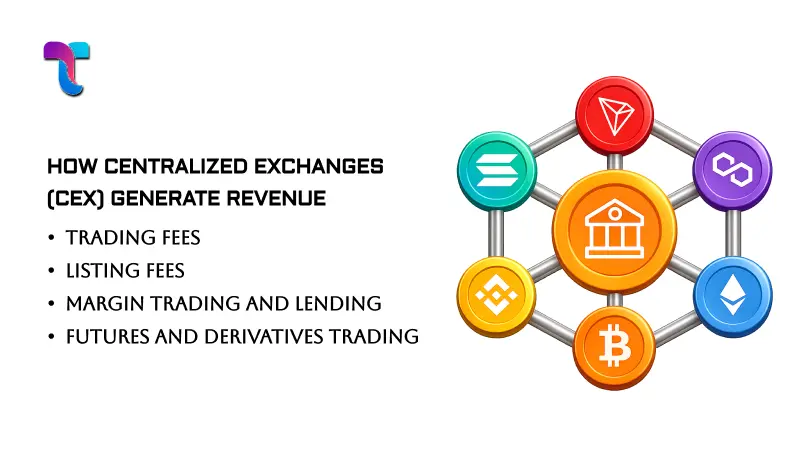
Like traditional financial platforms, centralized exchanges have monetization options because they are typically operated by businesses. Here are some ways in which CEX platforms earn revenue:
Trading Fees
This is the most significant source of income.
Every time a user buys or sells crypto, the exchange charges a small fee.
For example, if you trade $10,000 worth of Bitcoin, the exchange may charge a 0.1% trading fee.
Deposit and Withdrawal Fees
CEX platforms often charge fees when users:
- Withdraw crypto to an external wallet
- Withdraw fiat money to a bank account
- Use payment gateways or cards
Listing Fees
New crypto projects pay centralized exchanges to get their tokens listed.
Listing on major exchanges gives projects visibility and liquidity, so exchanges earn heavily through these fees.
Margin Trading and Lending
Many centralized exchanges offer services like
- Margin trading
- Crypto loans
- Borrowing services
By this, they earn interest and fees from users who trade with borrowed funds.
Futures and Derivatives Trading
Advanced features like:
- Futures contracts
- Options trading
- Perpetual swaps
With the help of these features, CEXs generate higher fees compared to normal spot trading.
How Decentralized Exchanges (DEX) Generate Revenue
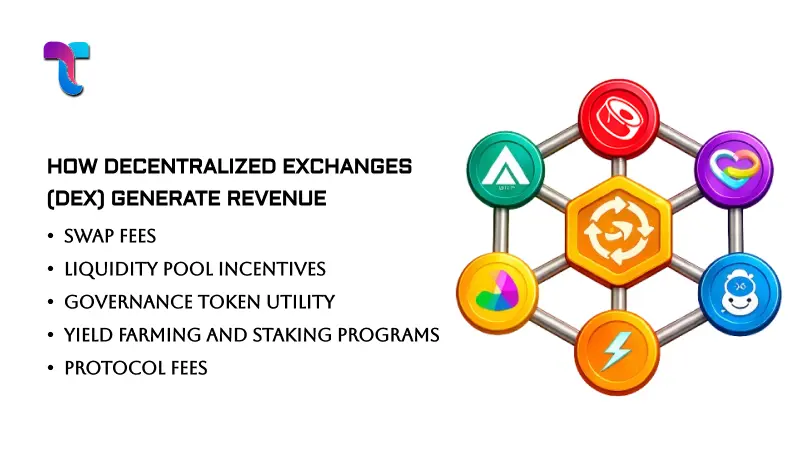
Decentralized exchanges do not depend on a central operator holding money, in contrast to CEX. Most DEX revenue comes from protocol-based fees and incentives. Here are some primary ways DEXs generate revenue:
Swap Fees
DEX platforms charge a small fee on every token swap.
Example: Uniswap charges 0.3% per trade.
These fees are usually shared with liquidity providers.
Liquidity Pool Incentives
DEXs attract liquidity by rewarding users who provide tokens into pools.
The platform benefits from increased activity and earns a portion of trading fees.
Governance Token Utility
Many DEX platforms launch their tokens, such as UNI or CAKE.
Revenue is generated through:
- Token demand
- Ecosystem participation
- Protocol growth
Token value increases as usage grows.
Yield Farming and Staking Programs
DEXs earn indirectly by offering DeFi features like
- Yield farming
- Token staking
- Liquidity mining
These programs boost platform engagement and trading volume.
Protocol Fees
Some DEX platforms charge an extra protocol fee, which goes to:
- Platform treasury
- DAO community
- Development upgrades
This helps sustain long-term growth.
Quick Comparison Table: CEX vs DEX Revenue Models
| Revenue Source | CEX | DEX |
| Trading Fees | Yes | Yes (Swap Fees) |
| Listing Fees | Common | Rare |
| Withdrawal Charges | Yes | No |
| Future & Margin Trading | Yes | Limited |
| Token Launch & Governance | Optional | Very Common |
| Liquidity Incentives | No | Core Feature |
| Subscription Plans | Possible | Rare |
Regulatory and Compliance Factors
When building a cryptocurrency exchange, technology is only one part of the process. Another major factor is regulation and legal compliance. Since exchanges deal with money, user funds, and financial transactions, government and regulatory bodies closely monitor them. Before you choose between a CEX and a DEX, it’s important to understand the compliance requirements.
Why Regulation Matters for Crypto Exchanges
People often compare crypto exchanges to banks or financial institutions due to their ability to facilitate asset buying and selling, fund storage, and global money transfers.
Authorities aim to prevent the use of exchanges for money laundering, fraud and scams, terrorist financing, and illegal transactions.
Compliance Requirements for Centralized Exchanges (CEX)
Centralized exchanges are operated by companies, so they’re directly responsible for following financial laws. Here are some main regulatory obligations:
KYC (Know Your Customer)
Most CEX platforms must verify user identity before allowing trading. This includes: Government ID proof, address verification, and PAN or passport details. KYC helps prevent anonymous misuse of the platform.
AML (Anti-Money Laundering)
CEX platforms must monitor transactions to detect suspicious activity. Here, AML systems help in tracking large transfers, preventing illegal fund movement, and reporting unusual behavior to authorities.
Licensing and Legal Registration
To operate legally, many countries require exchanges to obtain proper licenses, which include crypto exchange licenses, money transmitter licenses, and virtual asset service provider (VASP) approval. With these licenses, exchanges may face shutdowns or penalties.
Tax Reporting Obligations
Centralized exchanges may need to report user trading activity, share transaction data with governments, or support tax compliance regulations. This is becoming stricter worldwide.
Compliance Situations for Decentralized Exchanges (DEX)
Decentralized exchanges operate in a different way, which complicates regulation. A single authority does not control most DEX platforms, which operate through smart contracts and are non-custodial and permissionless. Because of this decentralized structure, regulatory rules for DEXs remain unclear and uncertain in many regions.
No Direct KYC Requirement
Most DEX platforms do not require identity verification because users trade directly through wallets and there is no centralized onboarding process. However, regulators are starting to explore new rules for DeFi.
Legal Grey Area
Since DEX platforms are decentralized, governments often ask, who is responsible if something goes wrong? Who controls the platform? And how can compliance be enforced? This makes DEX regulation unclear in many countries.
Smart Contract Accountability
Even though DEXs avoid intermediaries, developers may still be held accountable for smart contract failures, security breaches, and financial losses. This is why audits and legal consultation are essential.
Future Regulations May Increase
As decentralized finance grows, regulatory bodies may enforce compliance layers, decentralized identity solutions, and transaction monitoring tools. Therefore, DEX builders must prepare for future policy changes and evolving regulations.
Which Exchange Should You Build? Key Decision Factors
Choosing between a centralized exchange and a decentralized crypto exchange is one of the most important decisions for a crypto startup. Therefore, when making this decision, it is essential to select the ideal crypto exchange development company first. Choosing the right partner will play a crucial role in building and launching a secure, scalable, and future-ready exchange platform that aligns with your business goals and market needs.
So, without looking further, let’s simplify the decision:
Choose a CEX if…
You want to build a platform for beginners and mainstream users who prefer simple interfaces.
- Your goal is rapid trading with high liquidity in exchange and an order-book system.
- You want to support fiat deposits and withdrawals through banks or payment gateways.
- You plan to offer advanced features, including margin trading, futures, staking, and copy trading.
- You’re ready to handle regulations, licenses, and compliance requirements like KYC and AML.
- You want complete control over platform operations, fees, customer service, and security.
In simple words, a CEX is an ideal platform for your business if you’re aiming for large-scale adoption and professional trading services.
Choose a DEX If…
Building a decentralized exchange is a perfect option for you if:
- You want to build in the DeFi and Web3 ecosystem with wallet-to-wallet trading.
- Your priority is transparency, decentralization, and giving users full control over their funds.
- You want to avoid custodial responsibility since users keep assets in their own wallets.
- You’re comfortable building smart contract-based platforms using AMM liquidity pools.
- Your focus is on global accessibility without heavy onboarding barriers.
- You want a community-driven exchange model powered by governance tokens.
In short, a DEX is an excellent option for startups whose primary focus is on decentralized finance and blockchain-native users.
Consider Hybrid Exchanges
If you’re confused between the two and want the best of both, then you can also choose a hybrid exchange. This is a combination of CEX and DEX, offering the speed and liquidity of centralized platforms alongside the security and transparency of decentralized systems.
And over time, this model has become popular because it can offer rapid execution with non-custodial fund control. This model combines a compliance-friendly structure with decentralized features, striking an outstanding balance between user trust and platform performance. Meanwhile, hybrid exchanges are often considered the future of crypto trading.
Conclusion
When entering the crypto exchange market, choosing between a centralized and decentralized exchange is the most important step. While CEXs offer speed, liquidity, and a user-friendly experience, DEXs provide transparency, user control, and strong integration with the DeFi ecosystem.
The right choice completely depends on your target audience, business goals, regulatory readiness, and the type of trading experience you want to deliver.
No matter which exchange type you choose, success requires a platform that is secure, scalable, and built on the right technology foundation. If you’re planning to develop a crypto exchange, Technoloader can help you turn your idea into reality with end-to-end development solutions, advanced security measures, and industry-leading expertise.
Frequently Asked Questions
Which type of exchange is better for beginners?
For beginners in cryptocurrency, centralized exchanges are widely considered the best choice. They provide a user-friendly experience similar to traditional stock trading apps, making it easier to buy, sell, and manage digital assets.
Is a decentralized exchange safer than a centralized exchange?
Compared to centralized exchanges, a decentralized exchange can be a safer choice for fund custody because users control their assets and private keys. However, DEX platforms can still face risks, such as smart contract vulnerabilities. Centralized exchanges offer convenience but remain targets for hacks since they store user funds.
Can a DEX support fiat currency deposits like USD or INR?
Most decentralized exchanges do not support direct fiat deposits because they operate through crypto wallets and blockchain networks. Users must already have cryptocurrency to trade on a DEX, unlike centralized exchanges, which allow bank transfers or card payments.
Which exchange model is more profitable to build?
Centralized exchanges will be more profitable to build because these exchanges usually offer more revenue streams, like trading fees, listing fees, withdrawal charges, and premium services. On the other hand, the DEX platforms primarily generate revenue from swap fees and liquidity incentives, thereby relying on platform adoption and trading volume for profitability.
What is a hybrid exchange?
A hybrid exchange combines the benefits of both CEX and DEX models. It offers fast trading and liquidity on a centralized platform while also providing decentralized features like better fund control and transparency, making it a balanced solution for modern exchanges.
Should startups choose CEX or DEX in 2026 and beyond?
The choice completely varies depending on the business vision. CEX platforms are better for mass adoption, fiat support, and advanced trading features. DEX platforms are ideal for DeFi startups that value transparency, wallet-based trading, and decentralized user control.

Kanak Badaya
Kanak Badaya is a Technical Content Writer at Technoloader with over 3 years of experience translating complex technology into content that actually makes sense. He works closely with emerging domains like Blockchain, Web3, AI, and DeFi, turning intricate technical concepts into clear, structured, and engaging narratives that help businesses communicate with confidence. Rather than just writing for search engines, Kanak focuses on writing for people. He combines in-depth research with a practical understanding of the industry to create blogs, website content, and technical guides that inform, educate, and build credibility. His goal is simple - make advanced technology feel approachable while helping Technoloader strengthen its authority in the digital space.
Published in Cryptocurrency Exchange


