 +91 7014607737
 info@technoloader.com






Table of Contents
Key Takeaways:
- Machine learning enables systems to learn from data, identify patterns, and improve performance without being explicitly programmed for every task.
- The five foundational techniques of ML include supervised learning, unsupervised learning, semi-supervised learning, reinforcement learning, and deep learning, each suited for different types of problems.
- In 2026, advanced approaches such as transfer learning, ensemble learning, federated learning, AutoML, explainable AI, and Edge AI are driving modern AI innovation.
- Machine learning powers real-world applications across industries, including healthcare, finance, e-commerce, cybersecurity, autonomous vehicles, and manufacturing.
- Businesses use ML to automate complex processes, enhance personalization, improve decision-making, and increase operational efficiency.
- Key challenges in machine learning include data bias, poor data quality, overfitting, lack of explainability, high computational costs, and privacy concerns.
Have you ever wondered how Netflix knows what show you will love next, or how self-driving cars learn to navigate city streets?
The answer is Machine Learning (ML), a technology that allows computers to learn from data and improve automatically without specific programming.
ML systems learn by identifying patterns and making decisions, becoming smarter with experience, similar to human learning. It powers various AI solutions, such as voice assistants and fraud detection systems.
Looking to gain more details on this? That’s what this blog is for!
In this, we will cover the most common machine learning techniques, their functionalities, and the real-world AI solutions they enable.
Let’s get started with the blog!
What is Machine Learning?
Machine Learning, or ML, is basically a branch of artificial intelligence that enables algorithms to uncover hidden patterns within datasets. This technology allows them to predict new data without explicit programming for each specific task. Machine learning is being used in all sorts of industries these days. You will find it in things like recognizing images and speech, understanding natural language, spotting fraud, and even automating tasks.
Some of the most common examples of machine learning include:
- Recommendation engines suggest products, songs, or television shows similar to those available on platforms such as Netflix, Jio Hotstar, Spotify, Amazon, Flipkart, and others.
- Speech recognition software that helps users convert voice memos into text seamlessly.
- A bank’s fraud detection system that automatically highlights suspicious transactions.
- Self-driving cars and driver-assistance features like automatic stopping on crossings and blind-spot detection help improve vehicle safety.
Why Does Machine Learning Matter in 2026
If we discuss the importance of machine learning in today’s tech-savvy world, then the numbers speak for themselves. With the global size of the machine learning market valued at over USD 91.31 billion in 2025 and projected to reach nearly USD 1.88 trillion by 2035, its rapid expansion clearly highlights how essential ML has become. In 2026 alone, the industry is anticipated to be worth around USD 120.32 billion, reflecting strong global adoption.
Here’s the key reason behind its importance:
Automation of Complex Tasks
Machine learning (ML) is super important because it can handle tedious, time-consuming tasks we often struggle with. It can analyze large amounts of data, spot patterns, and make informed decisions. This ability to automate processes allows them to improve productivity, reduce operational costs, and boost efficiency.
Data-Driven Insights
Data is being generated rapidly, and businesses can use this to reach great heights. Machine learning enables organizations to use this data by extracting valuable insights and making well-informed decisions. Furthermore, ML can help identify trends and patterns that might otherwise go unnoticed by humans.
Improvement of Personalization
ML has transformed the way businesses interact with customers. It can help analyze individual customer preferences, behaviours, and interactions to deliver customized content, products, and services. Netflix and Spotify use machine learning to recommend shows, movies, and songs you might enjoy.
Improved Customer Support
ML has also revolutionized customer support. Chatbots and virtual assistants offer quick support by answering questions, solving problems, and guiding users through complexities. Because these are powered by ML, these systems learn from customer interactions and improve their responses.
Enhanced Decision-Making
Today’s businesses require making well-informed decisions. ML helps enterprises to make data-based decisions in real time. And, it can even process huge chunks of data quickly and provide valuable insights. Machine learning has the power to enhance pricing strategies for products by thoroughly analyzing market demand, competitor pricing, and customer behaviour.
Forms of Machine Learning (ML) Techniques
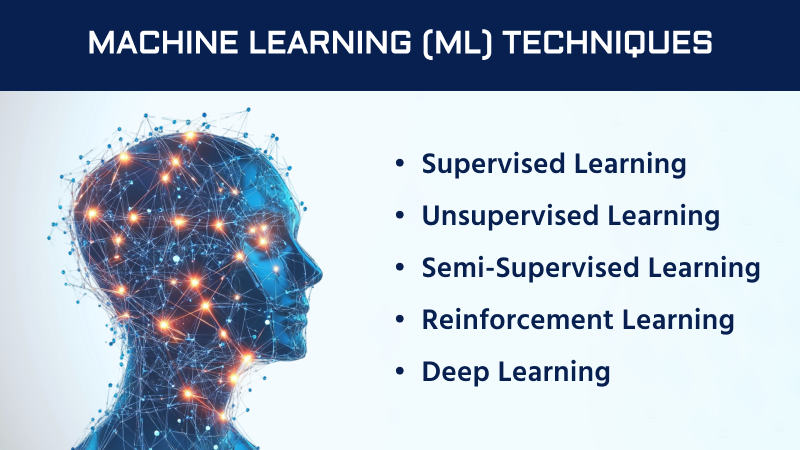
ML uses various techniques when it comes to teaching machines how to learn from data. Here are the five main techniques ML uses:
Supervised Learning
Supervised learning is a machine learning technique where the model is trained on a dataset that includes both input features and correct outputs. The system analyzes the data to uncover patterns, which enables it to match inputs with their respective labels.
This type of learning is used when the goal is to predict outcomes or classify data into categories. It is helpful when you have old data to look at, and you know what outcome you are expecting.
Examples:
- Detecting spam emails
- Approving or rejecting loan applications
- Predicting housing prices
Unsupervised Learning
Unsupervised learning is employed when the data lacks predefined labels or outcomes. The model is equipped with a dataset and is challenged to uncover patterns, similarities, and structures contained within it. This technique is valuable for segmenting data into clusters and identifying anomalies.
Unlike supervised learning, it does not aim to predict results. Instead, it takes data and sorts it out in ways that make sense. It is helpful for exploring new data and managing large and unstructured datasets.
Examples:
- Grouping customers based on buying behaviour
- Recommending related products
- Detecting unusual transactions
Semi-Supervised Learning
Semi-supervised learning falls between supervised and unsupervised learning. It uses a small amount of labelled data and a much larger pool of unlabeled data. The model initially learns from the labelled data and then applies that knowledge to label the rest of the dataset.
This approach is practical when labelling data is expensive or time-consuming, such as in medical or legal fields. It offers a balance between cost-efficiency and performance by improving accuracy with minimal manual labelling.
Examples:
- Classifying medical images when only a few are labelled
- Recognizing speech in audio recordings with minimal transcription
Reinforcement Learning
Reinforcement learning is a machine learning method where an agent learns by interacting with its environment and getting rewards or penalties as feedback. The system employs a trial-and-error approach to optimize long-term rewards.
It is helpful in environments where sequential decision-making is required. It doesn’t rely on labelled datasets; instead, it learns optimal behaviours over time.
Examples:
- Teaching self-driving cars how to navigate safely
- Training AI to play games such as chess or Go
- Robotic arms are learning how to grasp objects
Deep Learning
Deep learning is a specific part of ML that relies heavily on artificial neural networks with many layers. These models are set up to learn from raw data on their own. They figure this out by working through different layers that help them grasp more complex patterns.
This ML technique excels at handling unstructured data, such as images, audio, and text. It requires large datasets and substantial computational power but delivers excellent accuracy.
Examples:
- Voice assistants like Alexa or Siri
- Facial recognition systems
- Chatbots and language translators
Modern Machine Learning Techniques Driving AI Innovation in 2026
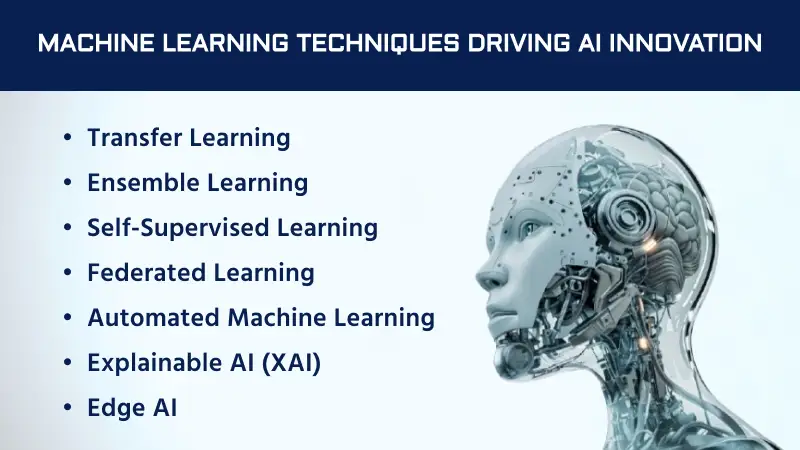
Artificial intelligence in 2026 is no longer limited to basic machine learning models, as emerging AI technologies are rapidly transforming industries. Today, AI breakthroughs are driven by more advanced, scalable, and intelligent ML techniques that solve real-world problems more efficiently. Below are the most impactful modern techniques shaping innovation across industries.
1. Transfer Learning
Transfer learning enables a machine learning model to reuse knowledge gained from one task and apply it to a new, related task. Instead of training a model from scratch, developers use pre-trained models and fine-tune them for specific applications.
This significantly reduces training time, data requirements, and costs. Furthermore, it is widely used in image recognition, natural language processing, and speech systems. Modern AI tools such as chatbots and vision systems rely on transfer learning to accelerate deployment.
2. Ensemble Learning
Ensemble learning improves model accuracy by combining multiple machine learning models into one stronger model. Instead of depending on a single algorithm, it aggregates predictions from several models to produce better results.
Techniques such as Random Forest, Gradient Boosting, and XGBoost are popular examples. Ensemble learning reduces errors, improves stability, and enhances prediction reliability. Therefore, this technique is widely used in fraud detection, credit scoring, and recommendation engines, where precision is critical.
3. Self-Supervised Learning
Self-supervised learning is a breakthrough technique that enables models to learn from unlabeled data by creating their own training signals. Since labelled data is expensive and time-consuming, this approach helps models train on massive datasets without manual labelling.
It is widely used in large language models and computer vision systems. This technique improves scalability and makes the AI system more adaptable. In 2026, self-supervised learning powers conversational advantage conversation AI and generative systems.
4. Federated Learning
Federated learning enables ML models to be trained across multiple devices without transferring sensitive data to a central server. Instead of collecting user data in one place, the model learns directly on local devices and shares only updates.
This enhances privacy, security, and regulatory compliance. It is especially valuable in healthcare, finance, and mobile applications. Federated learning supports secure AI innovation while maintaining user data confidentiality.
5. Automated Machine Learning
AutoML simplified the machine learning development process by automating tasks such as model selection, feature engineering, and hyperparameter tuning. It allows businesses to build high-performing models without deep technical expertise.
By reducing manual effort, AutoML accelerates AI adoption across startups and enterprises.
In 2026, it helps companies quickly deploy custom AI development solutions while minimizing development complexity and time-to-market.
6. Explainable AI (XAI)
Explainable AI focuses on making machine learning models more transparent and understandable. As AI systems become more complex, it’s important to understand how they make decisions. XAI provides in-depth insights into model reasoning and prediction logic.
This technique is especially important in industries like healthcare, finance, and law, where accountability matters. Explainable AI builds trust by ensuring that automated decisions can be interpreted and justified clearly.
7. Edge AI
Edge AI refers to running machine learning models directly on local devices instead of relying entirely on cloud servers. This ensures faster decision-making, lower latency, and reduced internet dependency.
Edge AI is commonly used in smart devices, IoT systems, autonomous vehicles, and surveillance systems. It improves performance in real-time applications and enhances data privacy by processing information closer to the source.
These are some advanced ML techniques that are innovatively transforming today’s AI solutions. If we look at its worldwide adoption, the impact becomes even more evident. The United States currently holds the largest machine learning market globally, with a value exceeding $21 billion. This leadership highlights how advanced machine learning techniques are being rapidly integrated into real-world systems at scale.
Meanwhile, with such widespread global adoption, the real question becomes: how exactly are these machine learning techniques applied across industries? Let’s explore how they power real-world AI solutions.
Looking to build next-gen AI solutions using modern ML techniques like Transfer Learning or Edge AI?
How These ML Techniques Power Real-World AI Solutions
In 2026, machine learning techniques will not just be theoretical concepts. Instead, they’re actively transforming industries by solving complex problems, improving efficiency, and enabling intelligent decision-making at scale. Below are how modern ML techniques power real-world AI solutions across different sectors.
1. Healthcare
In the healthcare sector, machine learning techniques such as deep learning and supervised learning are used to analyze medical images, detect diseases early, and predict risks.
Here, CNN models achieve high accuracy in identifying tumours in X-rays and MRIs. Additionally, predictive models assist doctors in diagnosing conditions faster by analyzing patient history and lab results.
As a result, it improves treatment outcomes, reduces human error, and enables personalized healthcare solutions.
2. Finance and Banking
The finance industry heavily depends on machine learning for fraud detection, risk assessment, and algorithmic trading. Ensemble learning and anomaly detection models examine millions of transactions in real time to detect suspicious activities.
ML systems also evaluate credit scores by studying customer financial behaviour. These techniques reduce financial losses, improve compliance, and enhance customer trust through secure digital transactions. The convergence of AI and blockchain development is also adding another layer of transparency and security to financial systems.
3. E-Commerce and Retail
In this sector, recommendation engines are powered by supervised and deep learning to analyze customer preferences, browsing behaviour, and purchase history. This helps platforms to suggest personalized products, increasing customer engagement and sales.
In addition, ML also helps optimize pricing strategies, forecast demand, and manage inventory efficiently. Personalization, driven by ML, improves customer satisfaction and boosts revenue growth.
4. Autonomous Vehicles
Reinforcement and deep learning are critical for self-driving cars. So, these systems process data from cameras, sensors, and GPS, which helps recognize traffic signs, detect pedestrians, and make driving decisions in real time.
The models continuously learn from new driving scenarios, regularly improve with safety measures, and navigation accuracy. ML enables vehicles to respond quickly to dynamic road conditions.
5. Cybersecurity
Machine learning helps improve cybersecurity by spotting unusual network activity and stopping cyber threats early. It can detect patterns in data traffic that look suspicious, such as possible malware or hacking attempts.
Unlike traditional systems, ML models continue to learn and adapt to new types of attacks. This helps businesses and individuals stay better protected against evolving digital threats.
6. Manufacturing and Predictive Maintenance
In manufacturing, ML models help analyze equipment data to predict failures before they occur. This technique, known as predictive maintenance, decreases downtime and maintenance costs.
Machine learning also optimizes production workflows, improves quality control, and enhances supply chain efficiency. Through this, businesses often prevent disruptions and maintain consistent operational performance.
Challenges in Machine Learning
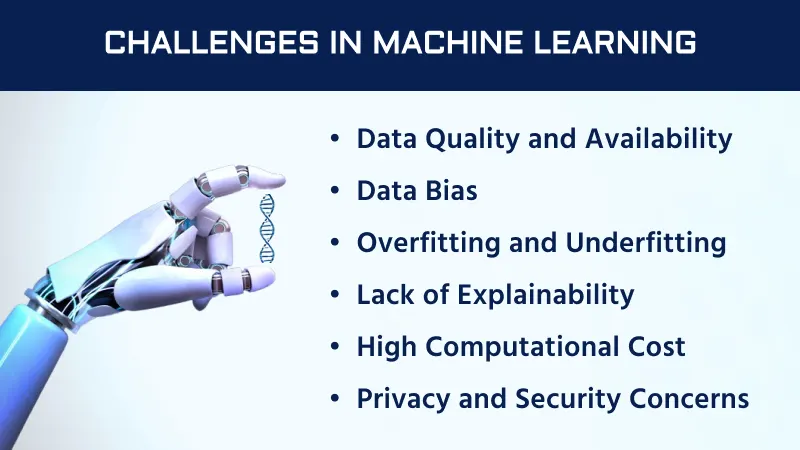
While machine learning is rapidly transforming industries and powering intelligent systems, it also comes with several challenges. Understanding these limitations will help you build reliable, responsible AI solutions. This includes:
1. Data Quality and Availability
Data is very important for machine learning models. If the data is missing, biased, old, or inaccurate, then the model’s predictions will also be flawed. Getting high-quality and useful data can be expensive and time-consuming. In many industries, it’s hard to get large datasets due to privacy laws or limited availability, which directly affects model performance.
2. Data Bias
Data bias occurs when the information used to train a machine learning model is not balanced or complete. If the data primarily represent one group of people or one type of situation, the model may produce unfair or incorrect results. For example, when hiring or giving out loans, biased data can lead to unfair decisions. This is why it’s important to use data that is both accurate and varied.
3. Overfitting and Underfitting
Overfitting occurs when a model learns the training data too closely, almost as if it were memorizing it. As a result, it doesn’t work well when new data comes in. Underfitting happens when the model is too simple and fails to learn important patterns. In both cases, the model doesn’t work well in the real world.
4. Lack of Explainability
Some advanced machine learning models make choices without clearly showing how they reached them. It gets harder to understand why a specific prediction was made. This can be a problem in areas like healthcare or finance, where people need clear reasons for decisions. However, when AI systems cannot explain themselves, trust becomes an issue.
5. High Computational Cost
Advanced machine learning models require powerful computers and substantial computational resources. Training these models can be expensive and time-consuming. At the same time, companies may need special hardware and cloud services, which increases overall costs. Smaller businesses may struggle to afford these resources.
6. Privacy and Security Concerns
Machine learning systems frequently utilize personal and sensitive data to generate predictions. If this information is not protected well, it could be stolen or misused. Hackers may also go after AI systems. This is why strong security measures and privacy protections are essential when building ML solutions.
Wrapping Up
And that’s a wrap for this blog!
Machine learning, or ML, is no longer a futuristic concept. It’s here, and it’s already changing how we work, live, and make decisions. Machine learning helps make online experiences more personal and can also speed up how doctors make diagnoses.
Understanding these core machine learning techniques is the first step to unlocking smarter solutions in almost any industry.
And if you are wondering how to actually apply these techniques to your business or startup, that’s where we, the experts at Technoloader, come in.
Let’s make AI work for you smartly and transparently!
Frequently Asked Questions
What are the best ways to use machine learning today?
Supervised learning, unsupervised learning, reinforcement learning, deep learning, transfer learning, and ensemble learning are some of the most common machine learning methods used today. These methods help systems look at data, make predictions, and run modern AI programs.
How does machine learning work in the real world?
Machine learning works by looking at a lot of data, finding patterns, and then using those patterns to make choices or predictions. For instance, it helps voice assistants work, suggests products on shopping apps, finds fraud in banking, and helps self-driving cars find their way safely.
Which fields use machine learning the most?
Healthcare, finance, e-commerce, cybersecurity, transportation, and manufacturing all use machine learning a lot. ML is used in these fields for things like finding diseases, stopping fraud, suggesting products, doing maintenance ahead of time, and making decisions automatically.
What makes machine learning important in 2026?
Machine learning is important in 2026 because it makes automation possible, helps people make decisions in real time, and lets people have personalized experiences. ML helps businesses look at huge amounts of data, cut costs, work more efficiently, and stay competitive in a digital world.
What are the hardest parts of machine learning?
Some big problems are bad data, biased results, high computing costs, decisions that aren’t clear, and worries about privacy. To make AI systems that people can trust and rely on, these problems need to be fixed.
In machine learning, what is transfer learning?
Transfer learning is when you take a model that has already learned how to do one thing and use that knowledge to do something else that is similar. It saves time, needs less data, and is often used in systems for recognizing images and processing language.
What is the purpose of reinforcement learning?
Reinforcement learning is used in systems that learn by making mistakes and trying again. It is often used in AI that plays games, robots, and self-driving cars. The system gets better over time when it gets rewards for doing things right and punishments for doing things wrong.

Kanak Badaya
Kanak Badaya is a Technical Content Writer at Technoloader with over 3 years of experience translating complex technology into content that actually makes sense. He works closely with emerging domains like Blockchain, Web3, AI, and DeFi, turning intricate technical concepts into clear, structured, and engaging narratives that help businesses communicate with confidence. Rather than just writing for search engines, Kanak focuses on writing for people. He combines in-depth research with a practical understanding of the industry to create blogs, website content, and technical guides that inform, educate, and build credibility. His goal is simple - make advanced technology feel approachable while helping Technoloader strengthen its authority in the digital space.
Published in AI Development


