 +91 7014607737
 info@technoloader.com






Table of Contents
Key Takeaways:
- Crypto derivatives trading dominates the market today. According to latest reports, derivatives account for over 70% of total crypto trading volume. This shows the growing importance of these instruments for traders all around the world.
- Crypto derivatives allow traders to speculate without owning the asset. Instead of actually buying cryptocurrencies, traders often go for contracts like futures, perpetual swaps, and options to trade on how prices will move.
- These exchanges use advanced systems for trading management. Components such as order books, matching engines, margin systems, funding rates, and liquidation mechanisms help in efficient execution of derivatives trades.
- There are a number of benefits to trading derivatives instead of spot trading. Traders can profit in both rising and falling markets, leverage for greater exposure, and employ strategies like hedging and arbitrage.
- Understanding trading stages helps beginners learn gradually. Most traders start with spot trading and then go on to futures, perpetual contracts, options trading, and more advanced tactics like hedging and managing leverage.
- Top crypto derivatives exchanges offer tools and features that enhance trading. Binance, OKX, Gate.io, KuCoin, and Bybit are some of the platforms that offer high liquidity, advanced derivatives products, automated trading bots, and professional trading tools.
- In derivatives trading, risk management plays an important role. Leverage can increase earnings, but it can also increase losses. This is why traders need to know about things like margin requirements, liquidation price, and position sizing.
The crypto market has grown a lot since just buying and holding onto Bitcoin. Today, traders are participating in a much larger and more advanced market, that is, crypto derivatives trading.
In fact, derivatives have become the backbone of modern crypto trading. According to the latest report by CoinLaw, the total crypto trading volume rose to $3.12 trillion, with derivatives making up almost 74.2% share. This shows how derivatives trading is leading the market today.
Here comes the question: What are crypto derivatives and why are they becoming popular?
Basically, crypto derivatives allow traders to speculate on the future price of cryptocurrencies, like Bitcoin or Ethereum, without owning the underlying asset. This means you can earn profit whether the market goes up or down by taking long and short positions.
This is one of the main reasons why crypto derivatives exchanges have become an important part of the digital asset ecosystem. These platforms offer advanced trading products such as crypto futures trading, perpetual futures, and crypto options trading.
Well, all these would be too complex for a beginner to understand. Here’s a blog that will simplify everything for you.
By the end of the blog, you’ll become a pro in crypto derivatives exchange. Let’s begin!
What are crypto derivatives exchanges?
It is important to understand what crypto derivatives are before you learn about crypto derivatives exchanges.
A derivative is a financial contract whose value is based on the price of a cryptocurrency. You can understand it in a way like you are betting on the future price of a coin without actually owning it. You can use these contracts to bet on price changes, hedge against risk, or use your position to get larger possible rewards.
Now, have a sneak peek into what crypto derivative trading exchanges are!
Basically, a crypto derivatives exchange is a platform where traders buy and sell contracts based on the future price of cryptocurrencies instead of directly trading the coins themselves.
These allow traders to gain profits whether prices go up or down. The common types of contracts that crypto derivatives exchanges deal in are:
- Options: This contract gives traders the right to buy or sell crypto assets at a predetermined price and date.
- Futures Trading: A futures contract enables the buyer and seller to transact the cryptocurrency at a predetermined price and date.
- Perpetual Swaps: These types of crypto derivatives are futures contracts without an expiration date. These enable traders to hold positions and facilitate continuous trading.
How a Crypto Derivatives Exchange Works?
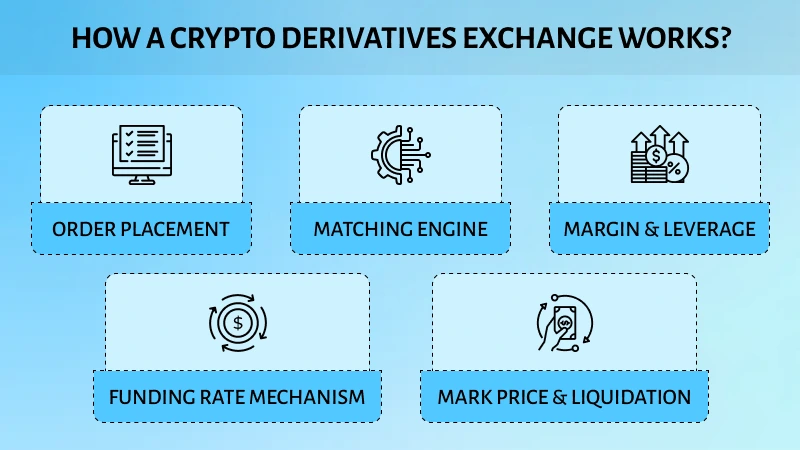
Crypto derivatives platforms include components such as order books, matching engines, margin systems, and risk management features. They make sure that trading goes smoothly and quickly. This is how it works:
Order Placement
Trading on a crypto derivatives platform begins when a trader places an order. Now, orders typically fall into two main categories, which include:
- Market Orders: These are executed immediately at the best available market price.
- Limit Orders: These are executed only when the market reaches a certain price limit set by the trader.
All the orders are recorded in an order book, which typically lists buy and sell orders at different price levels. This helps determine the current market price and available liquidity in crypto exchanges.
Matching Engine
The matching engine works behind any crypto exchange. It automatically matches buy and sell orders based on price and time. When a buyer and seller agree on a price range, the trade is executed instantly.
A high-performance matching plays an important role because it ensures:
- Fast trade execution
- Fair price discovery
- Efficient handling of large trading volume
Margin & Leverage
Unlike spot trading, derivatives trading often involves margin and leverage. Traders only need to deposit a fraction of the total trade value as collateral while borrowing the rest from the exchange.
For example, with 10x leverage, a trader can control a $10,000 position by using just $1,000 as margin. Using leverage can really help increase profits, but it can also result in some losses too.
Funding Rate Mechanism
Many crypto derivatives exchange platforms offer perpetual futures contracts, which do not have an expiry date. Derivatives exchanges use a funding rate mechanism to keep contract prices aligned with the market price of the underlying asset.
- If the funding rate is positive, long-position traders pay short-position traders.
- In a negative funding rate, traders with short positions pay those with long positions.
This mechanism helps maintain balance between buyers and sellers.
Mark Price & Liquidation
Derivatives exchanges use a mark price, which is based on a weighted average of spot prices across various exchanges, to stop market manipulation and make sure that liquidation is fair.
If a trader’s losses become close to their margin amount, the exchange may start liquidation, which means that the position will be closed automatically to stop more losses.
Some of the key liquidation triggers are:
- Falling below the maintenance margin
- Extreme market volatility
- Too much usage of leverage
Why Trade on Crypto Derivatives?
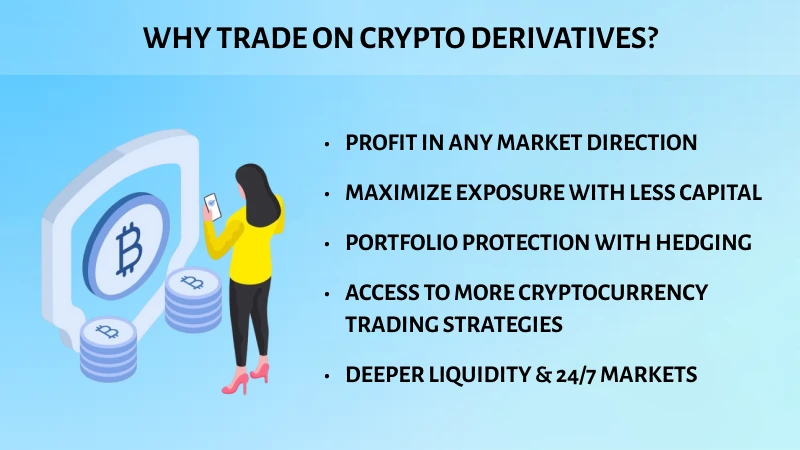
Now, you might be thinking, “If I can just buy and hold Bitcoin or Ethereum, why trade with crypto derivatives?” The answers to your question are mentioned below:
Profit in Any Market Direction
In spot trading of crypto, profits are only possible when prices rise. However, with derivatives like crypto futures and perpetual contracts, you have more options to profit.
- Go long: Gain profit if the price of cryptocurrency rises.
- Go short: Gain profit if the price of cryptocurrency falls down.
For example, If you think that Bitcoin will drop, you can short it using derivatives and gain profit from the downtrend. This is something that you can’t do with regular spot trading.
Maximize Exposure with Less Capital
When it comes to trading crypto with leverage, derivatives let you use borrowed money to take on a bigger position without needing to put up more capital.
For Example: with 10x leverage, a $100 investment allows trade as if you had $1,000. This means higher gains. However, with that comes a higher risk.
Portfolio Protection with Hedging
Hedging in crypto trading allows small investors to use derivatives not just for profits, but also for protection.
For example: If you are holding a lot of Ethereum but expect short-term volatility, you can open a short position to hedge against a drop in price.
If ETH goes down, the money you make from derivatives can help balance out your losses in the spot market.
Access to More Cryptocurrency Trading Strategies
Crypto derivatives open the door to more complex and strategic trading approaches, which include:
- Arbitrage
- Spread trading
- Volatility using crypto options trading
- Scalping strategies
These allow experienced traders to be more precise and dynamic in how they approach the crypto market.
Deeper Liquidity & 24/7 Markets
The derivatives market in the crypto space is more liquid than the spot market, especially for major assets like Bitcoin and Ethereum. This means tighter spreads, faster execution, and more efficient trading.
This also gives traders several benefits, such as:
- Gain profit from price moves without owning crypto
- Protect investments against market risks
- Increase profits with every trade
Beginner to Pro Journey of Crypto Derivatives
Understanding crypto derivatives trading is a gradual learning process that begins with basic trading concepts and continues to more advanced strategies. No matter whether you are looking to enhance your skills or someone planning to build a crypto derivatives exchange, understanding this helps create a smoother and more user-friendly trading experience.
Here are the stages traders go through as they move from beginner to professional derivatives trading.
Beginner Stage – Spot Trading
For beginners, trading on crypto derivatives is similar to spot trading. Basically, spot trading involves buying or selling actual cryptocurrency at the currency market price. After purchase, you own the asset and can hold, transfer, or sell it anytime.
For example, buying Bitcoin on a spot exchange is like buying an apple at the market. You pay the price and take the asset with you.
Early Learner Stage – Futures Contracts
Once you get a better understanding of spot markets, you can then get into exploring futures contracts. This brings in the concept of derivatives. In simpler terms, a futures contract is a legal agreement to buy or sell a cryptocurrency at a predetermined price on a specific future date.
For example, you agreed today to buy apples for $1 each next week. If prices go up to $1.50, you benefit from being locked in at a fixed rate. But if prices go down to $0.80, you still have to pay $1 and will suffer a loss every week.
Pros:
- Potential to gain profits from both rising and falling prices
- No need to hold the underlying asset
Cons:
- Higher risk if the market moves against your position
- Knowledge of margin, leverage, and liquidation is important
Intermediate Stage – Perpetual Contracts
Next, traders move on to perpetual contracts, which are also called “perps”. Basically, they don’t have an expiry date like traditional futures. They are meant to follow the spot price and let traders keep their positions for as long as they choose.
For Example: You can take perps as an open-ended bet on a crypto asset’s price direction. Considering that, you can maintain the position as long as your margin holds and you are not liquidated.
Here are some reasons why they are popular:
- 24/7 tradeable
- High volume and liquidity
- Ideal for quick trades
Advanced Stage – Options Trading
At this point, traders look into the options. These are mentioned below:
- A call option gives you the right to buy an asset at a predetermined price.
- A put option enables you to sell an asset for a predetermined price.
For example: You can understand it like paying a premium to reserve the right to buy Bitcoin at $30,000. If the price rises to $40,000, you can still buy it at $30,000 and realize a profit. If the price falls, you can simply let the option expire, which limits your loss to the premium paid.
Pro Stage – Hedging & Leverage
This stage focuses on mastering derivatives to protect capital and optimize trades. Basically, it is a combination of all the tools and strategies from earlier levels.
Hedging Example:
If you hold 1 BTC and anticipate a short-term price decline, you can open a short futures position. If the price drops, gains from the short position can help traders recover from losses in your BTC holdings.
Understanding leverage:
Leverage allows you to increase your exposure using borrowed funds. For example, with 10x leverage, a $100 margin controls a $1,000 position. But, while you are able to boost your profits, you can also end up in losses. If not handled correctly, a small market move in the incorrect direction can lead to liquidation.
The 5 Best Crypto Derivatives Exchange Platforms
The top cryptocurrency derivatives exchanges that are important in the market are as follows:
Binance

Binance is the world’s largest cryptocurrency exchange and a leading force in derivatives trading. Its Binance Futures platform offers a wide range of trading products, such as perpetual futures and options, with deep liquidity and competitive fees. Binance achieved an impressive derivatives trading volume of $3.2 trillion in 2025, which shows its huge share of the global market. It even supports automated trading through built-in crypto trading bots.
Key Features:
- Up to 125x leverage on futures contracts
- Wide range of crypto derivatives products (futures, options, perpetuals)
- High liquidity and small spreads
- Advanced trading tools and APIs
- Large selection of trading pairs (350+ assets)
OKX

OKX is recognized as one of the top cryptocurrency derivatives exchanges in the world. It offers tools like options, perpetual futures, and margin on a wide range of digital assets. It’s a favorite among institutional and professional traders who are into complex derivatives and need solid risk management tools. This platform is great because it provides deep liquidity and has a straightforward trading setup.
Key Features:
- Advanced derivatives, including futures, perpetual swaps, and options
- Competitive trading fees and deep liquidity
- APIs and tools for institutional trading
- Transparent proof-of-reserves reporting
- Strong global user base and security features
Gate

Gate.io is a popular crypto trading platform where you can find a wide range of derivative trading options. The exchange provides futures, perpetual contracts, and margin trading for hundreds of cryptocurrencies. Gate is popular for its variety of altcoins and derivatives, which grab the attention of traders who want diverse market exposure beyond just Bitcoin and Ethereum.
Key Features:
- A large number of supported cryptocurrencies and derivatives
- Futures and perpetual trading markets
- Competitive trading fees
- Advanced charting tools and trading interfaces
- High global liquidity for altcoin derivatives
KuCoin

People often call KuCoin “The People’s Exchange” because it offers a wide variety of cryptocurrencies and derivatives. It’s pretty popular for offering a wide range of trading options. The platform offers futures trading, margin trading, and robust automated trading bots, which allow traders to implement their strategies. Its derivatives platform is used by traders who want easy access to new tokens and advanced trading features.
Key Features:
- Crypto futures trading with leverage
- Built-in automated trading bots
- Wide range of altcoins and derivative pairs
- User-friendly trading interface
- Competitive fees and liquidity
Bybit
In the last several years, Bybit has become one of the fastest-growing crypto derivatives exchange platforms. It focuses on derivatives trading and offers a lot of different alternatives, such as perpetual futures, options, and powerful leveraged trading tools. Professional traders use Bybit because it has a high-speed matching engine, advanced charting tools, and deep liquidity in important trading pairs like BTC and ETH futures.
Key Features:
- High-performance trading engine
- Up to 100x leverage on derivatives trading
- Perpetual futures and options markets
- Advanced risk management tools
- Strong liquidity for major crypto assets
The End Note
So, this brings us to the end of this blog!
Crypto derivatives may seem complex at first. But as you have seen, it is a journey. You start by simply buying your first coin, and then you can explore futures, perpetuals, options, hedging, and leverage.
And remember, it’s not just about trading. With the rise of DeFi and blockchain innovation, more entrepreneurs are considering to launch their own crypto derivatives platforms to enter this space.
So, if you are thinking of building one too, Technoloader can help you get there. Reach out to us, and we can help you bring your idea to life!
FAQs
What is a crypto derivatives exchange?
A crypto derivatives exchange lets people trade contracts that are based on the prices of cryptocurrencies like Bitcoin and Ethereum. Instead of actually owning the asset, traders speculate on how prices will change in the future using tools like futures, options, and perpetual contracts.
How does a crypto derivatives trading work?
Crypto derivatives trading enables traders to speculate on the future price movements of cryptocurrencies. Traders basically open positions using contracts rather than buying the actual asset. These trades are carried out via an exchange that uses an order book, a matching engine, a margin system, and robust risk management features to ensure smooth and efficient transactions.
What are the most common types of crypto derivatives?
Futures Contracts: These are agreements that facilitate buying or selling crypto at a predetermined price on a future date.
Perpetual Contracts: These are future contracts without an expiry date that track the spot price.
Options Contracts: These are basically tools that let traders choose to buy or sell crypto at a certain price.
What does leverage mean in crypto derivatives trading?
With leverage, traders can control a bigger trading position using a smaller amount of capital. For example, a trader can control a $1,000 stake with only $100 as margin if they use 10x leverage. Leverage can make profits bigger, but it also makes it more likely that the position will be liquidated if the market goes against it.
Is trading crypto derivatives risky?
Yes, trading crypto derivatives is riskier than trading spot. Crypto derivatives use leverage and margin, which means that even a tiny change in price can lead to big profits or losses. Thus, before you start trading derivatives, it is important to know about risk management techniques such stop-loss orders, proper position sizing, and hedging.
What is the difference between spot trading and derivatives trading?
In spot trading, traders buy or sell the actual cryptocurrency and own the asset. In derivatives trading, traders trade contracts based on the price of the cryptocurrency without owning the underlying asset. People can earn from both rising and falling markets by using derivatives trading.
Can beginners trade on crypto derivatives?
Of course! It’s easy for beginners to trade crypto derivatives, but it’s best to start with spot trading to learn the basics of the market. After that, traders can look into derivatives like futures and perpetual contracts and learn about risk management, leverage, and margin.

Deepa Manwani
Deepa Manwani is a Technical Content Writer at Technoloader with over 7 years of experience creating high-quality content across Blockchain, Web3, AI, and fintech. She specializes in translating complex technical concepts into clear, engaging, and informative content that helps businesses, developers, and users better understand emerging technologies. Her expertise includes writing technical blogs, technical documentation, whitepapers, platform guides, and in-depth content for crypto exchanges, DeFi platforms, trading systems, and enterprise software solutions. At Technoloader, she contributes to developing strategic content that supports product growth, strengthens brand credibility, and educates users about next-generation technologies shaping the future.
Published in Cryptocurrency Exchange


