+91 7014607737
 info@technoloader.com





Table of Contents
Key Takeaways:
-
-
-
- Crypto wallets have evolved from basic storage tools to intelligent financial platforms. In 2013, wallets were mainly desktop-based and focused only on private key management. By 2026, they will support DeFi, NFTs, multi-chain assets, and AI-powered security.
- Security has been the biggest driver of wallet innovation. The industry moved from manual private key management to seed phrases, hardware wallets, multi-signature systems, MPC technology, and AI-based fraud detection.
- User experience improved alongside security. Modern wallets offer biometric authentication, simple recovery processes, QR payments, gas optimization, and seamless multi-chain interactions.
- Advanced technologies like Account Abstraction and MPC represent the future. These innovations eliminate single points of failure and allow programmable, customizable wallet security.
- AI is shaping the next phase of wallet security. Modern wallets are now using behavioral monitoring and fraud detection to prevent scams before transactions are completed.
- The future of crypto wallets lies in integration and abstraction. Embedded wallets, Wallet-as-a-Service (WaaS), cross-chain interoperability, and post-quantum security will define the next generation of digital asset management.
-
-
Can you carry your entire bank in your pocket?
A decade ago, that would have sounded unrealistic. Today, it’s a reality. Instead of cards or cash, millions of people now store digital assets in crypto wallets directly on their phones.
As of 2025, there are over 820 million unique cryptocurrency wallets active globally. What once began as an experimental technology used by a small group of Bitcoin enthusiasts has evolved into a global financial infrastructure.
Back in 2013, crypto wallets were clunky, confusing, and mostly used by only Bitcoin enthusiasts. Fast forward to 2026, and they have evolved into sleek, secure, user-friendly tools that millions rely on daily.
So, how did we get from basic desktop wallets to intelligent smart wallets?
In this blog, we’ll take you through the complete evolution of crypto wallets from 2013 to 2026.
Without further delay, let’s get started!
Snapshot Timeline of Crypto Wallet Technology Evolution (2013–2026)
Before we get into details, let’s take a sneak peek at the evolution of cryptocurrency wallets!
| YEAR | WALLET TYPE | KEY INNOVATION | SECURITY INNOVATION | LIMITATIONS |
| 2013–2015 | Desktop & Paper Wallets | First full-node wallets, seed phrases | Manual key management | Key loss, no backups |
| 2015–2017 | Mobile & Web Wallets | Mobile access, custodial wallets | Early encryption | Phishing, weak phone security |
| 2017–2018 | Hardware Wallets | USB-based cold storage | Offline private key storage | Cost, physical loss |
| 2018–2020 | Multi-Chain Wallets | Altcoin & cross-chain support | Stronger blockchain support | Online vulnerabilities |
| 2020–2022 | DeFi & Smart Wallets | In-app swaps, staking | Smart contract wallet logic | Smart contract exploits |
| 2022–2023 | Social Recovery & Multisig | Guardian recovery, DAO wallets | Redundant key models | Complexity of setup |
| 2023–2026 | MPC & Account Abstraction | Gasless tx, distributed keys | MPC, programmable keys | UX challenges |
| 2026 & Beyond | AI-Enhanced Wallets | AI fraud detection, automation | End-to-end encryption + AI | Regulatory & AI risks |
Now, let’s get into each era in detail!
2013–2015: The Early Bitcoin Wallet Era
Between 2013 and 2015, crypto wallets were mainly built for Bitcoin users. Most wallets were desktop-based applications like Bitcoin Core, which required users to download the entire blockchain. This made setup slow and storage-heavy, which often discouraged non-technical users.
Security during this period depended fully on private key management. Users had full control over their keys, but they also carried full responsibility. If someone lost their private key, the funds were permanently gone.
This era even exposed major security vulnerabilities. The collapse of Mt. Gox in 2014 resulted in the loss of approximately 950,000 Bitcoin.
Paper wallets also became popular during this time. Users would generate private keys offline and print them on paper to protect against online attacks. While this reduced hacking risks, it introduced new dangers such as physical damage, loss, or theft.
2016–2017: Rise of Mobile Wallets & Ethereum

The period between 2016 and 2017 marked a huge turning point for crypto wallets. Until then, wallets were mostly desktop-based. The rise of Ethereum changed everything.
Ethereum introduced smart contracts, which allowed developers to build decentralized applications (dApps). This created demand for wallets that could do more than just store Bitcoin. Users now need wallets that interact with ERC-20 tokens, ICOs, and smart contracts.
This is when browser-based wallets like MetaMask began gaining popularity. Instead of simply holding private keys, wallets started functioning as gateways to dApps.
At the same time, mobile wallets gained popularity. Apps like Mycelium and Electrum made crypto more accessible by allowing users to store and transfer assets directly from their smartphones.
However, it introduced new risks. Phishing attacks became more common, especially during the ICO boom of 2017. Many users were tricked into signing malicious transactions or exposing their seed phrases. Since Ethereum transactions were irreversible, mistakes led to permanent losses.
2017-2018: Hardware Wallet Adoption & Security Focus
As crypto adoption rose during the 2017 bull run, so did security concerns. With the rise of new investors and frequent exchange hacks and phishing attacks, the risk of keeping funds online concerned people.
Also, hardware wallets started gaining popularity. Devices like Ledger and Trezor allowed users to store private keys offline. These signed transactions were internal, which ensured that private keys never left the device.
Security awareness grew rapidly during this time. Users started moving funds off exchanges into self-custody wallets. However, hardware wallets were not perfect. They brought new risks such as physical theft, device damage, and improper seed phrase storage.
Despite these challenges, this era laid the groundwork for advanced security models such as multi-signature wallets, social recovery systems, and MPC-based solutions.
2018-2020: Multi-Chain Expansion & User Experience Evolution
After the growth of 2017, crypto wallet developers began focusing on security, usability, and multi-asset support. During this period, multi-chain wallets became standard. Users were no longer holding just Bitcoin or Ethereum; they were managing dozens of tokens across different blockchains.
User experience also improved at that time. It adopted 12 or 24-word seed phrases for easier backup and recovery. QR-based payments, simplified transaction interfaces, and clearer fee estimation tools made crypto more accessible to non-technical users.
At the same time, regulatory compliance requirements such as KYC, AML, and GDPR increased globally, which encouraged wallet providers to strengthen compliance features and improve transparency. Also, custodial and non-custodial wallets began gaining popularity.
2020–2022: The DeFi Boom & Web3 Wallet Integration
The period between 2020 and 2022 brought the growth of decentralized finance (DeFi). It enabled wallets to evolve from simple asset storage systems into tools for interacting with entire financial ecosystems.
Protocols such as decentralized exchanges, lending platforms, and yield farming applications also rose in popularity. To participate, users needed wallets that could connect directly to smart contracts. This led to the adoption of MetaMask, which allowed users to interact seamlessly with dApps.
WalletConnect also emerged during this time. It enabled secure connections between mobile wallets and Web3 applications. This bridged the gap between smartphones and decentralized platforms.
At the same time, NFTs (Non-Fungible Tokens) gained mainstream popularity. Crypto wallets began integrating NFT viewing, marketplace connections, and multi-chain compatibility. Users could now manage tokens, NFTs, and DeFi positions within a single interface.
2022–2023: Multi-Chain Expansion & Web3-Native Wallets
By 2022 and 2023, the crypto ecosystem had expanded far beyond Bitcoin and Ethereum. New blockchains such as BNB Chain, Polygon, Solana, Avalanche, and Layer-2 networks gained adoption. As a result, users needed wallets capable of handling assets across multiple chains without switching platforms.
This led to the rise of fully multi-chain wallets. Instead of managing separate wallets for each network, users could now store, send, and interact with assets across various blockchains from a single interface.
During this period, wallets also became deeply integrated with Web3. Crypto wallet addresses functioned as digital identities for accessing decentralized applications, NFT marketplaces, DAOs, and GameFi platforms.
Also, crypto wallets began offering built-in NFT galleries, improved metadata display, and easier connectivity to the marketplace. This made digital asset management more intuitive for mainstream users.
2023–2026: Smart Wallets, MPC, Account Abstraction, and AI Integration
Between 2023 and 2026, crypto wallet technology entered a new era that focused on intelligence, programmability, and top-notch security. One of the main breakthroughs during this period was Account Abstraction.
This innovation allowed wallets to function as smart contracts rather than externally owned accounts. Users can now enable features such as gasless transactions, batch transfers, session keys, spending limits, and automated approvals.
At the same time, Multi-Party Computation (MPC) technology gained popularity. Instead of storing a single private key in one location, MPC wallets distribute key shares across multiple parties or devices. Transactions were signed collectively without ever reconstructing the full private key.
Biometric authentication and passkey-based access also became more common. Crypto wallets began integrating Face ID, fingerprint scanning, and hardware-backed security modules.
Artificial intelligence (AI) also started playing a key role. Some crypto wallets introduced AI-powered fraud detection systems that analyzed transaction behavior and flagged suspicious activities in real time.
However, as wallets became smarter, threats also evolved. Social engineering attacks, sophisticated phishing campaigns, and malicious smart contract interactions became more advanced.
2026 & Beyond: The Future of Crypto Wallet Technology
As we move beyond 2026, crypto wallets are now becoming full-scale digital identity and financial management platforms. One major direction is the rise of embedded wallets. Instead of downloading separate wallet apps, users will interact with blockchain features directly inside Web2 platforms, gaming ecosystems, fintech apps, and social networks.
Another key evolution is Wallet-as-a-Service (WaaS). Businesses are increasingly integrating wallet solutions directly into their platforms, which enables users to create blockchain accounts without handling private keys manually.
Artificial intelligence is also expected to play a bigger role. The next generation of AI-integrated smart crypto wallets may include intelligent transaction assistants that analyze spending patterns, detect suspicious activity, optimize gas fees, and even automate portfolio balancing.
Security innovation will remain a priority. Post-quantum cryptography research is already underway to prepare for future quantum computing threats that could potentially break current encryption models. Multi-layer authentication, zero-knowledge proofs, and hardware-backed key protection will continue to evolve.
Cross-chain interoperability will likely become seamless. Users may interact with multiple blockchains without even knowing which network they are using. Wallets will abstract network complexity, making blockchain infrastructure invisible to end users.
The future of crypto wallets will be more about securely managing your entire digital financial assets from one intelligent interface.
How Security in Crypto Wallets Evolved?
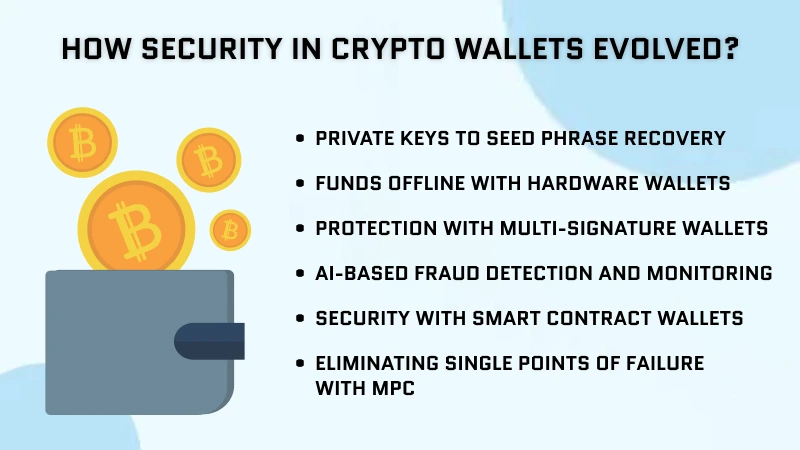
While crypto wallets evolved in terms of usability and features, the most notable transformation happened in security. Let’s have a look at how crypto wallet security evolved over the years!
- From Manual Private Keys to Seed Phrase Recovery
In the early days of Bitcoin, users were completely responsible for managing their private keys. A private key is what gives you access to your cryptocurrency. If you lost it, forgot it, or accidentally deleted it, your funds were permanently gone.
There were no easy recovery options. Security depended entirely on the user’s ability to store their keys safely. While this gave users full control, it also created a high risk of accidental loss.
To solve this problem, wallets later introduced seed phrases, also known as mnemonic phrases, which are usually a 12- or 24-word backup phrase. This made wallet recovery much simpler and safer.
- Moving Funds Offline with Hardware Wallets
As crypto adoption grew, online hacks and exchange breaches became more common. Many users realized that keeping funds connected to the internet increased the risk of theft.
This led to the rise of hardware wallets such as Ledger and Trezor. These devices store private keys offline. Even if a computer is infected with malware, the private key remains secure inside the hardware wallet.
This was a major improvement in security because it reduced the risk of remote hacking. However, users still needed to protect their recovery phrases carefully.
- Adding Extra Protection with Multi-Signature Wallets
Single-key wallets created a single point of failure. If one key were compromised, the funds could be stolen.
To improve this, developers introduced multi-sig wallets. These wallets require more than one approval before a transaction can be completed. For example, two out of three authorized parties must confirm a transaction.
This added an extra layer of protection. Even if one key was exposed, attackers could not move funds without additional approvals.
Later, social recovery features allowed users to assign trusted contacts who could help restore access if needed.
- Smarter Security with Smart Contract Wallets
As decentralized finance (DeFi) became popular, wallets started interacting with smart contracts. This allowed wallets to become more programmed.
Users could set transaction limits, restrict transfers to certain addresses, or require additional confirmations for large transactions. Instead of relying only on private keys, wallets began offering customizable security settings.
However, interacting with smart contracts also introduced new risks, such as malicious token approvals and phishing attacks.
- Eliminating Single Points of Failure with MPC
Multi-Party Computation (MPC) technology brought another major improvement. Instead of storing a full private key in one place, MPC divides it into multiple encrypted parts.
These parts are stored separately and work together to approve transactions. The full key is never reconstructed in one location.
This makes it extremely difficult for hackers to steal funds, even if one part of the system is compromised. MPC is now widely used in institutional-grade crypto custody solutions.
- AI-Based Fraud Detection and Intelligent Monitoring
Modern crypto wallets are beginning to use artificial intelligence to improve security. AI systems analyze transaction behavior and detect suspicious activity in real time.
For example, if a wallet detects an unusual transfer pattern or interaction with a risky smart contract, it may warn the user before confirming the transaction.
Instead of only protecting private keys, wallets now monitor behavior to prevent mistakes and scams.
It’s a Wrap
That’s it for this blog!
The evolution of crypto wallets has been marked by significant advancements in security, functionality, and user experience. From the early days of paper wallets to smart wallets of today, crypto wallets have evolved in various forms.
We hope this blog gave you valuable insights into how far crypto wallet technology has come and where it is headed next.
At Technoloader, we stay at the forefront of blockchain and crypto innovation. Our team of experts can help you build your own crypto wallet and can turn your vision into reality.
Get in touch with us to get started!
FAQs
How have crypto wallets evolved since 2013?
Since 2013, crypto wallets have evolved from simple desktop applications used mainly for Bitcoin storage to multi-chain financial platforms. Early wallets focused only on private key management. Today’s wallets support DeFi, NFTs, smart contracts, biometric authentication, Multi-Party Computation (MPC), and AI-based fraud detection.
What was the biggest security challenge in early crypto wallets?
The biggest challenge in early crypto wallets was private key management. Users were fully responsible for storing their keys safely. If a private key was lost or deleted, funds were permanently unrecoverable. There were no user-friendly backup systems. The introduction of seed phrases later solved this issue by allowing easier wallet recovery.
What is Account Abstraction in crypto wallets?
Account Abstraction is a crypto wallet that allows it to function as a smart contract instead of a traditional externally owned account. It enables features such as gasless transactions, spending limits, batch transfers, and custom security rules. This makes wallets more flexible, programmable, and user-friendly.
How does Multi-Party Computation (MPC) improve wallet security?
MPC improves wallet security by splitting a private key into multiple encrypted parts instead of storing it in one place. These parts work together to approve transactions without reconstructing the full key. This eliminates single points of failure and reduces the risk of key theft.
Are crypto wallets safer in 2026 compared to 2013?
Yes, crypto wallets in 2026 are more secure than in 2013. That’s because modern wallets use advanced technologies such as hardware-based encryption, multi-signature approvals, MPC, biometric authentication, end-to-end encryption, and AI-driven fraud detection.
What is the difference between custodial and non-custodial wallets?
In custodial wallets, a third party controls your private keys on your behalf. In non-custodial wallets, you control your private keys directly. Non-custodial wallets offer greater control and privacy but require careful key management.
Why is self-custody important in crypto?
Self-custody means you control your own private keys and digital assets. It reduces dependence on centralized exchanges and protects users from exchange failures, hacks, or account freezes. However, it also requires responsible security practices.

Deepa Manwani
Deepa Manwani is a Technical Content Writer at Technoloader with over 7 years of experience creating high-quality content across Blockchain, Web3, AI, and fintech. She specializes in translating complex technical concepts into clear, engaging, and informative content that helps businesses, developers, and users better understand emerging technologies. Her expertise includes writing technical blogs, technical documentation, whitepapers, platform guides, and in-depth content for crypto exchanges, DeFi platforms, trading systems, and enterprise software solutions. At Technoloader, she contributes to developing strategic content that supports product growth, strengthens brand credibility, and educates users about next-generation technologies shaping the future.
Published in Cryptocurrency Wallet Development