 +91 7014607737
 info@technoloader.com





Table of Contents
Key Takeaways:
- MLM software helps in automating critical business operations, especially for commission calculations and payouts, reducing errors and saving time.
- With the help of real-time analytics and reporting, MLM software lets businesses make informed, data-driven decisions for consistent growth.
- Built-in e-commerce integration enables seamless product selling, order tracking, and centralized inventory management.
- MLM software offers regulatory compliance and transparency, which helps minimize legal risks and build trust among users.
- MLM software supports scalability and efficiency, enabling businesses to grow their network without any operational limitations.
Introduction
Over the years, multi-level marketing businesses have come up with a unique set of challenges. Sometimes they’re unable to track commissions, maintain an accurate overview of the network, stay compliant with regulations and so forth. And for many businesses, trying to handle all of this on their own leads to errors, delays, and frustrated distributors.
That is where MLM software comes in.
A dedicated platform that is designed to automate, streamline, and manage every aspect of a network marketing business.
From commission calculations and downline tracking to e-commerce, reporting, and distributor communication, this software controls everything seamlessly. What once demanded specific teams and large spreadsheets can now be handled smoothly from a single, centralized system.
As the direct selling industry continues to grow, businesses that rely on outdated or manual processes are finding it increasingly difficult to scale and compete. To overcome this challenge, MLM software is more of a necessity for any serious network marketing operation.
In this blog, we will uncover the network marketing software advantages in a business, which will be helpful for you to decide whether to go with the software or not.
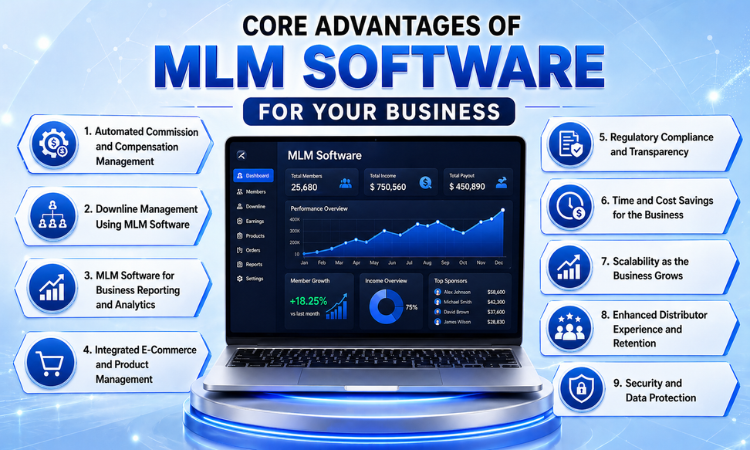
Core Advantages of MLM Software for Your Business
1. Automated Commission and Compensation Management
Calculating commissions manually, and that’s across a growing distributor network, is generally a costly process with errors and disputes. But here, MLM software automates the complete payout process, and commissions, including sales, rank achievement, and other qualifying activities, are calculated according to your specific compensation plan rules.
No matter whether your business runs a binary, matrix, unilevel, or hybrid structure, the software will manage the complexity without any human input. Now, finance teams no longer spend multiple days before proceeding with the payout cycle. Instead, payment will be processed accurately and on a fixed schedule.
And as distributors gain real-time access to their earnings dashboard, it also removes doubt about what they’ve been paid and why. This cuts down complaints and payment disputes. For businesses handling thousands of distributors across multiple levels, for them, this automation is not just a comfort; it’s a system that enables accurate and scalable payouts.
2. Downline Management Using MLM Software
As the MLM business continues to grow, keeping the proper track of who recruited whom, who sits at which level, and how each branch of the network is performing becomes increasingly complex. However, MLM software resolves these issues by integrating a visual genealogy tree that delivers a clear distributor network in one place.
With the help of this, admins can discover a clear structure of their organization and decide which branches are continuously growing and which are inactive. Additionally, recruit onboarding is managed through automated workflows, through which account creation, welcome emails, and role assignments will take place without any manual input.
Role-based access also ensures that each distributor sees their information appropriate to their level, keeping all sensitive business data protected. Instead of tracking spreadsheets or switching multiple tools to understand the network, business owners have a single, accurate, latest view of their entire organization at their fingertips.
3. MLM Software for Business Reporting and Analytics
MLM software generally delivers what is needed to make informed business decisions. Instead of putting together all the information, business owners and managers get centralized dashboards that show sales figures, team activity, revenue trends, and growth metrics all in one place.
Meanwhile, all these reports are updated in real time, which means leadership always has a revised picture of how the business is performing. Beyond the top-level numbers, the software lets deep-dive analysis identify which distributors are consistently hitting targets, which product lines are driving the most revenue, and so on.
This level of insight will help businesses to act quickly for recognizing and rewarding high performers, all while offering them support to struggling distributors, or adjusting strategy based on what the data reveals. Here, intuition-feel decisions will be replaced completely with evidence-backed ones, leading to more consistent and measurable growth over time.
4. Integrated E-Commerce and Product Management
The main work of an MLM system is to sell products, and MLM software simplifies this process by integrating e-commerce right into the platform. Using this software, each distributor gets their own storefront link that lets them sell and promote products without requiring any separate website or technical setup.
Once orders are placed using these links, they are recorded automatically while inventory levels are updated in real time, and fulfilment workflows are started without any manual teamwork. For businesses, their product management is centralized and pricing, availability, and promotions can all be changed once they’re reflected across every distributor’s store instantly.
Customers get a smooth, professional shopping experience, and distributors can spend less time on management and more on selling. The direct connection between the sales activity and commission calculations also means there is no delay between a purchase and the distributor’s earnings, keeping the whole sales process linked with one another.
5. Regulatory Compliance and Transparency
The multi-level marketing operates under strict legal scrutiny, and failing to meet compliance requirements can result in serious financial and reputational damage. MLM software helps businesses stay on the right side of regulations by automating the documentation and reporting processes that compliance demands.
Income disclosure statements are generated precisely, audit trails record every transaction and payout, and the software ensures that compensation structures remain within legal boundaries. For distributors, this transparency helps in building trust; they can see how earnings are calculated and have access to records they may need for their own tax reporting.
For businesses, these systems automatically maintain compliance, cut down human errors and lead to legal complications. As regulations around direct selling continue to evolve, having software that can be updated to reflect new needs keeps the business protected without requiring any constant manual monitoring.
6. Time and Cost Savings for the Business
While running an MLM business, you typically need to manage multiple operational tasks. These tasks can be anything, like managing distributor accounts, sending out notifications, handling support queries, keeping up-to-date records, and so forth. But without MLM software, following up on the following tasks is quite challenging and time-consuming.
Herein, if you use MLM software, then this software will handle all these tasks in a single place, all while keeping everything in sync. As a result, billing cycles get shorter, payment processes are faster, and costly mistakes are also reduced significantly.
And when the system itself answers routine questions, customer and distributor support also becomes more useful, decreasing the volume of incoming requests the team has to handle. The result is a leaner operation, with the business spending less on maintaining everyday processes and more on initiatives that directly contribute to revenue and network growth.
7. Scalability as the Business Grows
A business that works well with 500 distributors must also perform well with 50,000. To handle this, MLM software is built to scale alongside the business without requiring a complete overhaul of processes every time the network expands.
New distributors are onboarded into the same system, compensation calculations continue running accurately regardless of network size, and reporting remains just as clear as the business operates in one country or twenty. With multi-language and multi-currency support, MLM businesses can also support international expansion without any additional operational chaos like regional differences in tax, currency conversion, language, etc.
As the business introduces new products or makes changes in its compensation program, the software accommodates those changes instantly. This flexibility means limitations do not block business growth, and leadership can focus on expansion with confidence that the system will keep up.
8. Enhanced Distributor Experience and Retention
Keeping distributors engaged and motivated is one of the hardest ongoing challenges in network marketing, and the experience the business provides through its tools plays a significant role in retention. MLM software gives distributors a professional, self-service environment where they can track their own progress, manage their teams, place orders, and access training resources, all without needing to contact support for routine tasks.
Mobile apps extend this access further, enabling distributors to run their business from anywhere at any time. Gamification features such as leaderboard, rank badges, and milestone rewards tap into the competitive nature of network marketing and give distributors visible goals to work toward.
When distributors feel equipped, informed, and recognized, they are more interested in staying active and continuing to build their network. This directly impacts the long-term revenue of the business, making distributors experience a strategic priority rather than just an option.
9. Security and Data Protection
An MLM business deals with a lot of personal information, including details of distributors, banking, sales, financial transactions, and others. Without the right protection systems, this data is vulnerable to breaches, fraud, and misuse.
So, MLM software addresses this with a strong security infrastructure that is built into the platform. Here, role-based permissions ensure that individuals only access the data that is relevant to their position, preventing internal misuse or accidental exposure of confidential information. All the data is stored safely and protected through encryption, reducing the risk of external breaches.
For distributors and customers, knowing that their data is secure builds trust and confidence. And for the business itself, strong data security means fewer vulnerabilities, reduced liability, and the ability to work with the assurance that sensitive information is shielded at every level of the system.
Conclusion
Running a successful MLM business needs more than just a strong product and a motivated distributor network. It requires the right systems in place to keep everything running accurately, efficiently, and at scale. MLM software provides exactly that. Using this software, businesses get some valuable benefits, including commission management, network tracking, e-commerce, compliance, security, and distributor support under one roof.
Whether you are launching a new MLM venture or looking forward to improving the efficiency of an existing operation, investing in the right MLM software is one of the most important decisions you can make. If you’re looking for a trusted and experienced MLM software development company, connecting with Technoloader is a reliable choice for businesses looking to scale efficiently.
With deep expertise in building customized MLM solutions, we help businesses get the right software that is made for scale, performance, and to fulfil their specific needs.
Frequently Asked Questions
What is MLM software, and who is it designed for?
Multi-level marketing software is a specialized platform that is built to manage the operations of a network. This software is built for business owners, administrators, and distributors who need a centralized system to address commissions, network tracking, sales, compliance, and reporting. It is a great option for businesses of all sizes, and it can handle tens of thousands of distributors globally.
How does MLM software help with commission accuracy?
Based on the rules of your specific compensation plan, MLM software automates the entire commission calculation process. They keep track of every sale, referral, and qualifying activity and execute payouts without any manual input. This removes the risk of human error, ensures distributors are paid correctly, and forms a transparent earnings record that both the business and its distributors can refer to at any point.
Can MLM software support different types of compensation plans?
Yes, most of the MLM software platforms are established to support a wide range of compensation structures, including binary, unilevel, matrix, stair-step breakaway, and hybrid plans. The software can be configured to match the specific rules, rank requirements, and bonus structures of whichever plan the business uses, making it suitable enough to adapt as the business evolves.
Will MLM software help retain distributors?
Yes, by providing self-service portals, mobile app access, real-time earning tracking, and gamification features, MLM software can help in holding distributors. And when distributors have the tools they need, then they can manage their business independently and clearly see their progress; they’re far more likely to stay and remain committed to building their network.
What should a business look for when choosing MLM software?
While choosing the MLM software, businesses usually consider including a specific compensation plan, mobile accessibility, e-commerce integration, compliance features, data security, quality of customer support, and so on. Based on this, businesses evaluate whether they can integrate with the tools they’re using.

Kanak Badaya
Kanak Badaya is a Technical Content Writer at Technoloader with over 3 years of experience translating complex technology into content that actually makes sense. He works closely with emerging domains like Blockchain, Web3, AI, and DeFi, turning intricate technical concepts into clear, structured, and engaging narratives that help businesses communicate with confidence. Rather than just writing for search engines, Kanak focuses on writing for people. He combines in-depth research with a practical understanding of the industry to create blogs, website content, and technical guides that inform, educate, and build credibility. His goal is simple - make advanced technology feel approachable while helping Technoloader strengthen its authority in the digital space.
Published in MLM Software Development


