 +91 7014607737
 info@technoloader.com





Table of Contents
Key Takeaways:
- Building an e-commerce website like Amazon or Flipkart is not simple; it needs a whole developing ecosystem that includes things like multi-vendor management, secure payment systems, logistics integration, and scalable infrastructure.
- The type of platform you choose plays a major role in determining the overall cost, as a multi-vendor marketplace is significantly more complex and expensive than a single-vendor e-commerce store.
- The best way to keep costs down on any platform is to focus on its features and functionality. For example, essential systems like vendor dashboards, product management, order processing, and advanced search can have a direct effect on both development and long-term maintenance costs
- The development approach you choose, whether SaaS, open-source, or fully custom, defines your platform’s scalability, flexibility, and total investment, with custom solutions offering the highest long-term potential but at a higher upfront cost.
- The tech stack you choose creates a direct impact on performance, scalability, and future costs, making it important to pick the right frontend, backend, database, and cloud infrastructure from the beginning.
- Ongoing and hidden costs like hosting, transaction fees, marketing, security updates, and support tools can grow rapidly over time and often exceed the initial development cost if not planned properly.
Introduction
The craze of shopping online is growing continuously; today, if someone even wants to buy a simple item like groceries or a heavy electronic appliance, they prefer to do it online to enjoy discounts, a wide variety, and doorstep delivery.
By looking at this trend, you might have also imagined building an e-commerce site like Amazon or Flipkart. But here’s the real truth: what seems like a simple idea is actually a very complicated business model that depends on powerful technology, multiple integrations, and constant improvement.
From managing thousands of products and sellers to handling secure payments, logistics, and user experience, everything costs a lot of time and money.
So, before you take any step towards development, it’s very important to understand what you’re really building and how much investment you actually require for it. In this blog, we will break down the real cost of building an e-commerce website like Amazon and Flipkart, so with the help of which you can plan smartly and build strategically.
First, Define What You’re Actually Building
Start the development of your e-commerce website by defining the purpose behind your platform.
This is the most important thing that you need to figure out first, because websites like Amazon and Flipkart are the big bulls of e-commerce websites, and building a competitor is not an easy task.
Most of the businesses make a big mistake by jumping straight to budgeting without even understanding that the type of platform they choose can drastically change the overall cost.
Like, for example, there is a major difference between a single-vendor store and a multi-vendor marketplace. A single-vendor store is easy because you can sell your own products and keep track of your own inventory and orders.
But a multi-vendor marketplace, like Amazon and Flipkart, involves multiple sellers’ dashboards for sellers and buyers, commission systems, and much more complex backend operations, making it considerably more expensive to build.
Along with the platform type, your business model also plays a crucial role in determining the cost.
- B2C is the standard Amazon/Flipkart model.
- B2B adds complex pricing, bulk ordering, and procurement workflows, all of which raise costs significantly.
- D2C focuses on brand-owned customer relationships.
- Hybrid platforms combine two or more models that are the most expensive to build correctly.
Defining the following requirements will not only help you get a more accurate cost estimate but also ensure a smoother and more efficient development process.
Features Every Marketplace Needs
Features are the biggest driver of your development budget. The more features you include in your website, the higher the cost becomes, so knowing what’s essential versus optional is very important before you scope anything. Meanwhile, here are some features that every marketplace should have:
- User Management: This feature handles buyer and seller registration, login, authentication, and profile management. It is the entry gate of your platform; without it, nothing can work out. Most of the platforms offer this out of the box, but custom flows for seller verification add cost. (Cost: $1,000 – $3,000)
- Product Catalog & Search: Controls product listings, images, descriptions, categories, filters, and sorting logic. For a marketplace with thousands of SKUs (Stock Keeping Units) across multiple sellers, the backend architecture becomes genuinely complicated. Therefore, smart search with autocomplete and relevance ranking adds extra to the build. (Cost: $3,000 – $10,000)
- Cart, Checkout, and Order Flow: This is the main part of your platform that handles transactions. This feature covers add to cart, wishlist, address selection, coupon application, and final checkout sequence. At this point, any problems, bugs, or slowness can directly affect conversions, making it one of the most sensitive elements of the build. (Cost: $3,000 – $8,000)
- Payment Gateway Integration: Integrate your platform with payment processors like Razorpay, Stripe, PayPal, UPI, COD, and other options. Integration is a one-time cost, but every transaction carries an ongoing fee of 1.5% to 3.5%. (Cost: $2,000 – $6,000) (additional 1.5% – 3.5% per transaction ongoing)
- Seller/Vendor Dashboard: It gives every seller their own interface to manage their product listing, track orders, view earnings, and handle returns. For multi-vendor platforms, this is the most expensive single feature that requires custom commission-split logic, onboarding workflows, and payout automation that simply don’t exist in single-vendor builds. (Cost: $15,000 – $40,000)
- Order Management, Returns & Refunds: From placement through delivery, track every order and manage the full post-purchase lifecycle, including returns, replacements, and refunds. At this point, customers judge your platform the hardest and a poor experience here can pull out retention faster than anything else. (Cost: $3,000 – $8,000)
- Ratings, Reviews & Admin Panel: The ratings and review system makes trust through social proof, which is often critical for any marketplace where buyers can’t physically look at products. With the help of this admin panel, you give full backend control, like managing sellers, monitoring orders, resolving disputes, and tracking platform-wide performance from one dashboard. (Cost: $2,000 – $5,000)
- Push Notification, Email & SMS Alerts: Keeps buyers and sellers informed at every touchpoint, like order confirmations, shipping updates, promotional offers, and restock alerts. These communications make a direct impact on repeat purchases and seller engagement, making them a high-ROI feature. (Cost: $1,500 – $4,000)
2026 Must-Have: AI & Advanced Features
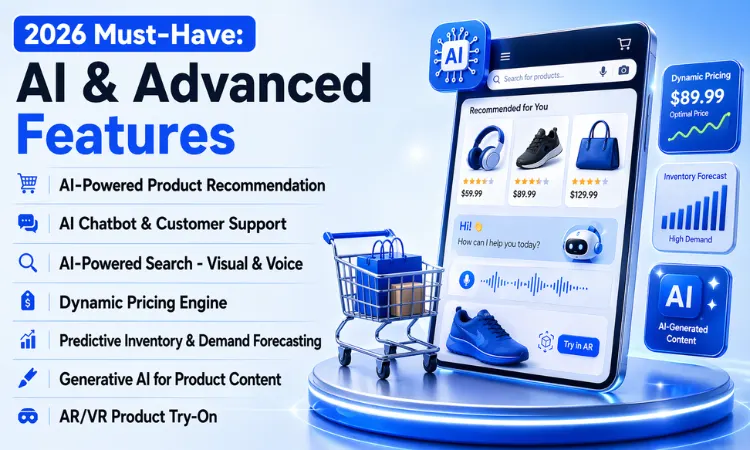
As we are living in 2026, at this point, AI is no longer a premium add-on; instead, it is a baseline for any marketplace that wants to be taken seriously. Here are some of the great must-have features your platform should have:
AI-Powered Product Recommendation
This feature will help you analyze each user’s browsing and purchase history, which also shows personalized product suggestions, exactly what Amazon’s “Customers also bought” and Flipkart’s “Similar products” section do.
According to McKinsey’s analysis, while using this tool companies can earn 40% more revenue, making it one of the highest-ROI investments. (Cost: $10,000 – $50,000+)
AI Chatbot & Customer Support
This feature automatically handles order queries, return requests, and product questions without human agents. Today, AI chatbots have capabilities to handle 30–50% of common queries, with Gartner projecting this will reach 80% by 2029. It can deliver around-the-clock coverage while cutting down the high cost of a support team. (Cost: $5,000 – $30,000)
AI-Powered Search – Visual & Voice
Let buyers find products by simply uploading an image or speaking a query instead of typing. This feature is especially strong in the fashion, furniture, and electronics categories. And talking about its adoption, visual searches worldwide increased 70% YoY, per Amazon, which shows a strong signal for targeting a larger audience. (Cost: $8,000 – $25,000)
Dynamic Pricing Engine
This feature automatically sets product prices in real time based on demand, competitor pricing, inventory levels, and buyer behaviours. Over the years, airlines and electronics retailers have been using it and today, in 2026, it is actively entering fashion and FMCG. (Cost: $10,000 – $35,000)
Predictive Inventory & Demand Forecasting
This feature uses old sales data and real-time signals to predict which products will run out and when. Prevents stockouts, reduces overstock, and improves supplier coordination. Forecasting accuracy can increase by up to 20% for businesses that use predictive analytics. (Cost: $8,000 – $20,000)
Generative AI for Product Content
Auto-generates product descriptions, catalogue tags, ad copy, and SEO metadata at scale. Saves huge manual effort when onboarding thousands of sellers’ SKUs and upholds product pages optimized without a large content team. ($3,000 – $15,000)
AR/VR Product Try-On
Allows buyers to virtually try on clothes, place furniture in their room, or preview electronics before making any purchase. Platforms like Amazon and IKEA have already started using this amazing feature, requiring a higher cost to build, but with a proven impact on reducing returns and increasing conversion. ($20,000 – $80,000)
Build Approach: Platform, Open-Source, or Custom?
As important as what you build is how you choose to build your marketplace. This single decision creates a big impact on your overall launch timeline, flexibility, scalability, and total cost more than anything else.
SaaS Platforms – Shopify, BigCommerce, Wix
- SaaS platforms are ready-to-use hosted platforms that have built-in themes, payment processing, hosting, and basic features.
- Fastest way to launch any website, with no server management or deep technical expertise.
- Modifications can have hard limits, and you’re permanently dependent on the platform’s pricing and roadmap.
- Cost: $25 – $300+ per month
Open-Source Platforms – Magento/Adobe Commerce, WooCommerce
- They are free to install but require significant developer investment to configure, customize, and maintain.
- Magento is the go-to for large-scale marketplaces, which are powerful, flexible, and battle-tested.
- WooCommerce suits smaller builds with moderate customization needs; you own the code, which matters at scale.
- Cost: $10,000 – $199,000+ (depending on customization depth)
Fully Custom Build from Scratch
- Everything is designed and coded specifically for your business, all with maximum flexibility, scalability, and competitive differentiation.
- This is the path if you wish to build a true Amazon or Flipkart-scale platform.
- Requires an experienced development team and significantly longer timelines.
- Cost: $60,000 – $500,000+
Readymade Marketplace Scripts
- Pre-built clone scripts that mimic marketplace functionality out of the box.
- Low cost and the fastest shortcut to launch.
- Scalability is severely limited; most businesses outgrow these within the period of 12-18 months and face expensive rebuilds.
- Cost: $500 – $5,000 one-time
AI-Native Builders – Shopify AI, Emergent
- This is a 2026-specific option.
- These platforms use AI to generate storefronts, automate workflows, and reduce frontend development time by 40-50%.
- Perfect suited for teams wanting a fast, intelligent launch without heavy engineering overhead.
- Cost: $50 – $500+ per month (varies by platform and usage)
Tech Stack and Its Direct Cost Impact
Most of the founders focus on features and platforms, but the tech stack you choose quietly determines both your build cost and every penny you spend on maintenance for years after launch. Selecting the wrong stack at the start can mean an expensive rebuild at scale.
Frontend Frameworks
Frontend networks are the user-facing layer of your marketplace. Industry standards like React and Next.js are a great option if you prefer fast, SEO-friendly, and wider support. Flutter and React Native power cross-platform mobile apps from a single codebase, significantly reducing mobile development cost and building separate native apps. (Cost impact: $5,000 – $20,000) (Varies by framework and complexity).
Backend
Backend is the engine that is running your business logic, database operations, and API communication. Node.js and Python are two of the most liked choices, which are fast to develop, well-supported, and AI-integration friendly. Java suits high-traffic enterprise builds. Your backend choice directly affects developer availability and, therefore, hourly rates. (Cost impact: $10,000 – $50,000+)
Database Architecture
The database stores your products, users, orders, and transactions. Tech stack like PostgreSQL handles structured relational data reliably. MongoDB suits flexible, unstructured catalogue data. Redis manages caching and session data for speed. However, poor database design at launch becomes catastrophically expensive to fix once you’ve real traffic. (Cost impact: $3,000 – $15,000)
Cloud Infrastructure
AWS, Google Cloud, and Azure all offer pay-as-you-scale pricing, which means you only pay for what your traffic demands. This is far smarter than fixed dedicated servers at launch. As your marketplace grows, however, cloud costs scale rapidly and must be planned from day one. (Cost: $50 – $5,000+ per month)
Security Layer
SSL certificates, token-based authentication, multi-layer firewalls, and compliance with PCI-DSS for payments and GDPR for user data. Not optional, a single security breach at marketplace scale can cost far more than the entire original build. (Cost: $2,000 – $10,000 for setup) + ongoing
Third-Party Integrations
Logistics APIs (Shiprocket, FedEx), ERP systems, CRM tools, analytics platforms, and marketing automation; each combination adds development time and ongoing subscription cost. Every connection point is also a potential failure point, so quality matters here. (Cost: $2,000 – $15,000 per integration)
PWA vs. Native Mobile App
A Progressive Web App (PWA) works across all devices from a single codebase. Comparatively, it is lower-priced than building separate Android and iOS apps. Native apps deliver better performance and user experience, but cost more than $40,000. In 2026, PWAs have completed much of the performance gap, making them a viable cost-efficient choice for most MVP-stage marketplaces.
Complete Cost Breakdown
Here is the list of other costs that you will have to pay while building an e-commerce website like Amazon or Flipkart.
Domain Registration
This is your marketplace’s web address, the first thing you buy. A .com costs very little annually. However, premium or keyword-rich domains such as shop.com or market. It can cost thousands. Choosing to register for multiple years upfront is a minor cost with a meaningful SEO benefit. (Cost: $10 -$50 per year)
SSL Certificate & Security Setup
SSL encrypts all the information shared between your platform and users; without it, browsers flag your site as unsafe, and buyers will not complete purchases. Most SaaS platforms bundle SSL for free. Custom builds need standalone SSL certificates plus additional security hardening, including firewall configuration and vulnerability scanning. (Cost: $0 (bundled on SaaS) | $50-$200/year (standalone)
UI/UX Design
Design directly makes an impact on how long visitors stay, how easily they navigate, and whether they complete a purchase. Pre-made themes are cheap and fast, but generic; every competitor using the same platform looks similar. Custom UI/UX design built around your specific user flows, brand identity, and conversion goals costs more but delivers measurably better results at scale. (Cost: $0 – $500 (pre-made themes) | $5,000 – $30,000 (custom design)
QA, Testing & Security Audits
Functional testing, performance testing under traffic load, and security vulnerability audits before launch. These are the most common underbudgeted items in marketplace development. An unsuccessful launch or post-launch security breach costs extra in terms of reputation damage and emergency fixes than thorough pre-launch testing ever would. (Cost: $5,000 – $20,000)
Content & SEO Setup
Product descriptions, category page copy, metadata, image optimization, and initial keyword targeting. Strong SEO foundations at launch significantly reduce your paid acquisition costs over time. In contrast, generative AI tools handle much of this content at a fraction of traditional copywriting costs, but human review and strategy remain important. (Cost – $1,000 – $8,000)
Other than this, here is the list of ongoing & hidden costs where budgets actually die.
- Platform & Plugin Renewals – $50 – $500/month
- Hosting Upgrades as Traffic Scales – Can 10x between Year 1 and Year 3
- Security Patches & Annual Renewals – $500 – $2,000/year
- App Store Fees – Apple 30%, Google Play 15% – 30% on every single in-app transaction
- Transaction Fees at Scale – 1.5% – 3.5% on every single order, compounding daily
- Customer Support Tooling – $100 – $1,000/month
- Marketing & Paid Acquisition – $500 – $50,000+/month depending on growth stage
Together, the total ongoing operational cost is $1,000 – $10,000+ per month.
Who Builds It – Team Types and 2026 Hourly Rates
The same marketplace can cost you $30K or $300K; the price completely varies on who builds it. During the development phase, the team’s choice is one of the most consequential budget decisions you’ll make.
Freelancers
Individual developers are hired on the basis of per task or per project. Low-budget upfront option, but carries the highest coordination and delivery risk. No single freelancer covers design, frontend, backend, mobile, and QA; you need to manage people systematically, and accountability is limited. It will cost you between $15 to $80 per hour.
Offshore Development Agencies
Dedicated teams with full-stack abilities at significantly lower rates than their Western counterparts. Forthcoming, India and Eastern Europe will have a mature, experienced e-commerce development ecosystem, with cost-efficiency for building complex, multi-vendor marketplaces, provided they’re vetted properly, without sacrificing quality. (Rate: $25 – $80/hour)
Domestic Agencies – US, UK, Australia
With premium rates, higher accountability, clearer communication, and stronger legal protections. Domestic agencies are the best suited for enterprise-grade builds where budget is not the primary constraint and close collaboration is. (Rate: $100 – $250/hour)
In-house Development Team
Full-time salaried developers working purely on your platform. This might be the highest long-term cost, but you’ll have maximum control, institutional knowledge, and responsiveness. Only financially possible once your marketplace reaches meaningful scale and requires continuous active development. (Cost: $60K – $150K+ per developer yearly) (Rates vary significantly by geography)
Hybrid Model – Offshore Build, In-House Ownership
This is the highly adopted approach in 2026. An offshore agency handles the heavy development work at cost-efficient rates while an in-house product owner or CTO manages vision, quality, and roadmap. This approach balances cost control with accountability, the smartest structure for most growing marketplaces.
Realistic Cost Scenarios – What You’ll Actually Spend at Each Scale
Numbers are nothing without context. Here are the three honest scenarios mapped to real-world ambition levels, with the help of which you can see exactly where your plan sits.
Scenario A – MVP Marketplace
Platform-based is built using Shopify or WooCommerce. Core buying and selling flows, basic vendor onboarding, standard payment gateway, and mobile-responsive design. No AI features at launch. The goal is market validation, meaning proving demand before making a serious investment.
- Time Required: 1 to 3 months
- Team: Freelancer or small offshore agency
- What’s excluded: Mobile app, AI features, advanced integrations
In this scenario, your total build cost will be between $15,000 to $50,000; in addition, the ongoing monthly cost will be $1,000 to $3,000.
Scenario B – Growing Multi-Vendor Platform
Semi-custom build that works with multi-vendor support, advanced search and filters, basic AI recommendations, logistics integration, and a PWA mobile app. This is a platform that is built to handle real growth and real market intent.
- Timeline: 4 to 6 months
- Team: Offshore agency with in-house product owner
- What’s excluded: Native mobile apps, advanced AI infrastructure, ERP integration
In this method, the total build cost will be around $50,000 to $200,000, along with the ongoing monthly cost of $3,000 to $8,000
Scenario C – Enterprise-Grade Marketplace
Fully custom architecture built from scratch. Native Android and iOS apps, full AI infrastructure across personalization, search, and dynamic pricing, ERP and CRM integration, high-availability cloud setup, complete security and compliance layers. This is genuine Amazon and Flipkart territory.
- Timeline: 9 to 18 months minimum
- Team: Large offshore agency plus in-house CTO and product team
- What’s excluded: Nothing, because this is completely built from the start.
For this scenario, you’ll require $300,000 to $500,000+ for development, with ongoing monthly costs between $8,000 to $25,000+
The yearly cost of owning your site is more crucial than the cost of building it. In the long term, a low-cost MVP that needs to be rebuilt at 10,000 users costs more than a mid-tier platform that is built correctly and can be scaled up without worry.
To Sum Up
It costs a lot of money to build an e-commerce website like Amazon or Flipkart. Each choice you make has its own cost. All of these things, including features, platform choice, tech stack, team type, AI infrastructure, and so on, affect a number that looks very different depending on where you start and what you really want to achieve.
Through this comprehensive guide, we have discussed all the real costs of building an e-commerce website. If you’re ready to build a marketplace that scales, having the right development partner is important, Technoloader can help you as a website development company.
With years of experience and deep expertise, our expert team will provide cutting-edge development, quality assurance, 24/7 support, and A-Z development that will scale your e-commerce platform for long-term success.
FAQs
How much does it cost to build a basic e-commerce marketplace in 2026?
A basic MVP marketplace with essential buying and selling features, a standard payment gateway, and simple vendor onboarding typically costs between $15,000 and $50,000. The prices vary depending on the platform and the development team’s location. Therefore, this price does not include mobile apps, AI features, or any other advanced integrations.
What is the single biggest cost driver in building a marketplace like Amazon or Flipkart?
Custom development is the substantial cost, especially for the seller dashboard, multi-party payment splitting, and order management system. Together, these features can take up 40-60% of the total budget for a multi-vendor platform.
How much does AI add to the cost of building an e-commerce marketplace in 2026?
The basic AI features like product recommendations, chatbot support, and smart search can add $25,000 to $80,000 to a mid-tier build. Advanced AI capabilities like dynamic pricing, predictive inventory, and AR/VR can raise costs to $150,000 or more. Using these pre-built AI APIs instead of custom models can help reduce costs during the MVP and growth stages.
How long does it take to build a marketplace like Flipkart?
The timeline completely depends on scope and team size. An MVP marketplace generally takes 1-3 months, a mid-tier platform takes 4-6 months, and a fully custom enterprise solution needs a minimum of 9-18 months. And if you try to speed up the development process, then it can further lead to higher costs later due to fixes and rebuilds.
What are the hidden costs nobody talks about when building an e-commerce marketplace?
The most commonly overlooked costs include hosting upgrades as traffic grows, app store fees of 15-30% on in-app purchases, transaction fees that add up over time, security updates and yearly compliance audits, plugin and platform renewals, and ongoing marketing and customer acquisition. By year 2, these can add $1,000 to $10,000+ on the basis of your operating costs.
Is it cheaper to build an e-commerce marketplace in India than in the US?
Development costs vary a lot by location. Offshore teams in India typically charge $25-$80 per hour, whereas US or UK agencies will charge $100-$250 per hour. With a well-vetted team, the quality can be similar. A marketplace that might cost $200,000 in the US can be built for $60,000 to $80,000 in India, making it a highly cost-effective option.

Kanak Badaya
Kanak Badaya is a Technical Content Writer at Technoloader with over 3 years of experience translating complex technology into content that actually makes sense. He works closely with emerging domains like Blockchain, Web3, AI, and DeFi, turning intricate technical concepts into clear, structured, and engaging narratives that help businesses communicate with confidence. Rather than just writing for search engines, Kanak focuses on writing for people. He combines in-depth research with a practical understanding of the industry to create blogs, website content, and technical guides that inform, educate, and build credibility. His goal is simple - make advanced technology feel approachable while helping Technoloader strengthen its authority in the digital space.
Published in Ecommerce Development


